My son’s blue Skiff beanie, pattern by Jarod Flood, has gotten a lot of attention this winter. Yes, we can wear hats in Florida in winter. My son was born and raised here so he is always cold when the temps drop below 60!
Some friend’s of his have seen his blue Skiff, which I knit a while ago, and have mentioned that they really liked it. When he accidentally wore it into work at the fire department, a friend said he would like a hand-knit hat. I said I would make him one.
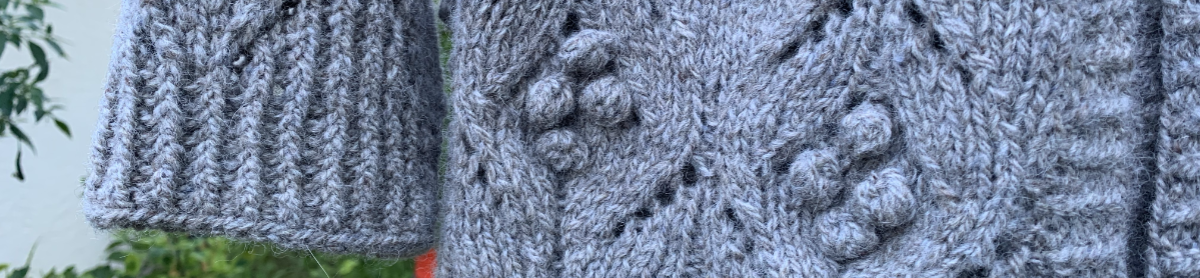
Skiff beanie in gray
Did I really want to knit another Skiff? Oh ya… this is a fun hat to knit. If you are interested, you should know that the pattern is in chart form. What I did, before ever knitting this pattern, was go through the whole graph and color code each cable area. I also made notes for the other stitches as some were very new to me. Every cable and stitch has an easy to understand description.
I use a wooden DPN for the cable needle, which holds the stitches nicely, and my circular needle is also wood. One of the cables needs 3 needles – over 5 stitches, but really I’ve found it to be so fun that I really enjoy the challenge of watching this extraordinary pattern emerge.
The Madeline Tosh Vintage yarn, in “Antique Moonstone” is some that I’ve had for a few years but it is perfect for this pattern. I love how the colors blend and make highlights, and the roundness of the yarn shows off the texture and cables.
Top of beanie
The Yarn
Mad Tosh is not cheap, but it is machine washable. I always wash by hand, and my brim on this gray Skiff is of a non-machine wash yarn by Quince & Company. So this hat needs to be hand-washed.
Madeline Tosh comes as 200 yards, and I had plenty leftover. Brooklyn Tweed Shelter comes in smaller size skeins at 140 yards and the pattern calls for 2 skeins for this beanie. You will spend about the same amount – a little more for the Mad Tosh, but will have more of the BT yarn leftover. Remember I used a contrast color for the brim.
Mad Tosh yarn leftover from knitting this hat
I cast on using a size 3 circular needle and used the German Twisted cast-on. For the top of the beanie I used a size 7 needle. This hat is quite roomy for me, but is probably perfect for a guy. My son loves his.
Yarn color: Antique Moonstone
Jarod Flood is known for his patterns for men, but he also has beautiful and intricate patterns for women. And many of his patterns are unisex. What I have noticed is that he goes into great detail when describing how a pattern is knit. I will be knitting his Cobblestone Cardigan soon to wear on my trip to New Hampshire!
I’m always on the lookout for future sweaters to knit. They must be fairly simple (I am not super experienced at sweater knitting) and I prefer a cardigan to a pullover, so I was excited to see the Cobblestone Cardigan pattern by Jarod Flood of Brooklyn Tweed.
I had just finished knitting a pair of mitts (Oulu) using the same Shelter yarn called for in the cardigan. I bought the sweater pattern and then I used my leftover Shelter yarn to knit up a swatch to find my gauge for the sweater. Suggested needle size is 8 US, and gauge should be 18 stitches (across) and 36 rows (vertical count). I used color “Camper” for the swatch.
Measuring gauge on swatch
How I Knit My Gauge Swatch
Using the size 8 needle, I cast on the 18 stitches plus an extra six. Then I knit for 36 rows, plus six more. In this case the gauge is counted on garter ridges, so the piece was simply knit back and forth. How easy is that? The piece needed to be slightly larger than (what I hoped) my gauge would be so I could easily count the stitches and rows.
I was knitting other projects and this little swatch took me a few days to complete. By the time I finished, and washed and dried the swatch, I couldn’t remember what the actual gauge should be. I got my gauge ruler and began counting, then looked up the pattern again to compare my numbers to the pattern. Well, I was exactly on gauge! This was very exciting! I want to begin knitting this sweater very soon.
You May Think You Hate Shelter, But Don’t Give Up!
If you knit at all and have come across comments on Shelter and Quarry yarn (both are BT brands) you may be very confused because this yarn gets both very high and very low marks. Knitters either love it and use it all the time, or they hate it for pulling apart easily. Some people also complain about the grass bits stuck in it. Personally, this does not bother me.
In fact, I avoided both of these yarns for a long time because of the trouble I had right after buying some Quarry yarn to knit a hat. Quarry is a bulky weight Brooklyn Tweed yarn and as soon as I cast on and tried to join in the round, the yarn pulled right apart! I kept trying and it kept separating… I was very irritated and decided that I hated it and would never buy this type of yarn again! It scared me away from Shelter as well. I moved on and knit with other yarns. I was convinced that this yarn was horrible.
My “bad” skein of Quarry
I now believe that I was unlucky enough to have received a “bad” skein, but more than likely I was simply not used to knitting with this type of yarn. I used it later to complete a hat and had no problems. When it has to be pulled, twist the yarn to make it stronger before doing so. I ended up using Quarry yarn once again to knit a big sweater, and I had absolutely NO trouble at all with it splitting or pulling apart. This is why I think that occasionally knitters get a “bad” skein, or are simply not used to knitting carefully.
Then I bought Jarod Flood’s “Skiff” cable hat pattern and it called for Shelter yarn. I knit the hat, but wouldn’t dare use Shelter yarn. I was so afraid that doing cables would be a problem with this type of yarn.
Then, one day Shelter was on sale, and I can barely resist a sale! Another reason I wanted to buy this yarn is that it is spun in a mill in Harrisville, New Hampshire which is very near where I had once lived. I would pass signs for Harrisville on my way to Keene, from Antrim, and never knew there was a mill spinning popular yarn nearby! So to me it’s a “local” yarn, and I knew I had to finally try it. I bought a bunch of skeins without a plan… can you believe it?
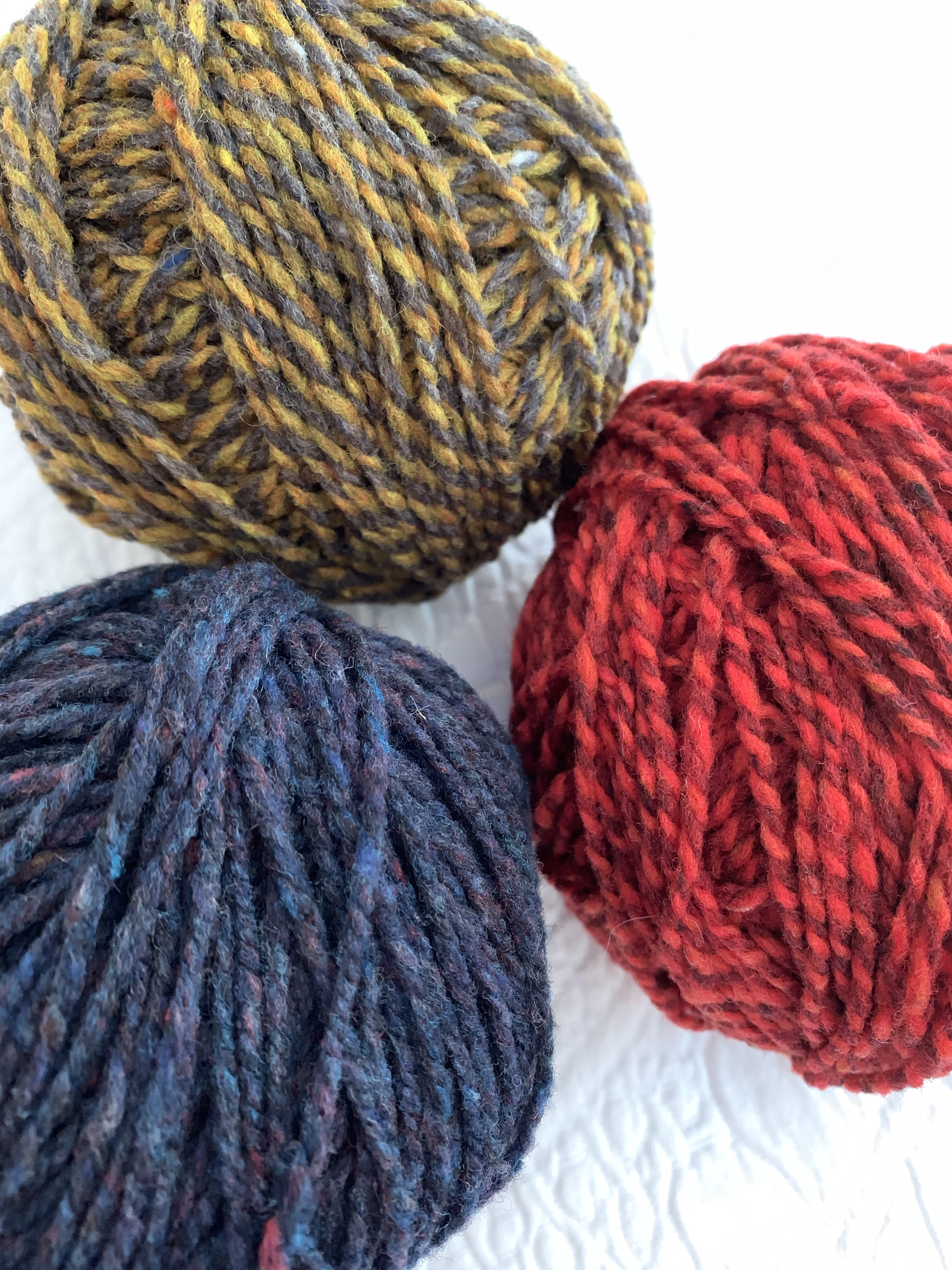
Brown: Caraway, Red: Amaranth, Blue: Old World
Now I have knit two pair of mitts (Maine Morning Mitts and Oulu Mitts) using this yarn and now I’m planning to knit the Cobblestone Cardigan. I’ve come to love this yarn! The yarn colors are so beautiful that it took me quite a while to decide on a sweater color. I almost went with Meteorite (brown) which is beautiful, but decided I wanted a lighter color.
My final decision was to go with gray, to match my hair, so Narwhal it is! The yarn has arrived and I will cast on any minute! More to come about knitting the Cobblestone!
I’ve wanted to knit hats using bright, hunter-orange yarn for a while now. My kids live in rural New Hampshire towns where hunting happens pretty much throughout the year. Almost all land is open to hunters unless it is posted as “No Hunting”. Hunters can be in state forests, federal land, parks and even on privately owned land, and the thing is, non-hunters can be there also! If you are out and about in New Hampshire during hunting season, it’s a good idea to have on bright orange clothing of some kind.
Non-hunters also need to be seen in the woods
I had searched for the bright orange yarn, also called “hunter orange” or “neon orange” and been relatively unsuccessful at finding some. So, I lost interest and moved on to knit other things. My daughter mentioned at Christmas (after she opened my hat gift to her) that she and her fiancé would like orange hats.
Page update: *In July 2021, after I wrote this page, I found brightly colored orange yarn at Hedgehog Fibres and knit a cabled hat in worsted yarn.
Or see more ideas for hat knitting down the page.
Nice and bright!
Where to Buy Hunter Orange Yarn
Below are some yarn options I found while searching for my own knitting needs. I chose the Mega, bulky yarn to quickly whip up a couple of hats. I may buy some cotton as well to make lighter weight beanies that could work for early Fall and late Spring hiking. Once I have this yarn in hand I will note the actual color.
When searching for bright orange yarn, use these descriptions; safety, blaze, hunter, vibrant, or neon, along with orange.
Cascade Ultra Pima Fine – link goes to Webs – the yarn is 100% cotton, comes in 136 yard skeins of DK / Sport weight and is machine washable. They offer a “vibrant orange” color. This would be good for warmer weather hats. Cost: $5.25 (at time of writing)
Purl Soho’s Super Soft Merino – Super Orange Solid looks promising (thank you to the reader who pointed it out). $23 for 87 yards.
Maybe ***Plymouth Encore Mega – link to Wool & Company – is and acrylic and wool mix in bulky weight. It comes in 64 yard skeins and is machine washable. Knit up a hat quickly with this bulky yarn. Cost: $6.50 (at time of writing) – this seller offers free shipping for any purchase to US… ***NOTE: I knit a hat (photo below) using this and it’s not really bright enough for walking in the woods, IMO.
Paintbox “Blood Orange” – link to Lovecrafts – is worsted weight, 100% wool yarn that comes in 219 yard skeins. It is machine washable. Cost: $10 (at time of writing)
Fiber of Maine – Blaze Orange – Now we’re talking, except it is sold out (at time of writing). I am adding the link in case it comes back in stock because this yarn looks perfect.
Etsy – a search on the Etsy site could be successful.
* Found: HedgeHog Fibres – “Kid You Not“, in aran worsted is the PERFECT color…. but it is expensive, $30-$32 skein (166m / 180yds – approx).
How Much Yarn is Needed to Knit a Hat
Honestly, it is difficult to say how much yarn you will need to knit a hat, but there are general suggestions out there.
At Lion Brand they have a chart, where you will see at the top a section for hat knitting. It goes from “yarn weight 1” to “yarn weight 7” which would mean the finest yarn – lace weight, to the bulky type yarn.
Less yarn is needed as the thickness of the yarn goes up. Also, less yarn in each color is needed if a hat is knit in more than one color. A rolled brim adds to the yardage.
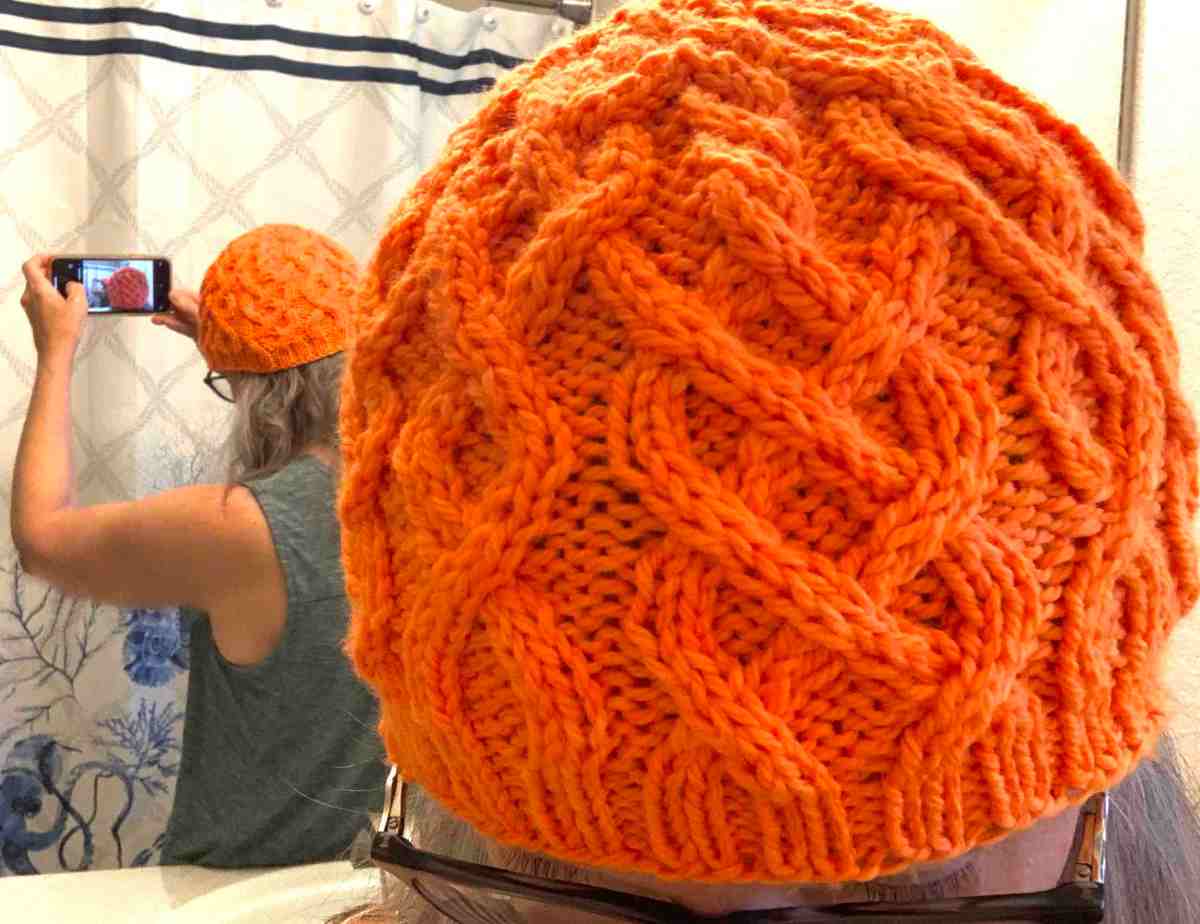
My orange hat, pictured below, was knit using one skein of the Encore Mega yarn. I only had a short strand leftover, but the hat is not bright enough, in my opinion.
Not quite bright enough, IMO for “hunters” to see.
Hats for Men (and Women) in Worsted Weight Yarn
When aran or worsted weight yarn is used, a hat can be knit up quickly. The Men’s Basic Hat pattern is free and uses this type of yarn. I have not used the pattern, but many knitters have. Unfortunately it is knit flat and not in the round. Seems weird.
Bankhead is also a free pattern that is knit in worsted weight yarn.
The Classic Ribbed Hat is a free pattern offered by Purl Soho and is probably my favorite pick. It is knit in a DK weight, so will take a bit longer to finish.
More Hat Pattern Ideas For Hunter Orange Yarn
Nearly any hat pattern would work when knitting with orange as long as the weight of yarn you find works with that pattern. A search for hat patterns will bring up many, both free and to purchase. Or, if you know how to knit a basic hat, make it up like I did.
If you are knitting for a man, make sure he approves of the look. Guys can be very particular.
A popular and simple hat to knit is all one color and done in ribbing. The watch cap may be a bit boring to knit, but it’s perfect practice for beginners and is also they type that boys and men prefer – no frills! The hat below was knit in washable DK weight yarn. The hat below is loosely based on a pattern by Churchmouse Yarn & Teas.
The Northward cable beanie, (bulky yarn) by Tin Can Knits, was knit in a day’s time. It’s a free pattern and the link goes to the TCK site.
Quick knit in bulky yarn
I have made two Triple-patterned Watchcaps, (worsted yarn) and the style is perfect for keeping ears warm. The thick brim folds up double, and it could be knit in all one color. The pattern is in the “Hat’s On” book, which is full of great hat knitting patterns suitable for beginner knitters and also experienced.
Triple-patterned watchcap Knit in sizes, XL (red), L (green) and S (pink)
I had never done an I-cord bind off, but I’ve used the i-cord to make rope handles and long points or tassel holders on the end of hats.
I must say, this type of bind-off is quite nice. I used it recently when the Bay’s Edge Shawl called for binding off in this manner. As I neared the end of knitting on the Scrappy Bias Shawl, I wanted to do the same thing.
Directions for I-cord Bind Off
To begin binding off, first add three stitches to the needle, with right side of project facing, also called a “cast on” of 3 extra stitches. Wrap the yarn around your thumb and place it onto the needle (at the end of the work – or Left-hand needle). Do this three times to add 3 extra stitches at the end of the work.
*Begin the bind-off: Insert the Right Hand needle and knit 2 stitches. Now, slip the next stitch knit-wise (as if you were knitting) from the left needle to the right. There should be three stitches on the right hand needle (see below).
Next…Knit one, and pass that slipped stitch back over the knit stitch. This is the bind-off stitch so it drops. (See the video below for more help). This leaves 3 stitches on the Right needle. Slide those 3 stitches back onto the left needle.
And begin again from *: K2, Slip 1, PSSO and slide 3 stitches back to L needle.
Once you get to the end, there will be 3 stitches left. Either bind them off in the regular way, or pull the yarn tail through all three.
i-cord bind off
Binding-off this way takes longer, but the finished edge is more rounded and substantial than a regular knit bind-off. See it below in my photo.
Rounded edge using the i-cord bind off
Very Pink Knits shows all these steps on the video here. She does go a bit fast, but once you learn the steps, the bind-off will progress quickly.
If you are interested in creating an i-cord edging while you knit, I have a page that explains that as well. It leaves a nice edge up the side of an item, such as a scarf, dishcloth or other flat knit project.








 New England's Narrow Road