Hats are one of the best things to knit, whether you are a beginner or advanced. All types of stitches can be used to create intricate designs, or do simple knits all the way around. My collection of unisex hat designs on this page are some I have recently knit. They are all fairly easy to create, and men and women alike can wear them by simply changing the colors. Some of the patterns are free, so what do you have to lose?
Useful info: Hats generally take less than a skein of yarn to knit! You will need a set of 16 inch long needles in the size suggested with double-pointed needles in the same size for the crown decreases. Find a stretchy cast-on to use – I like the Old Norwegian / German Twisted cast on. Youtube has videos, and it is simple once you learn.
Northward Hat
The Northward Hat is a free downloadable pattern by Tin Can Knits and has chunky cables. If you’ve never knit cables, this hat will help you learn. I knit this pattern using bulky “Franca” yarn by Manos del Uruguay, and I knit it in one day! This yarn is also washable, so it’s good for gifting purposes.
Chunky one day hat
Two by Two Hat – Free Download
Blue, 2×2 ribbed watch cap. I honestly can’t remember what pattern I followed for this hat, but it’s obviously a k2, p2 ribbing all the way up to the decreases at the crown. I may not have used a pattern – wait, here it is – the Two by Two pattern. Hats like this are quite easy to knit once you know how many stitches to cast on for what weight yarn. Your own knitting experience will tell you that number.
Blue yarn is Miss Bab’s Madison which is an Aran weight and knits up fast. It’s also 100% Superwash Merino wool. I made this one for my son who will never hand-wash a hat!
Blue hat in 2×2 rib using Miss Bab’s Madison yarn
Churchmouse Ribbed Watch Cap
This brown hat is a Churchmouse pattern Ribbed Watch Cap. See my notes on knitting this one. It is knit inside out. I used another washable yarn from Lorna’s Laces. This pattern takes some time as smaller needles are used so there are more stitches to deal with. The decreases are odd as well – to me anyway. It also comes as a Beanie, which might be the place to start.
Finished watchcap
The Colorado Chic(k) Beanie is a free download and it mimics the popular hats of it’s name. This one is very simple, and especially if you leave off the double brim, as I did. I was using up some Miss Bab’s Madison yarn in aran weight, so this was finished fast. I think I would like it better in a solid color.
Colorado Chic hat knit in Miss Bab’s Madison “Mad Hatter” colorway
All of these hats can be found on the Ravelry site where you will see more colors used. It’s a great place to find ideas for yarn types and finished projects in colors you may be considering.
The Turtle Dove sweater pattern was at the time, a free pattern from Espace Tricot. The company has since begun to charge for their patterns.
I knit mine using bulky Brooklyn Tweed Quarry yarn because it was on hand.
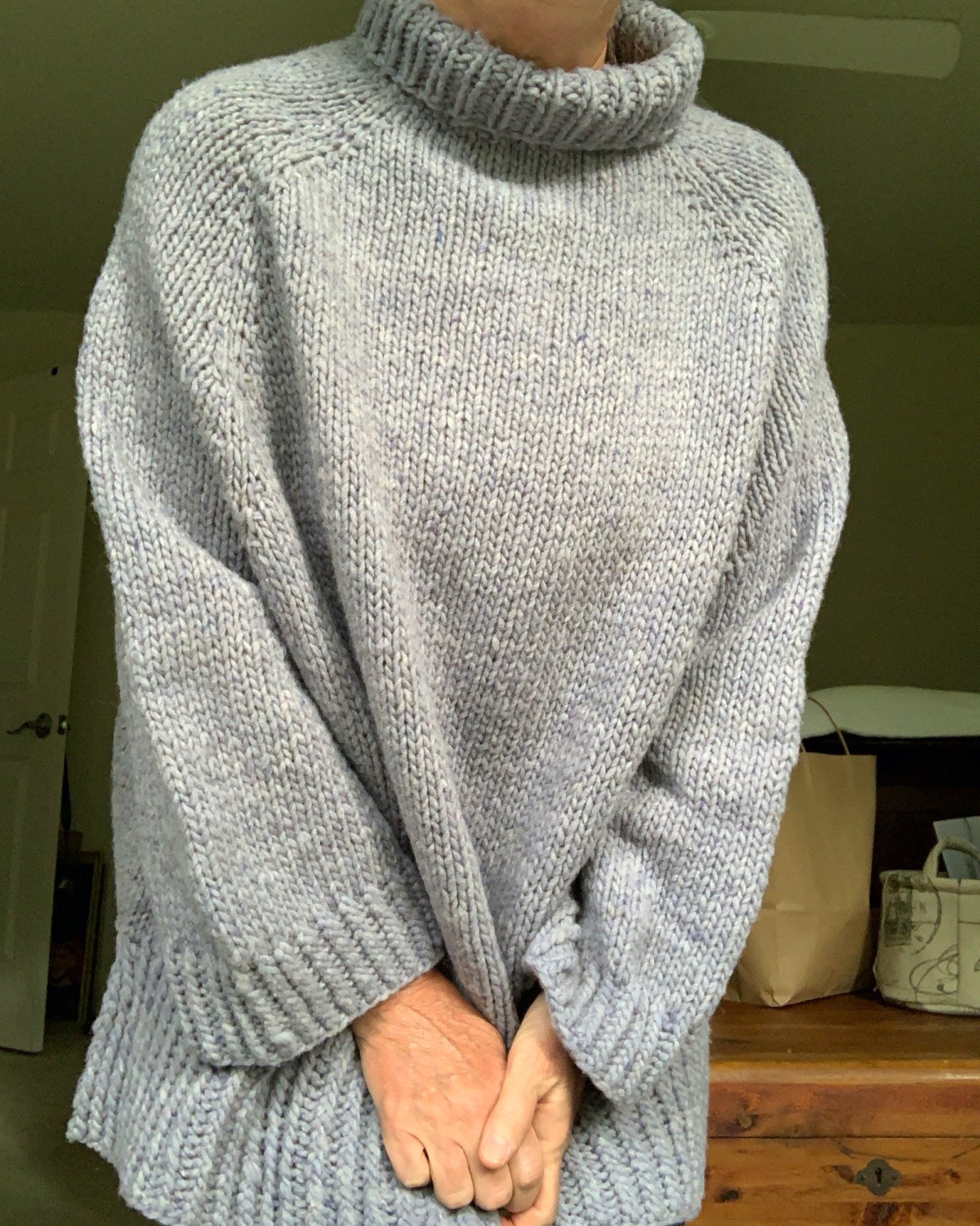
The front
The Size
Even though I knit the size Medium, it came out huge! But really, that is okay because now it is my sweater / poncho. My yarn was thicker than the pattern calls for and my needle size was larger. I expected it to be big.
I used about 1,000 yards of yarn, or 5 skeins. I had to frog the Oxbow cardigan, which is why I bought this yarn to begin with.
The color used for the back ribbing is Granite. I changed the color at that part of the knitting so I could easily tell the back from the front. There are short rows near the neck cuff for the back, so even though it may not look it, there is a Back and Front to this thing. Having a different color hem in the back just makes things easy.
I chose the split hem option
The pattern offers two types of bottom hem options. I knit the split hem version. Although I planned to have 3/4 sleeves as the pattern is written, they ended up long.
The Pattern – Good for Beginners
The Turtle Dove pattern is one of many free patterns (no longer free) offered by Espace Tricot, a Canadian yarn shop. The link here goes the pattern on Ravelry.
I also just want to mention that as I began this pattern I had a hard time figuring out where the back, front and sleeve sections were located. I’d never knit a raglan sleeve sweater. I wrote a blog post about that, just in case other’s have this problem.
Once I got past that, the pattern was very easy to follow. I would say it really would be good for any beginner knitter to try.
The Yarn
I loved working with the Quarry yarn. I had no problem with it pulling apart, and came across one knot where I cut the yarn. Because the needles were size 11 and the yarn is bulky, the sweater worked up quickly.
Quarry yarn leftover
The one personal problem I had was that as the project grew, it became hot in my lap. It was summer in Florida as I knit this, and even with the AC on, it became uncomfortable to knit.
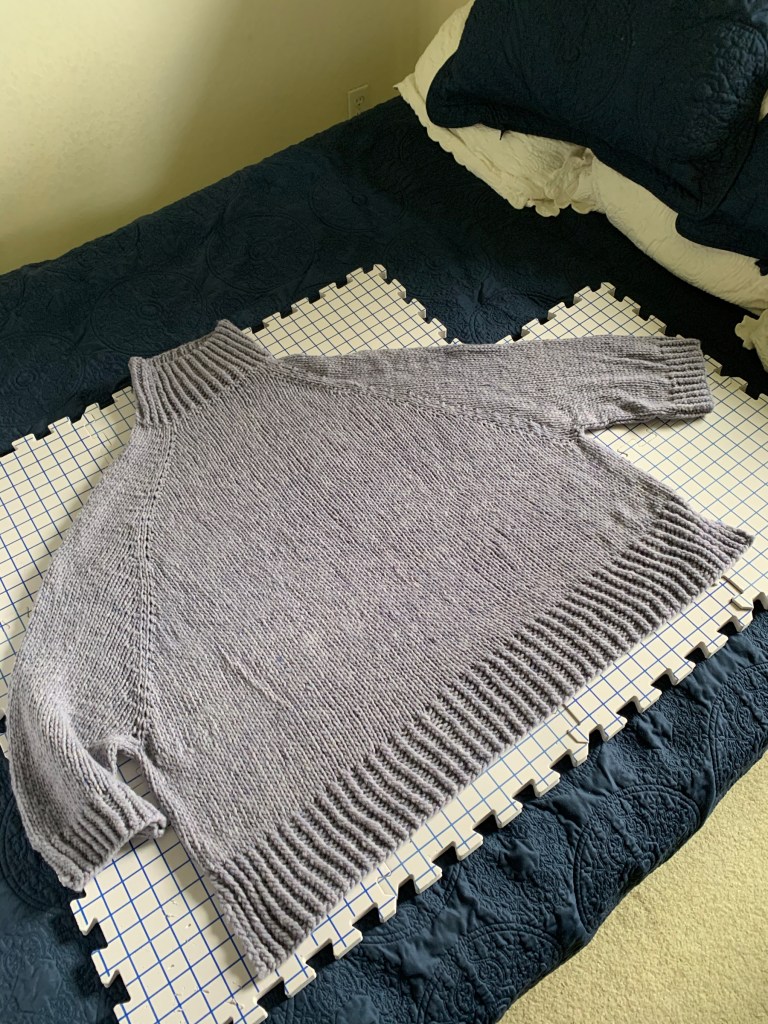
I washed the finished sweater in my kitchen sink with Eucalan wool wash that doesn’t need to be rinsed out. I wrapped it in a towel to remove excess water and put it in the spare bedroom, on a queen size bed, to dry. It could almost be a bedspread… LOL. This yarn dries fast.
The sweater was dry in about a day’s time
I bought my yarn at Wool and Company when it was on sale. I like to order from this place because shipping (US) is free always, no matter the amount you buy, and they will wind skeins for free also. I’ve never found any other company who does that. They have a great selection of yarn as well.
This thing is massive!
Currently I live in Florida, but I picture myself in my (future dream) New Hampshire home snuggled up in my poncho on a cold evening.
In need of a hat pattern that was fun to knit, I began to search my favorite patterns which are saved at Ravelry. Many hat patterns are simple enough to knit up quickly. The Colorado Chic(k!) Beanie looked interesting, and it could be knit in a heavy weight yarn – and it’s free!
If you are at home more these days thanks to the Coronavirus, you may need to find a hobby to stay busy. How about knitting? Knitting is not just for Grannies! There is much to learn, which means your brain can be challenged for years learning new knitting techniques.
Even if you don’t have someone to teach you, YouTube videos can be a huge help. Getting started is the first step, where practicing on easy projects leads to bigger and better knits.
I’ve written this page with the beginner knitter in mind, with advice for yarn, needles and free project links. The best projects to begin with when learning to knit are simple back and forth projects. You knit one row, turn the needles and knit the next row – or purl.
When I lived in New Hampshire I knit scarves. I would cast-on and just go, trying out various stitches along the way to see what happened. I would cast off when the scarf was long enough. But a better idea is to knit smaller projects that are useful, like cloths for the kitchen and bathroom.
Hand-knit cloths hold up well.
Let’s begin with an easy project, such as one of the dishcloths or facecloths below, which are knit with one color – or a variegated color. Whenever you knit something that will be used to wash with, choose a washable cotton yarn. Cotton yarn will be absorbent and easy to care for, going into the washer and dryer.
Here are some ideas for beginner projects with FREE patterns you can download at Ravelry. Join Ravelry (it’s free) if you plan to do more knitting because it can be a wonderful resource for patterns and help. You don’t have to be a member to get these patterns.
They use little yarn, so are inexpensive to make and in the end, you have a useful item. If it has some mistakes, who cares? This is a great way to practice without worrying about boo-boos.
Seed Stitch Washcloth – knits and purls create a nubby fabric. personally, I love this stitch and it’s great practice for doing both of the most basic stitches in knitting.
Your Own Design: Knit a few rows and purl a row – or knit all rows. Make something up until it becomes the size you want. I have links below for help with CASTING ON and BINDING OFF.
Buying Cotton Yarn
Lily’s Sugar ‘n Cream Cotton Yarn – comes as single, affordable skeins, in sets, or on cones. They offer a huge selection of solid and variegated colors. Search Amazon (they have all types) and order online, or go to a local craft store such as Michaels, Joannes, or Walmart. This yarn is easy to find.
Key West Karribean Kotten Yarn – The blue and orange striped dish cloth in my photo below is made with this yarn. The colors are super bright and don’t seem to fade as quickly as the other cotton yarn. It does cost more, but I love the quality. This cotton yarn is perfect for making kitchen towel gifts!
Karribean Kotten – comes in tropical colors
Needles, Types and Sizes
Straight needles are fine to use for little knitting projects. I had some of my grandmothers old straight needles and I used them when I began. But then I discovered the versatility of circular needles, which is what I mostly use these days.
Circular needles can be used like straight ones. Just pretend they are not connected! Turn the work each time you begin a new row. Once you begin to knit projects in the round, circular needles are needed and you will already have them. So my advice (if you have NO needles) is to buy a 16 inch (length), needle size 5 to 7 US to use to knit your washcloths. Chiaogoo Red are favorites of mine. Later on you can use that same needle to knit hats – most hats (unless they are for babies) are made using 16 inch needles.
Knitting needles come in various lengths as well as needle sizes. Tiny needles such as 0 – 3 or 4 US are used to knit tightly, such as for socks and mittens and / or when using lace and fingering weight yarn. Larger sizes will be used for heavier yarn weights and for knitting sweaters, hats, and bulky items.
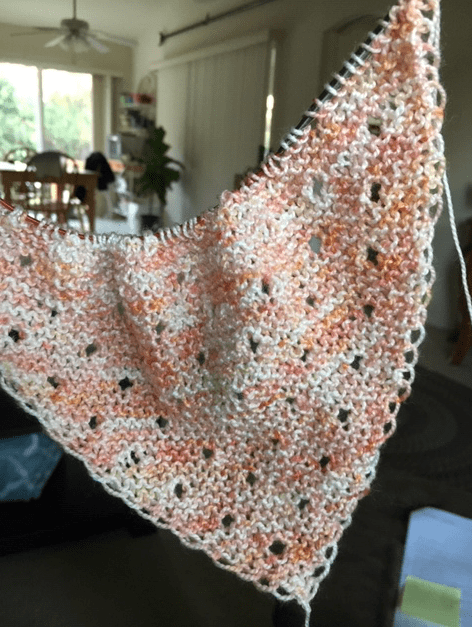
Beginning the Dewdrops shawl pattern
The Dewdrops shawl above is knit on a long, circular needle. I began knitting at the very bottom point, with only a few stitches. As I went on, more stitches were added and I needed that longer needle. Straight needles are too short to hold that many stitches.
How to Cast-On and Bind-Off
Once you have found or purchased your needles and cotton yarn, this is how you get started.
A simple cast on begins with a slip knot on the left hand needle. Then you will begin adding stitches – as many as the pattern calls for. That is your cast-on number and everything you make requires some type of cast-on. You will “cast on” as many stitches as are needed to begin knitting. The project will always become bigger than your cast on looks!
The video links below are some good ones I found. If you want to search for other cast-ons at YouTube, be my guest. There are many.
There are many ways to cast-on, but all you need is the basics when beginning. I now use the Long-tail cast on, or the Norwegian Cast-on (aka German Twisted cast-on) because it’s faster, but for a long time I did this simple, basic cast-on. The others are more complicated, but you may like them.
From there, you begin knitting the pattern, or your rows of knitting as you choose if you are not following a pattern. When you finish all your rows, you must bind-off to finish the project.
I like Purl Soho’s videos because they get right to the point. Also the teacher generally uses larger yarn and needles that make it easier to see what’s going on. Purl Soho also has many FREE patterns on their site, where they also sell pretty yarn – including cotton.
Once you know how to begin a knitting project, you either make up your own pattern / stitches as you go, or follow a pattern. Below I list links to videos showing the two basic stitches needed to create many patterns, the knit and purl stitches. You can do a lot with just these two stitches.
Anytime a pattern calls for knitting, this is the stitch you do. It’s the base for all knitting projects. These show English forms of knitting where the working yarn is held in the right hand.
Many knitters dislike doing the purl stitch, but it’s not difficult and you will need to do it a lot if you choose to create anything with the “seed stitch” pattern. Purl stitches add texture as well. You can knit one row and purl the next to make the stockinette stitch. Doing this will create a smooth fabric.
Fun With the Knit and Purl
It is easiest to knit a few rows right after the cast on. From there, try some purls. If you alternate a row of knits and a row of purls, you will end up with stockinette.
In my little cloth samples below, I played around with these two stitches. I suggest you search YouTube to find beginner videos. Many knitting sites have loads of advertisement clutter to wade through to get to real information.
My Own Beginner Samples
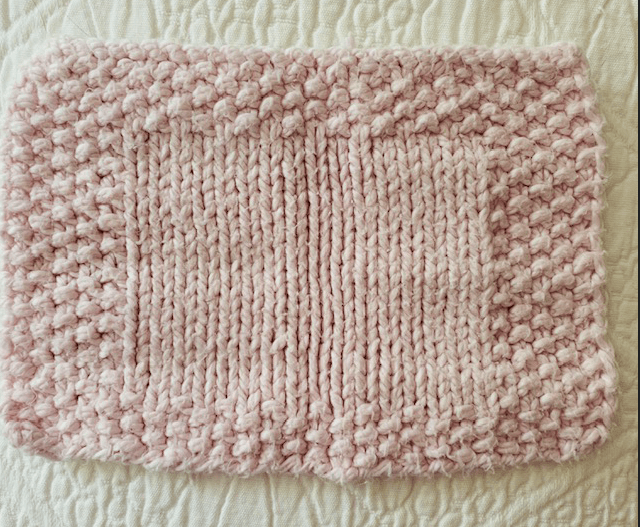
Here are a few of my knitting samples. They are not beautiful, but they gave me practice. To leave a center “flat” area, knit a few rows back and forth – this means to do all knit stitches, for a few rows (4 or 5). On the next row, knit 5 and purl until 5 stitches remain, then knit those five. This way you are making a textured border with center flat (stockinette) stitches.
Center stockinette
On the white cloth I did some alternating knits and purls along the bottom and top borders. In the center I did seed stitch, also called moss stitch. Seed stitch is simply K1, P1 – switch off continuously across each row, but alternate row by row. First center row: K1, P1 (you need an even amount of stitches.) Second row: P1, K1 – your purls will be over the knits and knits will be done over the purls. It creates a pretty little texture.
Seed stitch or moss stitch
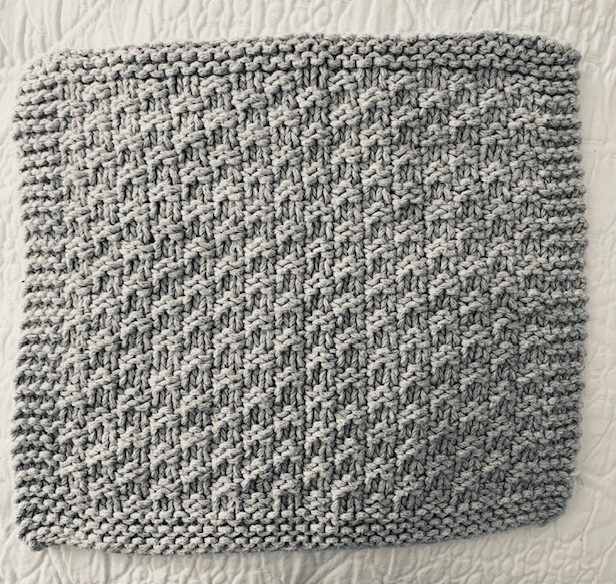
On the gray cloth I made the same type of knit border and then for the center I knit 2 stitches, then purled 2 stitches (K2,P2). On the next row I did the same thing so the stitches lined up. On rows 3 & 4, I did the opposite (P2,K2). This is a double moss stitch.
Two knits and two purls
As I knit my little cloths, I used various types of yarn. I honestly don’t remember what they were! I still make little cloths because nighttime knitting for me needs to be simple.
Want Something Bigger to Knit?
If you are not interested in little facecloths or kitchen items, check out my page on free shawls. You may never feel the need to wear a shawl, but they are popular choices in the knitting world AND the easy ones are great practice for beginners.
Try your hand at adding new colors and using variegated yarn on the Scrappy Bias Shawl. Learn what to do to make lacy holes appear in rows when knitting the No Fuss Shade-Loving Shawl.