Knitting projects I have completed or have in progress. My thoughts and review of the pattern, yarn, and outcome. Also knitting project ideas to consider or find for free.
This page contains notes on knitting figerless mitts using stranded colorwork. I will be using Jamieson & Smith wool in five colors (added one, so six).
This is a free pattern download at Ravelry for the Fair Isle Mitts. The pattern has charts and written instructions with two hand / palm motifs to choose from. I put one on the top and the other on the palm.
Some of my favorite beginner knitting projects were winter scarves. And they are something I would wear often when I lived in New Hampshire. Usually the repeats are simple enough that a scarf project can be picked up and worked on at any time without losing your place.
My daughter asked for a set of boot cuffs and the request seemed easy enough. The actual knitting of the cuff is pretty simple, but the cast-on number and cast-off style took some trial and error.
I began by searching for boot cuff patterns. All I really needed to know was approximate cast-on numbers and then figuring the cables and where to place them.
The First Mistake
For my first attempt I cast on 60 stitches and then did a simple 4 stitch cable every 4 rows with two purl stitches between. This made for a lot of cabling! In the end – I got all the way through a loose bind-off – the cuffs were very big. My daughter’s legs are smaller than mine and I knew they wouldn’t fit her. She wants cuffs for the lower calf area for low boots.
Highland worsted in color Teak
I tore out the Highland yarn cuff and began again with some hand-spun brown yarn.
Cuff # 2 Knit With Handspun
This time I cast on 48 stitches using the German cast-on, which is stretchy enough. I followed (somewhat) a free pattern for the Simple Cable Boot Cuffs. I did only six knit rows between cables to shorten the cuffs a bit. This way of cabling makes for a faster knit because only three rows of cables are done – unless you want a longer cuff. The cables use six stitches and they look nicer that way.
When it came to the stretchy bind off, I tried a twist bind-off to begin with and found that it really didn’t seem very stretchy. I only got a few stitches in and then switched to Jeny’s Surprisingly Stretchy Bind Off as shown on Andrea Mowry’s YouTube video. BUT… I decided to do the yarn overs only on the two knit stitches and then bind off regularly on the two purl stitches – the video only shows knits. I was hoping for less of a flare when finished.
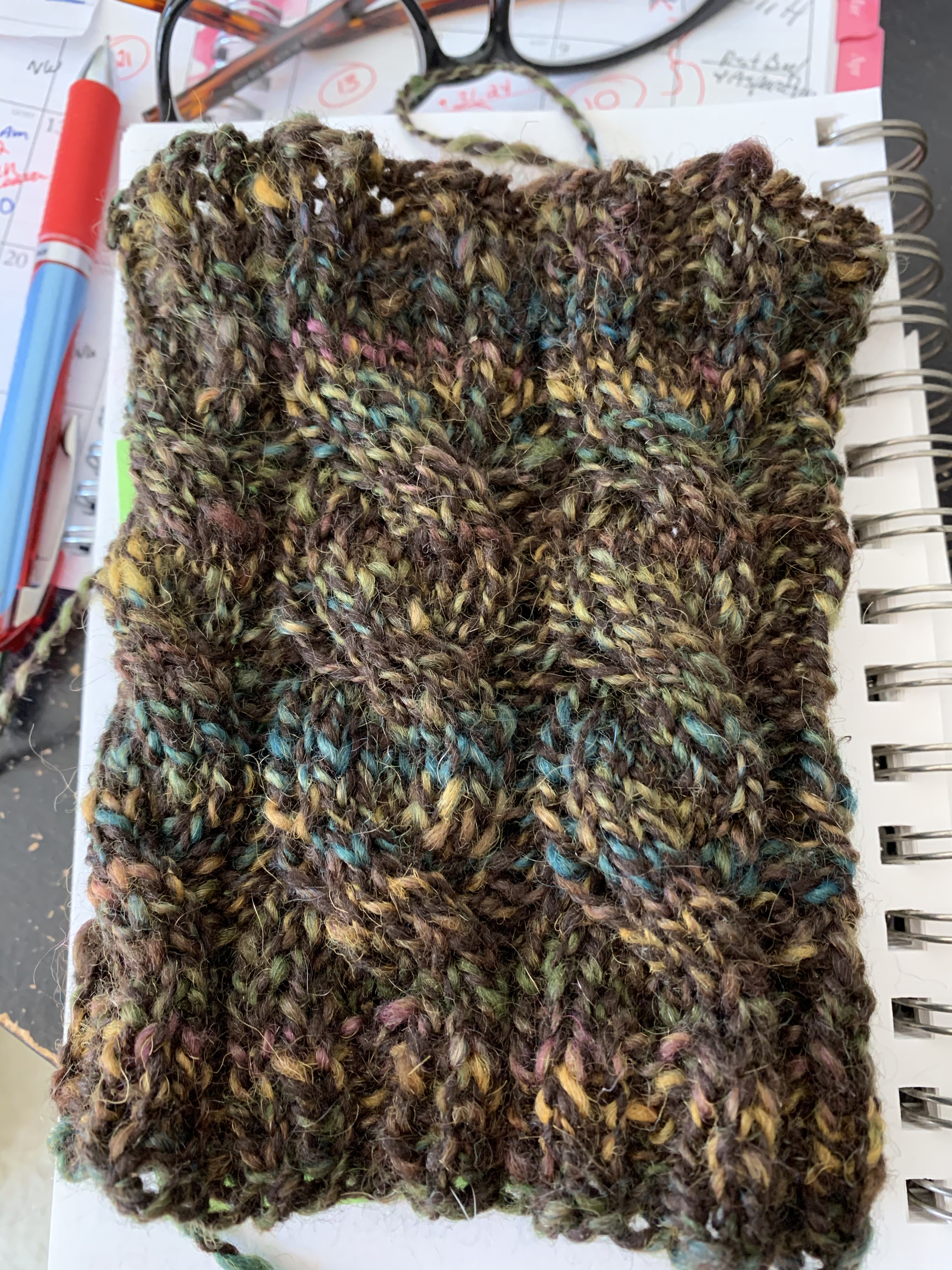
Handspun yarn by Clarion Call Fiber Arts
I messed up the top part of the cuff by knitting too many rows and doing the combined bind-offs so this cuff will have to be my experiment cuff. I will knit another to go with it, but I will begin again with the Highland wool for my daughter’s pair.
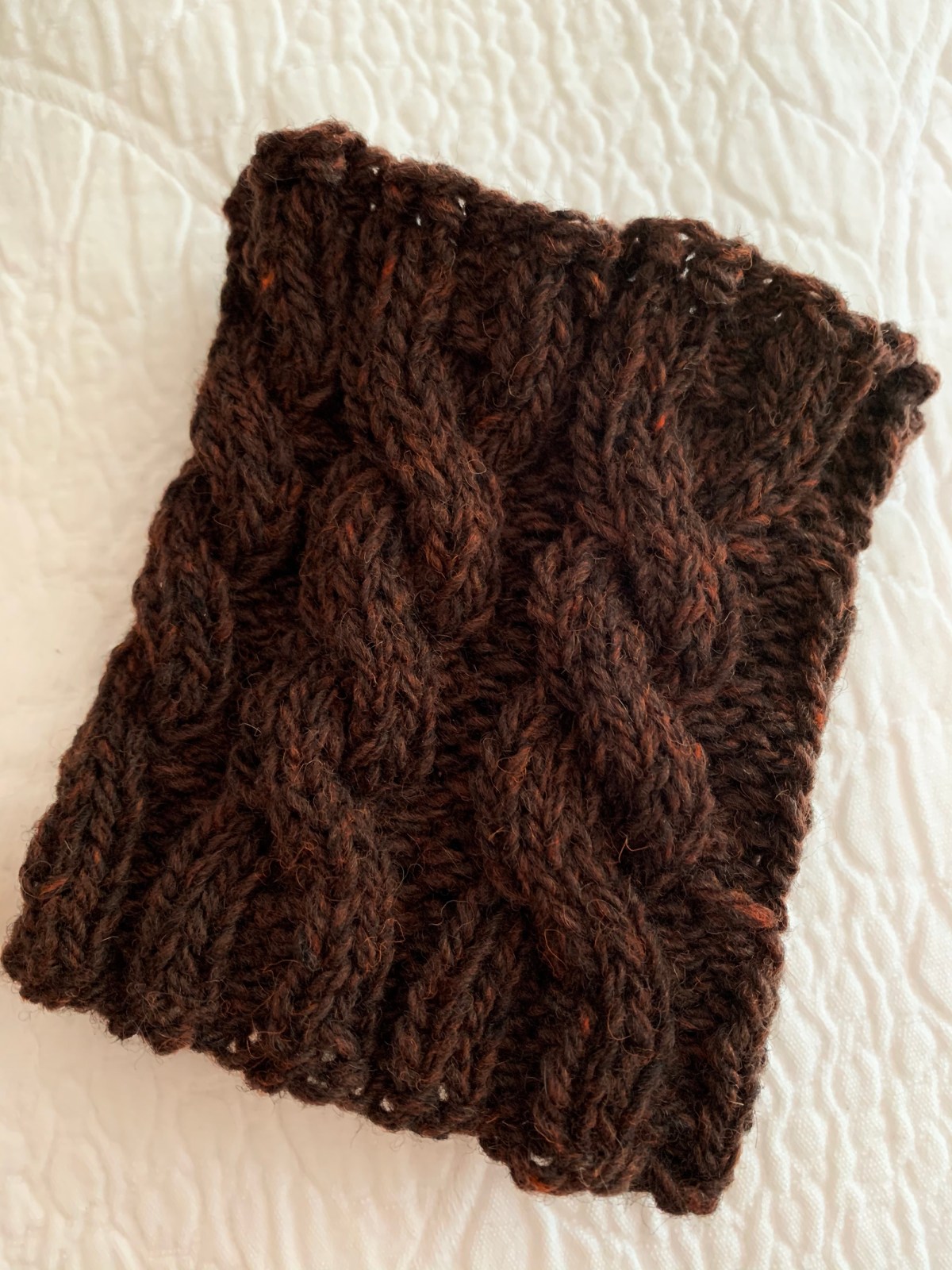
Brown “Teak” boot cuffs are about 5 inches tall
The brown “Teak” wool cuffs seem to be the perfect size for what my daughter needs. I won’t know for sure until I send them off to her for a try-on. For some reason these cuffs came out much shorter than the cuffs made of handspun. I guess it’s a difference in the yarn, and I did a few extra rows on the variegated cuffs.
Cuff size differences
My daughter will get both sets of boot cuffs because I don’t wear boots in Florida. Once I finish her orange hat, I will send them all off to her.
Ankle Boot Cuffs, Note to Self
You may not follow my directions, but I’ve written this info down for myself.
Size 7 circular needle (9 inch) cast on 48 – German Twisted makes a loose cuff.
Knit 2×2 rib for 4 rows
Switch to size 8 DPN’s (my 9-inch circular will not work) 16 stitches each needle.
Rows 1-5 *Knit 6, Purl 2 around
Row 6 Cable – hold 3 stitches front, knit 3, then knit 3 from cable needle (I use a DPN) & purl 2
Repeat rows 1-6 twice more.
Do 3 rows of *knit 6, purl 2
Do 3 rows of ribbing, k2,p2
Bind off using the stretchy bind-off for knit stitches only. BO purls normally. (Stretchy bind off: knit one to begin, then yarn comes over needle from the back. Knit one and pass the first two stitches (stitch & yarn over) up and over the third stitch on the needle.) See Jeny’s bind off video link above.
My son’s blue Skiff beanie, pattern by Jarod Flood, has gotten a lot of attention this winter. Yes, we can wear hats in Florida in winter. My son was born and raised here so he is always cold when the temps drop below 60!
Some friend’s of his have seen his blue Skiff, which I knit a while ago, and have mentioned that they really liked it. When he accidentally wore it into work at the fire department, a friend said he would like a hand-knit hat. I said I would make him one.
Skiff beanie in gray
Did I really want to knit another Skiff? Oh ya… this is a fun hat to knit. If you are interested, you should know that the pattern is in chart form. What I did, before ever knitting this pattern, was go through the whole graph and color code each cable area. I also made notes for the other stitches as some were very new to me. Every cable and stitch has an easy to understand description.
I use a wooden DPN for the cable needle, which holds the stitches nicely, and my circular needle is also wood. One of the cables needs 3 needles – over 5 stitches, but really I’ve found it to be so fun that I really enjoy the challenge of watching this extraordinary pattern emerge.
The Madeline Tosh Vintage yarn, in “Antique Moonstone” is some that I’ve had for a few years but it is perfect for this pattern. I love how the colors blend and make highlights, and the roundness of the yarn shows off the texture and cables.
Top of beanie
The Yarn
Mad Tosh is not cheap, but it is machine washable. I always wash by hand, and my brim on this gray Skiff is of a non-machine wash yarn by Quince & Company. So this hat needs to be hand-washed.
Madeline Tosh comes as 200 yards, and I had plenty leftover. Brooklyn Tweed Shelter comes in smaller size skeins at 140 yards and the pattern calls for 2 skeins for this beanie. You will spend about the same amount – a little more for the Mad Tosh, but will have more of the BT yarn leftover. Remember I used a contrast color for the brim.
Mad Tosh yarn leftover from knitting this hat
I cast on using a size 3 circular needle and used the German Twisted cast-on. For the top of the beanie I used a size 7 needle. This hat is quite roomy for me, but is probably perfect for a guy. My son loves his.
Yarn color: Antique Moonstone
Jarod Flood is known for his patterns for men, but he also has beautiful and intricate patterns for women. And many of his patterns are unisex. What I have noticed is that he goes into great detail when describing how a pattern is knit. I will be knitting his Cobblestone Cardigan soon to wear on my trip to New Hampshire!