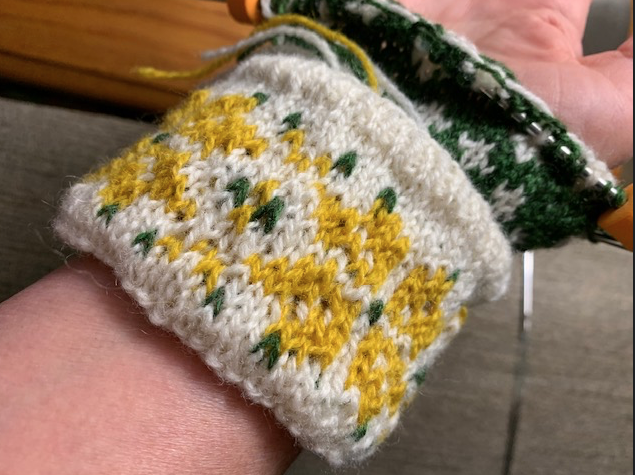
There is a lot more to knitting than picking up a pair of needles and choosing a pretty yarn. If you have done any amount of knitting yourself you will understand. I have learned a lot as I’ve knit various projects over the past year and a half.
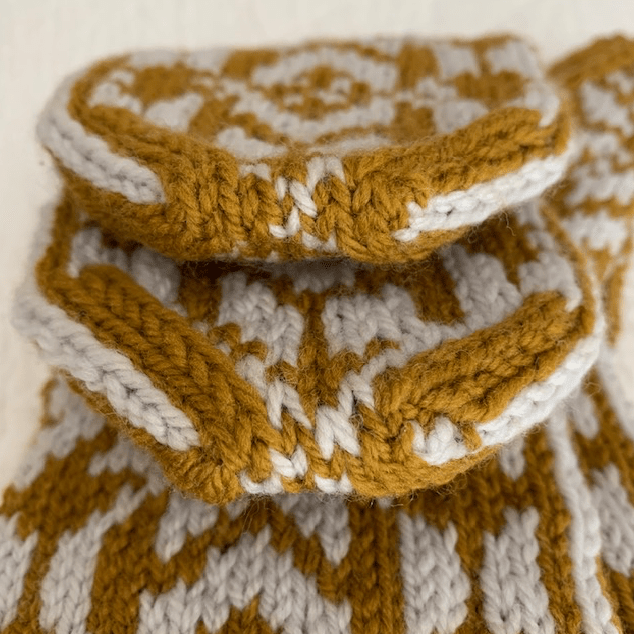
One aspect of knitting you will undoubtedly come across if you knit mittens, socks or even sweaters, is the Kitchener stitch. It is usually done with a tapestry needle to either close up a mitten top (see below), sock toe, or stitch something together seamlessly. (See my Playdate Cardigan page also where I used this stitch on shoulder seams.)
Glissade mittens
Basics of the Kitchener: End your knitting with even number of stitches on each of 2 needles. Do a set up stitch, and then begin the Kitchener. It weaves both sides of the project together without making a seam. If you look at my mitten tops, it appears that my stitches flow over the very top of the mitten like magic!
I have not done the Kitchener stitch often, but there is a good YouTube video by Very Pink Knits which has helped me to understand it better. She has a little mantra she says while stitching. She shows it on a sock toe, in slow motion, which is very helpful!
My Glissade mitten tops look pretty good, if I do say so myself. When I first tried this stitch, I practiced on something that didn’t matter.
At first, this stitch drove me nuts. I really hated it, but after practicing, it’s really not that bad. I just have to go slow and pay attention. A lot of videos don’t tell you what to do with the last two stitches, but this video does.
Now, whenever I have a pattern that calls for this stitch, I write that little saying on the pattern itself so I don’t have to go look up the video when it’s time to do the Kitchener.
For the mitten knit-along I am doing, colorwork knitting is a requirement. The pattern must include more than one color for this KAL, and the mittens I am knitting have three. Once you know the basics of doing colorwork, also called stranded knitting, the project will end up looking good instead of a mess (like mine used to be).
Colorwork Basics
I have a little experience in knitting colorwork. Basically you are knitting with two or more colors and using them to create an image or pattern. Yarn is held in both hands, with left hand using the prominent yarn, and right hand holding the “background” yarn color.
However, if there is a long bunch of stitches in one color only, it means the other yarn must be carried along until ready to use. Because you can’t just let it droop and create a long “float”, or unattached length of yarn, you have to know how to “carry a float” for both the left and right hand yarns. This is knitting talk for catching the unused yarn with the used yarn to bring it along correctly. And it is done differently for each hand (color).
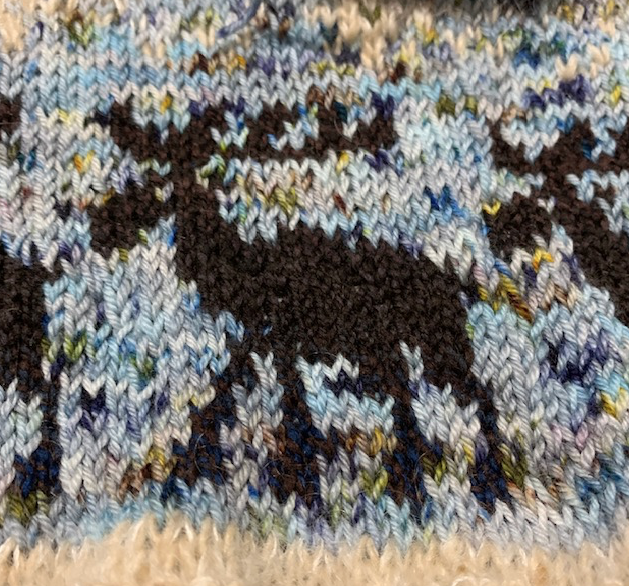
Moose motif
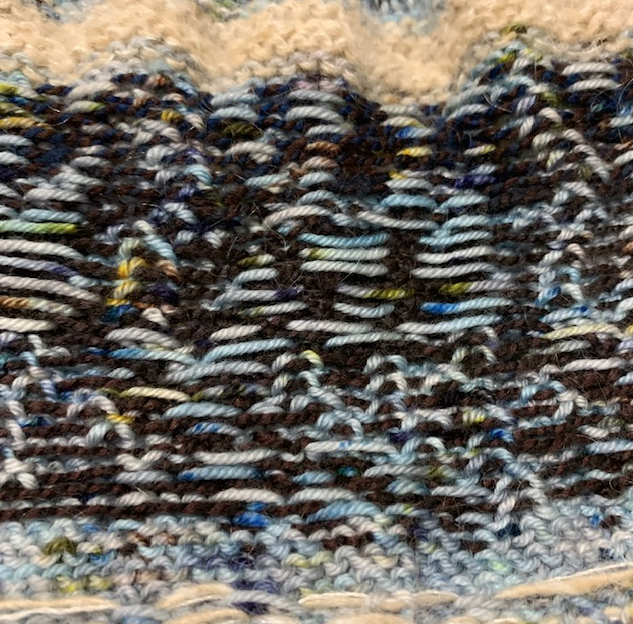
For instance, when I knit this moose motif I had to carry yarn colors over numerous stitches. When knitting the rows of brown for his body, I had to carry the blue yarn and catch it up while I knit the brown so as not to leave a long strand drooping along the back of the hat.
Catching the floats for the moose motif
Catching floats is not difficult and once you know how to do it, it becomes simple. I suggest you knit something where you can practice this over and over until it becomes second nature. I’m getting more practice now while I knit the Milet mittens.
My new year knitting program is going to include smaller projects, namely socks and mittens. I began The Woolly Thistle Mitten KAL (knit-along) this month (2/2020) and while knitting my mittens, I’ve used 9 inch circular needles, Flexi-flips and DPN’s. Here is my opinion on all three.
A Look at 9-Inch Circular Needles
I really like the little 9 inch circular needles. I think I first used them when I made a little baby bootie (never made the second bootie!) But they were too big for the cuff of the bootie so I used DPNs. I also used them to knit the sleeves of the Polliwog Popover baby sweater sleeves.
Here you can see my Latvian Braid (first one I ever made) using two yarn colors on a 9 inch needle. I think Fontana is unimpressed, but I had fun making it. After doing a Latvian braid on the Milet mittens using Flexi-flips, I realized a 9-inch circular makes for a neater braid.
Fontana and my Latvian Braid
Overall, I do love using the small 9-inch circular needles. Yarn holders for the ends of the needles are necessary, and the tight circumference can tire my hands quicker, making them ache. Also my colorwork knitting is very sloooow on tiny needles because the stitches are so small and tight.
I have the ChiaoGoo and Hiya Hiya 9-inch and they are both very similar.
Three-Needle Knitting With Addi Flexi-Flips (Size Problems) and Hiya Hiya Flyers
Both Addi Flexi-flips and Hiya Hiya Flyers brands come as a three-needle set. You knit with two needles holding the yarn and use the third to knit. A bit like DPN’s but with fewer, and longer, needles, that flex.
Addi has different tips on the end of each needle so you can knit with either sharp or blunt points.
Addi Flexi Flips – One needle with two tip choices – sharp or blunt
Using the 3-needle set is easier than DPN’s as there 1 or 2 fewer needle changes, depending on the number of DPNs used, but I still have some trouble with the beginning of round stitches. See my braid rows below and how the BOR colors are off. I do have trouble adding a 3rd needle to start a row.
My braid is off a bit using the 3-needle combo
Also with only two needles holding the work, I found that I was dropping stitches, so I began to put stitch blockers at the end of the needle not being used.
I have both brands and the needles are similar. The tube connecting the needles is a little longer on the Hiya brand, and Addi’s needles are a little longer overall. Addi’s come in a tube and Hiya’s come in a plastic bag.
Addi’s Incorrect Sizing
But I want to warn you of one crucial difference and it has to do with needle size – dimension.
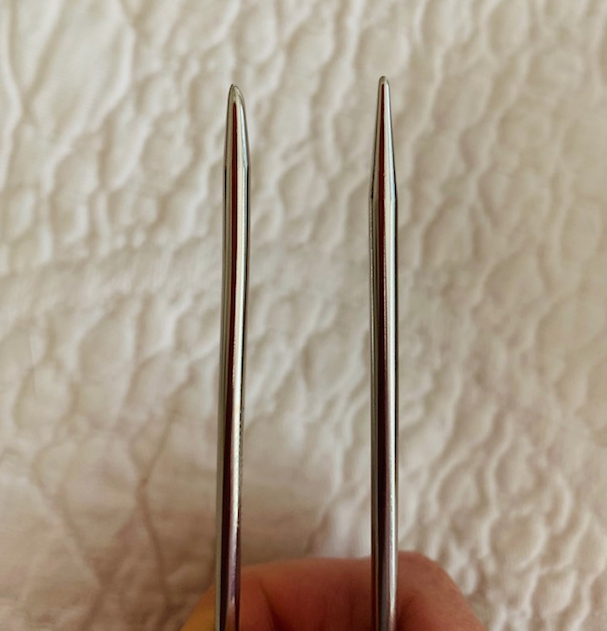
When I began knitting my first Milet mittens, I ordered (what I thought was) a size 1.5 US set of Addi Flexi flips. I ordered them from Wool and Company and they were listed as size 1.5 US – no mm size was mentioned. However, when they arrived, the tag simply said 2.75mm (see tag below). I had to look it up, and come to find out 2.75mm does not equal 1.5, it equals size 2. The needles were too large.
So I checked my older pair of Flexi’s which actually says 3.0mm / US2. (See the photo below) BUT…3.0 mm does NOT equal 2, it equals 2.5 US…!!!!
Incorrect mm to US sizing in FlexiFlips
I went back to my order form at Wool and Company to make sure I did not mistakenly order the wrong thing. I did not. I kept the size “2” needles since I didn’t have that size, but I still needed a 1.5 size for my mittens. So I looked at other places online. The small size needle is hard to come by but Amazon had them and advertised them incorrectly also. Or should I say, they were advertised as Addi Flexi Flips advertises them.
Jimmy Beans Wool was where I saw the only notice to customers that the sizes of the Flexi Flips were off. They mention that the smaller size needles are off in the product paragraph. I wasn’t crazy – the needle sizes are not true to advertising. And only 4 of the smallest sizes are listed wrong – all other sizes seem to equate correctly.
If you buy according to the metric system you are fine, but those of us in the US will be using the wrong size needles unless we compare the mm size to US sizing.
The Basic DPNs
I have a heck of a time beginning any small item using DPN’s (double-point needles. With all those pointy sticks in the way, it’s not fun to keep track of where I am and what I’m doing.
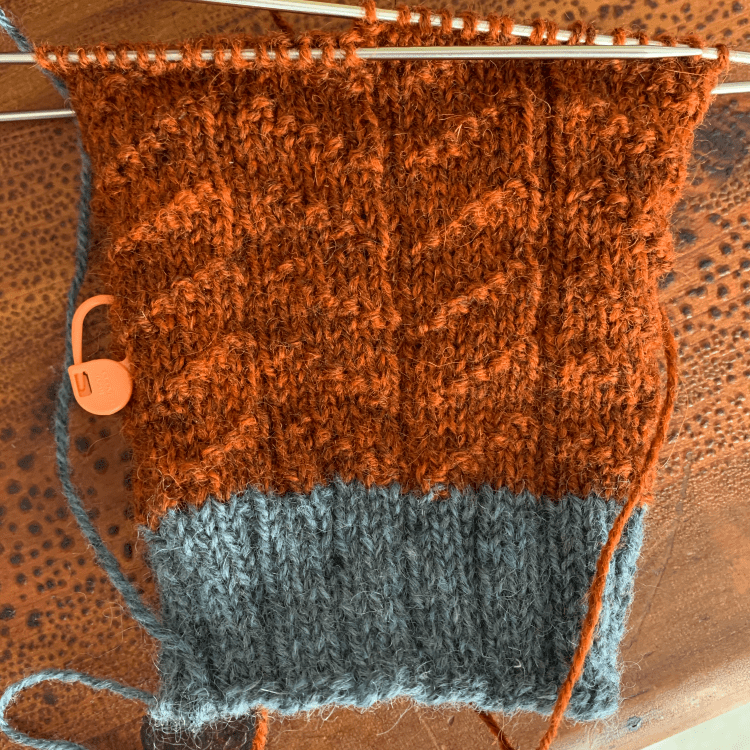
I think it’s actually a little better when using very small needles to knit socks or mittens. The Snowfall sock pattern below has a repeat pattern that fits nicely on four, size one, metal, DPNs. But I did cast on using a 9 inch circular and knit the ribbing before changing to DPNs.
Sock knitting using double pointed metal needles.
Magic Loop
Many knitters use the Magic Loop method to knit in the round. I have looked into it, on YouTube, and found a toe-up sock example, which I may try one day soon.
I can’t give an opinion on the Magic Loop method because I have never used it. Basically you use a long circular needle, split the stitches, and knit as in the round. Some clever people knit two pair (both mittens or both socks) at one time on the same long needle!
Knitting Inside Out… What?
Something else I have just learned is that when knitting colorwork some knitters knit their mittens, socks, and whatever, inside out! Crazy right? The reason for doing this is to keep the floats more uniform and less tight.
I had to search YouTube for that information as well. Melissa B has a good video explaining how simple it is to knit inside out.
In Conclusion
In conclusion, I’d have to say from personal experience that I prefer casting on with circular needles. If I need to do a Latvian Braid, circular is my choice. If needle size is not too small – say size 0 – 2, I don’t mind knitting along with them either. Normal knitting, or stripes, are easy, but for very small sizes and colorwork, they can make my hands ache.
Beyond that, it really depends upon the project at hand. I still have a lot to learn and new methods to try, and a pair of mittens to finish.
As soon as I saw the Milet mitten pattern, I knew I would try knitting it one day. The suggested yarn, Rauma Finull, is a wool yarn that I have never used. Come to find out an online store (The Woolly Thistle), which I’d been checking out, sells that type of yarn, which comes from Norway.
I’ve learned a lot from this experience. What I like and what I don’t.
Read on…..
Rauma Finull yarn from Norway
Then, I learned that The Woolly Thistle, (referred to as TWT), is also sponsoring a knit-along (KAL) for mittens! What this means is anyone who wants to can join in and we all choose a pattern and “knit along” showing off our progress and finished mittens by the time the KAL ends.
I’ve done one KAL before, which was actually a MKAL (mystery knit along) for a shawl. It was intense for me, and we all knit the same mystery pattern. This mitten KAL is different because we each choose our preferred mitten, or mitts, pattern. I’m also a bit more experienced knitter, but not with colorwork. For this KAL, the mittens must be knit of at least two colors.
Have Yarn Will Practice
I was not at all sure I would join the mitten KAL because I’m not good with double-pointed needles, or knitting small circumferences (socks, mittens), and I’m a newbie at colorwork too. But I learn best when I jump in without thinking too much about it. I ordered the Rauma yarn and the mitten pattern (see link in first paragraph) and decided to begin knitting just to see how my gauge was.
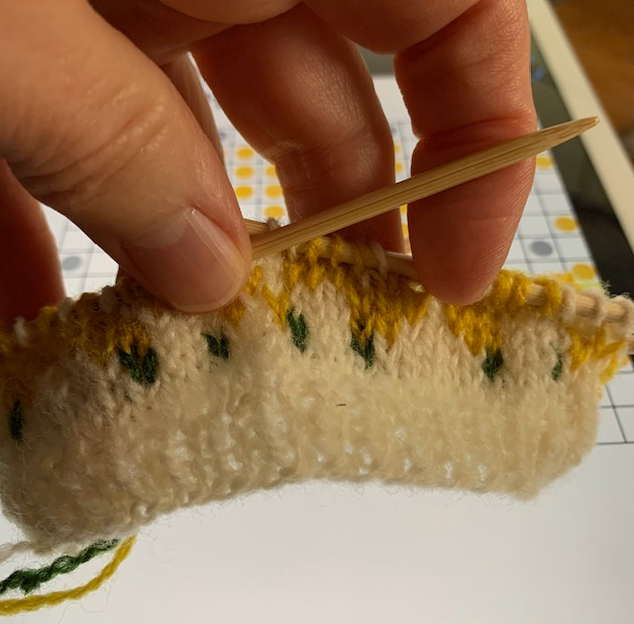
Using DPNs to do the colorwork cuff
This will not be the mitten I knit for the KAL. I can’t start that one until the cast-on date of February 13th and I haven’t decided which pattern to choose. (If you want to join in, see the rules and participating designers – offering discounts on their patterns! – in the Ravelry TWT forum – you will have to sign in.)
I’m not used to casting onto small needles and I REALLY DISLIKE knitting the first few rows. I didn’t have the correct needle size, and decided to go up a size, since I usually have to. But wow, that cuff seemed huge!
Small Addi Flexi-Flips Are Sized Off…so I am knitting with larger needles than I thought!
Come to find out, a few of the smaller Addi Flexi’s are not true to size. The mm measurements don’t equal true US measurements. I intend to write a new post on all that, but in the meantime, my size 2 (US) is really a 2.5.
If you are shopping for Addi Flexi-Flips (three needle sets for circular work) be careful of the mm to US conversion which is not correct.
For instance, I ordered a size 1.5 US and was sent needles saying: 1.5 US / 2.75mm. But 2.75mm does not equal 1.5, it equals a size 2 US! Jimmy Beans Wool actually mentions this discrepancy in their Addi sales page.
Stranded colorwork cuff
This cuff is unique as it will be folded over, but it still seemed way too large. I almost stopped, thinking I would tear it out, but I decided to keep going with the smaller needle (which was bigger than I thought!). Now that I have gotten further along, I’m glad I kept going. Maybe the cuff needs to be larger to fold up easily? Also my arm is bare and when wearing mittens I would be dressed in heavy clothing. That cuff would have to fit over a sweater or shirt. (Things I forget about living in Florida.)
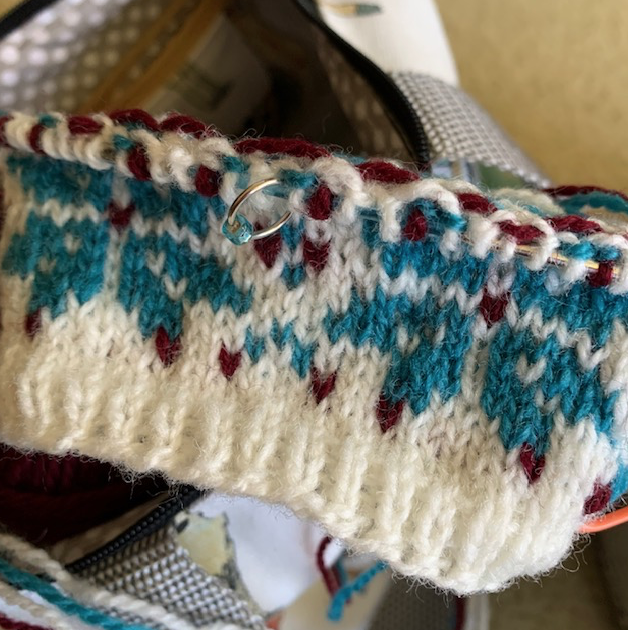
You can see the construction below and the green with white is the beginning of the hand. The cuff is inside out because it will fold up.
Milet mitten
See it on my arm with the cuff folded up to cover the yellow ribbing. I’m going to keep knitting and see how the first mitten comes out. The other mitten to this pair will be knit with a smaller needle.
My size 2 needles are Flexi-flips (are actually size 2.5), which are a bit strange to work with but better than DPNs. I kept dropping stitches so added little yarn blockers to the ends of the needle not being used.
Mitten cuff rolled up
I love the Rauma yarn and since it is pure wool, will make nice warm mittens (which I will never wear here in Florida, so I’ll have to travel to NH more often). I love this yarn so much that I am ordering a bunch of new colors (it comes in tons of colors!) to be prepared for the KAL. Because the Rauma Finull yarn comes from Norway, not all US stores carry it. Besides The Woolly Thistle, I have found it to buy at Wool and Company, who offers free US shipping with any order! (I bought my new Flexi Flips here, and there was no note about the size being off. I needed size 1.5 and now have size 2.)
Now to find a mitten pattern! Lots of designers are jumping on board and putting their mitten patterns on sale beginning Feb. 6th. I’ve already taken advantage of sales, which began earlier, to get some new patterns.
To Summarize:
I love Rauma yarn, but never found a mitten to knit with it for the KAL. Since then, I have used it to knit Katie’s Kep (a colorful, Fair Isle hat).
For the mittens, I used a DK weight (Brooklyn Tweed Arbor) and knit a faster pattern (two really) which gave me perfectly sized mittens. The Milet mitten ended up being something I did not like, so I never finished the pair.
Although I used the Flexi Flips, I was not crazy about them. They were not a lot easier than tiny circular, or DPNs. I won’t waste my money on more.