New England native, Florida resident. Blogging about boating, beach-combing, gardening, camping, and knitting. Work for Zazzle as a designer since 2008.
Today is Easter and my son is grilling ribs. I made southern style potato salad and we will eat outside later. It’s hot here in Florida so I have the AC on.
My other children are spending the day with their better half’s family. Did I say that right? They are in New Hampshire and Kentucky. Anyway, like every other holiday, nothing special happens here. We eat and drink and relax.
Years ago the kids and I would dye eggs using food coloring, or one of the popular store bought ways to dye eggs. It was fun, and we made memories. Funny, but I don’t remember their father being a part of any of it.
When my kids were small I would hide eggs (for the Easter Bunny) and put little notes inside which would have clues as to where to find the next egg. It was a treasure hunt, which took a lot of planning and organizing. At the end of the hunt there would be a big Easter basket which I had put together for each child. Usually there would be candy and a wrapped, special gift.
One year when my youngest son was small, he and my grown daughter searched for eggs in the woods near our rental house. Usually I didn’t put eggs outside because of animals, but this place was in the woods and it was perfect for a good-weather egg-hunt. I wrote down the number of plastic eggs I hid, and I think we came up one short although they looked and looked, and I couldn’t remember all the spots, so it may still be there. It could contain a dollar bill or maybe a quarter!
When I was a kid, my father used to do the same type of treasure hunt notes thing for me and my sister. None of my kids have kids of their own, but if they ever do, they may carry on the tradition.
I’ve been following the Keto Diet plan since August 2020. (Read about my Keto experience here.) I’ve been walking regularly for a couple of months and I should have done that sooner. Begin the day with movement to get the juices flowing. End the day with calm and relaxing activities like knitting and watching television. These are my goals.
For most of my adult life I left the house to go to work. Most of my jobs meant standing or walking around for long periods of time. I was a bank teller, cashier, florist, teacher’s assistant, substitute teacher, and at-home babysitter when my own kids were little. Like most mothers, there was not much time for me.
Now I work from home, and have been doing so since 2007. It means long hours in front of the computer – sitting. My knitting hobby also keeps me sitting for long periods of time. Sitting is not great for us so it’s important to find something that keeps us going.
What’s Your Reason For Improving?
My number one reason to continue to eat well and get moving every day is the fact that both my mother and my sister have had, and currently have dementia. My mother died of Alzheimers and my younger sister is suffering with dementia. No relatives ever had these problems.
Long story short, after much searching for an answer, I am convinced that good health begins first with eating correctly. Second to that is getting daily exercise. I won’t be in good shape if I don’t move, and at my age, it will be lost quickly if it’s not used. Old age is tough. Our bodies are not cooperative. In fact, I think my body would love to be in a chair all day. We must fight ourselves to keep going!
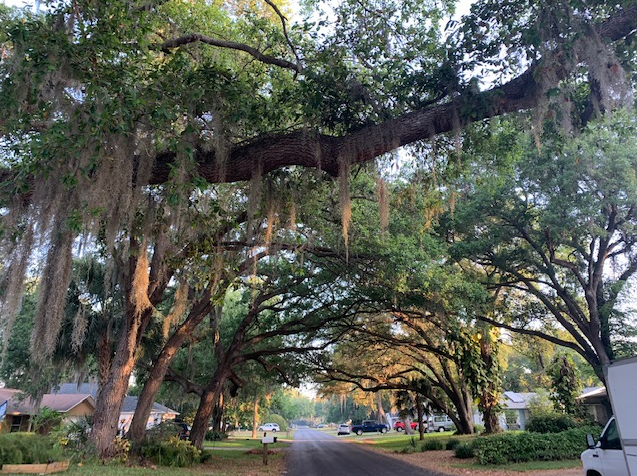
Oak trees with Spanish moss in my Florida neighborhood
I don’t like where I live, and I would love a few hills to climb, but whenever I get out and take a walk, I try to enjoy the scenery. My neighborhood has some very big and beautiful oak trees. They are not like the New England oaks I knew, witch had huge leaves that dropped late in fall for me to rake. These oaks are filled with Spanish moss and have long, crazy limbs. Those are called “Live Oaks”. But Florida has many types of oak, and I am not familiar with them all.
New Hampshire roads are where I’d love to be walking. The photo below was taken on my trip and I had walked up this road past huge, beautiful farms and homes. Walking here is so much better. The air is clear and the views are sweet. But for now I deal with what I have. Moving is the most important thing, so I need to go take a walk.
If you are at home more these days thanks to the Coronavirus, you may need to find a hobby to stay busy. How about knitting? Knitting is not just for Grannies! There is much to learn, which means your brain can be challenged for years learning new knitting techniques.
Even if you don’t have someone to teach you, YouTube videos can be a huge help. Getting started is the first step, where practicing on easy projects leads to bigger and better knits.
I’ve written this page with the beginner knitter in mind, with advice for yarn, needles and free project links. The best projects to begin with when learning to knit are simple back and forth projects. You knit one row, turn the needles and knit the next row – or purl.
When I lived in New Hampshire I knit scarves. I would cast-on and just go, trying out various stitches along the way to see what happened. I would cast off when the scarf was long enough. But a better idea is to knit smaller projects that are useful, like cloths for the kitchen and bathroom.
Hand-knit cloths hold up well.
Let’s begin with an easy project, such as one of the dishcloths or facecloths below, which are knit with one color – or a variegated color. Whenever you knit something that will be used to wash with, choose a washable cotton yarn. Cotton yarn will be absorbent and easy to care for, going into the washer and dryer.
Here are some ideas for beginner projects with FREE patterns you can download at Ravelry. Join Ravelry (it’s free) if you plan to do more knitting because it can be a wonderful resource for patterns and help. You don’t have to be a member to get these patterns.
They use little yarn, so are inexpensive to make and in the end, you have a useful item. If it has some mistakes, who cares? This is a great way to practice without worrying about boo-boos.
Seed Stitch Washcloth – knits and purls create a nubby fabric. personally, I love this stitch and it’s great practice for doing both of the most basic stitches in knitting.
Your Own Design: Knit a few rows and purl a row – or knit all rows. Make something up until it becomes the size you want. I have links below for help with CASTING ON and BINDING OFF.
Buying Cotton Yarn
Lily’s Sugar ‘n Cream Cotton Yarn – comes as single, affordable skeins, in sets, or on cones. They offer a huge selection of solid and variegated colors. Search Amazon (they have all types) and order online, or go to a local craft store such as Michaels, Joannes, or Walmart. This yarn is easy to find.
Key West Karribean Kotten Yarn – The blue and orange striped dish cloth in my photo below is made with this yarn. The colors are super bright and don’t seem to fade as quickly as the other cotton yarn. It does cost more, but I love the quality. This cotton yarn is perfect for making kitchen towel gifts!
Karribean Kotten – comes in tropical colors
Needles, Types and Sizes
Straight needles are fine to use for little knitting projects. I had some of my grandmothers old straight needles and I used them when I began. But then I discovered the versatility of circular needles, which is what I mostly use these days.
Circular needles can be used like straight ones. Just pretend they are not connected! Turn the work each time you begin a new row. Once you begin to knit projects in the round, circular needles are needed and you will already have them. So my advice (if you have NO needles) is to buy a 16 inch (length), needle size 5 to 7 US to use to knit your washcloths. Chiaogoo Red are favorites of mine. Later on you can use that same needle to knit hats – most hats (unless they are for babies) are made using 16 inch needles.
Knitting needles come in various lengths as well as needle sizes. Tiny needles such as 0 – 3 or 4 US are used to knit tightly, such as for socks and mittens and / or when using lace and fingering weight yarn. Larger sizes will be used for heavier yarn weights and for knitting sweaters, hats, and bulky items.
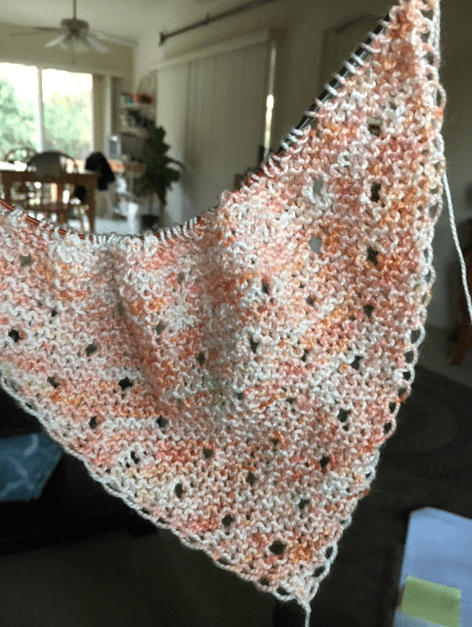
Beginning the Dewdrops shawl pattern
The Dewdrops shawl above is knit on a long, circular needle. I began knitting at the very bottom point, with only a few stitches. As I went on, more stitches were added and I needed that longer needle. Straight needles are too short to hold that many stitches.
How to Cast-On and Bind-Off
Once you have found or purchased your needles and cotton yarn, this is how you get started.
A simple cast on begins with a slip knot on the left hand needle. Then you will begin adding stitches – as many as the pattern calls for. That is your cast-on number and everything you make requires some type of cast-on. You will “cast on” as many stitches as are needed to begin knitting. The project will always become bigger than your cast on looks!
The video links below are some good ones I found. If you want to search for other cast-ons at YouTube, be my guest. There are many.
There are many ways to cast-on, but all you need is the basics when beginning. I now use the Long-tail cast on, or the Norwegian Cast-on (aka German Twisted cast-on) because it’s faster, but for a long time I did this simple, basic cast-on. The others are more complicated, but you may like them.
From there, you begin knitting the pattern, or your rows of knitting as you choose if you are not following a pattern. When you finish all your rows, you must bind-off to finish the project.
I like Purl Soho’s videos because they get right to the point. Also the teacher generally uses larger yarn and needles that make it easier to see what’s going on. Purl Soho also has many FREE patterns on their site, where they also sell pretty yarn – including cotton.
Once you know how to begin a knitting project, you either make up your own pattern / stitches as you go, or follow a pattern. Below I list links to videos showing the two basic stitches needed to create many patterns, the knit and purl stitches. You can do a lot with just these two stitches.
Anytime a pattern calls for knitting, this is the stitch you do. It’s the base for all knitting projects. These show English forms of knitting where the working yarn is held in the right hand.
Many knitters dislike doing the purl stitch, but it’s not difficult and you will need to do it a lot if you choose to create anything with the “seed stitch” pattern. Purl stitches add texture as well. You can knit one row and purl the next to make the stockinette stitch. Doing this will create a smooth fabric.
Fun With the Knit and Purl
It is easiest to knit a few rows right after the cast on. From there, try some purls. If you alternate a row of knits and a row of purls, you will end up with stockinette.
In my little cloth samples below, I played around with these two stitches. I suggest you search YouTube to find beginner videos. Many knitting sites have loads of advertisement clutter to wade through to get to real information.
My Own Beginner Samples
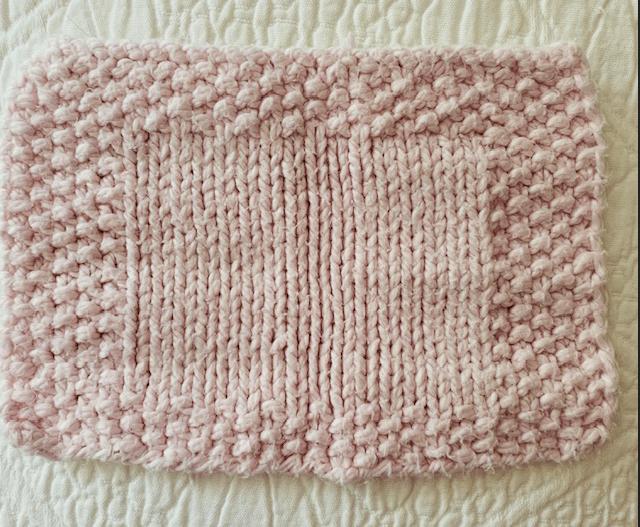
Here are a few of my knitting samples. They are not beautiful, but they gave me practice. To leave a center “flat” area, knit a few rows back and forth – this means to do all knit stitches, for a few rows (4 or 5). On the next row, knit 5 and purl until 5 stitches remain, then knit those five. This way you are making a textured border with center flat (stockinette) stitches.
Center stockinette
On the white cloth I did some alternating knits and purls along the bottom and top borders. In the center I did seed stitch, also called moss stitch. Seed stitch is simply K1, P1 – switch off continuously across each row, but alternate row by row. First center row: K1, P1 (you need an even amount of stitches.) Second row: P1, K1 – your purls will be over the knits and knits will be done over the purls. It creates a pretty little texture.
Seed stitch or moss stitch
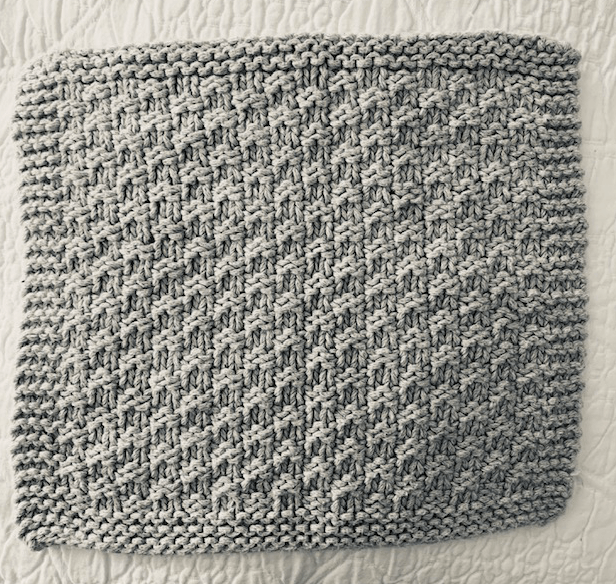
On the gray cloth I made the same type of knit border and then for the center I knit 2 stitches, then purled 2 stitches (K2,P2). On the next row I did the same thing so the stitches lined up. On rows 3 & 4, I did the opposite (P2,K2). This is a double moss stitch.
Two knits and two purls
As I knit my little cloths, I used various types of yarn. I honestly don’t remember what they were! I still make little cloths because nighttime knitting for me needs to be simple.
Want Something Bigger to Knit?
If you are not interested in little facecloths or kitchen items, check out my page on free shawls. You may never feel the need to wear a shawl, but they are popular choices in the knitting world AND the easy ones are great practice for beginners.
Try your hand at adding new colors and using variegated yarn on the Scrappy Bias Shawl. Learn what to do to make lacy holes appear in rows when knitting the No Fuss Shade-Loving Shawl.
I’ve caught the mitten knitting bug! As I write this the temperature here in Florida is 88 degrees (says the app on my phone) but it feels like 101…! What? I don’t think that is correct, but the humidity here can really spike the “real feel”. My AC is not on, so I don’t think it feels like over 100. It does feel like 88 though.
Even so, I am knitting on my second Glissade mitten beneath the ceiling fans. Once it is done, I will begin the Fiddlehead mitten pattern. Because it will be knit in the same DK yarn (Brooklyn Tweed Arbor), I have an idea of needle size to use.
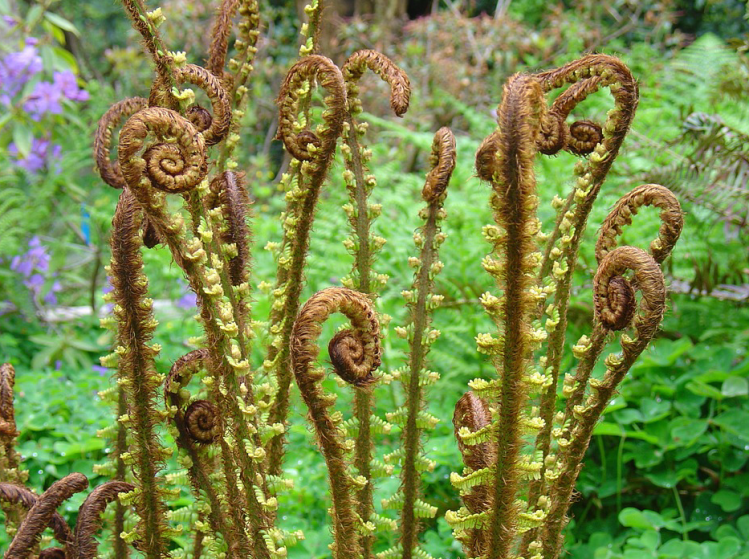
Fiddlehead fern
Fiddlehead Cast On Changes
The suggested needle size sounds quite big for such a large cast on number of 60. The Fiddlehead mitten pattern calls for a lining to go inside the mitten, and I want to avoid that. So I went down to a size 2 needle, and I am a tight knitter.
A different cast-on
I tried the suggested i-cord cast on – which took forever – and I didn’t like it for my purpose. So I began over, and used the Latvian Braid. The i-cord is probably used because stitches will have to be picked up inside the cuff to add the liner. Since I am not knitting a liner, I changed things.
Mitten gauge is hard to judge unless you’ve knit a lot of different mittens and know which sizes works for each yarn weight. I recently knit the Glissade pattern and used a size 3 and 4 needle, but the cast-on number was only 48, not 60. I knit with this exact same Arbor yarn, so I knew if I used a size 3 or 4 with a 60 stitch cast on, these mittens would be huge!
Now that I’ve knit this far along, they still seem slightly large, but should be okay.
DK Yarn and Colors Used
I loved, loved, loved the yarn I used for the Glissade mittens. It was my first time using Brooklyn Tweed’s Arbor yarn and it’s a new favorite. Need some nice DK yarn? Check it out. The link takes you to Wool and Company, and they ship free to US locations, with NO minimum order! Arbor comes in many colors, but I knew I wanted greens, because this is a fiddlehead pattern after all!
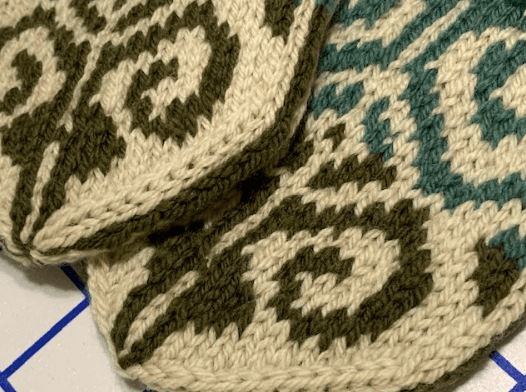
For the background color I chose Degas, which is a light tan. Then I chose five shades of green for each section of the pattern. Color names are: Dorado, Treehouse, Wreath, Lovat, and Parka, with Degas as the light color for the background. Very pretty yarn and colors, and a few are now discontinued.
Five green shades
Whenever I put stitches on hold, I always have a tough time picking those stitches back up again. This time I put the thumb stitches on hold using two different strands of yarn. I’ll use a very small size needle to pick them up, which may help. Then I can slip them onto the correct size DPN.
Thumb stitches are put on hold
Finished the hand, and it fits nicely
I have now reached halfway on the second mitten without doing the thumbs. I will do both thumbs last. These will not be done in time for the KAL with The Woolly Thistle, but I have already finished Glissade for that.
I am very happy with this pattern and the colors I chose – Dorado, Treehouse, Wreath, Lovat and Parka, with . Even without a liner, the knitting is quite dense and should keep hands warm.
Working on second mitten
Brooklyn Tweed Arbor DK yarn
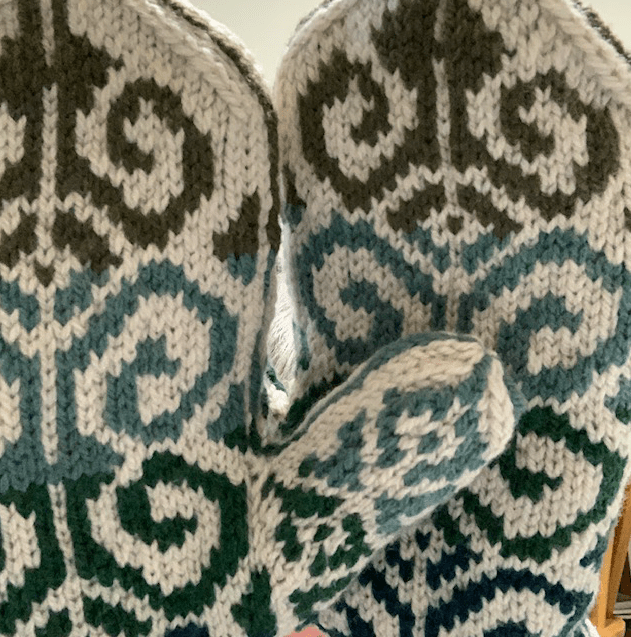
Got some pictures today of my finished “Fiddlehead” mittens. I love the way they turned out. Fantastic yarn, good pattern (although chart printing is small – and the called for cast on takes forever – I didn’t do it), and best of all, they fit me perfectly! Those thumbs took some patience, but I am not used to doing colorwork. I’m also very happy with the colors. Possibly I will knit a hat inthe future to match in order to use up the rest of the yarn.










 New England's Narrow Road