
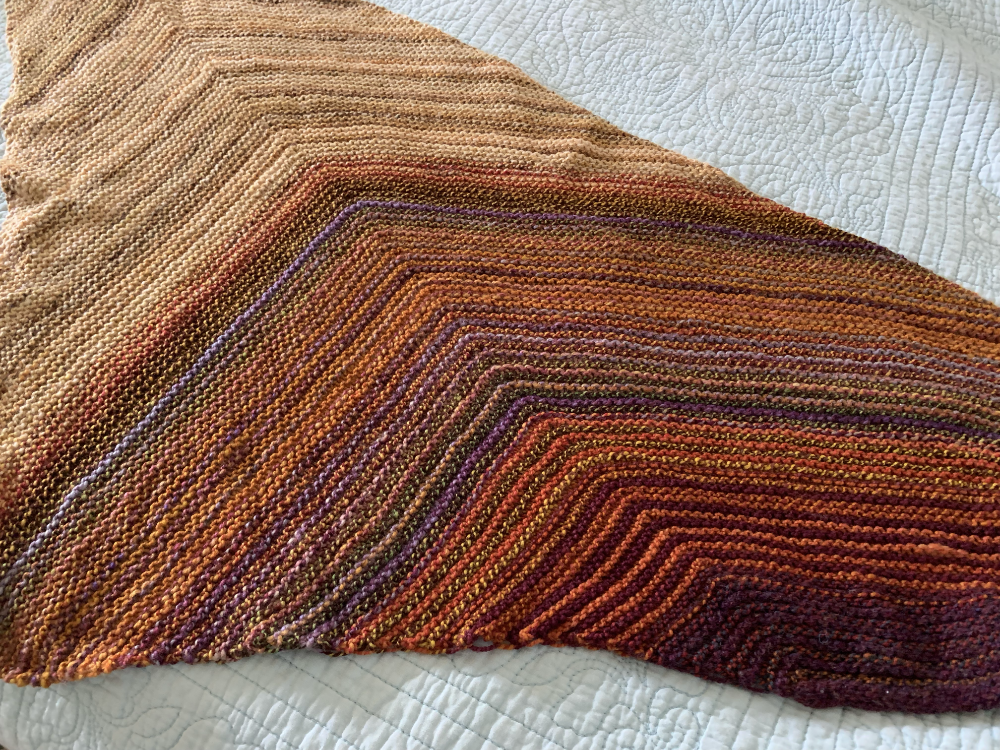
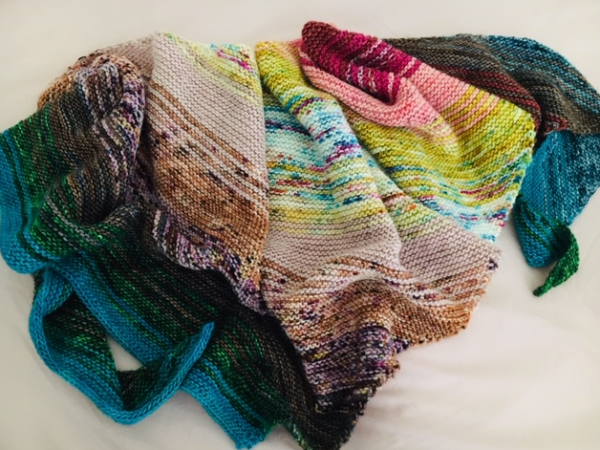
I knit this scarf back in 2022. It was offered as a free pattern by Lindsey Wong. The pattern came from her website, which is no longer up and running.
I’ve written a post about alternative and similar patterns for those who are interested, but none of them are free.

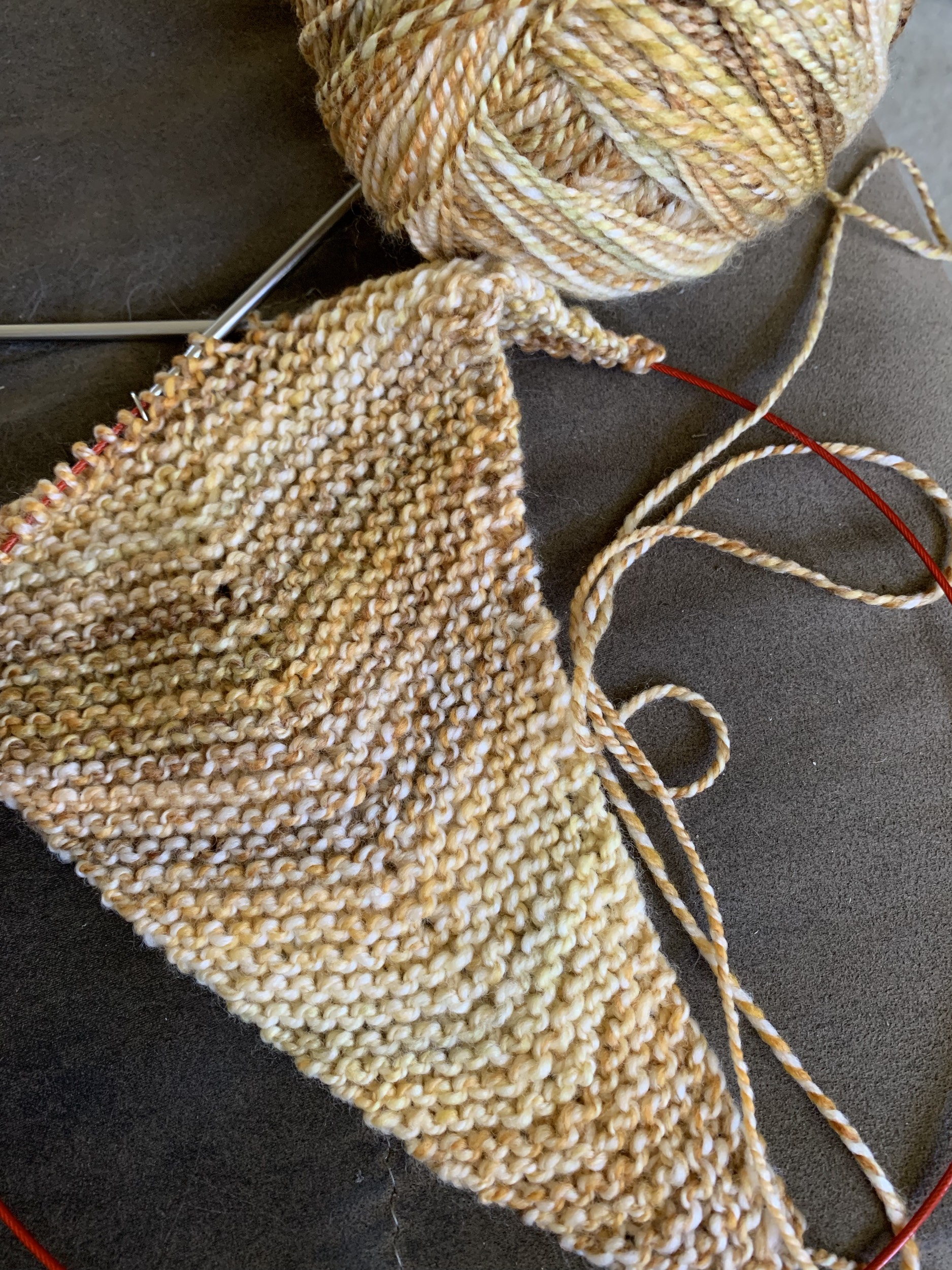
I have a few partial skeins of hand-spun and began knitting this pattern with the yellow, “coconut” – I think was the name. I knit until it was gone and then began alternating two different balls of hand-spun which gave a good color combination.
This pattern begins with a short cast-on at one end of the long triangle-shaped shawl, and expands outward. Once the center diameter is reached, the decreases are done on one side.
Because I was not using full skeins, I really didn’t know when to begin my decreases. I also don’t know how much yarn I used in total, but see the pattern for suggested yarn amounts.
My Shawl Knitting Notes
This is an easy shawl that should be fine for knitters who are just beginning their knitting journey. The cast-on begins on one end and the knitting expands outward until the widest part. Decreases along one side continue to create the other side of the triangle.
There is no purling, just garter stitch – knitting back and forth. Create increases and decreases for shaping. A self-striping yarn or solid color would work.
Stitches to know: K2tog (knit 2 together), SSK (slip, slip, knit). These stitches are in the center to create the angle. Kfb (knit front and back), are done at the outer edges to make the scarf wider.
One stitch marker is needed.
I used a size 6US, 32-inch circular needle.
I can’t remember how I knit this scarf, but that center marker is where the decreases are done. This creates the “V” in the center. To offset those two decreases, increases must be made at the outer edges. However this is not done on every row. There must be rows where only the increases are made. I suspect the rows alternate with edge increases made every row, and decreases made every other row. I’m guessing.
When the scarf becomes wide enough, decreases are made on one edge, while increases continue on the other. When the decrease edge meets the center, the scarf is done.
Savvy knitters may be able to figure all this out.

This lovely little shawl could be knit with any type of yarn. Just make it to the dimensions needed using an appropriate size needle.
The end measurements of my shawl are 58 inched long and 21 inches at the widest point. This ended up being a good size to wrap around my neck.




More scarf patterns to Knit
More knitting pages to read…


Share this:


I absolutely love this blog. Just found it, need to follow and learn as well as admire all the beauty.
LikeLiked by 1 person
Thank you! Glad you found me. Happy knitting… 😉
LikeLike
Great blog! I just discovered it by accident!
LikeLiked by 1 person
Thank you! I’m so glad you’re here… 😉
LikeLike