Practice Knitting a Cardigan, Tips for Beginners

If you are like me, sweater knitting is frightening. I’ve knit two now and I’m still intimidated by knitting a large project. For so long I checked out the forums and blogs and knitwear designer sites and would be amazed that people could create such things from strands of yarn. They all seemed so intricate and large! I doubted that I could get through the pattern directions and balked at the word “charts”.

The First Dumb Thing I Did

Not the first dumb thing I ever did, but this shows what a complete beginner I was. I bought a book of cute baby sweaters thinking that smaller would be easier. Not! As I looked through the pages of instructions – for knitting one sweater – I realized my mistake. I’d never be able to knit any of the sweaters in the book. Not until I advanced my knitting skills.

FYI – smaller projects are not necessarily easier. You probably know this, but just sayin’ for those just starting out.

Finding a Beginner Sweater Pattern

I needed to find a beginner sweater pattern, but I was having no luck. The patterns I found either were not my style or did not look easy to me. Of course I had never knit one, so what did I know? The second thing stopping me was the yarn. Lots of yarn is needed to knit an adult sweater and that equates to cost. I was very unfamiliar with types of yarn and getting gauge. I wondered what I would do with 5 or 6 skeins of yarn if I couldn’t manage knitting a large project?

Arranmore tweed in Finnegan yellow
Sweater yarn, Arranmore tweed in yellow

Basic needs for knitting any sweater

  • Long, circular needles in correct size for gauge.
  • Double-pointed needles / DPN’s, for sleeves – or a 16 in. circular will sometimes work.
  • Stitch markers
  • Yarn – washable / non-washable? Or use the exact yarn called for in the pattern. And waste yarn to hold sleeve stitches.
  • Ruler, darning needle, and scissors
  • Know how to cast-on, bind-off, put stitches on hold (sleeves), increases, decreases, possible shaping (German short rows).

As I did with my first (and only, so far) mystery knit-along (MKAL), I had to jump in. I found a pullover pattern I liked (the Umpqua sweater), bought it, got some yarn, and began. I think I chose a pullover because I wouldn’t have to mess with buttons! I don’t know if I would call this a beginner sweater, but I managed to finish it and although it’s pretty large (that gauge thing) I can wear it. My second was a cardigan – the Fine Sand pattern. I posted my knitting notes on these links, which might be helpful.

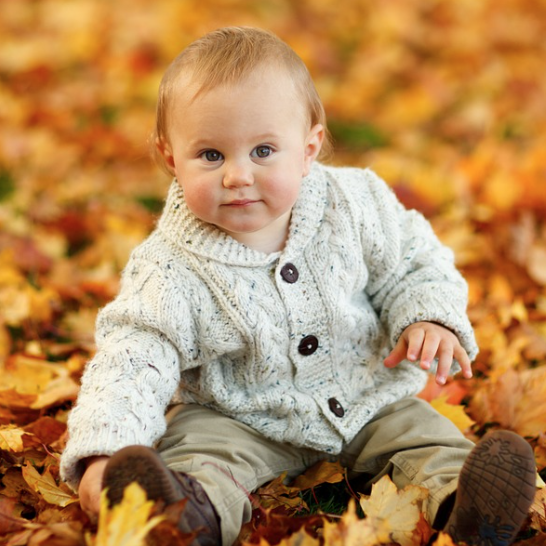
Tin Can Knits has a lovely and very helpful website and they offer a free beginner cardigan knitting pattern! How nice is that? I wish I had seen it during my search, but I’ll share it with you now.

Harvest Cardigan by Tin Can Knits – It’s Free!

The three best aspects of knitting this sweater are: It’s a free pattern (and it’s cute), you can knit a very small size (save money by using one skein only), and there is a page of tutorials which give good explanations, photos, and links to more help if needed.

The Harvest Cardigan has no buttons to deal with either (TCK has a great page on button bands too for when I get brave). The link to the tutorial page is at the bottom of the sweater pattern page – bold link above. So I looked at the tutorial page and wow, it does not seem like a beginner sweater to me! First you must do a provisional cast-on, which in itself is not difficult, but you have to pick up those live stitches later, which is where I have my problem. There is a lot to learn for those who truly are beginning, and that can be a good thing. Sometimes we just have to jump in…! Or start with some of their simpler free patterns and work up to the sweater.

cardigan sweater knitting

Free Bundle of Patterns by Tin Can Knits

The Tin Can Knits site offers a bundle of free patterns called The Simple Collection, and they reference it on the Harvest Cardigan page (or click the link I made). They call the collection a “step-by-step learn to knit program” and offer 12 free patterns which include a scarf, cowl, hats, mittens, socks, sweaters and a shawl. I highly recommend this site. They show off their knitwear on the cutest kids too! Recently I knit a pair of their mittens, which was also a free pattern.

More of My Favorite Cardigan Sweater Patterns

I have not knit any of these sweaters yet, but they are saved as some of my favorites to try. Currently I am focused on Christmas knitting and smaller projects and for the time being I am giving up shawl and big project knitting.

But here are some you might like, and they don’t look too difficult. The patterns listed below are not free.

If you are a member of the Ravelry site it will be easy to see all the sweaters other knitters have made following these patterns. Also read their notes and view the yarns they used. This is helpful especially if you have trouble visualizing, or selecting, a color for the project.

Miss Babs “Tea Party” Yummy 3-Ply Yarn

Quite a while ago I bought a skein of Tea Party yarn from Miss Babs. This one is sport weight and is one of the Yummy 3-Ply yarns offered at Miss Babs’ site. I bought it because it was pretty, and I don’t have definite plans for it yet.

Miss Babs Tea Party yarn

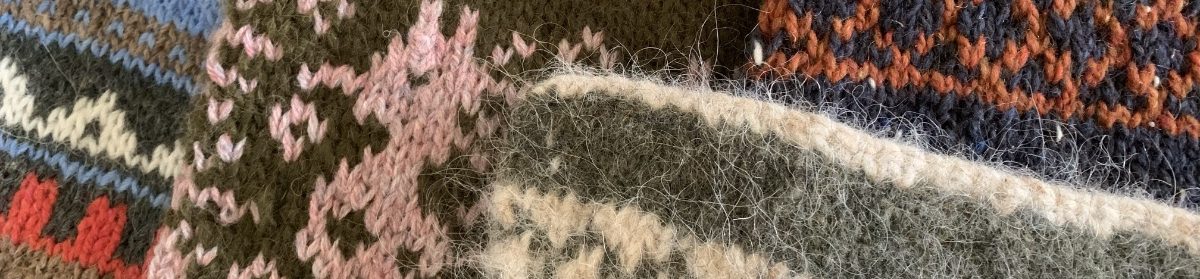
Before I wound it up, I took some photos of the various colors that can be seen among the strands of yarn in this lovely color way. “Tea Party” must be popular because it is currently sold out / out of stock in many of the yarn weights offered by Miss Babs. I hope it comes back because I love it.

color section of Tea Party yarn
bright pink of Tea Party yarn

Below is a little swatch where I played around with some stitches and used “Tea Party” with “Deep Sea Jellyfish” which is also a Miss Babs yarn in Big Silk worsted weight.

Tea party and jellyfish yarn
Swatch with Tea Party and Deep Sea Jellyfish

I don’t know what I will knit with this yarn, but I’m considering a scarf with both the bright pinks and purples of Jellyfish and the more subtle speckled white of Tea Party.

Learning About Plies in Yarn

I’ve been relatively clueless about plies of yarn. Probably like most beginner knitters, you jump in and buy because of color!

And….Sale yarns… don’t you hate them? They call to me and say “What a deal! Too good to pass up!” And yes, I am a sucker. Without any idea what on earth I will do with the beautiful bargain yarn, I buy and stash and hope some wonderful pattern will spring to mind.

When I purchased my latest deal yarn, I was hoping to knit a baby blanket. I wanted “baby” colors and since there is no baby on the way in my family, a neutral color would work best. I also wanted to try my hand at a “center out” blanket, because they look so cool (not so easy to begin). Also I would be learning a new knitting skill.

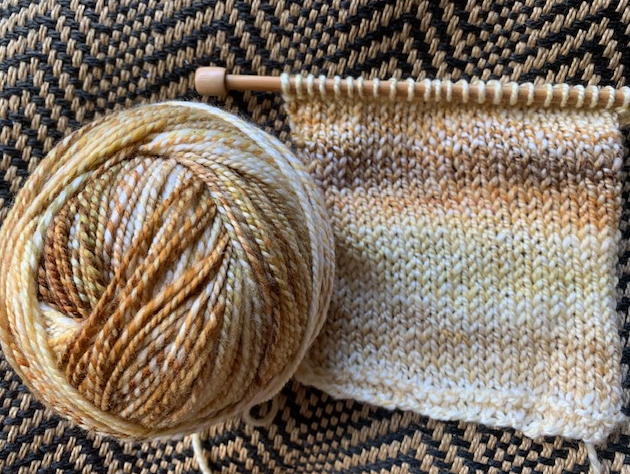
Mrs. Crosby single-ply Satchel yarn in color way Dogwood
Ball of single-ply yarn by Mrs. Crosby

The super-sale yarn I bought the other day is a single-ply by Mrs. Crosby in an off-white mixed with other pastels colors. The type of yarn is Satchel, color name is Dogwood. I am not really thrilled with the color, but I am knitting up a swatch. I had recently made a little baby hat with animals using a similar sock yarn by Madeline Tosh and did not like the outcome. I think it’s safe to say I don’t like single-ply yarns. Or maybe I just don’t know how to use them.

Vogue Knitting book
My new Vogue Knitting book

I now own the new, hardcover, Vogue Knitting book and I love it! (I bought a used edition on sale and it’s like new!) Already it has helped answer some of my knitting questions, and it’s just fun to read. Unfortunately it really didn’t help much with how to choose a ply. It did describe plies, but there were no suggestions for choosing single, double, or more plies for knitting – not that I have found anyway.

Help With Choosing Plied Yarn

Plies are single strands which are twisted together to give strength to the yarn, so the more plies, the stronger. Am I correct? It seems to make sense. I understand what plies are, but not how to choose the number of plies for projects.

Since there is usually such good yarn places online to find information I went to Mason Dixon Knitting and found a wonderful explanation of ply! She even uses the Mrs. Crosby yarn as an example of single ply, and she knits up swatches to compare single, two and three ply yarns. It was a fabulous article.

After reading the explanation, it appears that 3-ply yarn is the best for stitch definition and performance. Sometimes yarn descriptions simply say “plied”, so what then? If yarn is made from three fibers, they would be 3-plied, I assume. I will keep learning.

Free Knitting Patterns, Are They Worth It?

As a beginner knitter, I have searched for “free knitting patterns” to get a feel for stitches, directions and charts. Why would I want to spend money on a pattern that I can’t comprehend and knit once it is downloaded? For beginners, free is probably best to start with.

So is knitting something that is free worth it? Well, yes and no. Be careful where you find those free patterns.

A warning here is to try to find well known knitwear designers who sell patterns but also offer free ones. They care about their patterns because it’s a business for them. Offering free things could very well lead to purchases done the road.

Or, choose a free pattern that has already been knit a lot and has great reviews.

I do understand that starting out we beginner knitters have NO idea who the knitwear designers are. And where do we find reviews and comments on patterns?

This is where Ravelry – an online knitting (and crocheting site) can be a huge help. If you can ignore their politics, it’s an enjoyable place where I’ve learned so much.

My First Hand-knit Shawl Was a Free Pattern

My very first shawl was a free pattern from a designer who offered it with the stipulation that I sign up for her e-mails. The shawl was good practice for me, with wonderful directions, it and brought her a follower. Below is the Spindrift Shawl (a free pattern and my first shawl knit) by Helen Stewart. I still get her e-mails.

Spindrift shawl
My first shawl knitting project

That is not to say that many free patterns work out just fine. Usually they are fairly simple and closely match other free patterns of the same type. Sometimes knitters just like to share something helpful with other knitters.

The Scrappy Bias Shawl (below) is one that gets a lot of knitter’s attention. It is easy knitting and fun. The Honey Cowl is pictured at the beginning of this page, and it is a free, one or two wrap, cowl.

colorful scrappy bias shawl
Scrappy Bias shawl – completed!

For beginner knitters, using a free pattern can be very helpful. Usually they are simple patterns that give us good practice and cost nothing but the yarn. A great place to begin is with Tin Can Knits. I sure wish I had found them sooner in my knitting adventures. They have an excellent bunch of tutorials and a page full of free patterns such as hats, sweaters, mittens and more, for all ages and sizes. Below is my Playdate Cardigan.

Playdate cardigan in size 6-12 months
My experience knitting the Playdate cardigan

Purl Soho

One very good place to start, if you want clear knitting directions, often with video tutorials, is Purl Soho. They sell beautiful yarn, and offer many types of patterns for free! It is one of the first places I found for free things when I began searching. From simple hats and housewares, to sweaters and ponchos, this is an awesome site for free designs and helpful insights.

Beware that some of their pattern stitches are quite advanced, and those wraps and blankets can take a long time to knit.

One place to also find more advanced free patterns (as well as the more simple) is the Espace Tricot collection. They offer a slew of free patterns of all types. The sweater below is one I recently knit.

In closing, I suggest being careful where the free patterns come from. If you begin to knit something that looks good and get toward the end and hit trouble, you’ve wasted lots of time. But, many free patterns are definitely worth knitting.