Creating My Own Mitts Fair Isle Pattern

When I recently traveled to New Hampshire, one thing I wish I’d taken along was a good pair of fingerless mitts. My emerging plan was to go home (to Florida) and begin creating my own mitts Fair Isle pattern.

I’m not a pattern writer, I am a pattern follower. I have no idea how to go about setting up a knitting pattern but, why can’t I learn? I’ve already learned so many things in the past decade which I ever would have imagined would be necessary for life after 50. My brain is working well, and I’ve taught myself numerous new tasks. The best way to do something new and challenging is to jump in!

The Yarn

My favorite yarn for colorwork, or Fair Isle, is pure wool, like Jamieson and Smith, Rauma, and the likes. I’ve used it for knitting Katie’s Kep (twice), Tettegouche hat, and the Keramos Cowl.

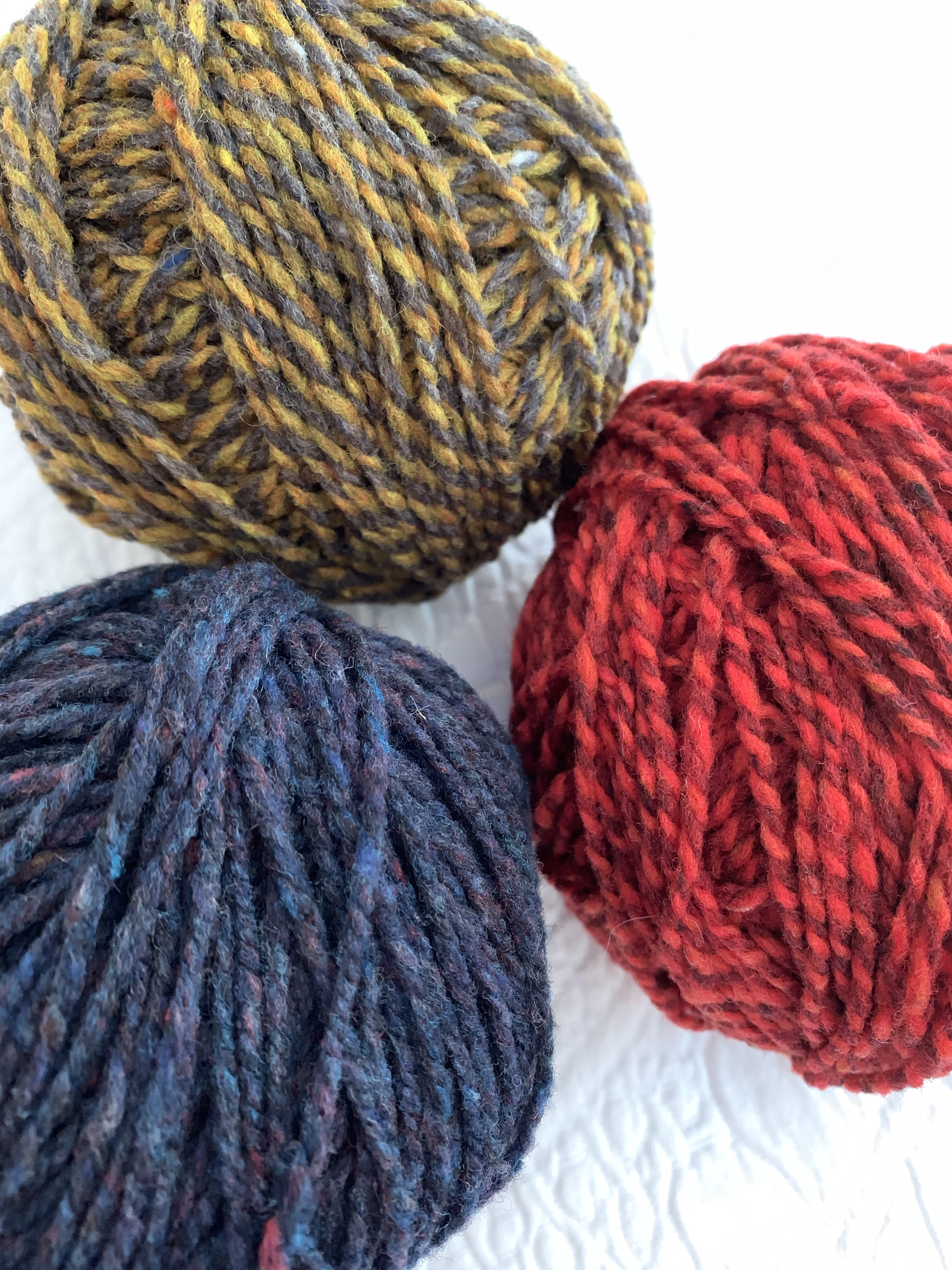
Jamieson & Smith jumper weight yarn comes in many colors and in affordable, little skeins, so I can gather lots of colors without spending a ton of money. (Fairlight Fibers has this yarn at a great price.) I also have a few skeins of Rauma Finull, and Tuku wool.

Knitting in stranded colorwork means using a little of each color, with more used for the main color. Mitts, mittens, socks and hats will use very little yarn compared to bigger projects like shawls and sweaters. I plan to focus on these smaller projects for a while.
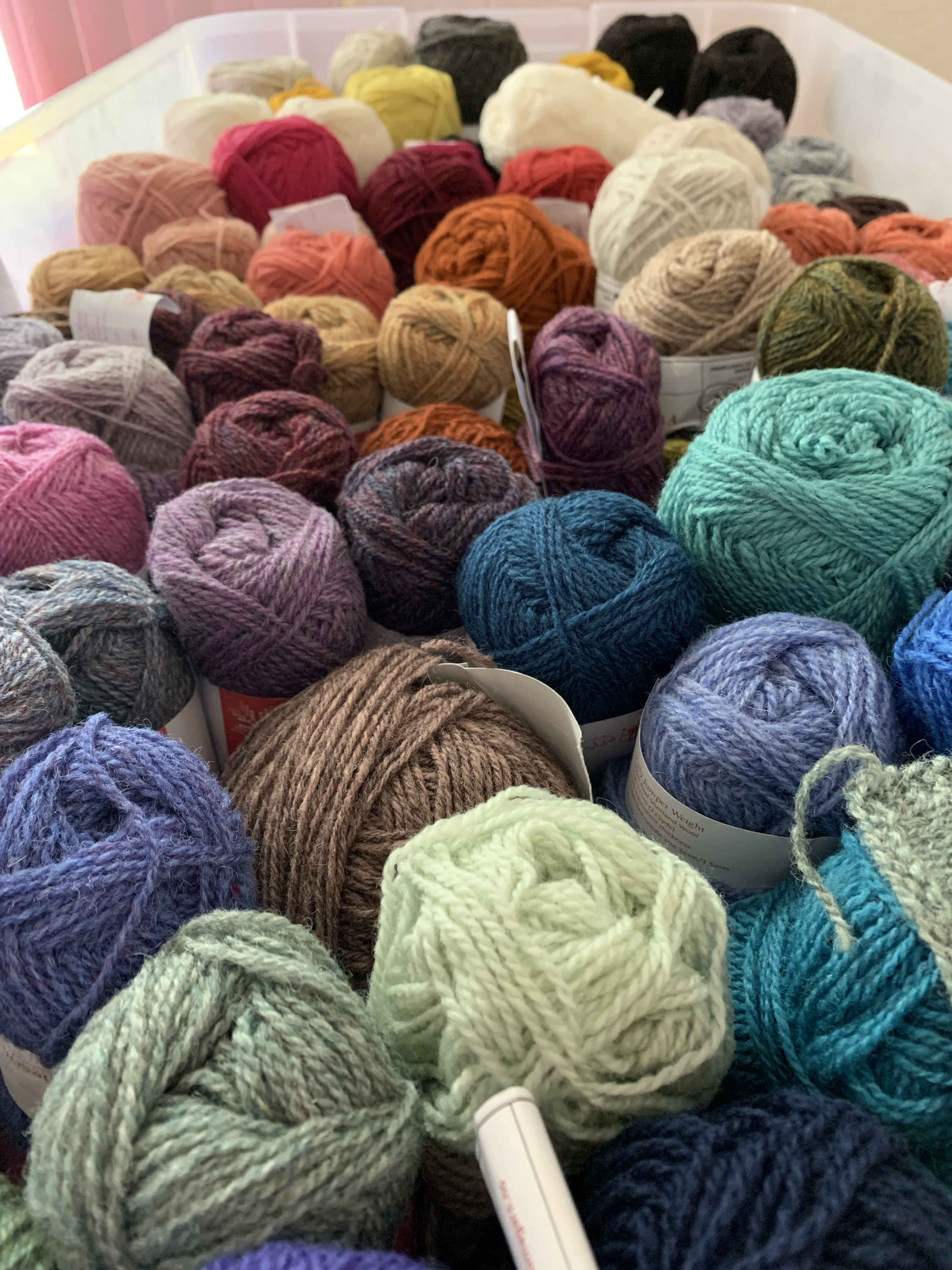
wool, Jamieson and smith, 2ply jumper weight,
Jamieson & Smith 2ply jumper weight / Rauma

Ideas For Getting Started With My Mitts Pattern

The best way to figure how many stitches I will use, is to have a mitt or mitten that is already knit. If I know the count, and that mitten fits me, I can begin my own pattern (for my own personal use) with that number of stitches. This works as my gauge.

The Hedgerow Fingerless Mittens (Ravelry page) is a FREE pattern offered by Mary Ann Stephens. I considered knitting this one first. Knitting up a free pattern would be a good place to start when creating my own mitts.

Although I like the Hedgerow mitts, I chose to knit a free pattern called Fair Isle Mitts. I was happy with the outcome and loosely based my own mitts pattern after that one.

Planning the Cuff

What I like about these mitts patterns is that they have a fairly short cuff. I don’t like a long cuff going up my arm for something like this. These mitts will be used for in the house when mornings are chilly, or when the weather is not quite bad enough for mittens. No long cuff is needed.

I can begin with a Latvian Braid, as I did in the Glissade mittens. Or I could begin with a corrugated rib as with the Oulu Mitts. A simple K1, P1 rib would work too.

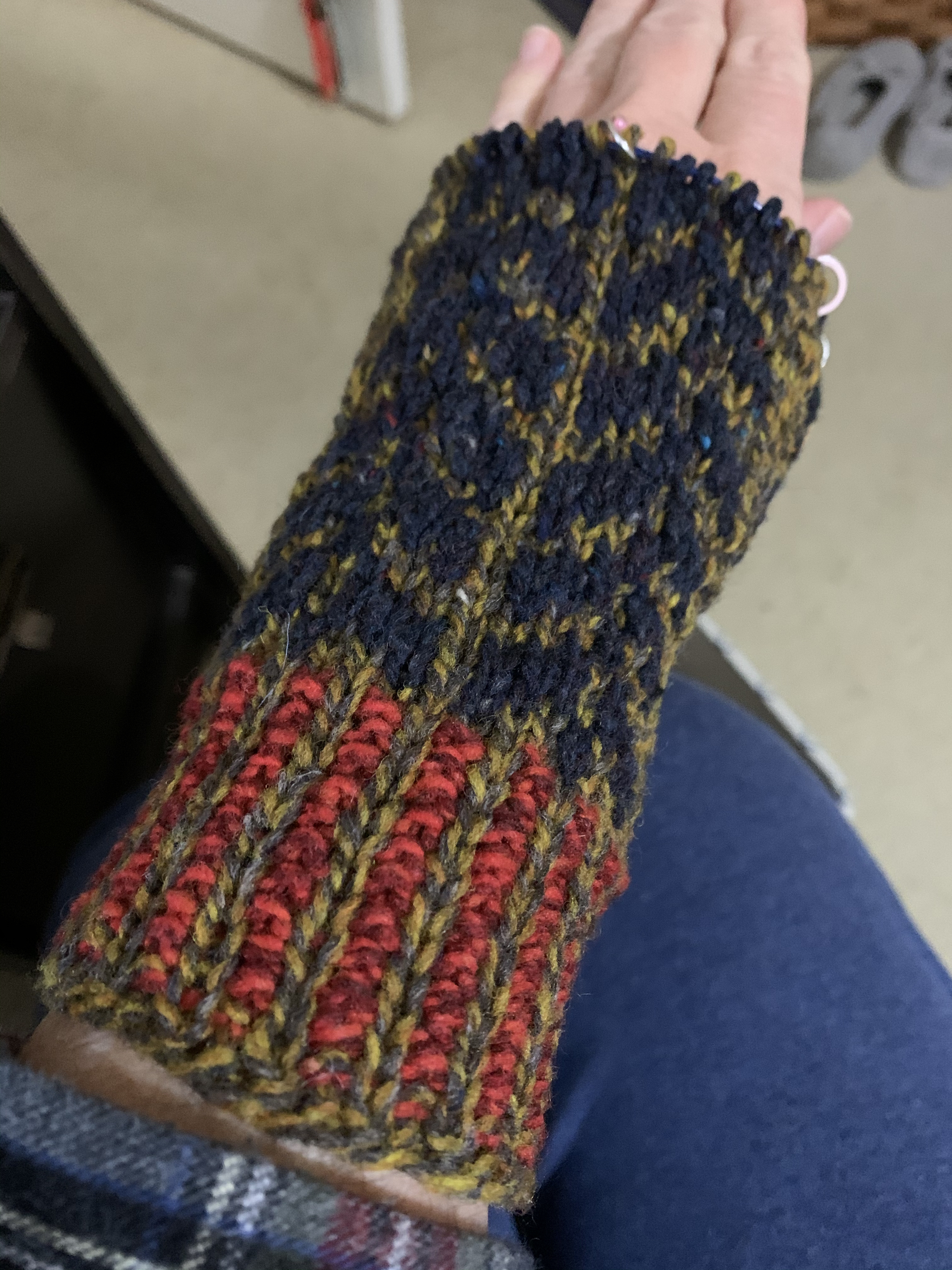
I chose a simple long-tail cast on, then 2×2 rib. I changed color after five rows. I cast-on only 52 stitches, because my daughter has skinny wrists, and then increased to 56 for the colorwork on the hand.

Planning the Colorwork

After knitting the Fair Isle Mitts, I can follow the thumb increases suggested. I needed to find colorwork patterns to follow for the top of the hand and the palm.

My knitting book library consists of some nice examples of Fair Isle graphs. These mitts will be for my daughter, so I’ll look for motifs that would be cute or pretty to appeal to her.

It really helped me to see the design by drawing it out and using colored pencils.

drawing of mitts pattern with flowers in colorwork
Mitt colorwork plans drawn out

I’d like the palm of the mitt to have a small, repeating pattern, and the top of hand to have a larger design. The thumbs could be stripes. It helps to have books on hand which offer lots of little patterns to choose from.

Colors will be purple and green, with possibly another overall base color which is lighter in color.

knitting books fair isle graphs colorwork stranded
Knitting books with Fair Isle graphs

The Mitts Design I Chose to Knit

After deciding on the flower pattern and finding yarn colors I liked, I jumped in and began knitting!

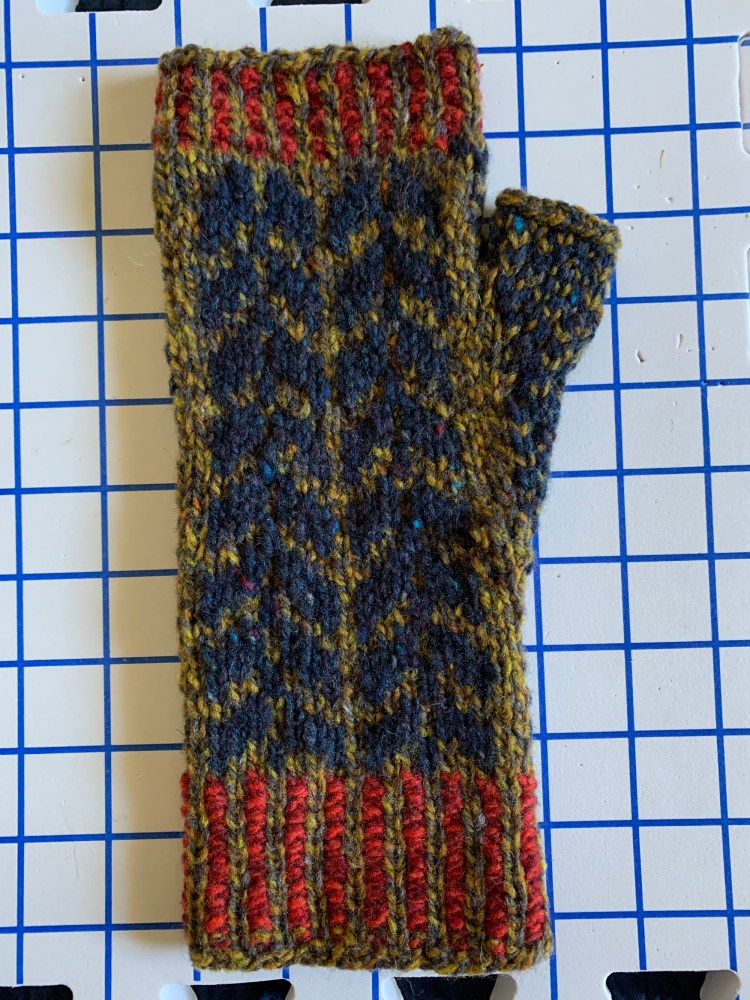
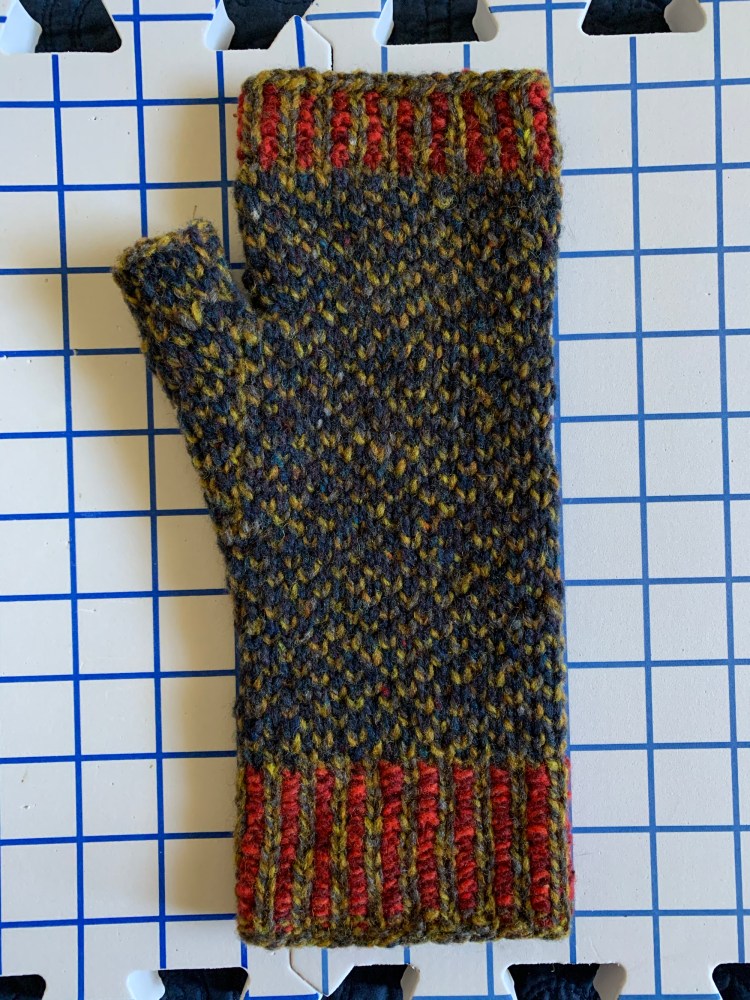
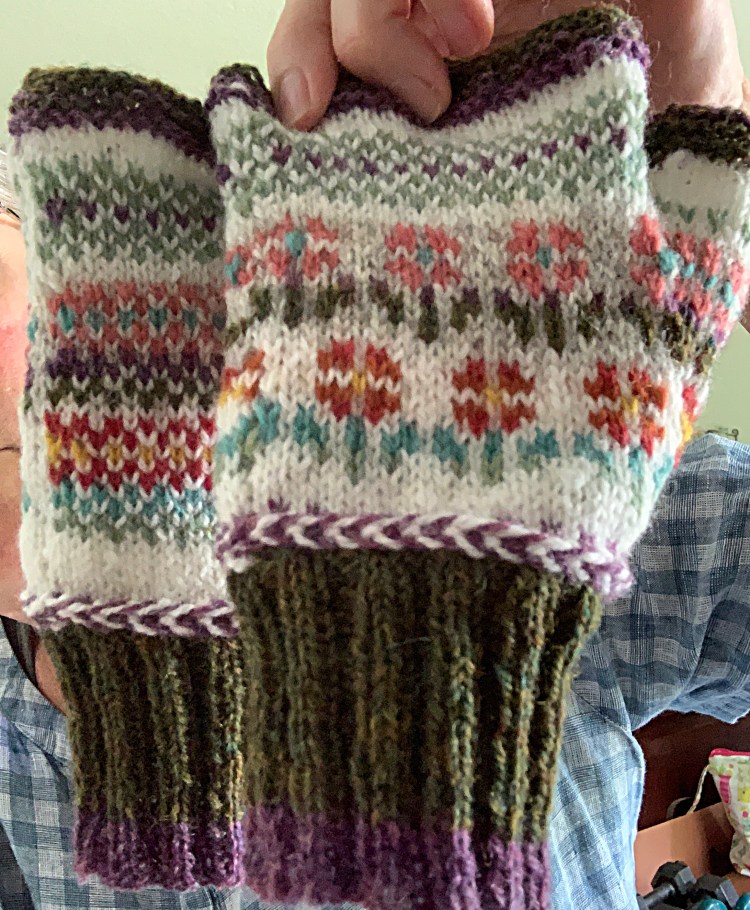
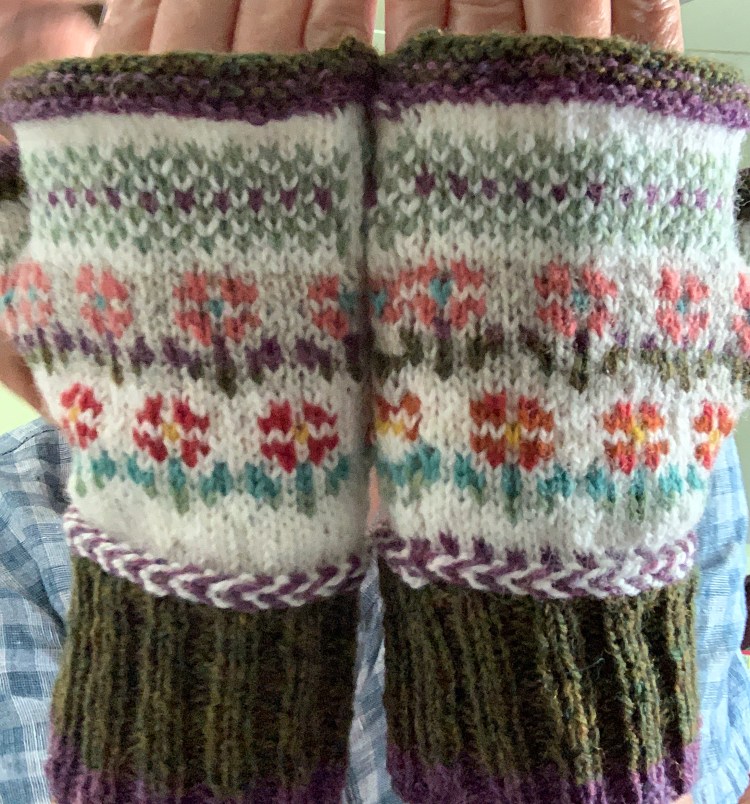
The first mitt I knit was for the left hand. I followed a flower pattern, for the top of hand, came from a book of hats I own. I also did a repeating pattern from another book. I changed that on the Right Hand mitt and gave the palm a pattern of rows with alternating colors.

I just carried the colors as stripes on the thumbs.
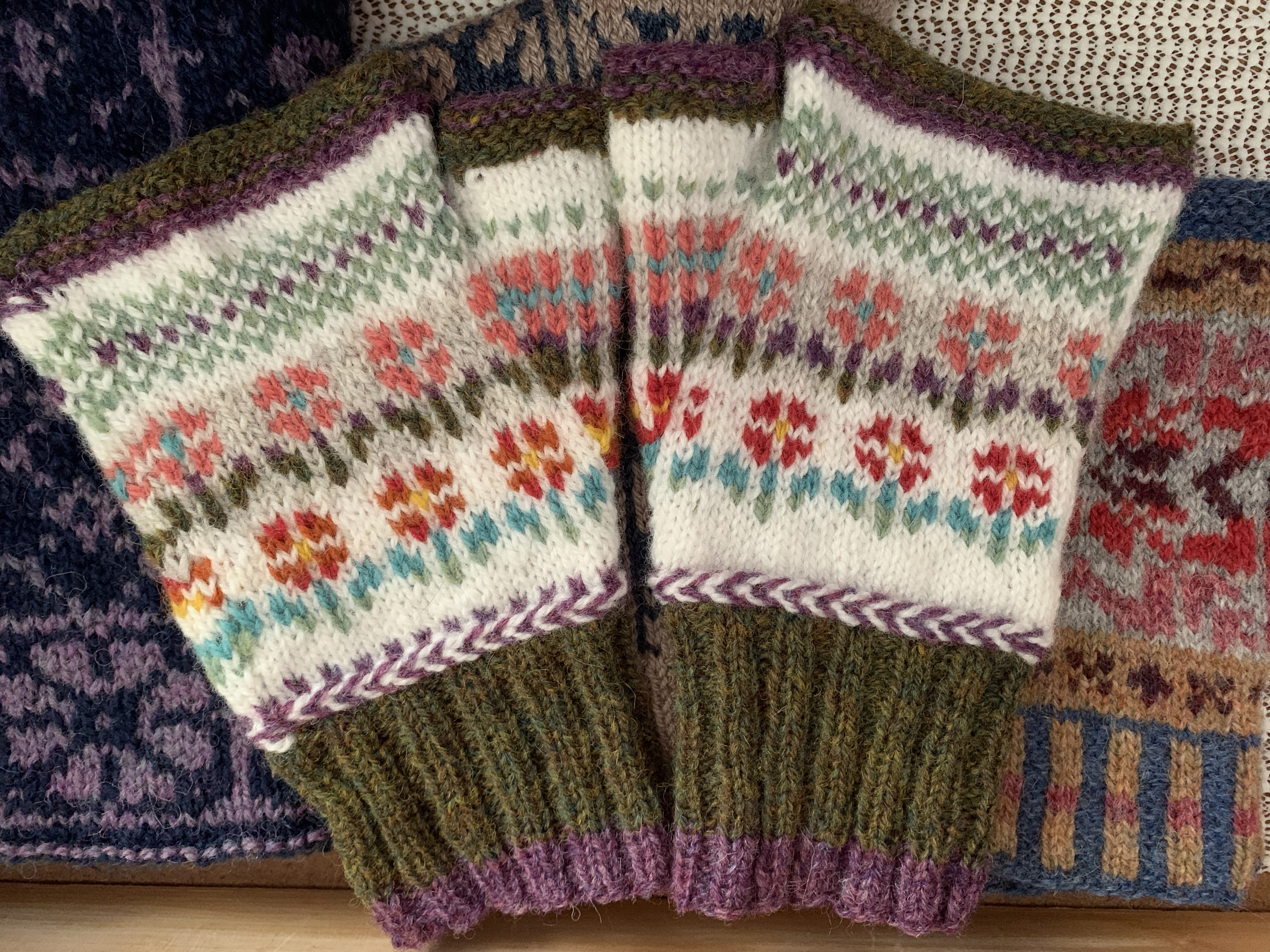
little flowers fingerless mitts pattern
Little flowers on the top of hand

For the second mitt, I also added a neutral line of white up the edge to separate the top from the palm. I did not do a line of alternating color after the braid either. In other words, I changed what I didn’t like about the first mitt.

fingerless mitts palm knitting patterns
Palm patterns are different

Final Words on Knitting My Own Mitts Pattern

The size is good on these mitts and I’m fairly happy with the colors. I learned a few things which I can carry over to the next pair of mitts I knit.

This design is for my own personal use and not a pattern you will find anywhere. The flowers are part of the Peerie Flooers hat in the Milarrochy Heids pattern book. I may have to knit the hat now to go with these mitts.
Keep it Comfy, Knit the Keramos Lined Wool Cowl

Knitting with wool, using two colors, is such fun. This is called Fair Isle, or stranded colorwork knitting. I was hooked after knitting two of the Katie’s Kep hats, and some mittens for a KAL (knit-along) last winter. Now I am knitting the Keramos lined wool cowl using two colors. What I really like about this pattern is that the wool is lined with a softer yarn.

Designers offer sales during the first weeks of TWTCOLORKAL2021 (a knit-along hosted by The Woolly Thistle), so it’s a great time to find patterns with discount codes! It’s how I found a new favorite designer named “Bunnymuff” and used the discount code to buy two of her patterns.

lined wool cowl Keramos knitting
Lined wool cowl

The one I will be knitting first is the Keramos Cowl, which is a Fair Isle pattern with a lining and optional embroidery. I’m entering this one as a project for the KAL, which began February 19th. The other pattern I purchased is a colorwork hat with chickens! My daughter plans to raise chickens soon, and I will knit the hat for her at a later date.

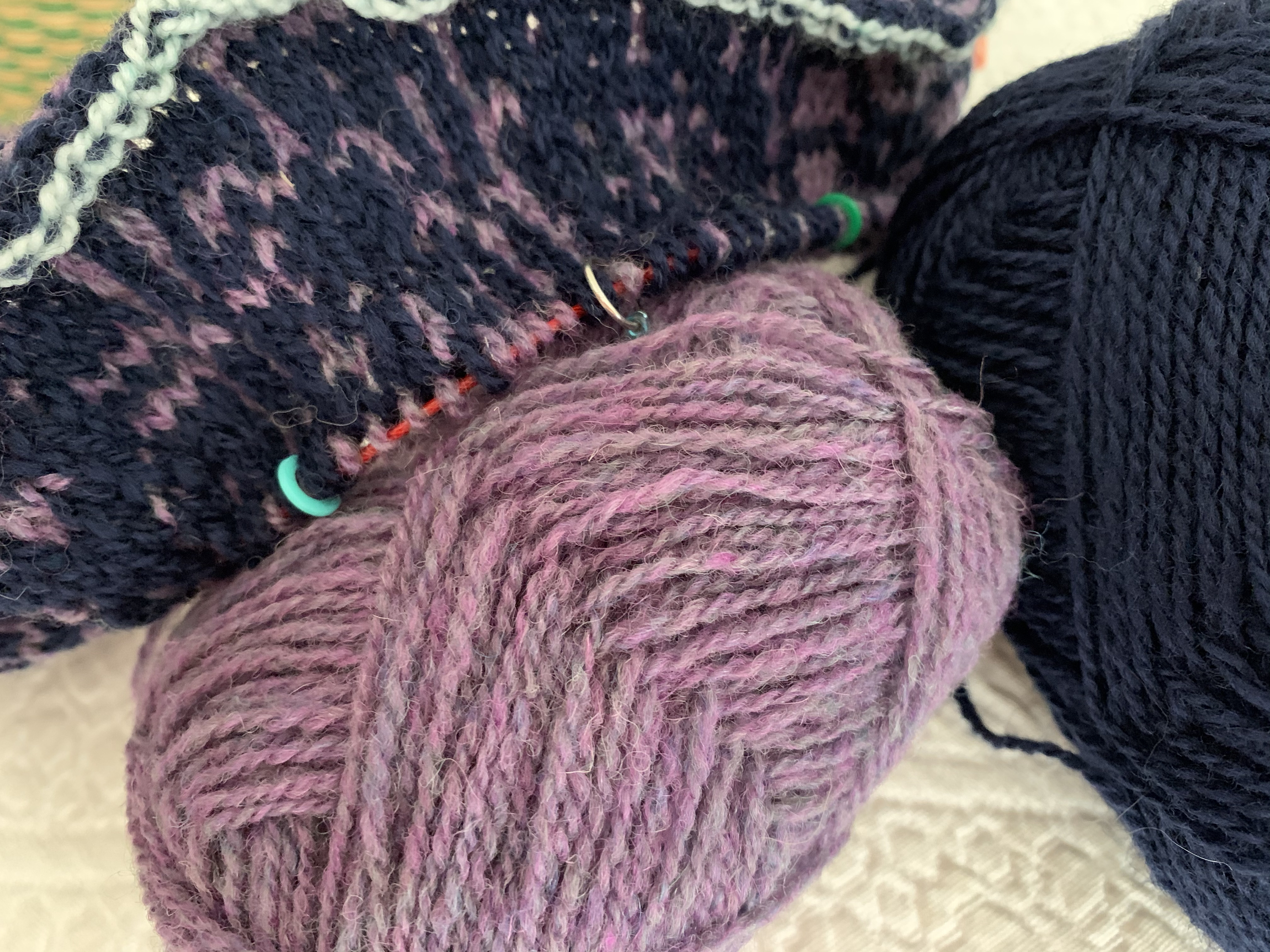
Jamieson & Smith purple yarn and Rauma navy blue
Pretty wool yarn by J&S and Rauma

My stash of wool includes Rauma Finull and Jamieson & Smith Shetland, which are both fingering yarns and are perfect for any stranded colorwork project. I’m not sure yet which stash yarn I will choose for the lining of this cowl.

Colors I am using: Jamieson & Smith shade FC9MIX (lavender) and it is so pretty. I’m using it for the background color. Rauma is the dark navy blue yarn, #0449. The embroidery will be done on the foreground color and it needed to be dark.

Cast on for the Keramos Cowl Fair Isle pattern
Keramos cowl, cast on to 16 inch needles.

Needle Length and Size

The pattern says to cast onto a 24 inch circular needle but all I had was a 16 inch. It worked okay, but the stitches were a bit bunched. I ended up buying a 24 inch needle so I could see the stitches more clearly. I also went up in size, and cast-on using a size 3 then changed to a size 4. This is quite a bit larger than what the pattern calls for, but I was afraid the cowl might be too tight if I didn’t.

The cowl begins with a provisional cast-on. Once the front pattern is knit, a lining is created and attached to the bottom, or beginning of the cowl using a 3-needle bind-off. I’ve never done that, *but it was fairly easy. Before the lining is attached by casting off, a little embroidery can be added. Another new thing for me.

Keramos cowl Fair Isle pattern
Pattern beginning to show on the Keramos Cowl

Notes on Knitting The Pattern Using Knit Companion

The Knit Companion app was a big help when it came to reading and knitting this pattern. If your eyesight is not good this app is invaluable when doing colorwork knitting. At first I had some difficulty getting it all organized as the colorwork pattern spans five pages which must be knit in sequence. As I am still learning all the ins and outs of this knitting app.

Eventually what I did was place silver stitch markers to separate my stitches to show each page of colorwork. To make things easier, and to catch mistakes quicker, I also divided each page chart in half. I used plastic stitch markers for that. This way I could easily see if I was on a new page, or in the middle of one.

I used the numbers section on Knit Companion to mark pages and rows. I used the “notes” section at the bottom to remind myself how I was tracking this pattern. Every time I finished an entire 5-page row, I went back to the first page number and changed my highlighter to the next row on every page before I began knitting. That way, once I went to the next page, the row was ready for me to knit.

Using the knit companion app on my iPad to keep track of rows of colorwork while knitting the Keramos Cowl

The image above is of my Knit Companion app on the iPad. The inverted highlighter shows my row as 19, and I have also kept track using the blue number on the right. The red number 4 is the page I will begin knitting on (Rows 4-8 hold the pattern). As I move through the next pages, I will change that number until after page 8 when I will go back to page 4 and change the row to 20.

For help using your KC see the Knit Companion Reference Guide PDF

What is The Best Way to Find Cowl Gauge?

Finding gauge for a colorwork cowl is not easy. Basically you need to knit the whole thing and then see how it turns out! Or, if you have colorwork swatches, or more likely whole projects knit up, find your gauge on those. It is not easy to count such small stitches.

Because cowls aren’t as important for fit, I didn’t count anything. I simply chose a larger needle size, because I tend to knit tightly. The cowl could not end up too tight for my neck, and it turned out I was right to do this. Once I had knit a couple of colorwork sections, I measured width and estimate the height.

It turns out that my width around is spot on and matches the sizing in the pattern (21 inches around). My two finished rows of colorwork sections measure about 5.5 inches and the pattern calls for 5 “rows”. But the finished cowl should measure 10 inches high! This means my horizontal gauge is good, but my height gauge is off. All I can do to fix this is shorten the project. This is easy to do on the Keramos because I will knit two more row sections and leave off the 5th row entirely.

Knitting a colorwork cowl and finding the right size
Finding the size on a colorwork cowl

In the photo above, I am comparing my Namu cowl size, which I knit a while ago for size. The Keramos is wider, but will not have the “give” of the cabled Namu, so that should be fine. Colorwork is not very stretchy.

Choosing a Lining Color, and Learning Embroidery

The turquoise blue yarn is a ball I’ve had sitting around. It’s some kind of single ply sock yarn, but that is all I know. The yarn is brightly colored and soft and silky which is perfect for the inside of this wool cowl. Now it’s just knitting along until the liner length is right.

Turquoise yarn for knitting lining of Keramos Cowl
I chose turquoise blue sock yarn, from my stash, for the lining

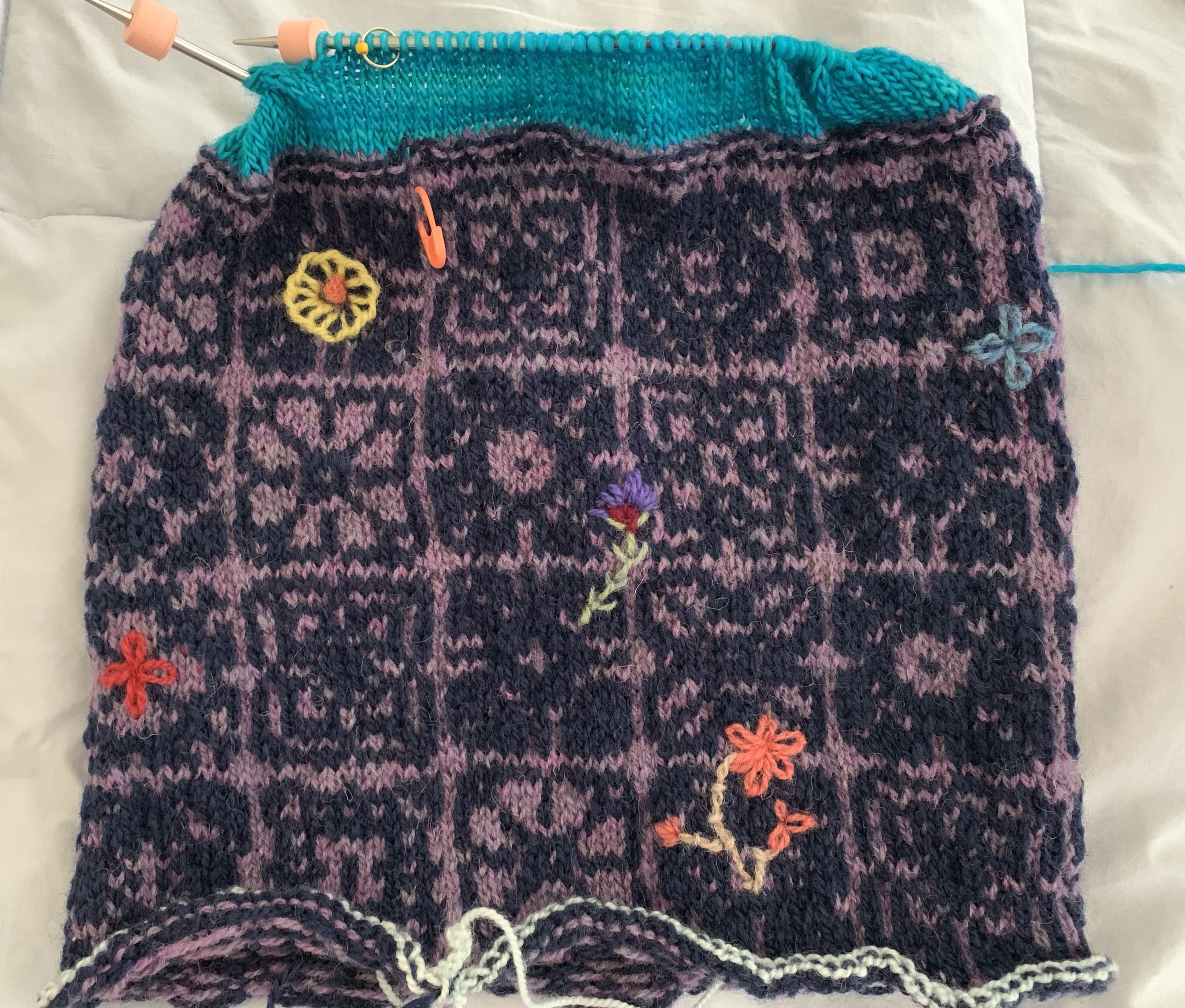
I stopped knitting after four colorwork “rows”, or sections. My cowl measures 9.5 inches tall. Now the lining will be knit and folded inside to be attached at that provisional cast-on along the bottom. I’m dreading that. It’s a 3-needle bind-off which I’ve never done. (Turned out to be pretty easy!)

Knitting a blue lining and doing embroidery on Keramos Cowl
Began my blue lining for the Keramos Cowl

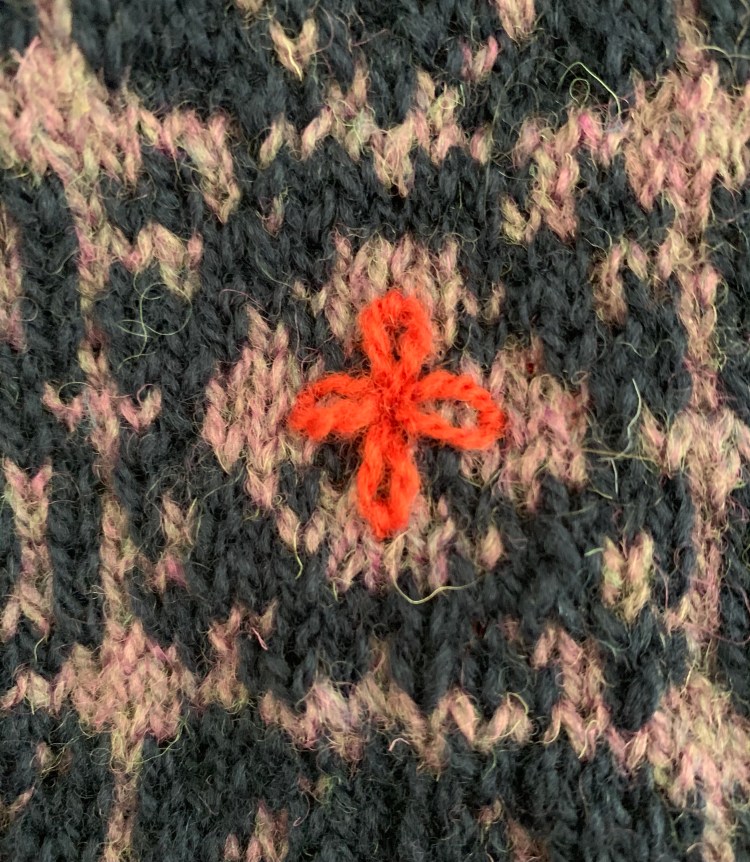
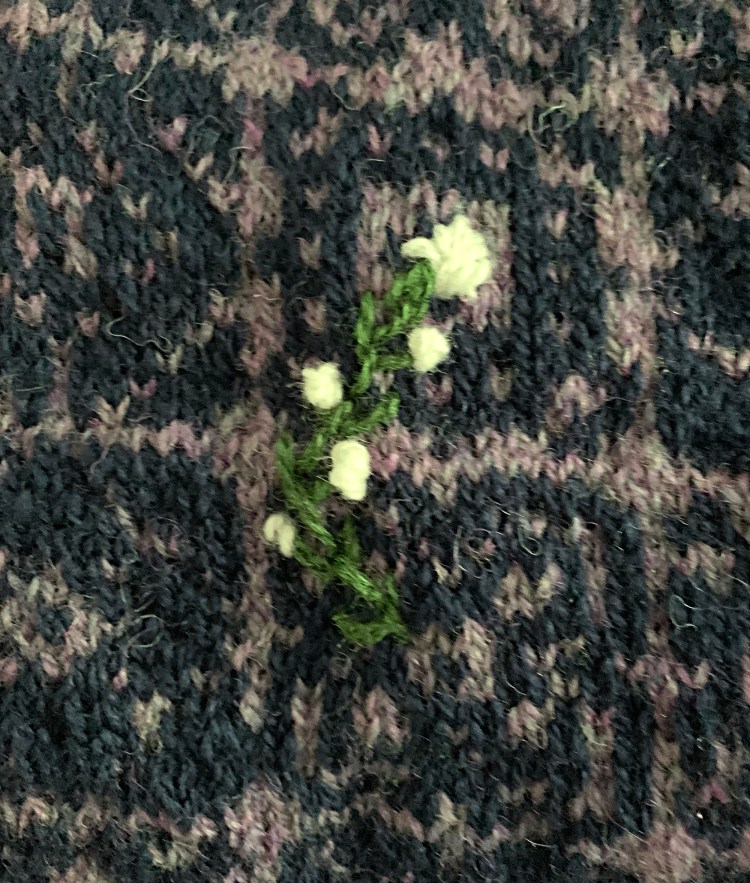
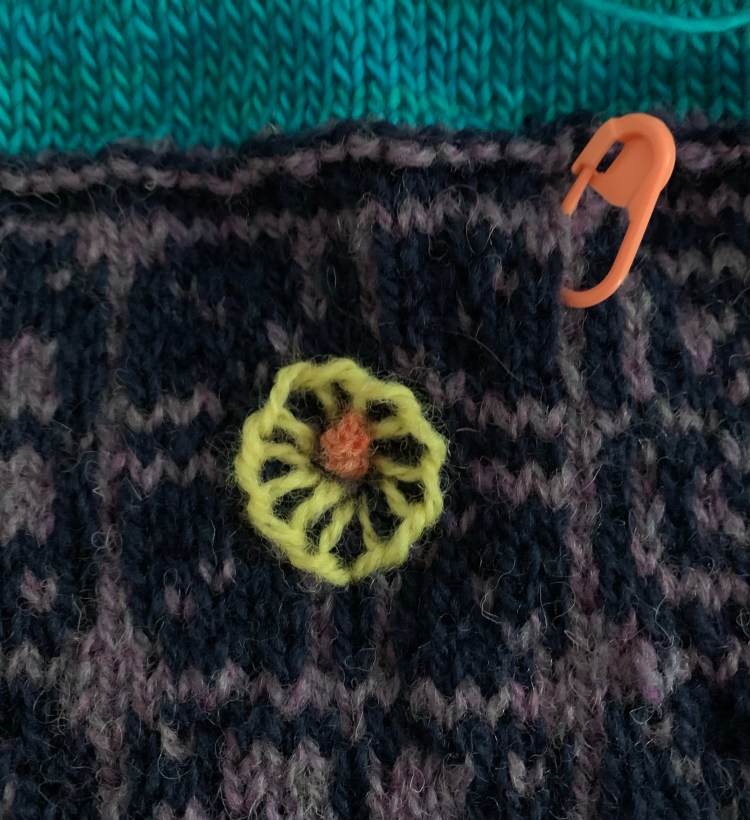
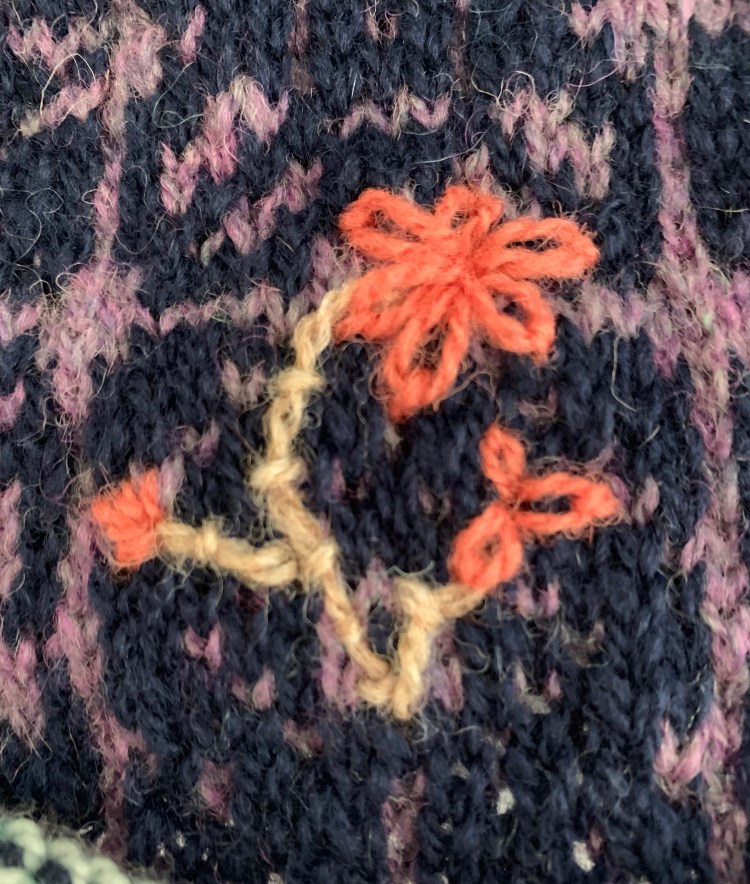
The Keramos Cowl designer, “Bunnymuff” aka Mona Zillah (link goes to her Ravelry Store page), includes cute embroidery on her knitting projects. My first try at embroidery is not exactly cute, but it was fun learning. I did a lot of flower removal over and over just to get these little sewing designs finished! Then, I did a little bee, which I love. I got the idea for this bumblebee from a YouTube image.

My Embroidery Skills Are Lacking, But it Was Fun Trying

  • Embroidery bumblebee
  • Thistle embroidery on Keramos Cowl
  • Simple Lazy Daisy embroidery flower on knitting
  • embroidery flower
  • Blanket stitch yellow flower
  • Wool yarn embroidery flower

YouTube Videos on Embroidery Stitches

After searching through a bunch of embroidery stitch videos on YouTube, I found a couple that were pretty nice so I’ll list them here. Using wool yarn, on a knit surface, is a bit more challenging than embroidery thread on drawn patterns, but you will get the general idea.

Finished cowl photos to come.

Finishing Up Knitting the Keramos Cowl

Finally I finished up knitting this cowl. It seemed to take a while, but it was on hold for two months when I took my trip to New Hampshire. I brought the Wild Angelica socks to knit and left this cowl behind.

The worst part of this pattern, for me, was picking up those stitches on hold. It was a tedious chore. The three needle bind-off went well, and ended up looking nice. I used the lighter purple color to do it and watched a YouTube video to figure it out.

3-needle bind off on Keramos Cowl
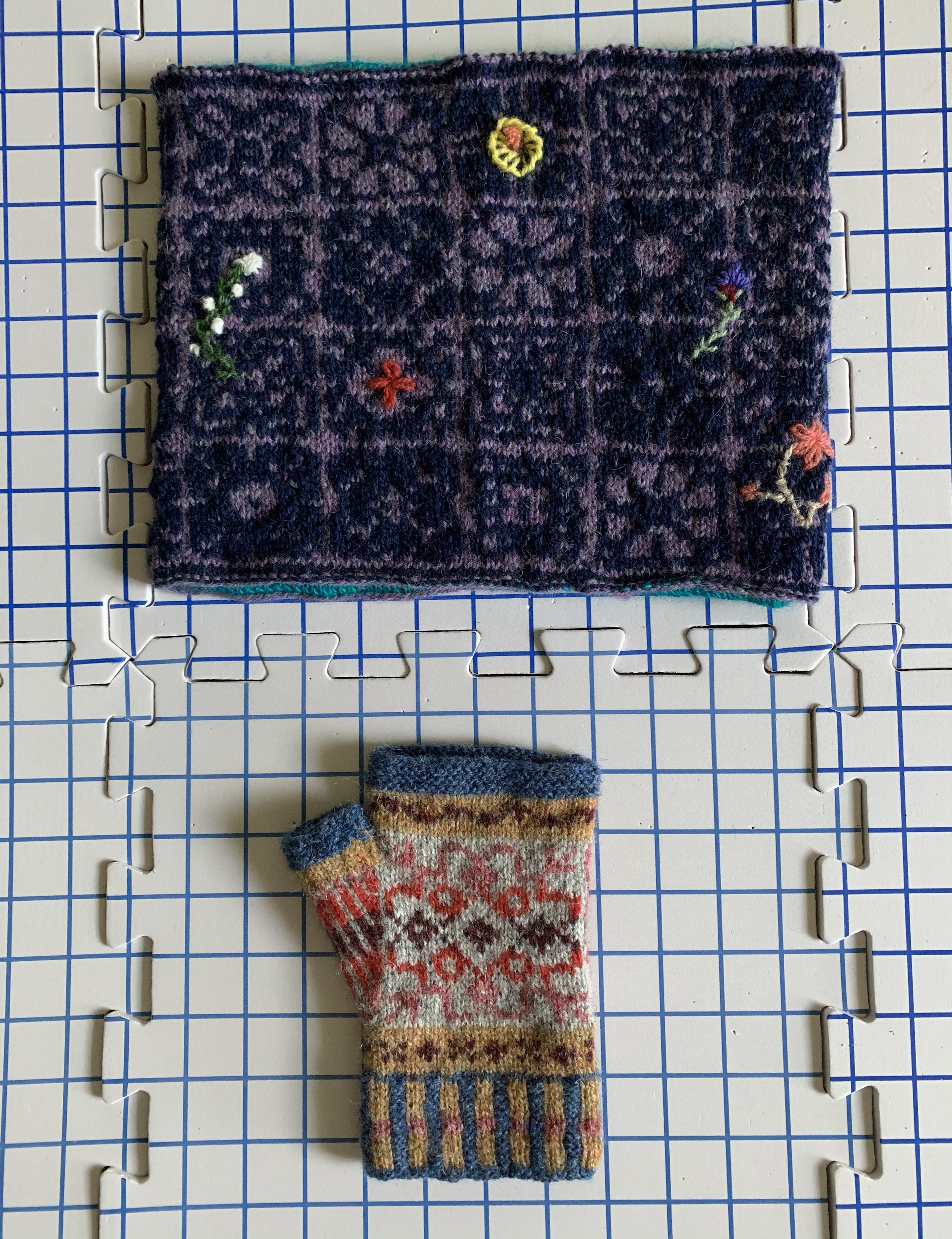
Fair isle wool knitting mitts and cowl drying on boards
Drying my knitting projects – Keramos and Fair Isle Mitt

I did try the cowl on before washing, and it is big and thick. Once it’s dry I’ll get photos wearing it (below). This one will definitely keep a neck toasty warm! It feels so good to finish up a knitting project.

Knitting Review of The Oulu Mitts Colorwork Pattern

The cold weather is here, and even in Florida temperatures have been freezing in my area. Knitting mittens and better yet, for me, knitting fingerless mitts, has become an obsession. I purchased the Oulu Mitts pattern as it was on sale in December. The pattern is from Caitlin Hunter of Boyland Knitworks.

I could see from photos that the cuff was a corrugated rib, which I am familiar with, and I can do colorwork. I had the right type of worsted yarn called for, so why not?

Brooklyn Tweed Shelter yarn in colors Old World, Amaranth, and Caraway
Shelter in Brown: Caraway, Red: Amaranth, Blue: Old World

The yarn is Brooklyn Tweed “Shelter” in colors: “Caraway” – the tan for my Main Color, “Amaranth” red for the ribbing, and “Old World” navy blue. I had this yarn on hand so had to find three colors that would work. In the end, I like the look. Here is the left hand mitt drying, in size Medium.

Things to Know Before Knitting This Pattern

First thing to know about this pattern is that the directions are in chart form. The chart shows a k1 MC, P1 CC for the ribbing, which is actually a corrugated rib. The designer does not mention this and assumes the knitter will know how to do corrugated ribbing.

Corrugated ribbing of Oulu Mitt pattern
Beginning left hand mitt

The pattern notes say that the instructions are “written for the Magic Loop method of working in the round” – but, that is not really important because the mitts can be knit with small circular needles (which I used) or DPNs. She only references Magic Loop for the cast-on and dividing stitches between needles. I don’t really see the point in mentioning this at all.

Each of the three sizes has a “right” and “left” mitt chart to follow – so 6 separate charts are included. I began with the left, medium size, and ran into trouble with the thumb colors. The color chart is off, and since it was my first mitt, I wondered if I was doing it wrong or if the pattern was supposed to be that way. Eventually, I had to do the alternating colors and ignore the thumb pattern. Because of this, my thumb colors are not all correct, but the yarn covers the mistakes well enough. This problem was not mentioned specifically by test knitters or previous knitters, but a few did mention having trouble in general.

Neither the right nor left hand chart made sense to me when it came to knitting the thumb. It could be me, or a problem with the pattern, I honestly don’t know. In general I can follow patterns, and I have knit mittens without any problem, but the Oulu pattern did not make sense.

Pattern is wrong for left hand thumb
Thumb chart is off

Getting Gauge

I did not knit a swatch and used my first, washed and dried mitt to get my gauge. My gauge is way off for rows, which is why I needed to add an extra pattern repeat at the top. I got 24 rows in four inches, and she (the designer) has 31 rows!

While I was knitting the first mitt, I thought the mitt would end up too tight. In fact I added a couple extra stitches near the knuckles to widen it a bit. But the day after I finished knitting, I wore it outside while feeding the birds on a cold 32 degree morning, and the fit was good. Then I washed it and began mitt #2.

Oulu cuff and back of hand pattern
Cuff and most of hand finished

Changes I Made to Thumb Knitting

Needle size & Thumb stitches: Although the mitt seemed tight at first, it ended up fitting me very nicely. I knit the size Medium, on size 6 needles for the ribbing at the cuff and top. The rest of the mitt was knit using size 7 needles.

I did not use the smaller, size 6 needles for the thumb, as the pattern calls for. In fact I added stitches, by picking up 4-5 in place of the 1 stitch, and it’s perfect. Doing as the pattern suggested would have created a very tight thumb – for me. If you are also a tight knitter, you may want to do the same on the thumb.

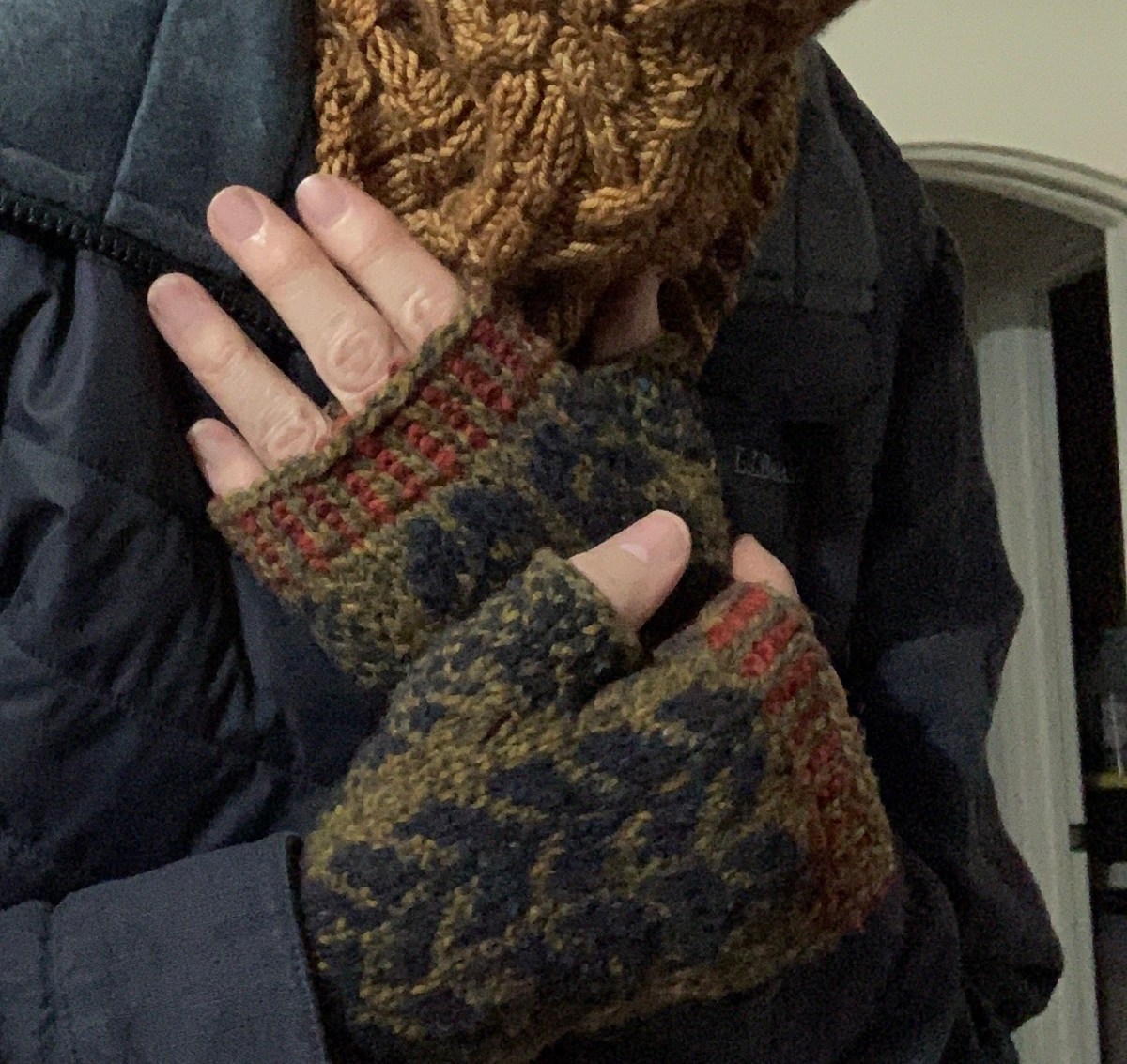
Wearing Oulu mitt for left hand
Before washing

Pattern repeats and bind off: I added one more repeat at the top of the hand to get the correct length for me – due to my smaller gauge. For the next pair I would maybe make the cuff shorter. It’s hard to say if I will appreciate the length on the wrist area.

The pattern calls for a “stretchy bind-off” and I did a regular, rather loose bind-off which was fine. Some of the reviewers mentioned that doing a stretchy bind-off made the top flare. I can imagine that would happen. As it turned out the top ribbing could have been more narrow overall. I will plan to decrease a couple of stitches before doing the top ribbing next time.

Finished! I had trouble following the pattern for both the right and left mitt. Don’t know if it was just me, or the pattern. I had to figure too many things out for myself. Maybe a more experienced knitter would not have this trouble.

Oulu mitts
Finished the Oulu Mitts before the end of 2020

Read More Knitting Stories

Something went wrong. Please refresh the page and/or try again.

Turkish Patterned Cap, Hand-spun Knitting Project

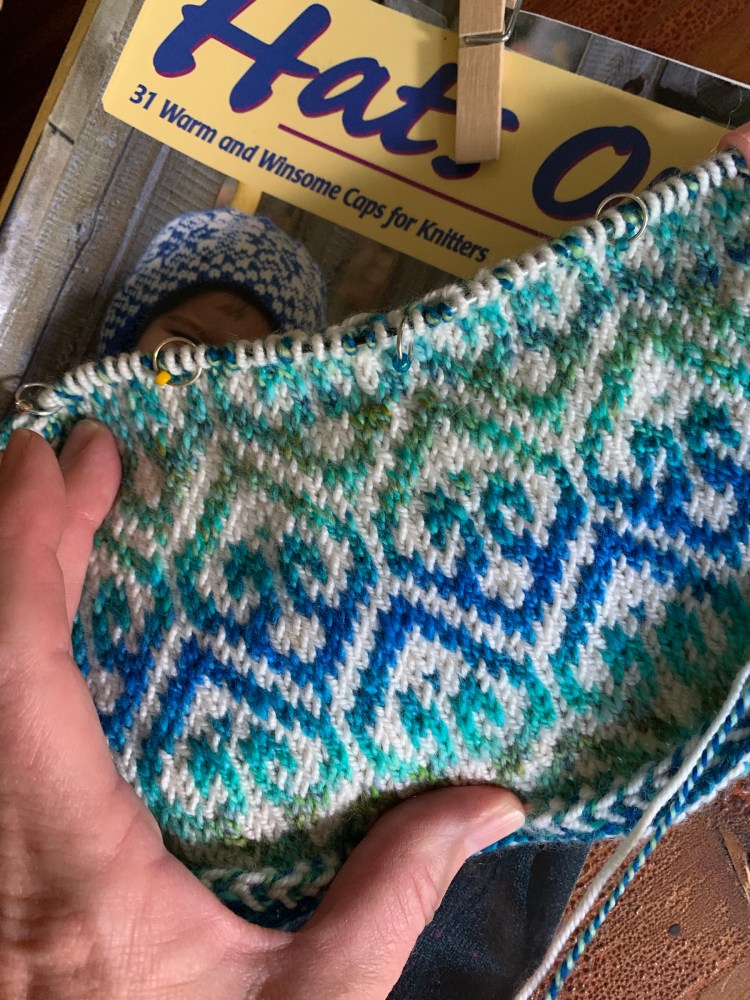
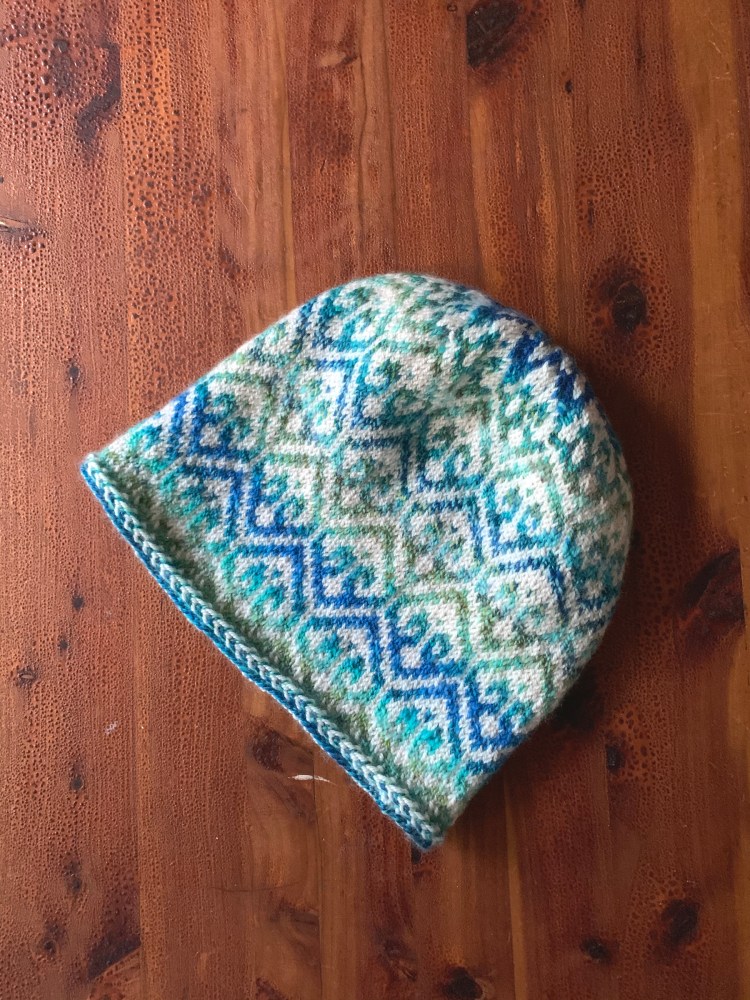
Hats, hats and more hats please! I don’t know why, but I love to knit hats. I’m pretty good at it, and I’ve knit enough of them to be fairly sure of size. The Turkish-Patterned Cap is my latest accomplishment. The pattern can be found in the Hat’s On book by Charlene Schurch.

The image here goes to Amazon, where the book costs around $10 for the Kindle version, or get a used book for around $13 (and up). For that price you will have 31 hat patterns to try out!

Although this particular hat is not a favorite of mine from the book, I’ve knit many others (nine, I think) that I would knit again. I really can’t say enough good about this hat knitting book.

The Turkish-Patterned Cap Review

Beginning the cap with a “Twined Herringbone” edge, or braid, was a first. I’ve done braids on mittens a couple times, but never a hat. I knew it wouldn’t stretch much, so I knit the size Large and hoped it would be large enough – it is. This hat will be a gift, and my daughter has a small head, so it should fit perfectly.

Turkish patterned cap stranded knitting
Size 4 circular needle using DK and fingering weight yarn, I knit size Large

I used the suggested needle size, but my yarn was not worsted weight. The circumference of the hat is spot on at 20″ around as the pattern says for a size large.

The hat was fun to make – until I reached the top decreases. I am not new to decreasing for a crown, nor am I new to colorwork at the crown. I knit two Katie’s Keps, and the Tettegouche hat without a problem. For some reason this pattern did not work for me at the crown. I did something wrong, and couldn’t figure out what. I had stitch markers for each section, but suddenly the colors were not matching up.

Please read the post about knitting my second hat like this one where I discovered the mistake in the pattern decrease area! I explain how to fix it- or how I fixed then problem.

Turkish patterned cap stranded knitting
I had trouble with the crown

All I could do was keep going and hope for the best. You can see that the “star” is not perfect, but oh well… . Because of this, and the fact that I am not crazy about the braided brim (for my own hat wearing), I won’t make this hat again. I think my daughter will love it! She does a lot of snowboarding and needs hats like this to wear beneath her helmet.

Turkish patterned cap stranded knitting
Washed and blocked hat

About the Yarn

I’ve been eyeing my hand-spun yarn stash and wishing I could knit something wonderful using those lovely skeins. They are labeled as “sock yarn” but I dislike knitting socks. Projects like this hat are perfect for this yarn. Stranded colorwork knitting is fun with this type of yarn.

Wound Up Fiber Arts sock yarn hand-spun
Beautiful hand-spun yarn

For the Turkish hat, I used my blue-green skein (fingering?) from Wound Up Fiber Arts (see the ball in my yarn photo). For my neutral color, I used off-white “Naked” Kunlun yarn from Miss Babs (DK) which I had bought on sale a while ago (it contains cashmere and silk). By the way, Wound Up Fiber Arts has limited amounts of yarn like this because it is hand-spun. I’ve considered myself fortunate to actually find yarn to buy on her site.

The Turkish cap pattern calls for two colors, and I thought this variegated yarn would make an interesting color gradient. While knitting, it’s fun to see the various shades emerge. Aren’t they pretty?

Turkish patterned cap knitting design
Gradient coloring due to the hand-spun yarn

Ever since I began knitting stranded colorwork mittens back in February, I can’t stop knitting items that require two yarn colors! It is such fun, and the end result is so nice. Those mittens could be knitted with this same yarn, which would make a pretty set.