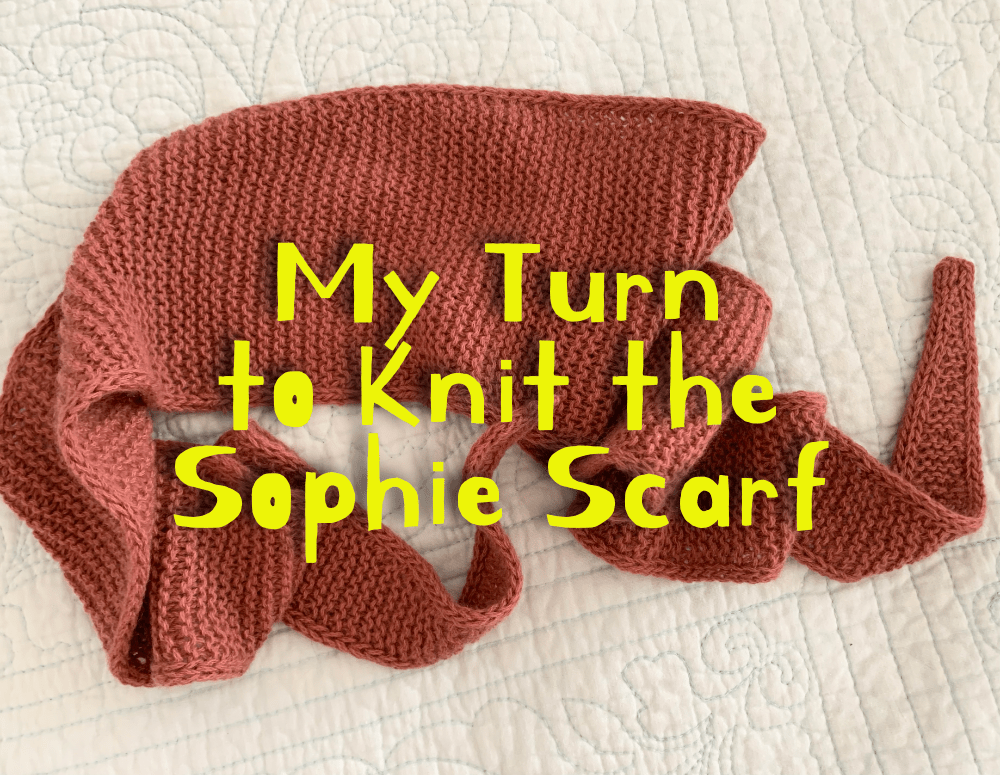
I splurged and bought two skeins of Cashmere yarn to knit the large size Sophie Scarf. But first, I knit it using some yarn from my stash. This pattern is quite popular and requires a next-to-the-skin softness. Read on to see how the yarns compare.
Sophie #1 – The First Try
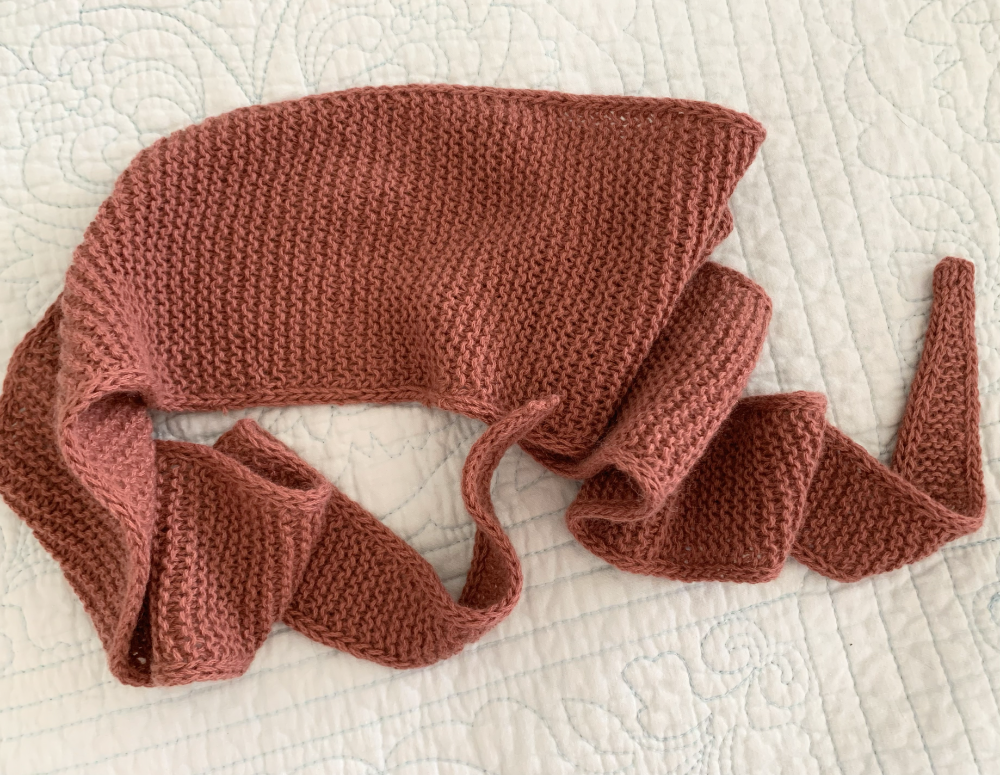
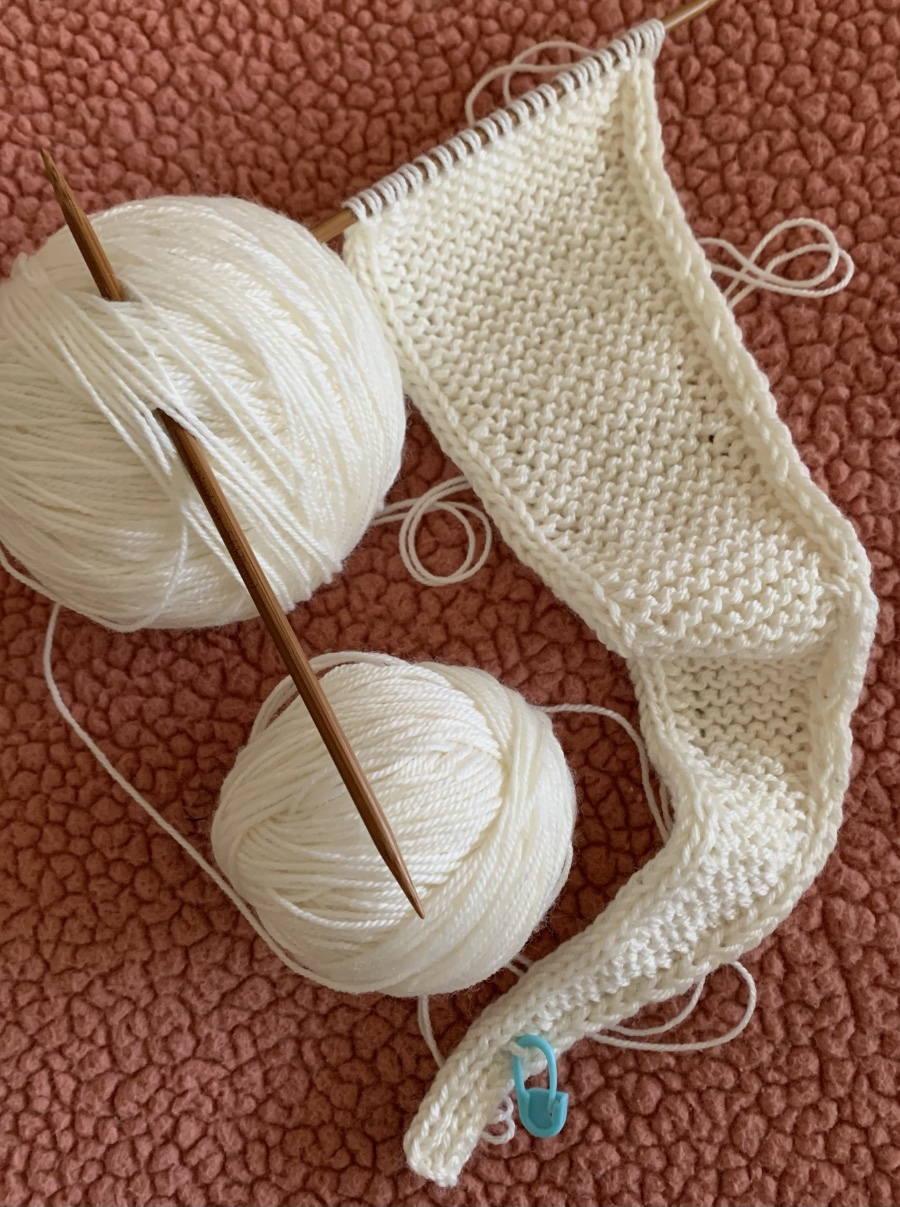
I’ve already knit one Sophie in off-white, Lorna’s Laces Soulmate yarn. I believe this yarn is discontinued, and I’ve had the skein for years. I split the skein in half, to knit with two strands held together. I knit it on a size 5 needle.
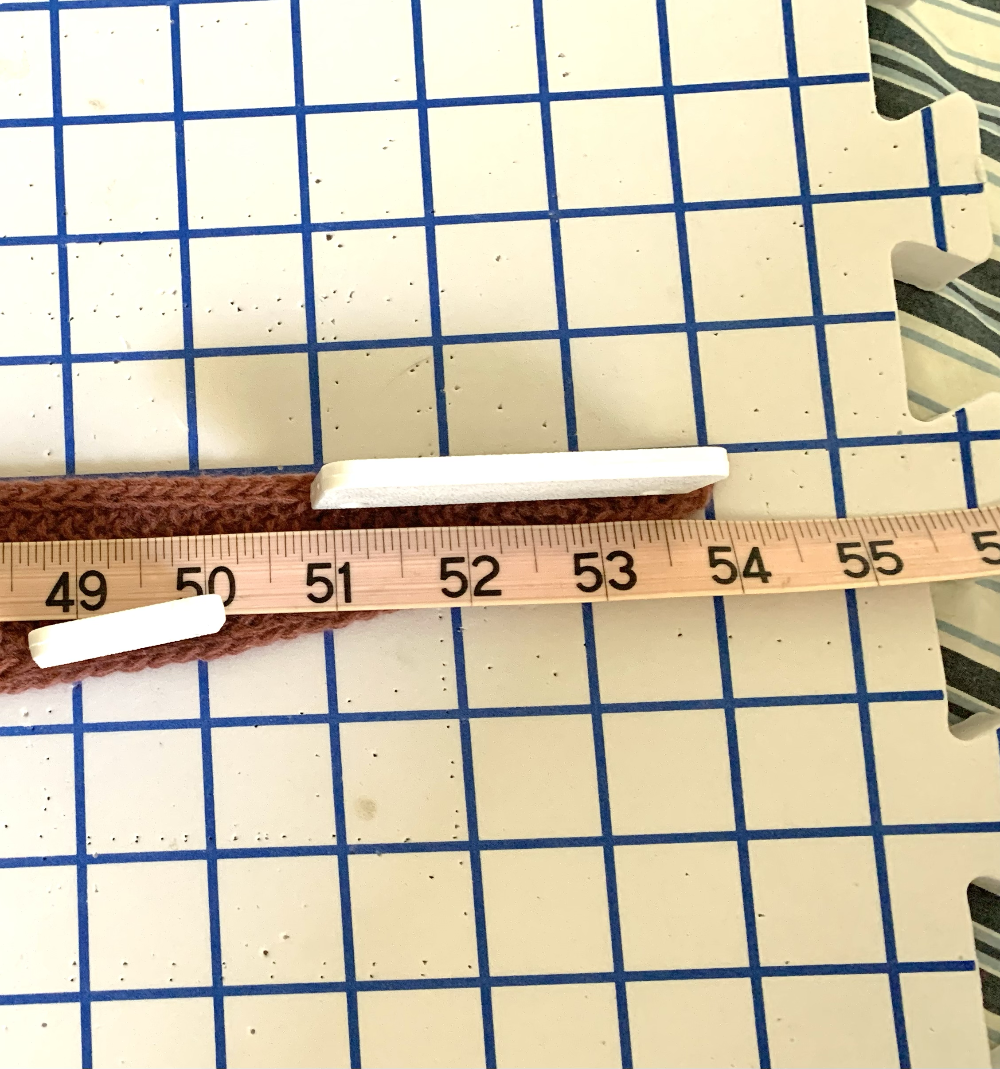
The scarf ended up 51 inches long and 5 inches wide. (Pattern measurements are 41 inches long and 5 inches wide.). Although my scarf is 10 inches longer, it is just long enough for my liking. I’ve read that quite a few knitters decided to make their large size scarves longer.
51 inches long
Sophie #2 in Cashmere Yarn
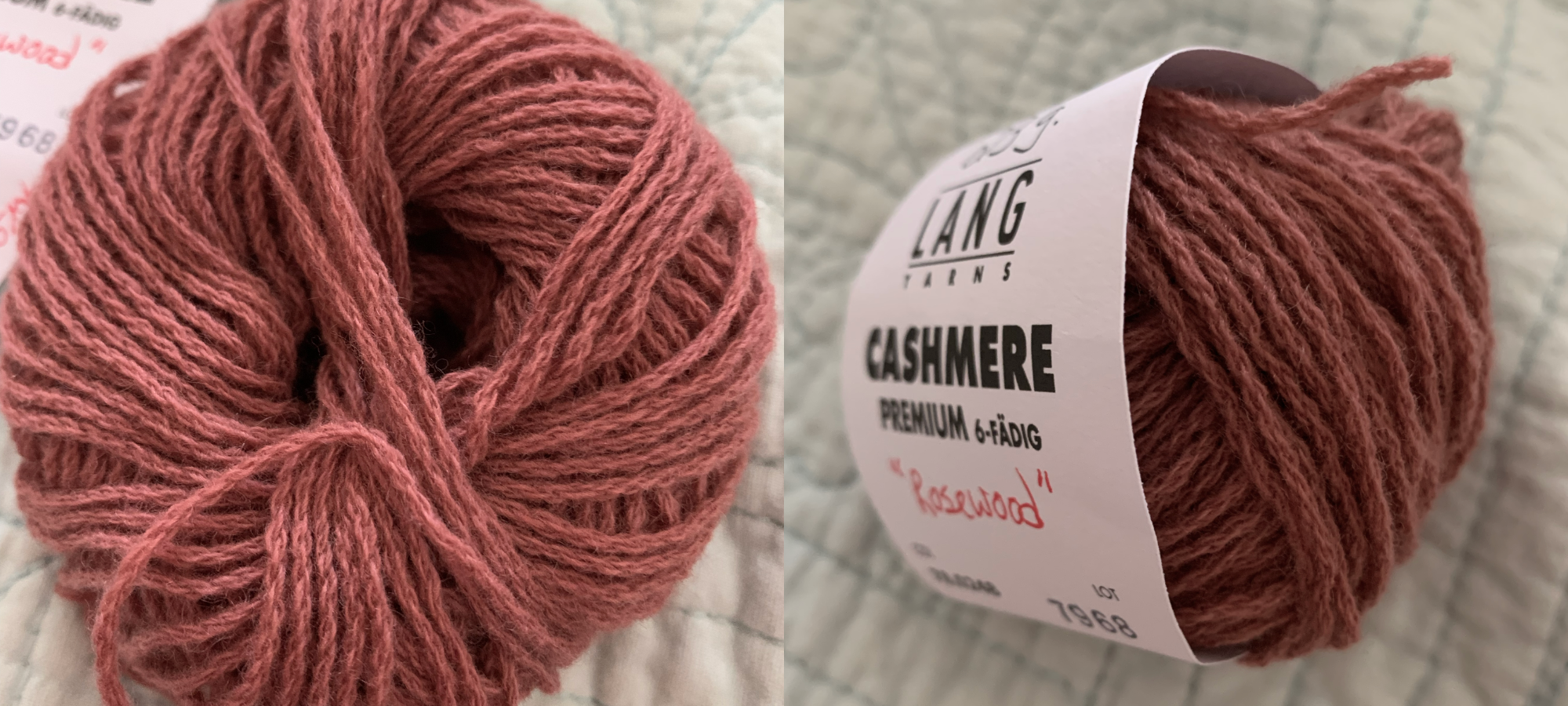
After scouring three little scarf patterns, I purchased three sets of cashmere yarn. Two sets are Lang Cashmere Premium, and one set is Pascuali Cashmere Charis (knitting another scarf with this).
The Lang yarn is sold in 25 gram balls, but each of them weigh 23 grams. the Charis is sold in 50 gram balls, but each of those weigh only 48 grams. Is there a reason that all six balls are not weighing in correctly? Do I have less yarn than advertised? Does all cashmere end up this way?
I’m going to start knitting and hope that my two balls of yarn will complete one, large size, longer, Sophie Scarf.
Lang Cashmere
Cashmere yarn is pretty expensive. Two balls of this yarn cost me around $50 and I will probably use just about all of two balls to complete the scarf. It makes a very soft and pretty fabric but, after knitting with one ball, I am not too happy with the yarn.
First, I had a knot that needed to be cut out. Knots are annoying, but they happen. Then, further along the first ball, I had an annoying split. The yarn strand was unraveling (see photo below). That had to be cut and reattached. This yarn does not splice and that means I have two tails, for each time I do this. The Sophie Scarf is double-sided, meaning that there is no good place (wrong side) to weave in the ends….!! I’m a bit perturbed.
A split in the yarn strandAll those ends…
The designer has a suggestion for attaching a new strand, and that is to do so along the edge. I had planned to only have to attach a new ball – leaving 2 strands somewhere along the middle of the scarf. I now have 6 tails, and that is thanks to the faults in this ball of Cashmere yarn!
I had to dip into the second ball, and discovered that it was perfect. Ravelry reviewers, who have knit with Lang Cashmere Premium have complained of the same things, so my bad ball is not all that rare it seems. I have two more balls of this same yarn brand, in another color. We’ll see how that goes.
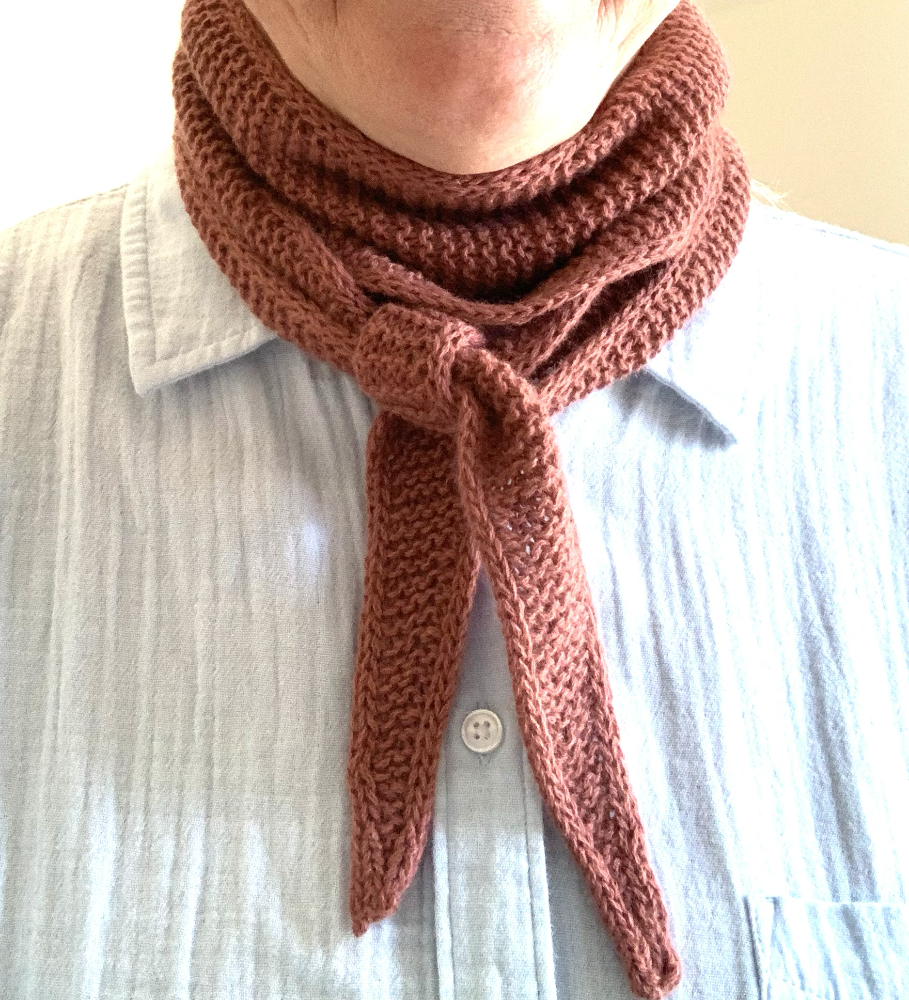
Loose tieSophie in RosewoodTighter tie
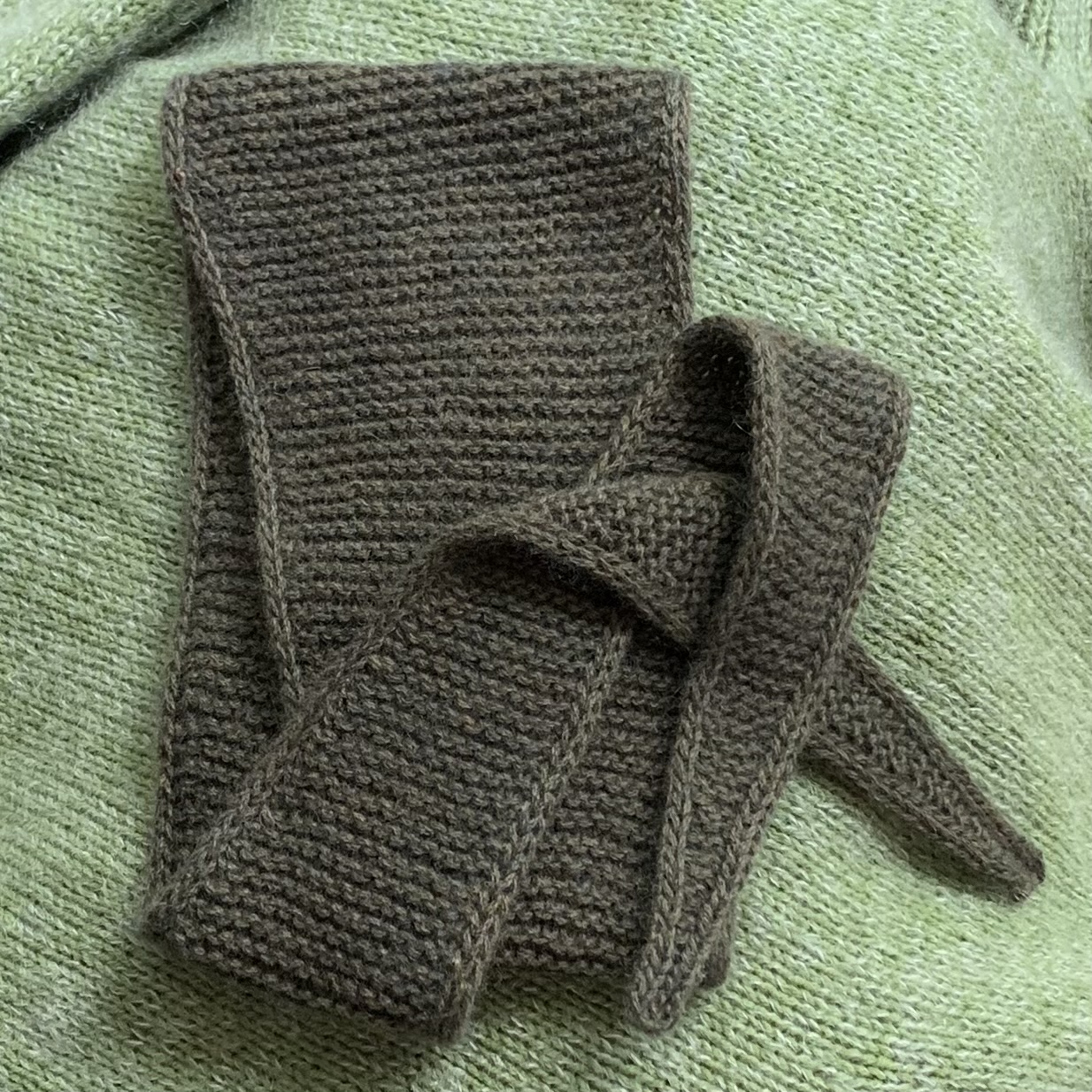
My finished Sophie scarf ended up being 54 inches long. I like to have the option to tie my scarf loosely. The length is perfect for me and it’s a very pretty color.
Now that Sophie is finished, I must get my next scarf done. I’m on a little scarf kick it seems.
Three little scarf patterns to knit with cashmere or other soft yarn. These are quick knits, and might be perfect practice for beginner knitters.
Here I am sharing some fun and cute scarf patterns that have recently caught my eye. These patterns seem easy enough for a beginner, if you’ve had some knitting practice, but want to branch out.
If you have mastered casting on and basic knits and purls, choose Sophie. If you can follow knitting and purling by sight to accomplish ribbing, choose Alex. The third scarf, called Scarf No. 4, seems a bit harder, but not much.
The thing about knitting a little scarf, is having a finished project fast. These are not your regular, long rectangle shapes. Each of the scarves on this page are much smaller, and take less yarn to complete. Consider a specialty, soft Cashmere yarn. I have some listed on this page.
Scarf Preview
I’ve begun knitting two of the three scarves listed on this page.
Sophie Scarf garter stitch
Alex Scarf 2×2 ribbing
I’ve begun knitting two of them, Sophie and Alex. That way I can give you first hand accounts of what I think. If you are somewhat of a beginner knitter, I believe you could knit them all. In fact, they would be good practice.
Scarf Style
The patterns are knit from one end to the other. They begin with a cast on and expand to the center width. Then they decrease for the other side. To use up one skein, use the weighing method.
Weighing Method
If you have one skein to use, it should have double the length needed (and then some). Begin by weighing the yarn. This step is crucial if it’s very close to the amount of yarn needed. Find the mid point of the pattern, and begin decreasing when you are just less than halfway through your skein. How do you know? Buy a scale that shows grams and ounces (Amazon paid link). Weigh the skein before you begin, and then along the way.
Choosing Yarn
The patterns on this page are for small scarves. They take one or two smaller skeins of yarn. (Please go to each pattern’s page – I provide links – for more information on yarn needed.) Cashmere, or a cashmere combo, is recommended by all three designers, but any soft yarn would work. These scarves will be wrapped right against the neck, like a fun little accessory. Choose a yarn that will be soft and comfortable right on your skin.
Percentages next to yarn names below are for Merino wool to Cashmere in the yarn. Read this page for information about the reason for combining the two yarns. In short, it is for sturdiness.
Yarn Amounts
Check each pattern for yardage needed for your type of yarn and needle size. In my list below I have tried to figure, in general, yarn amounts needed for the longer scarves.
Alex: Size M: 49 inches = 273 yard ball listed. (219 yards on project page.) BUT this changes according to yarn weight and needle used!
Scarf #4: One size: 49 inches = 219 yards (or more) of yarn total.
Honestly, all three scarves gave me a headache while trying to figure out how much yarn I needed for each. “Alex” lists grams and yards, but uses three different weights and needle sizes for each of the three scarves. “Sophie” says 35g. needed of Compatable Cashmere @ 25g. balls. (so 2 are needed, if I use this specific yarn). “Scarf No.4” lists everything in grams and meters and I had to figure the yards.
We all knit a little differently. Also, remember that if you prefer a longer scarf, the yardage will be more. It is always better to have a little more yarn than needed.
Prices are listed here, but remember that they will no doubt change over time. I’ve listed them to give you an idea of the cost of knitting with a special – in this case Cashmere – yarn. Please note that when I purchased some of these Cashmere yarns, the skeins weighed in at less.
Lang Yarn Cashmere Premium – 100% Cashmere with chainette construction for holding shape. -Around $28 per skein for 125 yards. (two skeins needed for longer scarf) – save 10% at WoolandCompany on $100 or more & they have free shipping in the US ❤️ for all orders. * I ordered some of this and the 25 gram ball weighs in at 23 grams.
Pascuali Cashmere Charis 70%/30% Mongolian Cashmere– cost around $30 for 122 yards (50g.) – you need 2 for the longer scarves – More for Alex. *My balls each weigh 48 grams, not 50.
The Alex Scarf (link to pattern below) is a pattern by Pernille Larson, aka Knitting for Olive. This is her page at Ravelry. The business is run by her and her daughter. They sell yarn that is not mulesed (look that up). They use only pure natural fibers. They also create really lovely patterns of all kinds, and have lots of knitting patterns for babies and children.
I thought that some new Knitting for Olive yarn would be nice to have. I wanted to make the scarf with their Merino held with Cashmere. Then I looked in my spare bedroom at all the yarn just sitting there….. I passed on the new order (boo hoo)and chose to use up some old Miss Babs yarns.
Miss Babs Tarte & MohairBeginning Alex Scarf
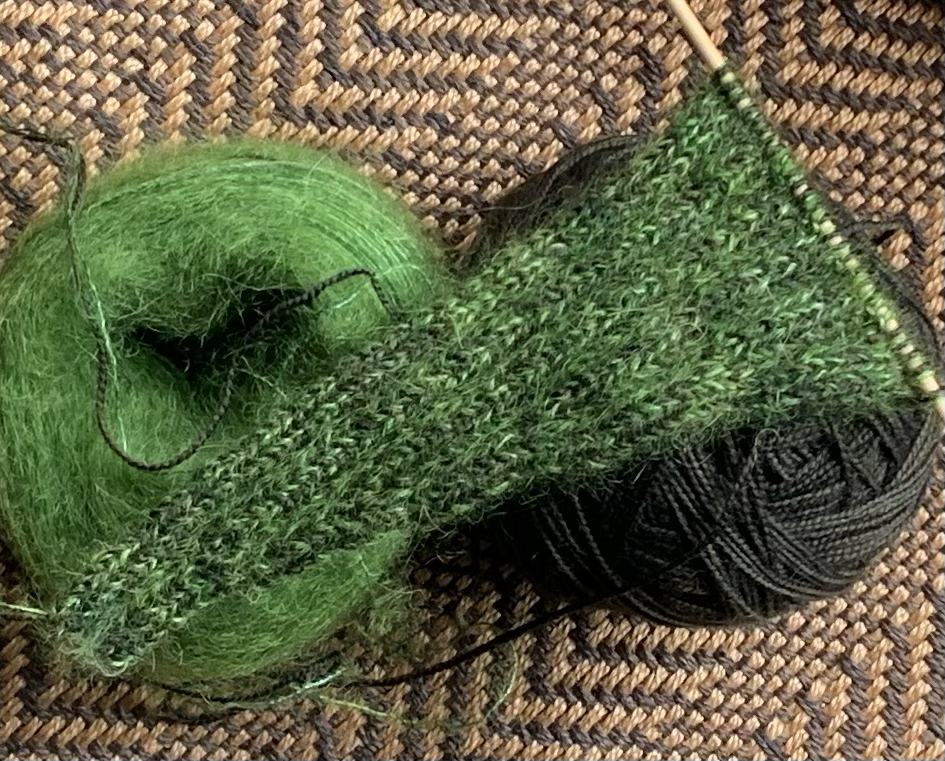
From my stash I chose a dark brown-green “Lobster Legs” colorway, in Superwash. The skein contains 400 yards, which is plenty for the Medium size scarf. I also have some green mohair to use up, so I combined the two. The color was nice, and the pattern is great. But as I knit on, I am wondering if the Mohair will be too scratchy.
One ball of Knitting For Olive Merino with 273 yards, held with 2 balls of KFO Cashmere is suggested.
Mohair is not really a good choice when something is worn near the skin. I’m not super sensitive to wool, but mohair – especially certain types of mohair – can be itchy and uncomfortable. This scarf is turning out to feel that way, so I may not continue with this yarn. I do love the pattern.
The Alex Scarf pattern can be purchased at Ravelry. The pattern includes three sizes and various yarn weight options. Only Knitting for Olive yarns and amounts are used in the yarn section. One ball of KFO merino is 273 yds. Only one ball is used for the Medium size scarf.
2. The “Sophie Scarf” by PetiteKnit
The Sophie Scarf (Ravelry pattern page) is everywhere it seems! According to the pattern page, 25,000+ knitters are knitting, or have knit, this scarf. It’s a cute, and easy, pattern that takes DK yarn. Size 4 needles are suggested, and the pattern is for 2 lengths. It is done in garter stitch (knitting back and forth) with I-cord edges. The designer gives it a 2 of 5 difficulty rating. Knitting this scarf is addictive!
You will need to: Knit front and back for increases, and manage the decrease stitches. This is not difficult. The edging is I-cord, which is also easy. As you knit along, the edge is created. Keep good track of the rows when you begin so know when to increase and decrease. Those should all be made along the same edge. Use a marker to designate the “front” of the work.
Yarn required for the Sophie Scarf is 101 yds. (small size) or 140 yds. (large size) in DK weight.
The Sophie Scarf pattern offers two sizes. I am knitting the longer version. The shorter scarf will come around from the back and tie in the front, more like an accessory, or accent. The longer version will wrap twice for warmth.
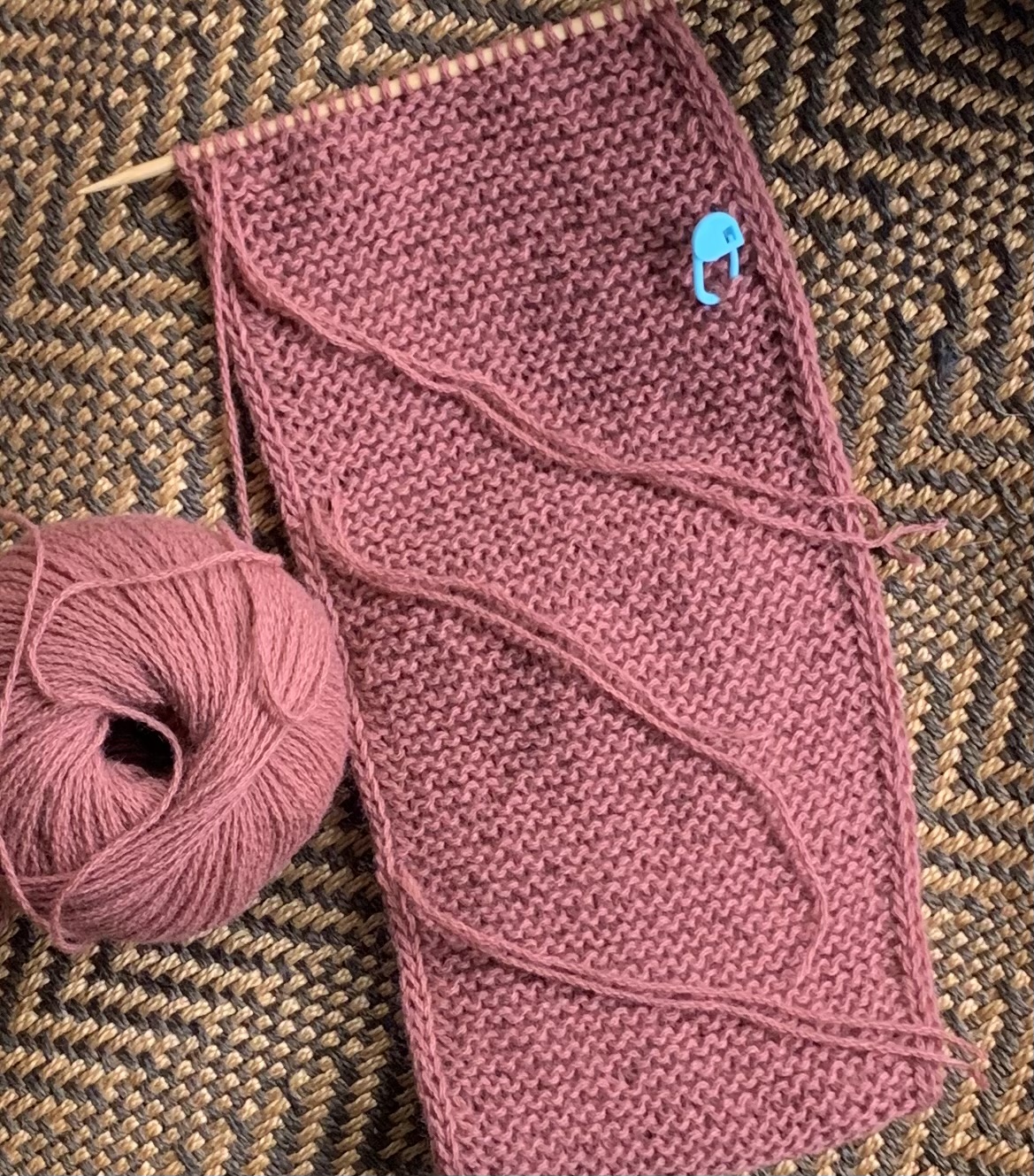
To show you the scarf as it is knit, I cast on using some stash yarn. This is Lorna’s Laces Solemate, and it is a very soft, machine washable merino, nylon and Outlast. I believe it is fingering weight, and I am holding it double. I went up to a size 5 needle. I really want to use up this yarn.
Sophie in white, 2 strands held together
Lang Yarn, Cashmere Premium in color Olive Melange
3. Pattern For “Scarf No. 4”
The third scarf, from “My Favorite Things knitwear” is named Scarf No. 4. It is also knit from end to end like the others. It is a long, triangle shape with a textured pattern. I have not knit this one.
Nice texture using simple stitches
Yarn needed is approx. 219 yards DK weight.
Yarn suggestions for this scarf are pretty much the same as the others. The cashmere mentioned is Lang Cashmere Premium, Compatible Cashmere lace (use two strands together). Or search for yarn that contains cashmere along with merino, silk, or other soft fibers.
This scarf has a different type of edging called “distitch”. It is not difficult to do. There is a YouTube video link included with the pattern. When I search “distitch edging” then I can see it here.
Scarf No. 4 is written for one size. Approximate length will be 49 inches. Yarn amounts are listed in grams and meters, but on the Ravelry page I see 219 yards.
Skills to know are yarn overs, knitting through the back loop, increases and decreases and distitch edging. Also knitting and purling in pattern. The directions seem easy to understand. When you see “est” in the pattern it means “edge stitches”. This is explained, but I missed it at first.
The Three Scarves Links List
In closing, I’m adding the links to all three scarves once more. Each link goes to the Ravelry page where the pattern is for sale. Also, find more information from the designer about yarn ideas and amount needed. Read reviews by knitters, and find out what types of yarn they used.
My goal is to use up some nice yarn in my stash. Have only one skein? See if you can use it to knit a comfy and usable neck warmer. These fun, cute projects make excellent take-along, travel knits. They are perfect for gift giving to special people too.
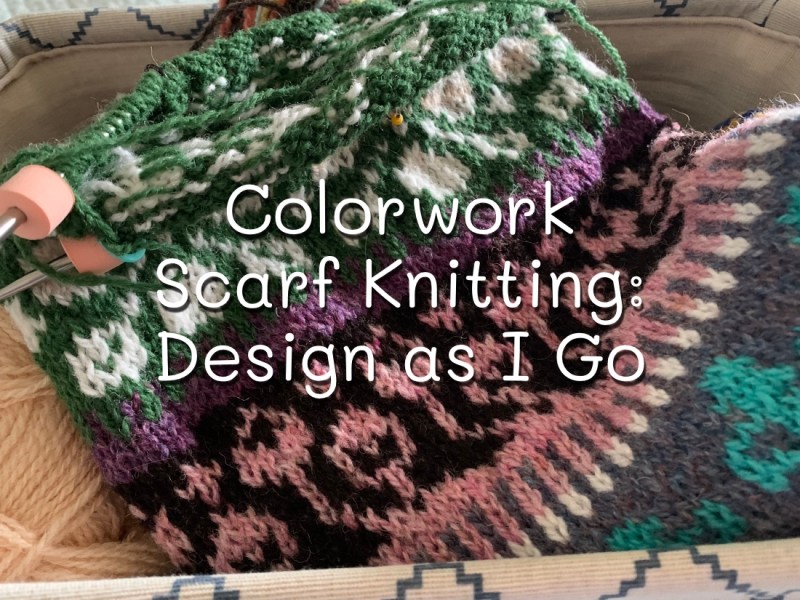
Whenever I get bored with a knitting project, and crave some two-stranded knitting, I pick up my DIY scarf. The colorwork patterns I’m using are random, and come from some books I have.
I began this tubular scarf with a provisional cast on. When it is long enough, I will connect the ends, using the Kitchener stitch, and create one long tube to wrap around my neck, twice.
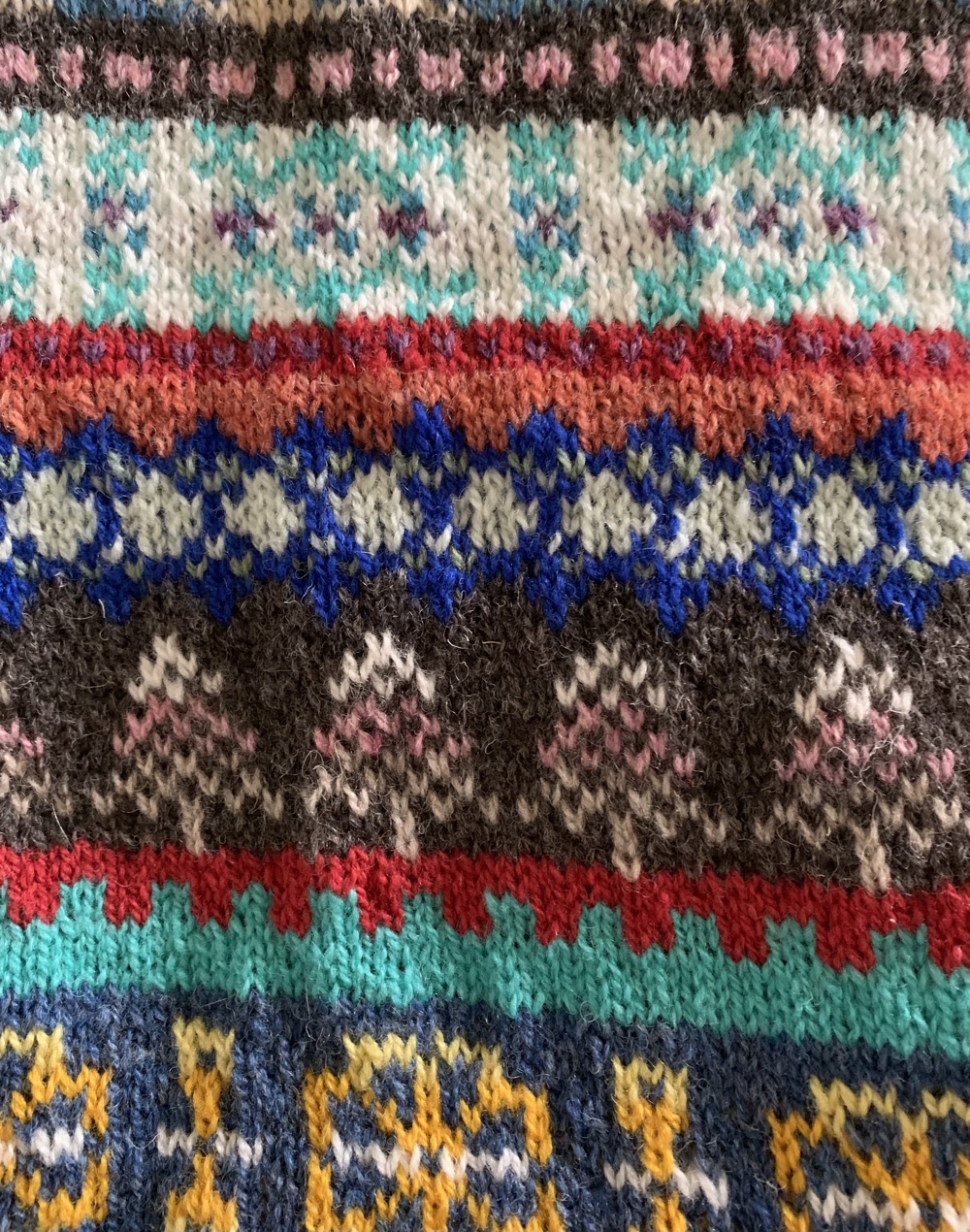
I began this scarf project out of boredom. It is my love for knitting colorwork that I needed a project like this. My stitch count is 100 and the repeating patterns must fit into that count. Patterns must evenly divide into 100.
Or, I can create an extra stitch. For instance, on the “people” pattern I had to add one more space (extra gray stitch) between them to make the stitch count work. I believe it was 19, and I made the repeat 20.
I’ve had fun choosing patterns and making some up myself (very simple ones). I think this type of knitting, with blocks of different patterns and colors, has a name.
All of this scarf is Fair Isle, meaning I use only two colors per row. Some rows are one color only, but I never use more than two at a time. I hold the dominant yarn in my left hand and knit it continental style, while knitting with the other color English style.
I found this fun blog post at Talvi Knits that talks about knitting in two passes when using more than two colors in a row. It sounds like mosaic knitting, but using more yarn colors. It sounds pretty confusing!
All I needed to do was to find repeating patterns with numbers that divided evenly into 100. There weren’t that many. You’d be surprised at how many repeats are4, 6, 8 and 12!
Occasionally, I don’t like the design once it’s knit. I’m not very good with selecting colors to combine. Because I am using only stash yarn, I have a limited amount of color variety to use.
It doesn’t matter on this project. I may never have a chance to wear this scarf anyway. I live in Florida where no one ever wears a scarf.
Beginner knitters lesson #2 for knitting the Landscape Lessons scarf deals with purling, stockinette and seed stitch.
This is my second post about knitting a beginner scarf. Read Lesson #1 here. There is no written pattern for it, we are simply practicing knitting and purling in combinations that create interesting designs.
Anyone knitting the scarf is free to knit whichever stitches, for however many rows, as you’d like.
Along the way I will do some basic stitches that would be good for all knitters to know. If you feel willing to try them out, go for it.
We began by casting on 35 stitches with worsted weight yarn. My scarf measures 9 inches across. See Lesson #1.
Please ignore the fact that my yarn colors are changing. You should knit in one color – one skein. I am trying to use up some leftover yarn. I will help you learn to add a new skein, or color, in the next lesson. For now, as a beginner, just worry about learning the stitches.
You can knit your entire scarf in garter stitch if you want to!
For those who want to learn more, we will now do purl stitches. I’ll include good videos I’ve found to help with each step.
ALSO… don’t worry about making mistakes. The only way to fix a knitting mistake is to “un-knit” or Tink. This is quite difficult when you are first starting out. When I began knitting I simply left my mistakes to become part of the project! In fact, I sometimes still do that! Unless your mistake is horrendous, and you can’t stand it, leave it until you learn to un-knit. You can remove the yarn from the needles and unravel the whole thing is you want to begin again. That is up to you.
How to Purl
Besides knitting, you will want to know the purl stitch. It is very similar to the knit stitch except the yarn and needle come to the front. Your yarn has been coming around the needle from the back when you did your knitting rows. Now the yarn will be in front and your needle will go into the stitch as you see in my photo below. Forget about that strand, it just needs to be in front of your work before you insert the needle.
Here is an excellent purl stitch video.
My photos below show the needle placement to purl, and how the purl stitch will look on your needles. These are known as purl bumps. It’s good to know what stitches look like. Once you can do knits and purls, you are well on your way in the knitting world. These stitches can combine in many ways to create all kinds of designs.
Insert the needle to purlPurl bumps – these are purl stitches
A Little About Knitting Stockinette
Stockinette creates a smooth looking fabric. You can see how your garter stitch section – the beginning of your scarf – is bumpy on both sides. Knitting one row and purling the next will create a more smooth fabric.
You should be able to see the difference. Stockinette is more flat and smooth. In fact, that is how I remember which is which. Think of stockings being smooth on the leg.
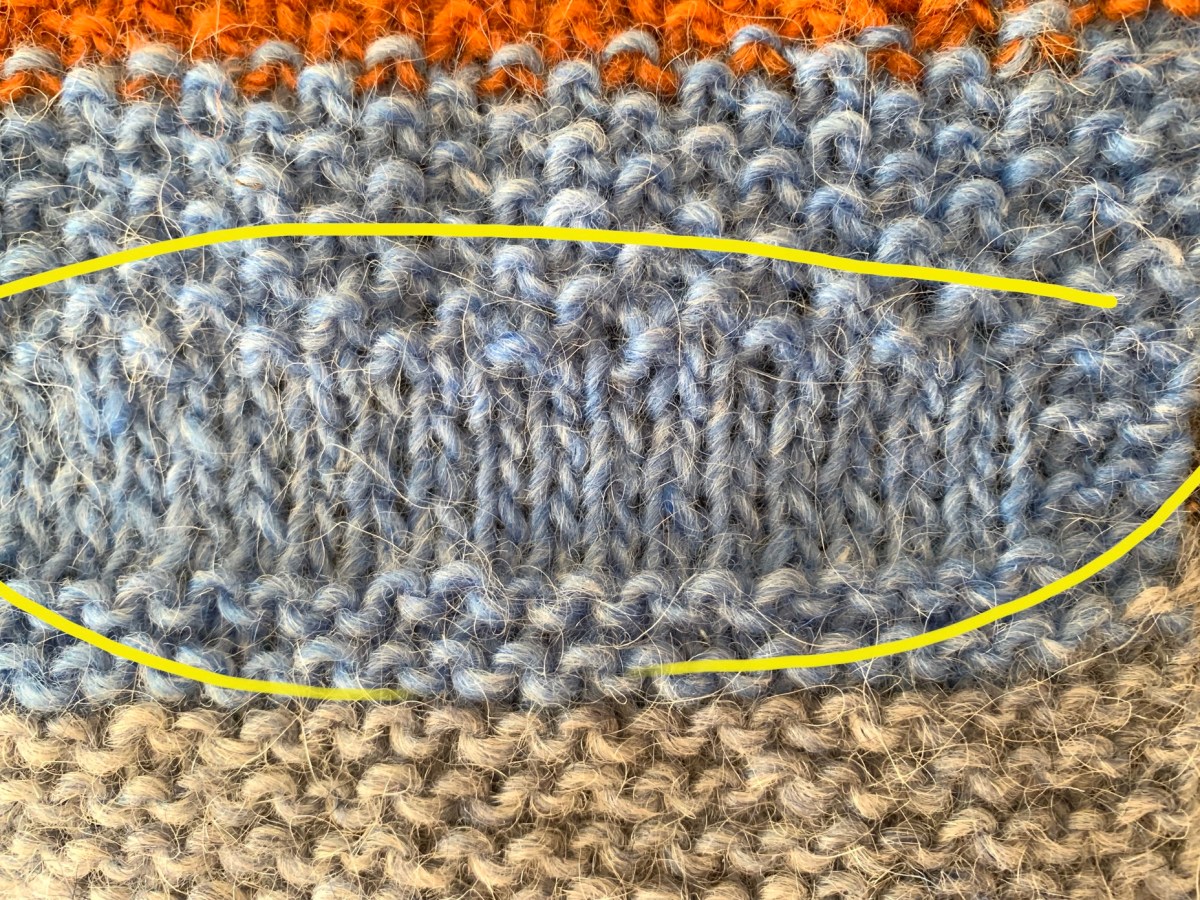
My photos below show the garter section, then my change to stockinette and last, the section in my knitting that is the stockinette. Above that, I did the seed stitch. More on that down the page.
Because stockinette tends to make a flat knitting project curl, I only did a few rows on my scarf. And I added garter stitch borders to our rows. For this reason, I suggest you only do a few rows of stockinette. This is our practice with making the purl stitch.
Our scarf will not have a “front” and “back” so don’t worry when – which end – you begin your stockinette knitting. After you finish knitting a row, turn the work and you are ready to begin the purl row.
The video link below is what we will be doing for the next few rows on our scarf, except that I have given our scarf a border of knitting only.
Knitting the Landscape Lessons Scarf Stockinette Section
Row 1 of stockinette: We will knit three stitches, then begin to purl. Purl across to the last 3 stitches and knit the last three.
Remember to switch your yarn to the front for purling, and back again when you knit. Try to remember to knit those edge stitches at the beginning and end of the rows.
End with three knit stitches
Turn the work. Row 2: You will knit this row, just like you have been doing for the first part of your scarf. The edge stitches will always be knit, so you don’t have to do anything differently on this row… simple knitting across.
Row 3: same as Row 1 – Knit the first three stitches and then purl across to the last three. Knit those last 3.
I only made about five rows, and ended after knitting a purl row.
Now you will begin the next section with the knit side showing, like in my photo on the left below.
#1: Stockinette section Seed Stitch section: Knits and purls
The Seed Stitch Section
If this all seems to be too much for you, please just knit along however makes you happy. Once you know how to do both the knit and purl stitch, these are just more options for practice. After the stockinette section, you can go back to knitting garter – knit every row. As you progress with your scarf, you may want to give this section a try.
The seed stitch is made by alternating knits and purls. That’s all. If you are interested in trying this, here is how I did my seed stitch section on the scarf.
Seed Stitch Section
Row 1: Knit the first three stitches (this is our border on both sides of the scarf). *Purl 1, knit 1, across the row alternating knits and purls, ending with a purl stitch (if your stitch count is 35 like mine). Knit the last three stitches.
Turn the work and do the same thing as row one. Because we are purling that last stitch on the previous row, it now looks like a knit when we turn the work over. Therefore we begin with the opposite – a purl.
For the seed stitch to work, we knit the stitches that had been purled on the previous row. We also purl the knit stitches. This alternates stitches to create a cool, bumpy look.
Seed Stitch, alternating knits and purls and doing the opposite on the following row.
You really must become familiar with how knits and purls look. If you lose your place, or set your knitting down, knowing which stitch to do next is important. (Also remember your yarn comes off the right hand needle if you start in the middle of a row.)
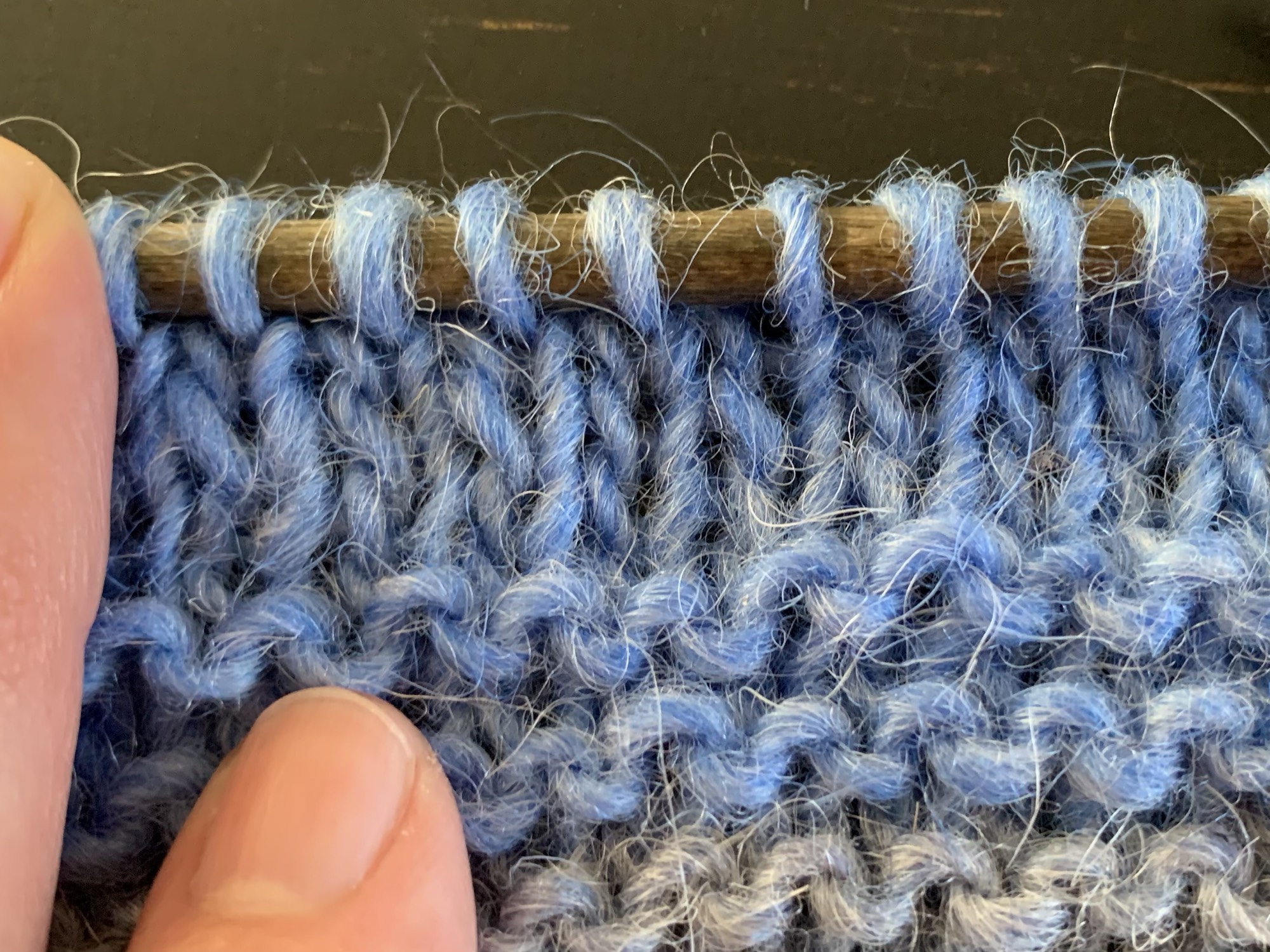
In my photo below, can you see the purl “bumps” and knit stitches on my needle? I am knitting with a very woolly yarn and if your yarn is smoother, the stitches may stand out even more. If it’s hard to tell, pull down on the fabric to make those bumps and V’s clearer.
If you lose your place on the seed stitch section, look at what is on your needle. It will tell you which stitch to make next. If you mess up, fix it on the next row.
If you hate it, go back to knitting every row until you feel better. Knitting should be calming and not stressful. If you do a lot of knitting your hand may hurt, so don’t overdo it. Remember that every stitch you make gets you closer to becoming a great knitter!
Knits and purls
I hope my tutorial makes sense to a beginner knitter. Once we are familiar with all of this, it’s tough to remember exactly how it was when beginning to knit.
I am by no means an expert. There are many things I still have not accomplished in knitting. It takes practice, and this scarf is a very good way to get the practice you need with basic stitches.
One of my very first scarves was knit all in seed stitch. It was my favorite scarf when I lived in the north.
Landscape Lessons Scarf: Lessons by Number
Lesson #1 – Yarn, needles, casting on, and knitting back and forth.



























 New England's Narrow Road