Teaching a Friend How to Knit a Scarf, Landscape Lesson #1

Want to learn to knit? Come learn how to knit a scarf with us from beginning to end. A good friend wants to learn to knit but she lives far away, so I’m writing her lessons on my blog! Are you a beginner knitter? Come join us for the fun.

A scarf is a great beginner pattern when learning how to knit. It’s what I knit the most, before graduating to knitting hats. A long, straight (knitting back and forth) project that should give the beginner lots of practice with knits and purls. And you just may have a beautiful and unique item to wear around your neck next winter.

I’ve decided to knit my own scarf as I show a beginner how to start. I live in Florida and my friend lives in New York. So she will be learning online. I have learned many things about knitting from YouTube, so I’ll include some favorite YouTube knitting tutorials.

Yarn and Needles

My friend had some very good and basic questions such as, what needles should I use and what kind of yarn? Obviously you need both of those things!

First buy some yarn, and look at the yarn band info. It should say what size needle is needed to knit with this yarn. The weight, or thickness, of the yarn will determine the size (thickness) of the needles. In the example skeins below, knitting needle size suggestion is US 1-3 (needle size can also be in mm). This is a thin yarn called fingering, so it needs a small needle. 

Hot Shot Toes mini skeins of yarn
Miss Babs mini skeins of sock yarn

What is a circular needle?

Knitting can be done with either straight needles or circular. Circular needles allow the knitter to join their knitting and knit in the round. This is something you can’t do with straight needles. Think of a hat, cowl, or sweater that is circular. But this type of needle can also be used for plain old knitting – flat, like a scarf. Pretend the needles are not joined by a cable. Or, use a pair of normal, straight needles if it makes you feel better.

Read more about buying needles on my previous post.

What I Am Using To Knit My Landscape Lessons Scarf

I am naming this scarf so it will be easier to find and it will be “Landscape Lessons” because I plan to show you some very basic knit and purl combinations along the way. It’s all about practice and deciding which combinations you favor.

If you live near a yarn store, or craft store, go there and pick out some yarn you like. Otherwise, I can suggest Wool and Company, an online site that ships yarn for free – no minimum purchase required.

I am using Lykke brand wooden circular needles with Lettlopi wool yarn.

knitting with wool on circular needle
Size 8 circular needles and wool yarn

Some yarn skeins will need to be wound before using. If your skein is twisted – like the Miss Baby yarn in my photo above, it will have to be wound. Skeins, like the Lettlopi above, do not need winding.

Cast On

Once you have your yarn and needles, you will cast on. I have written a whole page about various cast on methods, but beginners can use the very simplest.

The video below is excellent, except that I would not suggest bulky yarn. Big needles and bulky yarn can make your hands tired after a while. You can do this same thing with worsted weight yarn and see the stitches fine.

In the video below, she shows how to make the slip knot, begin casting on, knitting back and forth, and binding off! Who needs me? Haha… She also knits right handed, and “throws” the yarn. This is exactly how I knit. (Some people knit continental, which is different, and I’m not getting into right now.)

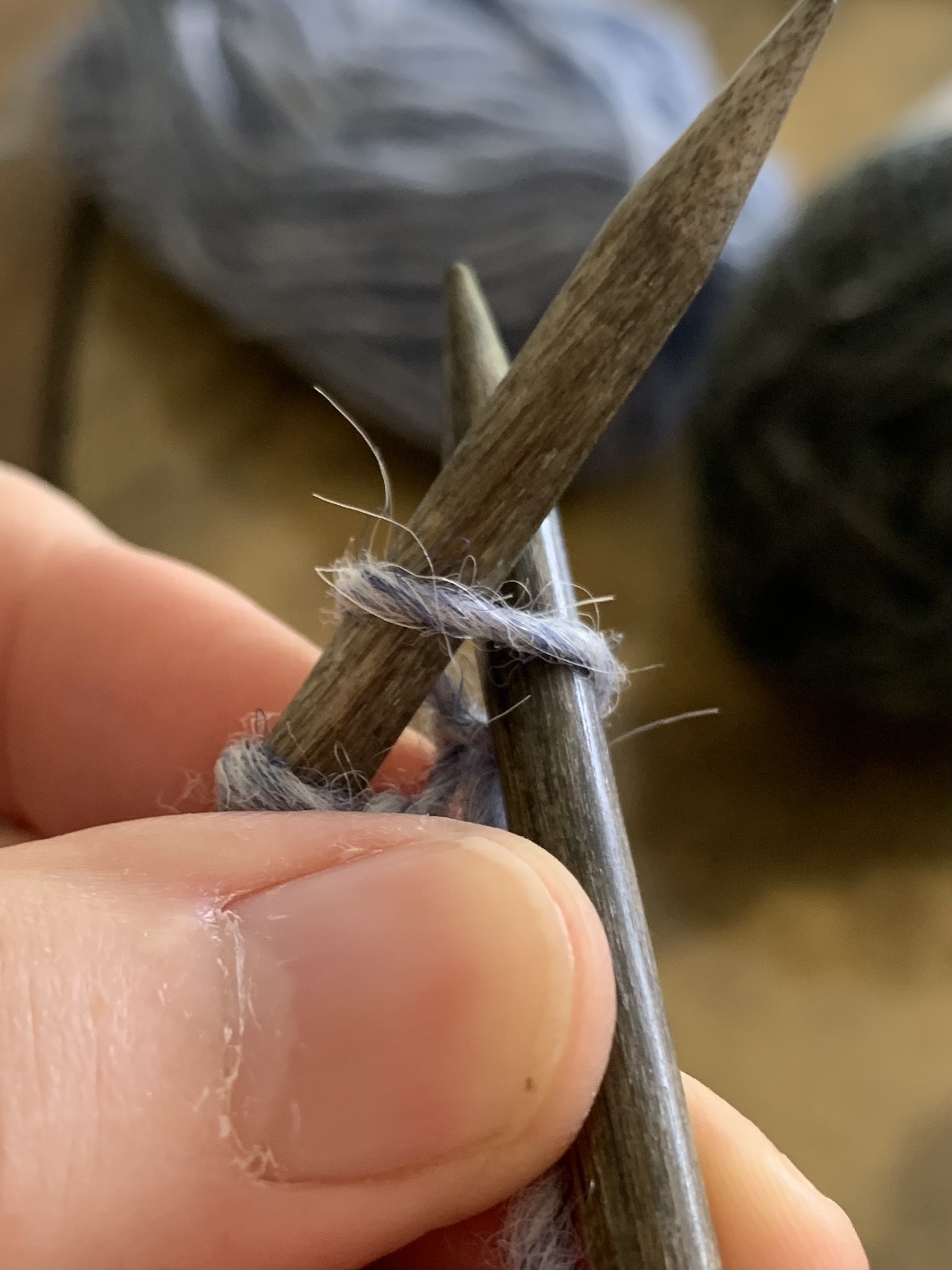
Well, I do have one suggestion. When she casts on, she is putting her right-hand needle between the two strands and is using only one. This is also how you do the knit stitch – The right needle goes between the two on the needle (photo 2 below).

However, you can also put your needle under BOTH strands for the cast on (photo 1 below). Do the cast on the same way, just stick the needle right under the entire stitch. Either way will still make a nice cast on. Going under both strands makes a sturdier cast on, or something. I forget. Don’t do that while knitting… do it only for the cast on row.

This is a great video, but don’t do the cast off… if you want to knit a scarf, we must continue knitting. I have some changes in store, just in case you want to branch out and try something new along the way.

For my Landscape Lessons Scarf you will cast on, and knit back and forth for as many rows as you like. This will be one end of your scarf. By knitting back and forth, it will help you get a feel for the basic knit stitch.

A light color yarn makes stitches easier to see the stitches!

Do as the woman does in the video above and cast on your stitches. This will be the width of your scarf. If you are using worsted weight yarn with size 7 or 8 needles, cast on 35 stitches. This should make your scarf around 7 inches in width (after I began knitting, my scarf is more like 8.5 inches). Everyone knits differently, so width may be different. You won’t be able to see the actual width until you have knit quite a few rows. Don’t measure the cast on row!

Some people knit English style, and others prefer Continental. Here is a video explaining the difference.

Do as she does in the video and knit back and forth – she is knitting English style.

If you are using circular needles, do the exact same thing as she does using straight needles. Turn the work, and begin knitting again. Forget the cord is there attaching your needles.

The reason I suggest buying circular needles is that they can be used for more things later on if you find you really love knitting. I rarely ever use straight needles for anything these days.

Read This – a Helpful Hint

Let’s say you have to set your knitting down and you just plop it on the table, or into the basket. When you come back to continue knitting you must know where to begin.

I’ve made this mistake back when I began knitting. It’s easy to pick up the work and begin knitting in the wrong direction, unless you know this:

Don’t just pick up the project and flip the yarn to the back and begin knitting. Photo on the left shows the yarn in the wrong place. Turn the work around so that the yarn is coming off the right hand needle. Then begin.

This page should provide the start to an easy, beginner knitting project. Let me know how you do, or if there are question. When these skills are mastered, please proceed to Lesson #2.

Go On to Lesson #2


More Knitting Stories From the Blog

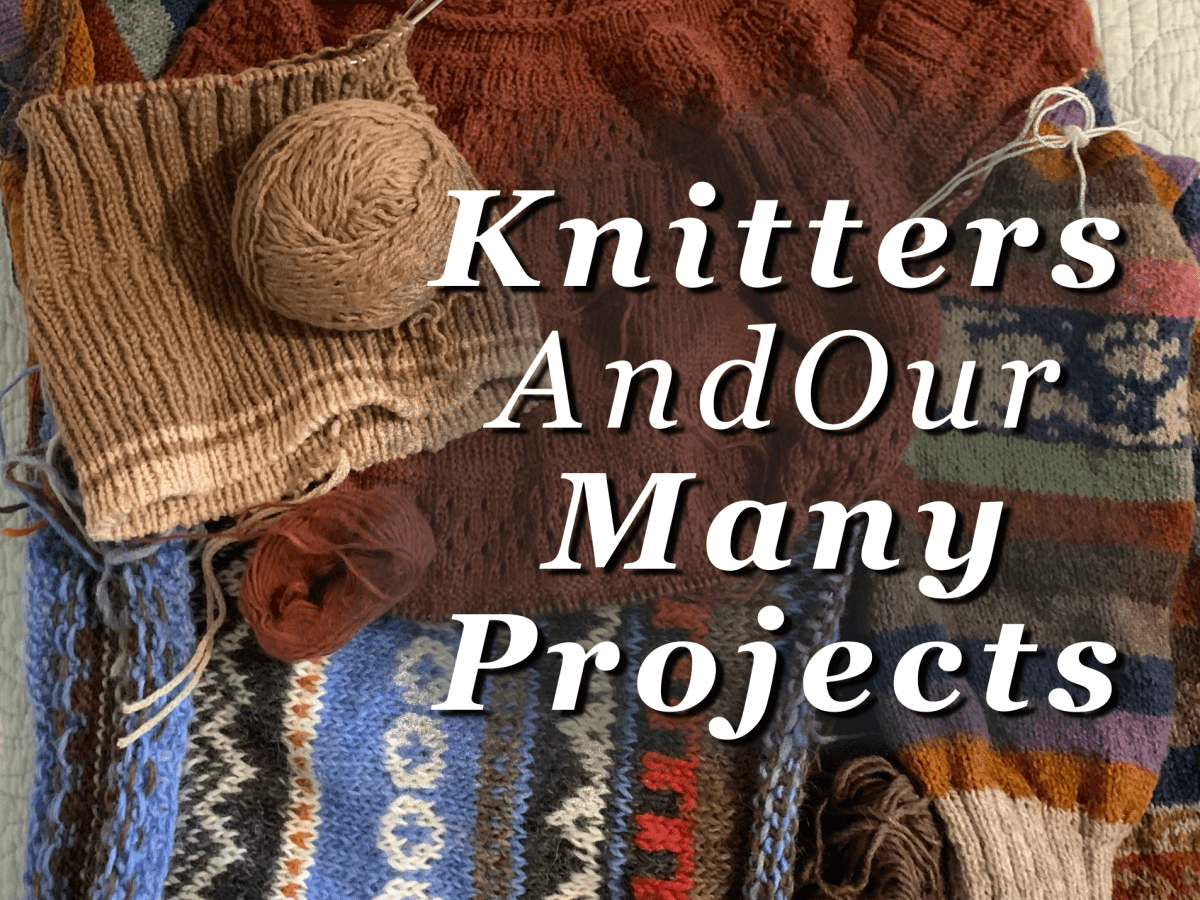
Knitters and Our Many Projects

How many projects do you have on your needles? It is not uncommon to find that fellow knitters have many things going at once.
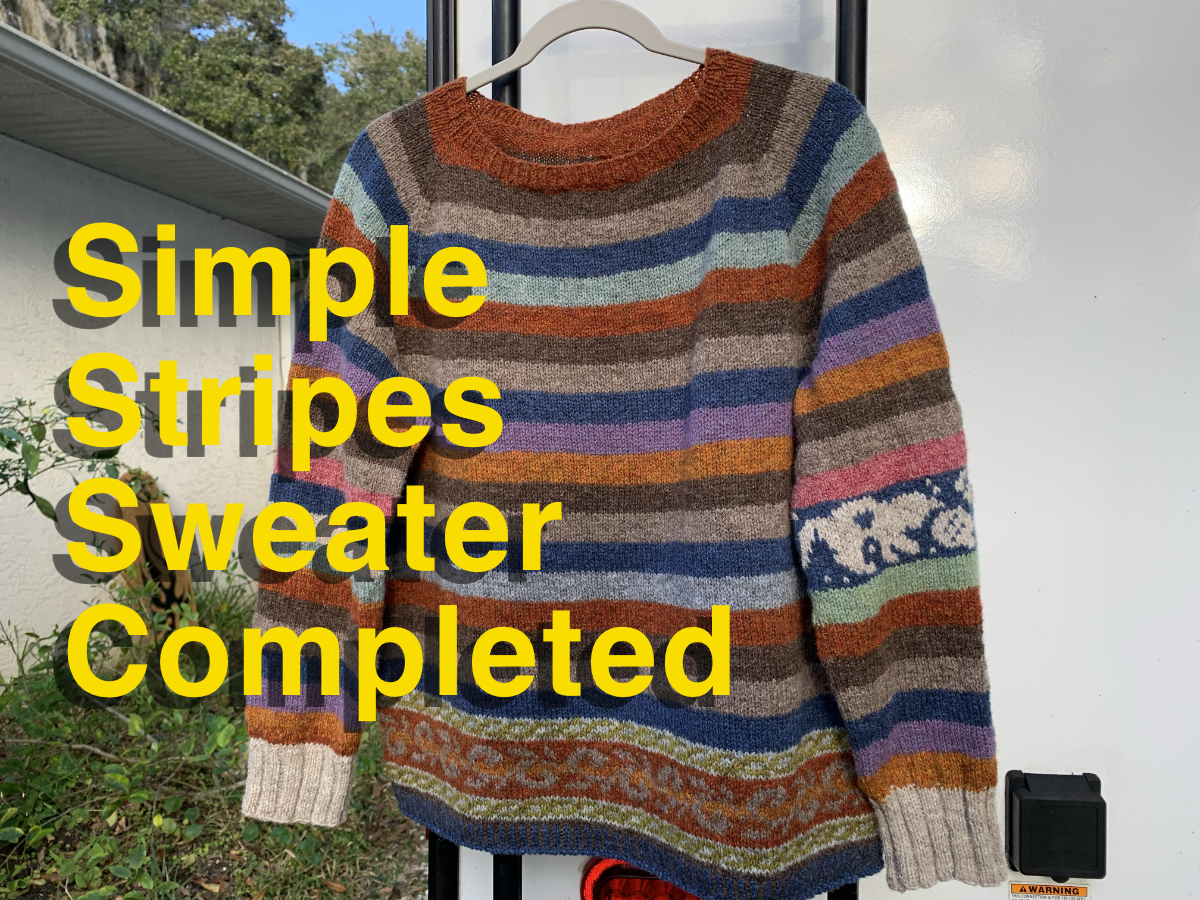
Year-Round Camping in Florida; Enjoying Nature While I Knit

The peaceful days of camping in the wilderness go perfectly with knitting. What could be better than having coffee outside, with knitting on my lap? We camped twice in the last month and here is a look at the knitting projects I took along.

Heading Into Summer – Four Projects On the Needles

Here’s what I am currently knitting. A couple of easy, free patterns, as well as a hat and sweater.

Because I live in a climate that is seldom considered to be “cool”, I knit with wool year round. I’m not sure what other knitters do, but this is the time of year when all the big yarn sellers come out with cotton, linen and silk yarns and showcase knitting projects for lightweight tops. I really don’t pay much attention to that because most “summer” projects are still too hot to wear here in central Florida.

Currently I am finishing up four knitting projects I have been working on regularly. I like to have a variety of knitting going at once.

The Hidden Gems Shawl

For a while now I have avoided knitting “shawls” because I never wear them. I would love to, but in this hot and humid climate the last thing I want is something around my neck. But, when I saw “Hidden Gems” knit up in hands-spun yarn, I thought it was a beauty and it might be nice to have one.

Hidden Gems free shawl pattern
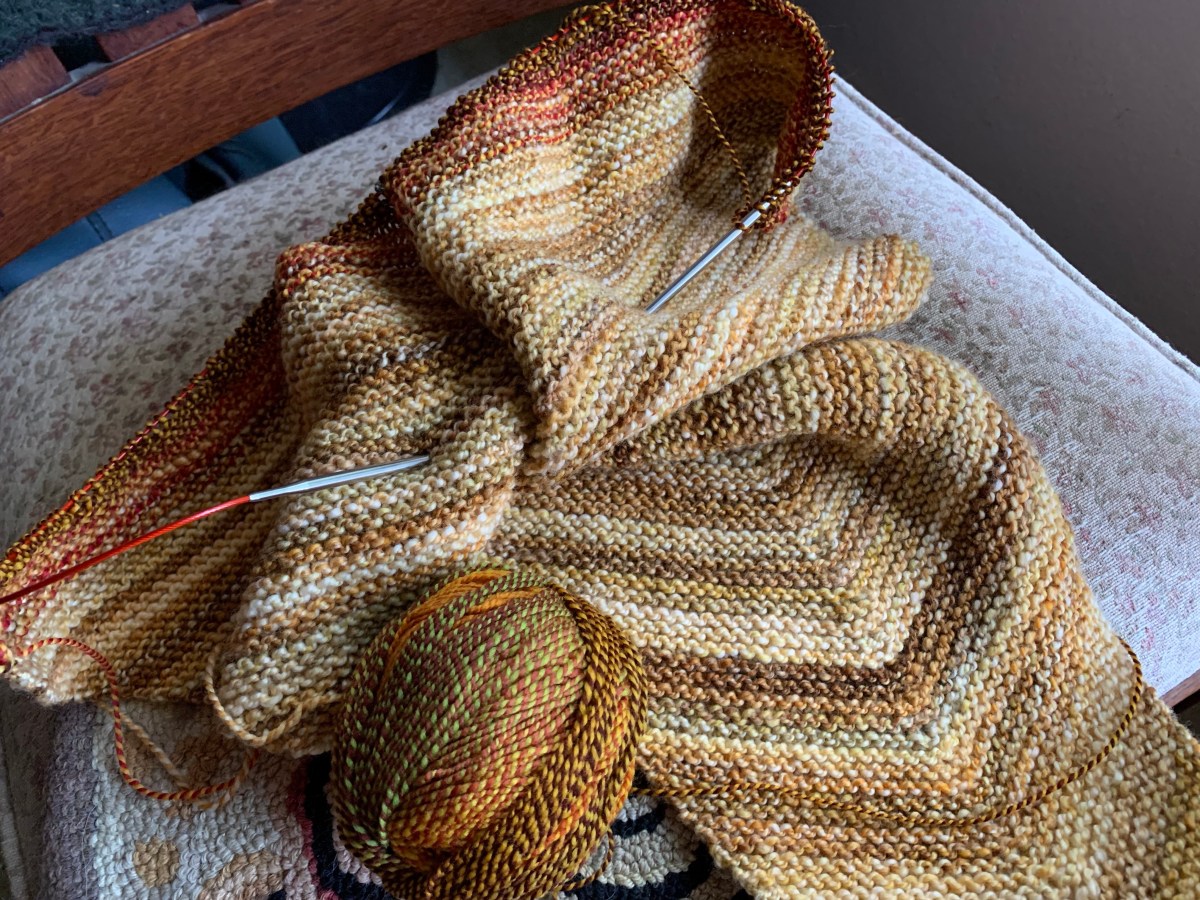
Hand-spun shawl / scarf

The shawl is more of a scarf in the shape of an elongated set of triangles – larger in the middle coming to points on each end. It is a free pattern, and could be knit using any type of yarn. This pattern would be great for a beginner knitter. It is mostly garter stitch with a few other stitches that would be good practice. You should know how to knit front and back, slip, slip knit, and knit 2 together.


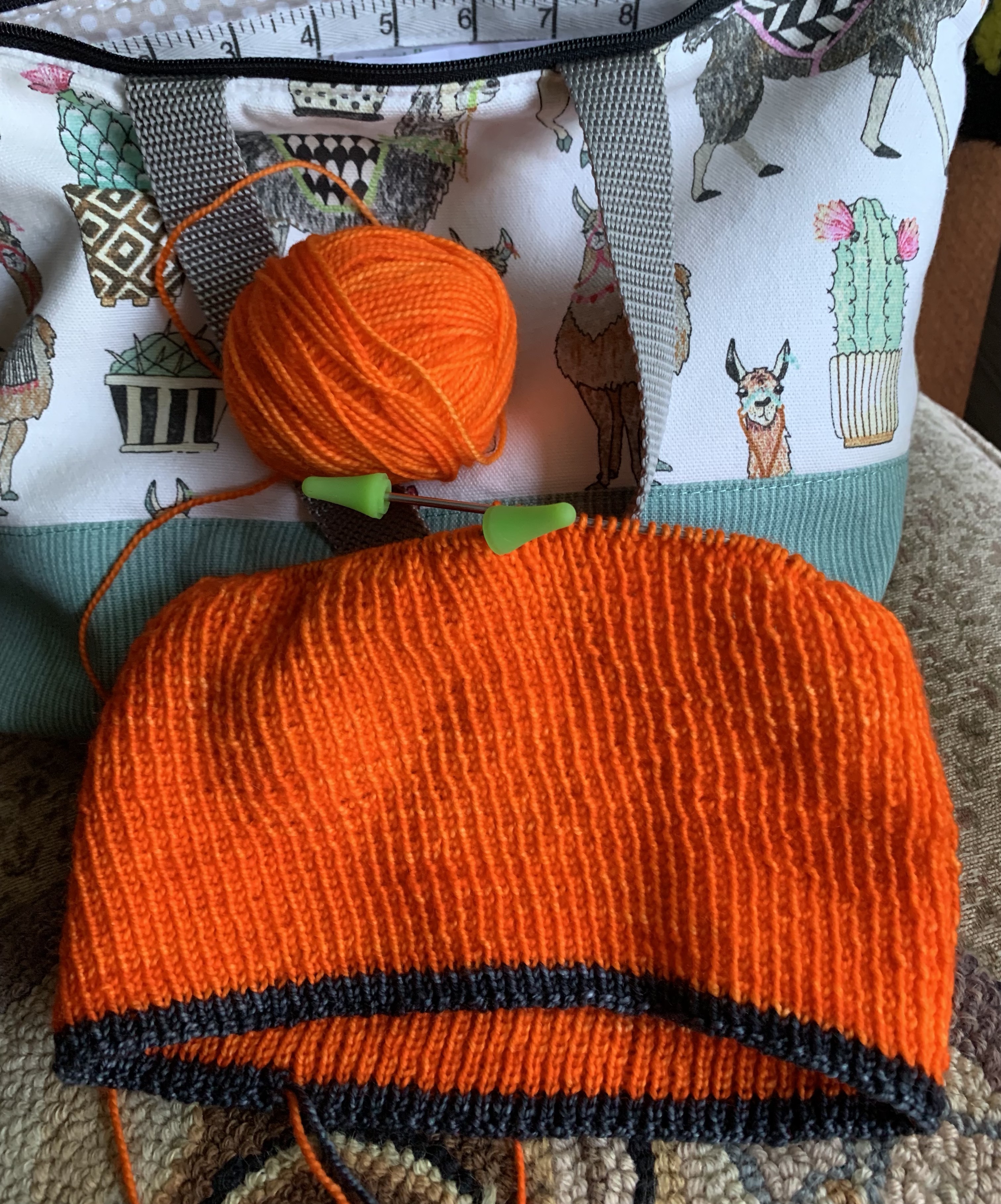
The Orange Slouchy Hat

I have knit this slouchy hat in light blue already. It is a tedious knit that seems to take forever and that makes it great as a take-along project AND becomes a very lovely everyday hat. I have mostly been knitting on this hat while traveling. I no longer have a car of my own, so I ride as a passenger everywhere. It is perfect for knitting this simple 1×1 ribbing.

orange hat knitting

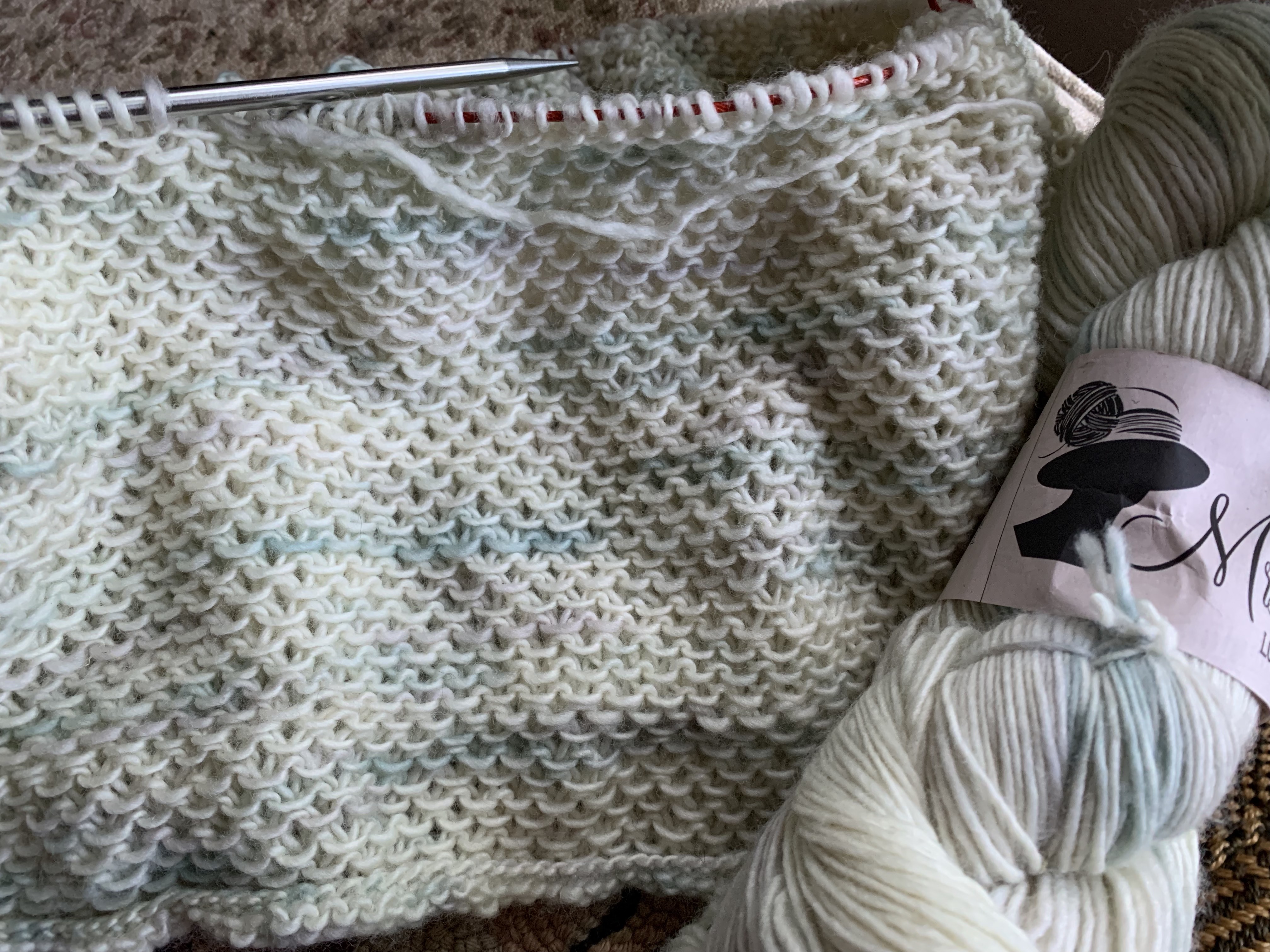
The Honey Cowl

The Honey Cowl is another simple (and FREE) pattern that is perfect for take-along car rides, or TV knitting. This is my third Honey Cowl and it is another good pattern for a beginner knitter to try. Because stitches are slipped, this is a faster knit.

Honey cowl knitting Mrs. Crosby yarn

The Lopi Sweater

This sweater started as a vest. The vest directions were hard to understand, mainly because I have never knit a vest. After I knit the body part of the “vest” I had to switch to making it a sweater. The whole thing was pretty much made up as I went along.

As I write this the pullover is nearly finished. I mainly have weaving in of ends, washing and blocking left. There is no pattern for this, but I followed stitch counts (mostly) from Farfuglar.

Yoke section of Lopi wool sweater
Yoke patterning of the Lopi Sweater

The sweater is nearly finished, and once that is done with I will look for another sweater to knit. I already have yarn set aside for two patterns, so I will probably begin one of those. The simplicity of the hat, cowl and shawl patterns make them perfect for occasional knitting and there is no hurry in completing any of them.

Free and Fast Knits for Christmas Gifts: Scarves in Worsted

This page contains a list of free knitting (and some crocheting) patterns for scarves and cowls that will knit up quickly in worsted or bulky yarn. *Please note these items were free when this page was created, and that could change.

Christmas Gift Knitting

If you are like me and the majority of the population, waiting until the last minute is typical. We have busy lives and at holiday time it’s worse. The months leading up to holiday season is the ideal time to begin knitting those Christmas gifts. We know it, and yet many of us procrastinate.

It’s okay to begin knitting late in the season, if you can find some fast knits, done with heavy weight yarn – worsted or bulky. Personally I am keeping a list of the best machine-washable yarn I can find. I have grown boys who will absolutely not hand wash anything.

Scarves, cowls and hats are about the quickest projects, in my opinion, and I’ve listed mostly scarves, a few cowls, and one necktie, on this page. A page about free hat patterns is coming!

Knitting Scarves for Guys (Unisex)

Guys can be the most difficult to buy for and that is why hand-knits could be the perfect gift. When I search around Ravelry for patterns, I see that a lot of people knit (and crochet) for husbands, boyfriends, sons and grandsons. My own grown sons, even the one here in Florida, seem to appreciate the hats I’ve knit them.

The links below go to their corresponding Ravelry page where the pattern can be downloaded. Most scarf patterns are unisex and color will differentiate male or female. Please note: Most of these items I have not knit myself. I can’t vouch for the pattern and these are ideas only, not suggestions.

The nice thing about knitting a scarf is that gauge doesn’t really matter. A scarf pattern is pretty easy to convert from fingering weight to worsted or bulky. Cast on fewer stitches if your yarn is heavier. Scarves can be knit to any length desired.

Scarves and Cowls For Women

knitting divider

Free Crochet Patterns

Although I mostly knit, I do occasionally crochet so thought I’d include a few patterns here for the crocheters. These links are for scarves and hats, which are the easiest and fastest projects in my opinion.

This is just a few patterns out there for free. If you have any favorites, please share in the comments.

LATEST POSTS

Pattern Review: Beginning the Magnolia Chunky Cardigan

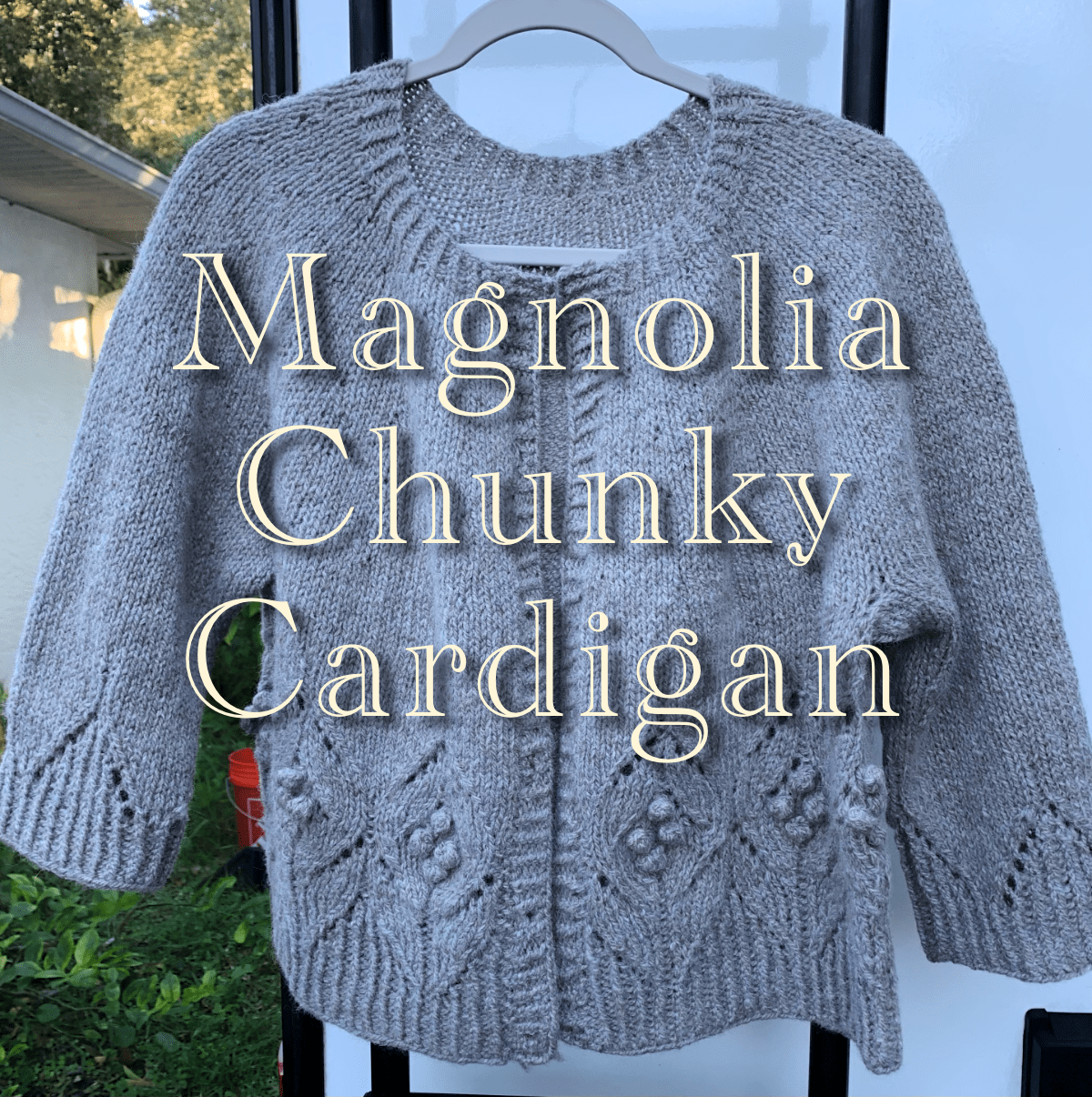
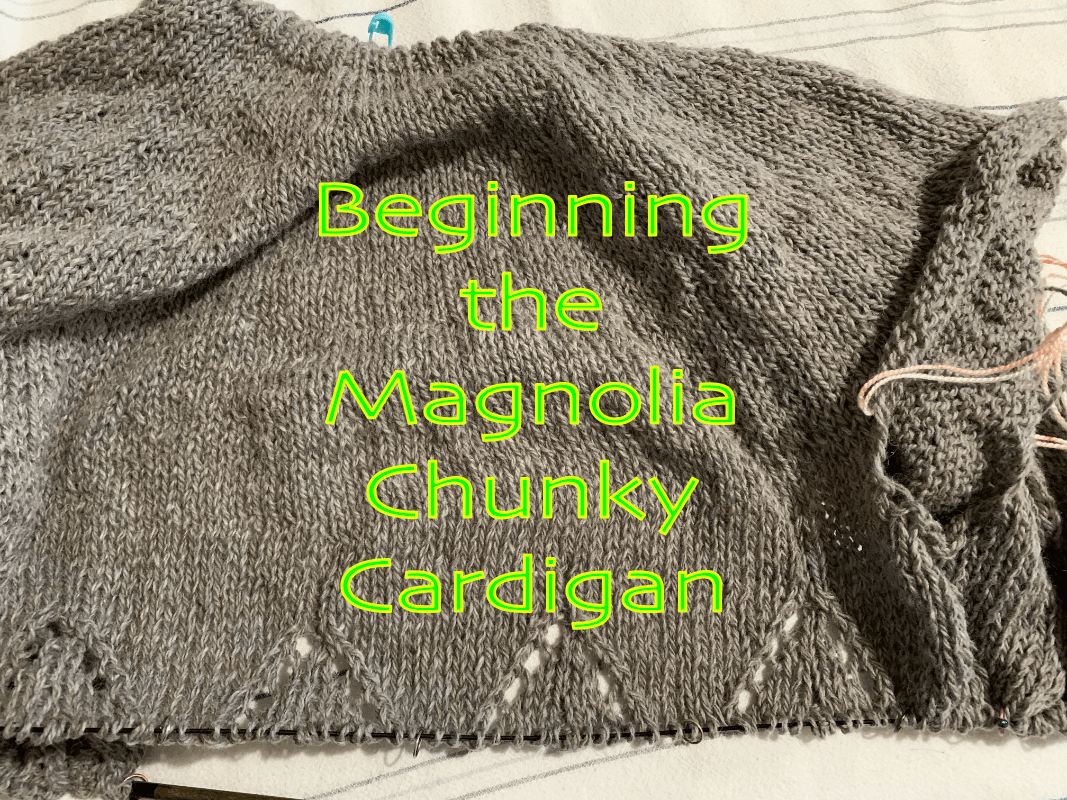
I’m knitting a beautiful cardigan pattern by Camilla Vad. The Magnolia Chunky Cardigan is knit top-down with lace and bobbles on the body and sleeves. On this page I cover some issues I had in the beginning.

First Attempt at Knitting Clotilde

I didn’t get far when I began the Clotilde Cardigan pattern, but it’s a good looking cardigan, and I’ll try knitting the pattern again.

Something went wrong. Please refresh the page and/or try again.

A Quick Little Scarf Knit For a Visit North

A trip to New Hampshire is planned – finally. With all this Covid stuff, New Englanders do not want visitors! I have not visited my children for over two years at this point. So it’s time.

I won’t be traveling in deep winter, but early Spring. It could still be cold and I suddenly thought about packing frugally for cold weather. Although I have loads of hand knits, most are bulky and I will only take one medium sized suitcase.

For this reason I decided to knit a smallish neck wrap.

I like the shape of crescent shawls. I wanted something not as big as a true scarf, and I wanted it to be useful and warm. Something I could just wrap around my neck on walks.

I’ve knit quite a few shawls and wraps, but few have been crescent shaped. My pattern collection has built up over the past couple of years and I began to dig through. It’s been a year of conserving and using up what I have, including yarn.

The Pattern is “Railings”, by Janina Kallio of Woolenberry

Railings is a pattern I had purchased and printed out a while ago, but never knit. To be sure of the shape, I looked it up on Ravelry and read the comments of other knitters. Many said it ended up too small, so I have added a few more rows.

Knitting the Railings crescent shawl
My Railings with stripes of mohair

First thing to consider, after the pattern was chosen, was color. I didn’t want sock yarn because I want this wrap to be warm. It also had to be soft. Digging through my stash, I found a ball of Anzula in dark gray. It is soft and wonderful and has 10% cashmere. To add some fuzziness, I made stripes of Anzula and mohair held together. White mohair would not have been my preferred choice, but it’s what I had.

I might run out of yarn, but I have more dark balls to use up. I’m not really concerned with color matching, just a warm and comfy end product.

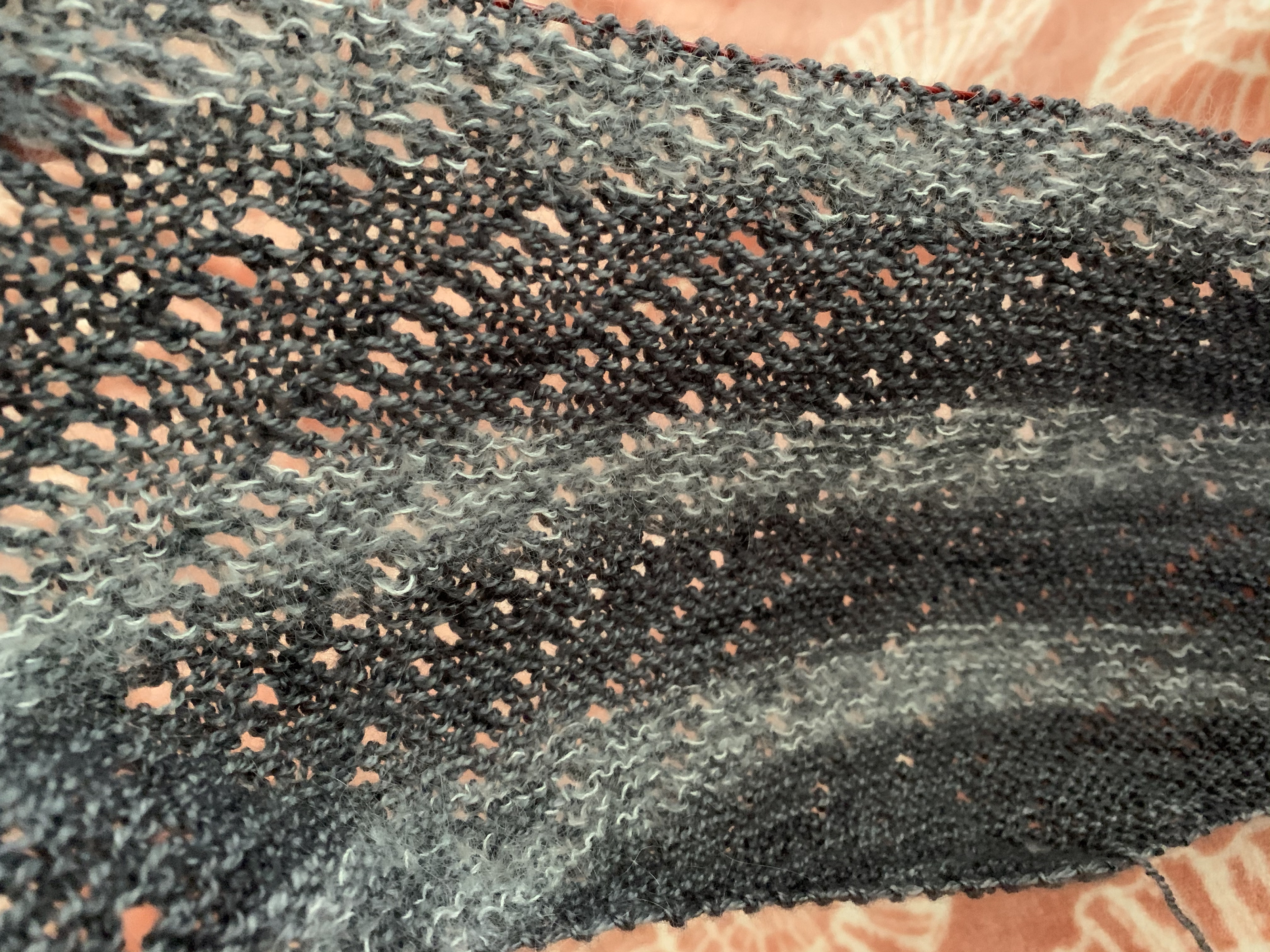
Railings crescent scarf in gray showing the pattern
Showing the patterning

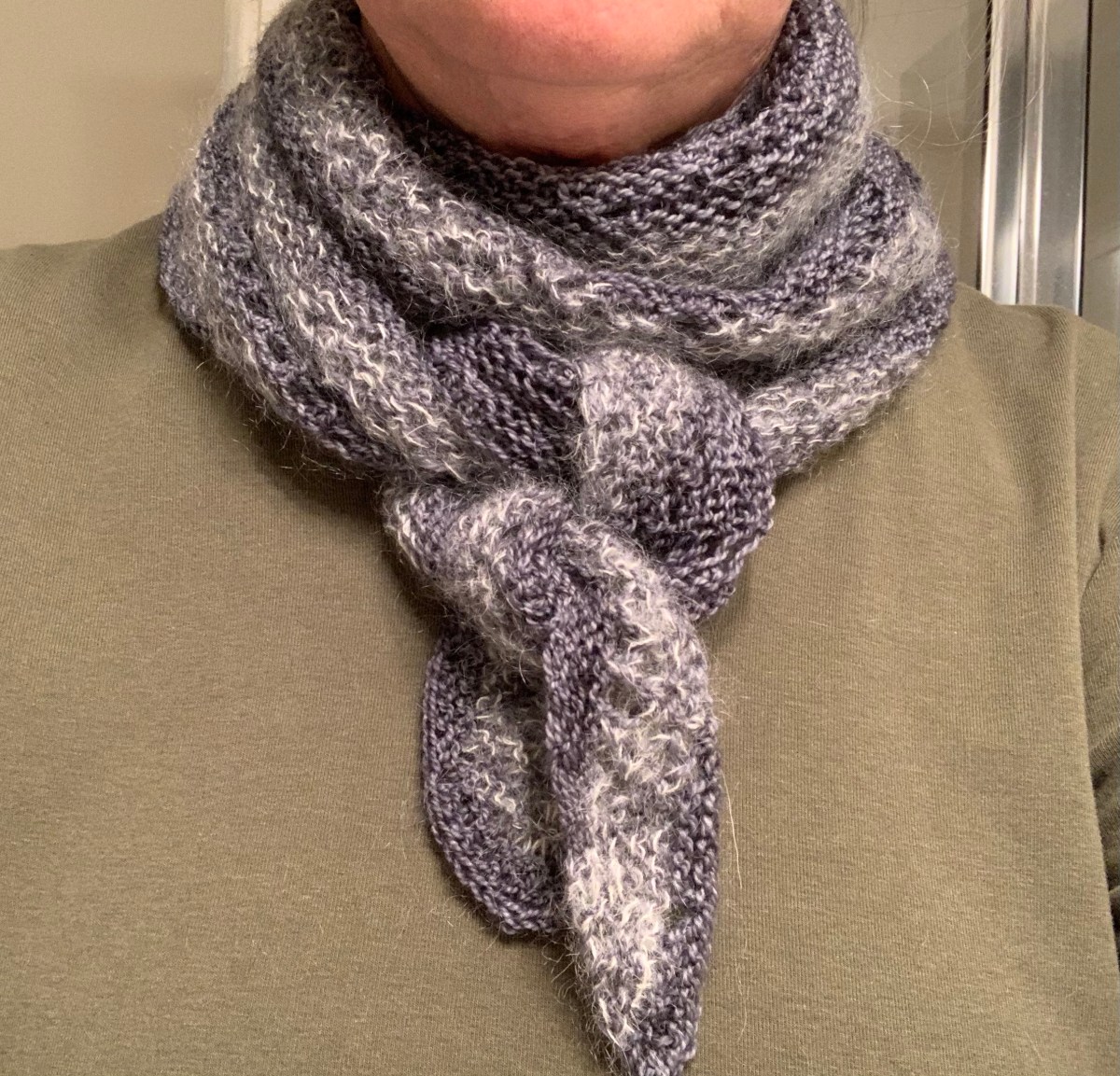
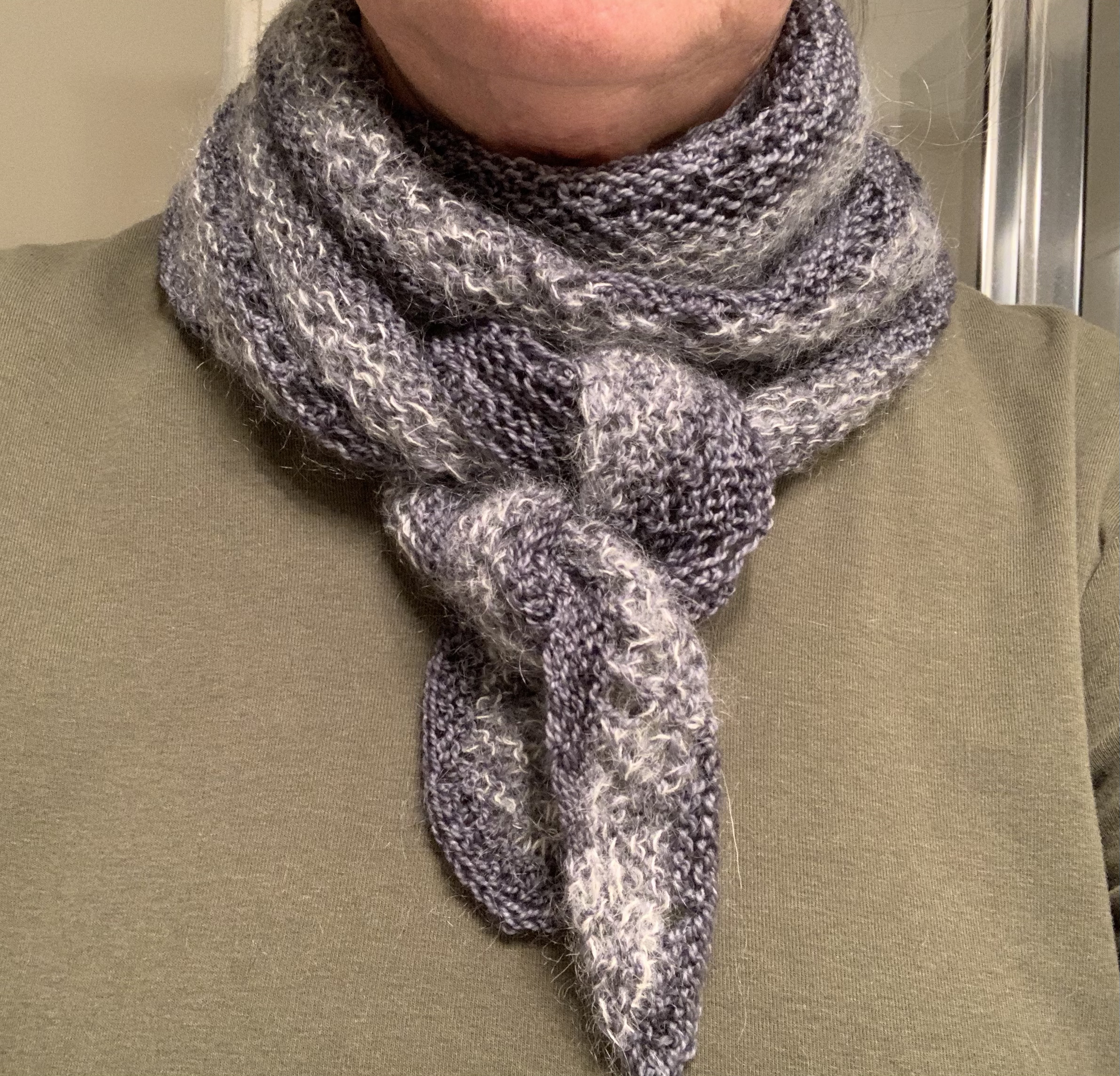
Railings crescent shaped scarf tied around my neck
This scarf is the perfect fit

The plan is to have this shawl wrap around my neck with the ends hanging down in front. *Update: photo above shows it wrapped and tied twice in front. I think it is the perfect size. The other thing I’d like to knit before my trip is a pair of fingerless mitts.

Woolenberry Patterns – She Does Shawls

When I think of Woolenberry, I think shawls. She is a good designer to follow if you are a bit of a beginner and want knitting practice. She offers a nice variety of fairly easy patterns which are easy to follow. She may also have more difficult patterns as I am not familiar with all she offers.

I have knit her Dewdrops shawl. It was an easy knit and is triangle shaped.