Leave No Tails! Three Ways to Join Yarn Ends

Here are some ways to join two yarn ends together while knitting to eliminate yarn tails.

Knitting is fun! Weaving in endless tails of yarn is not. On this page, I’ve written about three ways to join ends of yarn together that will eliminate tails. There will always be the cast-on and bind-off tails, but we’re talking about joining in a new ball, or color.

Unless you are knitting a small item, you will probably have to join a new ball of yarn to the project. Sweaters and large items require many skeins, and if colorwork is involved, even more.

Fair Isle projects, like the mitts below (shown inside out), require lots of color changes and therefore lots of ends! It took me a very long time to do all that weaving.

weaving in ends on Stellar Parallax mitts
Colorwork mitts and all the ends left to weave in!

I’ve always simply slipped the end of the new yarn over the needle, leaving a tail. That leaves two tails (the old and new) that must be woven in when the project is finished. These tails can add up, and the weaving in can be a project all on it’s own!

The ideas for joining yarn on this page make knitting a bit easier by NOT leaving any tails. Not every technique will work for every project. Know your yarn, and choose the join accordingly.

How to Do a Magic Knot – Works for (almost) any yarn, but might not be good for every type of project.

This is a simple way to join two yarn ends. But, I would not be inclined to use it except in certain circumstances. Personally, I don’t like knots. I’d be a little skeptical of the knot staying knotted, or popping through to the front side and looking bad.

Any yarn that comes apart easily would not work as the ends have to be tightly pulled.

Knitter’s Pride has a good page, with images and suggestions on when it’s best to use the Magic Knot.

Very Pink Knits has a good, slow-motion video on this technique.

I just knit the VENLIG sweater pattern with some Woolfolk nubby yarn. The skeins had a few knots here and there and I simply knit them in. With the fluffy texture of the wool, it would be hard to see this tiny knot even if it was on the front of the sweater.


How to Do a Russian Join – Uses a needle

The Russian join in knitting uses a tapestry needle to weave the yarn ends together. This method of joining two ends of yarn seems a little time-consuming, but looks better than a knot, IMO.

This join seems perfect for any type of yarn where a magic knot wouldn’t look okay, or the spit splice (read on) wouldn’t work.


How to Spit Splice Wool – No tools needed

The first two methods for joining yarn would work for nearly any type of yarn, but the spit splice is meant for wool. The water (or spit) and the friction of rubbing the yarn, are what turns two yarn strands into one. This splice will not work on Superwash, or any manmade washable fibers.

I’ve written before about how to do the spit splice because I used it on the Warm Up Sweater and Kate’s Poncho very successfully.

On the Warm Up pullover I created wide stripes, using two different brown yarns. This meant I had to change colors a lot. Because I used this yarn splicing method, I ended up with only a few tails – the cast-on, bind-off, and under the arms where I picked up the sleeve stitches.

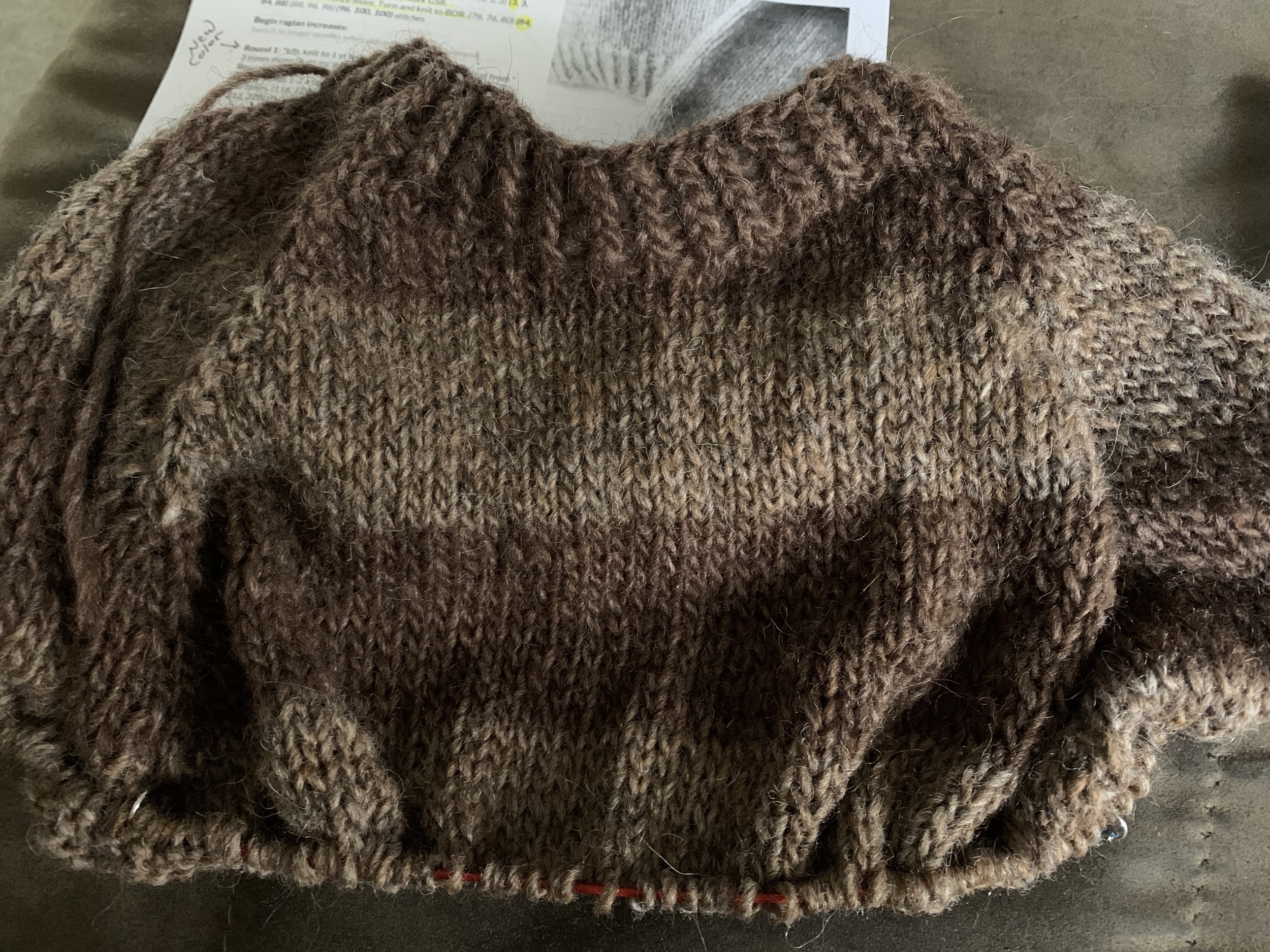
I find this to be an easy and nice splice to do. Unless two different colors are being joined, it’s tough to find the join section once it’s done. If knitting with wool is your preference, you must try this method.

A Spit Splicing How-To Video

Tin Can Knits has a short and to the point (my favorite kind) video below. What I do differently is unravel the yarn a bit to attach the strands. I suppose on smaller yarn like the type she is using, it wouldn’t be necessary.

A knot in a wool skein can be unknotted, or cut out, and re-joined using this method.

Do you have a favorite way of combining yarn ends? Please leave a comment.


More Knitting Adventures

Something went wrong. Please refresh the page and/or try again.

Picking Up Stitches The Easy Way For Garter Tab Cast On

When I began knitting a few years ago, I had no idea what it meant to “pick up and knit” or how to “pick up stitches”. Then, I knit a crescent shaped shawl and had to do a garter tab cast on. I remember watching a video that really didn’t help me much. I made a mess of the garter tab after four tries I said enough!

The garter tab cast on made absolutely no sense to me. It is often used to begin a shawl that is knit outward from the center top. Eventually I figured out that using a crochet hook to pull that yarn and pick it up was way easier than using a knitting needle – as I’d seen in some videos. But I was looking at the whole thing the wrong way. Use two needles and knit the stitches!

Often it’s difficult to find good knitting videos and if you find some you like, stick with those creators. For instance, Very Pink Knits has some good videos, although they are usually long because she likes to talk. Purl Soho has a few good videos – they get right down to business – but they don’t cover some techniques I’ve searched for. Brooklyn Tweed and Andrea Mowry are other video makers I like to watch.

For the Garter Tab cast on, I found Andrea Mowry’s Garter Tab video to be very helpful. Even after all this time, I finally learned how to do garter tab easily! Use a spare needle to pick up the stitches, and then knit them. It couldn’t be easier.

Some shawls I have knit which required a garter tab cast on.

  1. Moon Sisters – orange
  2. Sun Kissed – variegated
  3. Bays Edge – green
  4. Spindrift -purple (my first ever shawl and I’m not sure this one required a garter tab)
  • Moon Sisters Shawl
  • knitting sun-kissed shawl
  • knitting the Bays Edge shawl
  • knitting a shawl

Stephen West also does a garter tab video and shows off his fantastic shawls too (at the end). I’m not much of a shawl knitter but he made me want to start one. He’s also quite a character to watch.

In fact I would use this same procedure for picking up gusset stitches while knitting socks. This is truly the “pick up and knit” I’ve heard about.

Anyway, these are some links to help you get going with a shawl so you won’t dread that garter tab cast on.

More About Knitting Shawls

Why Knitters Need to Swatch and Get Gauge

Learning the importance of knitting a swatch and keeping that info for later. It’s not a waste of time, but a necessary part of knitting patterns.

I’ve been seriously knitting (as much as possible) for a couple of years now. I still consider myself a newbie to the knitting world. The more I knit, the more I realize I still have a lot to learn. (Photo at top: Miss Babs sends along this little bits of yarn to try out whenever I place an order, which I think is so cool!)

I want to say that I am a beginner in many ways. Swatching and getting gauge is still something I need to work on. I am searching for information on these subjects myself. This page is full of good links to help me as much as any reader.

Swatching is Not a Waste of Time

When I first began to read about swatching I thought it was going to be a tremendous waste of time. And then I would just have to unravel the swatch before I began knitting the item. What was this gauge thing and how off could I be? Plus, I really didn’t understand how to make a swatch.

This Very Pink Knits video was very helpful in making me understand more about making swatches.

Tie Knots For Needle Size Used When Swatching

In the Very Pink Knits video above, around 7:15, she will show you this handy trick to remember needle size used when swatching. Leave a long tail and tie one knot for each size. In my swatch samples below you can see I have 5 and 7 knots tied which means the dark green swatch was knit in a size 5 (US) and the lighter was knit with a size 7.

knots for needle size used in a swatch
Knots in the tail represent needle size used

I was thinking about swatching incorrectly. Each swatch can be kept as a reference to go back to and use when knitting something in the future. A swatch, made correctly, can be stored with other swatches to build an inventory over time. Of course labeling each one is important to remember the yarn used, needle size, etc.

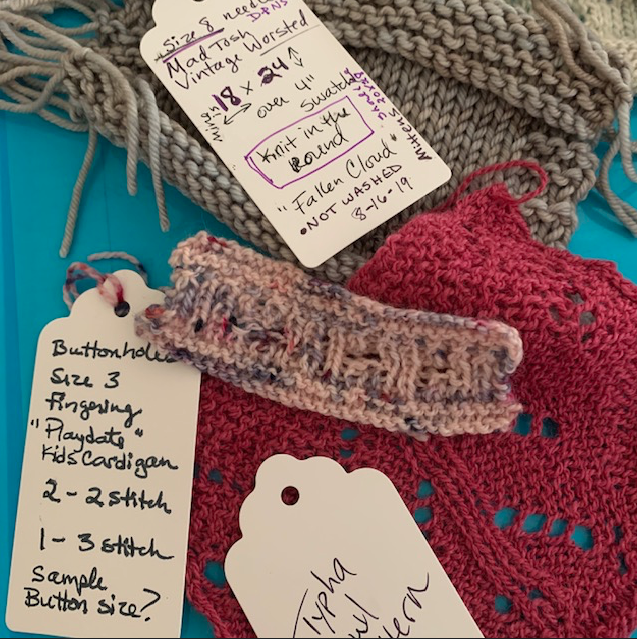
using tags to save swatches
Tags can be used to save swatch info, but must be attached to each swatch

Gauge is found by counting stitches across and also rows (up and down). Rows aren’t as important for scarves or items that can be a bit longer or shorter without a problem.

Changing needle size will help with gauge. Most times I need to go up a needle size to get gauge. This means I knit tightly and get more stitches in my 4 inch swatch count than there should be. When I go up to a bigger needle my stitches are bigger so there are fewer within the measurement. The type of yarn can also be a factor.

As you can imagine, not all knitwear designers knit the same, and they probably don’t knit the same way you do. And if you change yarn type – that matters too! This is why gauge is important to figure out before knitting something like a sweater. Pattern designers will give you the recommended gauge and you keep trying to knit swatches until you get that gauge – or very close to it.

Convert suggested needle sizes using this excellent chart (link below) which lists US, metric, and UK / Canadian sizes.

Knitting Needle Conversion Chart


Keep Reading: Recent Blog Posts

Learning How To Do Mosaic Knitting

Do you ever wonder how color-work knitting can be done flat? I’ve wondered if that is possible because I’ve only ever done color-work in the round.

Well, mosaic knitting is not really the same thing, but it can have the same effect with a pattern knit into a flat item, like a scarf, shawl, or cardigan.

I’ve been keeping my eyes peeled for my next sweater project. My top choices are either a stranded colorwork pullover, or a cardigan. Unless I do steeking, which I’ve never done, a cardigan can’t have patterning on the body because it’s flat knitting. Color-work is done during circular knitting. Unless… you do mosaic knitting.

The Boho Style Mosaic Cardigan pattern caught my eye. I love Bohemian styles. And this loose, flowing, cardigan has beautiful color-work on the body and sleeves. It is done with mosaic knitting as the name suggests.

Printable Mosaic Knitting Chart For a Swatch

If I am going to commit to knitting a big sweater using mosaic knitting, I’d like to know how it’s done. Before I began wading through bad YouTube videos, I thought I’d look for an article online explaining mosaic knitting. The Interweave site has a good article with a little chart to print out.

Basically if you can knit, purl and slip stitches, you can do mosaic knitting. It is a fast and easy way to create an interesting pattern.

I chose Chart 2 from the Interweave article. This chart does not show the purl side rows, but you don’t need them.

If chart knitting is not your thing, believe me, you will catch on quickly anyway. This little chart is great for a beginner. Once you follow the first couple of rows it will make sense, and you won’t believe how easy it is.

Go to the Interweave page and print out Chart #2.

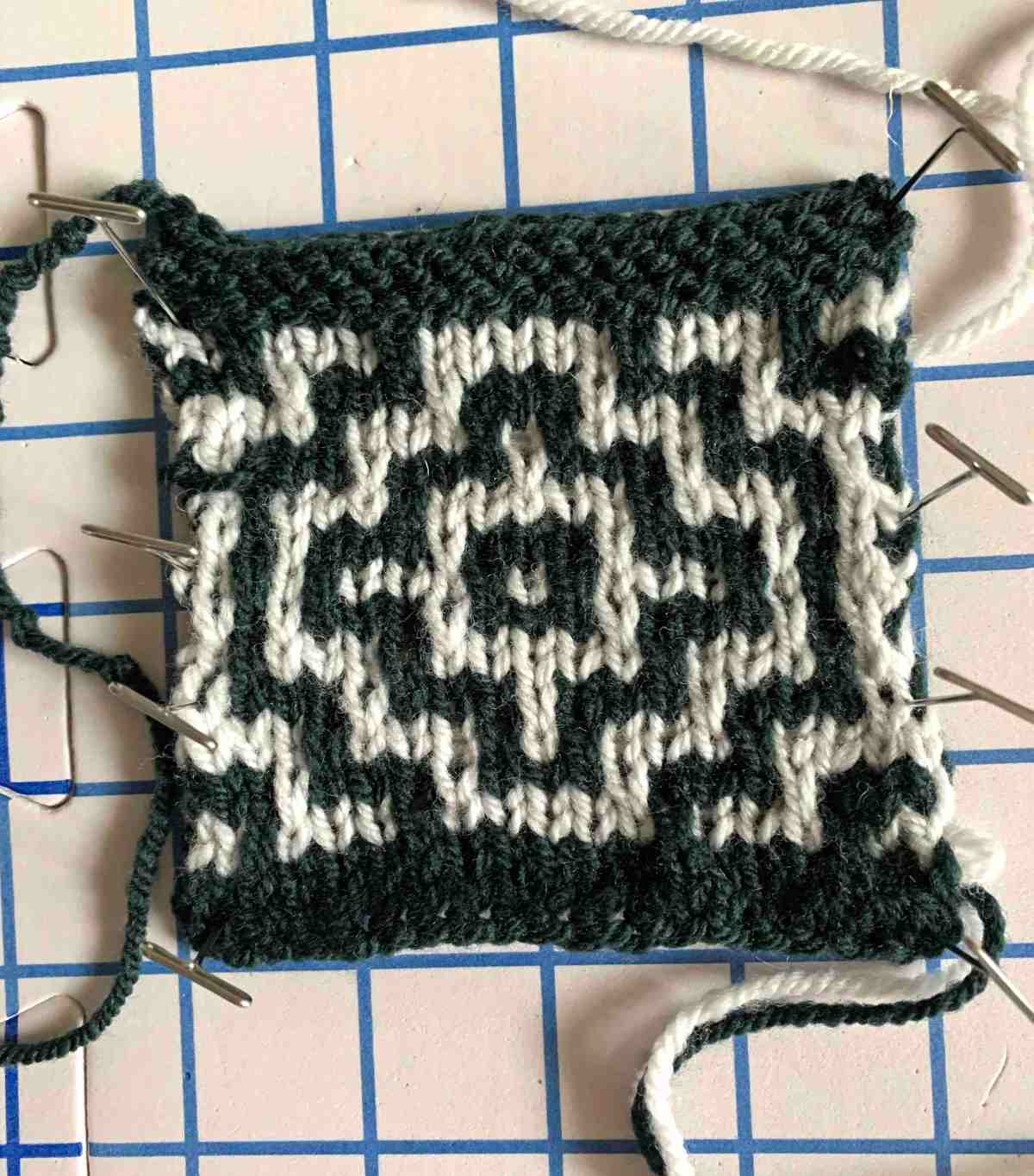
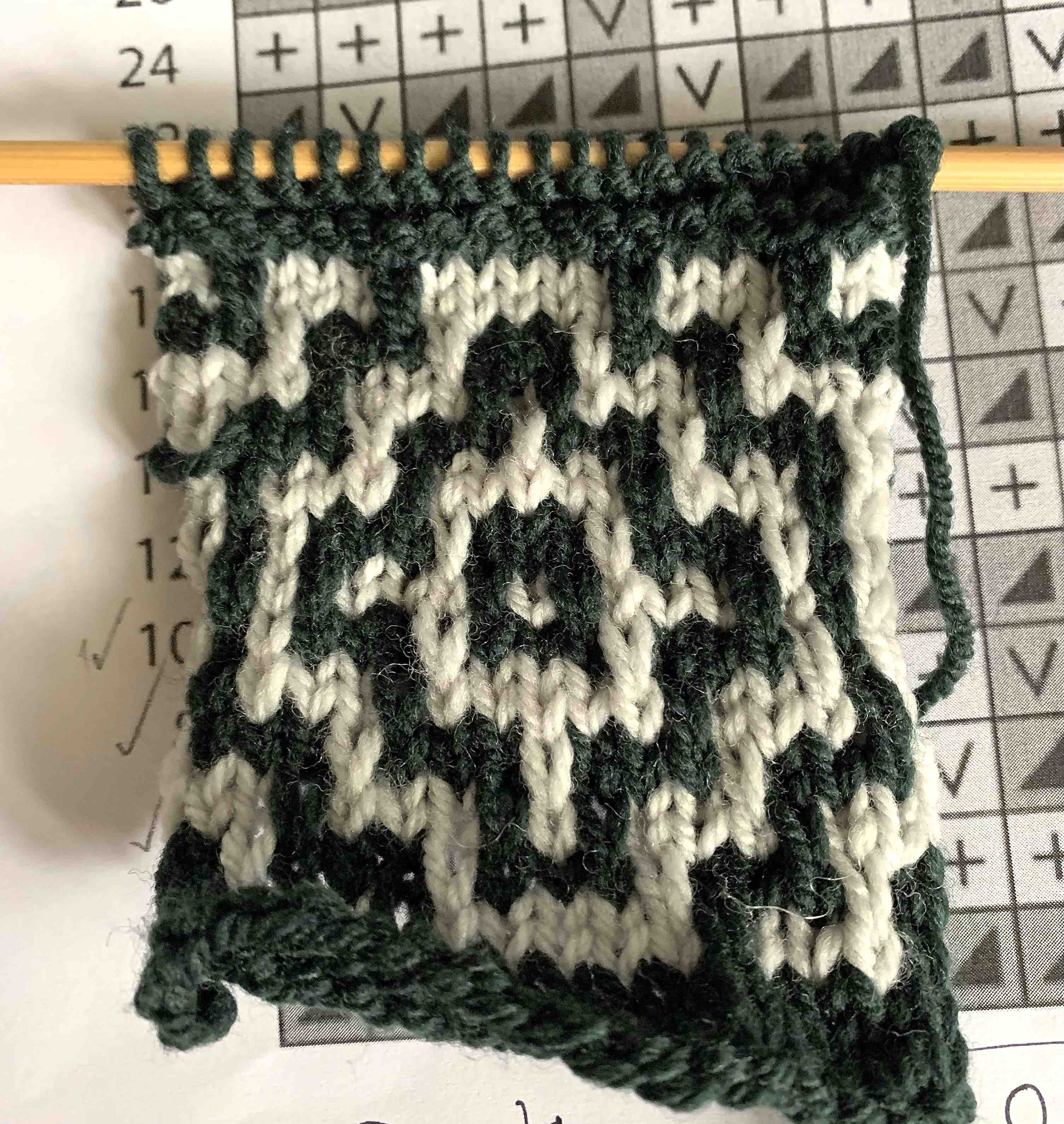
mosaic knitting swatch
Quick swatch to practice mosaic knitting

How to Follow This Mosaic Knitting Chart

Read the chart beginning at the bottom, reading right to left. This may seem weird, but that is how our knitting goes – we knit our stitches right to left.

I simply knit back and forth for the first few rows before beginning the chart.

Row 1 is all dark triangles and it’s all knit stitches in the darker color (green for me). At the end of the row, turn to the wrong side and purl all stitches to get back to row 3.

Now add the white yarn beginning at row #3. Knit 2 white, slip the next green stitch. (To Slip: put the needle in purl wise in the next stitch and slip it onto the right-hand needle… simple!) Continue across the row and turn to work the wrong side.

For the back of the work – the purl side – all stitches are purled with the color yarn you are holding. The other color stitches you come to will be slipped. There is no need to follow a chart because you can see the stitches you just knit as you come to them. If you just finished knitting with green, you will now purl those stitches with green. White stitches are slipped.

Also, wherever the yarn is – front or back – it will stay there while you knit or purl. On the Right Side / front of work, you will be knitting so the yarn will stay in back while you slip stitches. On the Wrong Side / back of work, you will be purling so the yarn will remain in front while you slip.

slipped stitches knitting mosaic swatch
Slipped stitches on back of swatch

All Purl Sides, back of work: Whatever color yarn you are holding – purl the same color stitches and slip the others!

For the next row, grab the correct color yarn – in this chart the dark triangle means the dark yarn – and begin knitting – and slipping the V blocks in the row. The yarns will travel up the side of the swatch as you change colors. This is not the best edging, and I would do something different if I were truly knitting a garment, but it’s fine for the swatch.

mosaic knitting

This is a very easy way to add an interesting pattern to a garment and I think the style itself looks a bit Boho! I don’t know yet if I will knit the Boho Style Cardigan, but at least I know what mosaic knitting consists of.

Mosaic vs. Fair Isle

For the mosaic type of knitting you are only knitting with one yarn at a time compared to Fair Isle where two yarn colors are held to knit a pattern across a row. That makes mosaic knitting quite easy to do. It can be worked on circular projects as well.

Fair Isle has a smoother finish as you can see in the images below, which are projects of mine. It’s a lot of fun to do, but must be used for circular knitting projects only. Cardigans can be knit in Fair Isle, but steeking is needed… yikes. I haven’t worked up to that yet.

This makes mosaic the perfect choice for adding designs to anything worked flat – including a cardigan.

Pictured projects L-R: Turkish Patterned Cap, Fair Isle Mitts (free pattern), and Wild Angelica Socks.

YouTube Videos on Mosaic Knitting

If reading how to do this type of knitting is confusing, a decent YouTube video can help. Unfortunately I can’t find any really good videos on this, but this one shows mosaic knitting in a shawl. It’s not exactly the same as I’ve described here because she is not purling the back of her work and the slipped stitches need the yarn in front for the slipping. But it shows a pretty way to add color to a shawl.

This video shows how to follow a chart, but as usual, there is a lot of talking. I didn’t watch the whole thing.

Free Mosaic Knitting Patterns