Planning to Knit – Mitten Patterns With Thrums

It is not a misprint – all mittens have thumbs, but not all mittens have thrums!

What is a Thrum?

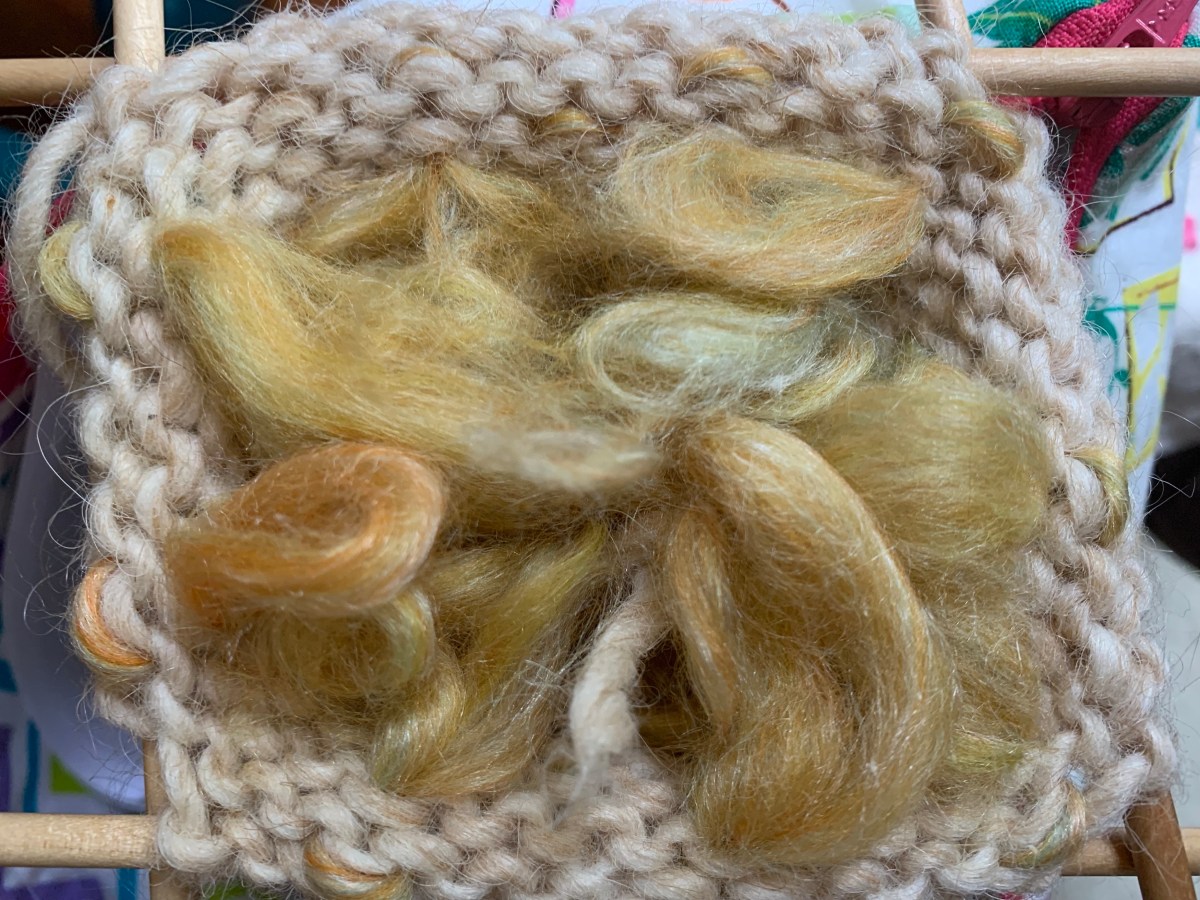
Before fiber becomes yarn as we know it, it needs to be spun. The puffy fiber which is used to spin the yarn is called roving, or a carded top. (To get the roving to that point requires other processes as well.) To make thrums, that fluffy roving is knit, piece by piece, into a mitten. Knit a simple pattern, and add the roving – here and there – to create fluff inside the mitten. Each bit of fluff is called a thrum. Hence, when you do this you have thrummed mittens.

Yarn spinners buy roving to spin (and sometimes dye, if it’s natural) to create their own unique hand-spun yarn. What I call roving, is also sometimes called a top. I’m unfamiliar with it really, but just wanted some fluffy stuff to add to my mittens!

Thrummed mittens are perfect for those who live in cold weather climates. The Well Sweep Sheep shop at Etsy has handmade thrummed mittens for sale. Take a look at the photos if you are not familiar with the look of thrummed mittens.

For a good result, most knitting projects take some planning. When I first saw mittens knit with thrums, I wanted to know more. I can’t believe I have never heard of this until recently. Now, I will plan and knit mittens with thrums – for the first time.

A Little About Mitten Thumbs – Two Ways to Knit

Be aware that mittens can have either “side gore” or “peasant / afterthought” thumbs. I’ve only knit mittens with the side gore directions, which makes them interchangeable – no right and left. The thumb area begins to expand shortly after the cuff is knit by making increases. Once part of the thumb is knit, those stitches are put on hold to finish after the hand.

All mitts and mittens I have knit have a side gore thumb. These are not Thrummed.

An afterthought thumb is added by leaving an opening in the hand where the thumb will be added later. The thumb is placed more toward the palm, which means each mitten knit will be for either the right or left hand and are NOT interchangeable. Read this article at Just Crafty Enough to see the difference.

Free Patterns for Mittens With Thrums

When searching for mitten patterns with thrums, free patterns and patterns to purchase are available. While most people love free things, we must take into consideration how well a free pattern works. Some free patterns are great, but others don’t work out.

Since I have knit quite a few mittens, I’m really only looking for cast on number, and thrumming information. I can’t see paying for that. YouTube and knitting websites all have information about how to thrum. Basically, I need a knitting pattern in worsted or chunky / bulky yarn where I can add thrums.

Here is a list of free patterns I would like to suggest. I have not knit any of these myself. The patterns are listed at Ravelry and get good reviews and ratings.

  • How to Make Thrummed Mittens – (Worsted) Advice and Free pattern with side gore thumb! Source: Haveayarn.ca
  • Chroma Thrummed Mitts – (Bulky) I printed this free pattern out and it has an “afterthought” or “peasant” thumb. This is something I am not thrilled about as I’ve never knit that type of thumb. But, the pattern has nice directions and advice on thrumming.
  • Worlds Simplest Mittensnot a thrumming pattern, but Tin Can Knits has offered this free pattern to knit mittens in 4 different weights of yarn, including worsted and chunky. Also a toddler size is included. I’m thinking I’ll watch a thrumming video, and add thrums to any of these mittens. Should work, right? Thumb type is side gore style.

Pay For Thrummed Mittens Patterns

Although free thrummed mitten patterns may be fine for anyone who can basically knit a mitten, some people will want more help. There is nothing wrong with supporting designers by buying their patterns.

Roving

One question I had was about the roving. I know nothing about it really, but I assume a nice wool of some sort would make those thrums nice.

I couldn’t find much info about this. At Three Waters Farm on Etsy, I see nice roving made from all sorts of fleece, including BFL, Merino, Merino and silk, Falkland wool, Romney, Corriedale, Targhee, Polwarth, and … yikes! Now I am more confused. I do know that you want wool, which will felt after washing. So do not use Superwash! This way the thrums will mesh together to create a nice soft layer inside the mittens…. right?

I am making mittens that I want to be very warm. Wool is my first choice so I don’t think I could go wrong with any of the wools listed, as long as they are not superwash. Bits of the roving will be pulled from the braid to match up with the yarn I use.

I ended up buying my roving from Paradise Fibers. I bought a merino and silk blend mainly for the color – I love the swirls of gold and pale green. Etsy shops also sell roving, and so do many yarn shops.

The roving I bought

Bulky Yarn Ideas for Quick Mitten Knitting

Roving is puffy, so a worsted, chunky or bulky weight yarn would be nice for a first thrummed mitten project. Apparently you simply make smaller thrums if the yarn is lighter weight.

Here are some bulky yarn suggestions for knitting thrummed mittens.

Prices listed here are current to the writing of this post (Jan. 2022) and obviously may change.

  • Wool of the Andes, Bulky – Knit Picks, $6.99 for 137 yds. per skein
  • The Petite Wool, Bulky- We Are Knitters, $14.90 – $19.90 for 142 yds. (+/-) per skein
  • Alafosslopi – Bulky – Istex Icelandic wool – buy direct from Iceland for about $6.29 per skein, or find it available in many US locations, usually for $10 each skein (109 yds). (I’m using this type of yarn for my thrummed mittens.)

Read about knitting my first pair of thrummed mittens on a post soon to come.

A Hat Pattern For Those Who Raise Backyard Chickens

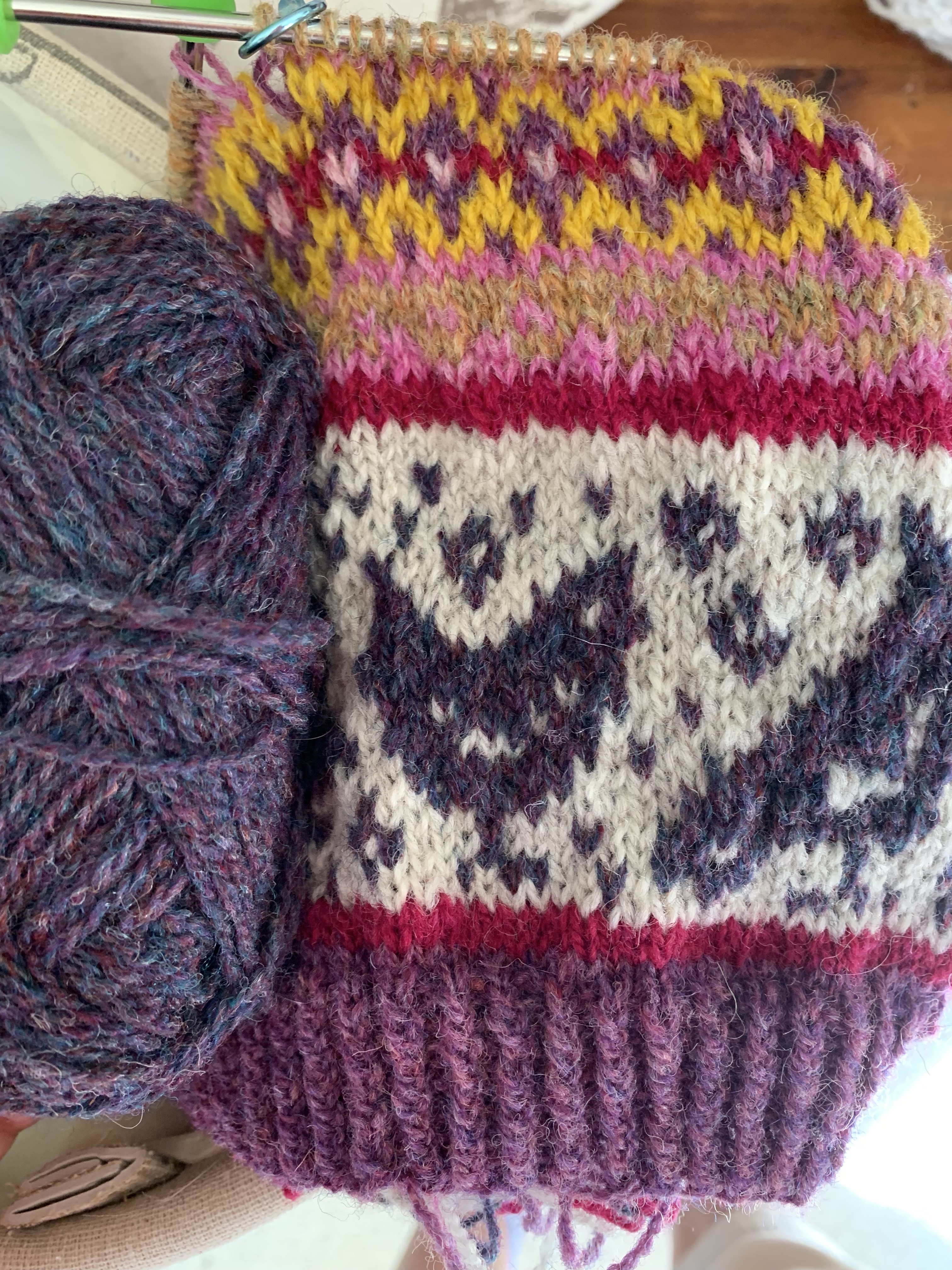
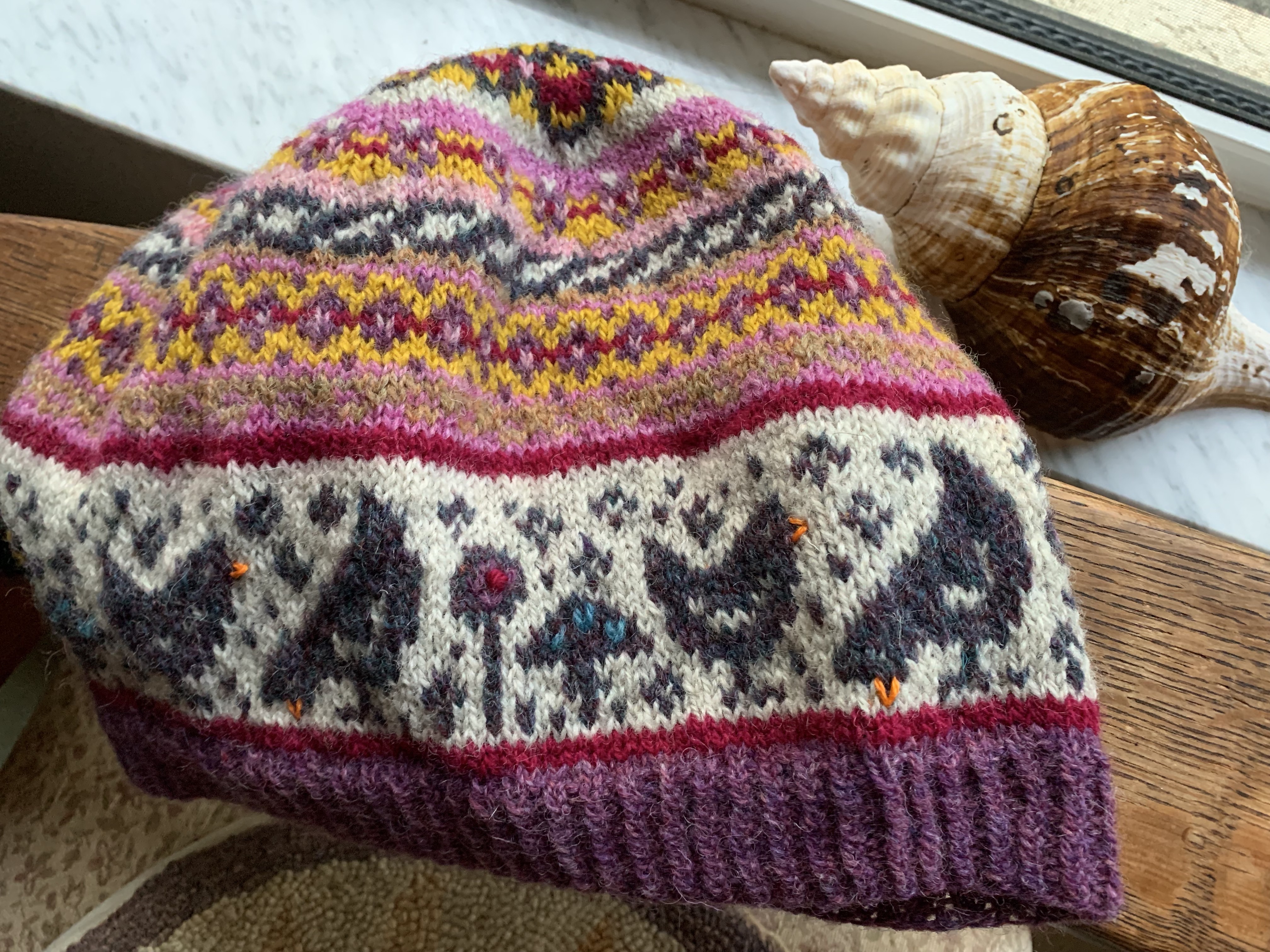
I’m knitting a fun little hat with a motif of chickens! The stranded colorwork pattern is called the Solstice Glow Hat and is by knitwear designer “Bunnymuff”, who is Mona Zillah.

A link to the pattern page is at the bottom of this page.

Jamieson and smith purple mix yarn

The yarn I am using is Jamieson & Smith 2-ply Shetland wool combined with some Rauma. Mona (the designer) uses gorgeous Gathered Sheep Yarn. I would buy it in an instant if it was available in the US. If you are in the UK, check it out. But, the J&S is also very lovely, with some wonderful coloring.
Yarn: FC14, dark rainbow mix purple is the color I used for the chickens. I don’t leave my yarn in the sun, just used this sunny spot to show colors better.

wool yarn in the sun

This is my first hand-knit project for 2022. I did my cast-on January first. When I saw this cute hat pattern a while ago, I knew I had to make it one day for my daughter. Anyone who raises backyard chickens would just love it!

The pattern includes more than just chickens. Geese and pigs charts are included with this pattern. They could all be included on one hat – perfect for farmers..!

Finished Knitting

I’ve finished knitting the hat, but it’s not done. I still need to add the duplicate stitches on the chicken motif and weave in all those ends. Colorwork is such fun and all the yarn ends, from changing colors, are just part of it. Once it’s washed and blocked the puckers will come out and the hat will be smoother.

The chicken motif is meant to be enhanced with embroidery, called duplicate stitch.

The pattern designer explains how she used this technique to finish each of the animal motifs, so you are not left in the dark wondering where to begin. This Very Pink Knits video shows how to do duplicate stitch at about six minutes in.

Hat is Done… Duplicate Stitch, Washed and Dried

Altogether, the hat knitting was completed in nine days. It fits me fine, but might be a little big for my daughter.

Final Words on the Solstice Glow Hat

After knitting the chicken chart section I went a bit off pattern and added some other colorwork patterns of my own. I found it difficult to follow the yarn color placement because my pattern printout is in black and white. The hat calls for a Main Color yarn and five contrast colors.

I chose to do my own thing for a few rows in the center. This is not anything against the pattern. I love Bunnymuff patterns and have already knit a few.

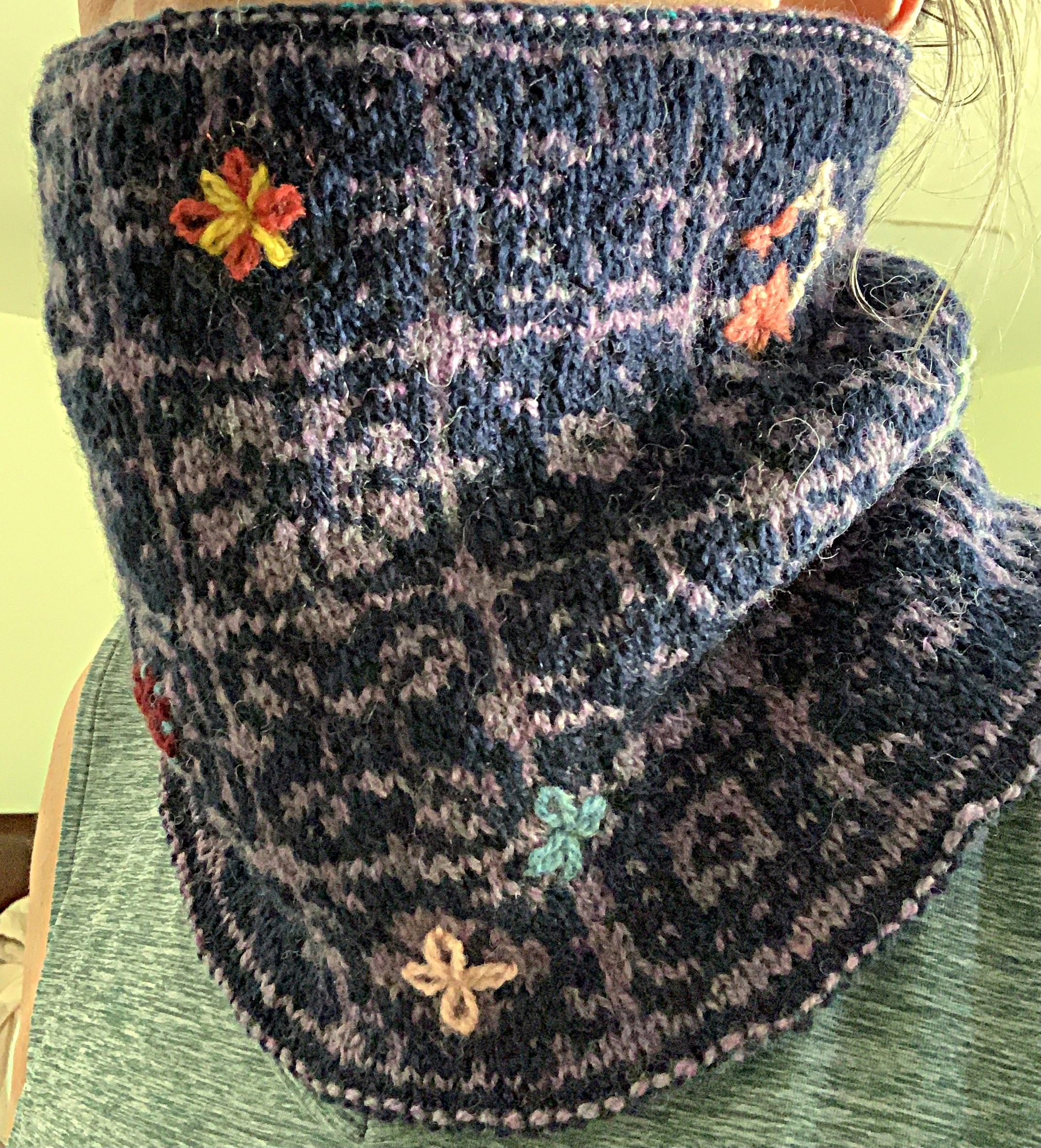
The Stellar Parallax Mitts were great fun (learned a new corrugated rib). The Keramos Cowl had some embroidery (a first for me). It seems I always learn something new when I knit one of her patterns.

More Patterns by Bunnymuff

This designer includes wonderful directions in her patterns. If you like this type of knitting be sure to check out Mona Zillah’s Ravelry Store where all her pattern designs are on display for sale.

This chicken motif hat will be sent to my daughter in New Hampshire. She is building a coop and hopes to begin raising backyard chickens sometime this year. I think she will love it!

Click here to Get The Solstice Glow Hat Pattern

Backyard chickens, hens as pets
Photo credit: Pavlofox @ Pixabay

Empty Needles Just in Time for The New Year

January first means getting organized for the new year, and planning for new knitting projects.

Happy new year! It’s January first, 2022 and first thing this morning – before the sun was up – I had old and new knitting patterns scattered all over my bed.

Yesterday, I finally got the Carbeth Cardigan off the needles – just in time for the new year!

I was looking for information about my Lopi wool order, to see how much yarn I used, and ended up with this mess! So I went with it, and continued to organize my printed knitting patterns.

organizing knitting patterns
Getting organized!

Although all patterns are kept on file on Ravelry, I like to print them out. If the power goes out, or the internet is down, I won’t have access. I also like to make notes on my printed patterns, like the date I began and ended the project. Also, what I changed, liked or disliked about the pattern itself. Sometimes I make a note of which yarn I’m planning to use on patterns not knit yet.

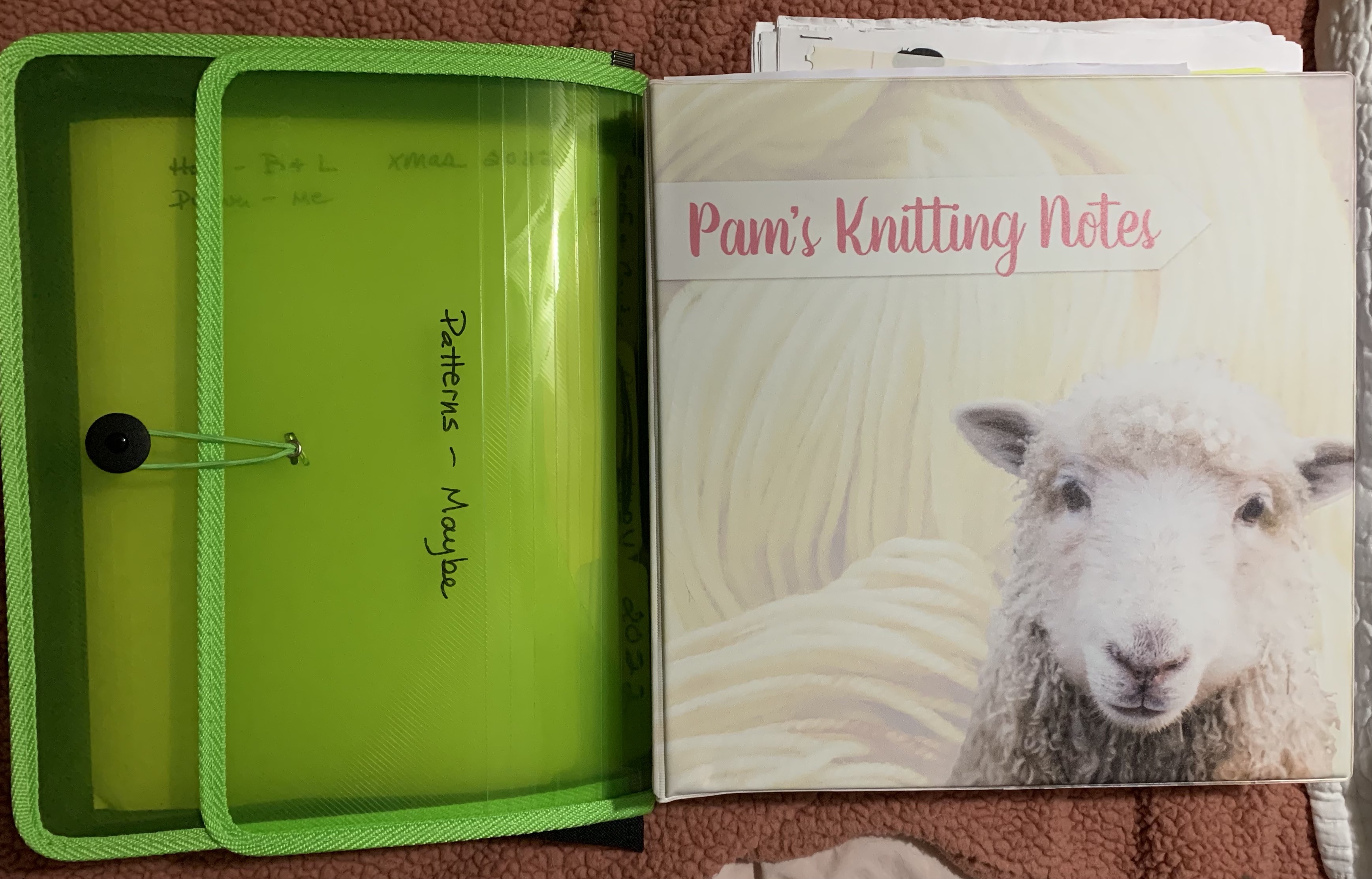
Today, I left old patterns in my big sheep binder and put newer patterns in a green file folder. They are organized by project, such as “hats”, “cowls”, “sweaters”, etc. I threw some old patterns away because I decided I would never knit them.

My sheep binder (Zazzle affiliate link) is something I created and put up for sale in my Zazzle shop. The wording on the front is customizable. Then I bought plastic expandable folders (this is an Amazon affiliate link) to fit inside where I slid my printed patterns. They were filling up and expanding to the point of overflowing.

organizing knitting patterns

A few weeks ago we took boxes of things to Goodwill. My bookshelf is now more sparse and I can more readily find my knitting books. With my patterns sorted out, I am ready to knit new things!

Knitting Project Plans for 2022

I also had the chance to group my most recent pattern printouts into a folder “to be knit”. Sometimes I will buy and print a pattern and it gets lost in the shuffle. As I sifted through my patterns I came across some Brooklyn Tweed hats which had been filed and forgotten.

The Tillage cabled beanie, by Jared Flood, would be perfect for my daughter. Also Solstice Glow hat, a chicken beanie by Bunnymuff (Mona Zillah) is a must because my daughter plans to raise chickens this year…!

For the boys (maybe for next Christmas) Hirombe and Treefolds, also by Jared Flood. Both are solid color hats with interesting designs. I’ve missed knitting hats.

Last year I knit 4 sweaters, 5 hats, 2 pair mittens, 2 pair fingerless mitts, 4 socks, 2 boot cuffs and 1 cowl. How do I know all this? If you have a Ravelry account, go to your account projects page and click on “challenge” in the top bar. It’s where you choose to challenge yourself with an amount of projects to complete, but then it lists all the crafts that were completed in each year.

Decided: My January 1 cast-on was for the Solstice Glow Chickens Hat.

Holiday Knitting a Woolly Carbeth Cardigan in Alafosslopi

My son worked Thanksgiving Day and since it’s only me and him, I spent the day getting a new knitting project on the needles (I finished it on New Years Eve). The Carbeth Cardigan (Ravelry pattern page) is a design by KDD and Co., Kate Davies Designs. The pattern suggests holding two yarns together, but I chose woolly Alafosslopi yarn for this garment.

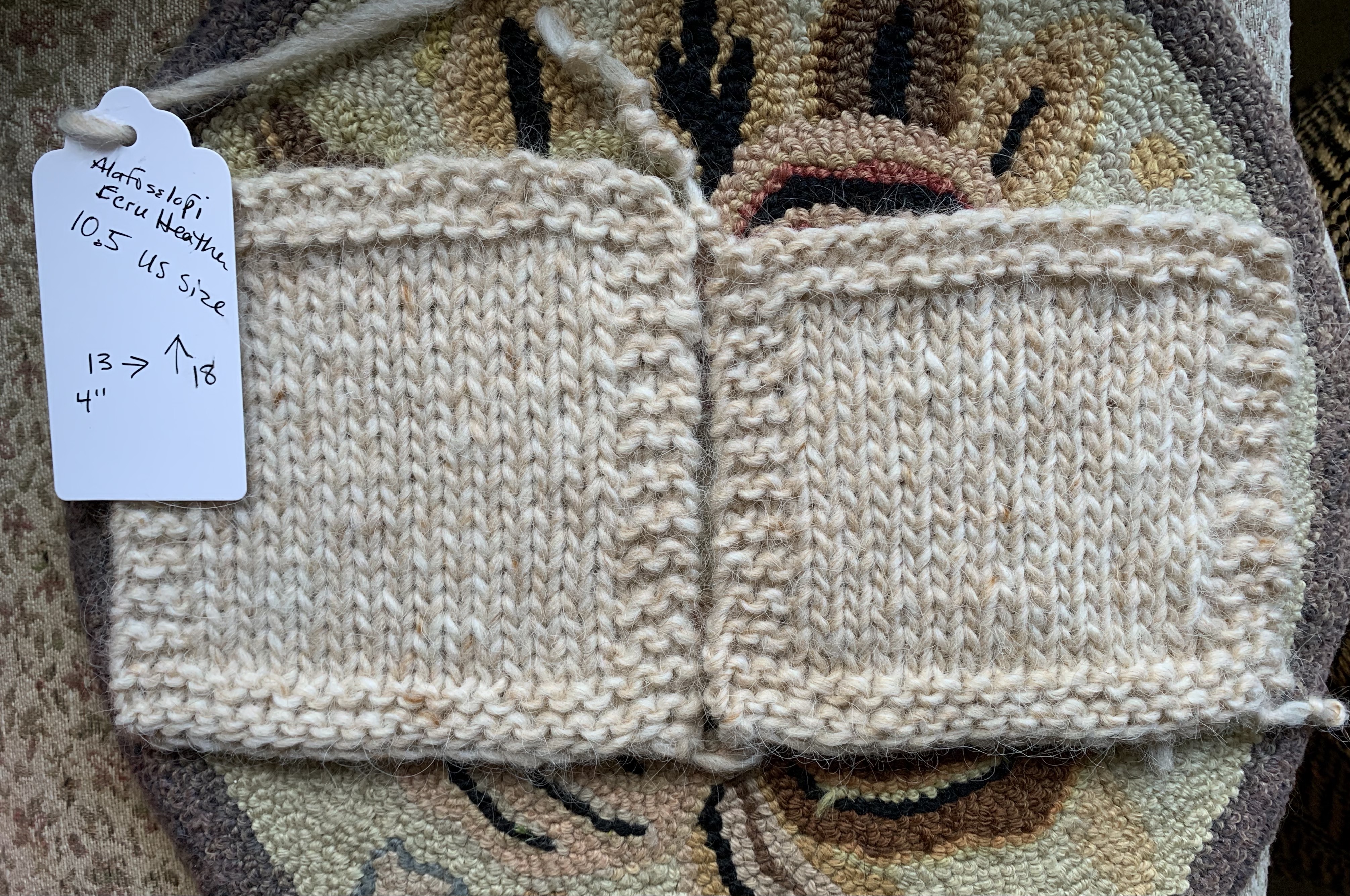
I did a swatch in size 10.5 with Alafosslopi yarn which was too large, so knit up another in size 10. That one turned out to match gauge exactly. I’m knitting this sweater in Icelandic wool which is bulky weight. Color is Ecru Heather. I will also need below gauge needles for the ribbing, neck and front bands.

Sweater Construction

I began with a sleeve and since I did not have a “below gauge needle” I knit the rib with size 10. The cuff is long. The body is knit, bottom up, and then everything is attached. This makes sleeve length a bit tough to figure. I knit 19.5 inches and the pattern called for 18. I’m glad I went longer. This pattern seems to have been written for a mini-sized person. I am 5’5” so pretty average.

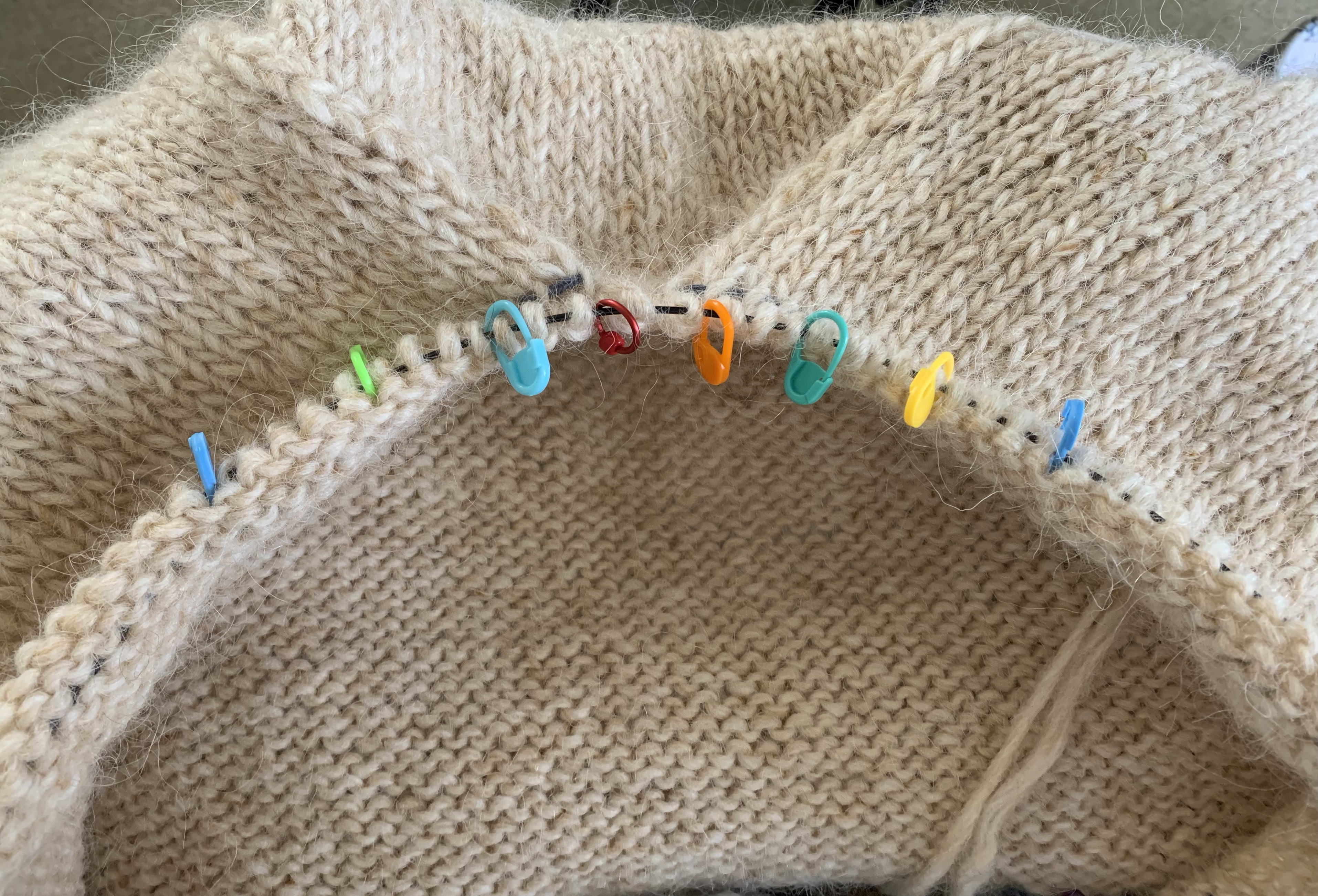
Here (below) I have reached the point where my decreases are almost done. The back of the neck seems low, so I will try to figure out my own short rows to bring it up. Other knitters have done this and I can see why.

Adding Short Rows to the Back of the Sweater

I watched this video to figure out my short row placement, but added a life line (good video at Very Pink Knits about adding a life line) before I got to this point. I’ve never tried to figure out my own short row placement and wanted to be able to rip them out if need be.

The blue yarn is my lifeline. Above that, in the center of the back, see the raised part which happened when I added short rows. I’m very glad I did this as the sweater seems to fit better.

Short Row Placement

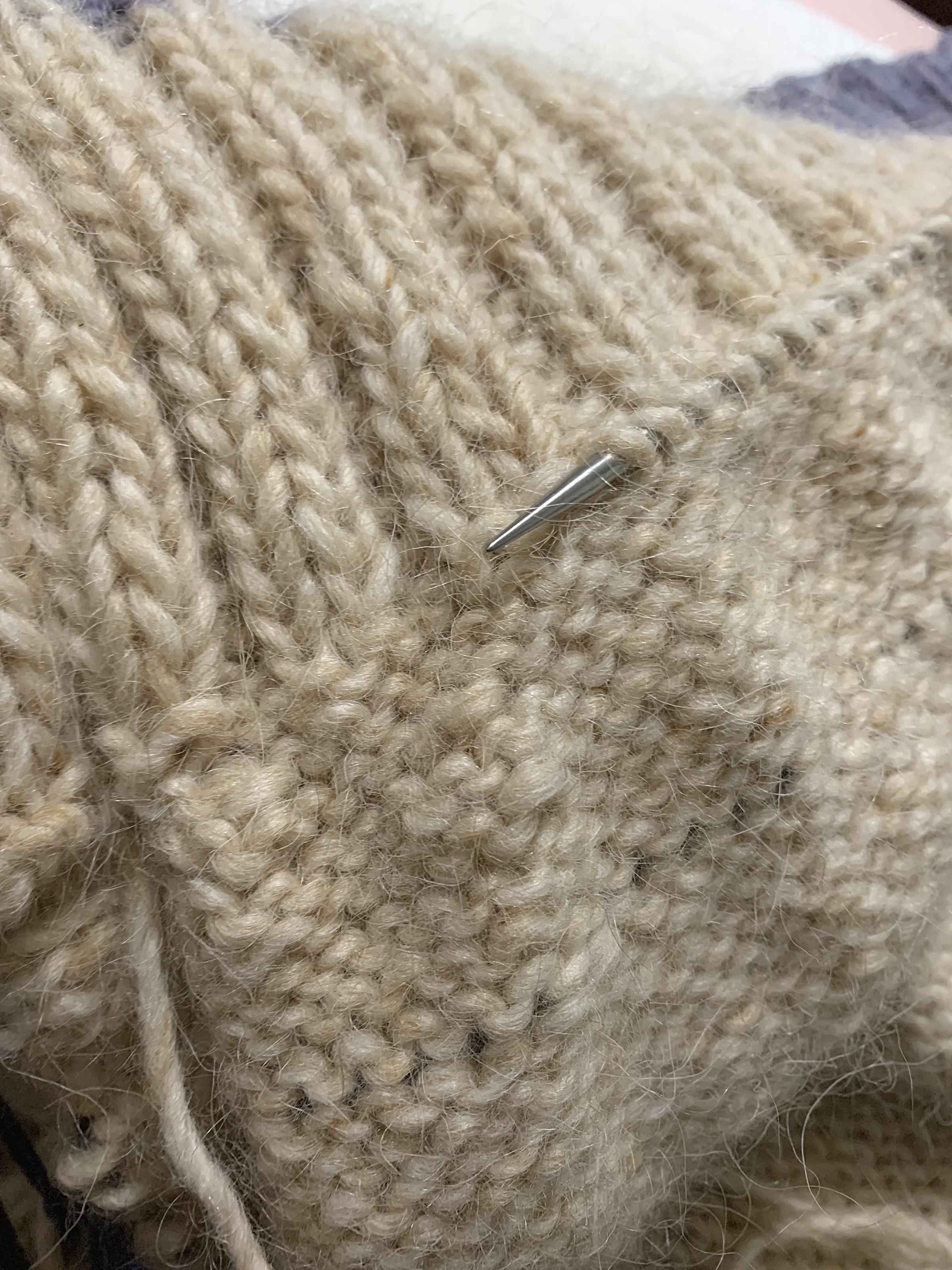
I marked off the stitches for my short rows one row too early. Next time: Do short rows after the last row where the two center back stitches are purled together (or knit together for some sizes) and markers are removed. This is the row just before the neck decreases begin. **Another knitter made a note that she did the short rows after the decreases. This may work better as my short rows left a bit of a pucker in one spot. I didn’t notice this until AFTER the collar was worked, and I was not ripping that far back!

The Front Bands and Neck Ribbing

There is a lot of putting stitches on hold in this sweater. Once the joining of the sleeves and body and yoke knitting is done, stitches are held until time to knit the collar. The collar and front ribbing is knit on the smaller gauge needles. I have one size 9, 32-inch needle which I needed for all of this. The front ribbing has to be completed before the collar is knit.

The front bands were difficult for me as far as trying to pick up the right amount of stitches to make the top three work. Also, because I knit the body two inches longer, I needed to pick up extra stitches and not what the pattern said..! I ended up doing about 80 stitches on each band – which were way too many – but I won’t realize this until it’s way too late.

The button loops are added with an i-cord edging so no buttonholes were made.

Carbeth cardigan knitting
Front ribbing on hold with neck ribbing begun

Neck Ribbing

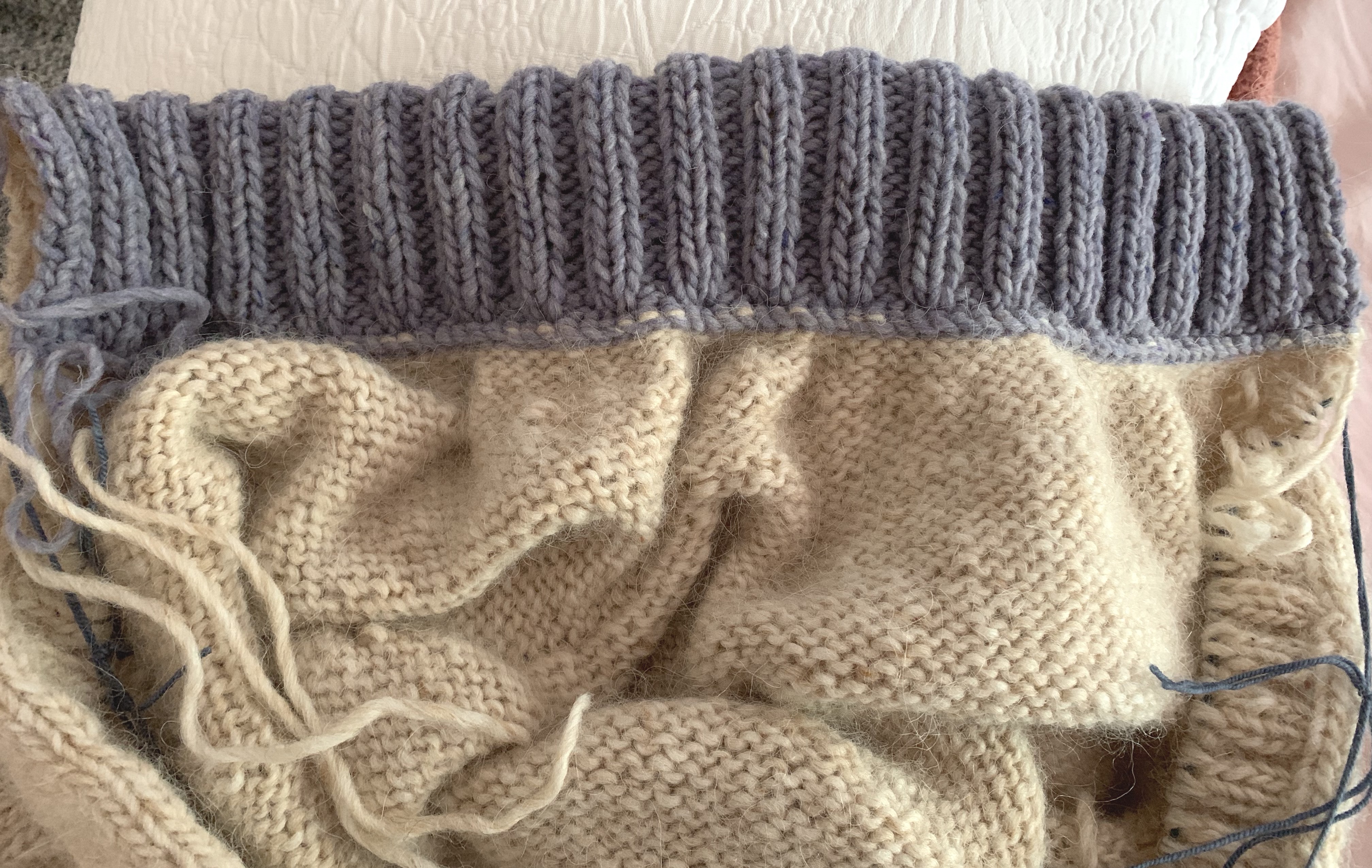
The neck stitches are knit in ribbing and will be folded over to the inside and attached. I followed the advice of other knitters and put a softer yarn inside the collar. I used gray Quarry yarn because I had it, and it matches the thickness of the Alafosslopi.

Knitting the neck was easy but then it had to be folded and attached inside. I used a size 5, long circular needle with pointed tip to pick up those stitches. You really need much smaller needle to make this easier. This video helped me see what exactly I should be doing as far as picking up stitches. I picked up two stitches for each knit and each purl section and then two stitches on each end. This matches the number of rib stitches to do the bind off – that number has to match the number knit for the ribbing! Purl Soho has a good 3-needle bind-off video if needed.

I used a much smaller size needle – size 5 US when picking up those stitches. Then I used a size 9 US DPN to knit the bind-off. I began binding off with a 5 DPN but the stitches seemed very tight. (A helpful note from the designer about all this would have been very nice!)

Explaining Pattern Section 8

I got to section 8 in the Carbeth pattern and was stumped. After some searching, I found a good explanation in the Ravelry forum, because it seems other knitters were also stumped.

The point in section 8 is to close up that hole in the collar, which was made by folding it over, by picking up stitches along the edge. Then, the collar and front band becomes one long set of stitches.

My band is being held by scrap yarn so I needed to pick up all those band stitches also. Now the needle is full, from top of collar to bottom of sweater. Go back to the top (on one side, the bottom on the other) and begin the i-cord bind off.

Although this video, by Andrea Mowry, is not exactly how the i-cord is done in the Carbeth pattern, it gave me an idea of what I needed to do, only with a different amount of stitches. Begin the Carbeth bind-off by adding two stitches to the LEFT HAND NEEDLE, and continue as the pattern says.

Firsts For Me While Knitting This Sweater

I did my very first spit splice using this yarn! It was pretty cool and I will definitely be using it more often when knitting with wool.

The lld decrease on the wrong side. Clear directions are given in the pattern abbreviations page.

Added my own short rows – successfully – for the most part. I’m very glad I did this because the sweater would not have been “high” enough around my shoulders and neck otherwise. I’m very surprised the pattern didn’t include short rows as many knitters added them in on their own.

It was not my first 3-needle bind-off, but the first time I’d done it to tack down a double collar.

I-cord rib and buttonholes. This was pretty easy to do, but the fact that I had picked up too many stitches (way back) for the bands, made the ribbing wavy. At this point I was frustrated.

I am trying to fix this with button placement and blocking. A simple note from the designer about how to pick up those front stitches – such as “pick up 2 stitches for every 3” – or something, would have helped. She does say how many to pick up – if you follow the pattern exactly and want a cropped sweater.

Final Review of Knitting the Carbeth Cardigan

Some previous knitters of this pattern mentioned that the sweater runs small. I would agree. I made my sleeves and body longer.

In my opinion, it is necessary to add those short rows at the back too. My gauge swatch was exact, so I chose the correct size to knit, it just would have been very small had I followed the pattern.

There is a lot of picking up of stitches and putting stitches back onto needles. Also, parts of the pattern directions were difficult to understand, and I needed to search the Ravelry forum and use YouTube videos (none were referenced in the pattern) to figure things out. I have notes written all over this pattern just in case I ever want to knit it again …. which I highly doubt.

I love that this pattern uses a bulky yarn because the project is completed quickly. Overall the construction is unique, but it’s not flattering to my shape and the button bands are wonky due to reasons mentioned above.

Because many parts of the pattern needed some figuring out, I certainly would not suggest it for a beginner sweater knitter.

Other Sweater Patterns I Have Knit and Reviewed

L-R: Top row – Playdate and Marshland (by Tin Can Knits) Calliope by Espace Tricot (a free pattern)

Row 2 – Polliwog Popover, Cobblestone (Brooklyn Tweed), Fine Sand

Row 3 – Farfuglar (Lettlopi yarn) and my first sweater Umpqua – lots of mistakes here.