Because my first Katie’s Kep (hat) came out a bit large, I decided to cast on four fewer stitches for my second knit. (Find the link to the Kep pattern at the bottom of this page.) I still used a size 3 circular needle and did the Old Norwegian cast on – or something like it! I’m not sure I did it exactly right, but it looks okay.
The brim of this hat is knit in 2×2 corrugated rib
Once the corrugated ribbing was done, I increased around by four to get back to the original pattern count. Here’s how:
*Knit 33, make 1* – 4x’s around = 4 additional stitches. Total stitches are 136 now (as pattern calls for). Continue with pattern increase row.
Now I was back to the correct number of stitches needed for the colorwork. I would love to make this hat using a 2 or 2.5 US needle size, which would work out better I think, but I don’t have those sizes in a circular needle. I might have to buy them.
My main yarn used for the tan Kep is Rauma Finullgarn color 406, Wheat Heather. Other yarn used is Jamieson & Smith in colors: 4: brown, FC7: Peach / orange, FC62: green, and 133: medium purple. The colors are more subdued than what I used for my first Kep.
The fun of knitting this colorwork hat is choosing the colors. It’s probably the reason people can’t stop at knitting only one! As you can see in my photo above, very little yarn is used to make one hat. But if you choose to use J&S yarn as the main color, you will need 2 skeins.
Where to Buy Jamieson & Smith Yarn
This was the first time I knit with J & S yarn. I found it for sale, at a very good price, at Fairlight Fibers. I saved over $1.50 PER SKEIN compared to the current price of the exact same yarn at another online shop. And shipping is FREE when you spend over $50.
At this time, many yarn sellers are low on yarn, thanks to the Covid pandemic keeping people from making the yarn.
Other yarns the designer mentions in her materials section of the pattern are: Uradale (UK based), Shetland Handspun, and Jamieson’s of Shetland.
Wool
Some people don’t like wool because they think it is scratchy, although I don’t mind it. When wool is used for a hat, it doesn’t really matter (unless you are bald). I find the Rauma and J&S to be similar in feel, and once it’s washed, it feels softer. I use Eucalan no rinse wash, and it conditions the wool.
Anything made of wool dries quickly and will of course keep the wearer warm.
Katie’s Kep is a Free Download at Ravelry, by designer Wilma Malcolmson
If you have the Milarrochy Heids hat-knitting pattern book, you have the pattern for the Tettegouche hat. ( It is also sold separately – see the link at the bottom of this post.)
It’s a beautiful book, with lots of pretty hat patterns and they all use Kate Davies Milarrochy Tweed yarn. I bought the yarn in a variety of colors and began this hat a while ago. I didn’t like the way it was coming out. I blamed myself for not being familiar with colorwork, good cast-on’s, or having the right hat gauge. Honestly I didn’t like the yarn. I put it aside.
Finished Tettegouche
When I joined The Woolly Thistle knit-along, I became familiar with Rauma wool and fell in love! Everyone was using it to knit colorwork projects. After knitting some mittens by this hat’s designer, Virginia Sattler-Reimer, I went back to try to knit the Tettegouche, only this time I used Rauma yarn. By the way, she has mittens to match the Tettegouche hat pattern!
Good size, with a bit of extra room at the top.
I made some changes to the pattern, and one was to do a 2×2 ribbing for the brim. The colors I used were what I had available and they are not the greatest. But I had fun with this. It has been a good practice hat after knitting Katie’s Kep. Because I had already knit that colorwork hat, I knew to try a smaller needle for Tettegouche.
Buy The Tettegouche Hat Pattern
The pattern is also sold separately and you can buy the Tettegouche hat pattern here. Please click the link to see it, because it is so much prettier than mine! You won’t believe it is the same hat…!
What Was My First Colorwork Hat?
My first all-colorwork, Fair Isle knitting project was Katie’s Kep, which is a fun hat pattern which is Free to download.
After beginning The Woolly Thistle mitten knitalong with one mitten pattern, I came across a new pattern for sale that I liked a lot better.
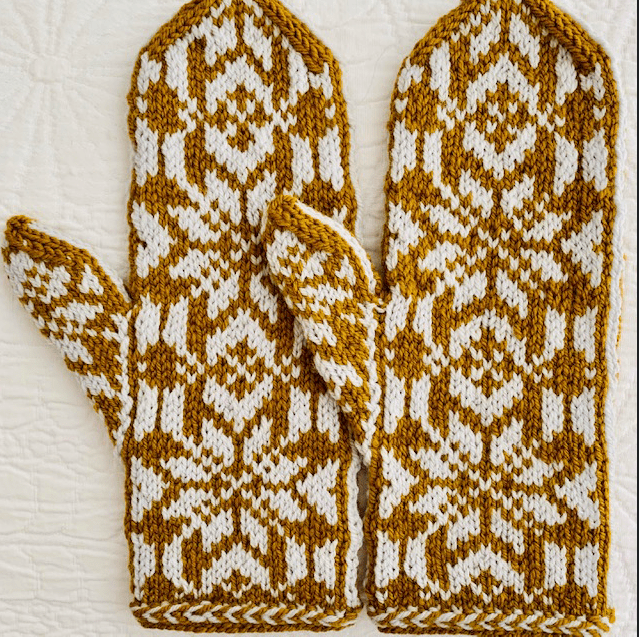
I finished on mitten in my first choice (Milet) and then started this one which is called “Glissade” and you can buy the pattern and download it at Ravelry – I have a link further down the page. I have finished one mitten, and I do love this pattern! Read on…
Brooklyn Tweed Arbor yarn is pretty nice
I wanted to use the same DK yarn the designer used, but it was out of stock, so I began looking for other DK yarn to use.
One thing I want to do this year with my knitting projects is to use new types of yarn. I’ve already fallen in love with the Rauma yarn, and I vow to use more pure wool this year. The Woolly Thistle imports beautiful wool from overseas, so that’s a good place to start when shopping for “yarn with a story”. I love knowing where my yarn came from!
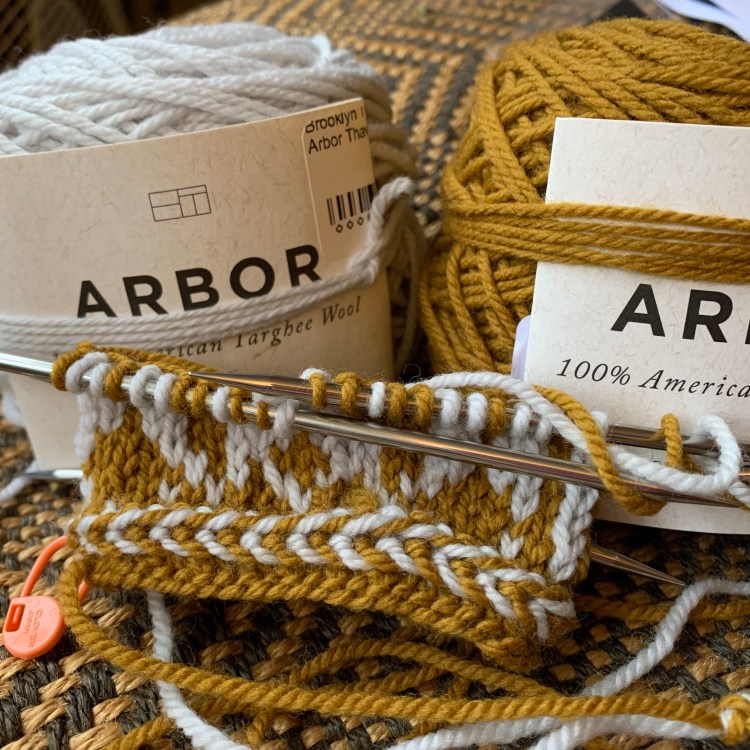
But this time I chose Brooklyn Tweed’s Arbor yarn for a couple of reasons. After researching this yarn, reviews are outstanding. Everyone loves it, and I can now join that group – it is so nice. Secondly, the color selection was fabulous. I bought mine at Wool and Company, and they wound the skeins for free (as always).
My Arbor colors are “Kilmt” (gold) and “Thaw” (silver gray) and I think I made good color choices. It’s not super expensive yarn for the nice quality. It will need to be hand-washed, but how often do you need to wash mittens?
Getting beyond the cuff
The Glissade Mitten Pattern is for sale on Ravelry by Virginia Sattler-Reimer and I believe it is one of her newer patterns. She also has a very popular mitten called Tettegouche mitten which has many colors. She has a hat with the same name which is featured in the Milarrochy Heids book which I bought a while ago.
This mitten pattern is fun. It starts with a Latvian Braid, which I think looks really nice. (The designer includes directions for making the braid.) I think one reason a braid is used at the beginning of the cuff is to keep it from rolling.
Knitting the Thumb
The pattern is in chart form, and the thumb is shown separate, which took me a bit to figure out. The thumb stitches have to be added at a certain point in the pattern, which takes some getting used to for a newbie like me.
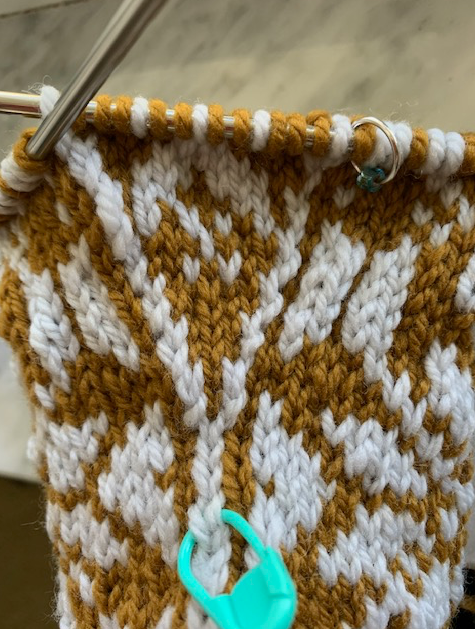
You can see my thumb placement knitting in the photo below. It was easier for me to add a marker so I would know exactly when the thumb stitches begin.
I placed a marker at the beginning stitches of the thumb area
It’s tough to know gauge with mittens until you get far enough along to slip your hand through the DPNs. I began using size 3 DPNs, as the designer used – I switched to size 4 after the thumb – because the hand seemed to be a bit tight.
Getting started on the colorwork thumb
I did okay for my first colorwork thumb. It did get a bit hairy at times, but all in all it was completely worth it because I love the outcome! I used a marker for the BOR, and added one in the center of the pattern, just to help keep me on track.
Love the color, love the yarn, love the fit, and love this pattern!
Here you can see how the side line of the mitten carries onto the thumb.
Pattern on inside of thumb continue along the side of the mitten as well
I Love This Mitten!
Although I still have one more Glissade mitten to knit, I look forward to having a pair of these. The fit is perfect, but I did end up going up to size 4 DPNs once I put the thumb stitches on hold. I tend to be a tight knitter.
When I do the next mitten I will do the cuff in a size 3 and then change to a size 4 for the hand and thumb. It’s the only change I’ll need to make. (That worked well on #2)
I have not washed and blocked it yet – I am waiting for the second mitten to be knit.
Love this!
When doing stranded colorwork knitting, the inside of the mitten looks like the image below. It makes for a bit thicker fabric than plain knitting.
Wrong side
I am trying to be a better “pairs project” knitter, where I finish two mittens, two socks, etc., but I have to love what I am knitting for that to happen. I can’t see wasting time knitting something I dislike.
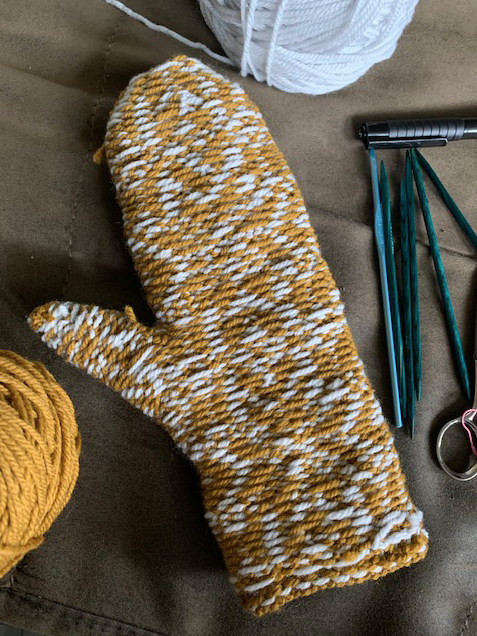
Finished today! My first pair of hand-knit, full colorwork mittens. They still need to be washed and blocked, but they fit well and look decent. In fact, I really enjoyed this knitting project. It was quick, even for me.
I did not knit every day. I have to work also, but the pair only took 13 days. Haha… some knitters can knit 3 pair in that length of time! Still, I am happy that I have a new pair of mittens AND I finished before the knit-along ends (March 26th).
Washed and blocked and ready to wear
Inspired to Knit More Mittens
Once I knit a project that I enjoyed, and turned out wearable, I want to do more. The Brooklyn Tweed Arbor yarn is so fabulous that I have my eye on a new mitten pattern in DK yarn. It’s called Fiddlehead, and is very popular. The DK weight works up quicker than fingering, and that is a good thing for a beginner.
In fact I might write a page full of DK and Worsted weight patterns.
Frogging is a knitting term meaning “ripping out”. I have tried to knit this Moose hat twice with different colors of yarn (link to pattern below).
First I knit a yellow beginning row then brown for the brim. I tore that out. The pattern sample hat is white with two contrast colors, but I didn’t want a white hat. I was also trying to use up stash yarn.
I thought this would be a quickly done FO using up DS sharing HOTN within a day or two. Instead I had a TOAD! (Don’t understand Knitcabulary? Read this fun post at Knitfarious.)
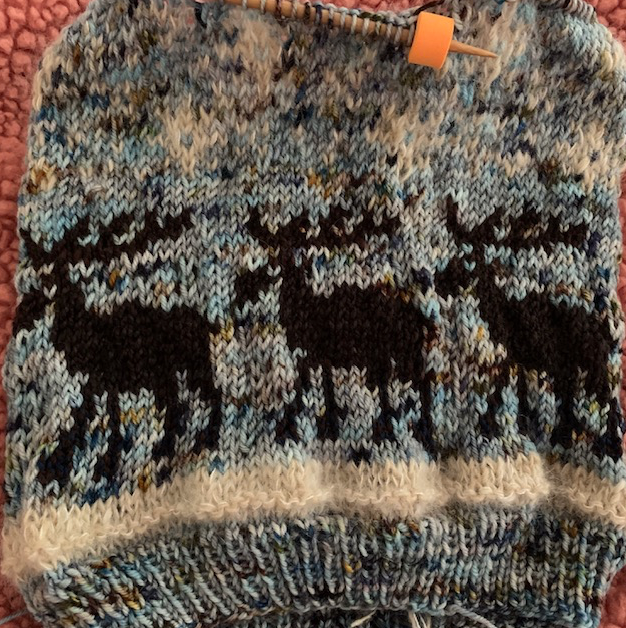
This time I used Yarn Cafe Creations merino wool (blue, “The Ring”) with brown Spincycle for the moose motif. For the third color I used an off-white light fingering wool and combined it with mohair (think snow).
Purl ridge added for texture
I’ve learned how to carry floats with the left and right hand yarns while knitting projects like this. I’m no expert, and this was good practice. No knitting is a complete waste!
Trial and Error and My Mistakes
I did a little purl ridge to give some texture with the white (not a great idea!) and I began the moose design first instead of the trees. Many Ravelry comments from previous knitters mentioned that they should have done the moose first and that the hat gets too long with all the motif sections.
Because I wanted the moose, but no white, I envisioned the moose walking in snow with snowflakes falling above. The pattern actually has a row of trees, then moose, and more trees at the top. Each section is divided by two rows of a third contrast color. If the hat is knit according to the pattern, it will be quite tall.
Adding some mohair in the white rows
I Love to Knit Hats… But
The trouble with knitting hats is that you can’t actually try them on until they are nearly finished. The moose stranded knitting area seemed tight, which I guess usually happens with colorwork. From the brim to the main hat area the needle size goes up by 2, and I used a size larger than that because I know I am a tight knitter.
Nearly done with the moose motif
Yesterday I got past the moose rows and wanted to do snowflakes instead of trees along the top. The off-white with mohair blended in with the blue variegated yarn and could barely be seen.
Now the hat was tall enough that finally I could try it on …. and I hated it! It was loose at the brim (I made the brim half the recommended length) and tight around the moose motif section. This is not the type of yarn I want for a hat either! (Note to self: don’t use sock / fingering yarn for a winter hat – unless it’s a man’s cap.)
I’ve decided to frog it. The pattern is not something I will try again, but I have the moose motif to save for another time – maybe a scarf / cowl / or mittens.
Link to the Moose Hat Pattern
Most of the problems I had with this hat were brought on myself andI don’t blame the designer. If you want to buy this pattern, or read comments from other knitters, find it at Ravelry: Beware of the Moose.








 New England's Narrow Road