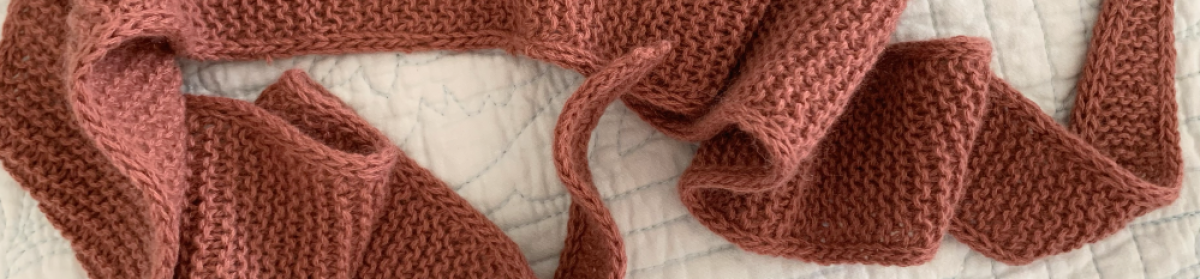
The Chunky Turtleneck Sweater in Alafosslopi

Knitting a bulky pullover using Alafosslopi wool and pulling directions from two different patterns.

This page is all about how I combined notes from two different patterns to create a chunky, turtleneck sweater. Jumping into a knitting project without one simple pattern to follow has expanded my knitting proficiency. I tried some new things here, some of which worked well, and others that did not. I was happy to have had this learning experience, while making a new lovely sweater.

I’m continuing on in my quest to find patterns to help use up stash yarn. Although I did use quite a lot of my Alafosslopi when knitting the Carbeth Cardigan, I still have quite a bit leftover. It would be perfect to use for a chunky turtleneck.

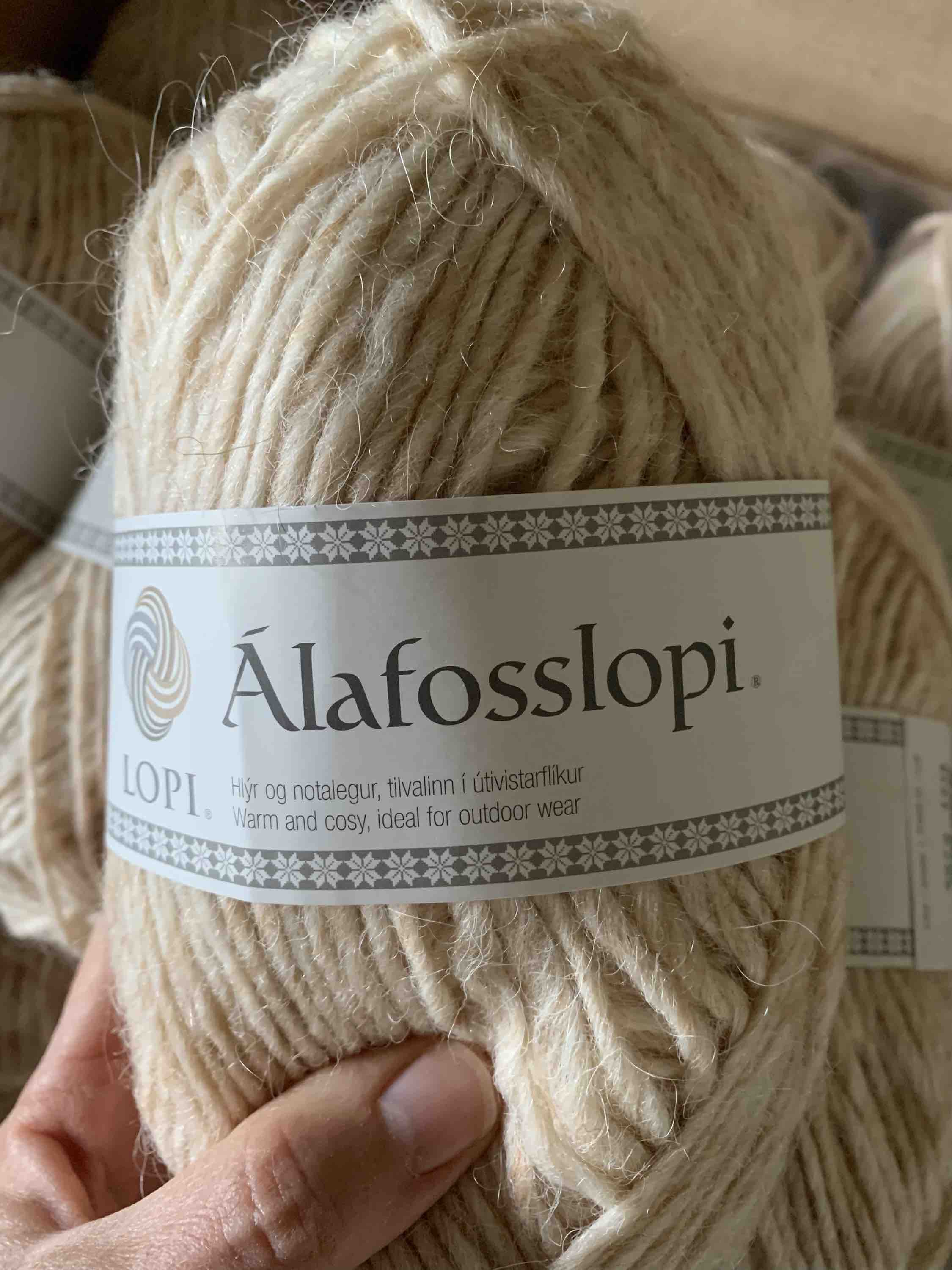
In my search for a pattern on Ravelry, I found the VENLIG pattern, which is knit with Woolfolk’s newer yarn called Flette Bulky. I love the look, but thought maybe I could also use the pattern and knit it with my Alafosslopi.

My gauge with the Lopi was off for the Venlig pattern, so I had to make adjustments (which I should have done from the very beginning) – see my notes further down. Venlig’s pattern directions for short rows and raglan increases were needlessly difficult. Because of this, I gave up, frogged, and began over with a pattern I knew was easy to follow.

Starting Over With The “Turtle Dove” Pattern

The Turtle Dove pattern is free, from Espace Tricot, and I have already knit it using bulky yarn.

I am using a size 11 needle. My cast on number was 60 and I did six inches of 2×2 ribbing for a rolled neck. After that, I followed the short rows section on Turtle Dove, which are done before any increase stitches. This is much simpler to follow than the Venlig.

The Turtle Dove pattern knits up with big, wide, bat-wing type sleeves, which I do not want. You can see my finished original Turtle Dove sweater on this page. It came out huge – probably because I knit it long ago and didn’t check my gauge!

So, when it came time to knit the raglan increases, I went back to follow VENLIG.
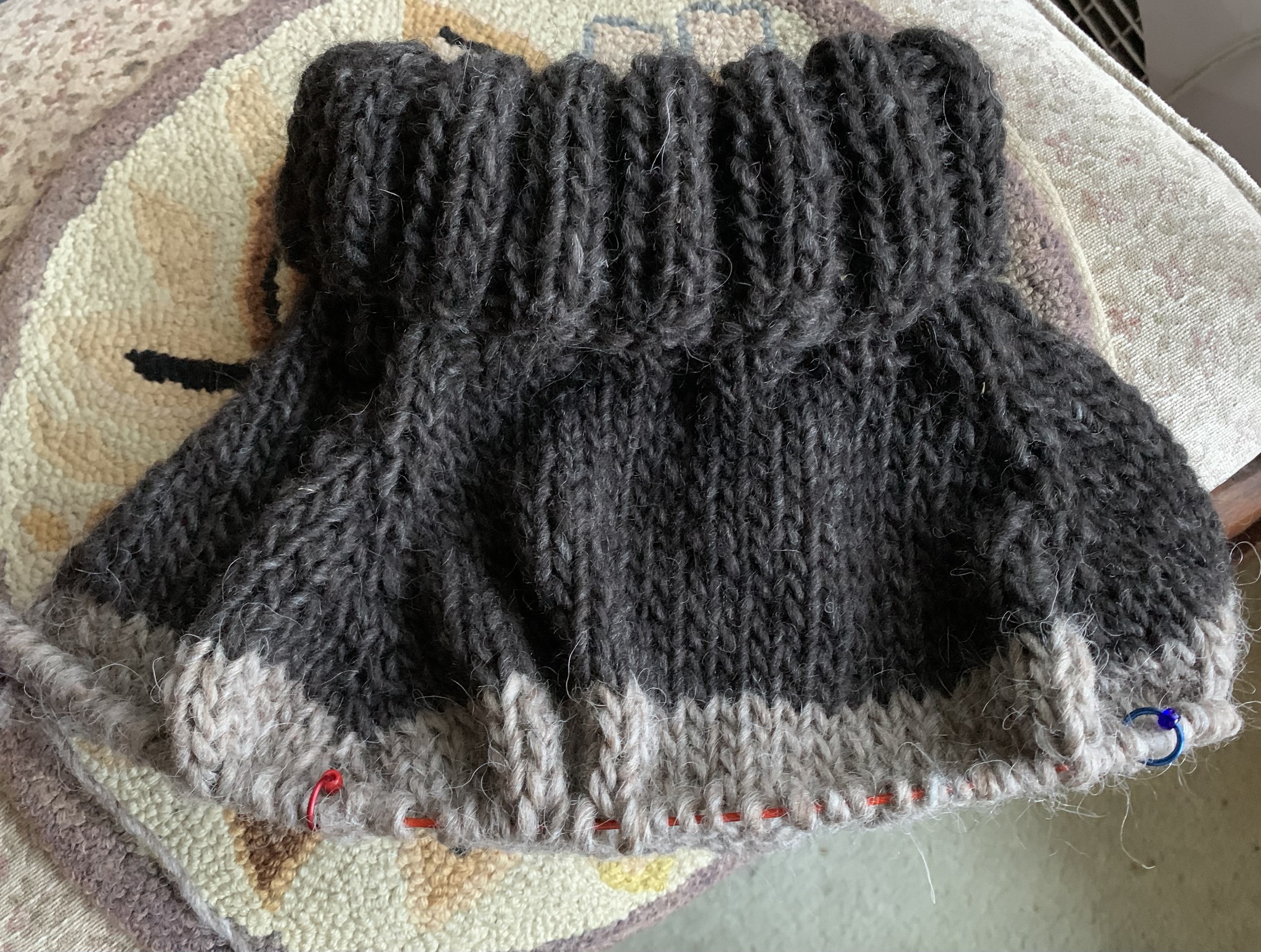
When my body, back and sleeve stitches match up with the number in the Venlig pattern, I will continue and separate for the body and sleeves as VENLIG says.

Fixing Gauge Problems

After 18 increase rows my totals for the body will be 57 front and 57 back, which is a total of 114 for the body (I should have increased more stitches here). The row count (height) is perfect, but stitches are way off.

My gauge is 12 stitches and 15 rows. VENLIG calls for a gauge of 10 stitches with 15 rows. I have 2 more stitches than I should. This changes things.

I have too many stitches within the gauge of 4 inches, which means … that my sweater will end up being smaller than it should be. I need to adjust for this by adding more stitches.

Because I have too many stitches in my gauge, the fix would be to go up a needle size. But, here is my problem – I am already using the largest needle (size 11) that I have! The next size up is needle size 13 US which I suspect would be too big. I’m not investing in size 13 needles just to see if my knitting gauge will work!

Here is a great page at Making Stories that explains gauge and how to fix it. Wish I’d read it before I began knitting this one.

What I should have done (as explained in the link above) is to take my gauge of 3 stitches per inch (12 stitches divided by 4 inches = 3 stitches per inch) and used it to measure size for my needs and adjusted my stitches accordingly.

Bust measures 40 + positive ease of 5 = 45 inches around. 45 x 3 = 135 stitches needed at largest part of body. This does not help me with the cast-on, but at least I know what my stitch count should be on the body. I had to increase to get there because as you read above, I have only 114 total stitches for the body! I created those increases under the arms on each side as I knit down the body.
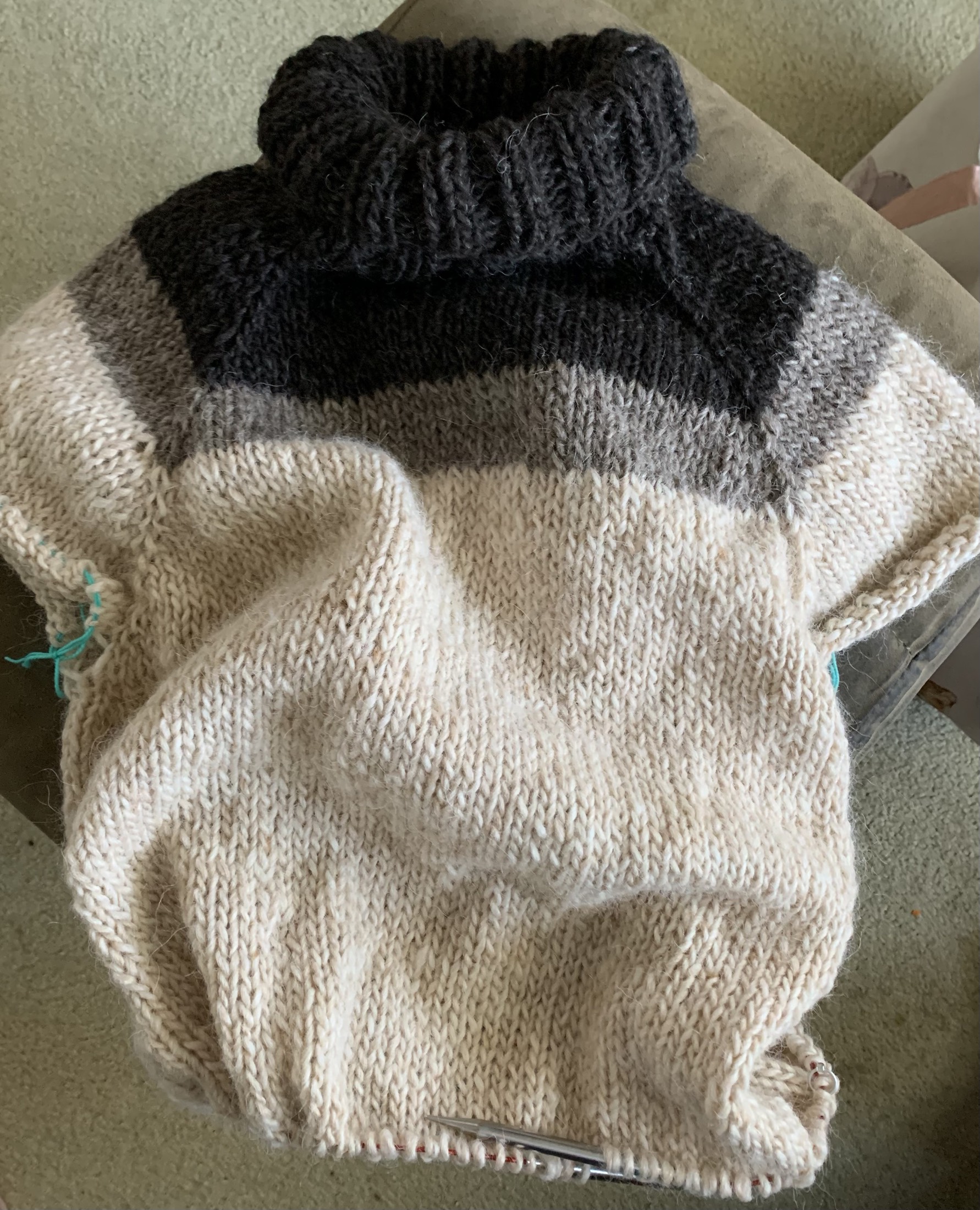
Corrugated Ribbing at Bottom of Sweater

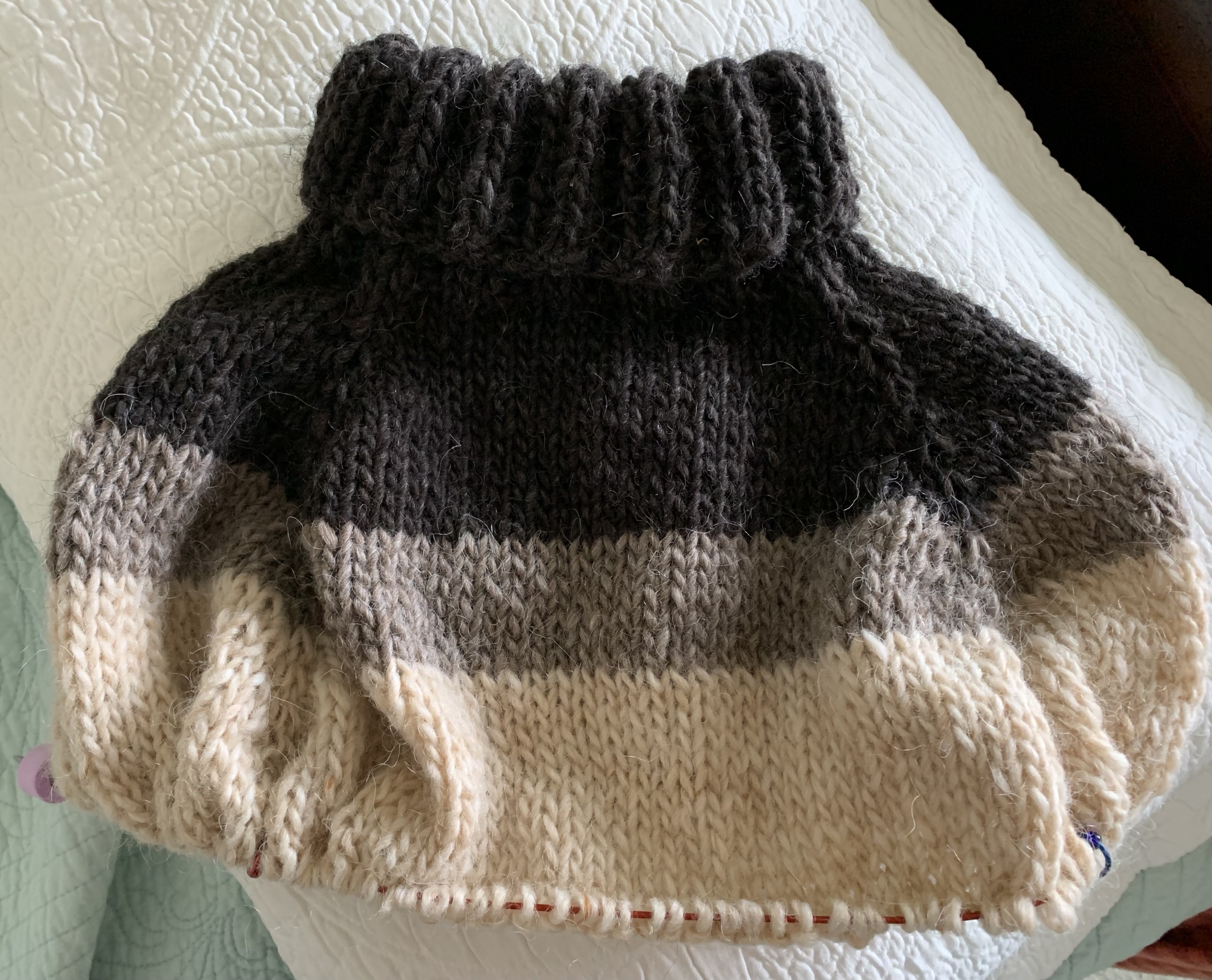
I’ve been trying to decide what type of ribbing I should knit at the bottom of the body. I’ve decided to go with a corrugated rib using the white with the light gray and black.

To this point, all my corrugated rib knitting has been done on hat brims. Cast-on, do ribbing and continue knitting. I’ve never added it to the bottom of a top-down sweater.

After searching for helpful advice, all I read was that when using corrugated rib I would NOT go down a needle size. This type of ribbing is not stretchy like a 1×1 or 2×2 knit and purl ribbing would be. So I am continuing with my same needle, size 11.

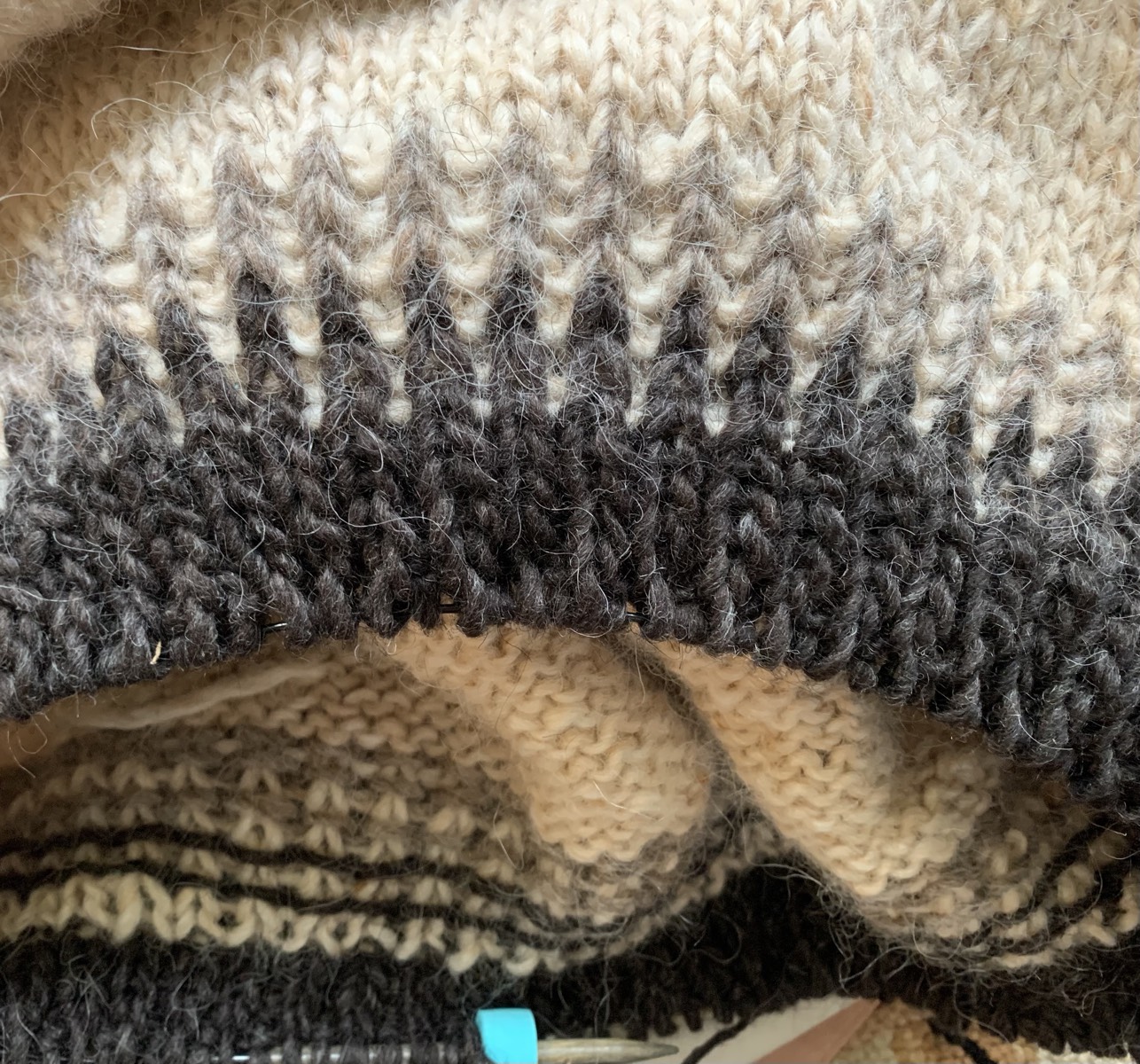
Tried on when the body was finished, and yes that bind-off curls up. *In the end I decided to re-do that bottom.

Once the sleeves were finished I went back and picked up the body rib stitches, then unraveled my corrugated rib. I had no idea how to pick up those stitches, and I ended up having to do it twice – the black stitches were on the needle, but the white were not. It all turned out okay, and then I began knitting the 1×1 ribbing in black. I used a size 10 needle for that ribbing – down one size from the 11 for the body. (I used a size 9 on the sleeve ribbing.)

Knitting The Sleeves

So I know that my gauge is off and that means my sleeves may end up being too narrow. I will do only a few of the decreases down the sleeve and then continue to the cuff without more decreases. *I ended up doing only 3 decreases and ended up with 42 stitches on the needles.

I’m considering some colorwork near the cuff. I also don’t know what type of cuff I will do. I like the colorwork on my other Lopi sweater sleeves, so maybe something like that.
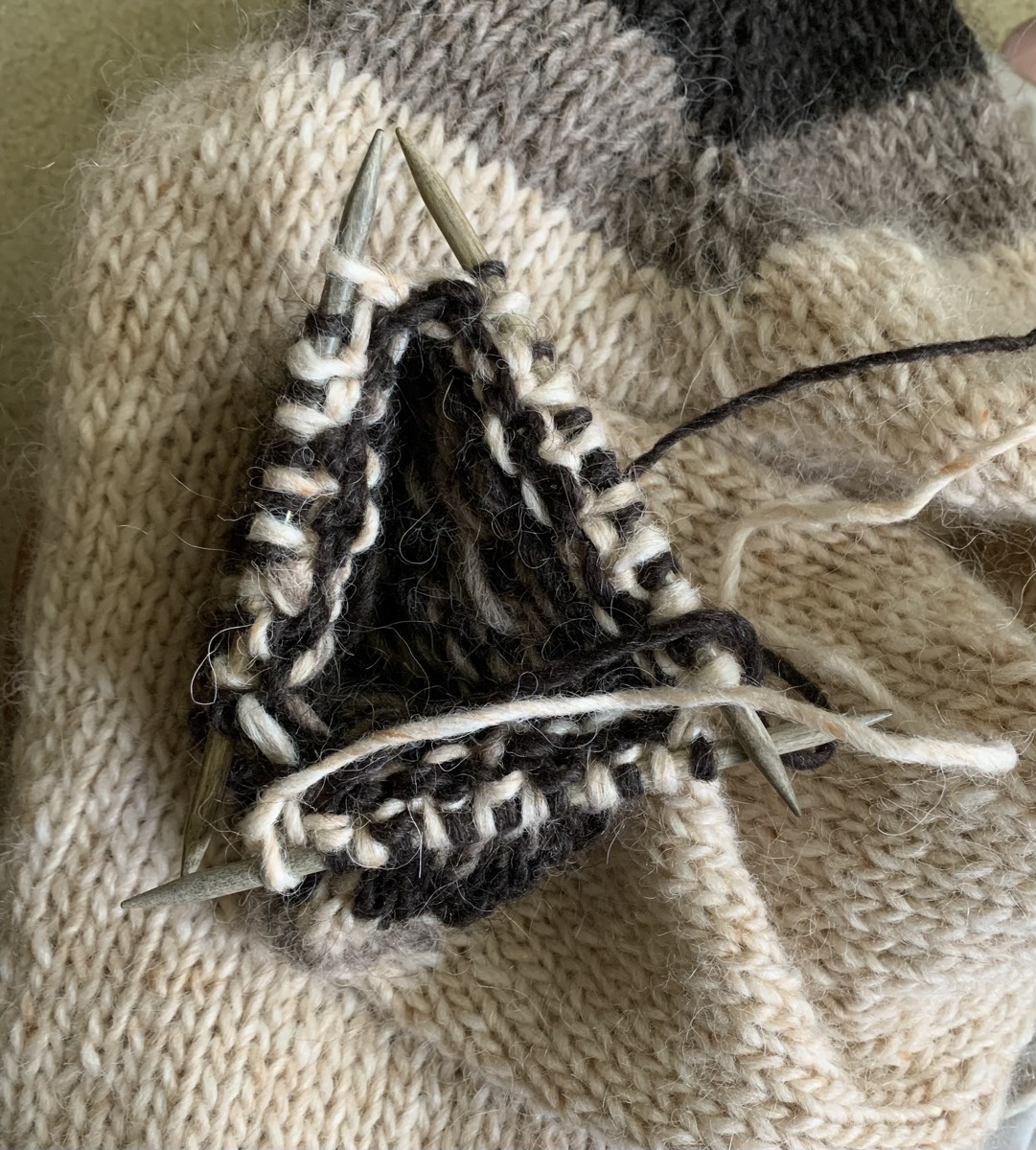
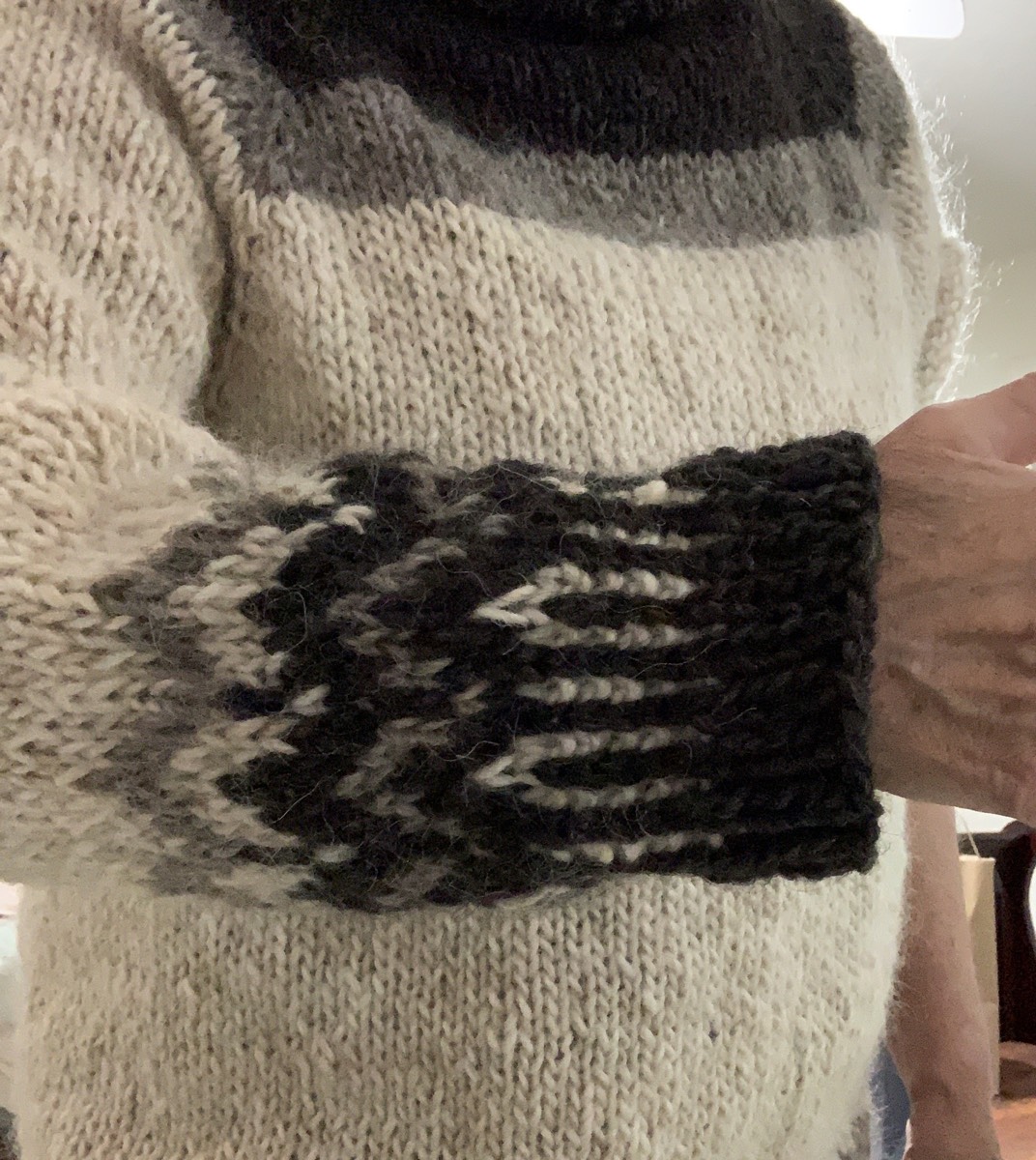
After the three decrease rounds (done as pattern directed), I knit round and round until the sleeve was 11 inched long before beginning the pattern incorporating the gray and black. For the colorwork, I chose to follow a chart on pg. 92 in Alice Starmore’s Charts for Color Knitting (Amazon link to the book) continuing to use the size 11 needles. I know colorwork will pull in a bit.

Next, I changed to size 9 dpns – right after the patterning part – and did a few rows of corrugated ribbing. To finish the sleeve, I did a few more rows, in black only, of 1×1 rib. This way the end of the sleeve won’t roll. I’m very happy with the sleeves!

Bulky turtleneck sweater is done.  Knit in three colors of Alafosslopi wool doing Fair Isle colorwork and corrugated ribbing in ecru, gray, and black yarn.
Finished knitting the sweater

In the end…

I’m happy with the end product and just need to give it a wash and block. I’ve decided to wait for cooler weather and have a photo shoot day for this, and all my other wool sweaters.

Now that I know a little more about sweater knitting than I did in the beginning of my knitting journey, this type of project expands on my list of accomplishments. The more I knit things that I’m happy with, the more I will have to draw from as I continue my knitting journey.

The collar may need to be tacked down, but otherwise this sweater is great. I’ve decided that the reason most of my hand-knit sweaters come out large is that I have a weird body. Most patterns have you choose a size according to bust measurements. My entire middle is large, but my shoulders and arms are not. Even though I get gauge, many of my sweaters come out too big. I’ll have to begin adjusting for that.

More Patterns and Reviews Here

Meadow Moon is My First Jennifer Steingass Pattern

A while ago I decided to make 2021 a year for knitting sweaters. Now we’ve entered 2022 and I am finishing up my projects on the needles.

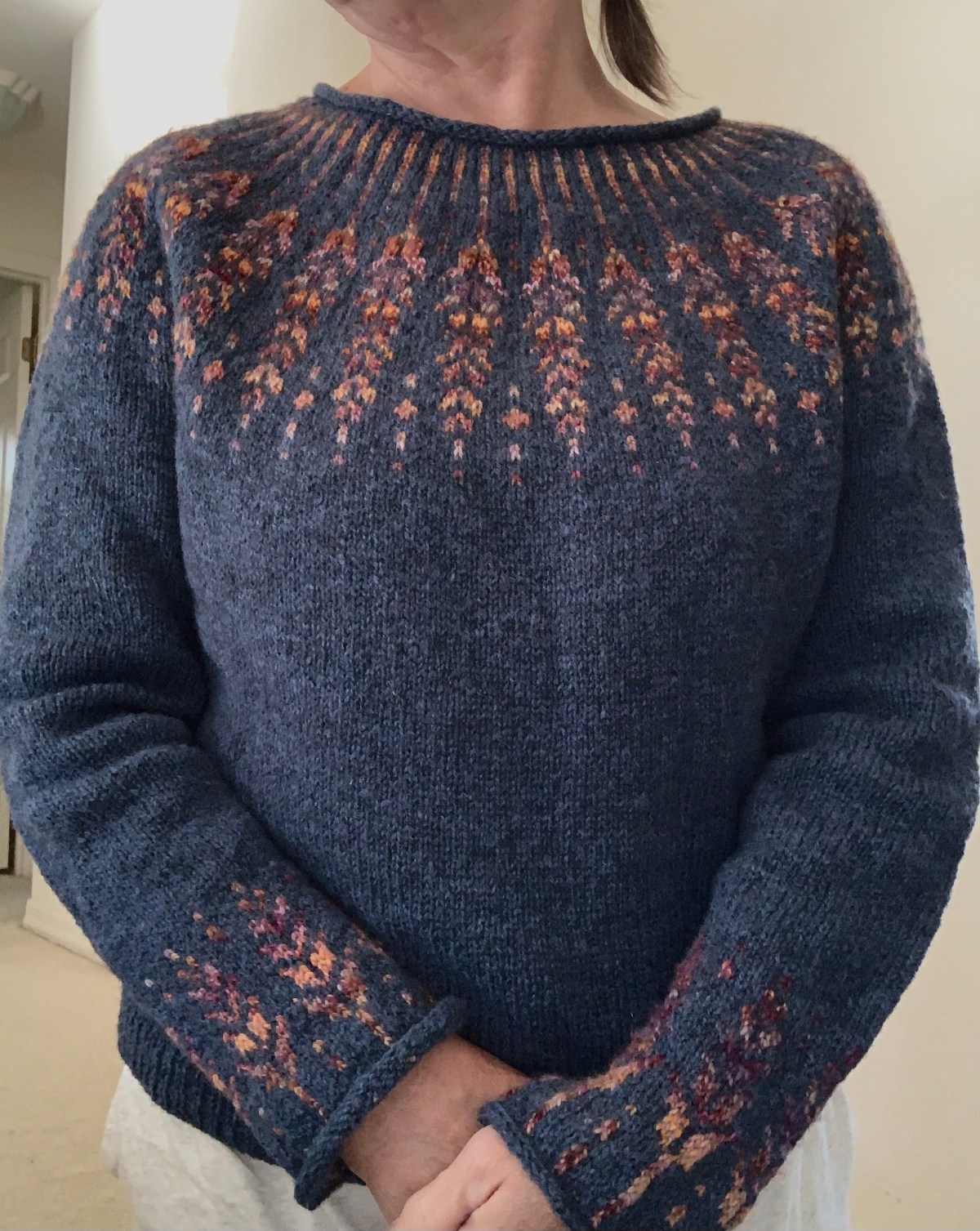
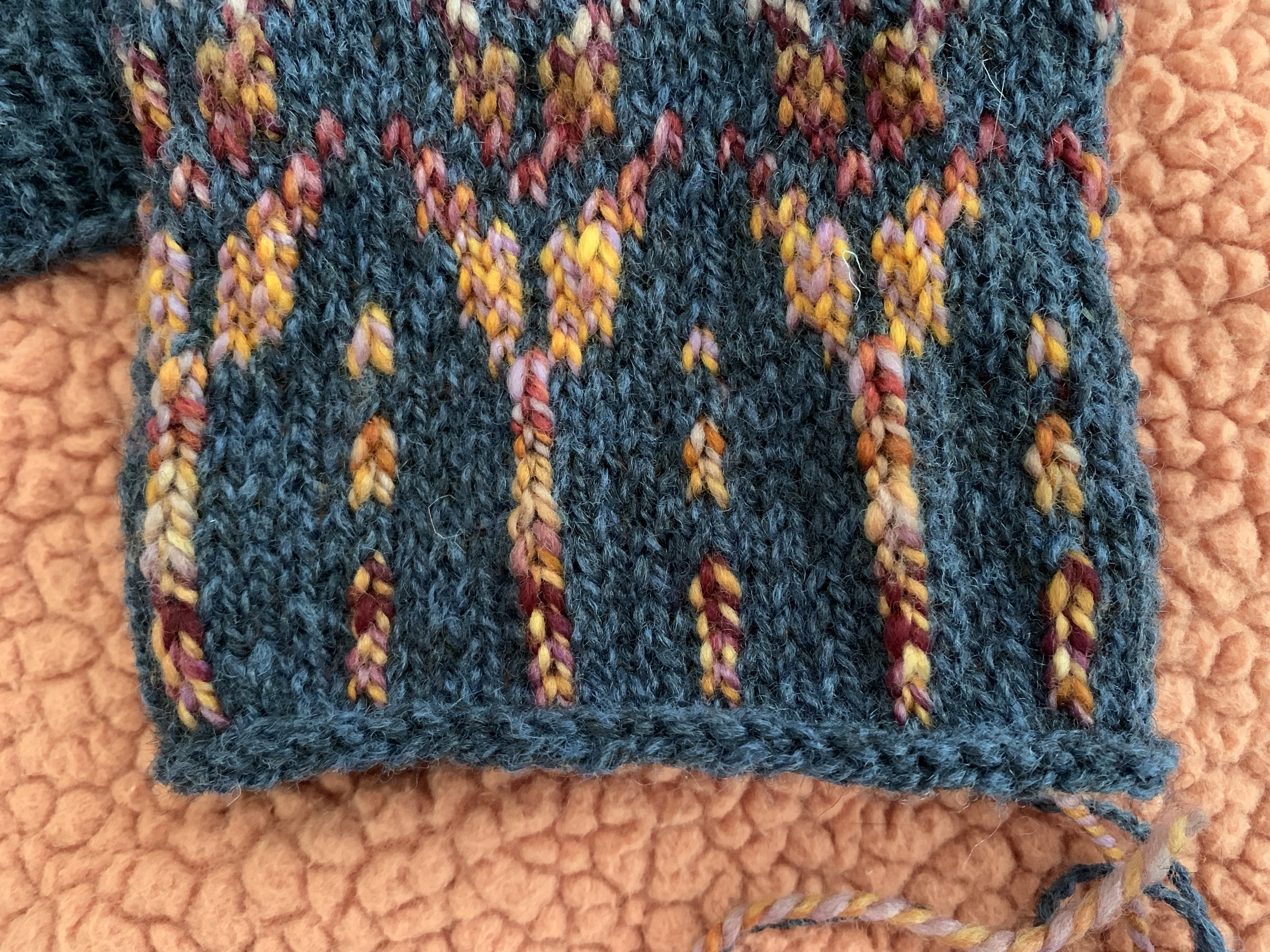
I’ve seen the Jennifer Steingass patterns around and love many of them. Her Ravelry store is Knit.Love.Wool and her sweaters have colorwork yokes, cuffs, and bottom hems. Many of her designs look to be nature inspired with patterns that resemble leaves, stems, and feathers. The pattern I chose looks like stems of wheat coming down from the neckline.

Sweater Knitting is an Investment

Choosing to knit a sweater means an investment of money as well as time. The sweaters I have knit have generally required around 1200 yards of yarn. Depending on the type of yarn purchased, it can be over $100 in material. Choosing a good quality (non-superwash) yarn is worth it. Wool will hold it’s shape and the sweater won’t stretch like crazy when it’s washed.

I purchased seven skeins of Rauma Finull wool in blue and decided on a hand-spun skein I already had as my contrast color. I had no idea how this variegated yarn would look when combined with the dark blue. So far, I think it’s looking quite good. I did not want a completely opposite yarn color for the contrast. With this yarn I have no control over what colors are coming up on the skein. It’s fun to see the colors emerge.

The Meadow Moon pattern is well-written and very easy to follow. This is big. I’m also knitting another sweater and the directions are difficult. Some designers go the extra mile to help knitters and some don’t. I’m learning to avoid some popular designers who have made me unhappy by not going that extra mile.

After the Fun Colorwork…

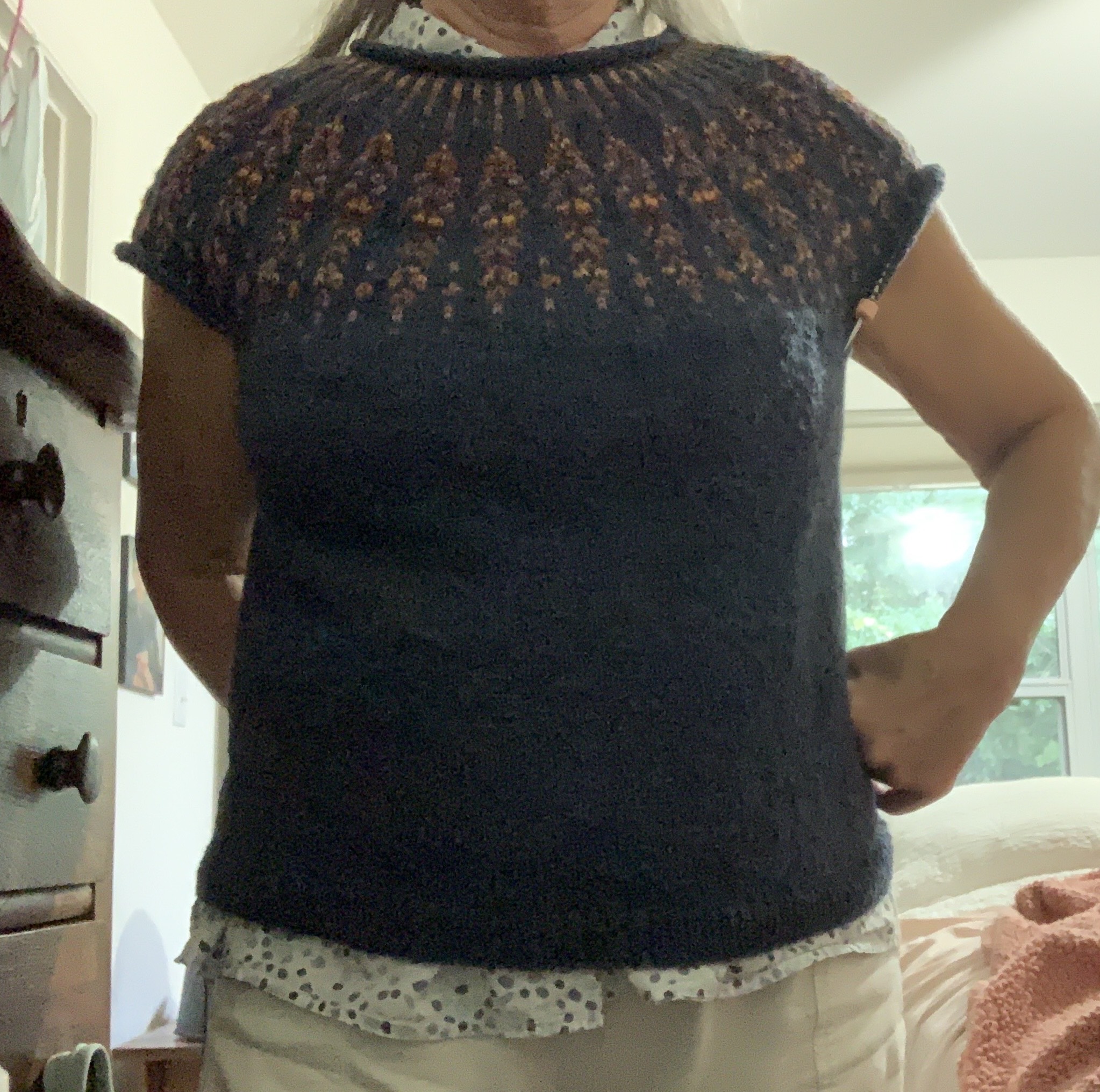
The body is a slog… it has taken a while for me to complete. Finally I bound off the ribbing and tried it on. Fit seems perfect. On to knitting the sleeves. At least there will be colorwork at the ends.

Although round and round knitting can be tiresome, it is great for car trips, late night television knitting, and knitting outdoors and soaking up the sun. I like the fabric being created, and would probably knit more sweaters like this one.

Meadow moon sweater knit
Body is done!

The first sleeve is finished. The decreasing was easy and looks nice and I followed the directions for length, which seems to be perfect.

One thing I changed was the bind off. I found the i-cord bind off directions in the pattern to be difficult. I began with it, but it didn’t look good. Possibly, I was doing it wrong. So I did it my way.

My i-cord bind-off resembles the one Stephen West shows in his video here. Except, I only cast on 2 – to the left needle, not 3, which follows my sweater pattern more closely. Then, *knit one, k2tog tbl, slip both stitches back to the left needle. Repeat from the star.

This bind-off takes some time to do, but it does leave a nice rounded edge.

With one sleeve to go I can see the light at the end of the tunnel

Finishing Up My Sweater Knit

None of these photos are great, but here I am wearing the sweater BEFORE washing and blocking. The middle photo is AFTER the wash, and taken in the sun to show the colors of the contrast colorwork. All the bunching of the colorwork became flat once it was washed. Sleeve length is perfect for me.

The sweater is a perfect fit. I would do more short rows because I have a hard time figuring out which is the front / back!

The yarn has created a lovely, lightweight fabric. I think this is one of my favorite knits so far. *Also, it has become the most worn hand-knit sweater I’ve knit so far. It fits perfectly and is very light weight and comfy.


Read about what else I’ve been up to in my knitting world…

Knitting Farfuglar “Migrating Birds” Icelandic Wool Sweater Pattern

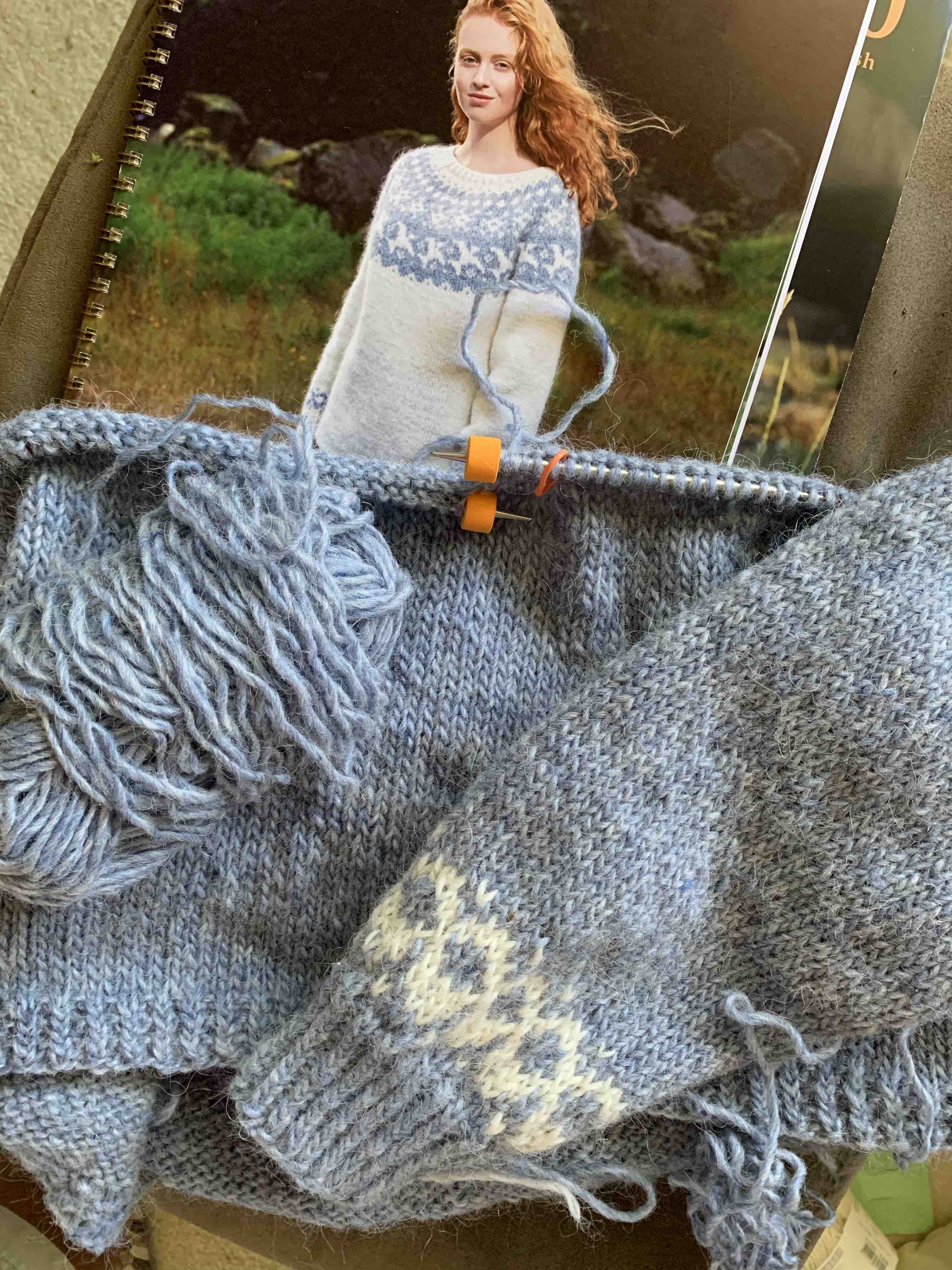
This new sweater pattern is from the Lopi 40 book which I bought along with some Lettlopi yarn recently. I want a light blue sweater with white accents and Farfuglar is the pattern I chose. It means “migrating birds”. The sweater shown in the book uses my same choice of colors (air blue and white) as I chose, but in the opposite way. The yoke can also have more colors in another version.

Lopi 40 is full of Icelandic designs knit with Lopi wool and apparently it is one of the newer books.

This Farfuglar pattern, and other patterns in the book, can also be purchased separately. (This link goes to Ravelry.)

The Farfuglar Learning Curve

I purchased bunches of the Lettlopi yarn variety which is aran weight. The first pattern I chose was one by Jennifer Steingass. After beginning the sleeve twice, and not being happy, I gave up and moved on. That is when I chose this pattern from the Lopi book: Farfuglar, or “Migrating Birds”.

I knit a flat gauge swatch which matches the required gauge for the sweater. I know that garments knit in the round should have swatches knit in the round, but oh well, I didn’t do that.

The pullover is knit bottom up. I have begun knitting one of the sleeves and really like the way this yarn looks and feels. The pattern uses the same two colors I chose, white and “Air blue”, but the sample sweater is mainly white with blue accents whereas mine will be the opposite. The colorwork chart is in five colors because there are two ways to knit this sweater. As I knit the chart I will convert it to two colors in my head.

The patterns in Lopi 40 are Icelandic and measurements are given as centimeters. Needle sizes are also mentioned in mm except at the beginning of the pattern where they give the US size also.

Increases and Decreases

After the sleeve ribbing is finished, we are told to increase around evenly to end up with correct stitches for the colorwork. I had to go from 42 stitches to 50. I don’t know why, but this was hard to figure out. I will have to do something similar at the neckband except it will be decreases! Oh Boy….

Had to decrease at the neckline from 100 to 84 stitches evenly around. This strained my brain, but I did it.

Learning New Things

Two new (to me) types of decreases are also mentioned: KRPR (right leaning) and SKP (left leaning) – both links go to pages at the New Stitch a Day site where videos show the process.

I’m not a super experienced sweater knitter, but I have finished a few. Most have been top-down knits, but this is a bottom up. The underarm stitches need to be grafted together when finishing, which I’ve never done, that I recall. The pattern doesn’t say how to accomplish this, but I found this page at Laura Chau that explains Grafting Underarm Stitches. It uses the Kitchener Stitch, which I have done.

Joining Sleeves to Body – Notes for the Inexperienced (Me)

I’ve only knit one other sweater bottom up which means the sleeves and body must be joined. It’s not difficult, but for me, drawing out a diagram while reading the directions was helpful. I got a better picture for how this would happen. I also placed a pink marker on the front section so I would know front from back.

I’ll keep this for future reference and noted needle sizes and other hints to the paper.

Notes I made: After finishing the second sleeve, leave stitches on the needle (I used a 9-inch circular). When beginning to join, I used the longer (body needle) to knit off the sleeve needle. When I got around to the second sleeve, I put those stitches from the holder yarn onto a smaller (size 4) needle and then knit off of it. Once that happens, the whole sweater is now combined into one piece.

Needle lengths: Begin knitting the whole yoke with a 40 inch (The pattern says 32, but I found the longer needle to be easier). Changed to 32 inch farther up, and ended up with 16 inch for the neck.

Four places are on holder yarn and stitch holders for the underarms. Those will be grafted together using the Kitchener Stitch when I’m done knitting.

Now I have begun the colorwork yoke. Some of the yarn carries are quite long, so knowing how to catch floats is definitely necessary for this design. I was very excited to see the birds emerge!

Yarn Used For Size L

  • Blue Yarn total used: 8 skeins – nearly every bit of 8, so 9 is better just in case
  • White Yarn total used: less than 2 skeins

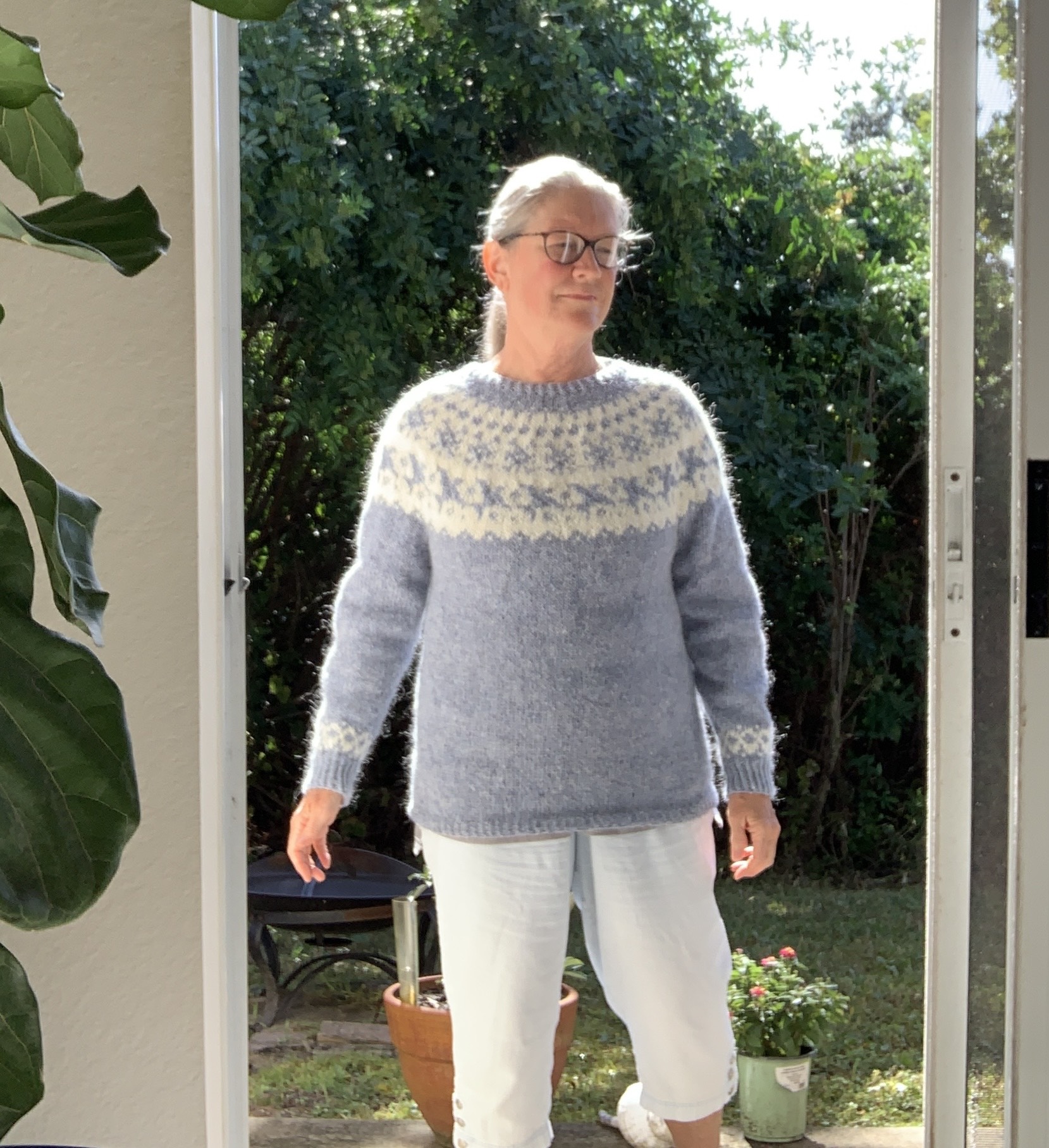
October 29th and the Sweater is Finished! See My Photo Shoot Below

At this point I was still trying to decide if that high front neckline would be okay. Without any type of short rows, the front and back of this one are exactly the same. This makes the front neckband ride on my neck. I would probably have a shirt on underneath, so I decided I could live with the neck as it is. Also, I didn’t want to risk ruining things since I am not experienced at changing knitwear designs!

The hat photos were taken in “winter” when the temps dropped to the low 40’s here in Florida. I went out to feed the birds bundled up in my woolies! (Triple-patterned watchcap, mittens, Woolfolk cowl) All other photos were taken before I washed the sweater.

I will be writing a separate blog post about how I finished off this sweater.


Learning About Lopi Wool

The sheep who provide this wool live in the harsh Iceland landscape. If their wool can keep them safe and warm during winters spent outdoors, certainly the wool in your Icelandic sweater will do the same. The yarn comes in lots of pretty colors (if you can find them in stock!) as well as natural colors such as white, gray, tan, brown and black. It comes as heathered, solids, and tweeds in various weights, including unspun yarn. The yarn is a combination of insulating and water repellant, not to mention very warm indeed! If you are not a knitter, the sweaters can be purchased already knit up.

After knitting with the Lettlopi, I found there were quite a few knots to deal with. More than most yarn I knit with, but maybe that is just the nature of the yarn.

I don’t yet have a sweater or other garment to try on so I can’t comment on the scratchiness of this yarn. Some people think it is exceptionally scratchy, but many people say the wool softens over time and gets better and better.

Finding Lettlopi and Alafosslopi Wool to Buy

As is unfortunately true these days, finding yarn can be challenging, and especially in the popular color ways.

The Lettlopi (aran) and Alafosslopi (bulky) yarn in my stash has come directly to me from Iceland and is from the Istex company. It was ordered from The Icelandic Store where they still have quite a few colors in stock. The low price of the skeins, compared to prices in the US for the same yarn, made it worth paying the high shipping rates.

My order of Alafosslopi arrived in four days..!!… and came with a little candy surprise. I have already knit up a swatch and plan to knit the Carbeth Cardigan by Kate Davies, but that plan could change.

For instance, many places in the US have Alafosslopi for around $10 a skein, or close to that price. When ordering from Iceland, each skein is $5.99, which is a big difference, and especially if you need many skeins to knit a sweater. The Lettlopi costs about $5.75 in the US compared to $2.99 each in Iceland.

Webs yarn offers big discounts if large amounts are bought, and the cost can be less in the end, but many of the colors are out of stock at the time of this writing.

More From the Blog

Knitting The Calliope Sweater Pattern

Knitting has begun on my Calliope pullover sweater pattern (link to the pattern below).

Somehow I managed to pull a muscle in my neck which is causing me some extreme discomfort. The pain is keeping me from doing much of anything except sit in front of the television and knit. For that reason, my sweater is coming right along! We must take the good with the bad 😉

The Yarn Story

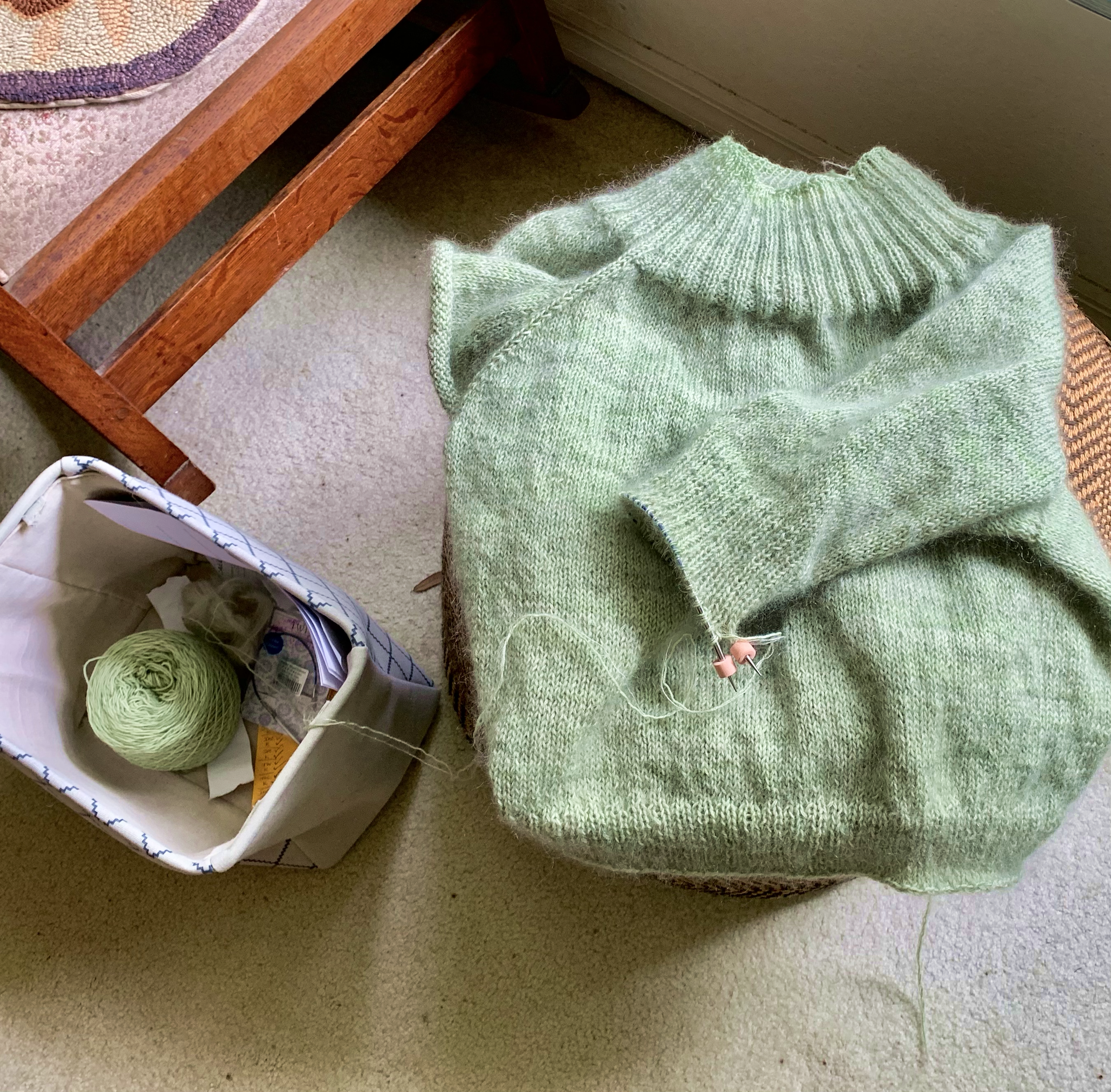
I’ve had the Miss Babs “Katahdin” green yarn for a long time now. The “Spring Clover” yarn is a Wild Iris – meaning they only made the color once – and the skein has 1750 yards of yarn..!! It’s made up of Bluefaced Leicester Wool and is Superwash. Originally, I thought I would use it to knit a large, rectangular stole for my daughter, then I decided not to.

So, this huge skein of yarn sat around until recently when my new idea was to pair it with mohair and knit a sweater.

Miss Babs Katahdin yarn and Filcolana mohair
Yarn is ready to knit

I ordered some dark green mohair to use, but after knitting up a swatch, decided I didn’t like the colors together. After trying the Katahdin with some leftover white mohair, and liking that combination better. I ended up buying the Filcolana Tilia mohair (link goes to Fairlight Fibers) in very light green called “Green Tea”.

Swatching for the Sweater

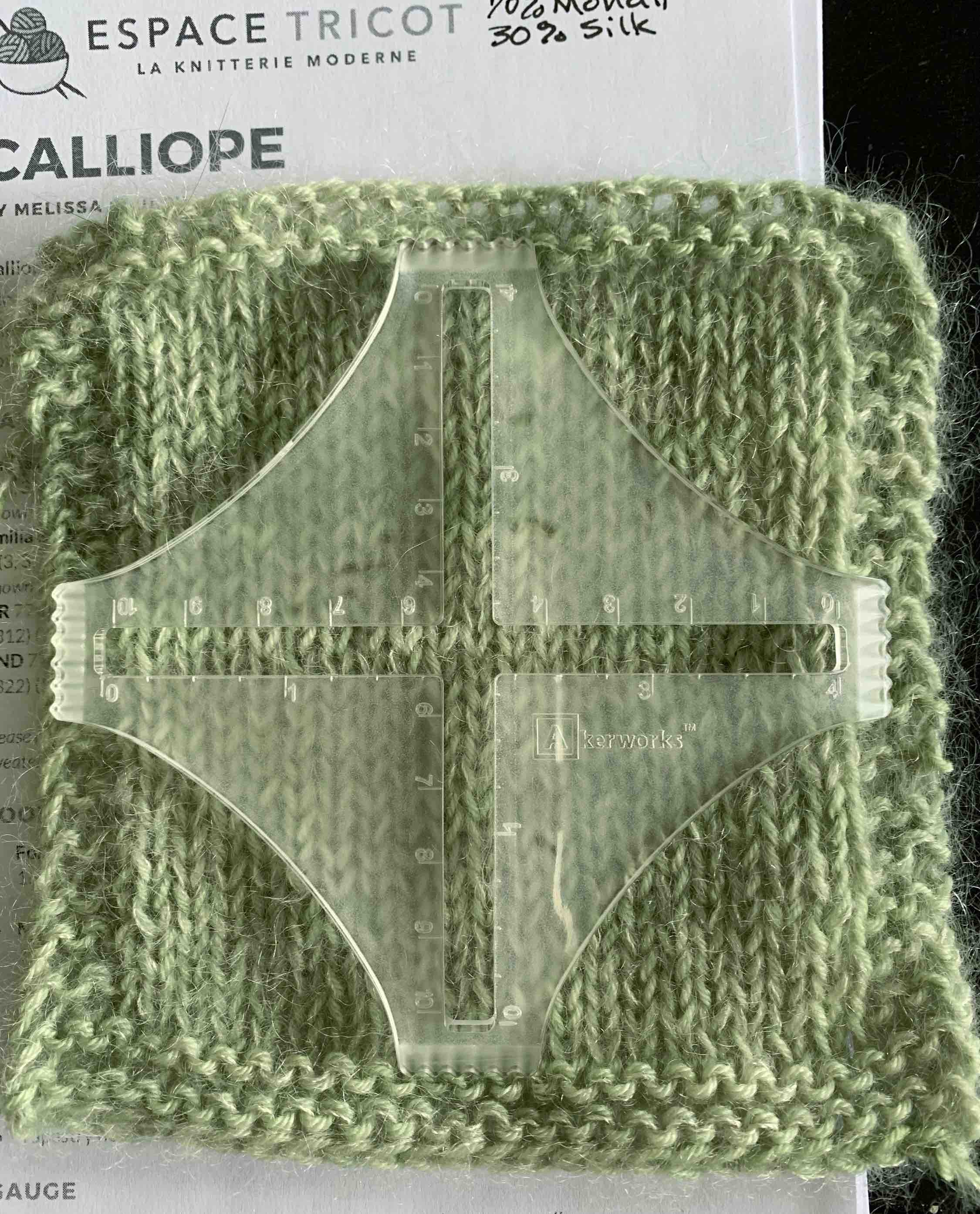
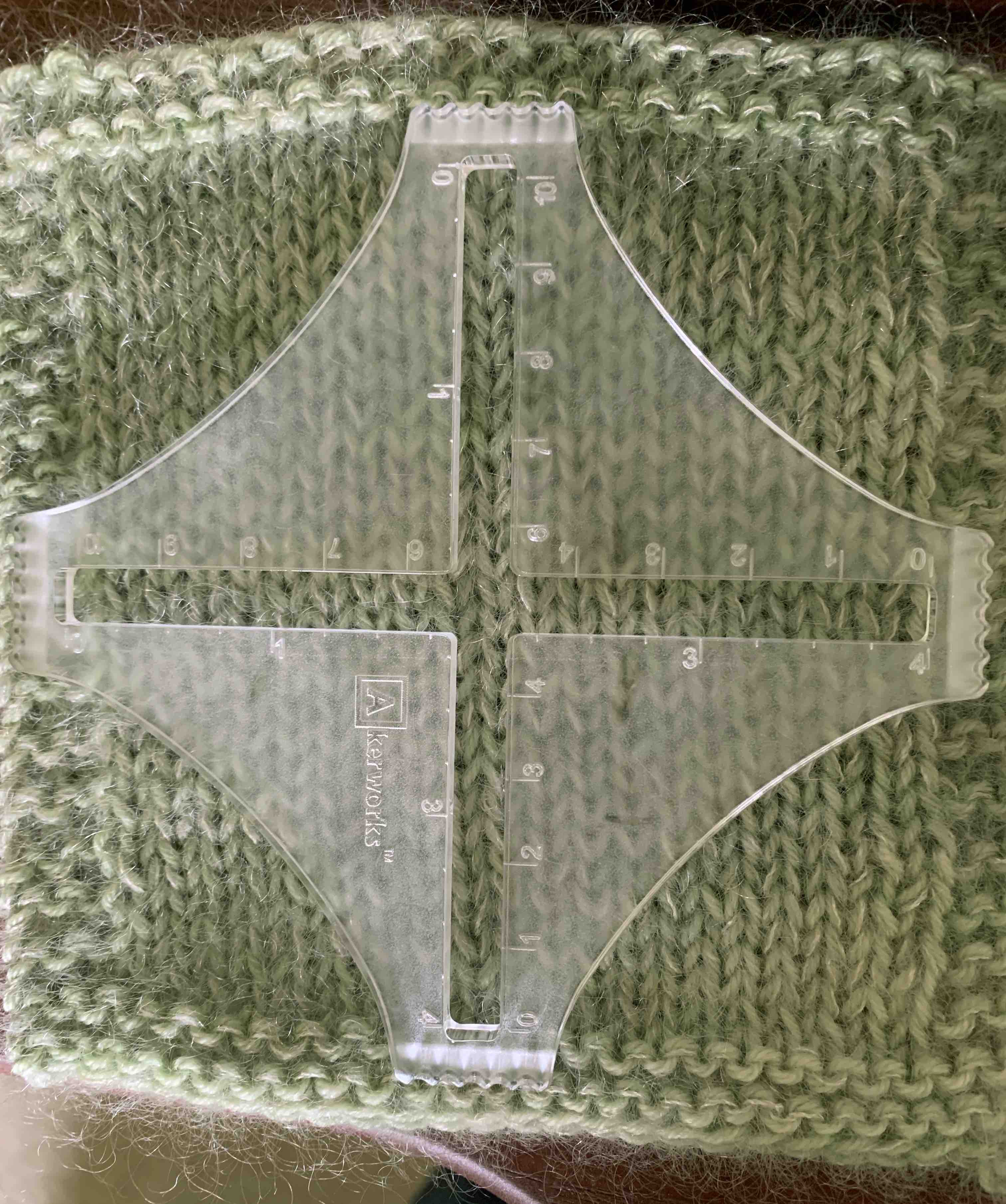
Using the size 7 US needles, I knit up a swatch to check for guage. Before the washing and drying of the swatch, the row counts were pretty exact. But after blocking, the knitting expanded to be slightly taller, so I will watch the length of my sweater. It’s not terribly off, so I stayed with the same size 7 needles. (I should have gone down a needle size because this sweater really grew!)

The Sweater Pattern is “Calliope” from Espace Tricot

Raglan sweaters are generally quite easy to knit and I’d already knit the Turtle Dove pattern offered by the same designers. That one was my first raglan knit, but it came out huge – more like a big poncho / blanket.

This pullover has texture at the yoke which is created by simple knits and purls. The pattern begins with a cast-on for the neck and is knit top-down. I decided not to include the mohair until I knit a few rounds. Something about fuzz at my neck turns me off.

Photographing knitwear projects, and getting the color right to share, can be difficult. For some reason this mint green color is exceptionally difficult to capture. GRRRRRR….. I promise, my sweater color is not that ugly!

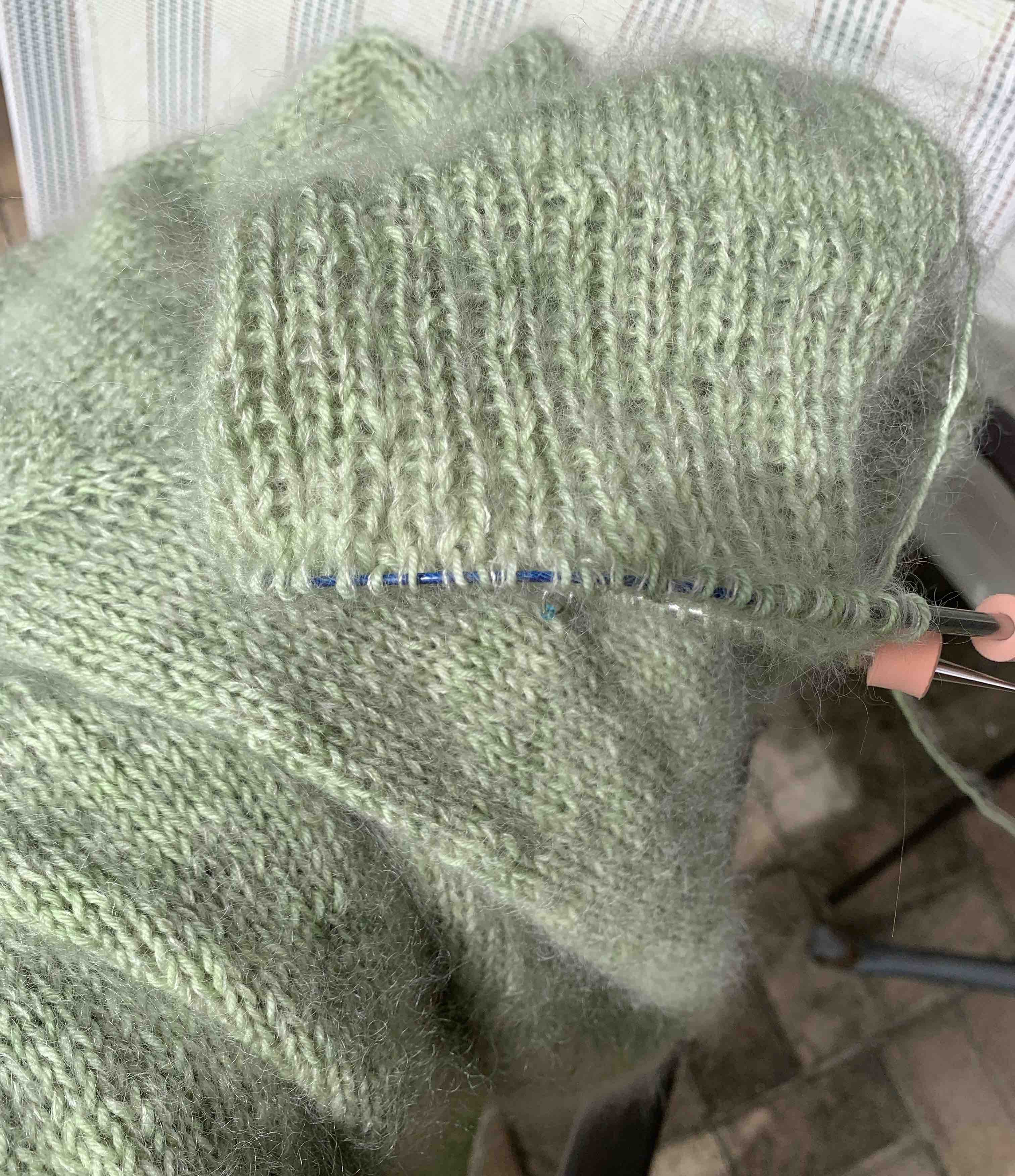
Calliope has short row shaping using German Short Rows. They are explained in the pattern, and are very easy to do, and a link is provided to a video by Very Pink Knits for further explanation. Short rows give the sweater a better and more comfortable shape by raising up the back section (shown in my photo below). You can see that the front of the sweater (photo on the right above) has fewer knit rows after the short rows are completed.

Once that is accomplished, the raglan increases begin. This creates the sleeves and widens the front and back. My sleeve increases are easy to see in the photo above. I have just put the two sleeves onto waste yarn and will now continue to knit the body – round and round in stockinette.

Not Liking This Mohair

Body of sweater is done. It seems a bit big around. On to the sleeves, but the fuzziness of the mohair is quite annoying. Every time I knit, I end up with fuzz in my nose, mouth and eyes – like I am a magnet for it. I don’t know if it’s this type of Mohair, or all mohair which would do this. (I have since discovered Knitting for Olive Mohair, which is much better.)

Photographing this green has been a real pain in the neck! Finally I took the sweater, with one sleeve half knitted and the other on hold, and put it outside in the sun. The photos came out a bit better, but they are not true to the pretty green of this yarn.

The sleeves have a very long section of ribbing that runs down the arm from about the elbow area. I began that with DPN’s and switched to 9-in. circulars because I really don’t like using DPNs for long lengths of time.

Because I was working on this pattern alongside the Meadow Moon color-work pullover pattern, and also my Lettlopi “Migrating Birds” pullover, among other projects, the sweater was finally done three months after I began knitting.

Calliope Sweater End Results

The Calliope Sweater is quite an easy knit. The directions are well written, and mostly you are knitting, or knitting and purling. I chose the yarn from my stash because this past year has been a year of “no buying” (for the most part).

What I like, is the easy going style and the fact that most of this sweater can be knit at night while watching TV.

The sweater is big. Superwash yarn tends to do that, and that is why I usually avoid using it for sweaters. This is a good lesson in watching the gauge and changing needles accordingly – especially if using a Superwash yarn. I may toss it into the dryer one day to maybe shrink it a bit.

Espace Tricot used to offer all free patterns. They no longer do, but the patterns are nice even if you have to spend a few bucks. Recently, they came out with a classic raglan sweater called Gingerbread Sweater and it’s another that is most likely perfect for a beginner knitter.

Please keep reading….

A Simple Sweater With Stripes

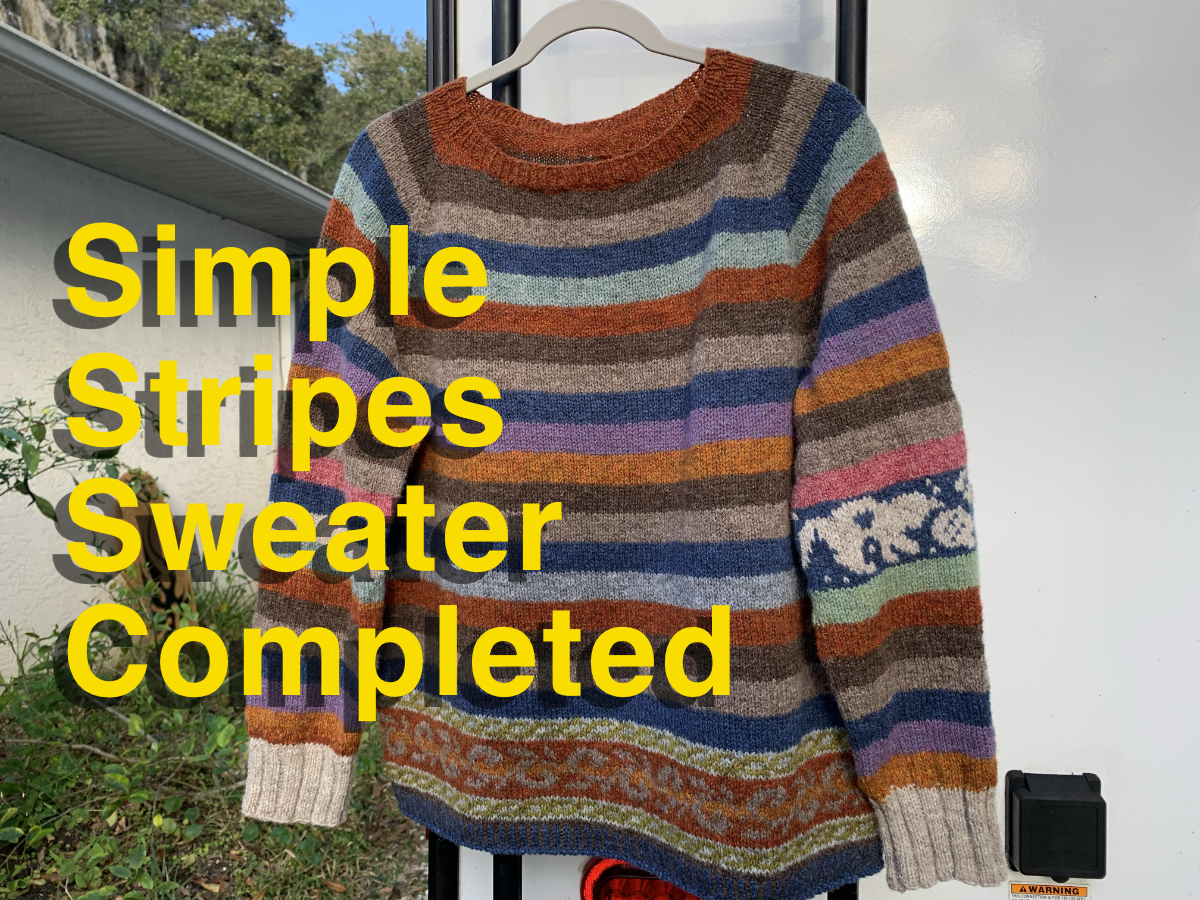
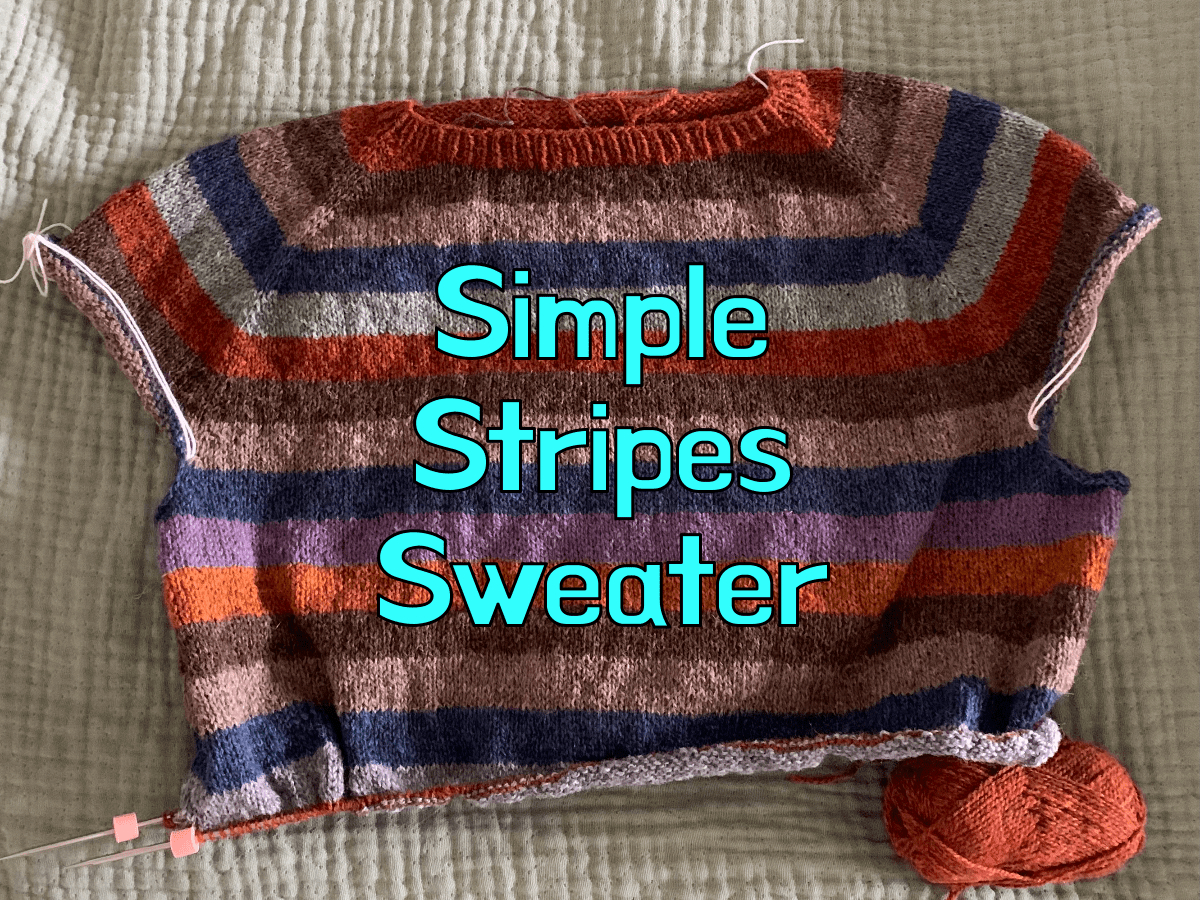
My newest knitting project is a simple sweater with stripes. A link to the pattern page on Ravelry is further down the page. This one is advertised as a good project to use up stash yarn. I can see how that would be true. I was finishing up knitting the Warm Up sweater (#3), and…

Understanding Knitting Pattern Theft and Its Impacts

Pay for your knitting patterns. Never accept a copy, or you are actually breaking the law. Designers work hard to create those awesome patterns for us. It’s only a few dollars, but designers need to earn from their creations to keep their small business afloat.
Alternatives to the Hidden Gems Shawl Pattern

Hidden Gems was a popular free shawl knitting pattern. Since it is no longer available, I have found some similar patterns for knitters. Check out the list and let me know if you choose one.