How to Add the Tassel to The Doublemassa Hat

How to make a tassel for a knitted hat. Finding a way to attach the tassel to a lined hat with no underside access.

Making a tassel is not difficult, and I was looking forward to making the one for my Doublemassa. But there was a problem. How is a tassel added to this type of knitting project?

I have now assembled the tassel (and it’s far from perfect looking). But, my big problem is how to add it to this hat. Ordinarily, when finishing up a hat, you have an underneath, or wrong side, where the yarns are pulled through and tied off under the crown. The Doublemassa is knit in a way that the underneath can’t be accessed. It is completely closed up. The pattern is no help.

Tassel Making Video

It was hard to envision tassel making in the Hat’s On book where the Doublemassa pattern is found. This video on YouTube was very helpful. However, I still must figure out how to add the tassel to my finished hat.

One of the Doublemassa knitters mentioned opening up the top of the hat and making a big knot to tuck through. Then, she closed up the top again. I ended up doing this, but a little differently.

My Tassel

I wrapped both yarn colors 60 times around a six inch cardboard. I tied two strands of yarn around the top and then braided the 4 strands. I wish I’d used more strands for this.

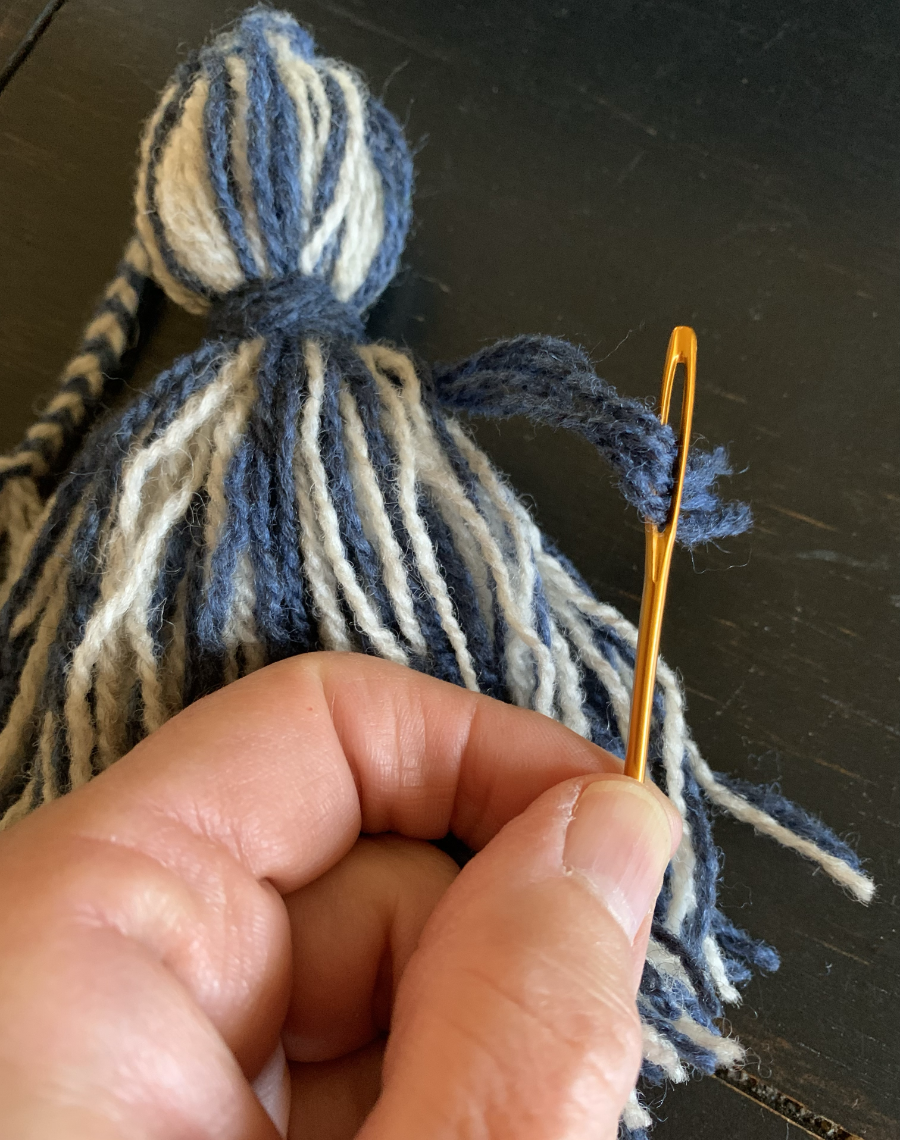
Next I wrapped the blue yarn around the tassel.
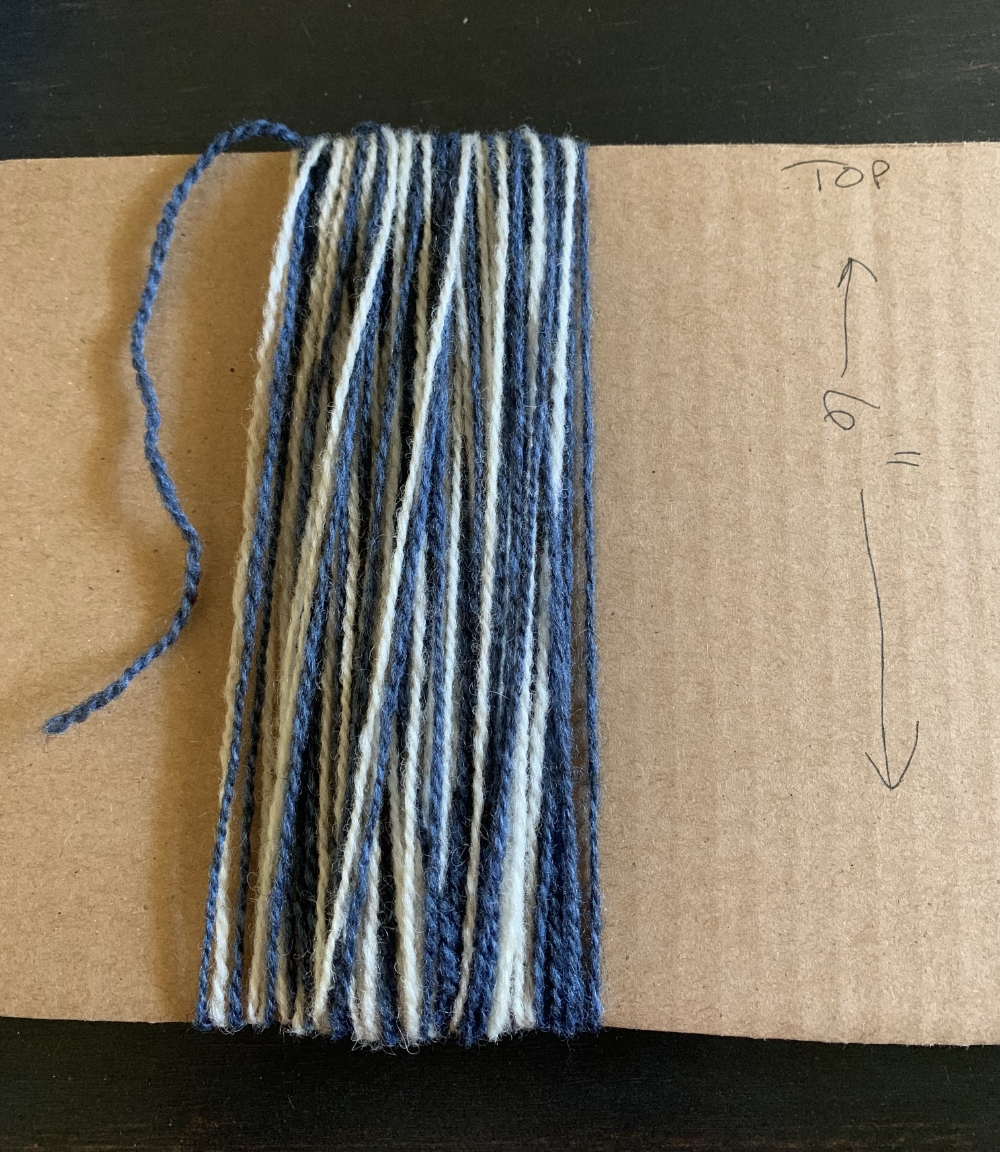
I do not have a bodkin (Amazon paid link), which is a special flat “needle” which is used by the woman in the video. My larger sized embroidery needle worked fine. This is used to wrap the tassel and tuck the yarn down inside.

After my washed hat was dried, I noticed that two stitches at the very top were loose and not bound off! Somehow they did not unravel (wool is so awesome). It left a small opening.
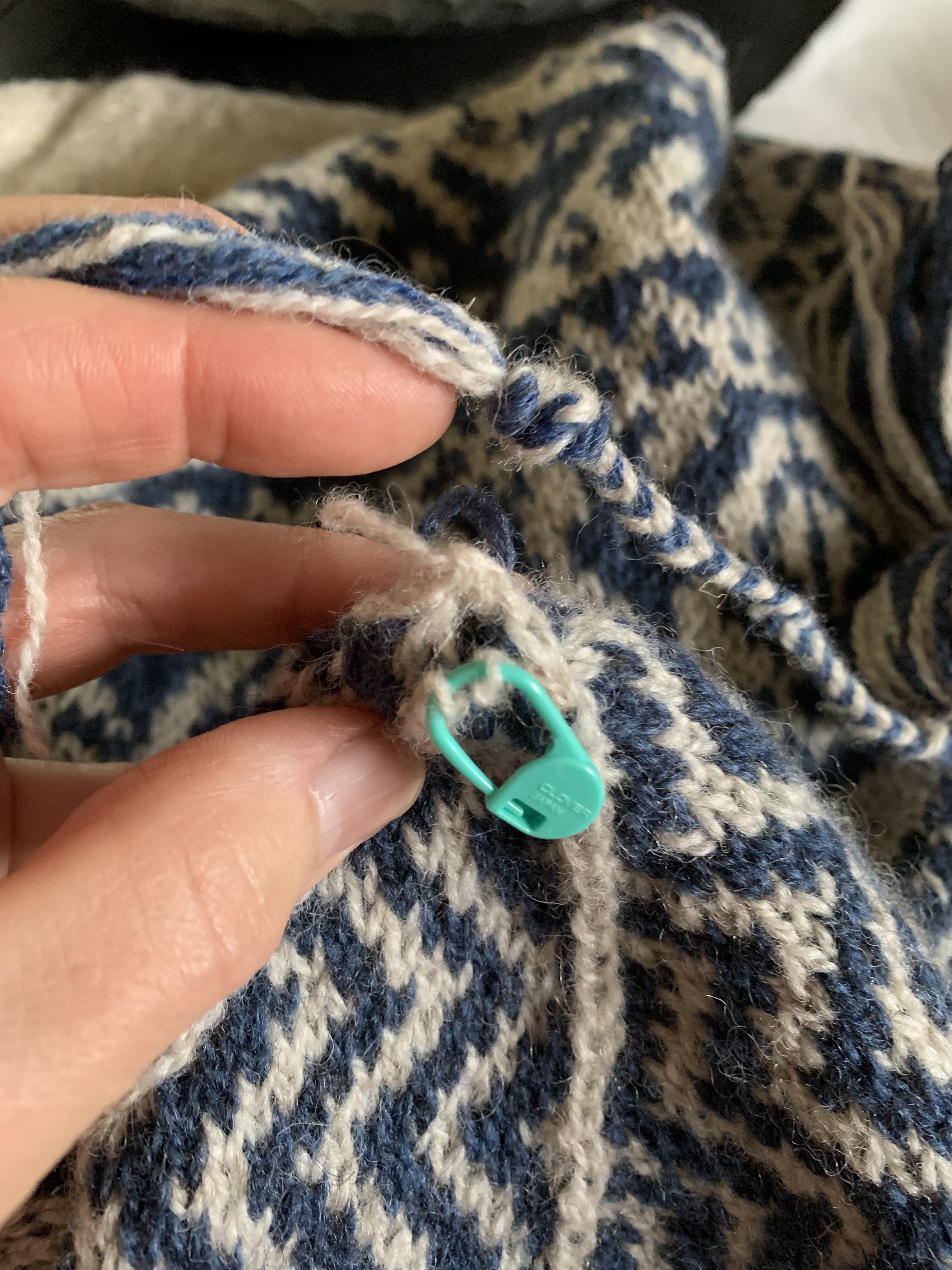
Adding the tassel was a challenge, but I simply did as one of the other knitters mentioned. I made a big knot and pushed it through the top. My dropped stitches mistake turned out to be the thing that saved me. Then I used the two yarns, one blue and one off-white, to close up the top tightly. I wove the ends down through the hat and cut the yarn.

A Better Way to Attach The Tassel

Now that I have done it, I feel lucky that it worked out. And I know that there is a better way to achieve this. The pattern simply says make a tassel and attach it – which is very unhelpful.

My advice is this: When knitting the last rounds of the crown, do NOT close up the top of the hat. Leave a tail and tuck one tail down inside the hat. Put the open stitches onto plastic holders, or waste yarn, for washing.

Make the tassel and wash the hat.

Once the hat is washed and dried, open the top and tuck the knotted end of the tassel braid down into the hat. Use the remaining yarn tail to close up the top.

Alternatives

A few of the Doublemassa hat knitters decided to begin knitting the hat with the colorwork. By using a provisional cast on, the lining of the hat could be knit last. This would do away with the need to begin the hat with a tiny disappearing loop cast on, and magic loop knitting.

It also makes adding the tassel easier. Then, the tassel would be washed along with the hat. I’m not sure how that would work. It could take a while for a tassel to dry.

Have you knit this hat, or one like it? Do you have ideas about adding the tassel?

More knitting stories…

Something went wrong. Please refresh the page and/or try again.

Knitting a First Sweater, Warnings, Ideas and Suggestions

Want to know more about knitting a first sweater? I have some advice for beginner sweater knitters, as well as pattern suggestions.

After fiddling around with dishcloths, hats and scarves for a while, and getting basic stitches learned, I needed a bigger knitting project. I yearned to make a sweater just like all those pretty knitted sweaters I was seeing everywhere online.

I tried to find out as much information as I could before choosing the pattern. I read blogs, Ravelry pattern reviews, and visited the forums, but I still felt indecisive. What type should I choose? A top down, or bottom up? Cardigan or pullover? Plain or colorwork? I had done a bit of colorwork and liked it. A cardigan seemed like too much to handle with button bands, buttonholes and buttons! So, I chose a bottom-up pullover with some colorwork at the top by a designer I’d seen mentioned quite a bit, and bought the Umpqua sweater pattern by Caitlin Hunter.

Continue reading “Knitting a First Sweater, Warnings, Ideas and Suggestions”

How to Fix Knitting Mistakes

How to fix some common knitting mistakes. Every knitter needs to know how to un-knit, and frog to get back to their mistakes to be corrected.

One reason I refused to learn to knit when I was younger, was the difficulty in fixing mistakes.

When crocheting, we simply remove the hook and pull the yarn back past the goof, and begin again. This can’t be done when knitting.

How to “Tink” or Un-knit

While happily knitting along, suddenly you look back down the row you just knit (and it’s a good idea to get into the habit of doing this) and see something is wrong. Maybe what should have been a purl, is a knit. Maybe a stitch has dropped. Maybe the wrong color was used in a colorwork pattern. Whatever it is, it needs to be fixed. Now the stitches just worked need to be taken out, or un-knit / un-purled – back to the spot of the mistake.

Please note that if your mistake is waaaay back and it would take forever to un-knit to make the fix, read the next section about how to fix that type of booboo by frogging back.

The Chilly Dog has a good video showing (very slowly) how to take out knits and purls.

Sometimes your row will also have other stitches, such as K2tog, SSK, or more involved stitches. Good luck! Look that up on YouTube if you need help. Basically, undo the stitch by remembering how you made it in the first place.

While knitting the Field Sweater (left below) I used lots of stitch markers to divide my knitting into sections. I did the same for the ribbing in the Venlig sweater, mainly because the type of yarn made the stitches difficult to see.

If you knit to the end of the section, and something is off, you haven’t gone too far and the Tinking should be manageable. This is especially helpful for repeating patterns and colorwork.

Ripping Out Many Rows in Knitting, or Frogging Back

When I began knitting I feared making some huge mistake that would mean I’d have to start the whole project over. I actually took out entire hats because I couldn’t get back to the place I needed to be. This is known as Frogging in the knitting world.

Sometimes I’d slip the stitches completely off the needles and then attempt to put them back on at the desired place! Nightmare. I don’t recommend this.

Now I know the correct way to remove rows of knitting and begin fresh from the last correct row. It’s tedious and a bit scary for a big project, but doable. And, it’s a very good thing to know how to do.

I’ll be honest, I can only do this on a knit row. I use a small size circular needle, with a long cord, and pick up the right leg (or left – but do the same for every stitch, and only pick up one for each V) of each row of stitches. Do this all the way around, or across, to get every stitch held.

HINT: A sewing needle and waste yarn can be used in place of a knitting needle to hold the stitches. But the stitches held with waste yarn will have to be put back onto a needle, so it’s a bit of an extra step.

While picking up those stitches, be sure to stay on the same row – stitches picked up should be side by side, or in the same knit row. Once the spare needle is full with stitches from all the way around, or across (however your project is being knit – in the round, or flat), remove the project needle from the stitches.

Pull the knitting yarn (unravel) until only the stitches on that spare needle are left. Go slowly, and re-wind the yarn that has already been used. All stitches should now be on that small needle and are ready to be knit. Begin knitting according to the pattern, using the correct size project needle.

I did this for the first time when knitting the Marshland sweater. I’d done too many increases at one point, and had to go back many rows on the yoke to fix it.

Sometimes, depending on how you have picked up those stitches, they will be on the needle the wrong way. If the stitches are twisted, fix each one (quick video) as you knit the new row. HINT: You can also knit through the back loop to un-twist the stitch.

Gather Knitting Knowledge

In knitting, like many things, the more you know, the more you can do.

This frogging back many rows also comes in handy if you are unhappy with a finished, or partially finished, project. For instance, when I knit the Calliope sweater, I re-knit the first sleeve a few times before I was happy. I could never have done this without knowing how to frog many rows of stitches.

I plan to take out the neck ribbing on my recently finished Autumn Alpine and replace it with a better one. I’ll need to pick up stitches before I do that.

In other words, you are now free to correct and fix things you don’t like in a pattern. Even if you’ve finished the entire knit!

We Aren’t Perfect

We aren’t perfect and our hand knits don’t have to be either. I am a firm believer in leaving the little mistakes and moving on. Often it is something that only another knitter, upon close inspection, would notice. I don’t let it bother me.

Sometimes if I am off in my stitch count, I discreetly add, or remove, the extra stitch with a simple “make one” or “knit two together”. I’m becoming more creative in fixing little goof ups.

Knitting, for me, is a calm way to spend my time. If fixing a mistake will be more stressful than it’s worth, I ignore it.

I’ve only covered a couple of basic ways to fix knitting problems. Thank goodness for YouTube because we can usually find generous people who share their info with us.

More from my knitting world…

Understanding Knitting Short Rows on a Pullover Sweater

On this page I try to help beginner knitters understand short rows, and the important shaping they do when knitting sweaters.

Short rows are just that, shorter than normal knitting rows. Most often I come across directions to use short rows while knitting sweaters. In order for a sweater to fit properly, the back needs to be raised up a little higher than the front. It makes the neckline lower in front and therefore more comfortable. This is done by knitting back and forth over one section (the back) and ignoring the front stitches, for a few rows. 

Short rows also can be used to shape things, like sock heels, or shawl edges. I’m no expert on short rows, but I feel they are necessary as part of sweater knitting.

Sweaters Knit Without Short Rows

I’ve knit a couple of sweaters that did not include short row shaping. They are not the most comfortable to wear. The Carbeth Cardigan really needed short rows. The pattern was unique and pretty nice except that the back pulls downward, and shouldn’t. I tried to add some short rows myself, which I think helped, but I didn’t really know for sure if I had done them correctly.

Farfuglar was another pattern that omitted short rows. I wish that pullover pattern had included a few short rows as well.

Without short rows, there will be a noticeable difference when wearing a sweater.

Picturing Short Rows

It is always more helpful to me when I can picture how short rows will be knit. The Warm Up Sweater is a pattern from Espace Tricot and it includes short row shaping. I will use this pattern as an example to explain how the rows are knit.

Warm Up is a top-down raglan. Once the neck ribbing is knit, the sleeves, front and back are separated and expanded. Markers are placed to delegate all these sections. The sleeves will have fewer stitches than the front and back, because our arms are smaller parts of our bodies! You should also have a BOR (beginning of round) marker that should be different from the other markers.

We knit from right to left. We cast on and do the neck, and then begin the body. Our sweater is being knit top-down, but while we are knitting we are holding it upside down.

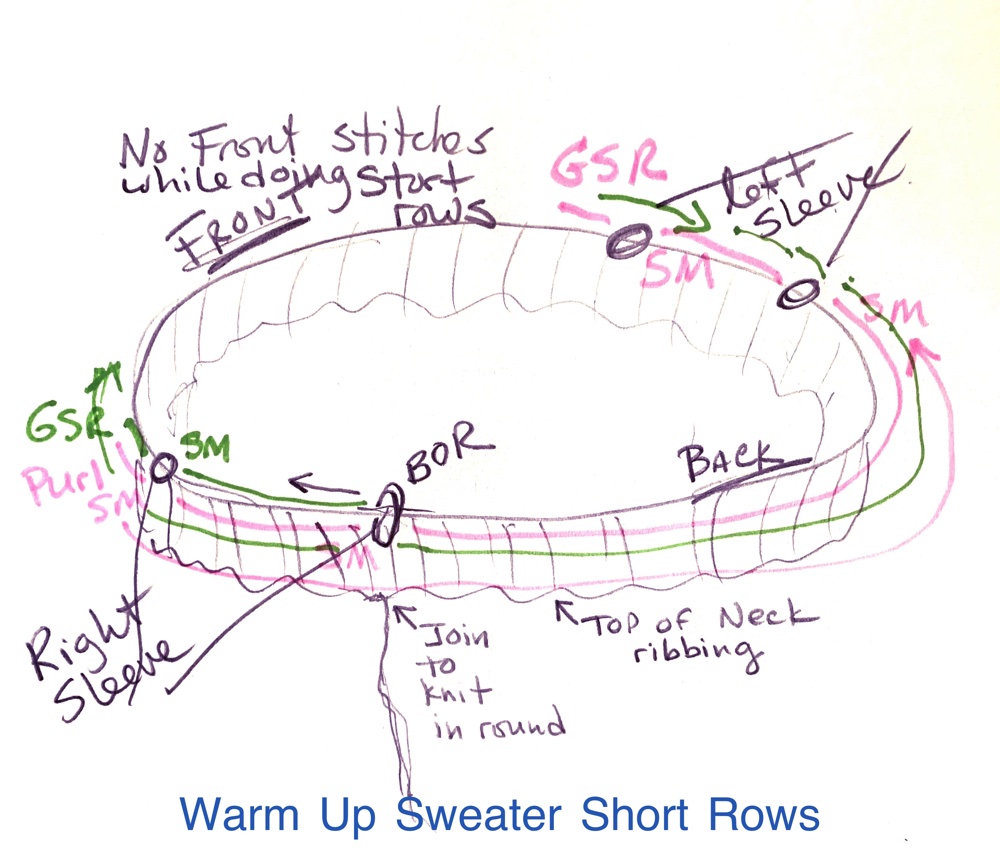
The Warm Up pattern short row directions say that the first marked area is the Right Sleeve, then Front, then Left Sleeve, and Back. In that order. (See my chart below.)

*Helpful hint: Place a removable marker at the “back” middle area. I do this just to keep the front and back straight in my mind – because no knitting should be done across the front (only while making short rows). Short rows will be knit across the back, and in this case, the sleeves.

short rows drawing

Short row shaping on the Warm Up sweater begins with Row 1 which says to “knit to marker”. From the BOR the knitting goes across the Right Sleeve. Then, “slip marker and knit X” which ever number for your size. 

This brings you a few stitches into the “front” of the sweater (Green GSR in my image), but now you turn – doing a German Short Row (see how below) – and will purl back (pink line in my image) – across the right sleeve, and the back, and the left sleeve. (This is Row 2, which says: *P to marker, SM and repeat 3 more times. This takes you past the R. sleeve marker, BOR marker, and both L sleeve markers – plus 3 or 4 stitches into the other side of the Front.)

Row 3 of this Short Row section includes increases, in the form of kfb (knit front and back) which are done on either side of the sleeves. You also do a GSR. It is not hard, just do each thing when it says to in the pattern. Some people mark where their short row turns are, but the double stitch made will stand out so there is really no need. 

The German short row turn is done like this: Knit (or purl) to the stitch indicated. Turn the work and with the yarn in front, slip the stitch on the left needle onto the right. Then pull that stitch up and over. It will look odd, like two stitches. You are now ready to either knit – on the RS, or purl, on the WS. Follow the directions for the next short row. 

Watch this excellent Short Rows Video for more help.
small green yarn

More About Short Rows

Making the turn for short rows will become second nature once you practice enough. If the pattern is well-written, the designer will walk you through those rows. Once the short rows are finished, you will continue knitting normally, or as the pattern directs. 

The funny looking short row stitch is always knit together – as one stitch – when it comes time to either knit, or purl that weird stitch.

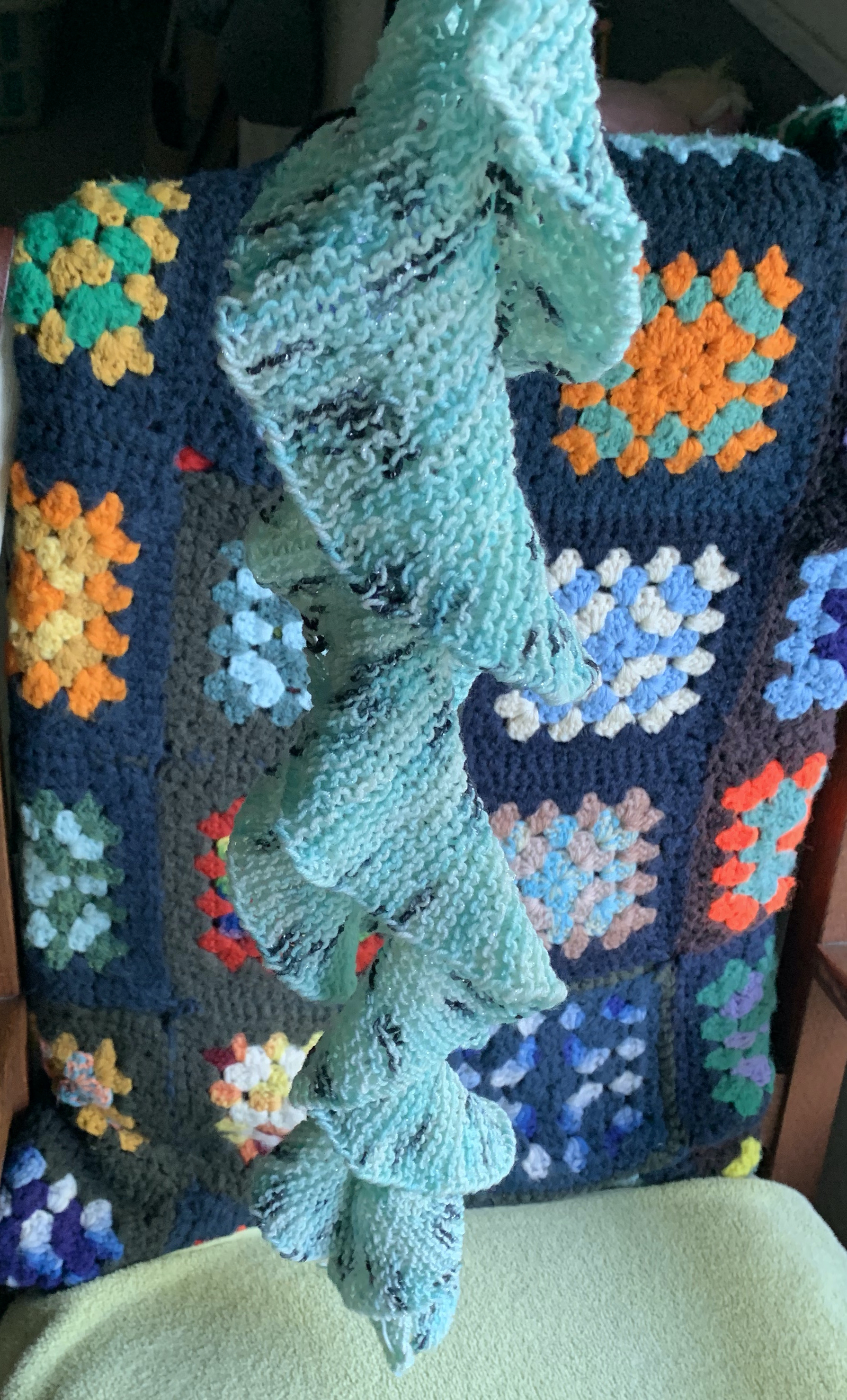
Socks use short row shaping at the heel. And short rows can make a ruffle on a scarf or other project. 

My Knitting Life