Leave No Tails! Three Ways to Join Yarn Ends

Here are some ways to join two yarn ends together while knitting to eliminate yarn tails.

Knitting is fun! Weaving in endless tails of yarn is not. On this page, I’ve written about three ways to join ends of yarn together that will eliminate tails. There will always be the cast-on and bind-off tails, but we’re talking about joining in a new ball, or color.

Unless you are knitting a small item, you will probably have to join a new ball of yarn to the project. Sweaters and large items require many skeins, and if colorwork is involved, even more.

Fair Isle projects, like the mitts below (shown inside out), require lots of color changes and therefore lots of ends! It took me a very long time to do all that weaving.

weaving in ends on Stellar Parallax mitts
Colorwork mitts and all the ends left to weave in!

I’ve always simply slipped the end of the new yarn over the needle, leaving a tail. That leaves two tails (the old and new) that must be woven in when the project is finished. These tails can add up, and the weaving in can be a project all on it’s own!

The ideas for joining yarn on this page make knitting a bit easier by NOT leaving any tails. Not every technique will work for every project. Know your yarn, and choose the join accordingly.

How to Do a Magic Knot – Works for (almost) any yarn, but might not be good for every type of project.

This is a simple way to join two yarn ends. But, I would not be inclined to use it except in certain circumstances. Personally, I don’t like knots. I’d be a little skeptical of the knot staying knotted, or popping through to the front side and looking bad.

Any yarn that comes apart easily would not work as the ends have to be tightly pulled.

Knitter’s Pride has a good page, with images and suggestions on when it’s best to use the Magic Knot.

Very Pink Knits has a good, slow-motion video on this technique.

I just knit the VENLIG sweater pattern with some Woolfolk nubby yarn. The skeins had a few knots here and there and I simply knit them in. With the fluffy texture of the wool, it would be hard to see this tiny knot even if it was on the front of the sweater.


How to Do a Russian Join – Uses a needle

The Russian join in knitting uses a tapestry needle to weave the yarn ends together. This method of joining two ends of yarn seems a little time-consuming, but looks better than a knot, IMO.

This join seems perfect for any type of yarn where a magic knot wouldn’t look okay, or the spit splice (read on) wouldn’t work.


How to Spit Splice Wool – No tools needed

The first two methods for joining yarn would work for nearly any type of yarn, but the spit splice is meant for wool. The water (or spit) and the friction of rubbing the yarn, are what turns two yarn strands into one. This splice will not work on Superwash, or any manmade washable fibers.

I’ve written before about how to do the spit splice because I used it on the Warm Up Sweater and Kate’s Poncho very successfully.

On the Warm Up pullover I created wide stripes, using two different brown yarns. This meant I had to change colors a lot. Because I used this yarn splicing method, I ended up with only a few tails – the cast-on, bind-off, and under the arms where I picked up the sleeve stitches.

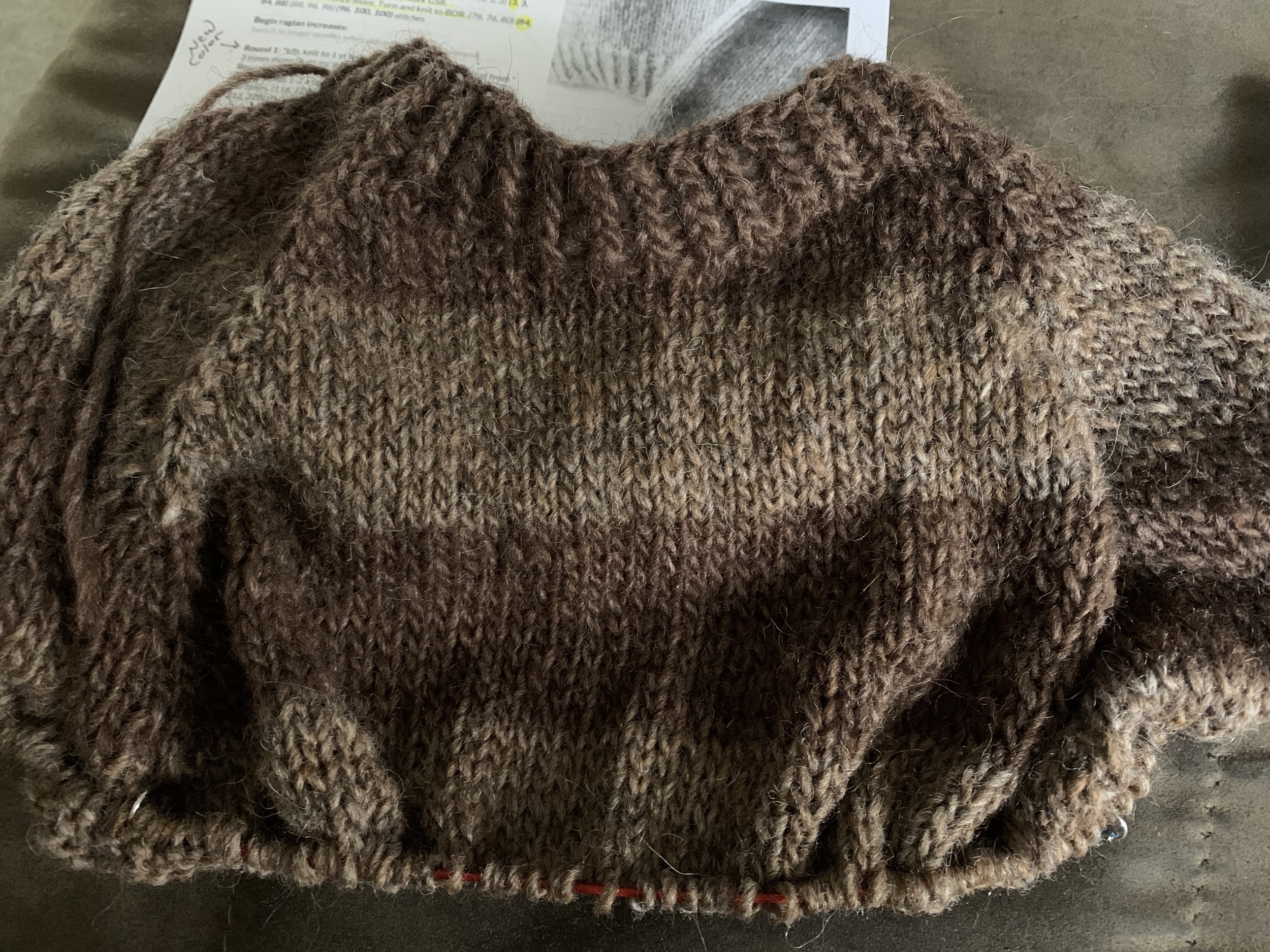
I find this to be an easy and nice splice to do. Unless two different colors are being joined, it’s tough to find the join section once it’s done. If knitting with wool is your preference, you must try this method.

A Spit Splicing How-To Video

Tin Can Knits has a short and to the point (my favorite kind) video below. What I do differently is unravel the yarn a bit to attach the strands. I suppose on smaller yarn like the type she is using, it wouldn’t be necessary.

A knot in a wool skein can be unknotted, or cut out, and re-joined using this method.

Do you have a favorite way of combining yarn ends? Please leave a comment.


More Knitting Adventures

Something went wrong. Please refresh the page and/or try again.

Hurricane Knitting, Mosaic Swatches

Learn to do mosaic knitting, which is an easy form of colorwork that even beginners can accomplish.

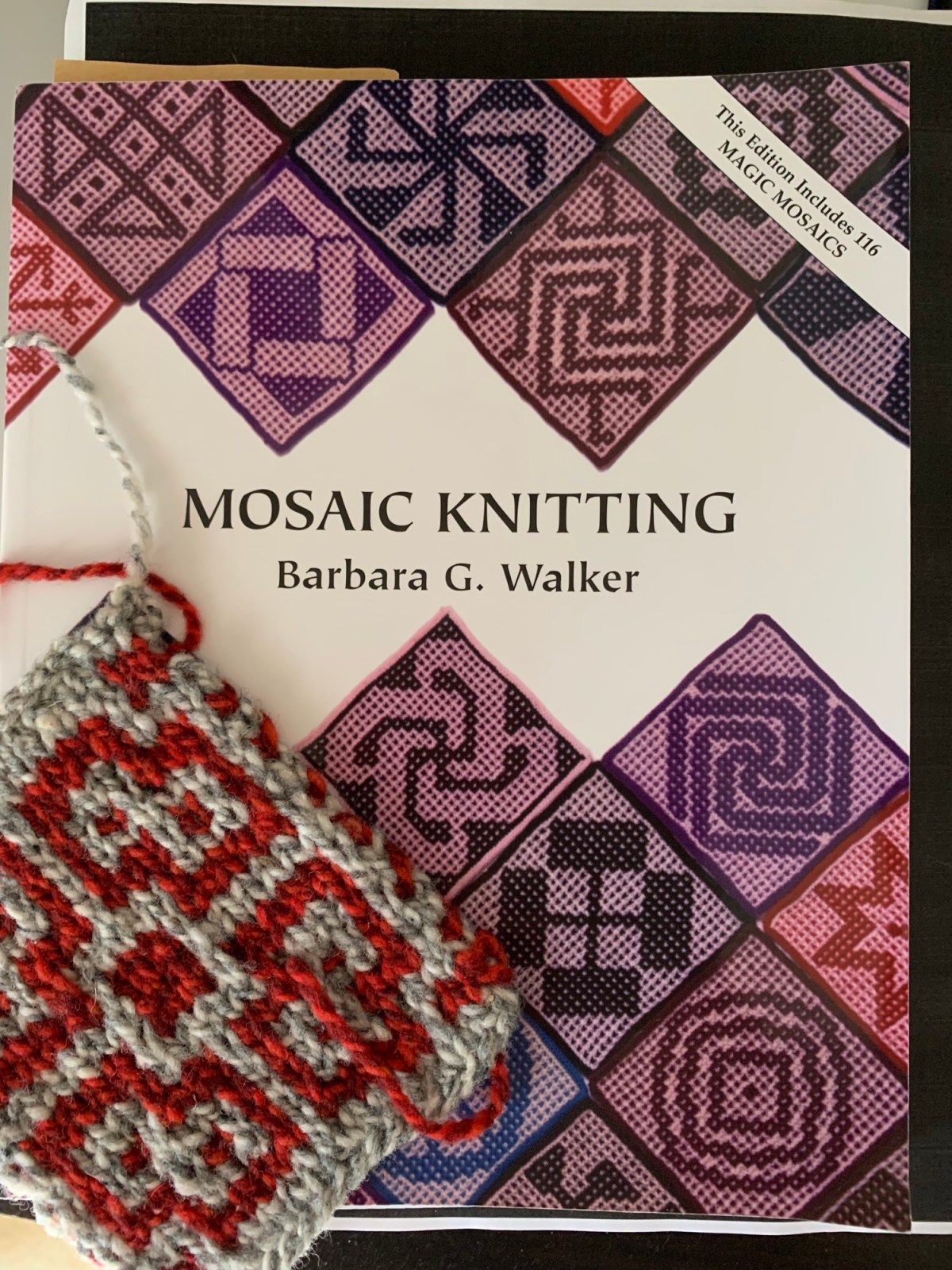
It’s been a few weeks now since we had Hurricane Ian to deal with. Knitting was what helped me keep my sanity while the power was out for four days (read more about that at the end of this page). I decided to learn mosaic knitting and knit three pattern swatches from my new (used) book “Mosaic Knitting” (link is down the page).

I’ve done mosaic knitting before, but I had totally forgotten how. It is a fun, and very easy, way to create colorwork patterns. I used some pretty wool (the red and gray swatch) and cotton for the others.

Often knitters will choose mosaic as the simple way to make colorwork patterns. This is not why I am learning it.

I love to knit stranded colorwork, or Fair Isle, and I enjoy using two colors to knit. I have made many patterns doing just that (mitts, mittens, hats, socks, pullovers). But, if I want colorwork on a cardigan, or anything that is knit flat, and not in the round, Fair Isle must be steeked and I don’t do steeking – yet. I’m thinking that mosaic is the way to go. I plan to knit a cardigan and incorporate mosaic colors.

How to Knit Mosaic Designs – Stockinette

Even beginner knitters can do mosaic. Only one color yarn is used at a time. All you need to know is how to knit, purl, and slip stitches. It’s super easy.

Find two colors of yarn to work with. One color will be represented by the dark blocks in the pattern and the other will be the light. The way these designs (the red and the blue) were knit began with doing a purl row after casting on. This puts you on the RS (right side) of the fabric.

Begin to knit, following the chart, right to left, across. You go right to left because that is how you knit. All knitting is done that way, unless you are left-handed I suppose.

The color used to knit each row will alternate. When you get to the end of the row, the same color will be used to go back to the beginning. Then, change colors for the next row.

For each row – use the color needed. If you are on a MC (main color) row – knit the black MC blocks, and slip the white CC blocks. Slipping is done purl wise. The yarn thread is always on the backside of the work. While you are knitting, on the front, the yarn is naturally behind the work and will remain there.

Mosaic knitting is one-sided with a definite wrong side.

Once the end of the row is reached, the back of that row is worked. Each knit stitch – color you are using – will be purled, and each CC stitch will be slipped (no following the chart, just do that!) – the yarn stays in front because you are working the WS (wrong side). Back to the beginning of the row.

Begin again with the other yarn color and keep alternating. Knit the white (CC) stitches and slip the MC stitches. This time you will purl the CC and slip the MC stitches on the back, or wrong side.

Mosaic Knitting Videos

Watching good YouTube videos can be very helpful. Here are a couple I found.

This video will help with the ability to read a mosaic knitting chart. She is knitting round and round, and not flat, like my swatches, so there is no mention of what to do on the wrong side of the work.

Suzanne Bryan has a good video showing how to knit garter stitch mosaic. This means you will knit all the stitches – no purling. But the yarn must be moved to the WS when doing the backside stitches.

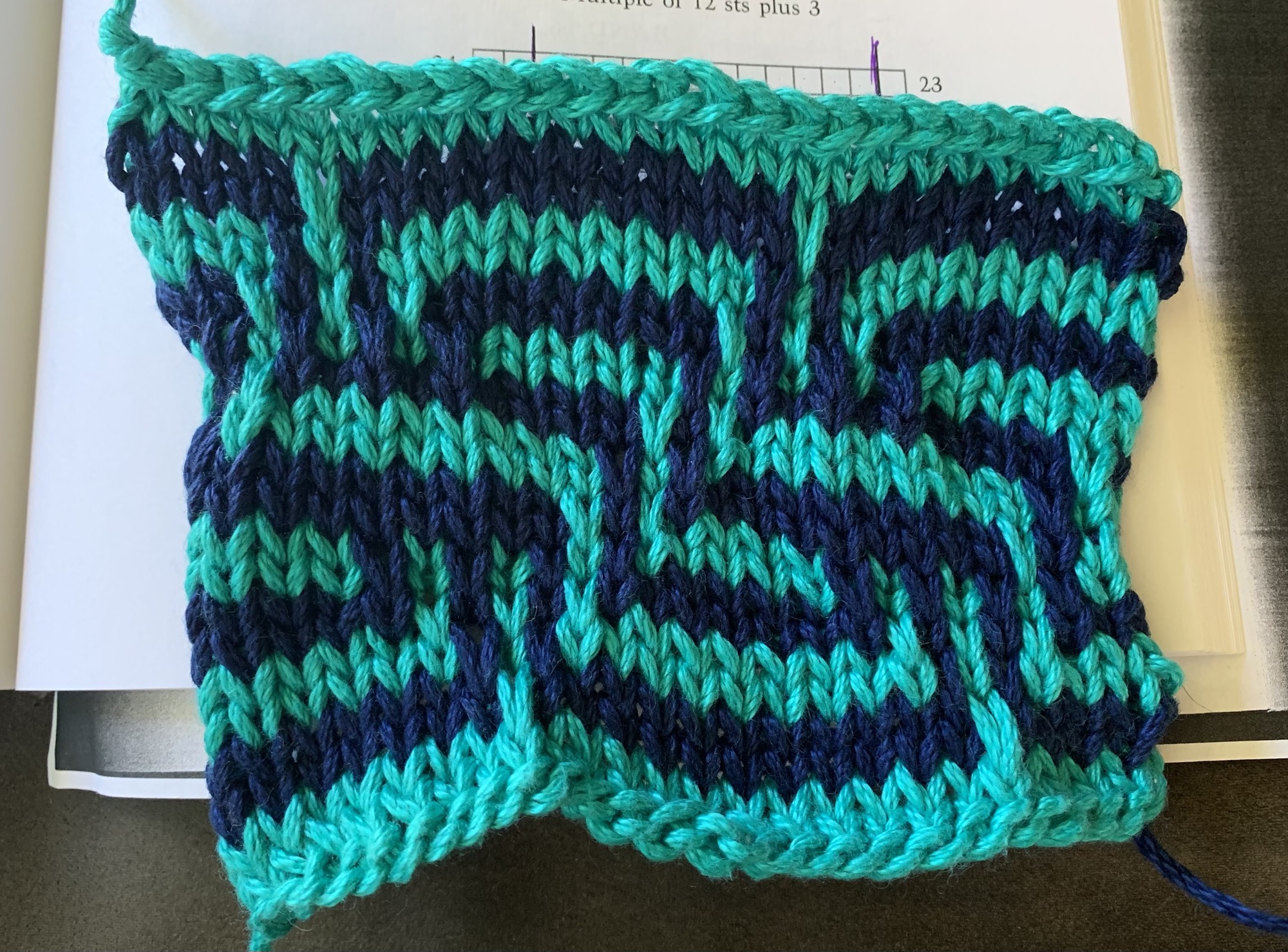
My swatch below was knit in garter stitch. It’s bumpier and I really didn’t like the end result as much. Also, every time you slip stitches on the wrong side the yarn has to be moved to the front, and then back again to knit.

mosaic knitting swatch
Knitting stitches on the wrong side (as opposed to purling) creates a bumpy pattern.

Stockinette mosaic is flatter, and my other two swatches were done that way. Purling is done on the wrong side rows. The yarn doesn’t have to be moved back and forth, and I like the look better.

A Book For Mosaic Knitting

The Mosaic Knitting book (Amazon link), by Barbara Walker, is stuffed full of various mosaic patterns. Many pages are dedicated to explaining – very clearly – how to knit this way. I purchased a used copy and spent $21.00.

If you want to try this type of knitting for free, see this page, where I did my first mosaic knitting swatch found on a blog post. When you see how easy it is, and are hooked, then buy the book.

All images and charts are in black and white except for the cover images. I think the book could have been improved slightly by including color when showing finished work. Black and white is perfectly fine for the charts. Charts are what you will use to knit – not written directions – except for the beginning chapter where she will guide you through understanding chart knitting.

I don’t need to say more, because if you buy the book, it will all be explained in detail. You will also have access to many, many charts to use for swatching (my cotton swatches become dishcloths) and garments.

Mosaic knitting book

Hurricane Ian in a Nutshell

This is the reason I decided to do mosaic knitting. It was a good time to learn something new as I had many boring, grid-down, hours and days to get through.

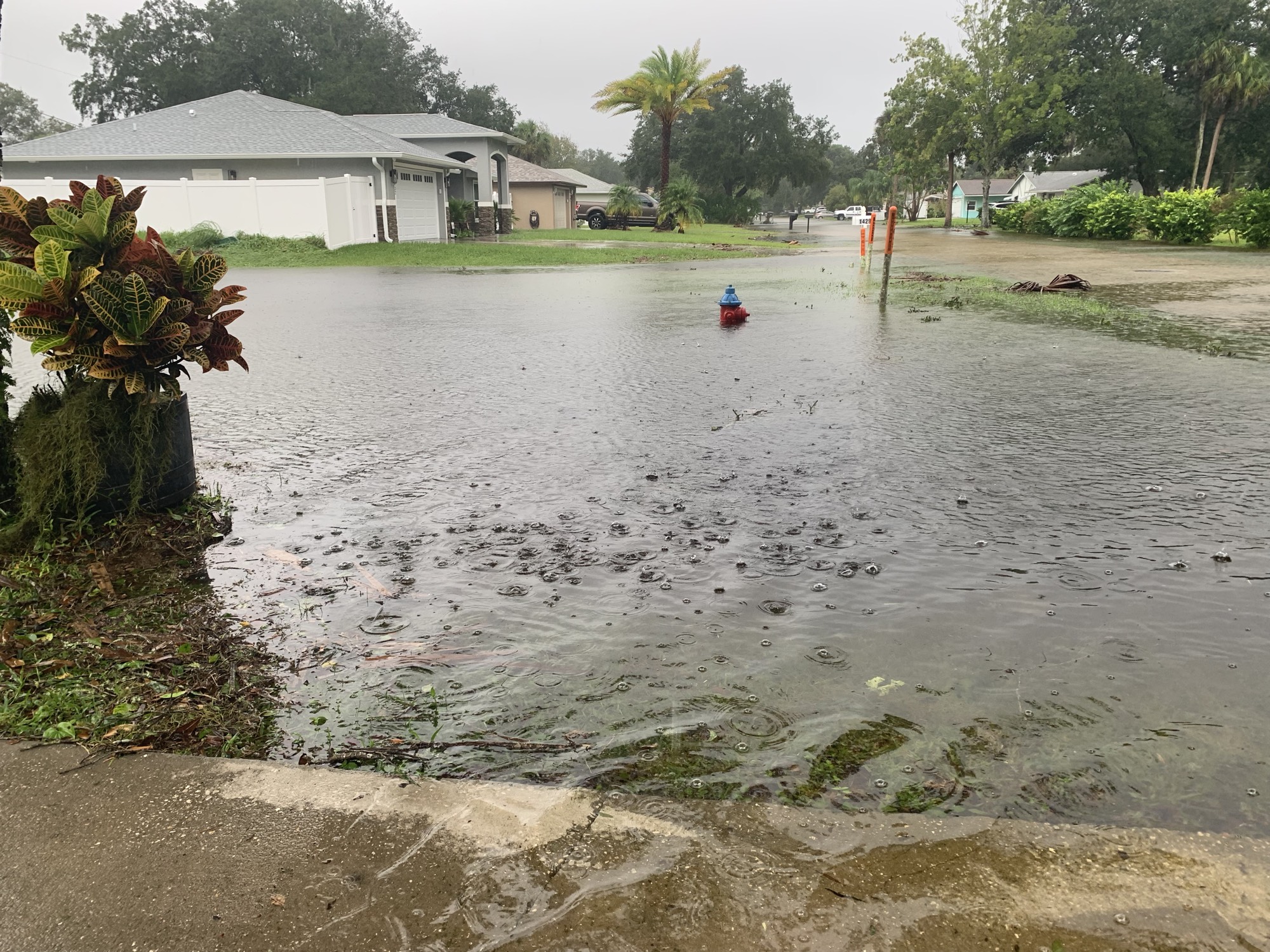
On September 28th Hurricane Ian arrived on the east coast of Florida. It had left devastation along the western, gulf coast and now wreaked havoc on central and east Florida.

We got wind, but nothing like when it first made landfall on the opposite side of the state. Our gusts were around 70-90mph (we heard). The rain was tremendous, and although Florida is a huge sponge, it is also flat. This area got nearly two feet of rain within 24 hours!! That is a lot of water.

Our yard is small and cleanup was quick. Mostly we had fronds from the palm tree out front and some branches from the oaks, but nothing big. We will need a new roof, because we lost a bunch of shingles, but we were lucky because the house did not flood.

We have a generator and ran it for the four days while we were without power. It kept our fridge going so we didn’t loose food. We cooked on a single electric burner. Once the internet went out there was no connection to news or anything and it got super boring! I’m glad to have a knitting hobby for times like these.

I know many people are still dealing with the devastation from wind and flooding. Flooding was the biggest issue in my area on the central east coast of Florida, and the debris piled along the roads gives an idea of the ongoing troubles.

Please keep reading the blog

See what I am knitting, and read my pattern reviews.

Something went wrong. Please refresh the page and/or try again.