Finished Knitting the Fine Sand Sweater

Here it is, part 2 of my journey through the knitting of the Fine Sand sweater. (To read Part 1, go here.) It came off the needles October 7th (2019) and has been washed and blocked.
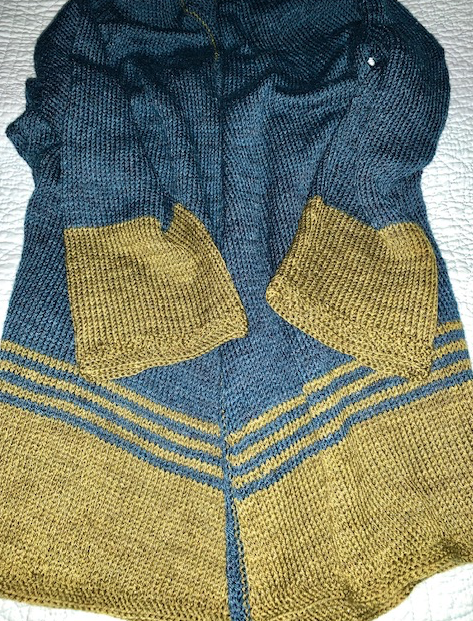
hand knit long-sleeve sweater in Miss Babs Tarte yarn

Overall I did like knitting this pattern. It’s only my second sweater, but with the exception of the short rows – wrap and turns, no part of the pattern really annoyed me. If you are familiar with knitting wrap-and-turn short rows, you would get by just fine. I have vowed to substitute German Short Rows in their place from now on.

Bottom Edge Finishing

Here is a photo of the bottom edge of the sweater showing the rows of garter stitch and my i-cord bind-off. The pattern does not suggest this type of bind-off but I’ve used it before on my Scrappy Bias shawl and Bays Edge. It creates a smooth, rounded rib and looks very nice. (See the end of this post for links and notes to binding off with the i-cord.)
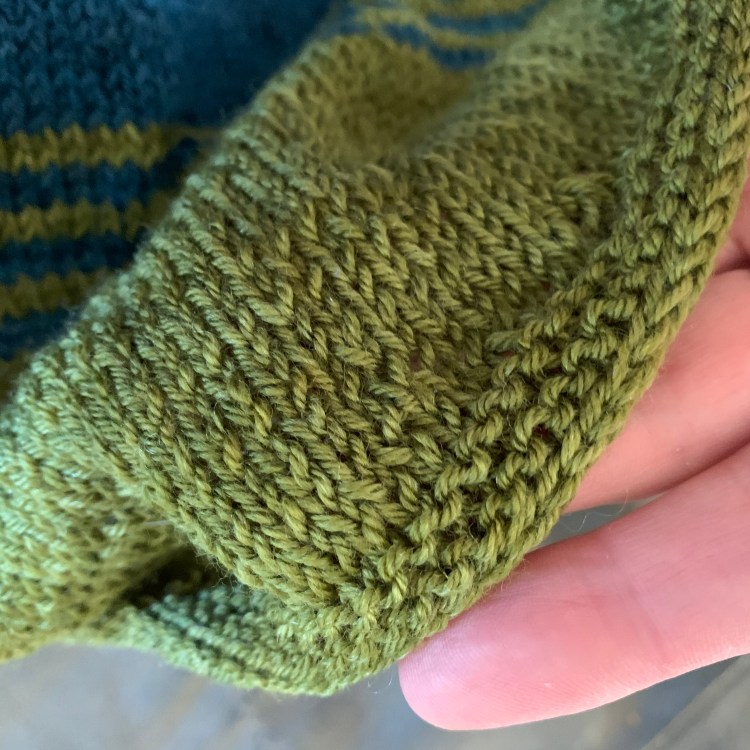
I-cord bind-off
Bottom edge with i-cord bind-off

This type of bind off takes a while, but it’s not difficult. The sweater bottom is curling like mad, but I assume washing and blocking will take care of that. Yes, it did! While knitting I couldn’t even try this on to see about length because it curled so badly.
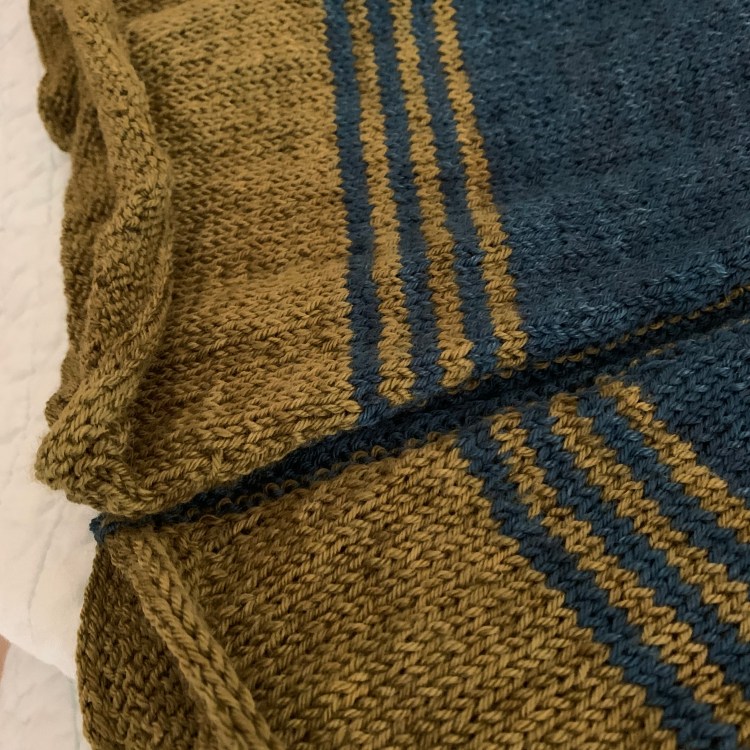
hemline curling up
Curling hemline

Once I finished binding off the green bottom section of the sweater, I had to begin picking up stitches along the front edge. I am not used to doing this. I’ve only ever picked up stitches when making socks (and I have not knit many socks because I dislike making them), or beginning a shawl, so I was feeling a little overwhelmed at this part of the pattern. There were a lot of stitches to pick up – all around both edges and neckline and I wasn’t sure if I was getting too many, or too few, but it turned out okay.
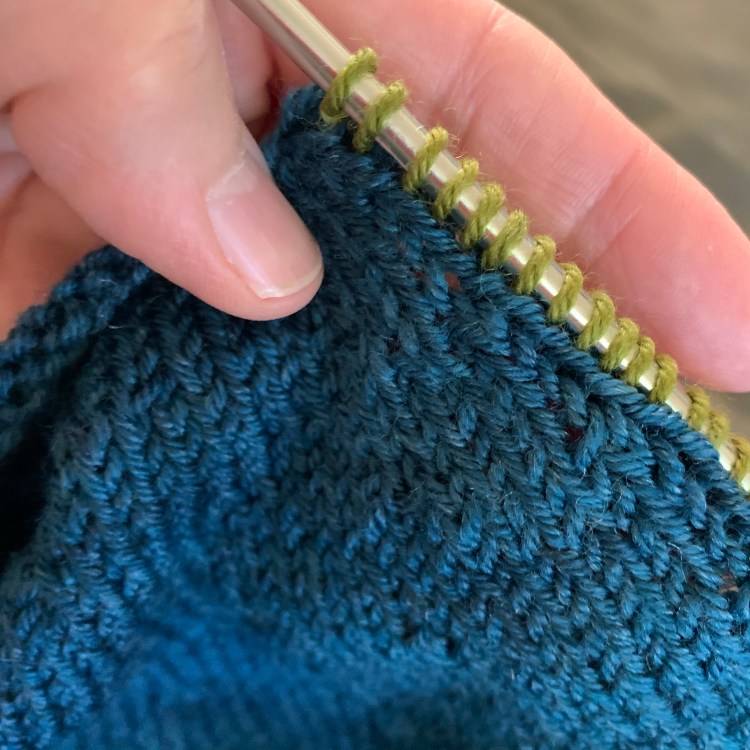
Picking up stitches along front edge of sweater
Picking up stitches along the front edge of sweater

Because I ended the bottom with green, I just kept right on using the green up the front edge. After I got part way along I realized that I was supposed to be using blue! It’s what I had planned to do, but I didn’t want to go back and begin again, so I kept on with the green, then switched to blue for the next few rounds of knitting and the bind off. I used the I-cord bind off here as well. In hindsight, I wish I had ripped out the green and done the edge in blue. The edges of this sweater tend to curl inward along the front so it really doesn’t show.
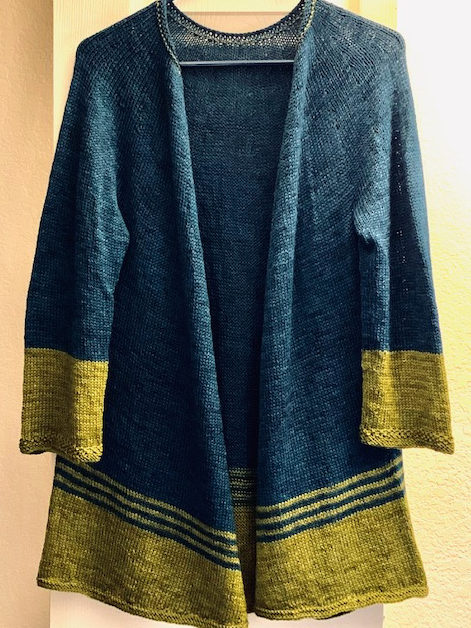
long-sleeve hand-knit sweater
Washed and blocked and ready to wear!

Finishing Up The Sleeves

Maybe it’s because I am a “new” knitter, but I really dislike making two of the same thing. Two socks, two mittens, two sleeves! But the sleeves knit up quickly and I didn’t have to use DPNs because I used a 16″ circular for the sleeves.

I messed up and followed the size M2 for the sleeves, when I should have been following the size L. But that worked out better because my sleeves are long enough. Before the garter rows I did four rows of seed stitch, which added a wider band of interest before the bind off. I did a regular bind-off here, not the i-cord.
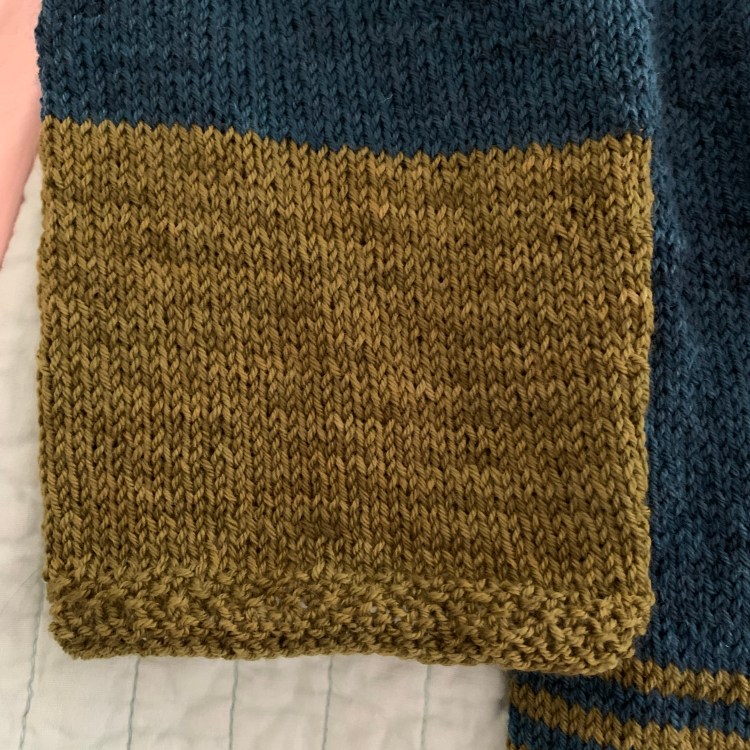
End of sleeve
First sleeve done

Finished length is perfect – I knit just as the directions said, but added a second color. I knit the size L and three skeins of Tarte yarn would be plenty. I had very little blue color left, but lots of green.
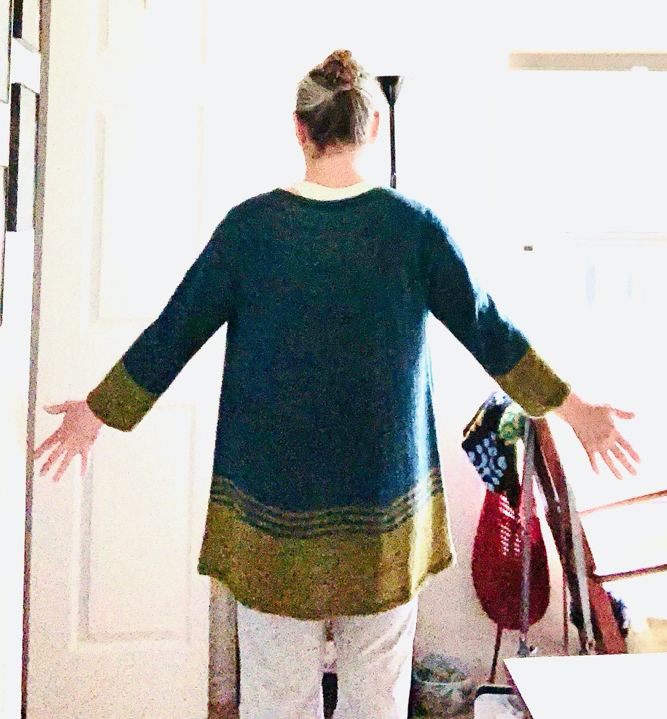
Fine Sand sweater
Finished knitting my sweater!

Final Thoughts – This is a sweater I will wear!

It fits perfectly, and the light weight, flowing drape is comfortable and good-looking.

For much of the knitting of the Fine Sand you are doing straight knits and purls. I could easily watch TV and do those rows. If you hate to purl, don’t choose to knit this one!

Once I got the hang of the LLIs and RLIs they were no problem. I like to learn new things when knitting new patterns, and these increases were explained well in the directions.

I will not do short rows again because the pick ups on the purl side were impossible for me to figure out! I don’t have the experience.

I’m not crazy about the front edge of this sweater. It will be something to throw on to keep arms warm, but won’t do much for the front of me.

Love The Yarn!

The yarn I used is Tarte, fingering yarn which is a 4-ply, superwash merino with added nylon and tencel. The skeins are large at 500 yards and it was purchased online at Miss Babs. I love the yarn and the finished feel after washing. That blue color is called “Franklin” and it’s beautiful. The darker color is also more forgiving of mistakes, but harder on the eyes to knit – especially at night. The green color is “Moss”.

I hand-washed the sweater and LOTS of color came out. I rinsed many times before it stopped bleeding color. The colors didn’t bleed together, just into the water. The sweater dried very quickly on the blocking mat – within a day – and it really is lovely and light weight as I’d hoped.
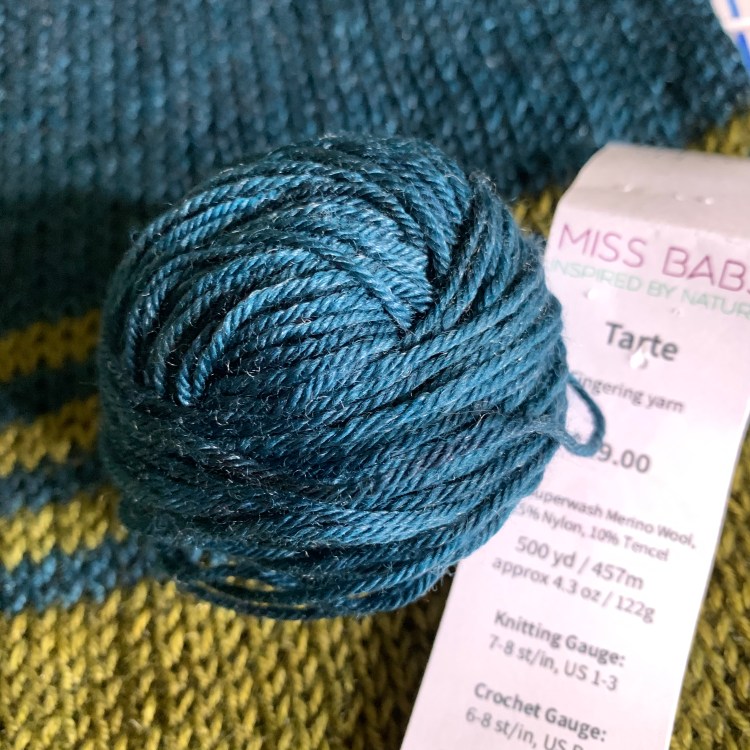
ball of blue yarn
All that is left of my blue yarn!

Tutorials and Notes For I-Cord Bind-off

Very Pink Knits has a video tutorial on how to do, the I-Cord Bind Off, but she does not say what to do at the end of the bind-off.

I have a pattern that says to slide the last three stitches to the opposite end of the circular needle and then pull the yarn through all three.

Or: when you get to the last 3 stitches on the needle, slip them to the left needle as you’ve been doing and then bind them off like regular – one at a time.

Or maybe bind-off one stitch and then the last 2 together. I’ve read that binding off the last 2 stitches together makes a neater ending.

This video does show the end, but the i-cord BO she does is different.

Below, I wore my sweater to the beach one morning in January.

Wearing my hand knit sweater on an early morning visit to the beach

Knitting the Fine Sand Sweater Pattern

After knitting my first pullover sweater Umpqua by Caitlin Hunter, I decided to try a cardigan. I chose Fine Sand, by Heidi Kirrmaier because I could knit it in a light weight yarn suitable for my Florida climate. At least, that is my hope. Also it is knit top-down, so that is something new for me to try.

Part 1 (of 2)

This post has photos and comments about beginning the sweater and knitting to the short rows. I’ll finish up on the sleeves and bind-off on another post (Part 2).

Miss Babs was having a sale on the Tarte fingering weight yarn, which is made up of washable merino wool, nylon and tercel. Sounds sturdy and washable, which should make a nice sweater. (Yes, I love this yarn, and the color is wonderful!) The pattern called for DK or Sport yarn, so I knit up a swatch using a needle two sizes larger and I got close to the gauge. I’m hoping the sweater will be a bit large in the end. I don’t wear tight clothing.

Casting on a top-down sweater pattern "Fine Sand"
Center back marker of Fine Sand cast on

This is the Franklin blue, and it’s very close in these photos to the actual color. And I have never been disappointed with any Miss Babs yarn. I knit a Mystery KAL Shawl with Miss Babs “Woodbury” yarn, which was soft and pretty.

Dark yarn is not as fun to knit due to difficulty in seeing stitches (my eyesight is not great), but I love this dark blue. Also the pattern is fairly simple, with no crazy lace stitches, so it shouldn’t be a problem. I can only knit dark colors during the daylight when stitches are easy to see.

Miss Babs Tarte yarn in "Franklin" colorway.

What I’ve Learned From This Pattern

First of all this pattern is written very differently than any other I’ve followed (ya, that ONE other… hahaha). Charts are substituted for complete written directions. These are not knitting charts, like in colorwork, but charts with letters which are used to take the place of changing repeats / number of stitches for each row.

I always read through a pattern and highlight the parts I will need to pay attention to, such as repeats in a row, or info for my chosen size. I’ll admit that when I saw the first page of instructions, I had to spend a few minutes figuring it out.

Right off the bat I had to learn how to do the RLI (right lifted increase) and LLI (left lifted increase). Specific instructions for how to do those are included in the pattern and links to video help are included too. The LLI gave me a bit of trouble at first and I lost count on one row, but every row contains stitch counts (thank you!) so I was able to easily add those stitches back in.

Separating The Body and Sleeves, How To

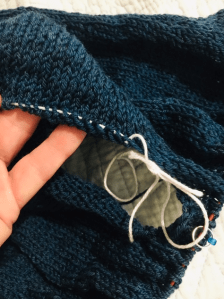
To separate the sleeves a bunch of stitches must be moved to waste yarn. That was easy enough to do using a darning needle and white yarn to be a contrast to the dark blue. The pattern called for a cast on of stitches and that threw me for a bit. Here’s what I did:

Turn the work to the wrong side. Yarn will be coming from the L needle. Use the R needle to begin a knit stitch but when it comes off the needle pick it up with the L needle (from the bottom) and let it stay there. Do this for the number of stitches called for in the pattern. For this sweater in my size I had to cast on 6, place marker, and cast on 6 more.

The video below is the one I followed. Begin it around 2 minutes for this type of knitted cast on. As he points out in his video, this is how to make a buttonhole!

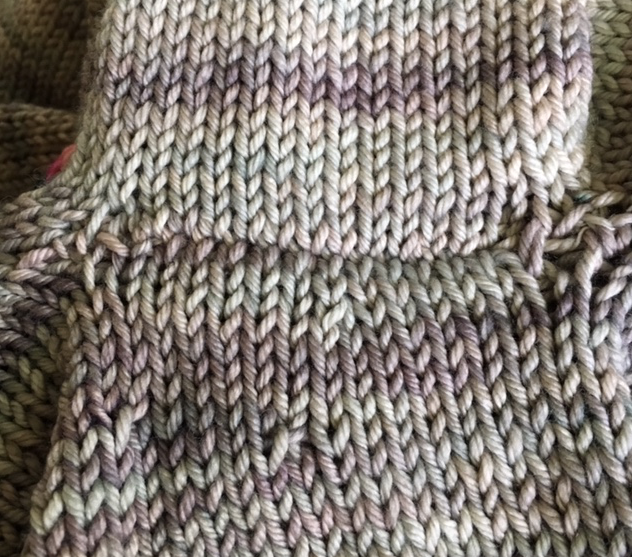
Ridge of extra cast on stitches which became part of the armhole
The cast on edge at the armhole
Armhole stitches are on hold while I continue working the body.
Armhole stitches on hold

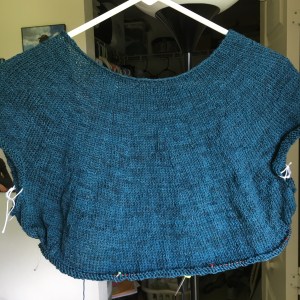
As of the beginning of July, 2019 here is where I am on my Fine Sand (photo below). I’ve passed the tricky armhole area and now the knitting will be pretty straightforward for a while. Next I will have to reacquaint myself with short rows. I love the yarn. I would definitely buy Tarte from Miss Babs again.

Along with this project I am also working on the Quince Wrap and Moon Sisters Shawl.

My first sweater was a bottom-up project and this is a top-down. With my cool new needle tips – those things that keep the knitting on the needles – I can try on my sweater as I go.

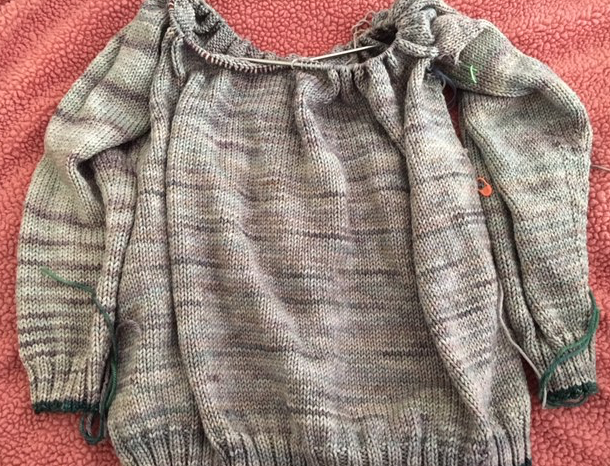
Fine Sand sweater knitting
Fine Sand sweater knitting with armholes on hold
Fine Sand sweater knitting project
Front of Fine Sand sweater in progress

Adding a Contrast Color at The Bottom

When I reached the last few rounds (rows 1-6) toward the bottom, I began adding the moss green color. Although it looks more gold in my photo, it really is green. The blue is also more teal.

Now that I am finishing up the repeats the short rows come next to create a longer back section. I think I am going to change that and do a longer squared off back leaving slits between the front sections and back of the sweater bottom. I can picture it in my head but not sure I should try it. I may chicken out and follow the pattern. (Yup, I chickened out!)

Once the sweater bottom edge is done, I will go back and finish the sleeves. The other day I began to knit one of the sleeves with the blue color I was using for the bottom. This pattern calls for 3/4 sleeves which I like. In the photo below one sleeve is still on the white place-holder yarn and the other is in the knitting stage.

By the way, I love those stitch stoppers! Mine are by Cocoknits and I bought them at Webs (that is where the link goes). I can easily try on this sweater as I go without worry about losing my stitches.

Finishing the Sweater With Edging

The Fine Sand pattern gives directions for finishing the sweater with a knit edging. The edge is curling so it does need something. As I looked through the finished Fine Sand sweaters at Ravelry, I have found a couple that had really pretty edging. I’ll be there soon, so I need to decide.

The Umpqua Pattern is My First Sweater Project

This is a big deal for me! I am knitting a sweater…!

For my first hand-knit sweater project I chose the Umpqua Sweater pattern by Caitlin Hunter of Boyland Knitworks. I know so little about knitting sweaters that I have no idea if top-down, or bottom up, are easiest, but here I go. I’m jumping in! This pattern is knit from the bottom up. The fun “arrow” design around the yoke caught my attention and I wanted to knit it.

Gauge is still a bit of a mystery to me. As far as I could tell, while figuring the gauge for this sweater, I needed to go up a needle size. I’m using a size 6 for the cuffs and bottom of body, and a size 8 for all the rest. I’d rather have the sweater fit loosely than tight. The pattern suggests going up a size for the color work (yoke area) if you generally do color work tighter. I have no idea if I should do that, but I don’t have a size 9 circular long needle, so I probably won’t. I’ll worry about that when I get to the color work part of the sweater.

Body and One Sleeve – I’m On My Way!

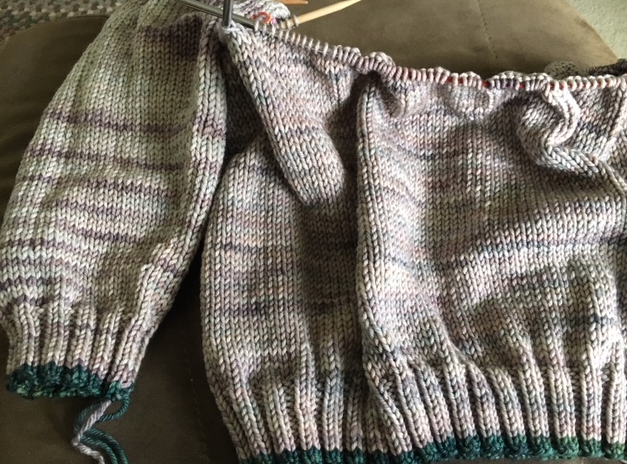
Here’s a photo of my one sleeve and body. I still have a few inches to knit on both parts, and no, they are not connected. I set them side by side for the photo. I’m happy with the main color (Whole Grain) and I love the Rios yarn. Check out the Malabrigo website and I dare you not to buy their gorgeous yarn. Rios is washable too! I also chose Aguas (dark green) for the trim, and English Rose (dark pink) for the Yoke colors.

One sleeve and body of the Umpqua sweater pattern using Malabrigo Rios yarn in color "whole grain".

Knitters who are savvy sweater people make all sweater knitting sound EASY. I’m scared to death while I knit this. I’m following the pattern exactly and if I am unhappy with some part (like sleeve length), I may knit another one of these sweaters one day and make changes. This one is really a test for me!

Attaching Sleeves and Body of Sweater

Now both sleeves are done and I put the stitches of the sleeves onto “holders” like the pattern said. One little section of stitches is for the armpits – which will be stitched up at the very end – and the rest of the stitches will be knit with the body.

Purl Soho has an excellent tutorial which explains how to do this, so I added it here. It helped me visualize the parts of sweater knitting. Also, after watching the video, I realized that when I finished up my second sleeve, I should have kept the stitches on my 3 DPN’s and not placed them onto yarn. I had to put the stitches back onto the needles to knit – a waste of time.

Knitting the Umpqua sweater and ready to join the sleeves and body
My finished sleeves and body which are ready to be attached.

Doing German Short Rows at Yoke

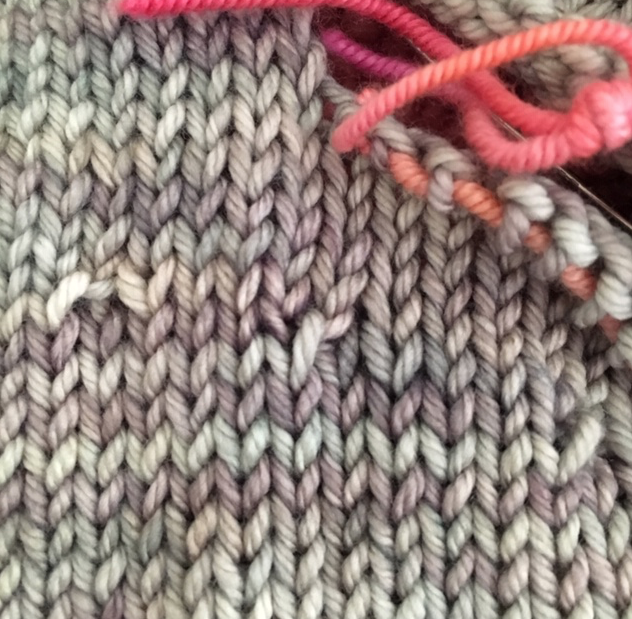
Because I was not happy with the look of the short rows I did earlier in the pattern (see photo below where you can see 3 “off” stitches where I did a wrap and turn to shape the back), I decided to try German Short Rows when it came to shaping the yoke.

NOT German short rows, but the 3 wrap and turns done for shaping the back.

I had read from some of the Umpqua knitters that they used this type of short row work. The YouTube video below is by Very Pink Knits and it is how I learned to do German Short Rows, which seem simple enough.

However, the sweater pattern itself was confusing when it came to doing short rows. Once I began doing wraps and turns (creating short rows) I had no idea where they were on my needles. Suddenly “Short Row 3” said to “knit to 5 stitches before last wrapped stitch, wrap and turn“. Does that mean the last stitch I wrapped, or the last wrapped stitch I would come to while knitting? I had no answer, so I turned at the first wrapped stitch I came to because the pattern said later on to “work wraps together”. I figured I should not hit a previously wrapped stitch until then. I have no idea if I did this part correctly.

Umpqua sweater knitting, bottom up, nearly at the yoke color work area.
Sleeves attached and almost ready for color work in yoke area.

Now I am nearing the color work area of the yoke, and that is shown in chart form only. Luckily I know how to read a chart for working in the round. I may order more Rios yarn in other colors because I still think I will be cutting it close with my main color (MC). If I substitute a new color in place of the main color for the rows of yoke color, I will conserve the MC yarn for finishing.

Adding Color to The Yoke Area

Below you can see my first rows of the color chart. I did decide to use another color of Rios yarn, which I just happened to have in my stash. I can’t find the tag for it, but it’s a peach color (Peachy?). I’m sticking with “whole grain” which is the MC for between the green rows as the pattern says. The same main color should also be where the yellow / peach color is, but I’m afraid I will run out by the time I need it to finish the neck area.

Colorwork for the yoke of the Umpqua Sweater using Malabrigo Rios yarn in English Rose and Peach color.
Umpqua sweater yoke pattern colors are done
Done with the yoke colors and finishing the neck.

Three-Needle Bind Off For Armpits

The yarn that has been held on stitch holders or extra yarn now needs to be put onto DPN’s once again – Do this on the WRONG SIDE. Holding them side by side a three-needle bind off is done. Watch the video below as it is easier to understand, but it’s very simple to do. Holes will probably remain at each end, but they can be closed up when weaving in the tails.

Binding off on the wrong side of sweater armpit area

I’ve found this tutorial by Purl Soho which shows exactly how to accomplish the three-needle bind off. Don’t sweat it – it’s easy!

Right side of sweater after underarm is bound off
A neat seam after binding off the underarm area of the Umpqua Sweater. I also closed the holes when weaving in the tails.

Finished..!

On April 7th I finished knitting my Umpqua sweater and I am pleased! It fits.. yay! There is lots of room to move and it would keep me very warm in cold weather, I’m sure. The day I finished, by weaving in the tails and closing up the underarms, it was in the 80’s here in Florida. Not exactly sweater-wearing weather. Because it was hot and muggy, I didn’t wash and block it yet. There is no hurry because I won’t ever be able to wear this garment unless I take a trip North to New England in cooler months! But I did get some photos.

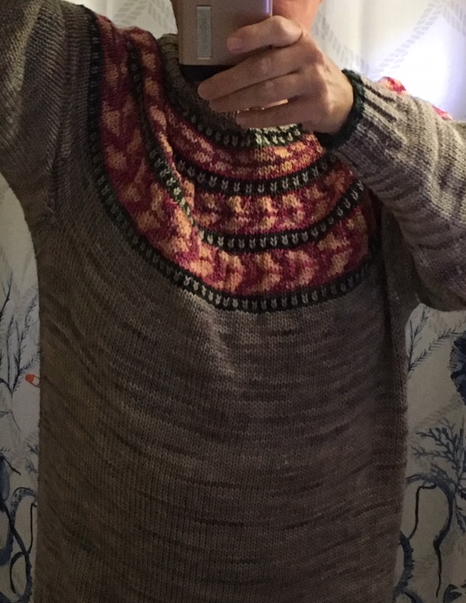
Wearing my sweater for a selfie
Selfie time!

You can see the “whole grain” main color and the peachy colored arrows. Those were supposed to be the main color, but I was afraid I would run short so I used some Rios stash yarn. I do like the addition of color. I knitted size “D” but I probably could have gotten away with one size smaller. Or, I should have kept the suggested needle size and not gone up one.

Umpqua Sweater finished and hanging to show off the pretty colorful yoke and Rios yarn colors.
Hanging with the drum set

I think I did my SSK’s incorrectly, but it’s not super noticeable. Live and learn is my motto.

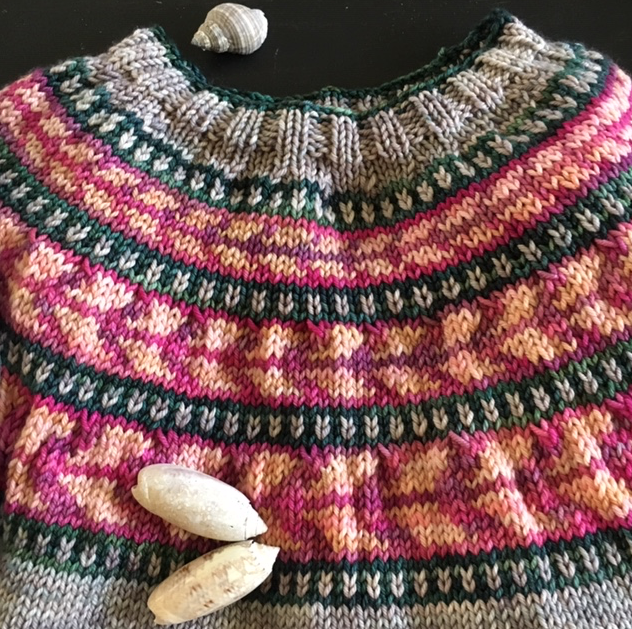
Sweater and seashells – a rock snail and two olive shells.

Collecting and photographing seashells is another hobby of mine. I have a blog about it at Seashells by Millhill.

Do I Dare to Knit a Sweater?

Since I began to knit again, only a few months ago, I’ve saved sweater patterns. They are saved to my “favorites” section at Ravelry, and pinned to my knitting board at Pinterest. I even bought a book of children’s sweaters called Baby Botanicals (image link below) mistakenly thinking that a small sweater might be easier. Ha! Guess I did not learn my lesson from trying to knit booties. Small knitting projects can be just as complicated, or worse, than big ones!!!

As I perused the loooong patterns within this baby sweater book, I gave up on the idea of sweater knitting. Or at least, I had to find something super simple to begin with. Were any types of sweaters simple to knit?

I can’t answer this question yet, but I have decided on one to try. If I don’t jump in and give it a go, I will never know if I have what it takes to create a wearable item of clothing. After much searching, I chose the Umpqua Sweater by Caitlin Hunter. I’ve looked at a lot of sweater patterns and this one tugged at me right away. The sample is knit in a tweed yarn and has a wide yoke with an arrow-like design. Of course you can choose your own favorite yarn to use, which I did. Here’s how that happened.

Finding the Right Sweater Yarn

This is what has held me back from beginning a sweater:

Besides finding a pattern I could follow easily, sweater-knitting requires lots of yarn. Sweater knitting requires many needle sizes as well because the sleeves require DPN’s and sometimes other areas need smaller or larger needles. This all mean expenses beyond what is required to knit a hat or scarf. It costs (lots of) money to buy all the required notions.

Sweaters can be knit top-down or bottom-up and I had no idea which would be easier, or if there was a difference. Pullover or cardigan? Interesting cables and colors or plain and simple? After I began my sweater I found this Top-Down vs Bottom-Up Sweater Construction article which has good points to consider.

Also, I live in Florida. I am never going to wear a sweater – well, rarely. I don’t have that to look forward to. But I do travel to New Hampshire occasionally, where I would be able to show off my knitwear. The fact that I can’t enjoy wearing my finished sweater is a bummer.

The Umpqua Sweater is My Number One!

The Umpqua pattern is knit in worsted weight yarn, and I liked that. The Brooklyn Tweed “Shelter” yarn, used by the designer, was a bit pricey and was hand-wash only, so I looked around for something else. There are a lot of pretty worsted weight yarns to choose from. I needed something soft, warm and easy to care for.

It turned out that I got an e-mail the same day from a local yarn shop advertising the re-stocking of Malabrigo Rios yarn, so I checked out the description and colors offered. I’ve never used ‘Rios’ yarn, but do love Malabrigo yarn in general. And the colors were very nicely variegated which I thought would work well for this sweater. Also it claims to be “soft, warm and washable”. Perfect! (So far I can vouch for the “soft” part of that statement).

Finding the Right Color Yarn For My Sweater

Once I decided to use Rios, I looked on the Malabrigo site. This Rios yarn page shows the beautiful colors and has little “closer look” and ” sweater” icons in the top corner of each color. The “sweater” link goes to Pinterest where you can see each particular yarn knit up into items. This is a wonderful thing!

Often it is difficult to imagine a skein of yarn turned into a project, but here you have links to some things already knit up. The Rios yarn page is where I found my perfect sweater colors.

I decided that I loved the “Whole Grain” color for the main sweater color (my gauge swatch is the image for this post). Then I chose two others for the yoke pattern. “Aguas” is beautiful, but my second choice, “English Rose” is debatable. It’s very pretty, but I may want something different to sit alongside the blue-green color once I get to the colorwork part of the sweater. IF I ever get that far!

L-R, English Rose, Aquas, and Whole Grain – Malabrigo “Rios” worsted yarn.

“Wool and Company” Had All My Color Choices

I really wanted to support my local yarn stores (they are not close, but I could order from them), but neither one had these colors in their shop. I think one of them had the English Rose, but most yarn stores offer “free shipping” over a certain amount. I didn’t want to split my order and have to pay shipping fees. (For the most part I refuse to pay for shipping.)

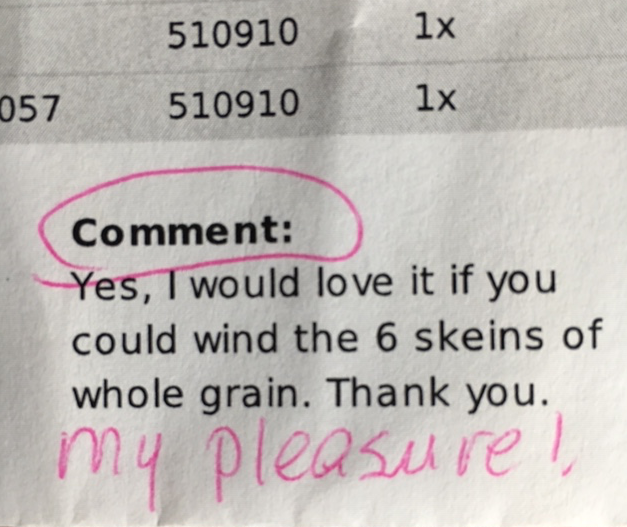
Somehow, I stumbled across “Wool and Company” and ta da… they had every color I was interested in! AND they offer Free US Shipping – no matter the size of the order! What? On top of all that, they will wind yarn for no extra charge! Double what..???? Yes, they offer complimentary ball winding. All I had to do was ask at checkout in the comments section (see my comment below). So I asked for the 6 balls of my Main Color to be wound. That is what you see in the photo above (3 of the 6 they wound for me, for free!). I don’t have a winder, so I have to create balls of yarn from skeins and wind them from draping the yarn over my knees. To have all those skeins ready to go was immensely helpful. Wool and Company is my new favorite place to shop for basic yarn online.  

I do love Miss Babs, and other hand-spun / hand-dyed shops for their unique offerings, but Wool and Company had the name brand yarn I wanted when I could not find it elsewhere.

Pink pen is their writing…. Awesome!

Wool and Company’s shipping was quite fast. They are in Illinois and I am in Florida. I got the yarn – 8 skeins, 6 wound by them – in 6 days. Not bad.

Now all I have to do is create a nice sweater from this lovely yarn. Fingers crossed… here I go. I’m currently figuring the guage.

See how the Umpqua Sweater knitting is coming along.