If at First You Don’t Succeed

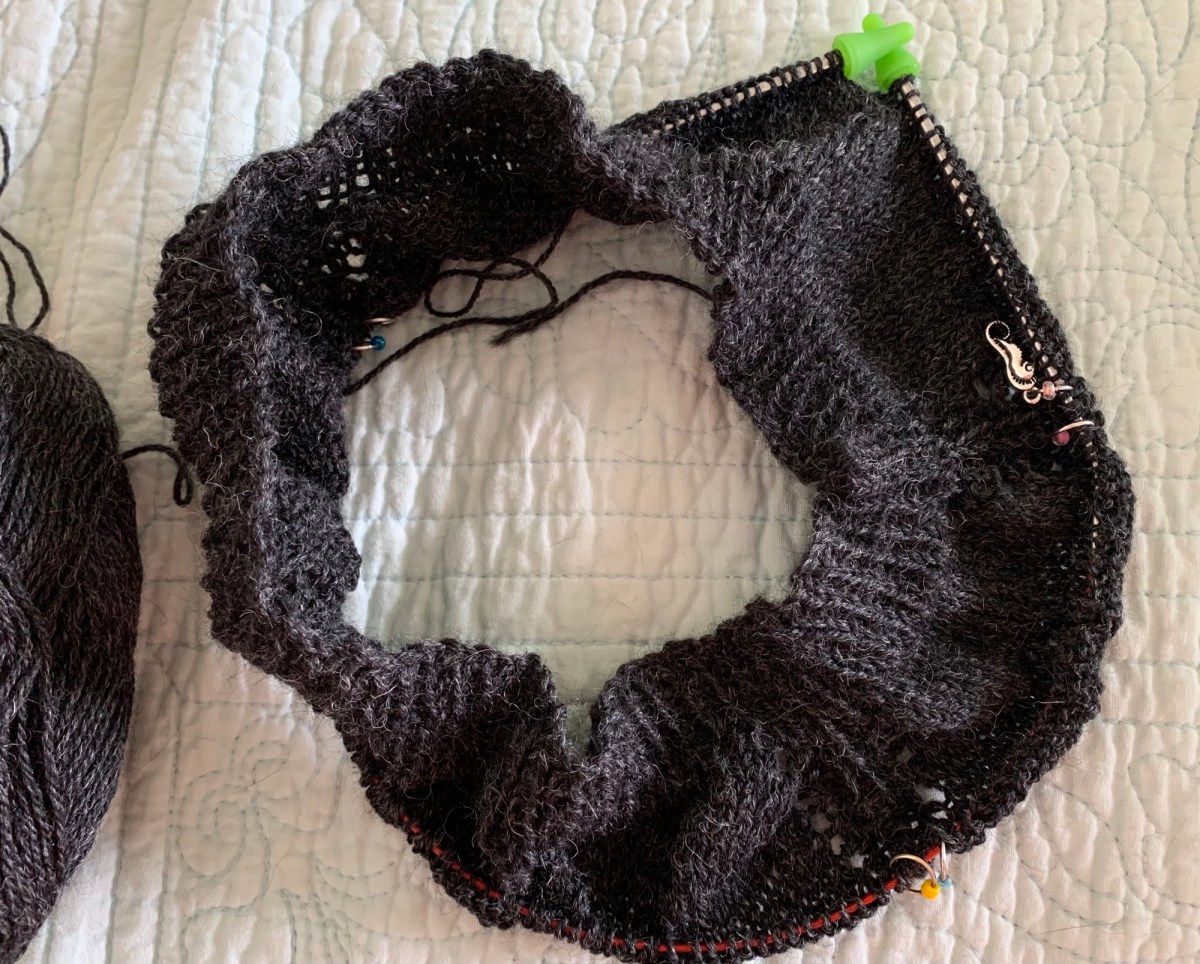
Beginning to knit a new sweater pattern called Blueberry Vodka Lemonade, but I messed up and must begin again. It happens.

The motto, “If at first you don’t succeed, try try again” is one I have in mind after casting on for a new sweater, knitting a bunch, and then goofing up badly. I was so looking forward to knitting this new sweater, but I’m not as good a knitter as I had hoped! After knitting all the way through the entire neck ribbing of a new sweater pattern…. I ripped the whole thing out.

It was totally my fault and not the pattern. In fact, this pattern is written better than any I think I have ever knit. Everything is explained in detail, with stitch counts, measurements, etc. to help the knitter. I’ve never knit a pattern by this designer (info below) but wow, I’m impressed…!

sweater neckband
Starting over

I will be starting again, but it is disappointing to get so far and then mess up. I had no hopes of going back and picking up the rib stitches because the yarn is black and difficult for me to see. It’s part of knitting life to make mistakes… it’s how we learn to fix them, or learn to deal with inevitable re-starts.

The Pattern

This new sweater pattern is named Blueberry Vodka Lemonade and is a design by Thea Colman, who is also known as Baby Cocktails in the knitting world. I love the look of this pullover knit in raglan style, with split hem, and 3/4 sleeves. My last project (the Lakeland Tee) also had a split hem, and I really like the look.

The Yarns I Chose

I searched for a while before I settled on two yarn types I wanted to try. I’ve never used either before.

First, a beautiful black, fingering yarn by Sandnes Garn: Tynn Peer Gynt, which comes from Norway. It is really lovely.

The gorgeous turquoise blue yarn is color “Peacock” and is Shetland wool from Harrisville Designs. Another beautiful yarn, which is spun in New Hampshire. I have visited Harrisville Designs, as I lived in NH for many years.

The Shetland seems a bit heavier for a fingering weight. On the other hand the Peer Gynt seems pretty thin.
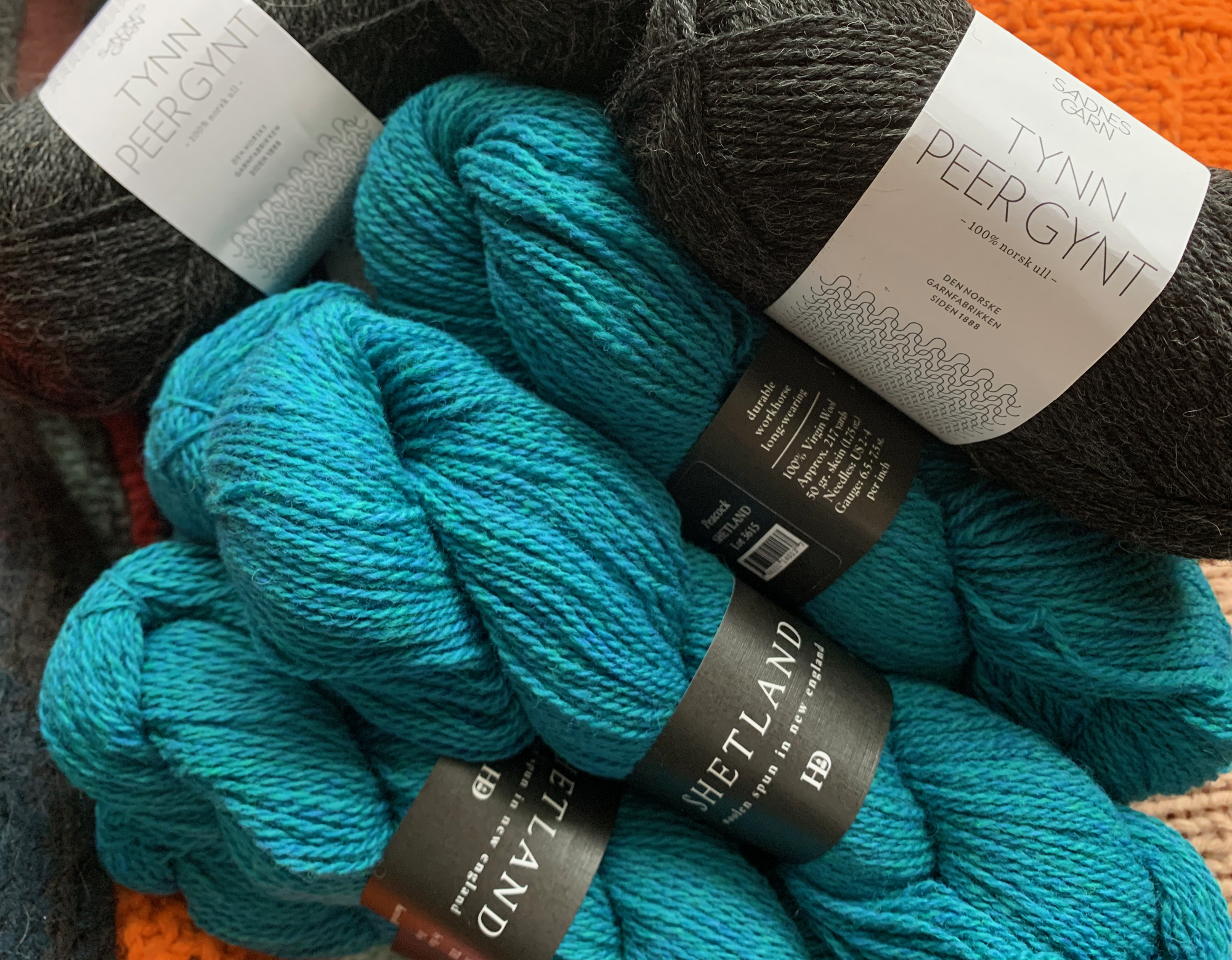
skeins of wool yarn Shetland by Harrisville Designs, color Peacock and black Sandnes Garn Peer Gynt.
New yarn order

The Swatches

Because the pattern calls for a size 5 needle for the main part of the knitting, I did two different swatches with that size. Both were too large. So, I knit up a shorter swatch with the black yarn using a size 4 needle. It was perfect. Usually I knit a larger swatch but I didn’t want to use up the yarn.

(I had to wind the Shetland, by hand over my knees, and it was very easy to do so.). The black yarn does not need winding. I pulled from the outside.

Knitting swatches drying
Swatches

Messing Up and Making Changes

I want to follow this pattern as it is written, so I used a needle one size larger for the neckband. I knit all the way through the set up row – for the raglan and then my issues began.

When I re-knit this, and I will soon, I plan to switch to the smaller (main) needle on that “knit around one row”. I found it difficult to switch needles while knitting short rows and making the lacy parts at the raglan. I kept getting confused as to which needle I should be using. This is probably just me and my inexperience.. AND the fact that I did something really stupid. When I made the short row turn, I began following the wrong part of the directions (mark your place !!!! – I’m yelling at myself here).

Once I did it incorrectly – with the yarn overs and such, I totally could not go back without making a mess. AND that dark yarn didn’t help … so difficult to see.

Before I gave myself some kind of stroke, I just pulled the needles out and said, “Oh well, I guess I’ll start over”. Keep calm and carry on… and all that. I’ll cast on again later today.

If you plan to knit this sweater, you will need to be good at yarn overs (YO) as that is how the open holes along the sleeves will be made. Purl Soho has a nice, short, to-the-point video to help with that. See it here if you need help: https://youtu.be/n6Bpde5wihE
cat and yarn image

More Knitting Stories on the Blog

Something went wrong. Please refresh the page and/or try again.

First Time Ripping Out Many Rows of Knitting

I’ve begun knitting the Marshland pullover sweater by Tin Can Knits – see the pattern link at the end of this page. The pattern is in the “Strange Brew” book. I chose this pattern because I had worsted weight yarn to use.

Something is wrong
I have too many stitches

Because the pattern colorwork looks to me like it was meant more for a man – it’s a unisex design, I decided to change up the knitting with other color patterns. The pink rows and the last yellow and green rows are different from the suggested pattern. However, all that was ripped back and I didn’t re-do it the same way.

The yellow Arranmore yarn was purchased to knit “Big Love” – a cardigan. That pattern was confusing, so I never knit it. I’m using other stash yarn, and some is not exactly the same weight as the Arranmore, but oh well.

How to unravel knitting mistakes
First time doing this – pick up right hand side of each knit stitch, all the way around. This will be the new starting row.

The “Make One” Rows

The pattern calls for places where M1 is needed – that is “make one” – and a stitch must be added. There is no suggestion about how to make a stitch, so you’d better have a favorite way! (HINT: Use the backwards loop method.)

On the very last increase row of the yoke, I somehow added too many M1’s and ended up with way too many stitches. I didn’t realize this, and kept knitting…. HINT / NOTE TO SELF: Count your stitches right after that last M1 row…!!!!!

In my photo above, my mistake row was in the brown section just below the pink. So I picked up stitches above the pink rows to start again. Everything below the needle was removed.

How to Rip Back Many Rows

I’ve never had to fix a knitting mistake as big as this one. I could not simply un-knit some stitches. I needed to rip many rows out. So I watched a couple of really bad videos, but the gist of it was to use a needle to pick up the right side of each V knit stitch. This has to be done slowly so none are missed. Also be sure you stay on the correct / same row!

But first, I pulled out the 32 inch needle I’d been knitting with – that gave me the ability to try on my sweater (very first photo). I used the same needle I’d been using to pick up the new stitches. I did this on a non-colorwork row because it was easiest. I began at the BOR marker and continued to the end. Now I had all new stitches on my needle.

Then I had to unravel all that previous knitting and rewind the balls. I was left with this (photo below) and ready to begin again. When I got to that M1 row where my error occurred, I used stitch markers to help me count.

Mistake removed and ready to knit again
Ready to try again

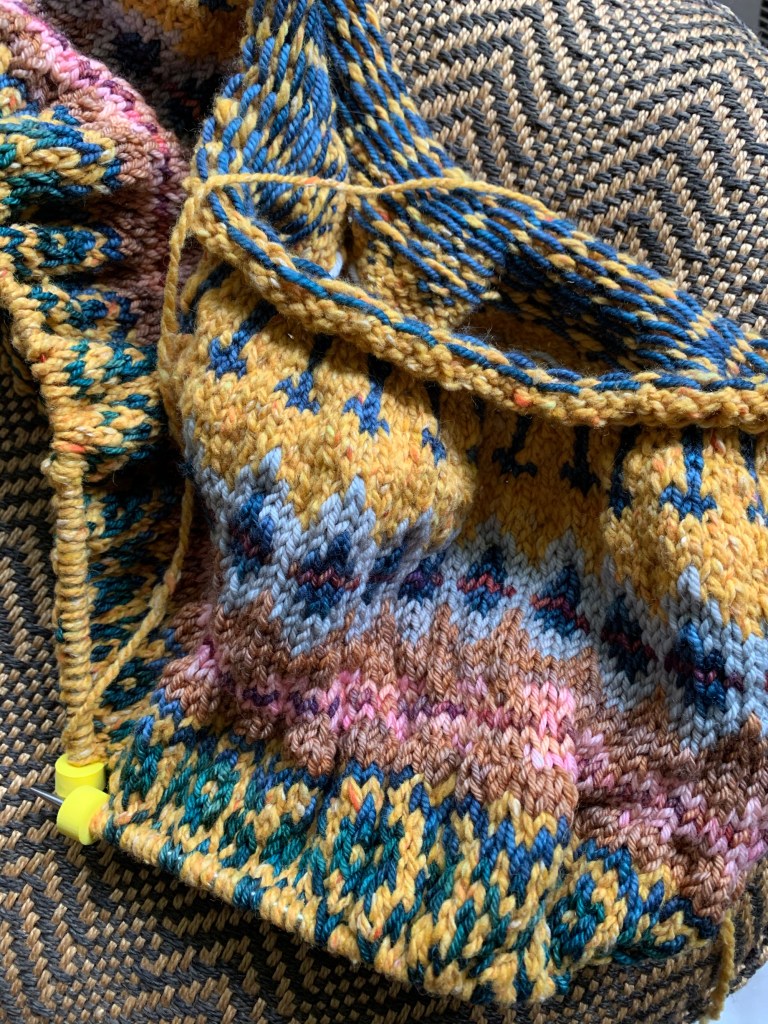
Below is the same yoke on my second knit. This time I followed the pattern’s suggested colorwork design. The sleeve stitches have been put on holders and all counts are perfect. So onward I knit!

Marshland yoke colorwork second try
This time I counted stitches

Stranded colorwork knitting is fun to do, and keeps a project interesting. Katie’s Kep, the Turkish Watchcap, and the Triple Patterned Watchcap were hats I enjoyed doing in Fair Isle, aka stranded colorwork. The only other sweater I knit like this is the Umpqua and it was my first sweater.

I’ve come across one row in the Marshland design where three colors were used, but all the others are two color strands.

Click here for the Marshland sweater pattern download at Ravelry.

More from the blog:

Frogging the Moose Hat

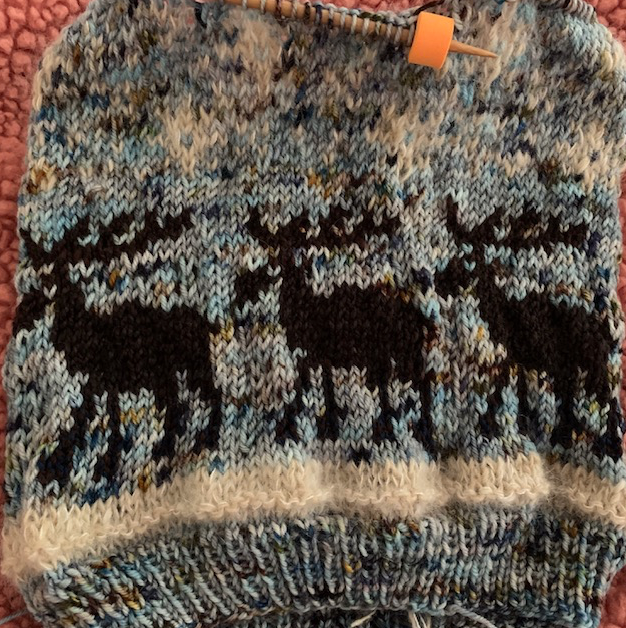
Frogging is a knitting term meaning “ripping out”. I have tried to knit this Moose hat twice with different colors of yarn (link to pattern below).

First I knit a yellow beginning row then brown for the brim. I tore that out. The pattern sample hat is white with two contrast colors, but I didn’t want a white hat. I was also trying to use up stash yarn.

I thought this would be a quickly done FO using up DS sharing HOTN within a day or two. Instead I had a TOAD! (Don’t understand Knitcabulary? Read this fun post at Knitfarious.)

This time I used Yarn Cafe Creations merino wool (blue, “The Ring”) with brown Spincycle for the moose motif. For the third color I used an off-white light fingering wool and combined it with mohair (think snow).

Moose Hat knitting
Purl ridge added for texture

I’ve learned how to carry floats with the left and right hand yarns while knitting projects like this. I’m no expert, and this was good practice. No knitting is a complete waste!

Trial and Error and My Mistakes

I did a little purl ridge to give some texture with the white (not a great idea!) and I began the moose design first instead of the trees. Many Ravelry comments from previous knitters mentioned that they should have done the moose first and that the hat gets too long with all the motif sections.

Because I wanted the moose, but no white, I envisioned the moose walking in snow with snowflakes falling above. The pattern actually has a row of trees, then moose, and more trees at the top. Each section is divided by two rows of a third contrast color. If the hat is knit according to the pattern, it will be quite tall.

Moose hat beginning knitting hat
Adding some mohair in the white rows

I Love to Knit Hats… But

The trouble with knitting hats is that you can’t actually try them on until they are nearly finished. The moose stranded knitting area seemed tight, which I guess usually happens with colorwork. From the brim to the main hat area the needle size goes up by 2, and I used a size larger than that because I know I am a tight knitter.

Moose hat pattern
Nearly done with the moose motif

Yesterday I got past the moose rows and wanted to do snowflakes instead of trees along the top. The off-white with mohair blended in with the blue variegated yarn and could barely be seen.

Now the hat was tall enough that finally I could try it on …. and I hated it! It was loose at the brim (I made the brim half the recommended length) and tight around the moose motif section. This is not the type of yarn I want for a hat either! (Note to self: don’t use sock / fingering yarn for a winter hat – unless it’s a man’s cap.)

I’ve decided to frog it. The pattern is not something I will try again, but I have the moose motif to save for another time – maybe a scarf / cowl / or mittens.

Link to the Moose Hat Pattern

Most of the problems I had with this hat were brought on myself and I don’t blame the designer. If you want to buy this pattern, or read comments from other knitters, find it at Ravelry: Beware of the Moose.

Beware of the moose hat pattern knitting project

I prefer my winter hats to be chunky, or at least knit in worsted weight, like my Quarry Hat, Simple Rasta Hat, or Star-topped Hat.

My next stranded knitting project will be a pair of mittens when I join the Woolly Thistle KAL.