Learning the Tubular Cast on For Knitting Hats and More

Found some tutorials for knitting the tubular cast on. This one looks so nice when it is accomplished, but may take some practice.

For every pattern I have knit that suggests a tubular cast-on, I skip that part and do my usual German Twisted cast on. One time I did try to do the tubular and it was a disaster. Now, it’s time to try again.

The tubular cast on gives the edge of any 1×1 (or 2×2) ribbing a “rolled” appearance, without an obvious front and back. Often it is used for hat brims, sock tops, collars on top down sweaters, ribs on bottom up sweaters, mitten cuffs or flat knitting the edge of a ribbed project. I have found that it is not an easy thing to accomplish, but worth the trouble.

On this page I have linked a variety of tutorials for doing the tubular cast on in the round and doing it flat. 

Three Ways to Do the Tubular Cast On

I’m covering three general ways to begin and knit a tubular cast on. There could be more, but these are the ones I tried – to some extent. Some tutorials are done English style (yarn held in right hand) and some are Continental (yarn held in left hand). Some use waste yarn and some don’t. I had success using Tutorial #3 using a crocheted cast on.

Tutorial #1: Backwards Loop Cast On With Waste Yarn

This tutorial shows flat knitting, or back and forth, not in the round. Half the number of total stitches needed – plus one – are added to a straight, or long, needle using the backward loop method and waste yarn. I used a size 3US straight metal needle for this. 

This is all I did. I did not continue with this cast on because I need to knit in the round for my hat. This beginning is similar to the crocheted cast on (see #3 tutorial).

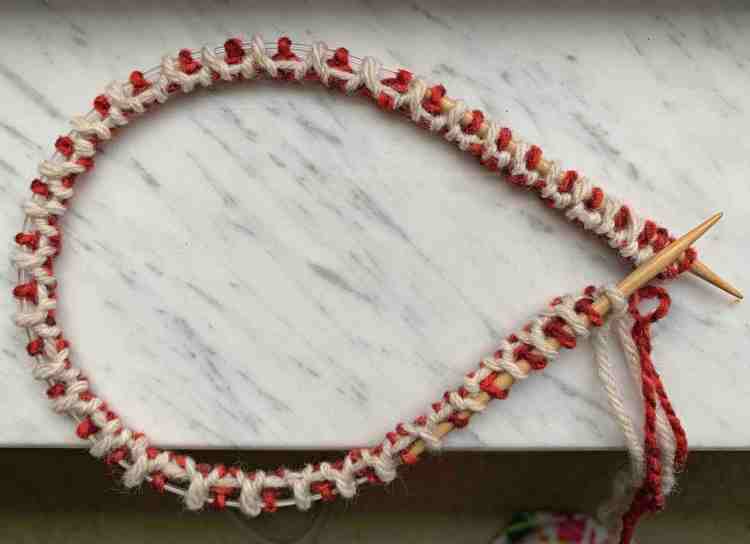
tubular cast on examples
Backwards loop directly onto a straight needle

After a couple of set up rows are complete, the stitches would be connected to knit in the round (if that is needed for the project). She mentions having a video for that, which I can’t find!

Here is her flat knitting tubular cast on tutorial, done English style: Knitting Whimsy Tubular Cast on. 


Tutorial #2: Italian Tubular Cast on, or Alternating Knit and Purl Cast On

This cast on was tough for me. The Italian Tubular cast on does not use waste yarn. Stitches – all the stitches needed for the project – are added to the needle by doing alternating knits and purls. 

It takes practice if you have never done this type of cast on. Also, the stitches twist around the needle and the whole thing can look horrible and confusing (my experience). Getting them all straight for the first set up row might be challenging. 

Wool Bird has a very good video showing how to do this in the round. She knits Continental style. As an English style knitter, I found this an easy video to follow.

Jared Flood / Brooklyn Tweed has a video: How to Knit: Italian Tubular Cast On. He uses a thin yarn, which is more difficult to see, but it’s a good tutorial for flat knitting, English style. His pointers: Use a needle 2 sizes smaller than the pattern to begin this cast on, snug up the stitches so they don’t roll, and do a backward loop to hold the stitches in place when finished.

Ysolda has an excellent, and slow enough to follow, video here. She knits English style and does show how to join and knit in the round. She suggests doing two set up rows before joining. Near the end of the video she explains how to convert the tubular cast on to a knit 2, purl 2, or two by two ribbing, if that is what the project calls for.

Tutorial #3: The Crochet Cast On

My search for info first brought me to this video: Cushion of Joy. It is the one I was able to get through. She gets right to the point, after talking a bit about why we would want to do all that work for a cast on. Her approach is to use a large straight needle and crochet waste yarn onto it.This cast on needs only half the total number of stitches to begin with.

This video is good but, she knits Continental style and I don’t.  Her waste yarn is nearly the same color as her main yarn, which can be confusing. However, she does connect the stitches to do her knitting in the round.
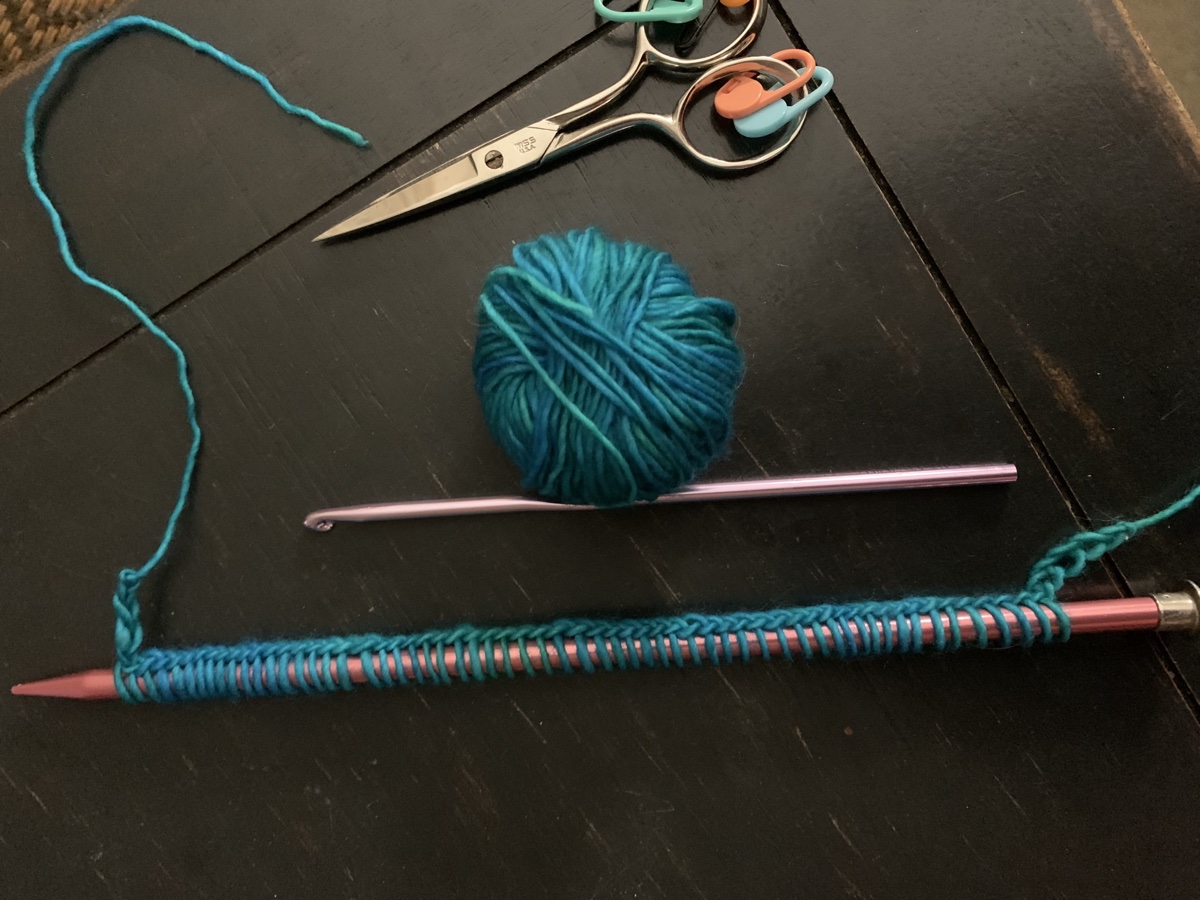
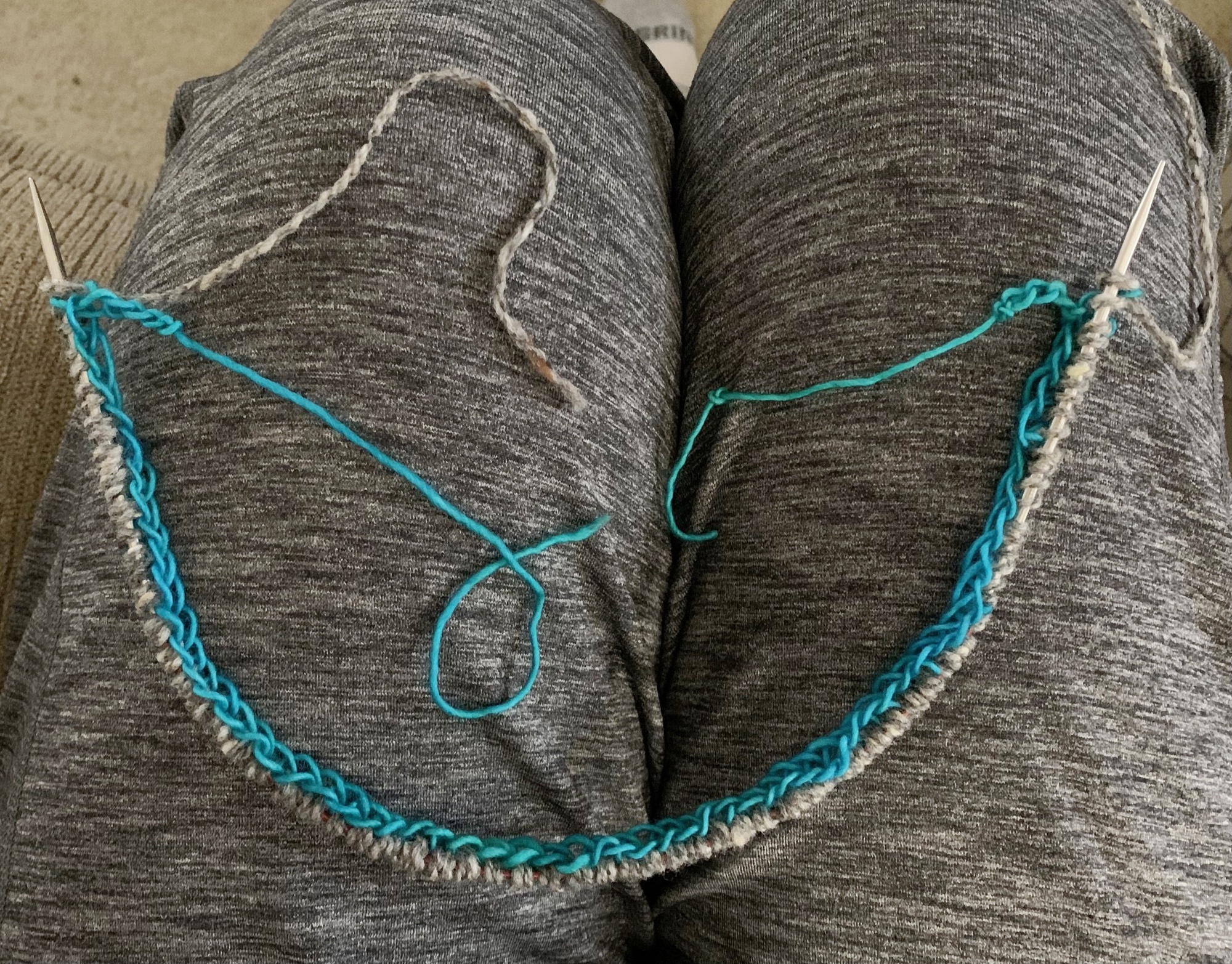
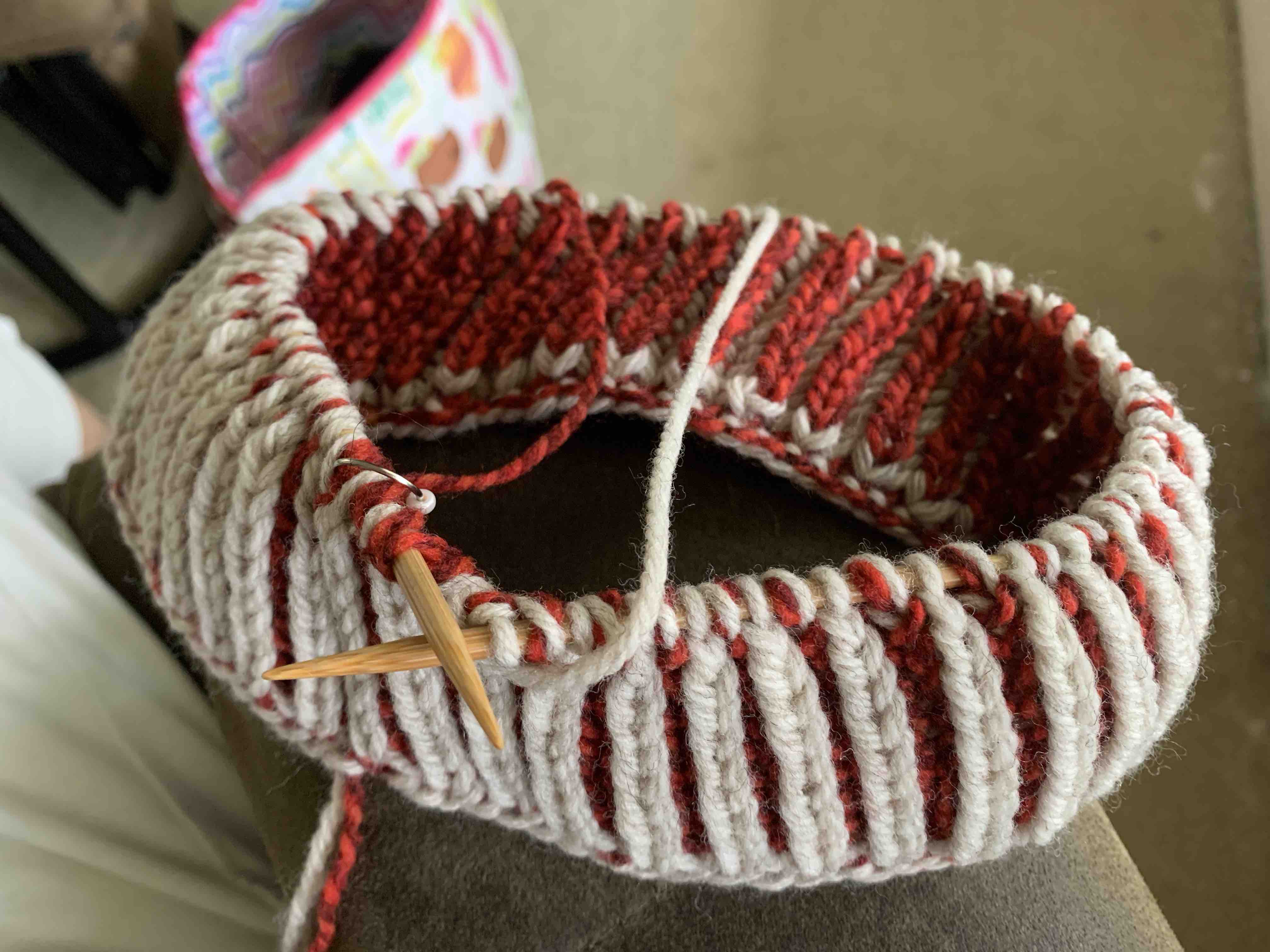
I did have some trouble. Before joining the ends to knit in the round, I made sure all my stitches were straight, as you do normally (middle photo). Once I did my first row, the stitches had become twisted! I fiddled around with it, and just kept going. I was sure the whole thing would be unusable anyway. So watch your stitches on that first row in the round.

This hat pattern (Classic Ribbed Hat – see pattern link below) had 120 stitches for the size I chose. It’s a lot of knitting on something that could end up a complete mess! 

As I knit each row, it was difficult to tell if my alternating stitches were in the right place. I really didn’t know what to look for and the tutorial could have been better in this area.

At the end, my crocheted blue waste yarn did not slip right out either. I had to cut it in various places and pick it out. 

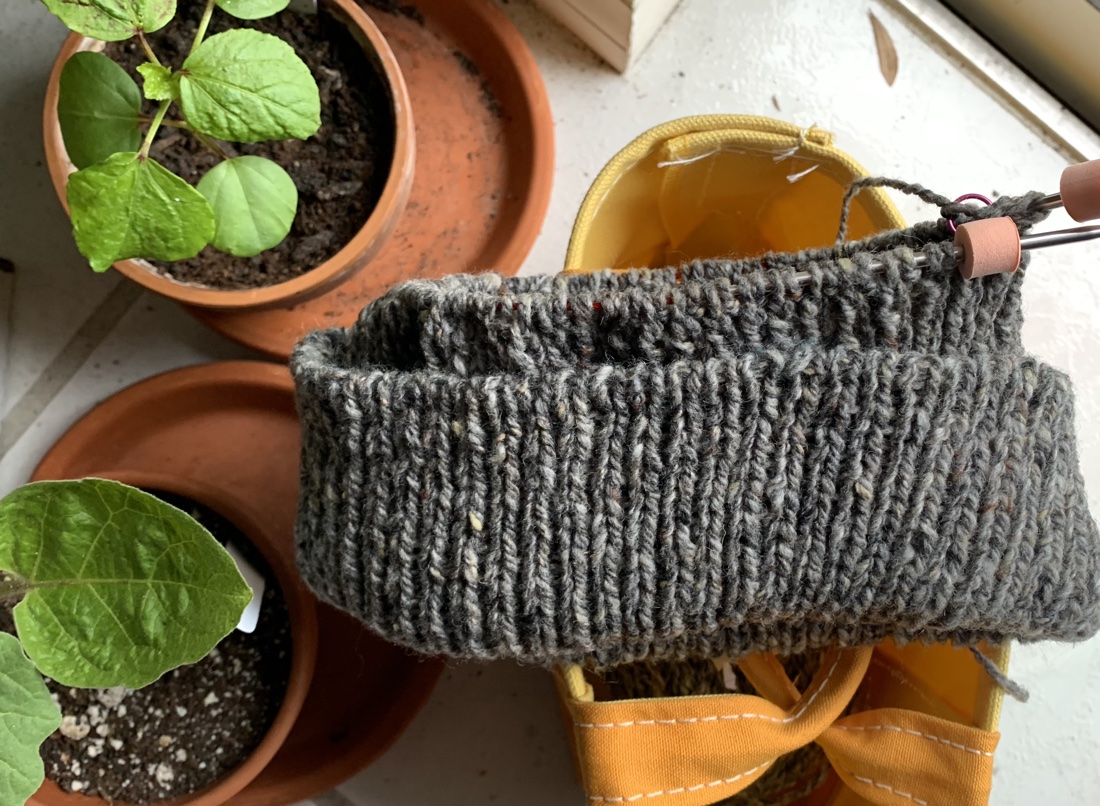
Somehow, and much to my surprise, my first tubular cast on looked pretty nice! It was a miracle…!! I was short one stitch, which I added on my first k1,p1 round. Also, my nubby, tweed yarn is probably hiding some mistakes!

I was happy and amazed that my tubular cast on was usable. When I do it again it should be perfect, right? Now I am continuing to knit on this hat with finished pictures to come.

Be Positive About Learning Something New

If you have the time, always strive to learn a knitting technique you love. This type of cast on takes time and practice, and I know a lot of people don’t have much free time. I had to rip the whole thing out and start over more than once. Sometimes that is part of knitting and I’m here to say, “You are not alone!”

I recently learned how to do magic loop – finally. And wow, it is really pretty easy. This tubular cast on is not necessarily easy, but is worth learning how to do. 


Fiber crafters read on

Something went wrong. Please refresh the page and/or try again.

Sorry, Giving Up on Knitting Brioche

I began writing this post in the hope of being able to easily explain how to knit brioche. It turns out that I simply can’t do it. This project was ripped out, but I do have some good notes, and videos, to reference for anyone trying to knit brioche in the round.

Where’s the Brioche Hate Club, I need to Join

After much difficulty with casting on, (I did learn some new cast-ons) I am on my way to successfully knitting brioche in the round – or so I thought. Well, honestly, I am making lots (and lots) of mistakes – ya, it looks horrible!, but that’s okay, I am practicing. But, at each BOR (beginning of round) the yarn color changes and I’m either going to knit or purl. This can be daunting for us beginners. And sometimes downright impossible.

After my many efforts to complete a nice cast on for brioche in the round, I gave up and simply used some sort of long tail cast on which is what I usually use. My cast on edge looks bad, but I needed to begin practice on brioche stitch.

My Practice Hat in Brioche Stitch – which I ripped out

I cast on 80 stitches using worsted wool and this was a good number. The Skipp hat pattern called for fingering yarn, so I tried to estimate with worsted, just to try out the pattern. Before I ripped out the hat, I tried it on and the fit was good. If I ever learn to knit brioche in the round correctly, 80 stitches are a good amount to cast on.

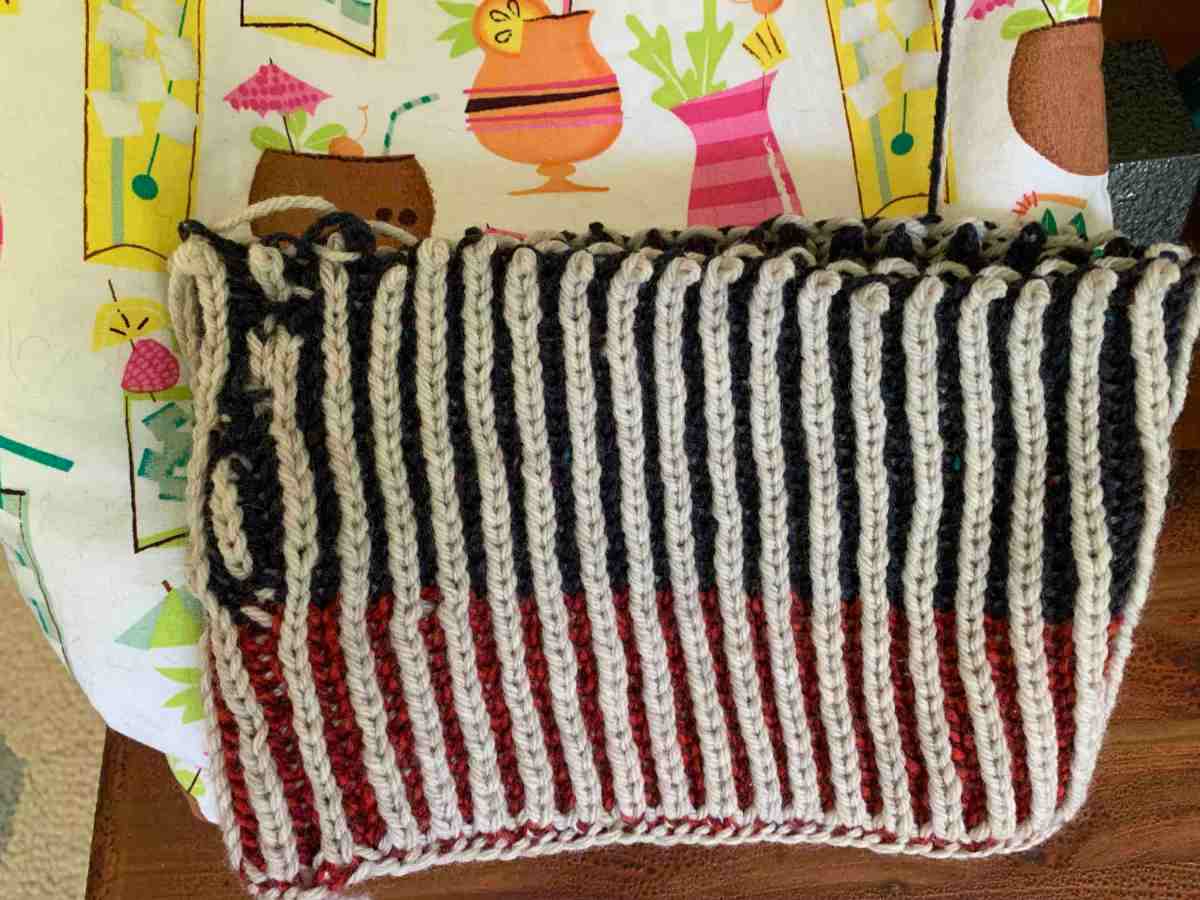
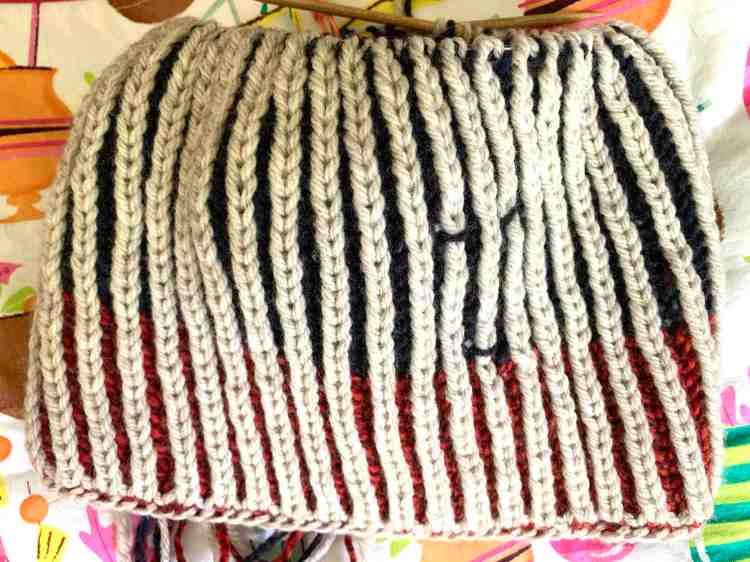
The light gray is unknown yarn and the red is Brooklyn Tweed’s Shelter. I’m using up stash with only a small ball of red yarn left, then I switched to dark blue.

Brioche hat knitting two color
Brioche knitting

My Brioche Knitting Advice For Beginners

To practice brioche knitting, I’ve found that doing the following makes things easier

  • Use worsted weight yarn
  • Choose two very opposite colors and NOT variegated
  • If you can’t get a good cast on done, do whatever you can so you can just knit! Consider this practice.

Figuring Out Beginning of Round Knits and Purls

Brioche knitting is not really all that difficult, but at the beginning of each round I get very confused. This mainly happens when I don’t see the yarn stitches I’m supposed to see for the next round! I guess I have some kind of mental block because so many people CAN DO THIS! What’s wrong with me?

With only two yarn colors and two types of rows (knits and purls), this shouldn’t be all that difficult. But as a beginner, who makes lots of knitting mistakes, I dreaded that BOR stitch – because it screwed me up….!!!

So here’s how it goes for two yarn colors, and two row changes. This much I understand.

Know your yarn and what it means. My knit row yarn is my MC (main color) which for me is light gray. That makes red yarn my CC (contrast color) and it is my purl row yarn.

  • MC Gray yarn = Knit Row
  • CC Red yarn = Purl Row

But in brioche, knit and purl rows are not all that obvious unless you know what to look for. This information is for “brioche in the round” because flat brioche is probably different – I don’t know. (Oh yes, I tried that too and still couldn’t accomplish it! – see the free pattern links below for brioche scarves.)

BOR Stitches – The Knit Row

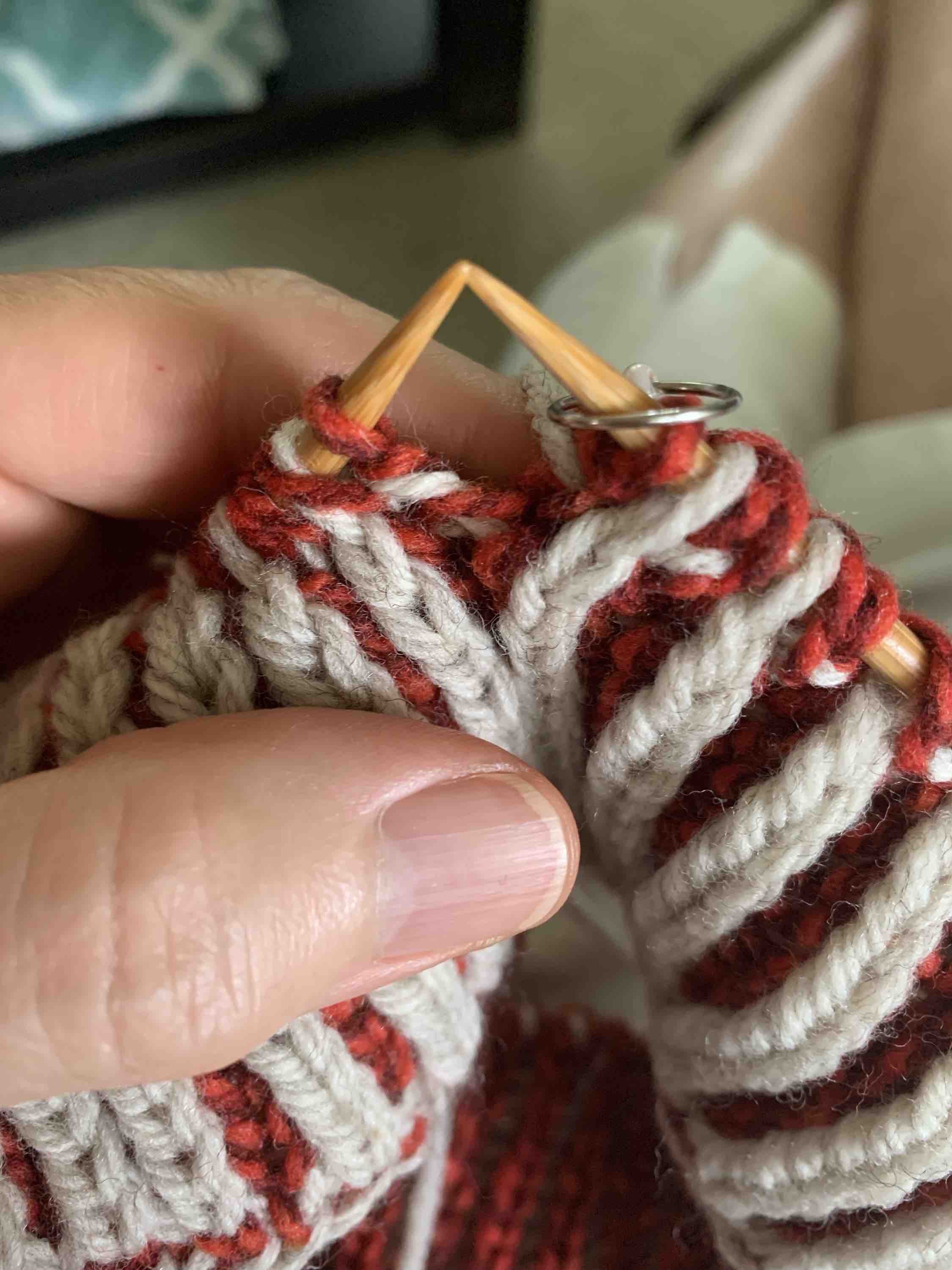
At the BOR, when I see a purl stitch as the first stitch to work (photo below), and it’s in my CC (red) yarn, it means I will be using the MC (gray) yarn for this row. That means it’s a KNIT row.

The knit row is worked as follows: *Gray yarn forward, slip that purl stitch (purl wise). Leave the yarn in front as I pick up the next TWO stitches (a gray and a red stitch – you can see them crossed in the image below) and bring the working yarn up and over the needle to knit those two stitches together. This creates a yarn over (YO) for the next round of knitting. *Do it again until I finishing knitting this round. It helps to repeat this in your head when you get going on the round…yarn front, slip, yarn over purl (2 – counted as one).

It’s not that difficult. It’s basically a slip and k2tog – but those two together are counted as one stitch. The yarn just needs to be in the correct position to create that yarn over with the knit.

brioche in the round, two color row stitch appearance
BOR, a slipped purl stitch begins this round, so I am knitting this row and using the MC yarn which is gray.

BOR Stitches – The Purl Row

My purl row begins incorrectly. This goes back to my difficulties in casting on. If I can’t make the right kind of cast on and join, I won’t have the correct stitch set up!

My photo below is in the middle of the round, but the beginning of the round would start with a knit stitch like this – at least I think it would. A gray knit stitch means I will slip it – using the other yarn color. Dark blue yarn has replaced my red so I am working with the CC color and purling this row.

Work the Purl Round / Row like this: *Yarn forward and slip the knit stitch. Yarn up and over the needle to purl the next two stitches together. *Continue around. Once the purl has been done, the yarn is in the front so just slip the next stitch. Yarn up and over and purl the next two. Pretty simple. Hahahahaha… do I sound insane?

Adding a New Yarn Color

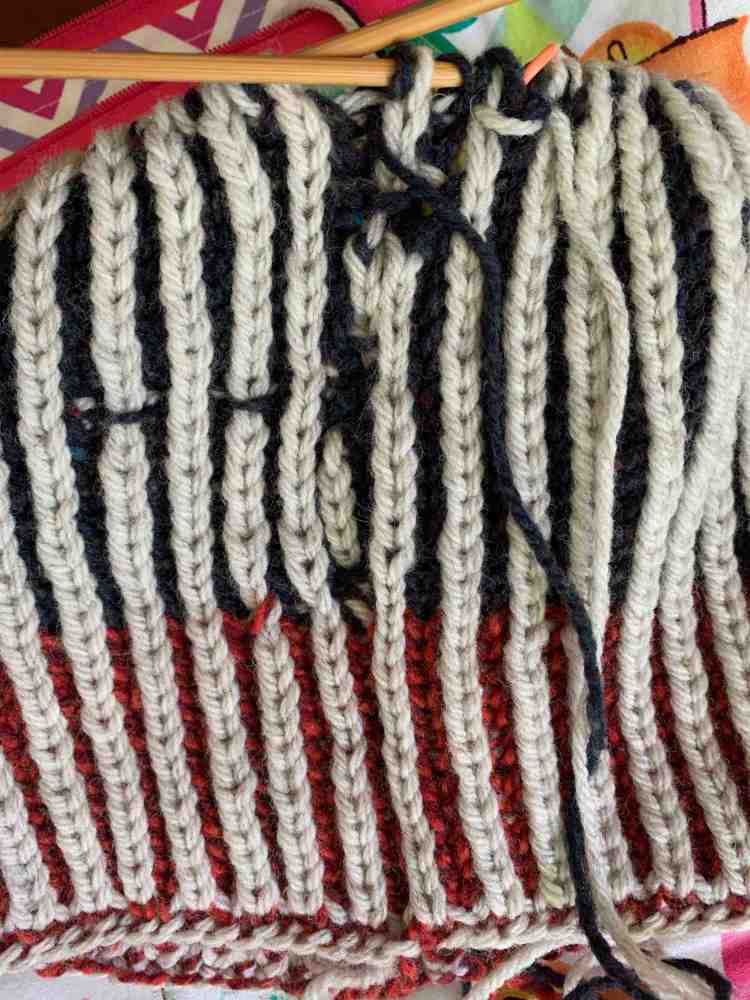
Eventually I ran out of red yarn so I have added a dark blue. The yarn was added at the beginning of a round and it now takes the place of the red yarn. Blue is now my CC.

I’ve made a ton of mistakes on this practice hat, which may not ever end up being a hat (No, it won’t) because I have no idea how to decrease at the top while knitting brioche – Oh Lord, I’m far from being able to do that!

Brioche in the round, hat knitting practice
Dark blue yarn added

My Brioche Hat Photos, Before I Ripped it All Out

The actual stitches were fun to do, but every now and then I would make a mistake on the round. The Beginning of round stitches, and end of round stitches, did not line up and I would lose it (glass of wine anyone?). Also, it’s easy to not carry the yarn correctly – front or back – which will make unwanted lines of yarn where they shouldn’t be.

This is nearly impossible to fix. Jared Flood suggests adding life lines to brioche and it’s definitely some great advice. See the link to his video below where he shows you how to do that.

The cast-on’s in my photos above were done following Andrea Mowry’s “Two Color Tubular Cast-On” which is really nice and a great cast-on to master. A couple of rows are knit back and forth before the join and the video is a very good one. BUT… and this is another big BUT… like so many other videos, it stops after the cast on – how do I join? How do I continue to knit from this? There is no explanation. The video ends. So the cast on is as far as I went, and then ripped it out.

Patterns For Practicing Brioche

Some patterns listed here are free, and some are not. I did buy the Jared Flood hat which I couldn’t complete. Then I found some free patterns for knitting brioche flat (should be simple right?), which I also couldn’t complete. It’s so sad that I am incapable. If you can’t do brioche, join my club. I may try again in a couple of years, but at this point I am OVER IT.

I’ve spent nearly two weeks trying to figure this out. I have all these patterns and saved videos to reference for later. I’m not one to give up easily and in general I believe that if others can do it, I can. Not so with knitting brioche.

Brioche Knitting Tutorials at YouTube

Lots of people have made tutorials for YouTube showing us how to brioche knit. Here is a list of some of my favorites. No videos I came across shows me how to create a good join and knit from there.

  • Stephen West
  • Brooklyn Tweed – Jared Flood – Brioche in the round – This video is awesome for everything except casting on and joining in the round. Jared explains what to do at the end of the round – with that other color yarn which is just hanging there waiting to be used. He also shows how to add a life line – which is a great idea for knitting something where mistakes could easily be made and be difficult to fix.

Woolfolk Tynd Yarn Stranded Motifs Cowl

Knitting a small cowl using Woolfolk Tynd yarn in colorwork motifs

This small wool cowl was a spur of the moment knitting project decision. I do not have a pattern to share as I made it up as I went along.

The idea bloomed when I came across the Glacier Park Cowl pattern by Caitlin Hunter at Ravelry and saw that she had used Woolfolk yarn in two colors to create it. I knew I had stashed away two skeins of that same yarn. My cowl is not in her pattern, but I did use up (nearly) my Woolfolk Tynd yarn!

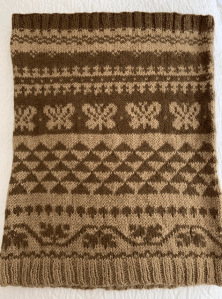
stranded colorwork cowl
I used Woolfolk Tynd yarn in brown and tan to make this knit cowl

My two skeins of the super-soft Tynd are dark and light brown colors, and I’m not sure of the numbers (Tynd colors are numbered, not named). Probably this was on sale somewhere at some point and I bought it not knowing what I’d use it for. The yarn is so very soft that a cowl is the perfect project.

A recent purchase of the book 150 Scandinavian Motifs gave me the incentive to do some math and find designs that would fit my cast on numbers. Then I screwed up and forgot my cast on, or counted the first row incorrectly, and messed up some of the rows.

I began with the lighter color as my main color and switched just before the butterfly row and made the dark color my main color. I did this to use up the yarn more equally. I can’t locate my leftover yarn, but I did use most of each skein to finish this cowl.

stranded colorwork cowl
Motif spacing error

I do love the Glacier Park cowl pattern (click the link above to see that beauty), but not for these duller colors. So I made up my own design which was really good practice doing stranded colorwork. And I did make a lot of mistakes! No biggie… a cowl hides mistakes well.

In the image above you can see where my butterfly row did not line up exactly with the stitches I (thought) I had counted, so I had to add a little wavy section to carry the yarn.

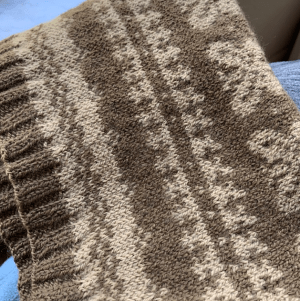
Below I am showing my goof up on the row above the butterflies where somehow my counts were off. Most of these motifs came from the book, but I did make some up myself.

two color stranded knit cowl in Tynd yarn

Just thought I’d share the stranding that went on inside the cowl. I didn’t have many ends to weave in because all the yarn was carried up inside the cowl.

Fun Selfies Wearing the Cowl!

I have no one to ask to take photos of me, so I did the best I could getting pictures of the cowl around my neck. My messy gray-hair braid kept getting in the way!

wearing the cowl
knitted cowl

Knitting this cowl was a little sidestep from knitting my Fine Sand sweater and finishing up my Quince Wrap. It was a quick knit and a brain challenge (although not too tough) to figure out which designs would fit around the cowl. Sometimes I need something different on the needles.

Knitting the Typha Cowl in Shades of Pink

Finished knitting the Typha cowl. I had trouble figuring the gauge for this because I was not very experienced, but I should have gone up at least one size in needles.

Two tone cowl in lace pattern
Finished Cowl

I am knitting a cowl in shades of pink – the finished photo above most closely matches the actual colors.   This pattern comes from designer Kirsten Kapur and is named “Typha”.  The link takes you to the Ravelry page where the pattern is sold as a download.

The cowl is a simple one to create, with the first part being a simple garter stitch.  One row of knitting and the next of purling.  After that, a simple repeating lace pattern is followed to finish off the cowl.  The pictures below came out very “Pink”.

pink cowl knitting
Done a few rows of the lace part of the cowl.

The second part of the cowl is a lace pattern. After knitting a shawl in the Through the Loops Knit Along, this pattern is very simple to follow. And I believe that most knitters with some experience can easily follow the pattern. It is fun to do.

pink cowl knitting
Cowl knit in the round in lace and garter stitch

I will admit that getting started with this pattern was not easy. For some reason my cowl is coming out much smaller than the pattern implies (Go up 1 pr 2 needles size next time!). I did do a swatch to check gauge, but I am not familiar with figuring out gauge and finding it with a lace pattern threw me off. (Now I know to knit the pattern in a 4×4 square to measure for gauge.)

Consequently when I tried to cast on (for first the smaller cowl, and then the larger) the yarn did not reach, so I had to begin over.

My yarn is obviously thinner than what Kirsten used to create her cowl. The yarn she used is Fibre Company “Meadow”, which is listed as “heavier lace”, so I bought “heavy lace yarn” from Miss Babs, thinking it would be the same.   I guess not.  Live and learn… that is my motto, and once again, I have learned from making a mistake.

So my “long” version will actually be short, and probably not long enough to wrap twice. My plan was to make the shorter version of the cowl to give to my daughter, but now I will keep this one and try again to make a correct size for her.

I do plan to make this cowl again using a heavier yarn and trying to figure out my gauge. It’s a beautiful and unique cowl in the two colors, which gives us many color choices.