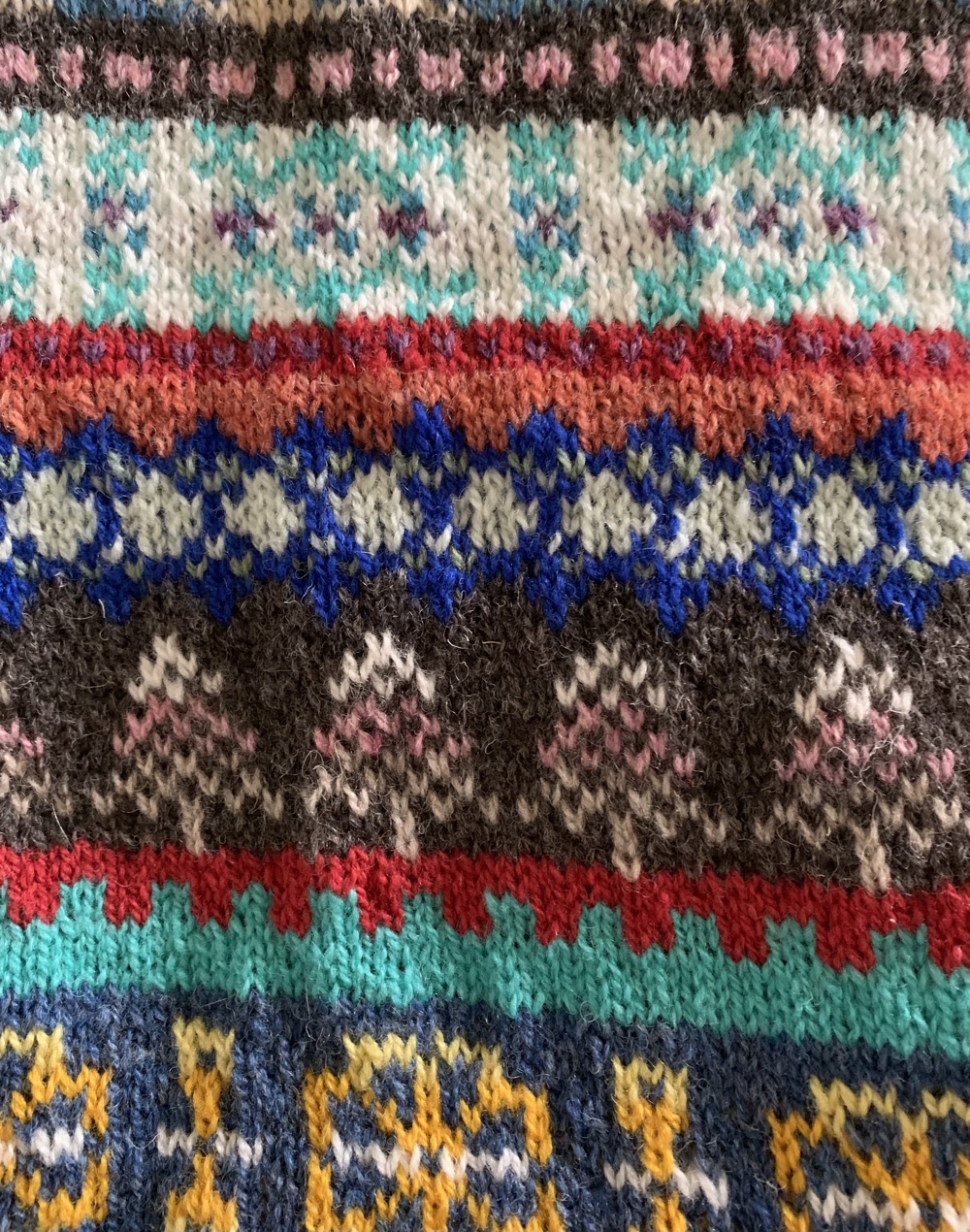
Whenever I get bored with a knitting project, and crave some two-stranded knitting, I pick up my DIY scarf. The colorwork patterns I’m using are random, and come from some books I have.
I began this tubular scarf with a provisional cast on. When it is long enough, I will connect the ends, using the Kitchener stitch, and create one long tube to wrap around my neck, twice.
I began this scarf project out of boredom. It is my love for knitting colorwork that I needed a project like this. My stitch count is 100 and the repeating patterns must fit into that count. Patterns must evenly divide into 100.
Or, I can create an extra stitch. For instance, on the “people” pattern I had to add one more space (extra gray stitch) between them to make the stitch count work. I believe it was 19, and I made the repeat 20.
I’ve had fun choosing patterns and making some up myself (very simple ones). I think this type of knitting, with blocks of different patterns and colors, has a name.
All of this scarf is Fair Isle, meaning I use only two colors per row. Some rows are one color only, but I never use more than two at a time. I hold the dominant yarn in my left hand and knit it continental style, while knitting with the other color English style.
I found this fun blog post at Talvi Knits that talks about knitting in two passes when using more than two colors in a row. It sounds like mosaic knitting, but using more yarn colors. It sounds pretty confusing!
All I needed to do was to find repeating patterns with numbers that divided evenly into 100. There weren’t that many. You’d be surprised at how many repeats are4, 6, 8 and 12!
Occasionally, I don’t like the design once it’s knit. I’m not very good with selecting colors to combine. Because I am using only stash yarn, I have a limited amount of color variety to use.
It doesn’t matter on this project. I may never have a chance to wear this scarf anyway. I live in Florida where no one ever wears a scarf.
Knitting up the newest in the line of Shetland Wool Week hat patterns, called Bonnie Isle.
I’m late to the party, but apparently every year there is a hat pattern to celebrate Shetland Wool Week. I’ve seen the cute lambs hat from a few years ago (Baa-ble), and knit Katie’s Kep twice, but otherwise haven’t paid much attention.
The latest SWW pattern – Bonnie Isle Hat – has come out for 2022, and I have begun knitting it. The nautical theme features waves and anchors and a bit of a unique cast-on and rib beginning.
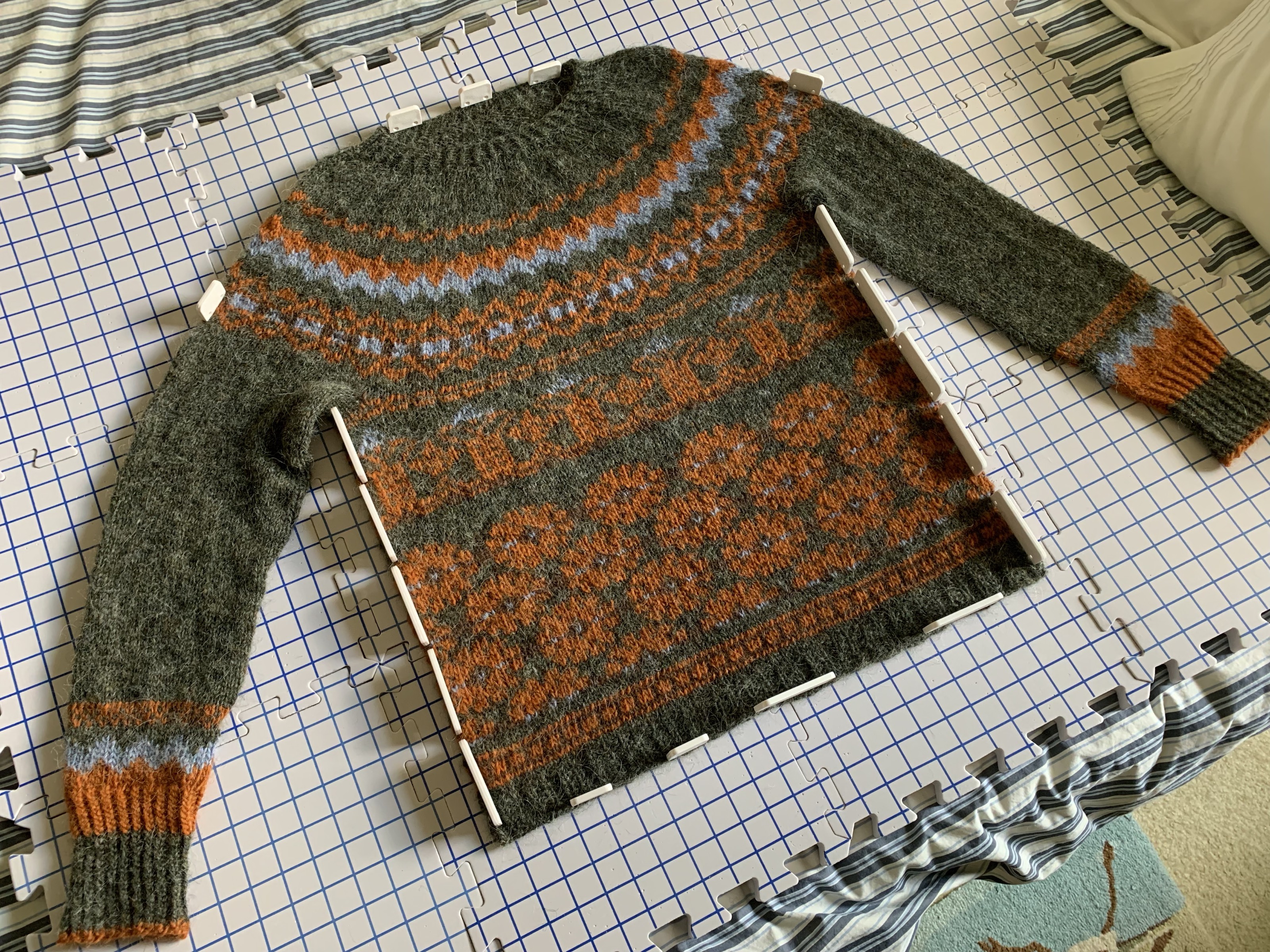
Knitting a pullover sweater with a made up colorwork design using Plotulopi and Lettlopi wool.
For a while now I’ve been a bit lost as to what to knit next. I began the thrummed mittens and lost interest (because I never wear mittens in Florida) and finished up my Meadow Moon sweater, and now… what?
Colorwork / Fair Isle is my love, and I have all these plates of Plotulopi so lets use them! I’m still trying to use up stash yarn, and combine the yarn with a good pattern.
Frost Grass plotulopi plates
I dug out the Lopi 40 book because I have some Lopi yarn to use up. After knitting the Farfuglar pullover, and Clacks mittens, I have light blue and a tiny bit of white. I had ordered some rust orange (Apricot) Lettlopi as well as a brown color.
After skimming through the Lopi 40 book, which has many lovely projects, I decided on a vest. It is shown on children, but has sizes for adults. I figure I can do colorwork around the bottom, to the underarms, as the pattern does, and then finish with solid plotulopi. (It is a bottom up vest.) But I want to choose my own charts and colors.
Yarn Being Used
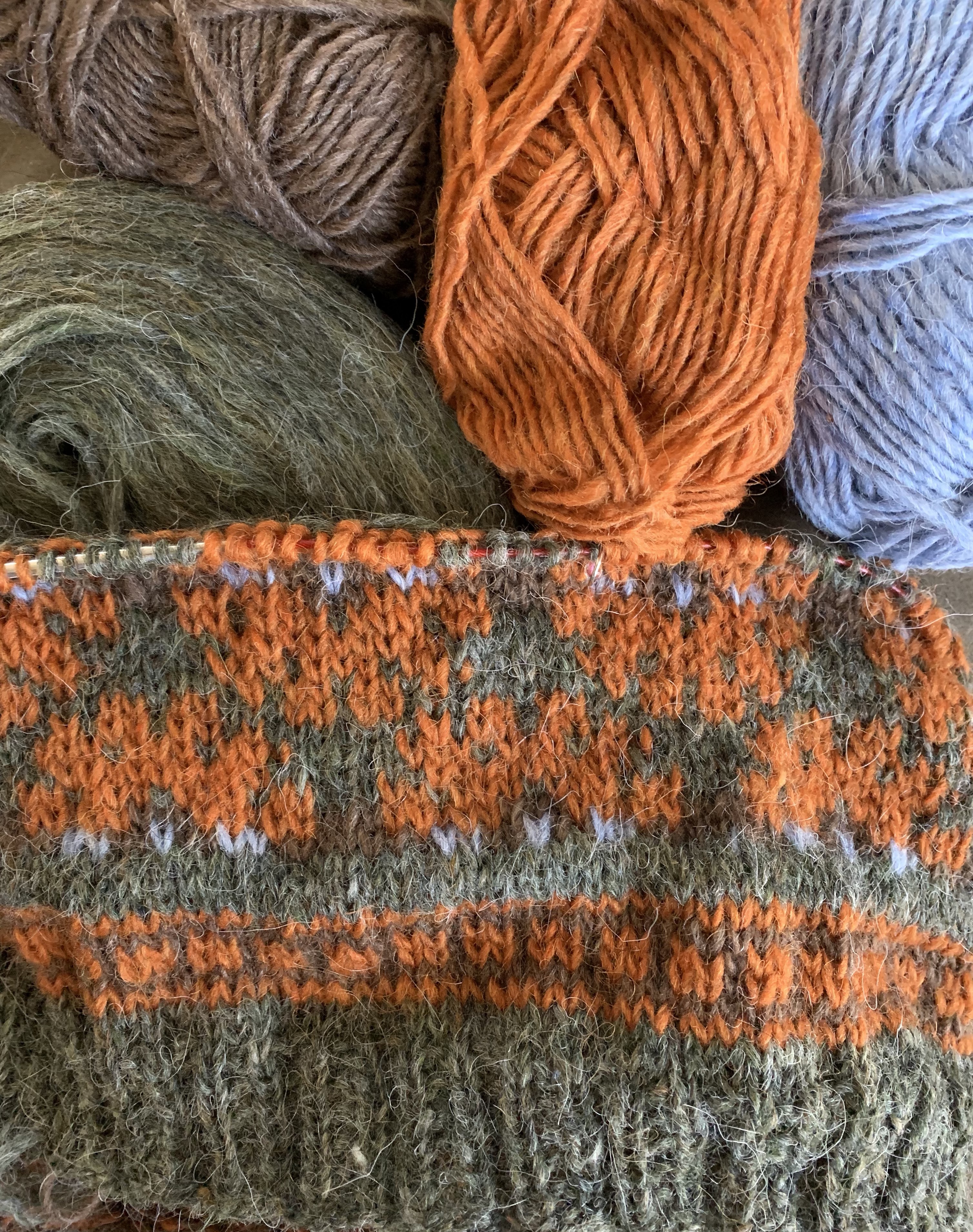
Because I have a lot of Plotulopi in “Frost Grass” green, that is my main color. The main contrast color is Apricot Lettlopi with a bit of Acorn brown and Air Blue Lettlopi in the center of the flower motif.
The “frost grass” color is really lovely, and I think a perfect name for this green yarn.
The Plotulopi is unspun and breaks easily. I must unwind it before pulling to knit. It does spit splice together well, which I’ve done when it unexpectedly breaks. I was worried about doing the colorwork and having to carry this yarn, but so far, it’s been okay. I am very careful not to tug on it.
The Lettlopi does not have this problem. I’m unsure how easy colorwork knitting would be with only Plotulopi yarn. Seems like it would be difficult. Unknitting, or tinking, can be tricky.
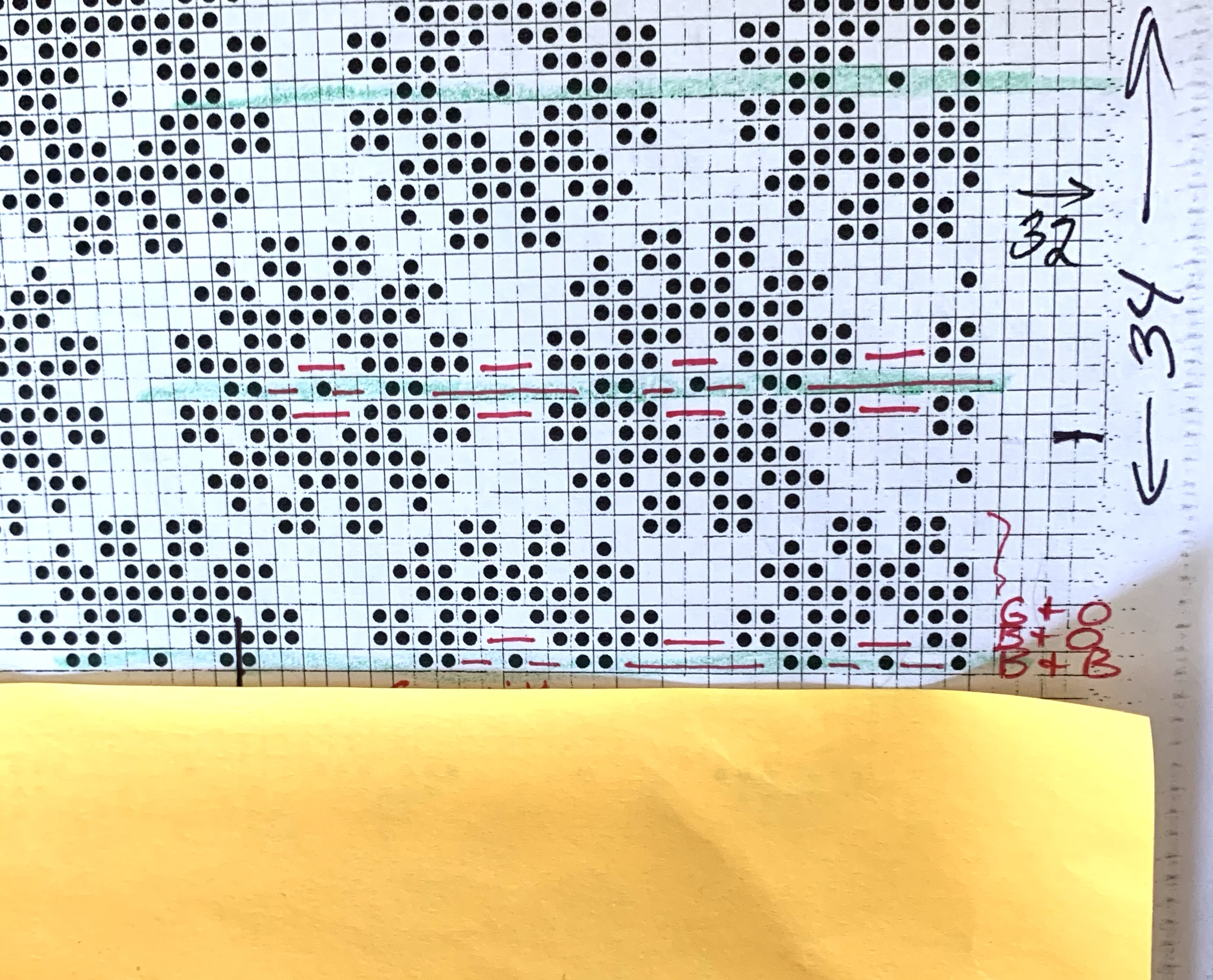
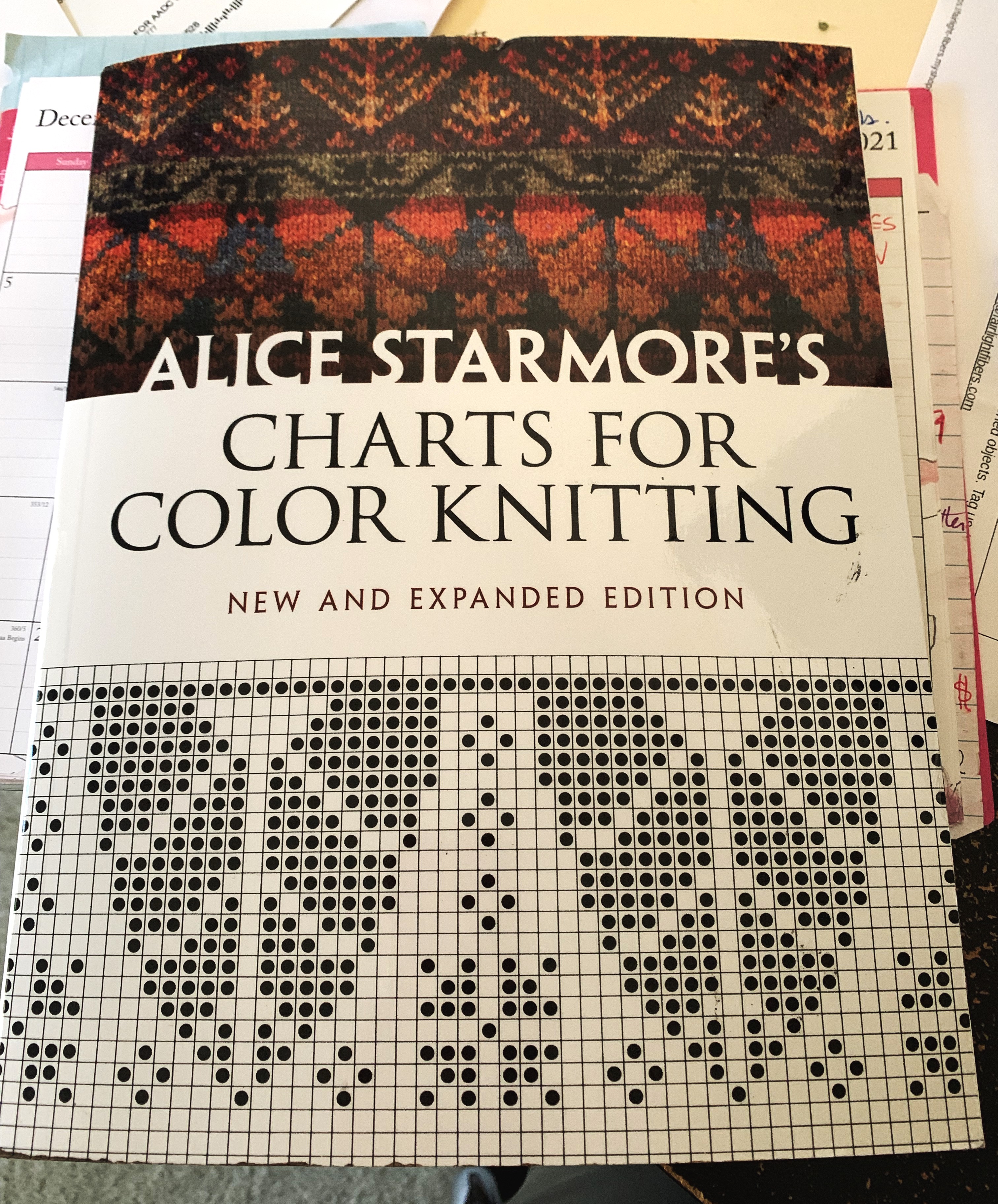
Finally, I settled on a pattern, which was taken from Alice Starmore’s “Charts for Color Knitting” book (This is an affiliate link to Amazon). I will knit the floral pattern for the length of the body and the top will be solid green.
The Knitting
I cast on for the body ribbing (knitting bottom up) with green, using a size 4US needle – 195 stitches. My ribbing choice is not typical 2×2 and needed to be divisible by 5. The ribbing is from my Gansey knitting book and is more of a 2×3 rib. It goes like this:
Row 1: K2, *[P2,K3] repeat * until last 3 stitches, P2, K1
Row 2: P1, K1 *[P2, K1, P1, K1] repeat * to last 3, P2, K1
This wasn’t a good idea for this yarn. A normal 1×1 or 2×2 would have been fine.
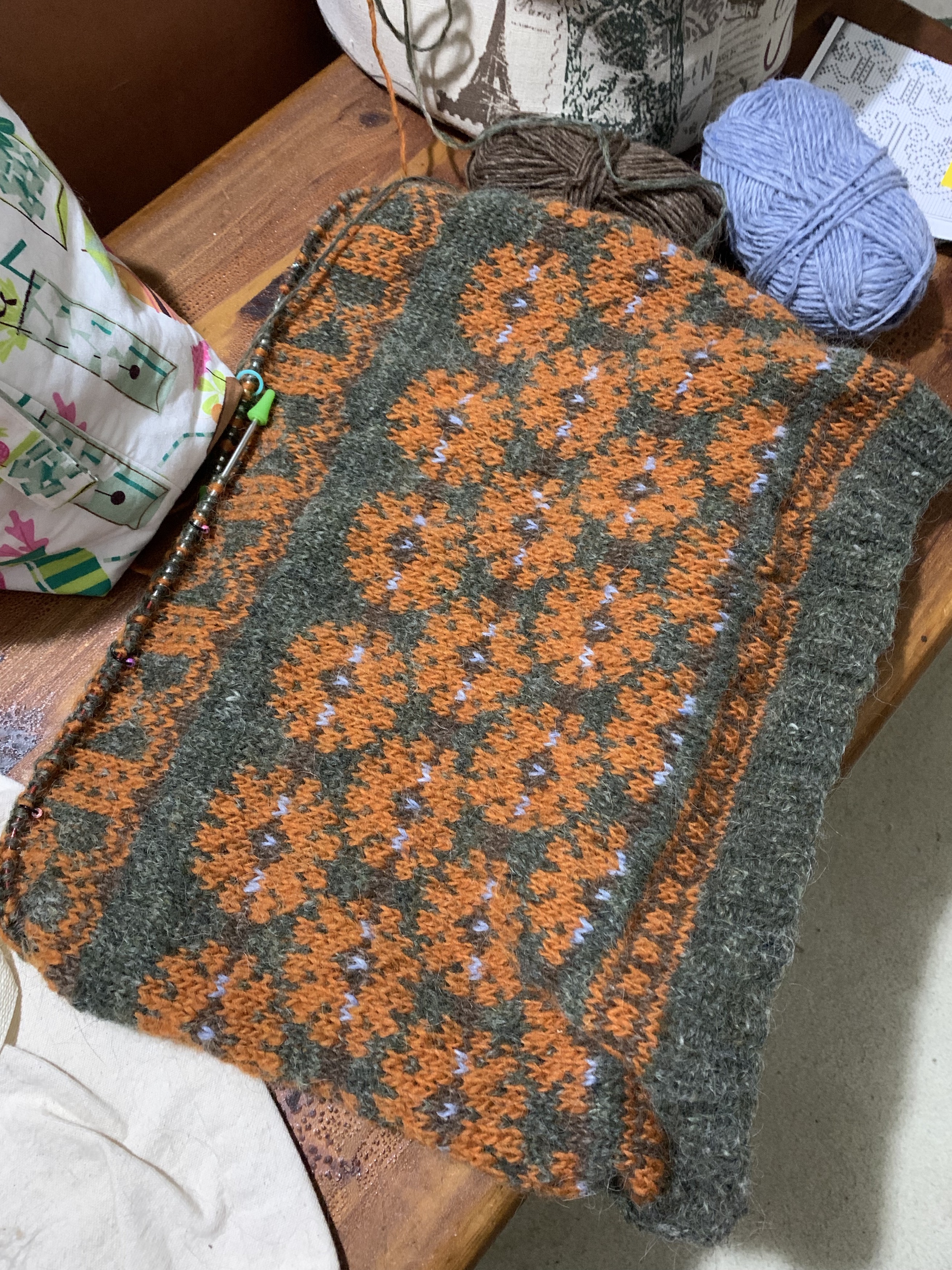
Then, after switching to the main needle size 7US, I reduced the stitches from 195 to 192 and began the divider row of little squares in orange (Apricot). The floral pattern is in 32 stitch repeats, which also fits into 192 stitches – I should have gone up a needle size here because this area of the sweater pulls in a bit.
The flower center three rows are brown with orange, brown with blue, and brown with orange. Then I go back to using green as the MC.
After finishing all the colorwork, I am still at 192 stitches, for size large, and will continue following the pattern from the book.
The Vest Becomes a Sweater
Unfortunately I have swapped out my vest for a bottom up sweater. I cannot understand the vest knitting directions. But I do know how to knit a bottom up sweater. Farfuglar was knit with similar yarn and in a similar size, so I intend to follow those directions and include some colorwork along the way. This sweater will end up being a total experiment! The Farfuglar sweater does not include short rows for the back, and I will definitely be including short rows.
I know that colorwork can make for a tighter fabric so I’ll have to be careful there. I really would have loved to have a vest, but I need a pattern with better directions for my first try.
Now I have continued on with a new chart motif to make the body longer.
Attaching the Body and Sleeves
I wanted to use more orange, but was running out with only one skein left. The sleeves became solid green after the cuff area colorwork.
Sleeves nearly done so the parts can be joinedJoined the body and sleeves and beginning the yoke.Yoke patterning
The neck is a simple k1tbl, p – around for about an inch. Then, I was finally able to try it on. The sweater is tight around the body due to all that colorwork. I have the underarm grafting to do and some ends to weave in. Once it’s washed and blocked, I will see how it fits.
Wearing the Sweater
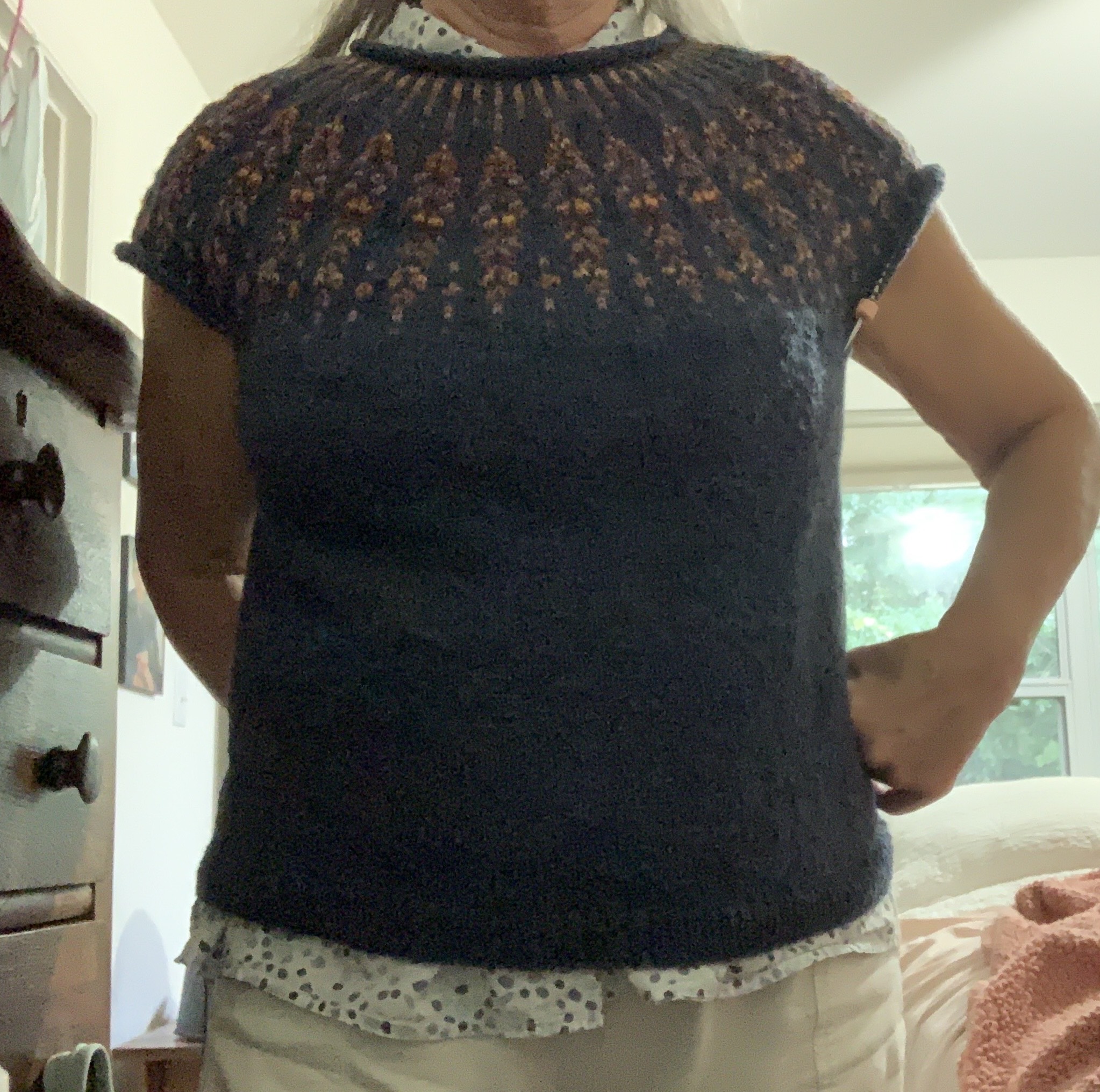
Finally in January 2023 I got some photos of myself wearing the Lopi Sweater. It is very comfortable. The flower colorwork area is a smidge tighter than I would like. If only my belly would shrink a little. Anyone else wish this?
If you are wondering about the comfort of this wool against the skin, I find it to be fine. Yes, I suppose it is a bit scratchy but I don’t mind it at all. Wool is a bit too hot – okay, a lot too hot – for Florida, but occasionally we have some cooler days.
A while ago I decided to make 2021 a year for knitting sweaters. Now we’ve entered 2022 and I am finishing up my projects on the needles.
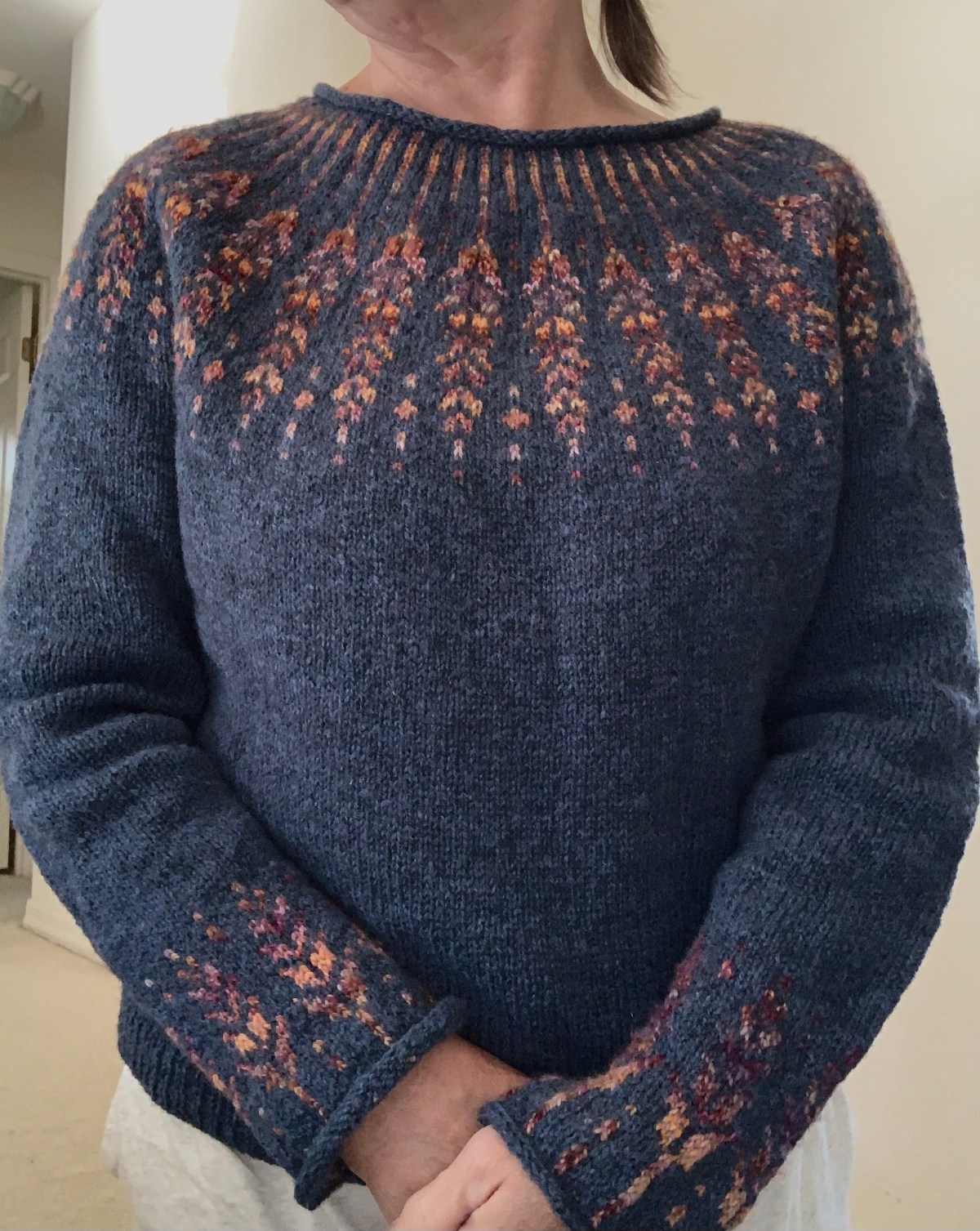
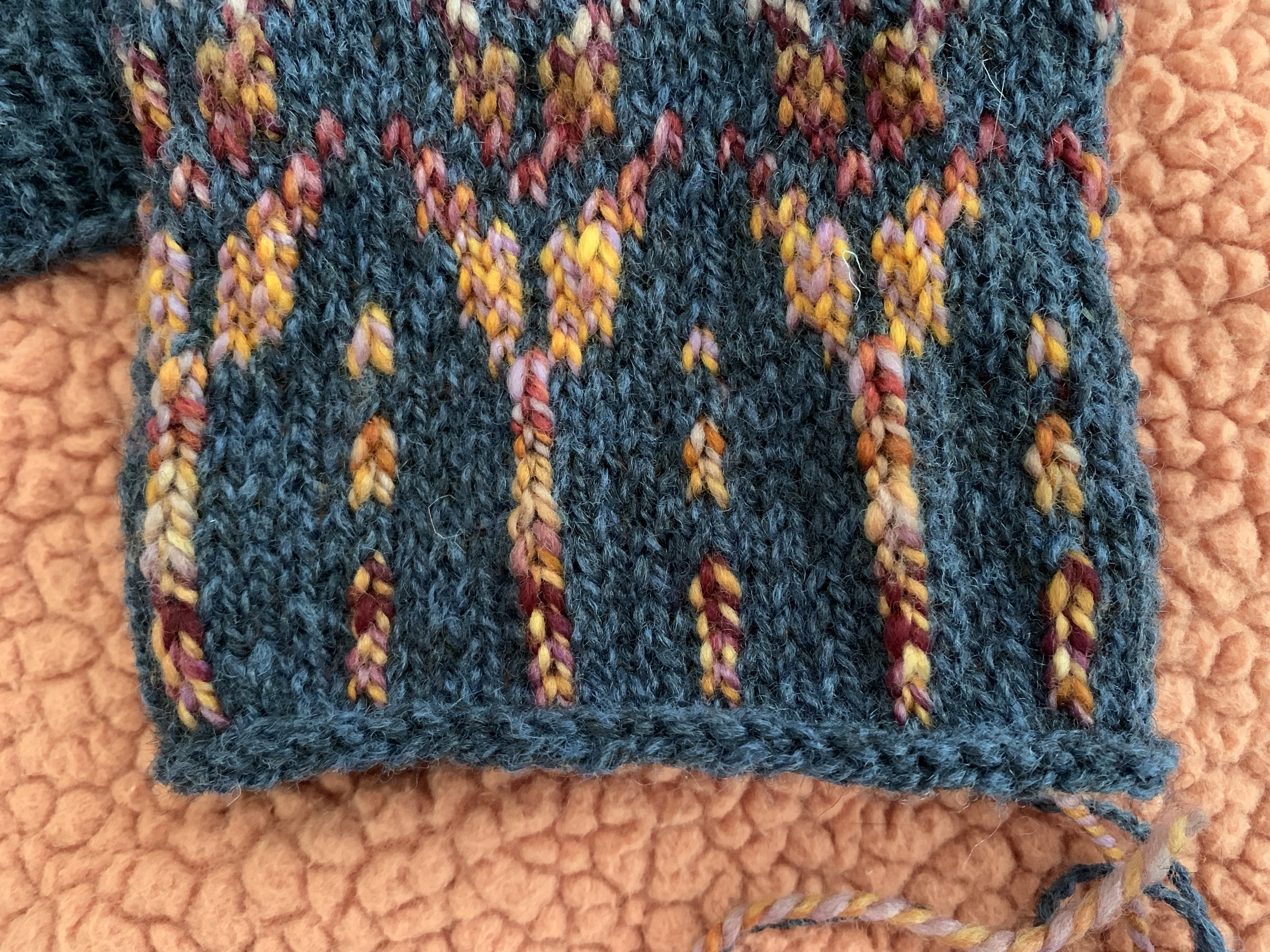
I’ve seen the Jennifer Steingass patterns around and love many of them. Her Ravelry store is Knit.Love.Wool and her sweaters have colorwork yokes, cuffs, and bottom hems. Many of her designs look to be nature inspired with patterns that resemble leaves, stems, and feathers. The pattern I chose looks like stems of wheat coming down from the neckline.
Sweater Knitting is an Investment
Choosing to knit a sweater means an investment of money as well as time. The sweaters I have knit have generally required around 1200 yards of yarn. Depending on the type of yarn purchased, it can be over $100 in material. Choosing a good quality (non-superwash) yarn is worth it. Wool will hold it’s shape and the sweater won’t stretch like crazy when it’s washed.
I purchased seven skeins of Rauma Finull wool in blue and decided on a hand-spun skein I already had as my contrast color. I had no idea how this variegated yarn would look when combined with the dark blue. So far, I think it’s looking quite good. I did not want a completely opposite yarn color for the contrast. With this yarn I have no control over what colors are coming up on the skein. It’s fun to see the colors emerge.
The Meadow Moon pattern is well-written and very easy to follow. This is big. I’m also knitting another sweater and the directions are difficult. Some designers go the extra mile to help knitters and some don’t. I’m learning to avoid some popular designers who have made me unhappy by not going that extra mile.
After the Fun Colorwork…
The body is a slog… it has taken a while for me to complete. Finally I bound off the ribbing and tried it on. Fit seems perfect. On to knitting the sleeves. At least there will be colorwork at the ends.
Although round and round knitting can be tiresome, it is great for car trips, late night television knitting, and knitting outdoors and soaking up the sun. I like the fabric being created, and would probably knit more sweaters like this one.
Body is done!
The first sleeve is finished. The decreasing was easy and looks nice and I followed the directions for length, which seems to be perfect.
One thing I changed was the bind off. I found the i-cord bind off directions in the pattern to be difficult. I began with it, but it didn’t look good. Possibly, I was doing it wrong. So I did it my way.
My i-cord bind-off resembles the one Stephen West shows in his video here. Except, I only cast on 2 – to the left needle, not 3, which follows my sweater pattern more closely. Then, *knit one, k2tog tbl, slip both stitches back to the left needle. Repeat from the star.
This bind-off takes some time to do, but it does leave a nice rounded edge.
With one sleeve to go I can see the light at the end of the tunnel
Finishing Up My Sweater Knit
None of these photos are great, but here I am wearing the sweater BEFORE washing and blocking. The middle photo is AFTER the wash, and taken in the sun to show the colors of the contrast colorwork. All the bunching of the colorwork became flat once it was washed. Sleeve length is perfect for me.
The sweater is a perfect fit. I would do more short rows because I have a hard time figuring out which is the front / back!
The yarn has created a lovely, lightweight fabric. I think this is one of my favorite knits so far. *Also, it has become the most worn hand-knit sweater I’ve knit so far. It fits perfectly and is very light weight and comfy.
Read about what else I’ve been up to in my knitting world…


























 New England's Narrow Road