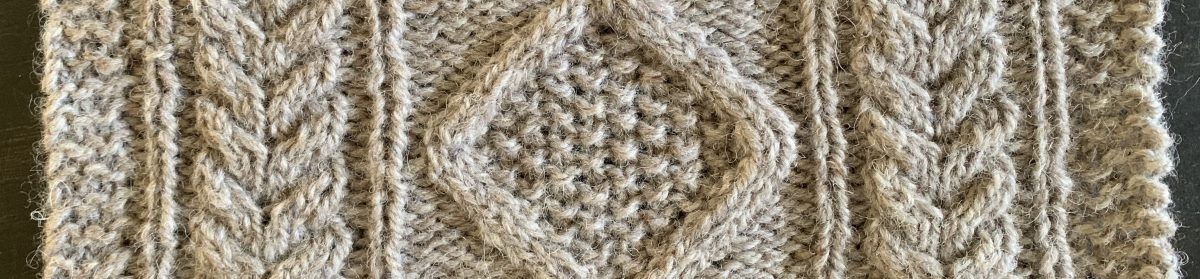
The Chunky Turtleneck Sweater in Alafosslopi

Knitting a bulky pullover using Alafosslopi wool and pulling directions from two different patterns.

This page is all about how I combined notes from two different patterns to create a chunky, turtleneck sweater. Jumping into a knitting project without one simple pattern to follow has expanded my knitting proficiency. I tried some new things here, some of which worked well, and others that did not. I was happy to have had this learning experience, while making a new lovely sweater.

I’m continuing on in my quest to find patterns to help use up stash yarn. Although I did use quite a lot of my Alafosslopi when knitting the Carbeth Cardigan, I still have quite a bit leftover. It would be perfect to use for a chunky turtleneck.

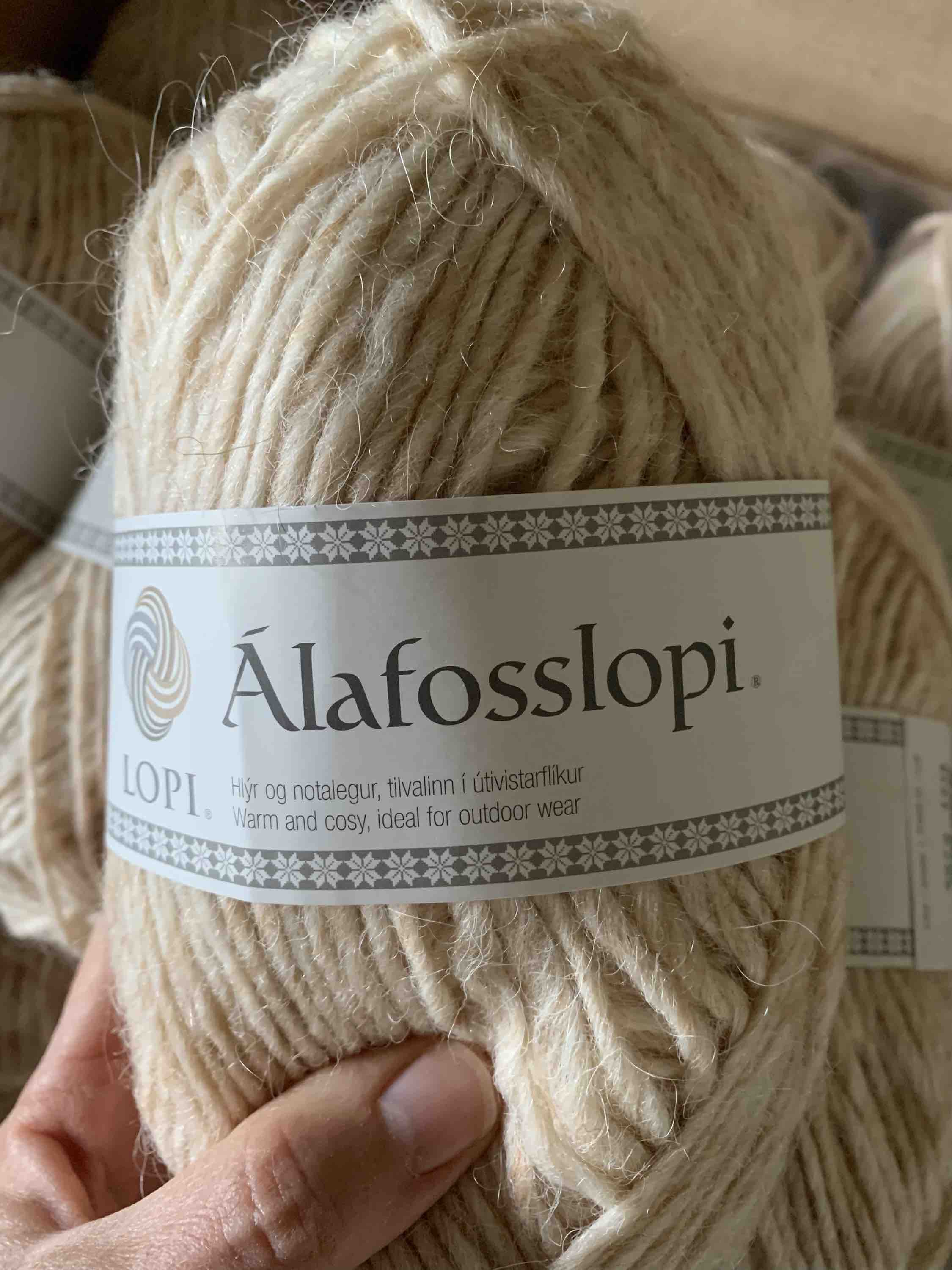
In my search for a pattern on Ravelry, I found the VENLIG pattern, which is knit with Woolfolk’s newer yarn called Flette Bulky. I love the look, but thought maybe I could also use the pattern and knit it with my Alafosslopi.

My gauge with the Lopi was off for the Venlig pattern, so I had to make adjustments (which I should have done from the very beginning) – see my notes further down. Venlig’s pattern directions for short rows and raglan increases were needlessly difficult. Because of this, I gave up, frogged, and began over with a pattern I knew was easy to follow.

Starting Over With The “Turtle Dove” Pattern

The Turtle Dove pattern is free, from Espace Tricot, and I have already knit it using bulky yarn.

I am using a size 11 needle. My cast on number was 60 and I did six inches of 2×2 ribbing for a rolled neck. After that, I followed the short rows section on Turtle Dove, which are done before any increase stitches. This is much simpler to follow than the Venlig.

The Turtle Dove pattern knits up with big, wide, bat-wing type sleeves, which I do not want. You can see my finished original Turtle Dove sweater on this page. It came out huge – probably because I knit it long ago and didn’t check my gauge!

So, when it came time to knit the raglan increases, I went back to follow VENLIG.
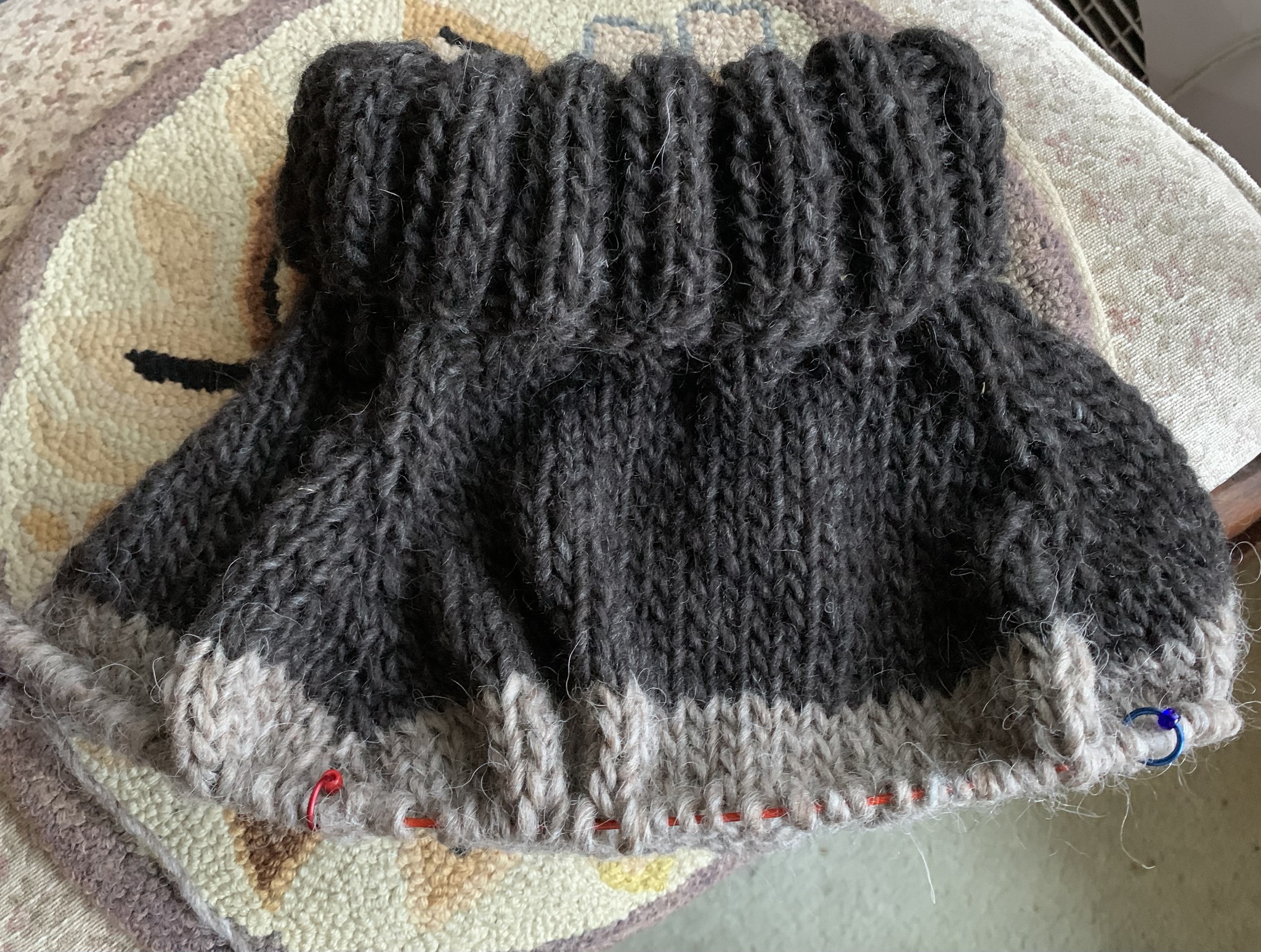
When my body, back and sleeve stitches match up with the number in the Venlig pattern, I will continue and separate for the body and sleeves as VENLIG says.

Fixing Gauge Problems

After 18 increase rows my totals for the body will be 57 front and 57 back, which is a total of 114 for the body (I should have increased more stitches here). The row count (height) is perfect, but stitches are way off.

My gauge is 12 stitches and 15 rows. VENLIG calls for a gauge of 10 stitches with 15 rows. I have 2 more stitches than I should. This changes things.

I have too many stitches within the gauge of 4 inches, which means … that my sweater will end up being smaller than it should be. I need to adjust for this by adding more stitches.

Because I have too many stitches in my gauge, the fix would be to go up a needle size. But, here is my problem – I am already using the largest needle (size 11) that I have! The next size up is needle size 13 US which I suspect would be too big. I’m not investing in size 13 needles just to see if my knitting gauge will work!

Here is a great page at Making Stories that explains gauge and how to fix it. Wish I’d read it before I began knitting this one.

What I should have done (as explained in the link above) is to take my gauge of 3 stitches per inch (12 stitches divided by 4 inches = 3 stitches per inch) and used it to measure size for my needs and adjusted my stitches accordingly.

Bust measures 40 + positive ease of 5 = 45 inches around. 45 x 3 = 135 stitches needed at largest part of body. This does not help me with the cast-on, but at least I know what my stitch count should be on the body. I had to increase to get there because as you read above, I have only 114 total stitches for the body! I created those increases under the arms on each side as I knit down the body.
Corrugated Ribbing at Bottom of Sweater

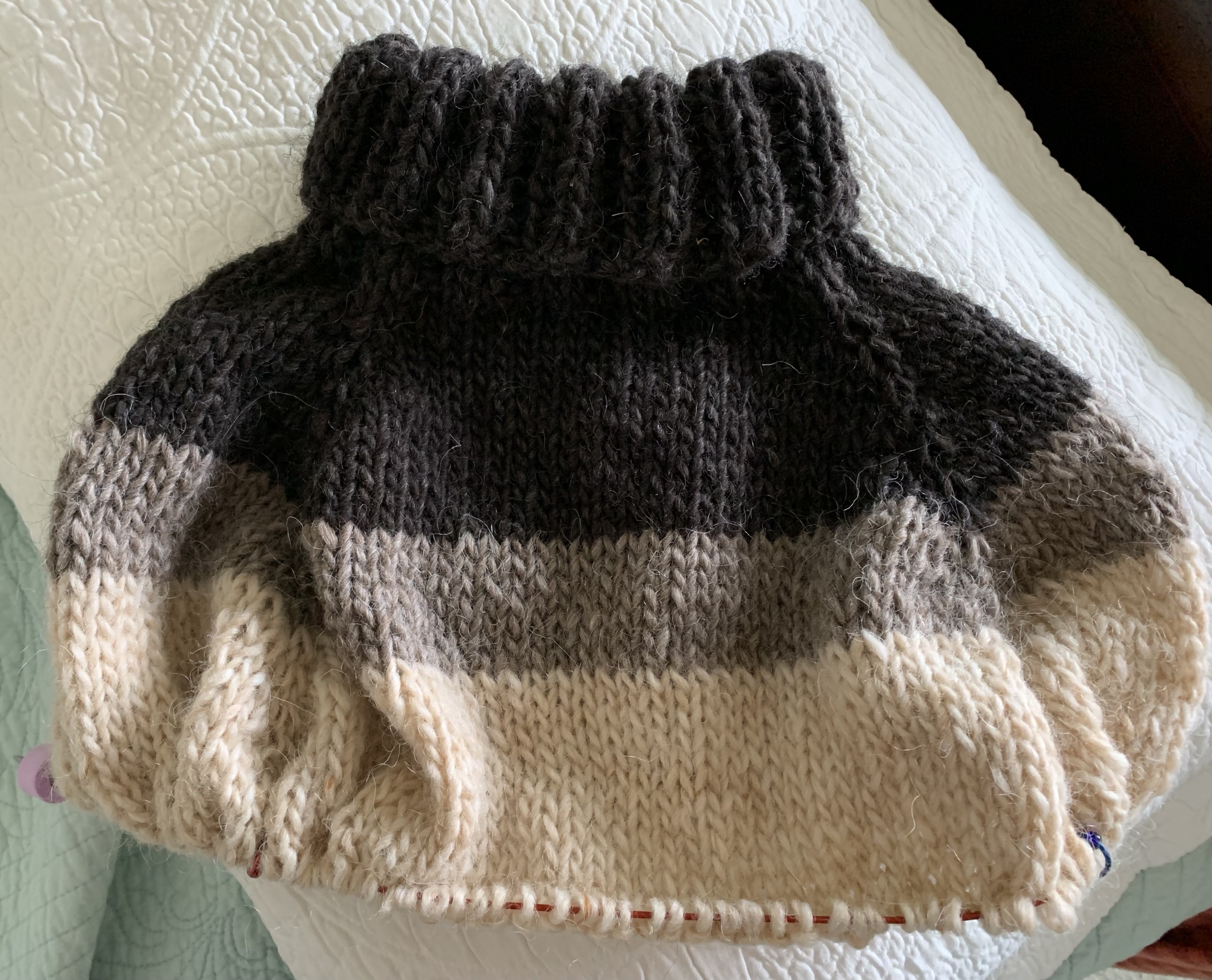
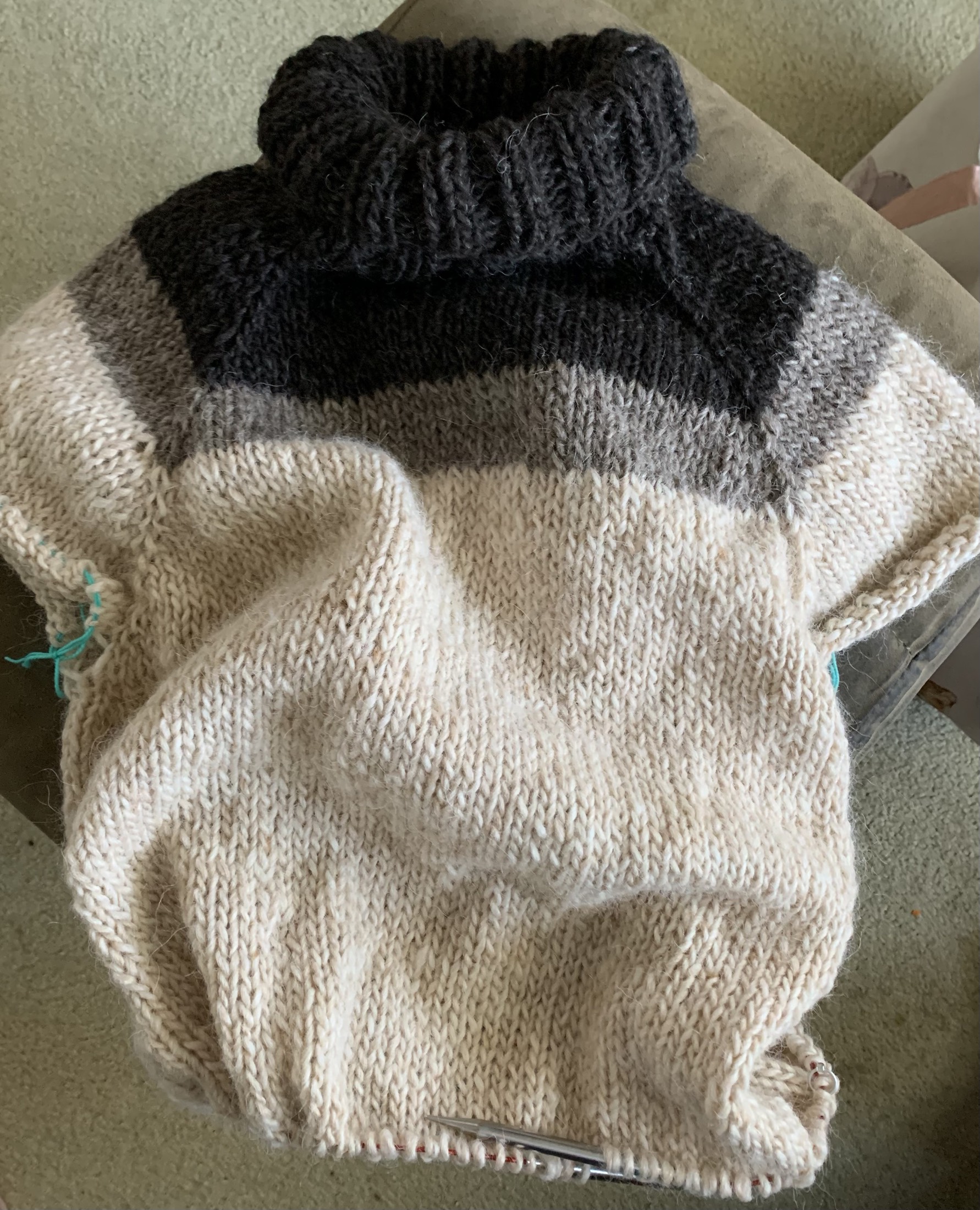
I’ve been trying to decide what type of ribbing I should knit at the bottom of the body. I’ve decided to go with a corrugated rib using the white with the light gray and black.

To this point, all my corrugated rib knitting has been done on hat brims. Cast-on, do ribbing and continue knitting. I’ve never added it to the bottom of a top-down sweater.

After searching for helpful advice, all I read was that when using corrugated rib I would NOT go down a needle size. This type of ribbing is not stretchy like a 1×1 or 2×2 knit and purl ribbing would be. So I am continuing with my same needle, size 11.

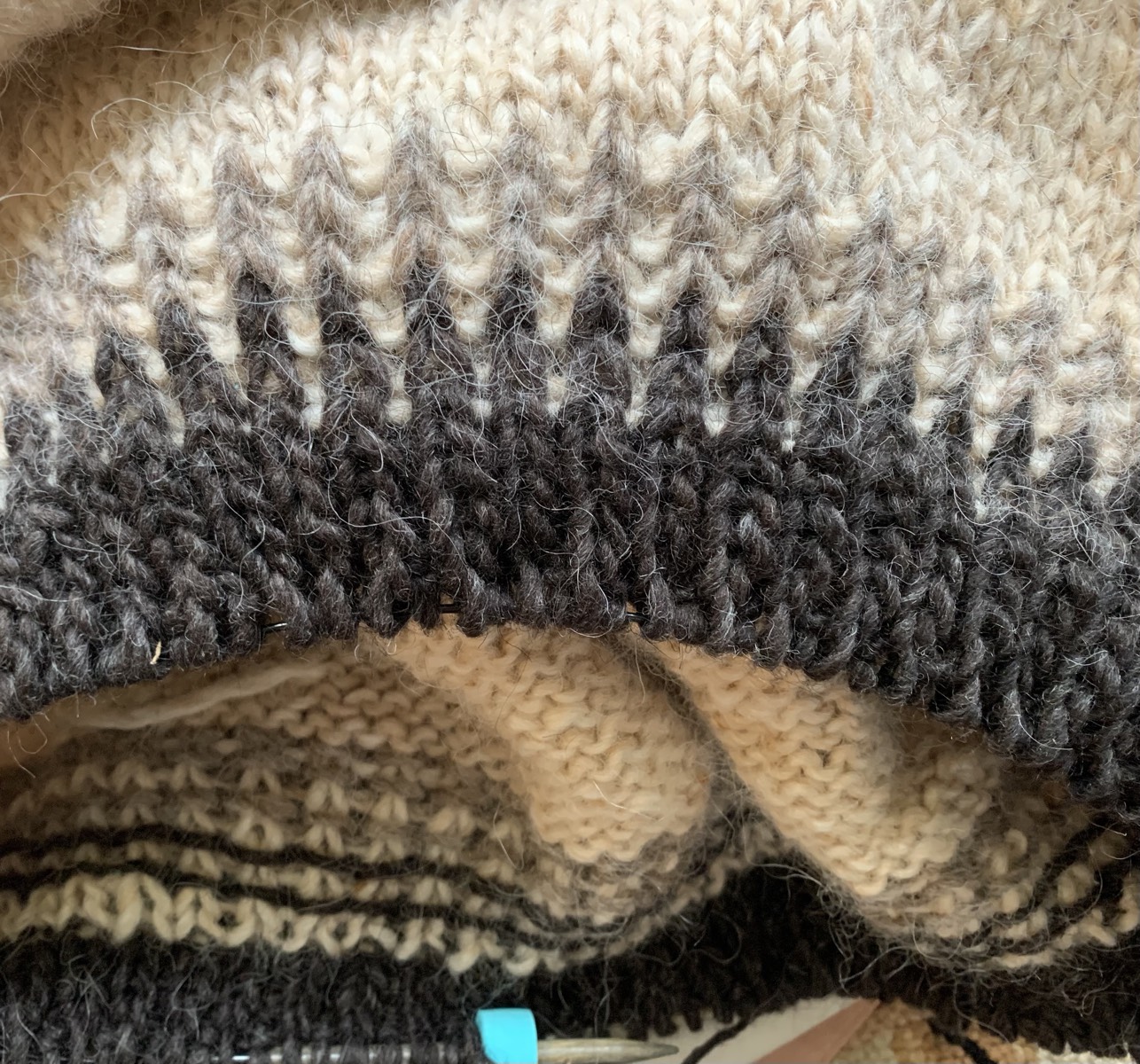
Tried on when the body was finished, and yes that bind-off curls up. *In the end I decided to re-do that bottom.

Once the sleeves were finished I went back and picked up the body rib stitches, then unraveled my corrugated rib. I had no idea how to pick up those stitches, and I ended up having to do it twice – the black stitches were on the needle, but the white were not. It all turned out okay, and then I began knitting the 1×1 ribbing in black. I used a size 10 needle for that ribbing – down one size from the 11 for the body. (I used a size 9 on the sleeve ribbing.)

Knitting The Sleeves

So I know that my gauge is off and that means my sleeves may end up being too narrow. I will do only a few of the decreases down the sleeve and then continue to the cuff without more decreases. *I ended up doing only 3 decreases and ended up with 42 stitches on the needles.

I’m considering some colorwork near the cuff. I also don’t know what type of cuff I will do. I like the colorwork on my other Lopi sweater sleeves, so maybe something like that.
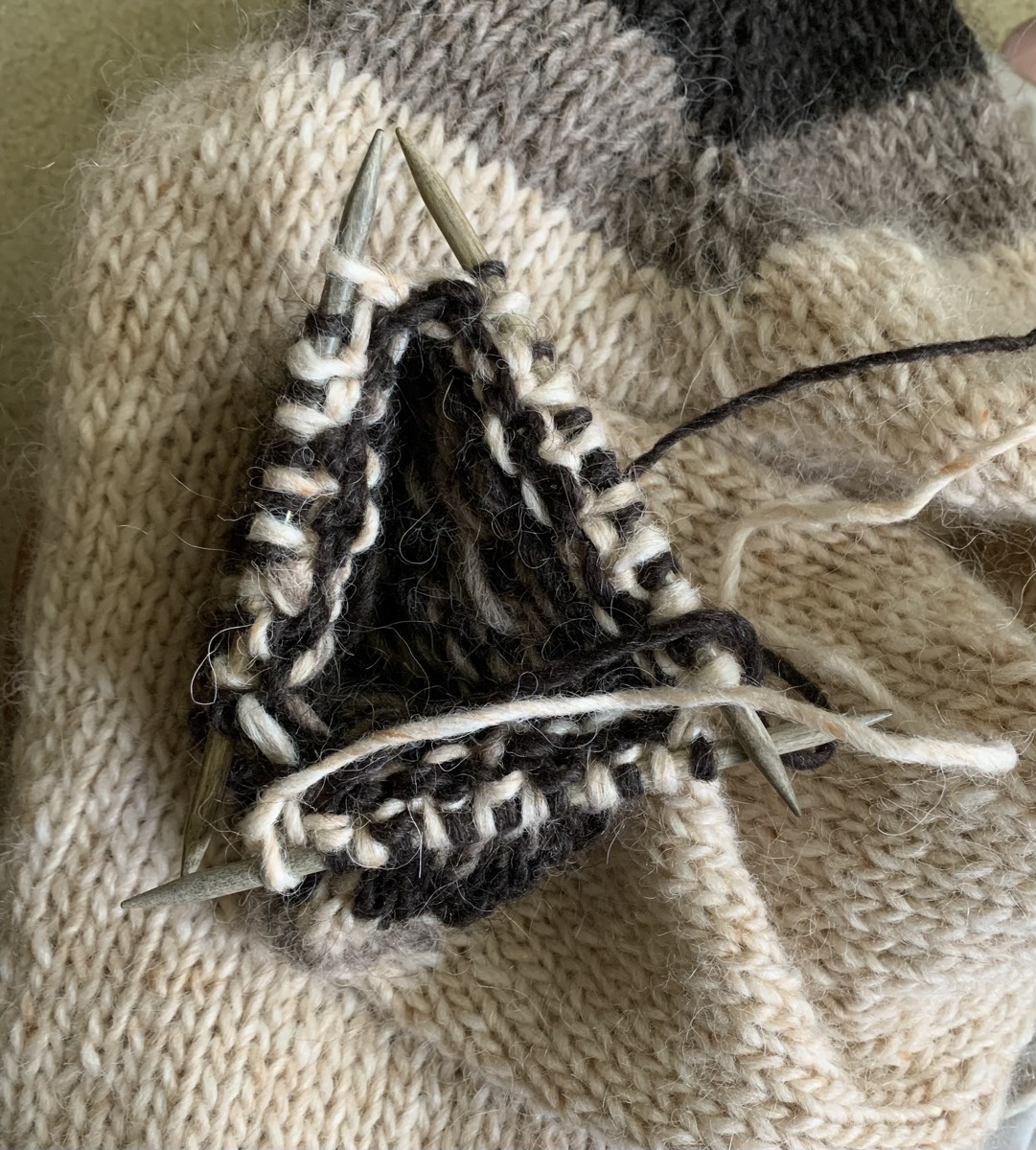
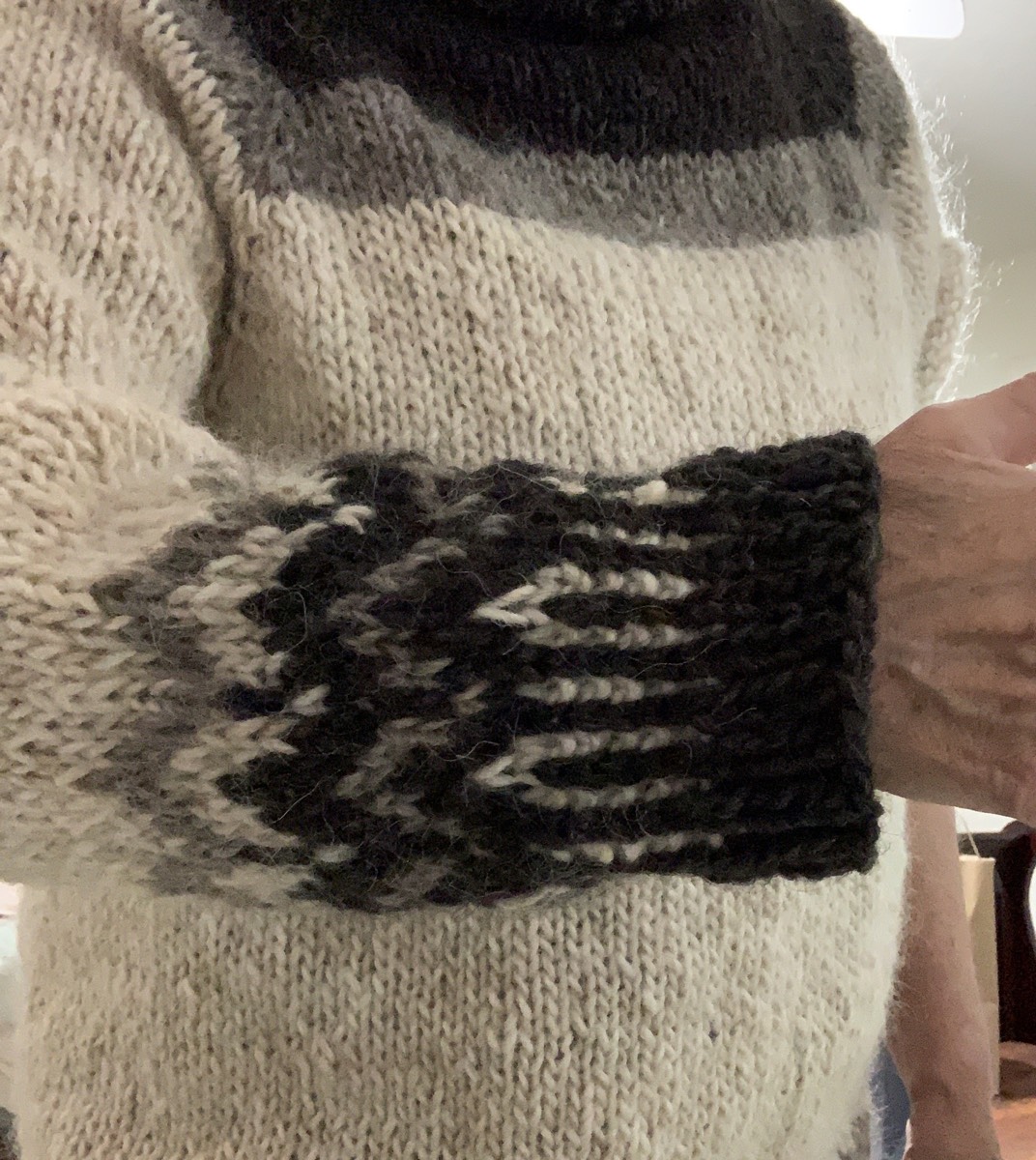
After the three decrease rounds (done as pattern directed), I knit round and round until the sleeve was 11 inched long before beginning the pattern incorporating the gray and black. For the colorwork, I chose to follow a chart on pg. 92 in Alice Starmore’s Charts for Color Knitting (Amazon link to the book) continuing to use the size 11 needles. I know colorwork will pull in a bit.

Next, I changed to size 9 dpns – right after the patterning part – and did a few rows of corrugated ribbing. To finish the sleeve, I did a few more rows, in black only, of 1×1 rib. This way the end of the sleeve won’t roll. I’m very happy with the sleeves!

Bulky turtleneck sweater is done.  Knit in three colors of Alafosslopi wool doing Fair Isle colorwork and corrugated ribbing in ecru, gray, and black yarn.
Finished knitting the sweater

In the end…

I’m happy with the end product and just need to give it a wash and block. I’ve decided to wait for cooler weather and have a photo shoot day for this, and all my other wool sweaters.

Now that I know a little more about sweater knitting than I did in the beginning of my knitting journey, this type of project expands on my list of accomplishments. The more I knit things that I’m happy with, the more I will have to draw from as I continue my knitting journey.

The collar may need to be tacked down, but otherwise this sweater is great. I’ve decided that the reason most of my hand-knit sweaters come out large is that I have a weird body. Most patterns have you choose a size according to bust measurements. My entire middle is large, but my shoulders and arms are not. Even though I get gauge, many of my sweaters come out too big. I’ll have to begin adjusting for that.

More Patterns and Reviews Here

How to Knit Corrugated Ribbing For Colorwork Hats

The last few hats I have knit have had brims with corrugated ribbing. You can see it on this page in the Katie’s Kep and Tettegouche (links to pattern below too). This type of rib is worked as a purl 2, knit 2 around, switching colors between the knits and purls. It is often used in Fair Isle, stranded knitting designs and the yarn is held in two hands.

Begin by Making a Nice Cast-on

When I began knitting, I hurried through my cast-ons so I could get started with the project. I only knew one simple cast-on, and it was not a good one for hats. Now I use the Old Norwegian, or German Twisted, cast-on, which is the same thing as far as I can tell. It makes a loose, stretchy first row so the hat won’t be tight around the forehead. It’s also a fast cast-on once you get the hang of it.

A good wool such as Rauma or Shetland (Jamieson & Smith), in fingering weight is suggested for this type of hat knitting.

Once the stitches are cast onto a 16 inch circular needle, in the size your pattern calls for, join them with the stitches straight and even, making sure there is no twist. I use the drop and switch method of joining, where each stitch at the end of the needles are swapped. Then, place a marker to remember this is the beginning of the round – BOR.

Since I first wrote this page I have found a helpful page at TECHknitting: Corrugated ribbing tricks and tips. They explain corrugated ribbing and it’s uses and potential curling problem. Also they have an interesting section about how to handle purling the colors.

Begin the Rib – this is how I chose to do it.

Once the cast on is complete DO NOT KNIT AROUND – go right into the knits and purls. Doing a solid knit row before the ribbing will cause the edge to curl up.

For the first round, begin with the main color (it was tan for my hat) held in the right hand (for knitting English style) and purl two stitches. Move the yarn to the back of the work. Now add the new color (orange in the hat pictured) and knit two stitches while the yarn is held in your left hand, Continental style. Bring the MC, (tan yarn) to the front and purl two – and so on. I will be using those two colors for the entire round.

Corrugated ribbing knit on the brim of a hat
The brim of this hat is knit in 2×2 corrugated rib

Don’t forget to move the yarn to the back of the work once the two purl stitches are made! ….I made this mistake and had to begin over.

For my Katie’s Kep #2 (above), my first CC (contrast color) is orange and I did three rows before I added the second contrast color, which is light blue. Every row is knit the same way with the MC (tan) held in my right hand and the CC in the left. I do it like this because I can’t purl using my left hand.

Holding the yarn correctly is important in colorwork knitting. Using two hands becomes quite easy with practice. Using two hands means the yarn will stay on top (right hand yarn, or Main Color) and on bottom (left, Contrast Color). Doing this makes the CC stand out. Sometimes a pattern will ask you to knit the main color and then purl the contrast color – which keeps the main color prominent.

See it below in the first Katie’s Kep I knit which has a dark blue background (MC).

Katie's Kep Fair Isle hat
Katie’s Kep Fair Isle hat begins with a corrugated rib around the brim.

Learn to Knit Using Two Hands

If you don’t know how to do this type of knitting using two hands, look for a good video that shows you how. And then practice! Colorwork is easiest when knit in the round. In fact, personally, I don’t know how to do it any other way.

Then, you will just need to know how to carry those floats when colors become more spaced apart in a row – but you won’t have to do (much of) that on these hats!

Colorwork is in chart form, FYI.

Love Katie’s Kep? Download the pattern for free here.

The hat below is called Tettegouche, and the pattern for this one can be purchased at Ravelry. Believe me, the other hats look a lot better than mine. I used colors on hand and they are not the greatest combination. You can see the use of the corrugated rib again.

Tettegouche hat pattern
Finished Tettegouche

My last word on the corrugated rib is that it is less stretchy than a 1×1 or 2×2 regular hat rib. It’s meant to be sturdy and pretty at the same time. Often a smaller needle is used for this type of brim and then you switch over to a larger size for the top of the hat. A wool yarn in fingering weight is suggested.

Knitting Katie’s Kep Number Two in Earthy Colors

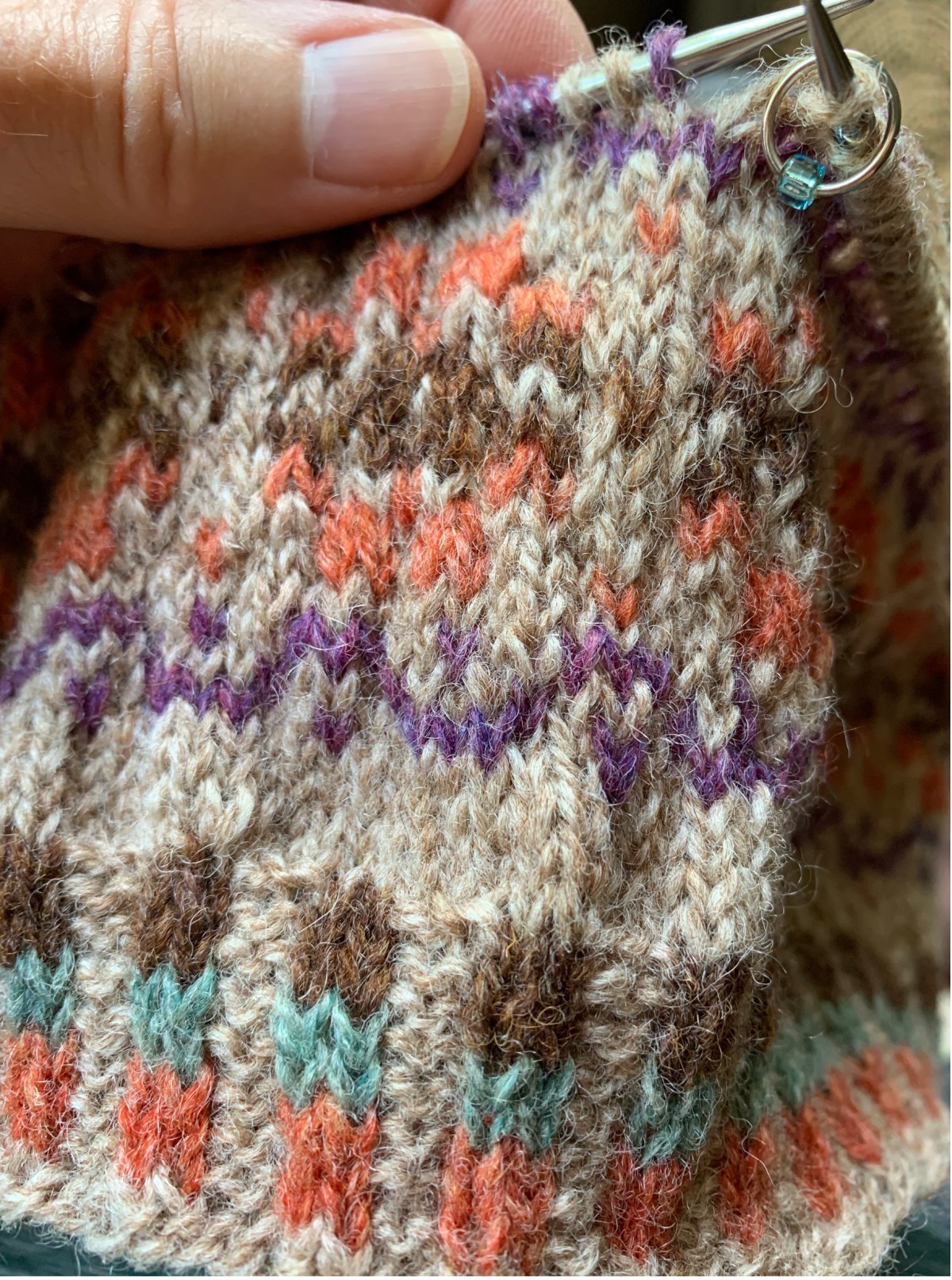
Because my first Katie’s Kep (hat) came out a bit large, I decided to cast on four fewer stitches for my second knit. (Find the link to the Kep pattern at the bottom of this page.) I still used a size 3 circular needle and did the Old Norwegian cast on – or something like it! I’m not sure I did it exactly right, but it looks okay.

Corrugated ribbing knit on the brim of a hat
The brim of this hat is knit in 2×2 corrugated rib

Once the corrugated ribbing was done, I increased around by four to get back to the original pattern count. Here’s how:

*Knit 33, make 1* – 4x’s around = 4 additional stitches. Total stitches are 136 now (as pattern calls for). Continue with pattern increase row.

Now I was back to the correct number of stitches needed for the colorwork. I would love to make this hat using a 2 or 2.5 US needle size, which would work out better I think, but I don’t have those sizes in a circular needle. I might have to buy them.

My main yarn used for the tan Kep is Rauma Finullgarn color 406, Wheat Heather. Other yarn used is Jamieson & Smith in colors: 4: brown, FC7: Peach / orange, FC62: green, and 133: medium purple. The colors are more subdued than what I used for my first Kep.

The fun of knitting this colorwork hat is choosing the colors. It’s probably the reason people can’t stop at knitting only one! As you can see in my photo above, very little yarn is used to make one hat. But if you choose to use J&S yarn as the main color, you will need 2 skeins.

Where to Buy Jamieson & Smith Yarn

This was the first time I knit with J & S yarn. I found it for sale, at a very good price, at Fairlight Fibers. I saved over $1.50 PER SKEIN compared to the current price of the exact same yarn at another online shop. And shipping is FREE when you spend over $50.

At this time, many yarn sellers are low on yarn, thanks to the Covid pandemic keeping people from making the yarn.

Other yarns the designer mentions in her materials section of the pattern are: Uradale (UK based), Shetland Handspun, and Jamieson’s of Shetland.

Wool

Some people don’t like wool because they think it is scratchy, although I don’t mind it. When wool is used for a hat, it doesn’t really matter (unless you are bald). I find the Rauma and J&S to be similar in feel, and once it’s washed, it feels softer. I use Eucalan no rinse wash, and it conditions the wool.

Anything made of wool dries quickly and will of course keep the wearer warm.

Katie’s Kep is a Free Download at Ravelry, by designer Wilma Malcolmson

Katie's keep crown star
Crown star