Considering a Cable Knitting Project

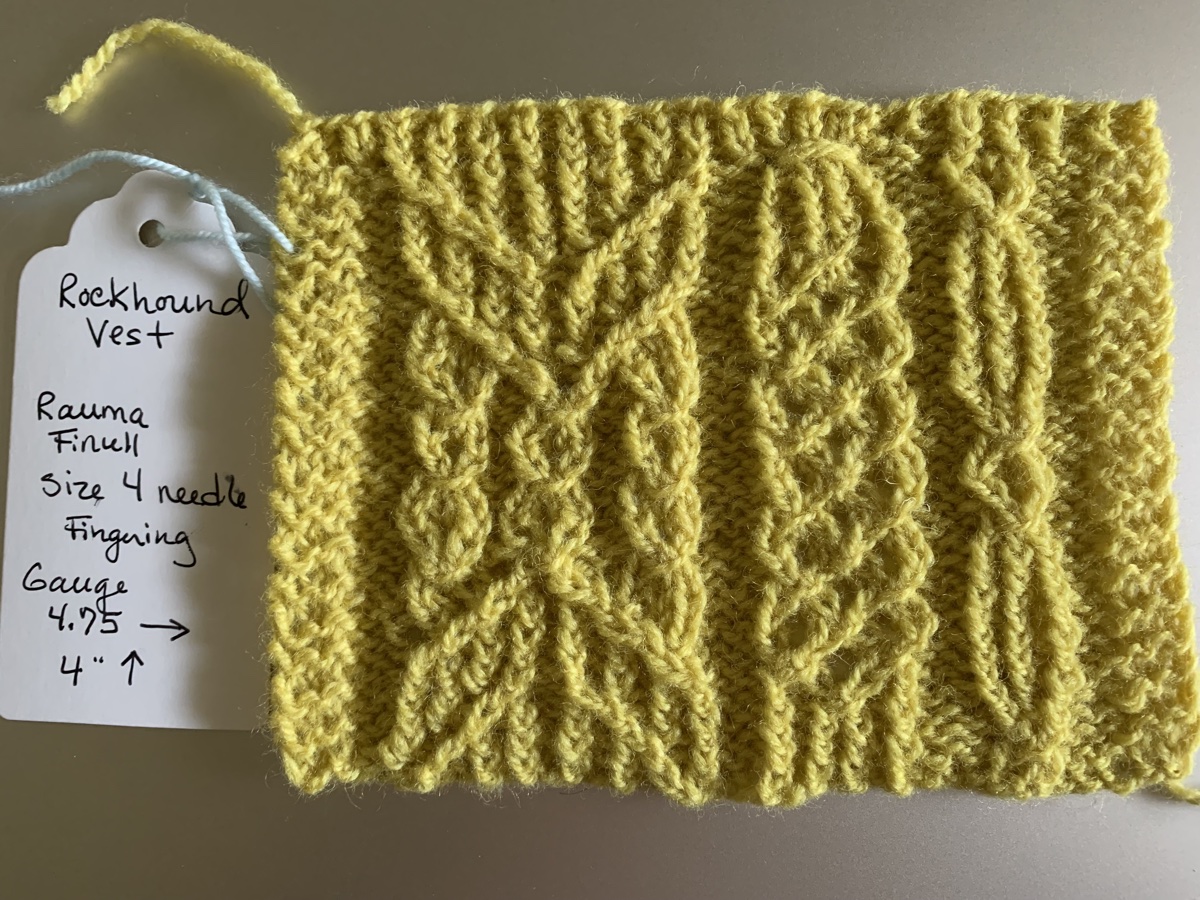
Knitting a cable vest swatch for size reference and cable chart practice. The Rockhound Vest is a beautiful cabled knitting project.

Cable knitting is not something I have much experience with. I tend to buy cable patterns and then file them away thinking “maybe one day”.

The biggest cable projects I have done were hats (Skiff and Habitat). Now I am looking at knitting a vest with cables on the front and back.

The Rockhound Vest is a pattern by Wool and Pine designs. The company was offering a discount on their patterns and I thought I would see what they had to offer.

You would think that a vest would be a simple and quick knit. This one has a section of cables that comes down from the shoulders and goes down the front. Cabling takes time, but it can be so pretty.

The V-neck and armholes have to be picked up and knit after, and I’m not looking forward to that. Also, the charts look a bit intimidating.

Knitting a Cable Swatch

The Rockhound Vest pattern (link at the bottom of this page) comes with a Swatch Chart, which is a section of cable that needs to be knit, washed, blocked and measured as a swatch – both flat and in the round.

I decided to knit the swatch using Rauma Finull yarn because I had a skein, and I already know I love this fingering wool.

Helpful

First thing I do when knitting cables is color code them! I also write a short description of each cable next to each cable diagram. I have no idea how to read a cable stitch, so the color helps me find the description quicker.
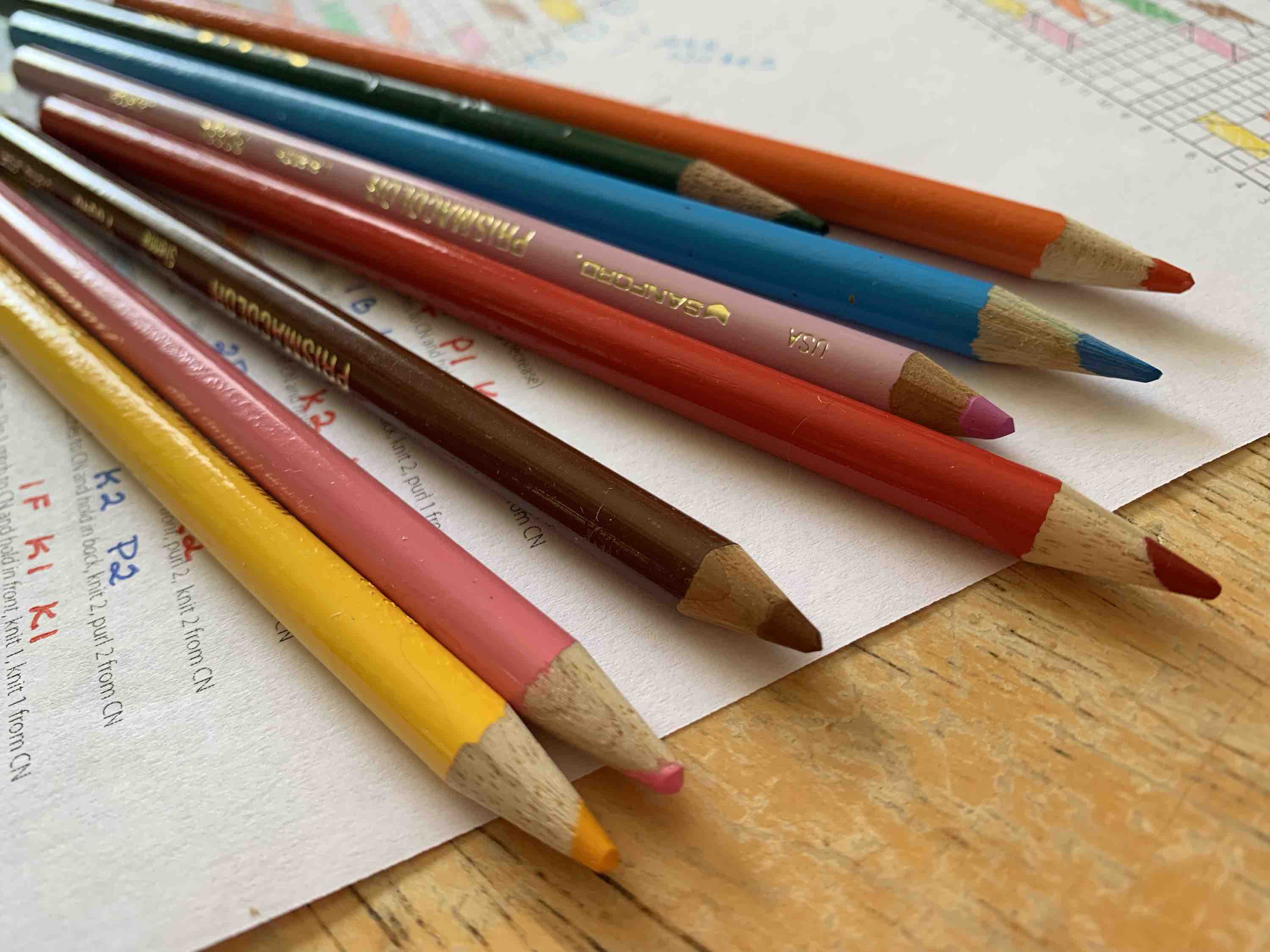
colored pencils

Use stitch markers!!! This helped me a great deal, even though I had to keep moving some of them because the cable section would move. I made small sections on the row to prevent a lot of ripping back.
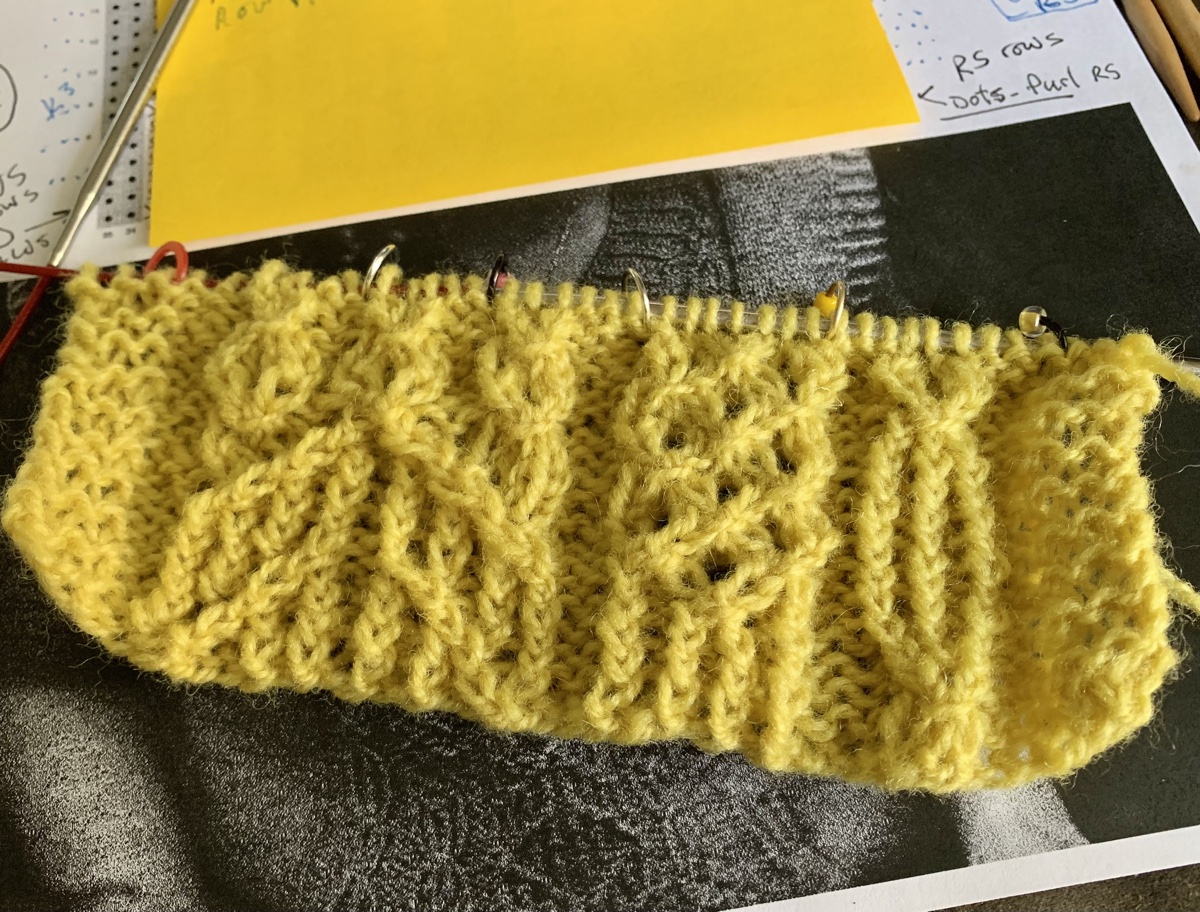
cable knitting with stitch markers
Use stitch markers to knit a flat cable swatch

Get a better cable needle!!! I was trying to knit using my old, metal cable needle and had my usual problems. The thing would slip out and leave my stitches hanging, or I had to clumsily hold it to be sure that didn’t happen.

Then, I searched for new types of cable needles. I just couldn’t understand why cable needles couldn’t work better! Low and behold… I discovered the Brittany short wooden cable needles (Amazon paid link). Amazing!
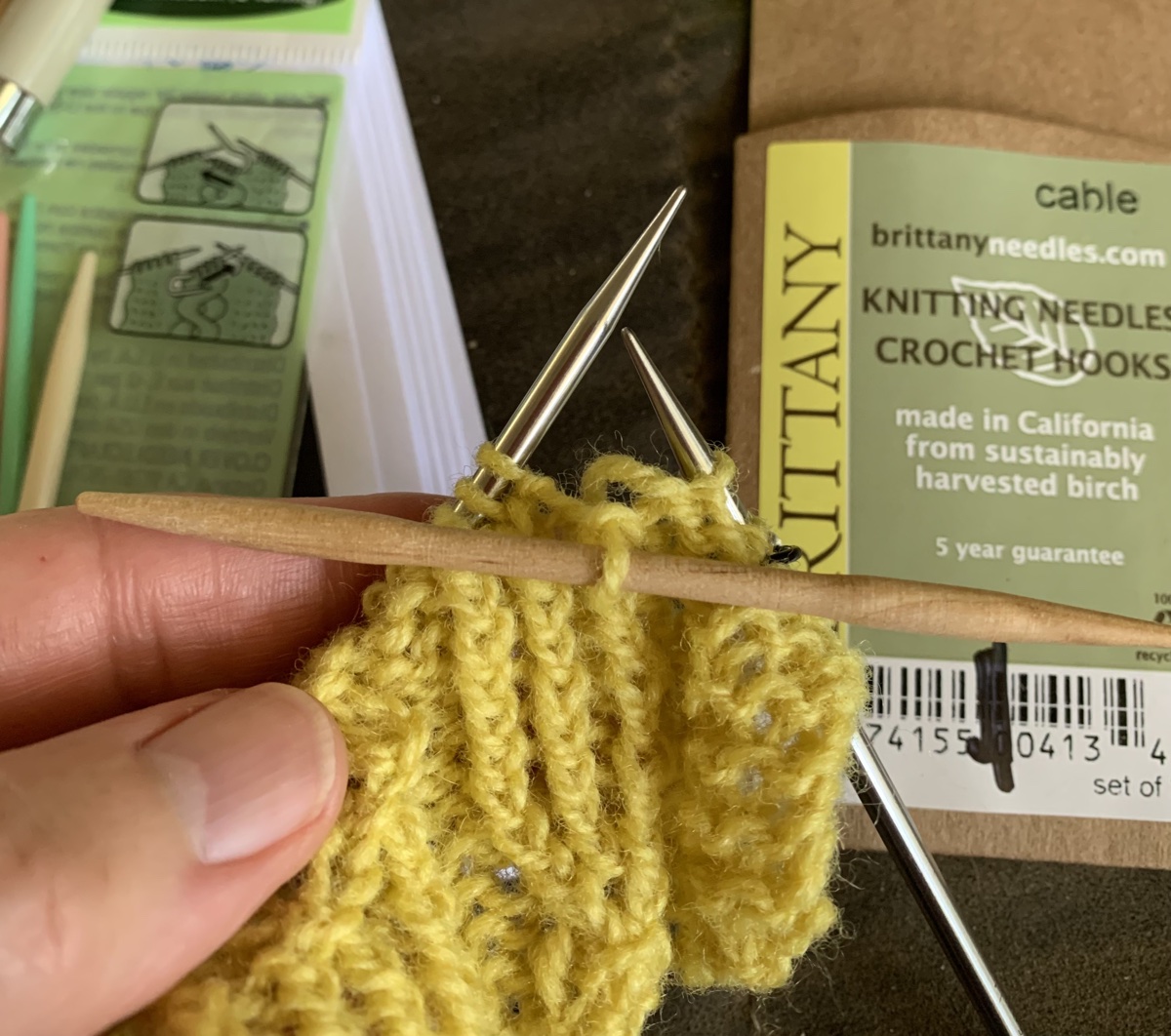
short wood cable needle
New Brittany wood cable needle – LOVE!

This set of cable needles comes in three sizes, and I used the middle size for this project, which is fingering yarn (picture above). The short, wooden needle is thinner in the center so the stitches stay put. The shortness also helps when knitting off the cable needle. This has made cabling a lot easier for me. I highly recommend them.

Swatch and Sizing

After looking over reviews, at Ravelry, written by previous knitters of this vest pattern, I see that many finished projects have turned out to be too tight. Even when a seemingly larger size was chosen, the vest seems to end up with a smaller circumference than planned. Maybe knitters did not do a swatch in the round???

I have added six extra stitches (3 on each side) to my swatch. Those stitches are not part of my gauge.
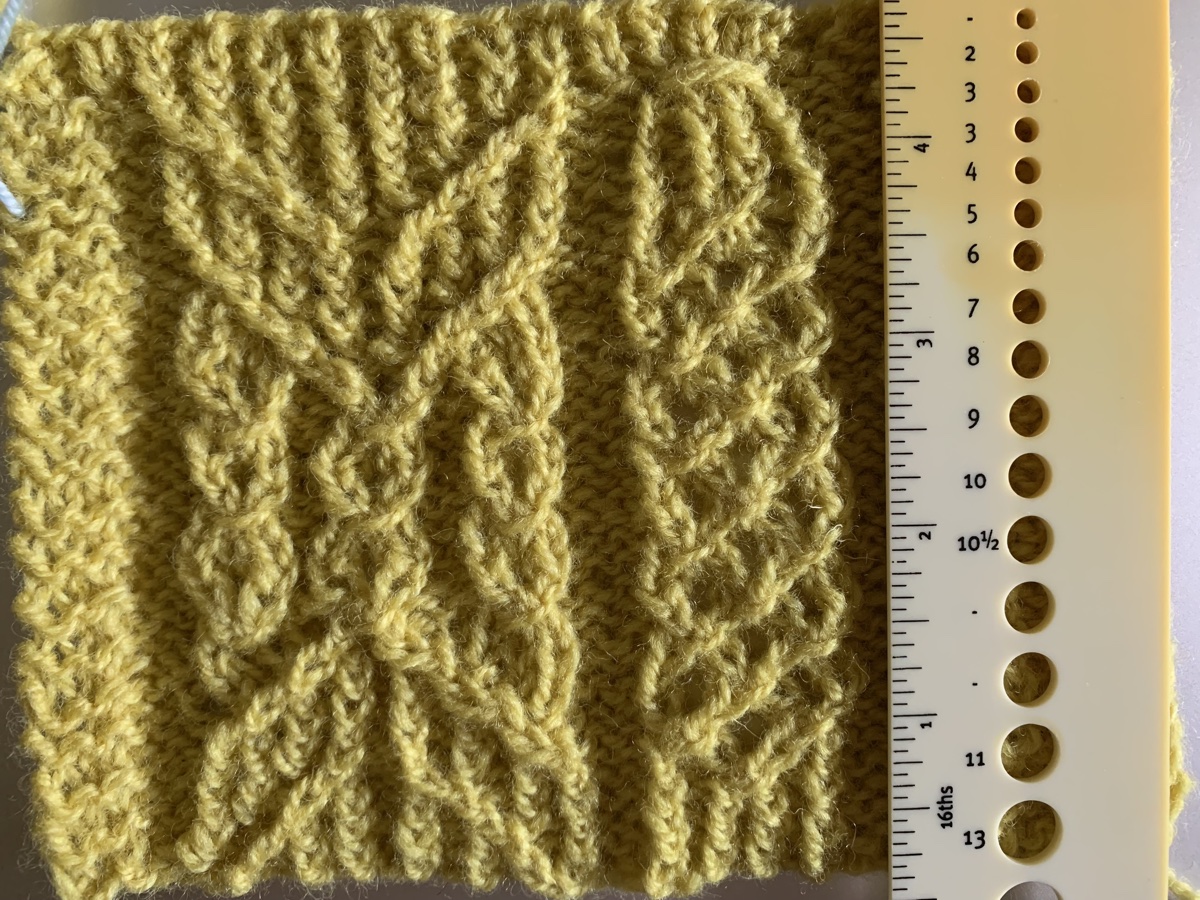
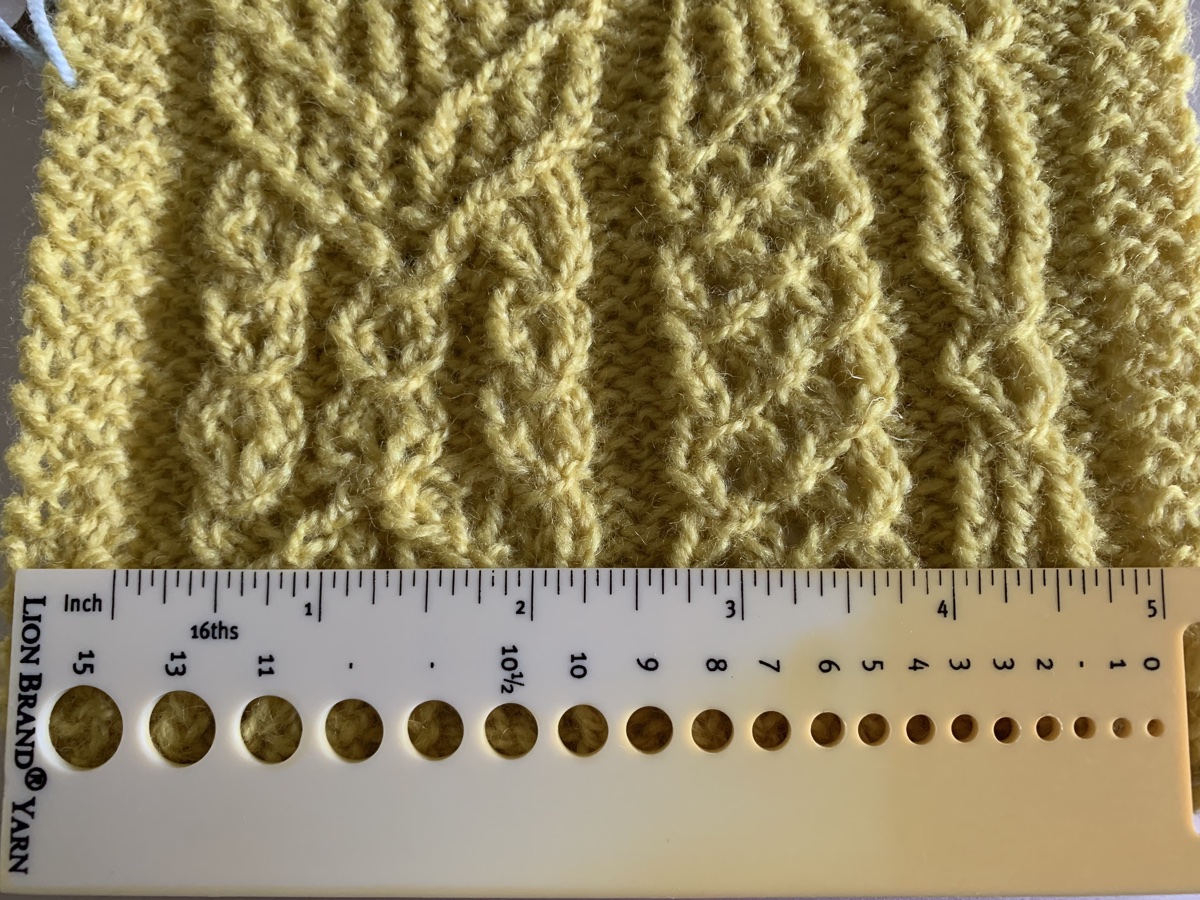
Knitting a swatch is very important and swatches should be knit flat and in the round, because that is how they are knit in the pattern. I’ve only done the flat swatch. The finished swatch size will be larger than normal 4×4 inches- according to the pattern. My swatch was nearly exact, but a tiny bit larger. Going down a needle size would most likely make this too small, and having things a little larger might be good with this pattern.

If I decide to knit this pattern, I need to buy the same kind of yarn, in a different color. I may knit a swatch in the round with my new yarn and see how that turns out. It is possible that the gauge is tighter in the round. That would explain why knitters were getting tighter vests. Maybe they never checked gauge in the round.
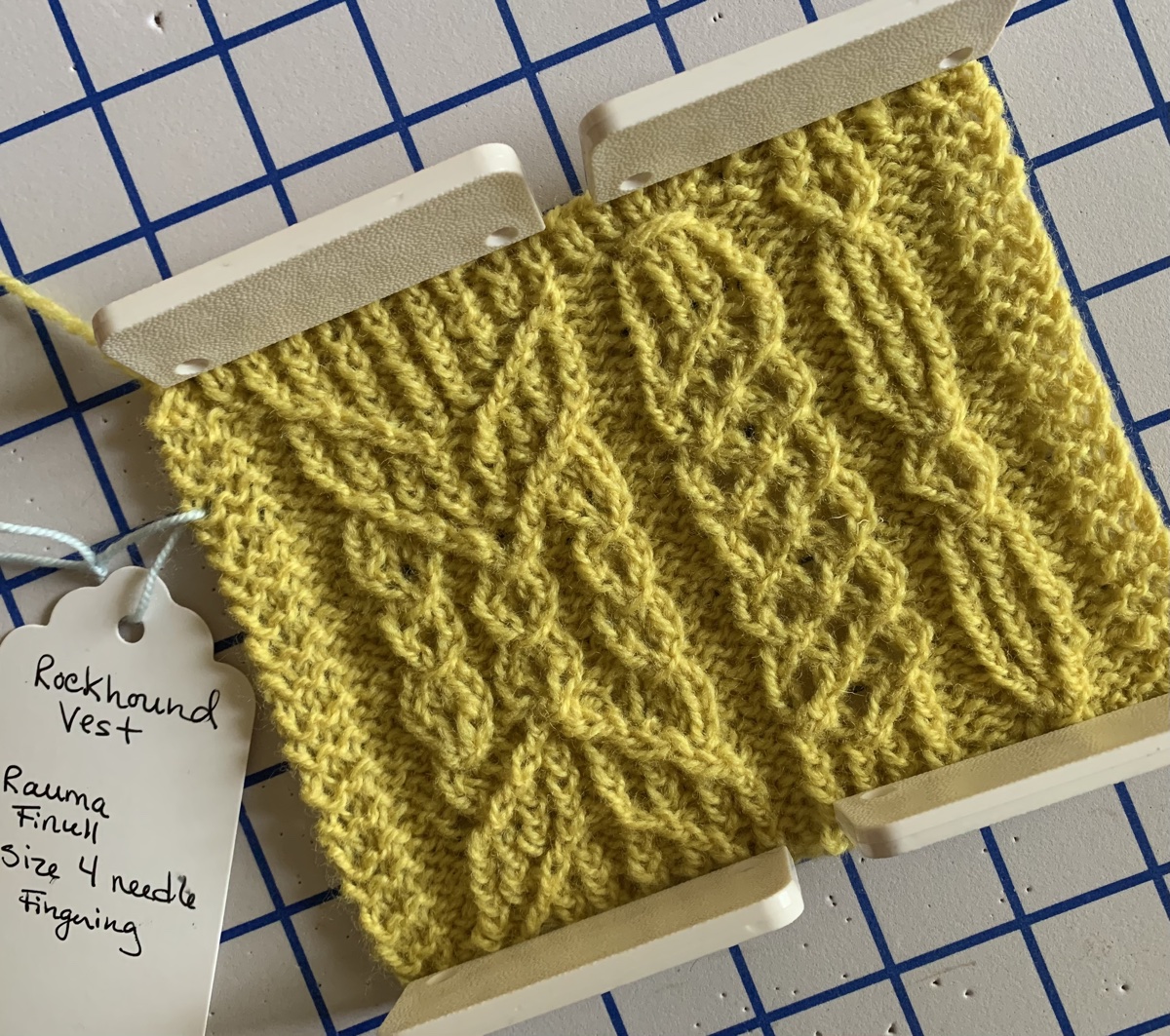
I definitely made some mistakes in this cable swatch, but it wasn’t that bad to knit. This swatch shows only part of the cable pattern which goes down the middle of the front and back. If nothing else, it was good practice at knitting from a cable chart.

More Knitting From Me

Knitting “Habitat” Hat With Cables in Hunter Orange

Last year I searched for a hunter orange yarn so I could knit hats for my kids who live in New Hampshire. Whenever hunting season is open – and it is regularly open year round for various animals in NH – walkers, hikers, bikers and anyone who ventures into the wilderness needs to wear hunter orange, aka safety orange, or an equally bright color.

Last year I was unsuccessful in finding the perfect, brightly colored yarn. This year I believe I have found it!

I came across the colorway “Kid You Not” by Hedgehog Fibres, in aran worsted weight and took a chance and bought two skeins from Eat, Sleep, Knit. Later, I found it at Wool and Company and was a bit less expensive. Hedgehog Fibres yarn is hand-dyed and comes from Ireland. It is beautiful, but pricey. What I also love is that it is superwash. Some people I knit for will not hand wash.

Knitting the Cabled Hat “Habitat”

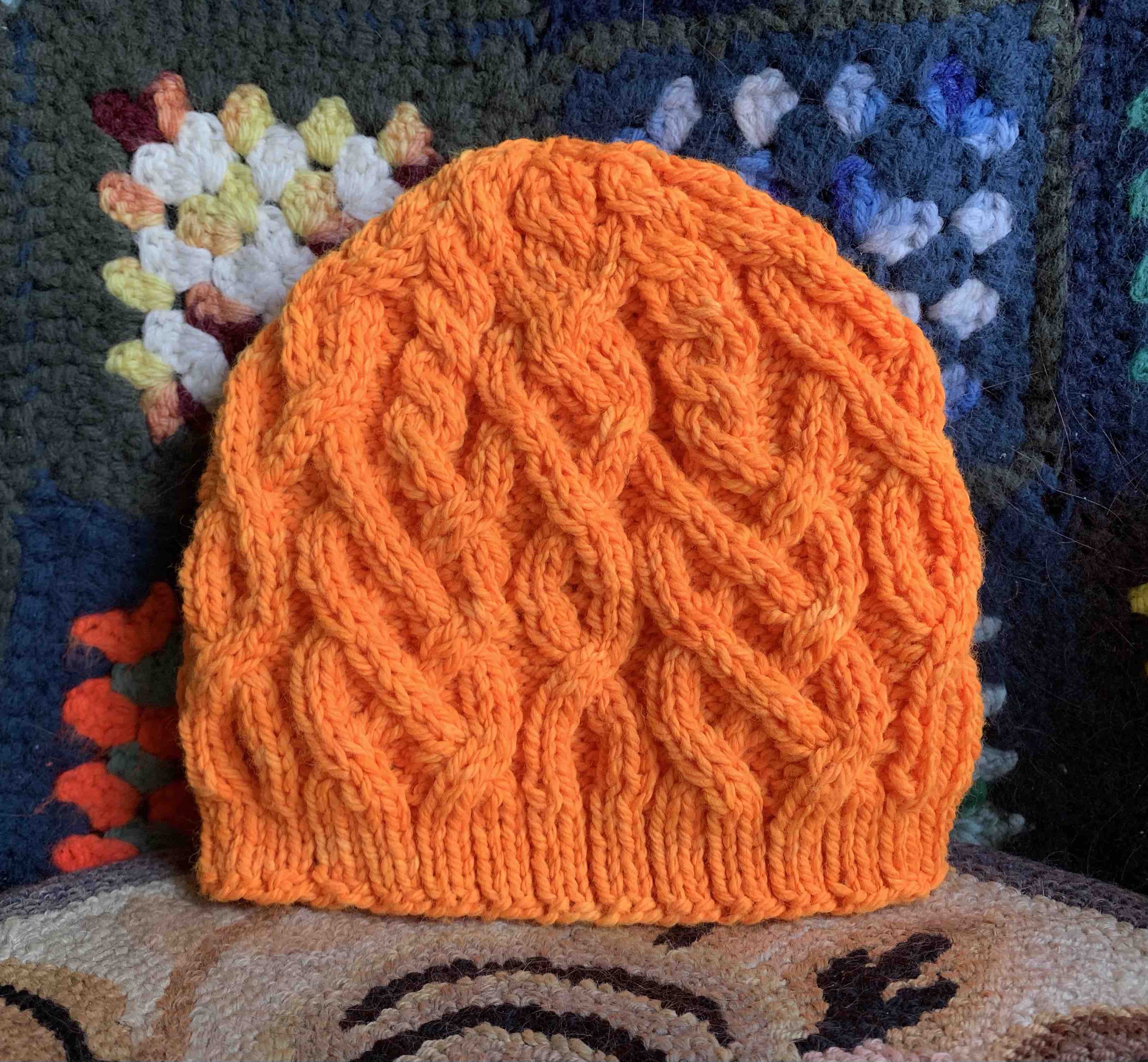
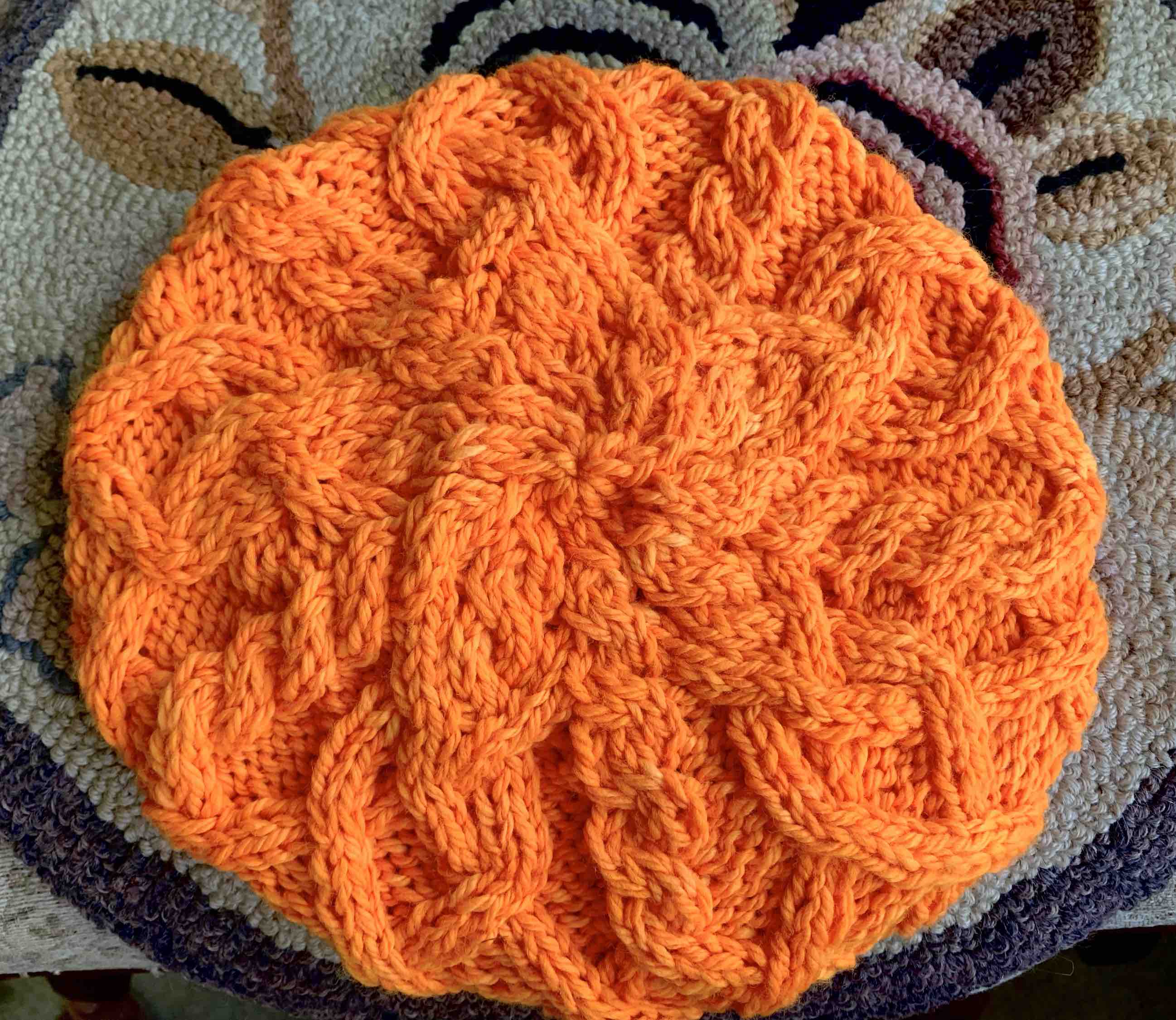
Because the yarn is a semi-solid color I wanted to knit some cables. I searched through many cable hat patterns and ended up with the “Habitat” by Jared Flood. I’ve knit his “Skiff” cabled hat a few times, so I suspected this pattern would be similar, and it is.

I love the way the cables criss-cross up the hat, but that means lots of various cables to do all throughout the project. I do okay until I have to switch and use the DPNs, but the end product is always worth the work.

Shorten the Cable Descriptions

This pattern is charted only, which can be a bit intimidating, but not too tough to figure out. Every cable used is listed on the right-hand side of the chart, with a description of how to make that cable. The chart and cable description prints out on the same page.

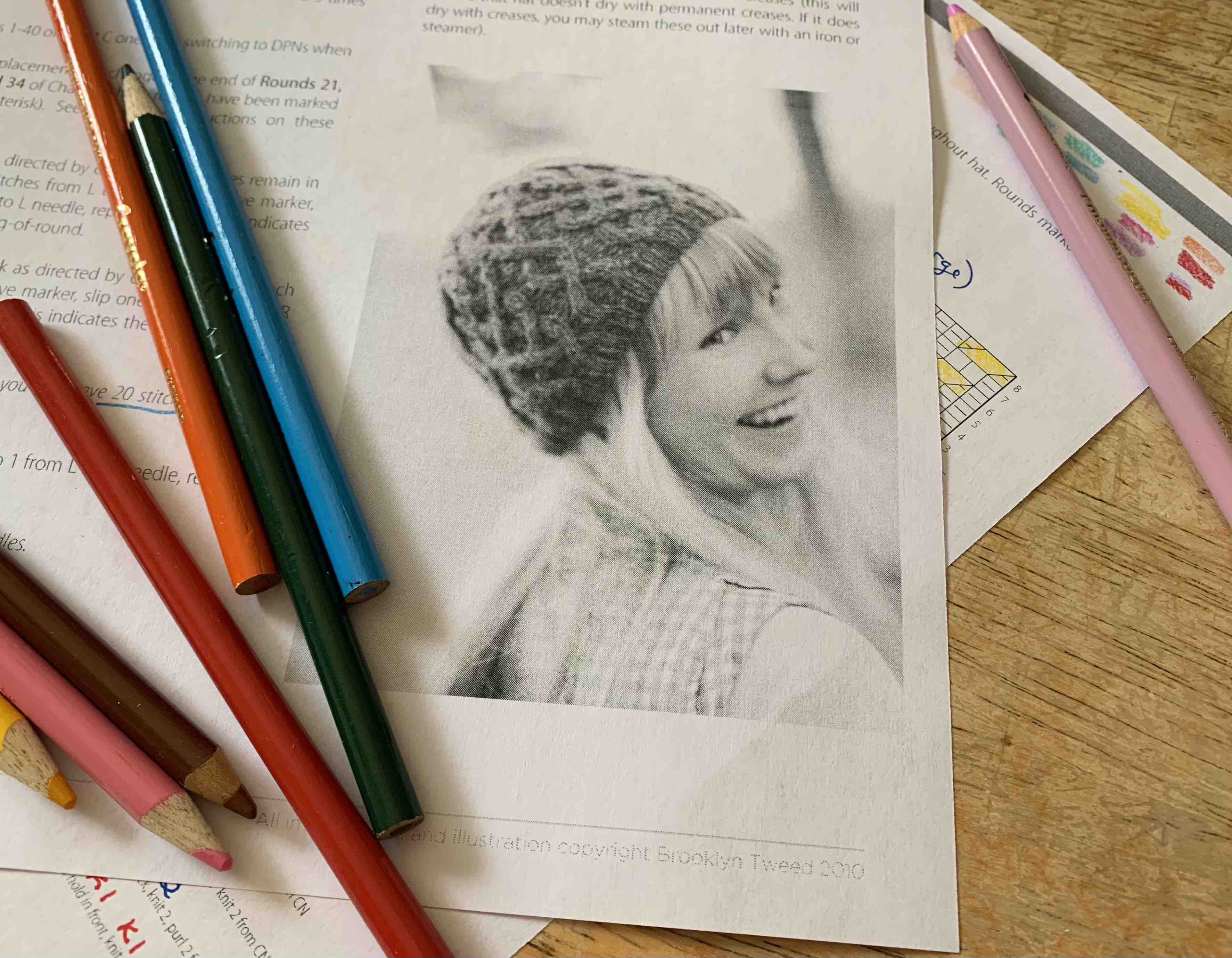
The printing is tiny – too tiny for those of us with older eyes to see well – so I use a pen and make each cable easier to read at a glance. This can be seen beneath the pencils in my photo below.

For instance: C3Lp = Slip 2 stitches to CN (cable needle) and hold in front. Purl 1, and knit 2 from the CN. That description is written out, but I make my note to simply say: 2F, P1, K2. When I get to this cable stitch in the pattern, a quick glance tells me what to do.

colored pencils
Creating my easy-to-read chart using color coding

Coloring the Cable Chart

The next order of business before knitting this cable design, is to get out the colored pencils. I’m sure some tech-savvy people can do this using some sort of spreadsheet, but I color the chart by hand. (I do use Knit Companion and I think this can be done with “Magic Markers” in the program, but I haven’t tried it. I do like having a paper printout too, just in case technology is down.)

Next, I go through each cable listed and find it on the chart. Each of the seven various cables used in this knit will get it’s own color coding. Doing this is time consuming, but totally worth the effort. The C3Lp cable which I mentioned, is colored pink for my chart, so every time I come to a pink colored cable in the pattern, I know at a glance to do 2F, P1, K2 ……. 2F (hold 2 front on CN), P1 (purl 1 from the normal needle), K2 (knit 2 from the cable needle).

When I am knitting each row from the chart, I use a sticky note to mark my place. I find this way of knitting the cables to be quite easy to follow.

Needle Sizes I Used

This hat is being knit for my daughter who has a small head. The hat is offered in two sizes, but that only means the length will change, not the diameter. Because of this, I dropped down a needle size and used a size 6US to cast on and knit the short brim. In general, I am a tight knitter, so I hope that will help with size reduction. I switched to size 8US for the cables.

The difference between the Small / Medium and Large sizes is a cable section which is done right after the brim. Choose the shorter, Chart A for S/M or the longer Chart B for size L. Whichever chart is chosen, it will be knit only once. This is a set up section before moving on to the longer, main hat chart.

Habitat Hat Knitting Photos

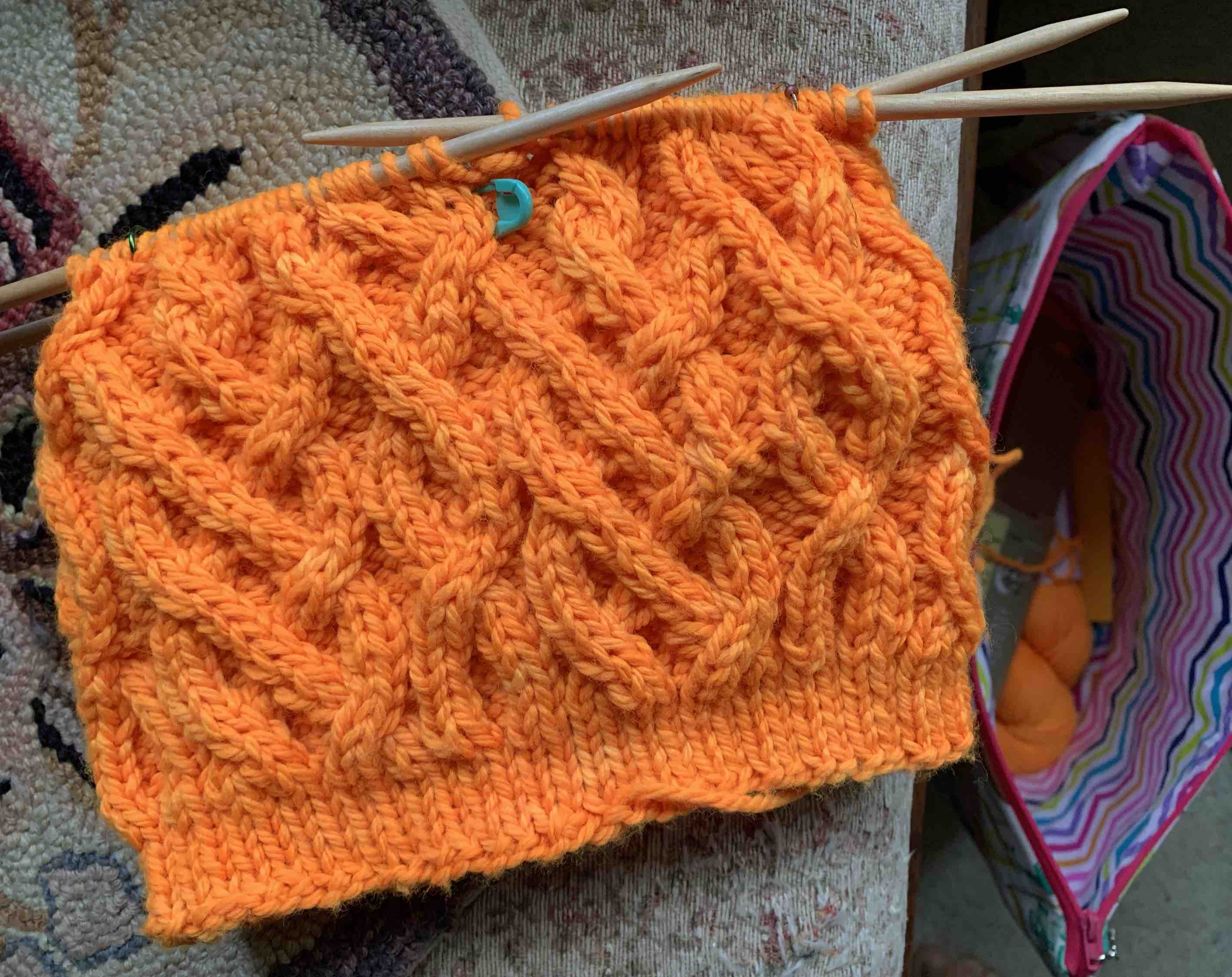
After a few inches of knitting, the cables begin to show. There are a lot of cables to do in this pattern. The yarn is beginning to remind me of Cheetos!

Switched to DPN’s on row 25 which is not a cable row, to make things easier.

Cabling on the DPN’s and keeping track of the cable sections got a bit difficult, but I hate DPN’s in general.

The Gift

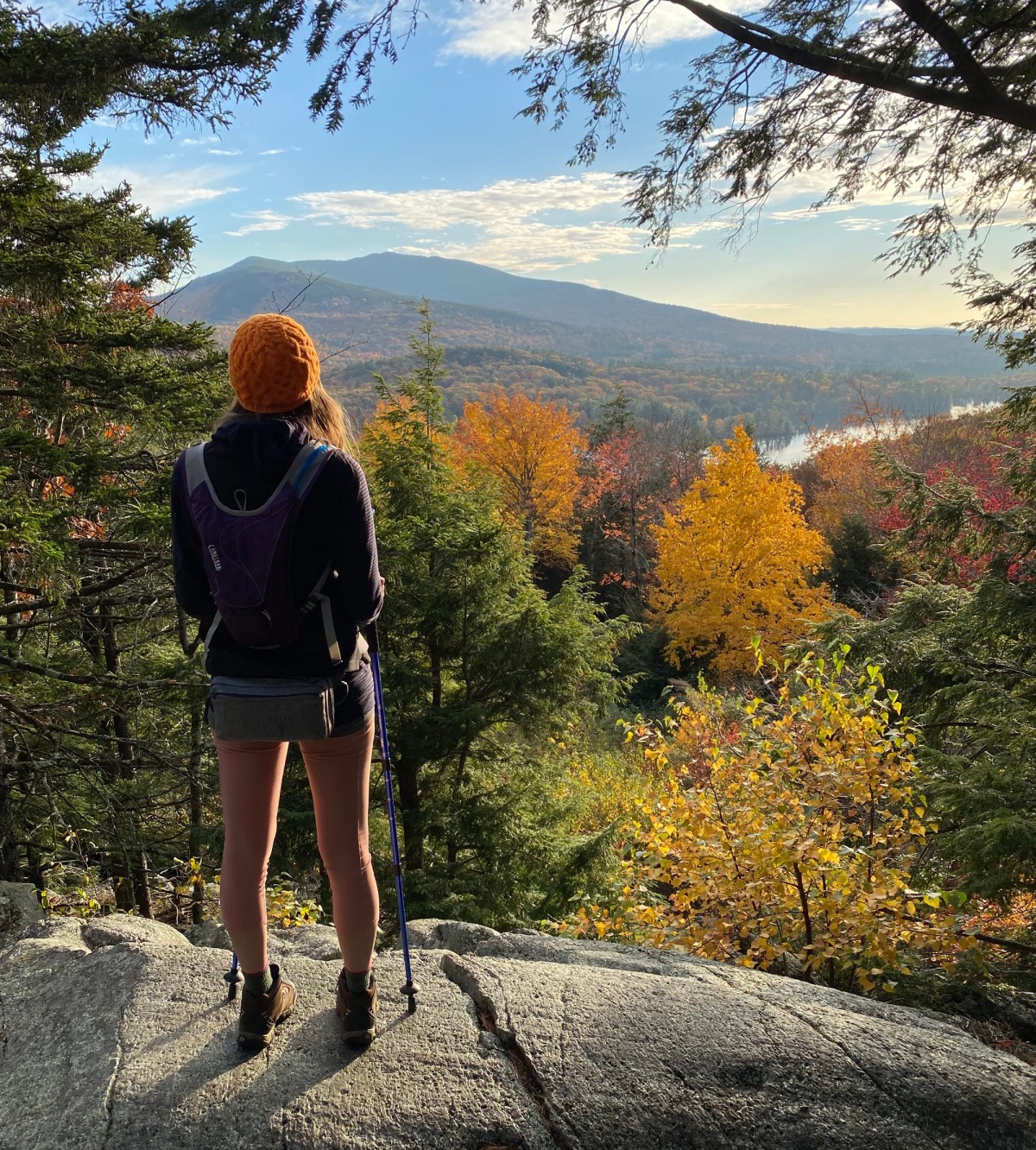
Hiking mountains wearing Habitat hat
Gifted this hat to my daughter who wore it on a New Hampshire hike in Fall!

My Last Remarks About Knitting “Habitat”

Loved the pattern and the yarn. Although this hat comes in “two sizes” there is not much difference between them. I may go up a needle size if I want to make a larger hat, but cables are stretchy.

I know from my experience knitting Jared Flood’s “Skiff” hat that I can do cables. This hat was similar, but was a quicker knit because there is no long brim.

Brooklyn Tweed patterns are full of information but sometimes it’s spread out on various pages. It is imperative that time is taken to read through the entire pattern carefully before beginning any project. I take a highlighter and mark all the important information as I read.

I used the sm/med size which makes the hat shorter only, and not by much. I knit it for my daughter, but for myself, I would knit the large size to make it a bit taller – only 4 more rows, so not a huge difference. I may do a rolled brim next time.

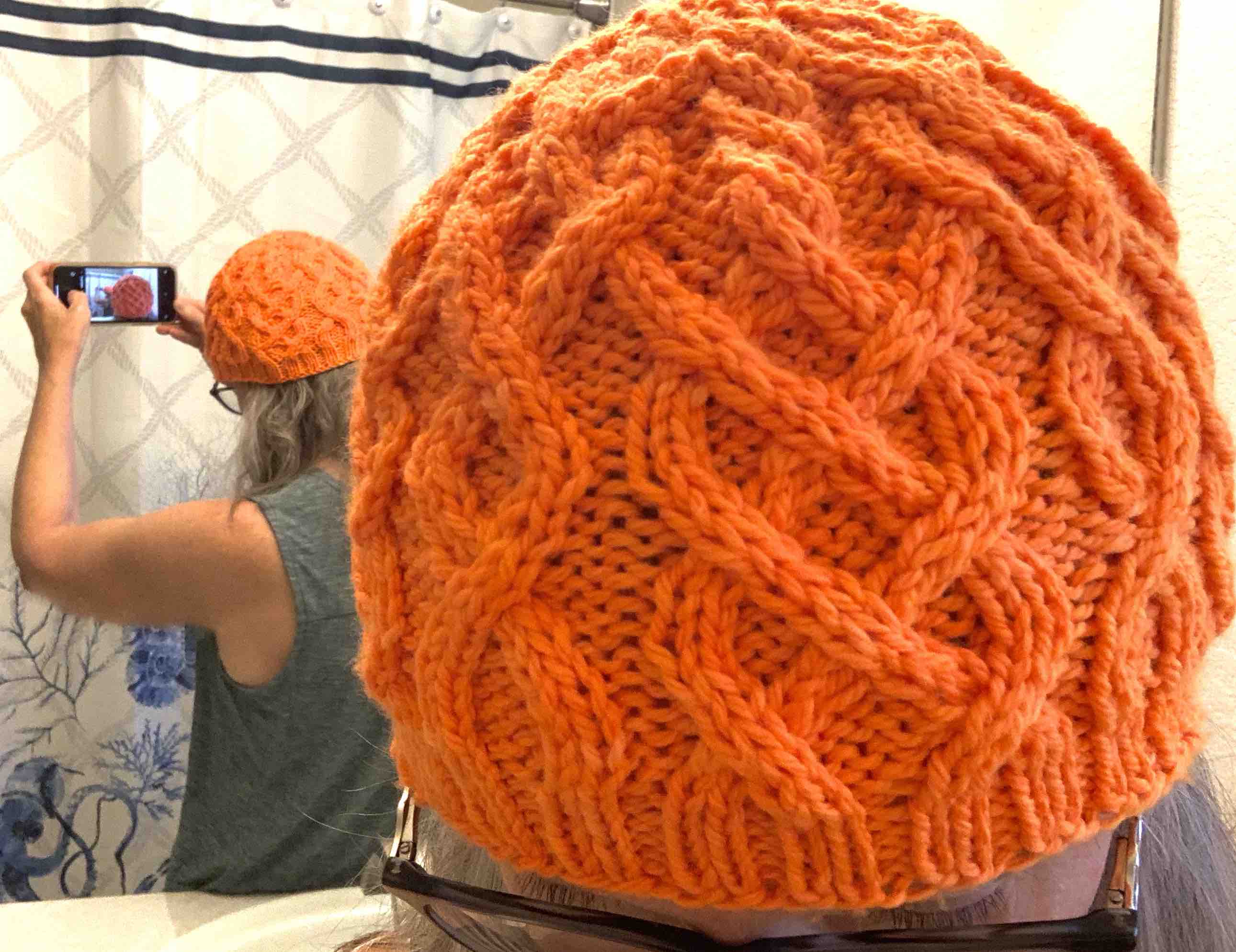
getting the shot newly knit cabled beanie
Getting the shot!

It’s fun to experiment with photography and as soon as I finish weaving in the ends (and sometimes before that!) I grab the iPhone and begin to get the shots that will be added to this blog and my Ravelry project page.

A New Skiff Beanie Gift Knit in Gray

My son’s blue Skiff beanie, pattern by Jarod Flood, has gotten a lot of attention this winter. Yes, we can wear hats in Florida in winter. My son was born and raised here so he is always cold when the temps drop below 60!

Some friend’s of his have seen his blue Skiff, which I knit a while ago, and have mentioned that they really liked it. When he accidentally wore it into work at the fire department, a friend said he would like a hand-knit hat. I said I would make him one.

Skiff hand knit beanie with cables
Skiff beanie in gray

Did I really want to knit another Skiff? Oh ya… this is a fun hat to knit. If you are interested, you should know that the pattern is in chart form. What I did, before ever knitting this pattern, was go through the whole graph and color code each cable area. I also made notes for the other stitches as some were very new to me. Every cable and stitch has an easy to understand description.

I use a wooden DPN for the cable needle, which holds the stitches nicely, and my circular needle is also wood. One of the cables needs 3 needles – over 5 stitches, but really I’ve found it to be so fun that I really enjoy the challenge of watching this extraordinary pattern emerge.

The Madeline Tosh Vintage yarn, in “Antique Moonstone” is some that I’ve had for a few years but it is perfect for this pattern. I love how the colors blend and make highlights, and the roundness of the yarn shows off the texture and cables.

Top of Skiff beanie with cables
Top of beanie

The Yarn

Mad Tosh is not cheap, but it is machine washable. I always wash by hand, and my brim on this gray Skiff is of a non-machine wash yarn by Quince & Company. So this hat needs to be hand-washed.

Madeline Tosh comes as 200 yards, and I had plenty leftover. Brooklyn Tweed Shelter comes in smaller size skeins at 140 yards and the pattern calls for 2 skeins for this beanie. You will spend about the same amount – a little more for the Mad Tosh, but will have more of the BT yarn leftover. Remember I used a contrast color for the brim.

Madeline Tosh leftover yarn
Mad Tosh yarn leftover from knitting this hat

I cast on using a size 3 circular needle and used the German Twisted cast-on. For the top of the beanie I used a size 7 needle. This hat is quite roomy for me, but is probably perfect for a guy. My son loves his.

Skiff cable beanie
Yarn color: Antique Moonstone

Jarod Flood is known for his patterns for men, but he also has beautiful and intricate patterns for women. And many of his patterns are unisex. What I have noticed is that he goes into great detail when describing how a pattern is knit. I will be knitting his Cobblestone Cardigan soon to wear on my trip to New Hampshire!

Simple Hand-knit Unisex Hats For Beginners

Hats are one of the best things to knit, whether you are a beginner or advanced. All types of stitches can be used to create intricate designs, or do simple knits all the way around. My collection of unisex hat designs on this page are some I have recently knit. They are all fairly easy to create, and men and women alike can wear them by simply changing the colors. Some of the patterns are free, so what do you have to lose?

Useful info: Hats generally take less than a skein of yarn to knit! You will need a set of 16 inch long needles in the size suggested with double-pointed needles in the same size for the crown decreases. Find a stretchy cast-on to use – I like the Old Norwegian / German Twisted cast on. Youtube has videos, and it is simple once you learn.

Northward Hat

The Northward Hat is a free downloadable pattern by Tin Can Knits and has chunky cables. If you’ve never knit cables, this hat will help you learn. I knit this pattern using bulky “Franca” yarn by Manos del Uruguay, and I knit it in one day! This yarn is also washable, so it’s good for gifting purposes.

Northward cable hat hand-knit
Chunky one day hat

Two by Two Hat – Free Download

Blue, 2×2 ribbed watch cap. I honestly can’t remember what pattern I followed for this hat, but it’s obviously a k2, p2 ribbing all the way up to the decreases at the crown. I may not have used a pattern – wait, here it is – the Two by Two pattern. Hats like this are quite easy to knit once you know how many stitches to cast on for what weight yarn. Your own knitting experience will tell you that number.

Blue yarn is Miss Bab’s Madison which is an Aran weight and knits up fast. It’s also 100% Superwash Merino wool. I made this one for my son who will never hand-wash a hat!

2x2 rib boys hat
Blue hat in 2×2 rib using Miss Bab’s Madison yarn

Churchmouse Ribbed Watch Cap

This brown hat is a Churchmouse pattern Ribbed Watch Cap. See my notes on knitting this one. It is knit inside out. I used another washable yarn from Lorna’s Laces. This pattern takes some time as smaller needles are used so there are more stitches to deal with. The decreases are odd as well – to me anyway. It also comes as a Beanie, which might be the place to start.

finished watchcap hand knit
Finished watchcap

The Colorado Chic(k) Beanie is a free download and it mimics the popular hats of it’s name. This one is very simple, and especially if you leave off the double brim, as I did. I was using up some Miss Bab’s Madison yarn in aran weight, so this was finished fast. I think I would like it better in a solid color.

Finished knitting the Colorado Chic beanie
Colorado Chic hat knit in Miss Bab’s Madison “Mad Hatter” colorway

All of these hats can be found on the Ravelry site where you will see more colors used. It’s a great place to find ideas for yarn types and finished projects in colors you may be considering.

Knitting Colorwork Hats

Turkish Patterned cap knit twice
Knitting and fixing the Turkish Patterned cap

Knitting the Turkish Patterned Cap

Katie's Kep Fair Isle hat
Katie’s Kep Fair Isle hat begins with a corrugated rib around the brim.

Triple patterned watchcap small
Triple-patterned Watchcap