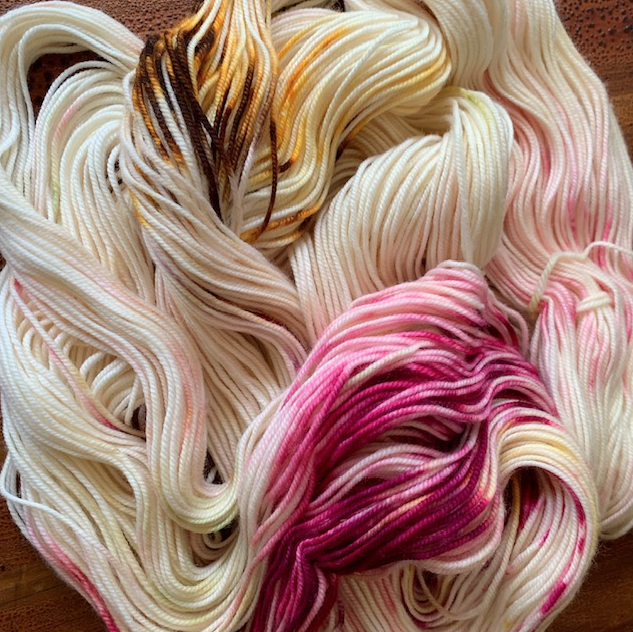
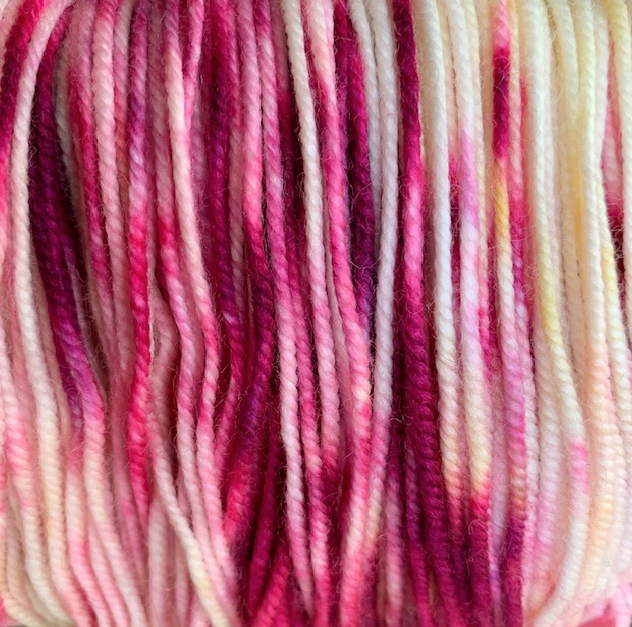
Quite a while ago I bought a skein of Tea Party yarn from Miss Babs. This one is sport weight and is one of the Yummy 3-Ply yarns offered at Miss Babs’ site. I bought it because it was pretty, and I don’t have definite plans for it yet.
Miss Babs Tea Party yarn
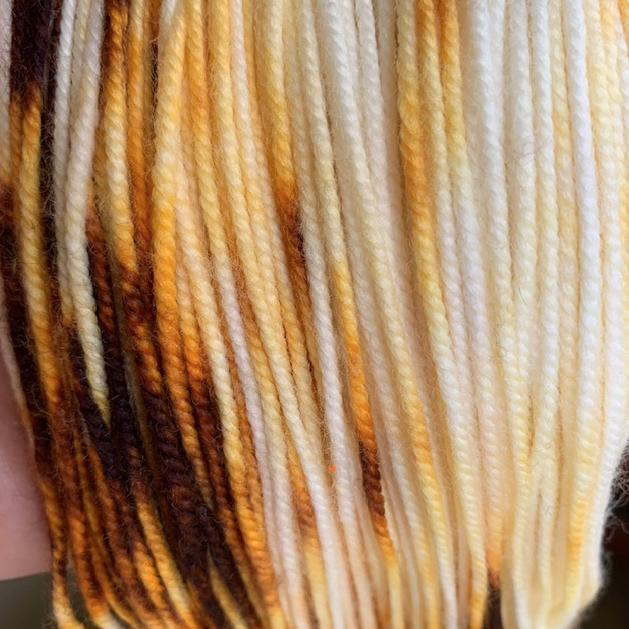
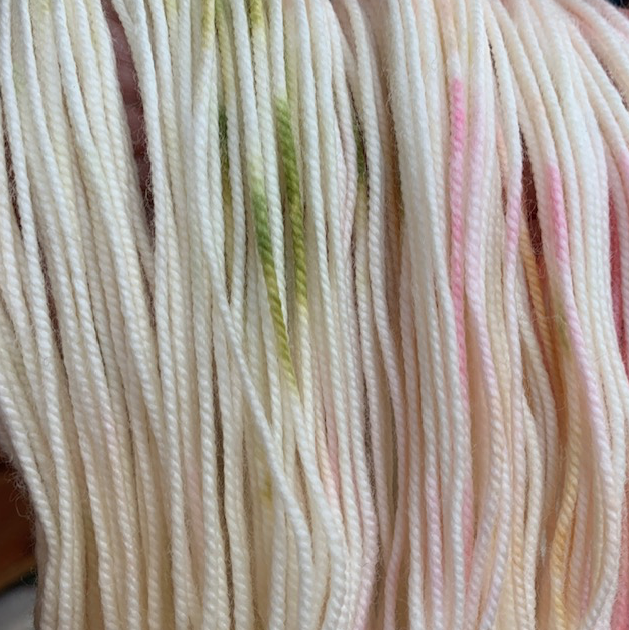
Before I wound it up, I took some photos of the various colors that can be seen among the strands of yarn in this lovely color way. “Tea Party” must be popular because it is currently sold out / out of stock in many of the yarn weights offered by Miss Babs. I hope it comes back because I love it.
Below is a little swatch where I played around with some stitches and used “Tea Party” with “Deep Sea Jellyfish” which is also a Miss Babs yarn in Big Silk worsted weight.
Swatch with Tea Party and Deep Sea Jellyfish
I don’t know what I will knit with this yarn, but I’m considering a scarf with both the bright pinks and purples of Jellyfish and the more subtle speckled white of Tea Party.
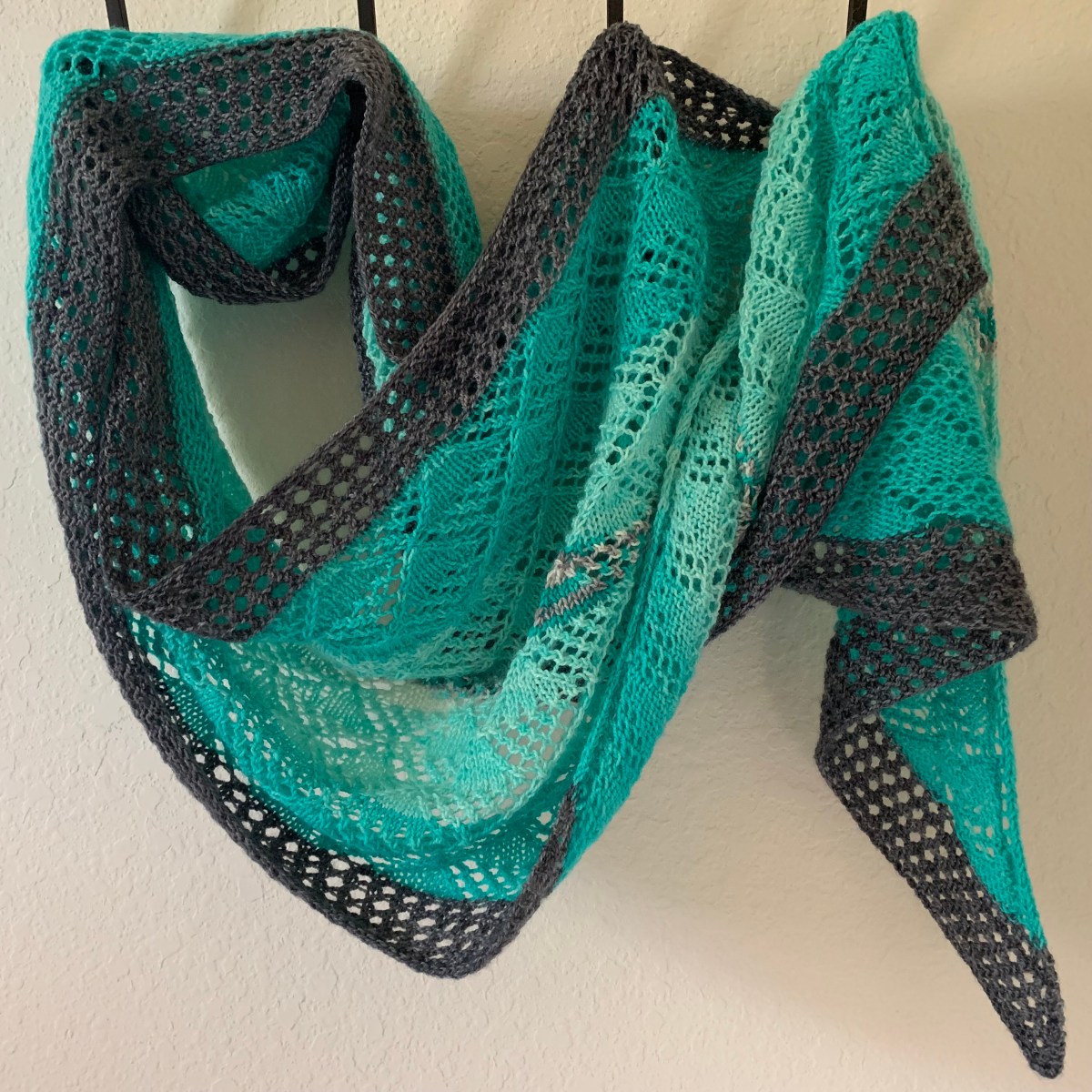
Ambah O’Brien’s Quince Wrap caught my eye because I liked the shape. I’m not big on those triangular wraps because I never know just how to wear them – if I could even wear them here in Florida!
But a long wrap is more like a scarf, and that is easier to deal with.
Practically Perfect Sock yarn by Emma’s Yarn in two tropical blue colors
Choosing colors was very tough for me. The pattern designer used color sets from Miss Babs and knit the shawl in rows of color. I decided to save money and knit using some yarn I already had.
Yarn I Used
Because I am in Florida and that means I love tropical colors, so why not use them in the Quince wrap? I used my two aqua blue skeins of yarn from a local Florida yarn store called Four Purls. These skeins of Emma’s Yarn were purchased when the Four Purls Yarn Truck visited my area of the state.
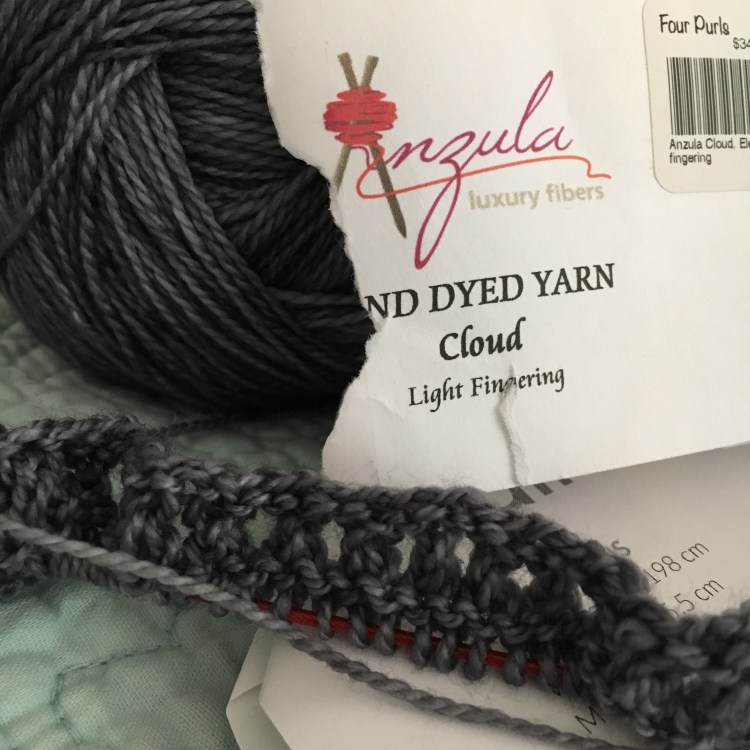
I had purchased a big skein of Anzula light fingering in gray (Elephant) and had no idea what to do with it. The gray color became my border for the wrap. The other colors I used are listed here and can be found under Emma’s Yarn Beautifully Basic at Four Purls online.
Ice Ice Baby (aqua blue)
Zuni (aqua blue)
Juneau (mix of blue, gray and white) used for center rows
Beginning the shawl with Anzula Cloud in “Elephant” gray.
All of this yarn was wonderful to work with, and I discovered the joy of Anzula which I had never knit with before. It’s definitely a favorite.
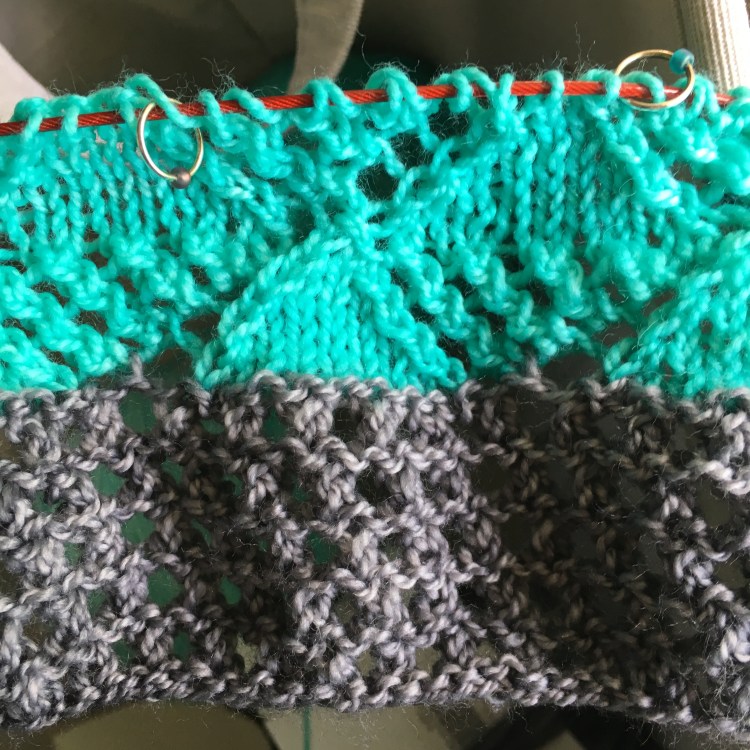
Beginning the lace section of the Quince Shawl
Figuring Out My Color Placement
I was a bit afraid that I might run out of yarn so I ordered the Juneau color way which I used for the 10 center rows. It contained similar colors to what I was using!
Rows of aqua in my Quince Wrap knitted shawl.
The pattern was fun to knit, but it did seem to take me a very long time to finish. I used stitch markers between the repeats on the lace rows and that was super helpful.
Click on the link to the Quince Wrap at the top of this page to see more like this at the Ravelry website.
After knitting my first pullover sweater Umpqua by Caitlin Hunter, I decided to try a cardigan. I chose Fine Sand, by Heidi Kirrmaier because I could knit it in a light weight yarn suitable for my Florida climate. At least, that is my hope. Also it is knit top-down, so that is something new for me to try.
Part 1 (of 2)
This post has photos and comments about beginning the sweater and knitting to the short rows. I’ll finish up on the sleeves and bind-off on another post (Part 2).
Miss Babs was having a sale on the Tarte fingering weight yarn, which is made up of washable merino wool, nylon and tercel. Sounds sturdy and washable, which should make a nice sweater. (Yes, I love this yarn, and the color is wonderful!) The pattern called for DK or Sport yarn, so I knit up a swatch using a needle two sizes larger and I got close to the gauge. I’m hoping the sweater will be a bit large in the end. I don’t wear tight clothing.
Center back marker of Fine Sand cast on
This is the Franklin blue, and it’s very close in these photos to the actual color. And I have never been disappointed with any Miss Babs yarn. I knit a Mystery KAL Shawl with Miss Babs “Woodbury” yarn, which was soft and pretty.
Dark yarn is not as fun to knit due to difficulty in seeing stitches (my eyesight is not great), but I love this dark blue. Also the pattern is fairly simple, with no crazy lace stitches, so it shouldn’t be a problem. I can only knit dark colors during the daylight when stitches are easy to see.
What I’ve Learned From This Pattern
First of all this pattern is written very differently than any other I’ve followed (ya, that ONE other… hahaha). Charts are substituted for complete written directions. These are not knitting charts, like in colorwork, but charts with letters which are used to take the place of changing repeats / number of stitches for each row.
I always read through a pattern and highlight the parts I will need to pay attention to, such as repeats in a row, or info for my chosen size. I’ll admit that when I saw the first page of instructions, I had to spend a few minutes figuring it out.
Right off the bat I had to learn how to do the RLI (right lifted increase) and LLI (left lifted increase). Specific instructions for how to do those are included in the pattern and links to video help are included too. The LLI gave me a bit of trouble at first and I lost count on one row, but every row contains stitch counts (thank you!) so I was able to easily add those stitches back in.
Separating The Body and Sleeves, How To
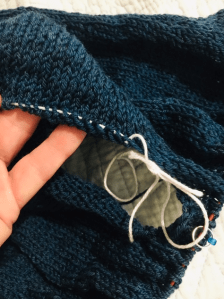
To separate the sleeves a bunch of stitches must be moved to waste yarn. That was easy enough to do using a darning needle and white yarn to be a contrast to the dark blue. The pattern called for a cast on of stitches and that threw me for a bit. Here’s what I did:
Turn the work to the wrong side. Yarn will be coming from the L needle. Use the R needle to begin a knit stitch but when it comes off the needle pick it up with the L needle (from the bottom) and let it stay there. Do this for the number of stitches called for in the pattern. For this sweater in my size I had to cast on 6, place marker, and cast on 6 more.
The video below is the one I followed. Begin it around 2 minutes for this type of knitted cast on. As he points out in his video, this is how to make a buttonhole!
The cast on edge at the armhole
Armhole stitches on hold
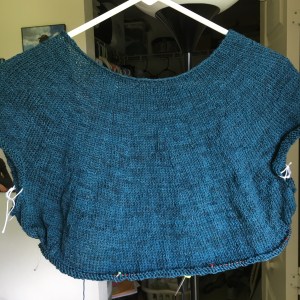
As of the beginning of July, 2019 here is where I am on my Fine Sand (photo below). I’ve passed the tricky armhole area and now the knitting will be pretty straightforward for a while. Next I will have to reacquaint myself with short rows. I love the yarn. I would definitely buyTarte from Miss Babs again.
Along with this project I am also working on the Quince Wrap and Moon Sisters Shawl.
My first sweater was a bottom-up project and this is a top-down. With my cool new needle tips – those things that keep the knitting on the needles – I can try on my sweater as I go.
Fine Sand sweater knitting with armholes on hold
Front of Fine Sand sweater in progress
Adding a Contrast Color at The Bottom
When I reached the last few rounds (rows 1-6) toward the bottom, I began adding the moss green color. Although it looks more gold in my photo, it really is green. The blue is also more teal.
Now that I am finishing up the repeats the short rows come next to create a longer back section. I think I am going to change that and do a longer squared off back leaving slits between the front sections and back of the sweater bottom. I can picture it in my head but not sure I should try it. I may chicken out and follow the pattern. (Yup, I chickened out!)
Once the sweater bottom edge is done, I will go back and finish the sleeves. The other day I began to knit one of the sleeves with the blue color I was using for the bottom. This pattern calls for 3/4 sleeves which I like. In the photo below one sleeve is still on the white place-holder yarn and the other is in the knitting stage.
By the way, I love those stitch stoppers! Mine are by Cocoknits and I bought them at Webs (that is where the link goes). I can easily try on this sweater as I go without worry about losing my stitches.
Finishing the Sweater With Edging
The Fine Sand pattern gives directions for finishing the sweater with a knit edging. The edge is curling so it does need something. As I looked through the finished Fine Sand sweaters at Ravelry, I have found a couple that had really pretty edging. I’ll be there soon, so I need to decide.
I’ve been relatively clueless about plies of yarn. Probably like most beginner knitters, you jump in and buy because of color!
And….Sale yarns… don’t you hate them? They call to me and say “What a deal! Too good to pass up!” And yes, I am a sucker. Without any idea what on earth I will do with the beautiful bargain yarn, I buy and stash and hope some wonderful pattern will spring to mind.
When I purchased my latest deal yarn, I was hoping to knit a baby blanket. I wanted “baby” colors and since there is no baby on the way in my family, a neutral color would work best. I also wanted to try my hand at a “center out” blanket, because they look so cool (not so easy to begin). Also I would be learning a new knitting skill.
Ball of single-ply yarn by Mrs. Crosby
The super-sale yarn I bought the other day is a single-ply by Mrs. Crosby in an off-white mixed with other pastels colors. The type of yarn is Satchel, color name is Dogwood. I am not really thrilled with the color, but I am knitting up a swatch. I had recently made a little baby hat with animals using a similar sock yarn by Madeline Tosh and did not like the outcome. I think it’s safe to say I don’t like single-ply yarns. Or maybe I just don’t know how to use them.
My new Vogue Knitting book
I now own the new, hardcover, Vogue Knitting book and I love it! (I bought a used edition on sale and it’s like new!) Already it has helped answer some of my knitting questions, and it’s just fun to read. Unfortunately it really didn’t help much with how to choose a ply. It did describe plies, but there were no suggestions for choosing single, double, or more plies for knitting – not that I have found anyway.
Help With Choosing Plied Yarn
Plies are single strands which are twisted together to give strength to the yarn, so the more plies, the stronger. Am I correct? It seems to make sense. I understand what plies are, but not how to choose the number of plies for projects.
Since there is usually such good yarn places online to find information I went to Mason Dixon Knitting and found a wonderful explanation of ply! She even uses the Mrs. Crosby yarn as an example of single ply, and she knits up swatches to compare single, two and three ply yarns. It was a fabulous article.
After reading the explanation, it appears that 3-ply yarn is the best for stitch definition and performance. Sometimes yarn descriptions simply say “plied”, so what then? If yarn is made from three fibers, they would be 3-plied, I assume. I will keep learning.








 New England's Narrow Road