I’ve begun knitting mittens before and always ended up ripping out the stitches. I don’t like to give up, and when I came across a free mitten pattern by Tin Can Knits, titled “The World’s Simplest Mittens” I tried once more. (The link goes to the download page at Ravelry.)
If I can’t knit the simplest mittens ever, then I should maybe give up for good.
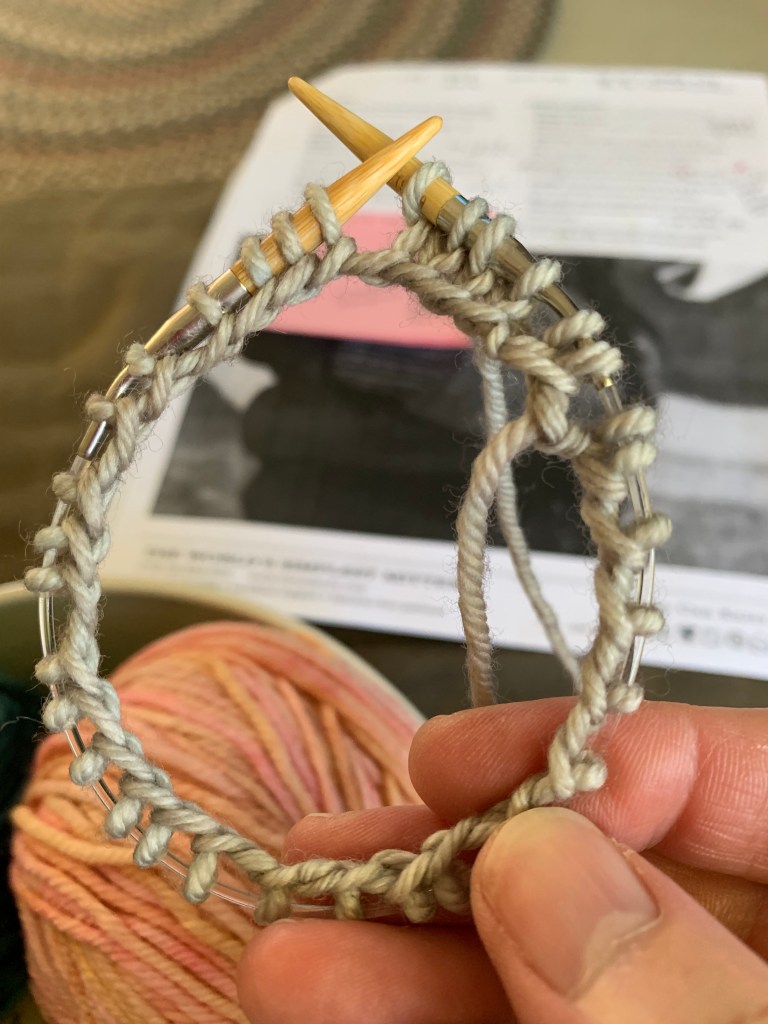
I dislike DPNs so I used my nine-inch circular needles to knit most of the mitten.. DPNs were used for the decreases at the top of the fingers and the thumb (and also on the second mitten for the colorwork). Both mittens are made the same, no right or left. Very easy.
Casting on and using 9 inch circular needles
Needles I Used
I began with a size 6, 9 inch circular needle (Clover brand) and used that for the entire cuff. Then I switched to a size 7 circular until the pattern where I used size 8 DPNs because I don’t have a 9-inch circular in that size.
The small circular needles work out well sometimes, but my hands can get tired. Recently I tried to knit baby booties and ended up switching back to DPNs.
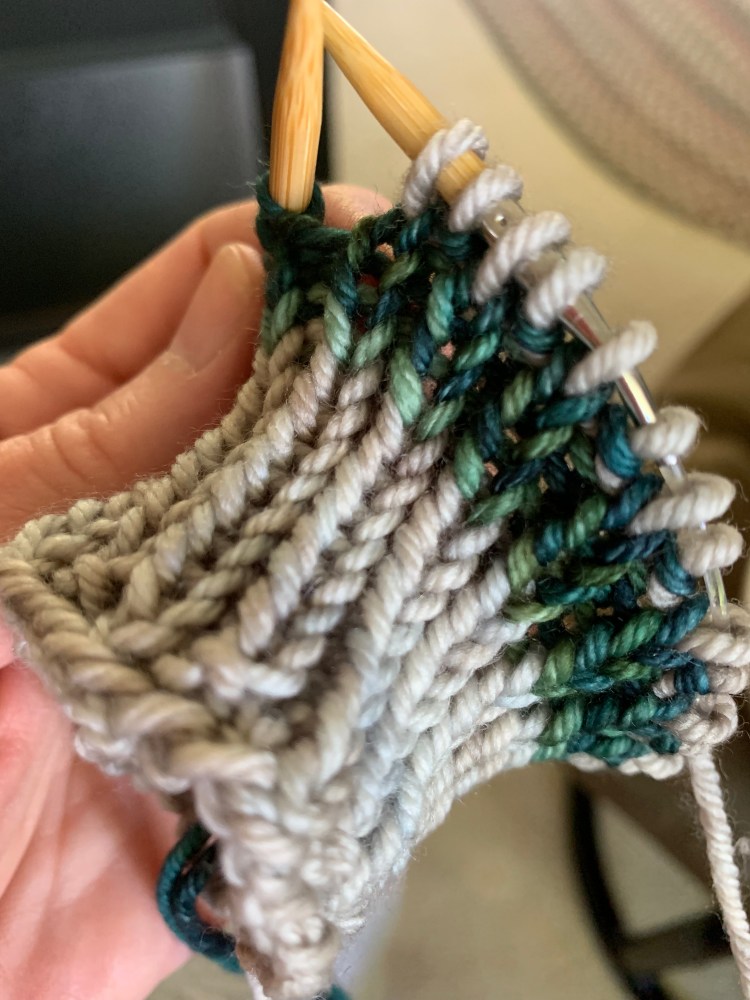
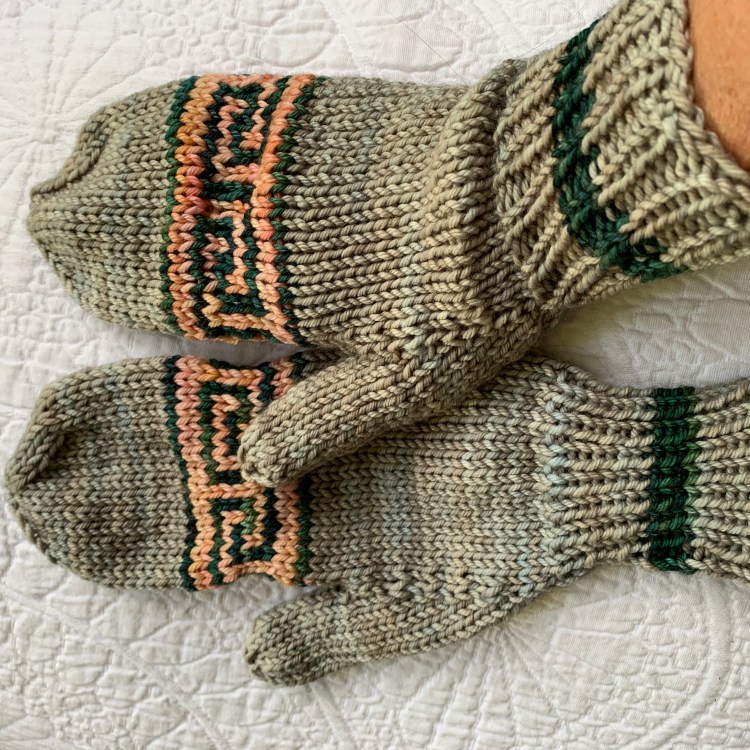
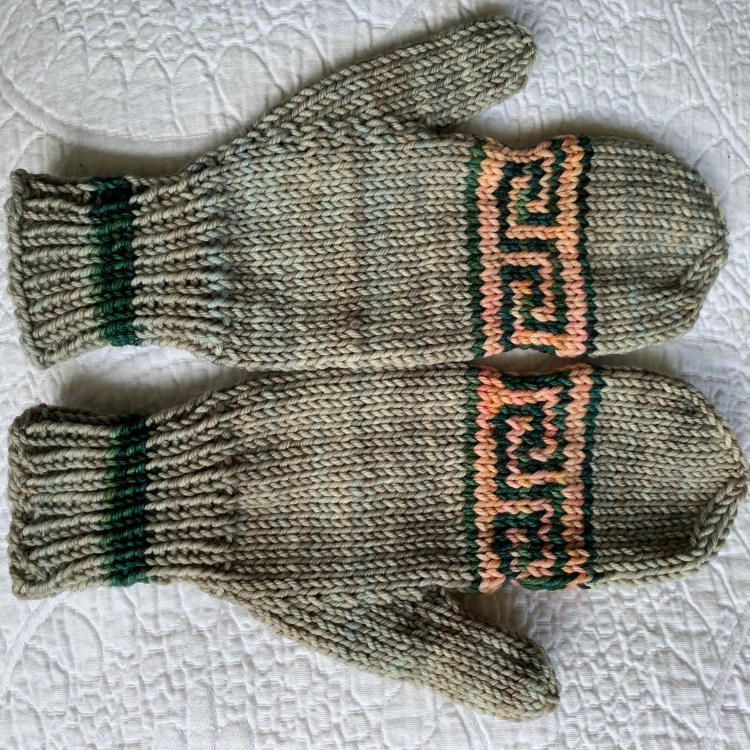
The yarn I used is Malabrigo Rios and was leftover from knitting my Umpqua sweater. I began with the gray / tan and added dark green in the cuff and pink with the green in the Greek Key design.
Adding a band of green to the cuff
The design came from my 150 Scandinavian Motifs book and fit exactly into my stitch count. I began the design right after putting the thumb stitches on hold.
The thumb is put on hold while I finish the finger section
For the second mitten I used a larger needle (size 8 US) while knitting the design and it seemed to work out a bit better and not as tight. It is not noticeable and now I know to do this when doing stranded colorwork.
Finished my first pair of mittens!
The mittens were washed in the washing machine inside a mesh laundry bag and then air-dried on the windowsill. First I did throw them into the dryer (while still in the bag) for a few minutes.
Now… if only it would snow in Florida because I am ready!
Mittens
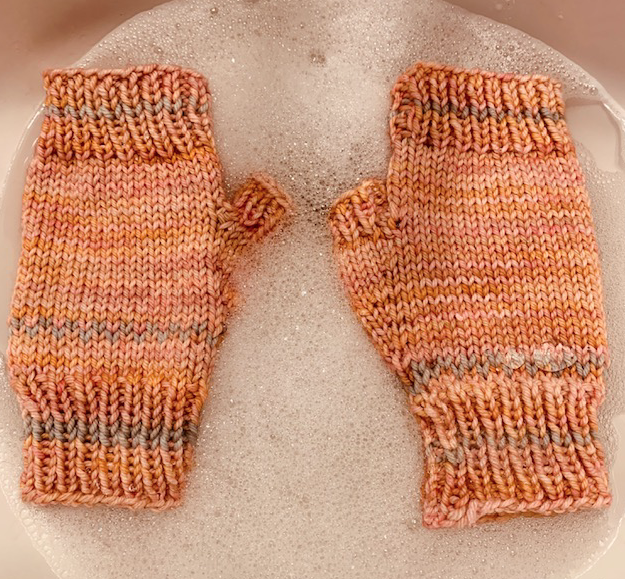
Next I made making fingerless mitts using this same pattern and the same yarn with the gray color as stripes.
Mittens pattern becomes fingerless mitts
Small projects are good for using up yarn, but I dislike knitting small things in the round. I made one pair of flip-flop socks for my daughter and will never make more..haha. I’ve given up on socks in general, but mittens are more fun and this pattern is super easy.
If you are like me, sweater knitting is frightening. I’ve knit two now and I’m still intimidated by knitting a large project. For so long I checked out the forums and blogs and knitwear designer sites and would be amazed that people could create such things from strands of yarn. They all seemed so intricate and large! I doubted that I could get through the pattern directions and balked at the word “charts”.
The First Dumb Thing I Did
Not the first dumb thing I ever did, but this shows what a complete beginner I was. I bought a book of cute baby sweaters thinking that smaller would be easier. Not! As I looked through the pages of instructions – for knitting one sweater – I realized my mistake. I’d never be able to knit any of the sweaters in the book. Not until I advanced my knitting skills.
FYI – smaller projects are not necessarily easier. You probably know this, but just sayin’ for those just starting out.
Finding a Beginner Sweater Pattern
I needed to find a beginner sweater pattern, but I was having no luck. The patterns I found either were not my style or did not look easy to me. Of course I had never knit one, so what did I know? The second thing stopping me was the yarn. Lots of yarn is needed to knit an adult sweater and that equates to cost. I was very unfamiliar with types of yarn and getting gauge. I wondered what I would do with 5 or 6 skeins of yarn if I couldn’t manage knitting a large project?
Sweater yarn, Arranmore tweed in yellow
Basic needs for knitting any sweater
Long, circular needles in correct size for gauge.
Double-pointed needles / DPN’s, for sleeves – or a 16 in. circular will sometimes work.
Stitch markers
Yarn – washable / non-washable? Or use the exact yarn called for in the pattern. And waste yarn to hold sleeve stitches.
Ruler, darning needle, and scissors
Know how to cast-on, bind-off, put stitches on hold (sleeves), increases, decreases, possible shaping (German short rows).
As I did with my first (and only, so far) mystery knit-along (MKAL), I had to jump in. I found a pullover pattern I liked (the Umpqua sweater), bought it, got some yarn, and began. I think I chose a pullover because I wouldn’t have to mess with buttons! I don’t know if I would call this a beginner sweater, but I managed to finish it and although it’s pretty large (that gauge thing) I can wear it. My second was a cardigan – the Fine Sand pattern. I posted my knitting notes on these links, which might be helpful.
Tin Can Knits has a lovely and very helpful website and they offer a free beginner cardigan knitting pattern! How nice is that? I wish I had seen it during my search, but I’ll share it with you now.
The three best aspects of knitting this sweater are: It’s a free pattern (and it’s cute), you can knit a very small size (save money by using one skein only), and there is a page of tutorials which give good explanations, photos, and links to more help if needed.
The Harvest Cardigan has no buttons to deal with either (TCK has a great page on button bands too for when I get brave). The link to the tutorial page is at the bottom of the sweater pattern page – bold link above. So I looked at the tutorial page and wow, it does not seem like a beginner sweater to me! First you must do a provisional cast-on, which in itself is not difficult, but you have to pick up those live stitches later, which is where I have my problem. There is a lot to learn for those who truly are beginning, and that can be a good thing. Sometimes we just have to jump in…! Or start with some of their simpler free patterns and work up to the sweater.
Free Bundle of Patterns by Tin Can Knits
The Tin Can Knits site offers a bundle of free patterns called The Simple Collection, and they reference it on the Harvest Cardigan page (or click the link I made). They call the collection a “step-by-step learn to knit program” and offer 12 free patterns which include a scarf, cowl, hats, mittens, socks, sweaters and a shawl. I highly recommend this site. They show off their knitwear on the cutest kids too! Recently I knit a pair of their mittens, which was also a free pattern.
More of My Favorite Cardigan Sweater Patterns
I have not knit any of these sweaters yet, but they are saved as some of my favorites to try. Currently I am focused on Christmas knitting and smaller projects and for the time being I am giving up shawl and big project knitting.
But here are some you might like, and they don’t look too difficult. The patterns listed below are not free.
If you are a member of the Ravelry site it will be easy to see all the sweaters other knitters have made following these patterns. Also read their notes and view the yarns they used. This is helpful especially if you have trouble visualizing, or selecting, a color for the project.
I found this free pattern called Winter Morning (Link goes to Ravelry) to knit a chunky / bulky yarn headband with a cable. So here are the results and tips I want to share. First of all, my grown daughter has shown interest in this type of accessory in the past, so I believe she will wear it. I’ll make one for myself too because my ears may get cold on early morning winter walks here in Florida.
This is an easy pattern which I knit in 2 hours, and I do like the way it came out. BUT… the cast on, and kitchener stitch took time because I had to look them both up. (See more about the Provisional cast-on and Kitchener stitch down the page.)
Washing: The Madeline Tosh yarn is machine washable so I put it into a zippered mesh bag and washed with my clothes. I took it out to air dry – and the yarn smelled awful… which sometimes happens with treated yarn – but once it was dry there was no smell. It’s ready to give away.
Finished!
Finding the Right Bulky Yarn
I needed to find some good, yet machine washable, yarn because it will be a gift for my daughter. She is a busy woman so I wanted an easy-to-care-for gift. The yarns below are not cheap and come from Peru, South Africa, and Italy. I should get 2 ear-warmers out of each skein of the Mad Tosh. You can find other super bulky yarns for a bargain, but I wanted nice yarn. After I bought my yarn, I found Mirasol Yaya for $5.54 on sale at Wool Warehouse. It ships from England. This yarn is only around 50 yards, and would make one headband, but it’s affordable.
Bulky Yarn That is Machine Washable
After doing much searching online I ordered the yarn shown below and chose the Mad Tosh ASAP in “Cosompolitan” (far right below) to knit the first headband. (I’ve begun a second using the Wool Addicts “Fire” super bulky yarn, in dark gray, and I love it and think it works better for this project.)
Bulky yarn by Mad Tosh, Spud & Chloe, and Wool Addicts
Because I want an idea of which yarn is best for this easy project, I will try all four of the yarns above and do a comparison, which I will share at some point!
“Franca” super bulky, washable yarn
Wool Addicts “Fire” super bulky yarn is very soft
Provisional Cast On to Needle Using Crochet Hook
A provisional cast on means using yarn that will be removed from the project – in this case, at the end of knitting the band. The stitches will be picked up onto the needle and the gray yarn here will be removed. That way both the end and beginning stitches can be knit together to create a nice-looking seam (hopefully).
I’ve included a video by Very Pink Knits to show how to do this because the pattern calls for it.
Casting right onto the needle using a crochet hook.
Once the provisional yarn is on the needle, knit one row. Then, begin the pattern.
Knitting onto the provisional cast on
Finish With the Kitchener Stitch
The worst part of knitting this headband / ear-warmer was putting the held stitches back onto the needle from the cast-on. It has to be done in order to finish with the Kitchener stitch. Once you figure that out, both needles should have the same number of stitches. They will be sewn together.
The Kitchener stitch is something I can only do when watching a video. I still don’t know if the working yarn has to come from the back needle or not. In Purl Soho’s video (below) they use an unattached piece of yarn, so I assume it doesn’t matter. Hold right sides facing out and have the same number of stitches on both needles. Once I get to the end with only one stitch on each needle I wing it because I have yet to see what to do!
For the kitchener stitch you will need a darning needle and long bit of yarn left from the end of knitting the headband. All I can say is watch the video and pause it as you go. I could not tighten up my stitches because I couldn’t tell where my stitches were! Purl Soho is using red on white, but I am not. Just a note: In case you are wondering, it’s helpful to know this stitch if you knit socks and mittens because sometimes you end the toe / fingers section doing this stitch.
In the middle of the kitchener stitch
My kitchener stitch
Changes to Make Next Time
Honestly, I wasn’t too impressed with my stitching (kitchener stitch) and I decided I would knit my next headband with a regular long-tail cast-on and regular bind-off and stitch the ends together. It will be much easier. We’ll see how it looks.
Also, if you know how to do other types of cables, it would be easy to change that part of the pattern. This cable is very simple and I knit with size 13 wooden needles and used a DPN as a cable needle.
Just so you can see that it fits!
Once the band measured around 18.5-19 inches (my daughter has a small head and for myself I would go another inch). I stopped and finished it off. As you can see in my photo above it fits on my gray-haired head. It will look much prettier on my daughter’s head. As I mentioned above, this yarn is not really bulky enough even though it is called “super bulky”. The skein is 90 yards long, so one skein should make 2 headbands.
Types and Cost of Yarn
Here is a list of the yarn I bought and the approximate price per skein (at the time of this writing). Remember that some skeins have enough yardage to make two headbands from this pattern.
Spud & Chloe Outer- $18 (wool and organic cotton – 60 yds, will make one headband)
Manos del Uruguay “Franca” – $36 (114 yards) is super bulky (reminds me of Mad Tosh “Rasta”, except it’s washable) I found some at Richland Street Yarns on Etsy for $26.75 per skein – in limited colors.
I want to say right off that I knit this hat for myself and did not use a specific pattern. I did take notes as I knitted, which I can’t seem to find.
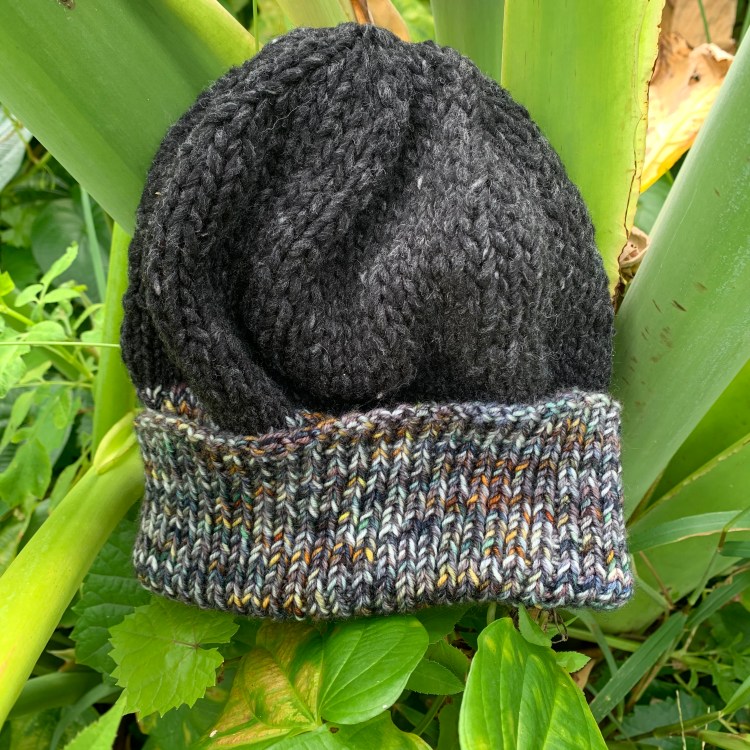
The two skeins of Quarry yarn I purchased a while ago were meant to be used to make warm, winter hats for some boys I know. I bought Brooklyn Tweed Quarry in Obsidian (black) and Slate (dark gray), but when I tried to start a hat and join in the round the yarn came apart! I was so disappointed.
The Quarry wool was put away until I read something somewhere about how to work with it. Apparently it does tend to have this splitting problem which can be remedied by twisting the yarn to make it stronger before putting stress on it. Because I didn’t want to have to deal with this when beginning a hat, I made my brim from other yarn, with the plan to attach Quarry for the top only.
The Hat Cuff
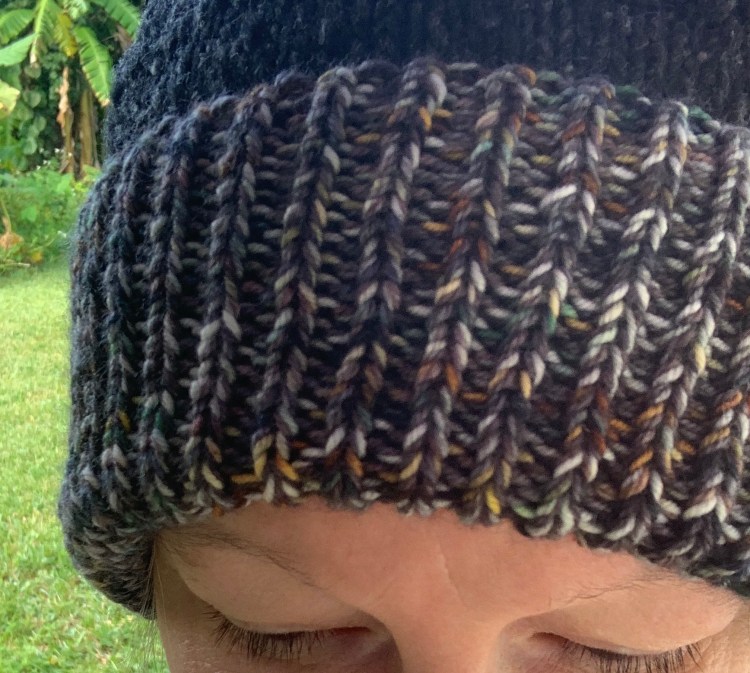
To begin the hat at the cuff I held two leftover (stash) yarns together and knit a K1, P1 rib for about 6 inches. The yarn here is Miss Babs “Coffee Break” and Madelinetosh sock in “Arch”… I believe.
Fold up hat brim knitted in two yarns held together
Although I now live in Florida, in New Hampshire my favorite winter hats had thick cuffs. Making an extra long brim to fold up gives an extra layer of warmth for the ears.
Extra ear warmth with roll up brim
After I finished knitting about six inches of ribbing, I changed to the Quarry yarn. Right away I discovered that I needed to use larger needles and have fewer stitches to work with. I also want to say that I had none of the previous problems with the yarn coming apart. I don’t know if I simply had a bad section of yarn before, or if I just never had to pull on it as much.
I did take notes when I was knitting, and here is how I began, but I didn’t figure out the decreases like this. Also my hat was getting too tall so I didn’t do the knit rows between the decreases at the top.
Cast on 110 and K1, P1 around for 6 inches (not sure about the needle size because I didn’t write it down, but probably a size 5 or 6)
Attach Quarry and use size 11 needle to knit around (size recommended by Quarry is 10 or 11)
Here is where I had problems. Quarry is more bulky than the two yarns held together. The rest of the “pattern” notes are what I should have done – I have no idea what I actually did – until the top decreases.
Reduce to 80 stitches: K4, K2tog around = 88 stitches first round, then K10, K2tog around, for 80.
Knit around for about 2 / 2.5 inches then begin top decreases
Crown: K8, K2tog, Place Marker – around
Next row Knit around (I didn’t do these knit rounds because my hat was becoming too tall)
Next decrease row: Knit to 2 stitches before marker and K2tog, around
Continue by alternating a knit row and decrease row – using DPNs for last few rounds.
Once there are only a few stitches left, finish as you do any hat.
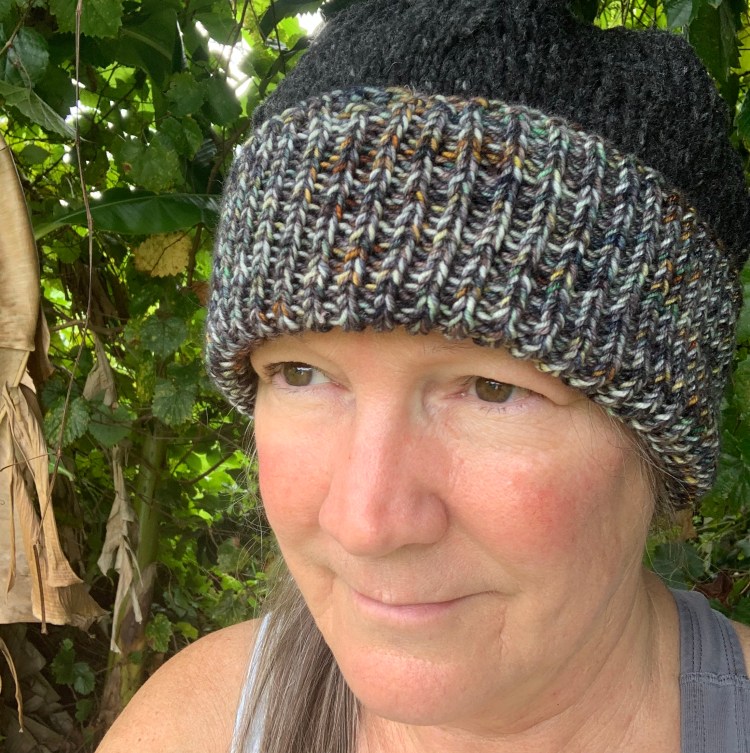
Anyway, the hat is not perfect, but it is somewhat how I planned. The warmth of the wool on top will keep my head warm when the temperatures drop to 60 around here… Haha…
But seriously, this hat will be nice to wear when I visit NH in cooler months.
You may be able to see the tighter and smaller stitches just above the brim. Then, I switched to a larger needle and decreased stitches somewhat evenly around. I still ended up with too many stitches so the top of the hat is a bit puffy. It looks okay, and overall I am happy with it.
Warm wool on top
The hat was hand-washed and laid flat to dry and the Quarry wool is very soft – not at all scratchy. In fact I look forward to using it again with the gray color I still have. Not only does it finish nicely, this type of wool makes excellent cold-weather items. Now I understand why it’s chosen for sweaters, mittens and hats.
Skittle, my cat, came out to watch me try to take my selfies and hat pictures. It was a little warm to be wearing a hat like this one!






 New England's Narrow Road