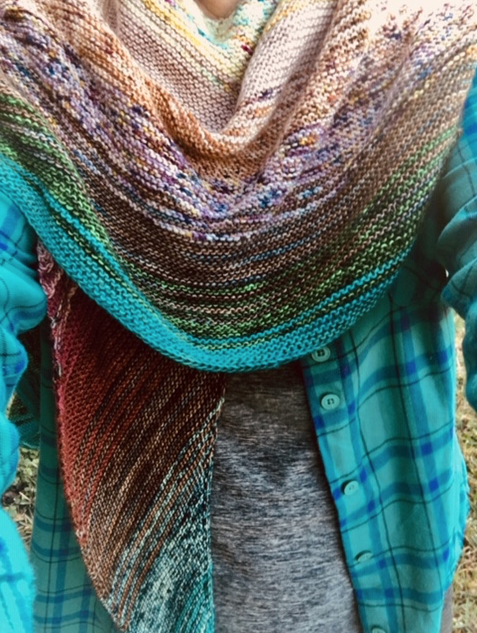
The Scrappy Bias Shawl was a free pattern I found at Ravelry (link below). The knitting begins at one point and expands outward by using increases on one edge and decreases on the other, which ends up as an elongated triangle shape. It’s very simple to work and can be knit in so many ways.
I liked the idea of the gradient, so I chose colors that complemented each other as they changed from darker blue, green, brown, and red, to light pink, yellow and speckled in the center. Then, back to the same dark colors at the long end of the scarf. Following a pattern, yet doing my own thing, made knitting this shawl fun. No one will have a scarf exactly like mine!
Scrappy Bias shawl – completed!
Fortunately I was knitting during the Florida winter so I could put on my flannel and wrap up in my finished shawl and not be roasting hot for the photo below. I don’t get much chance to wear any of my knitwear because of the climate, but occasionally it does happen.
Wearing my new shawl
***Here is the link to the Scrappy Bias Shawl pattern on Ravelry, where you will see some of the various styles and colors knitters have chosen. (You will need to create an account to view Ravelry pages.) It could be knit in a solid color, stripes, or using self-striping yarn. Use heavier worsted to make it chunky, or lighter weight yarn would give it more of a drape. Clever people could also add a design of some sort throughout.
I didn’t follow the bind off suggested in the pattern, but did an I-cord bind-off instead (See the video above for “How To”). I had just learned how when finishing my Bay’s Edge shawl, and love the look.
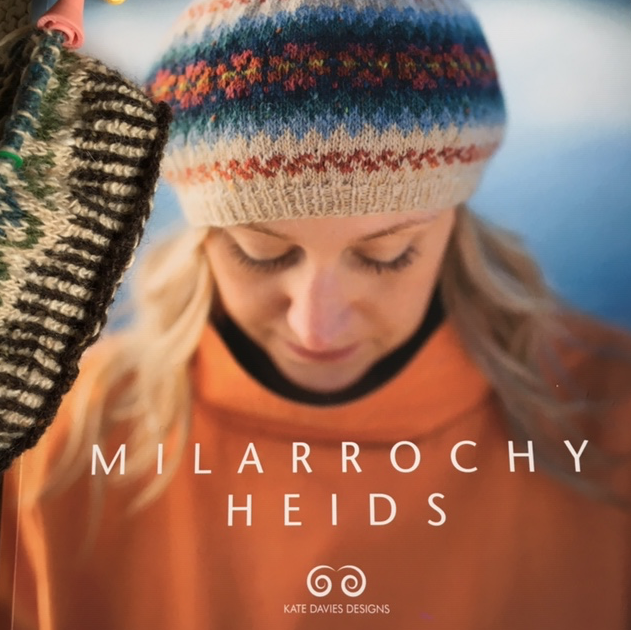
Just before Christmas I stumbled across the Milarrochy Heids hat pattern book by Kate Davies Designs. I honestly cannot remember how I came across this book, which comes from Scotland (awesome). I think I saw one of the hats, which grabbed my attention. It was the Tarradale, which is a slouchy, reversible hat with a big star motif. I fell in love with this hat! And as I saw more hats featured in this book, I knew I had to have it.
Unfortunately for me, the Tarradale hat is done in something called “double-knitting” and turns out to be a pattern that is currently too difficult for me to attempt (something to look forward to). But the book contains patterns which are doable for many skill levels, although reading a chart is necessary.
Let’s Stripe and Tettegouche
If you buy the Milarrochy Heids book, be sure to read the introduction pages. A number of designers contributed to this book, and the finished products are very unique. FYI: You will have to know how to read a chart.
Of course I wanted to jump right in and find a pattern, but the first couple of pages are insightful. And nature photography exists alongside gorgeous pictures of all the hats. It’s a very lovely book, with a total of 100 pages.
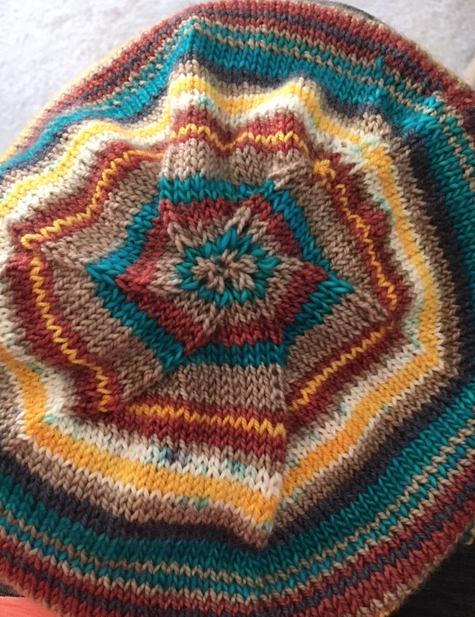
In that beginning section Kate Davies suggests a few patterns suitable for the novice knitter. Let’s Stripe was one, and I chose to make it first, but I chose my own colors and didn’t follow the color chart. I also made it a bit taller.
My version of “Let’s Stripe” hat pattern
Because my yarn order of the Milarrochy Tweed yarn had not arrived, I began the striped hat using yarn from my stash. Mostly I used Madeline Tosh sock yarn and other fingering weights. This is a great pattern for using up leftover bits of yarn, but be warned… there are a million tails to weave in when you finish! I carried some colors to reduce the cutting of colors, but still…..
There are a lot of tails to weave in on the Let’s Stripe hat
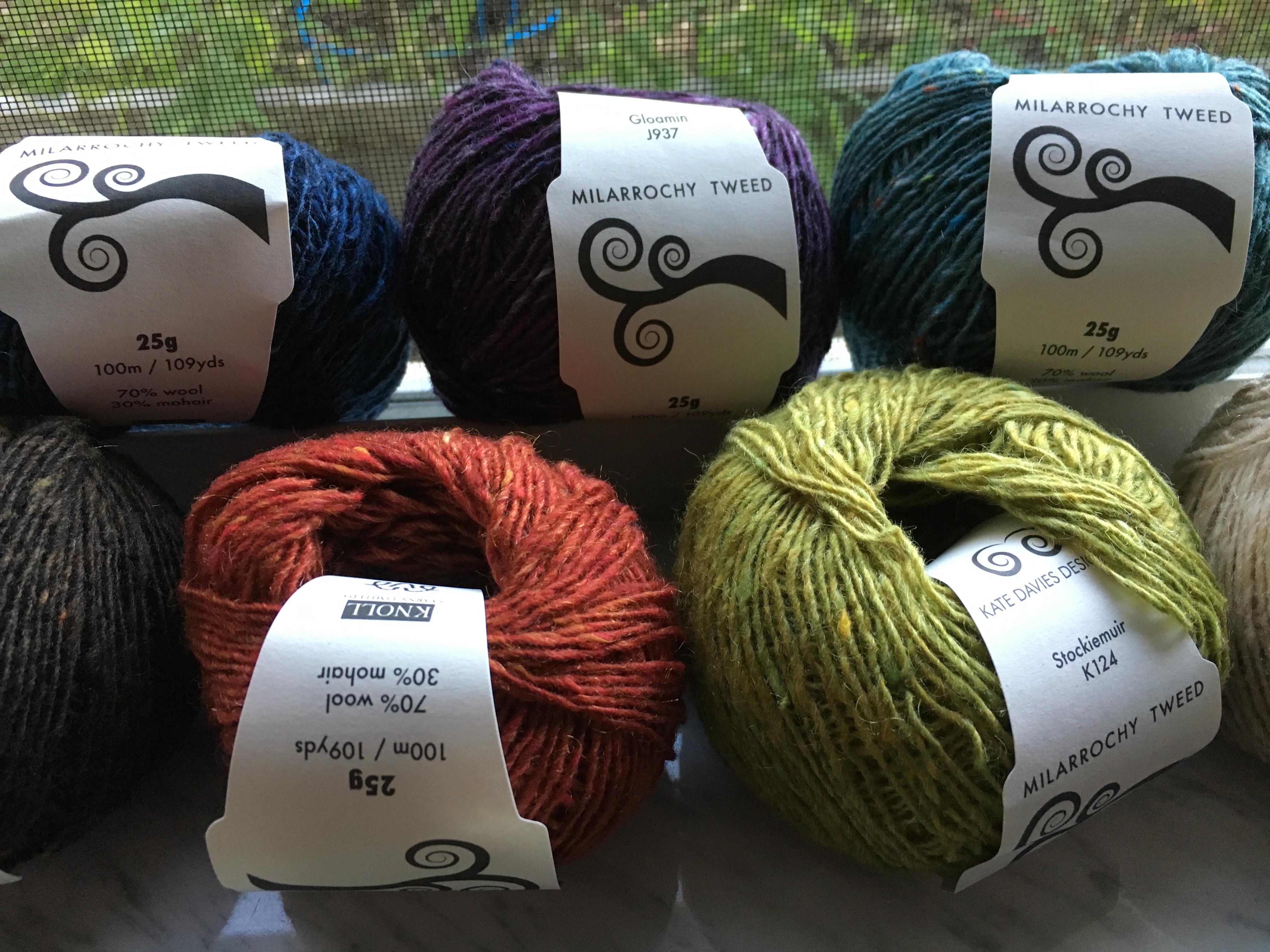
Once the Milarrochy tweed yarn arrived – all the way from Scotland!…., I cast on the Tettegouche. This one involves color work, which I don’t have a ton of experience with. It will take me a while to finish, but it’s fun to work on and the hat is so pretty. I will post a picture when it’s finished. Below is a photo of the cute little balls of tweed yarn.
Milarrochy Tweed colors
All the hats in this book are knit with small needle sizes, such as 2, 3, and 4. One takes a size 5, and your gauge may be different, but you won’t be able to go down much.
I hope to eventually make every hat in the book. For now, some other favorite patterns of mine are Roamin’, Breiwick (hat on cover), and Every Flavour.
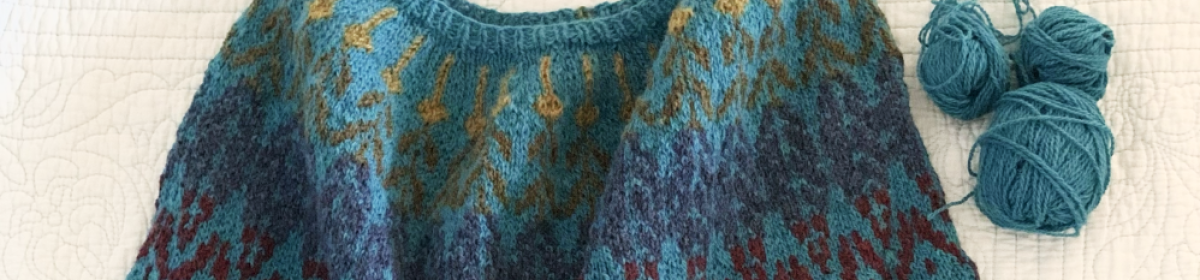
Milarrochy Heids hat pattern book with my beginning of the Tettegouche hat showing
I apologize for the absence of the Skinny Ruffle Scarf pattern, but the site has disappeared so the link I had here no longer works. But, a better place to find LOTS of pattern similar to this one (and they are FREE) is the Ravelry site. If you are not a member, it’s free to join and anyone who knits / crochets should be part of this site.
Check out the Pattern Search for “ruffle scarf” with the word “free” chosen on the left side options. Here is the page, which you may be able to get to if you have an account. It includes knit and crochet patterns and lists over 700 free scarves!
Since I began knitting, I’ve discovered that the item I love most to make is hats. Over the years I have become crazy about knitting hats of all kinds, in all sizes, for everyone I know. (The green hat shown is the Aran Watch Cap from the “Hat’s On!” book.)
Scarves were what I made most of the time when I lived in New Hampshire because my hats didn’t turn out all that well. I loved to knit hats, but didn’t have all the info needed to begin them correctly – using a good-looking cast on, and then joining in the round. And the beginning of a hat is one of the most important parts. When beautiful yarn is used and intricate cables and colors mix to create a lovely handmade garment, it pays to do everything correctly, from the cast-on to the pompom on top.
Three Ways to Join In The Round
Because I can’t always remember how to join in the round, I’m adding this YouTube video. Once the cast on is complete, the ends must be attached so circular knitting can begin. If the “join” is done wrong, the edge of the hat will have an obvious indent. The YouTube video below, by Very Pink Knits, shows three easy ways to make the join correctly.
Creating a Jogless Stripe in Circular Knitting
Another knitting trick I usually can’t remember and have to look up is how to make stripes, or changing colors, in circular knitting. The tutorial below shows how it’s done.
Topping Off a Hand Knit Hat
Once the decreases are over and the hat is finished, it may need something a little extra at the very top. Pompoms and tassels are often chosen for this honor.
I’ve also come across a fun tutorial for making covered buttons to top off a hat. This tutorial can be found at Kate Davies Designs and has pictures along with the description of how to cover a button with yarn. The end product is quite stunning and would make a unique addition to a special hand-made hat. I plan to try it myself one day soon.
Choosing Yarn and Figuring The Cast On Number
Most hats are knit on 16 inch long circular needles. The needle size depends on the yarn weight and gauge. I found a good printout which helps you guesstimate the number of stitches to cast on. View the Earth Guild “Super Simple Circular Hat Calculator“, and if you know your gauge – how many stitches per inch – and the circumference needed to fit the head that will wear it, the cast-on number is given.
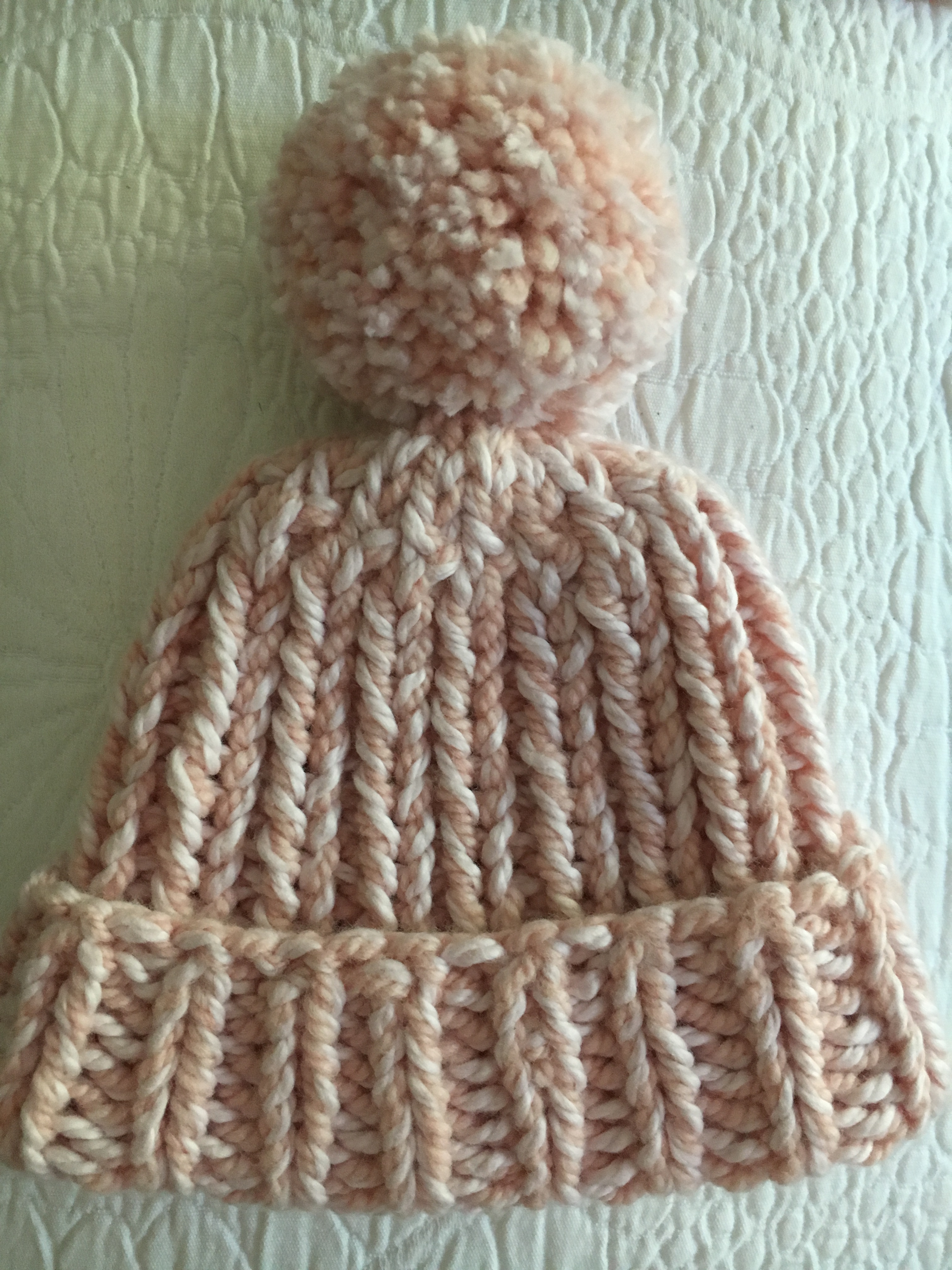
All types of yarn can be used to knit hats. Yarns can be held together to create a speckled look, like the chunky child’s hat I made from Purl Soho’s Snow Day Hat pattern.
Often a soft merino, or some type of warm wool, is used because hats are usually meant to keep heads warm in winter.
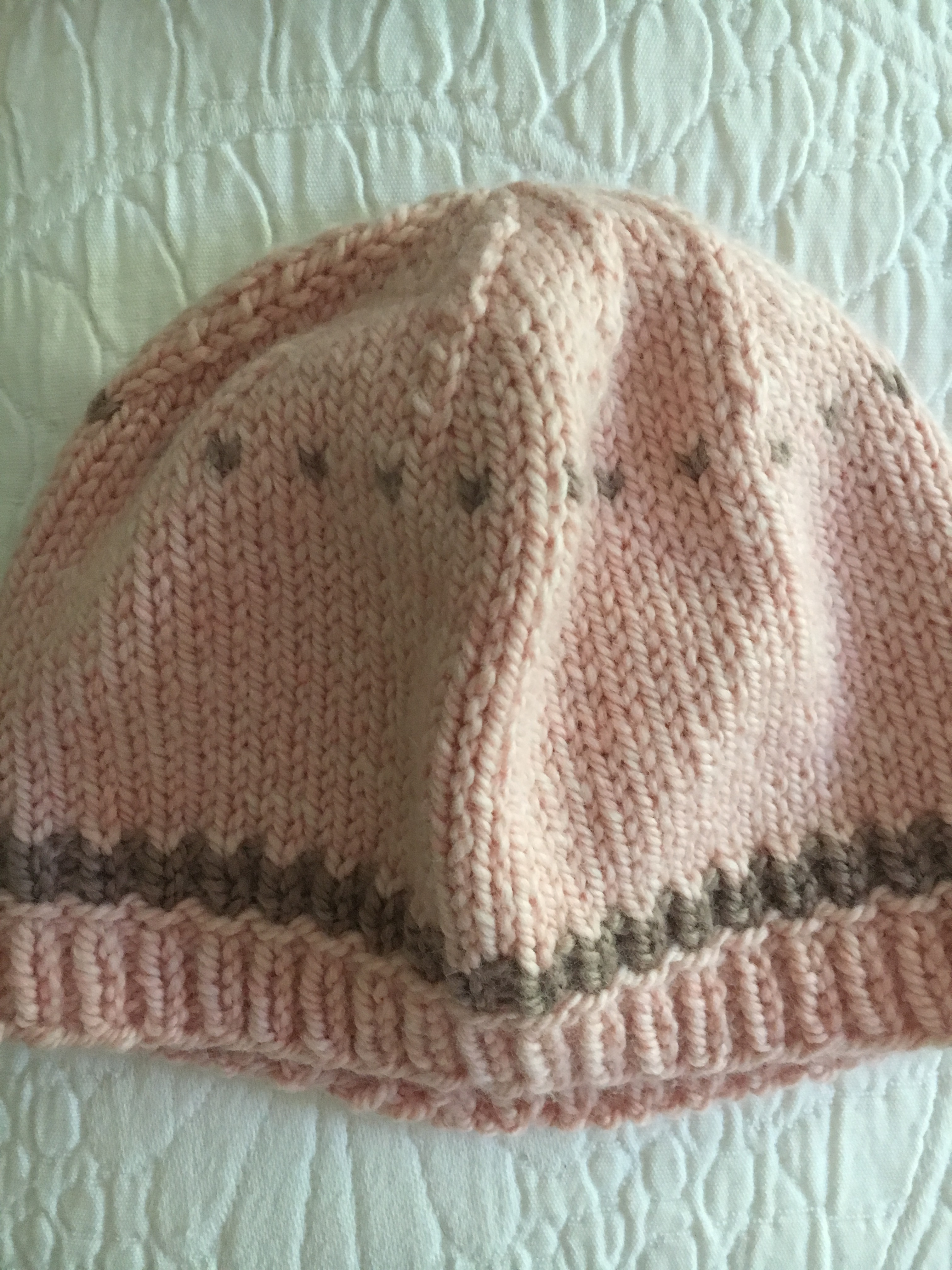
I added a flower to the side of this little pink baby hat, then mailed it to someone as a gift.
Once I got the hang of hat knitting with basic knits and purls, I decided to try more intricate cables and patterns. For hat knitting with advanced stitches, plan to pay for a pattern or buy a book. It’s good to know how to read a knitting chart also because some pattern designers use charts only.
Here is a link to a YouTube video which shows how to knit a Fair Isle hat- called the Fimmel Hat – in 5 colors. A link to the yarn kit and pattern is located beneath the video and Very Pink Knits provides the helpful “how to”. This includes casting on using a German Twisted (or Old Norwegian) Cast-on. It’s pretty involved, but it makes a nice edge. I’ve never done it myself, but will definitely give it a try on my next hat. I love the top of this hat with that star design. She also shares how she blocks her hats. It’s a great idea. Watch the video!
Buy Hat Patterns and Books of Hats
Following a pattern all the way around and up a hat can be challenging, but fun. Hats are small enough so as not to be overwhelming. They are good practice for cables and intarsia / Fair Isle (using multiple colors to create patterns). Or maybe start with two colors, like the Fana Cap I knit for my daughter (find in the Hat’s On book).
I just ordered the book listed below which has some very unqiue hat designs. I only hope I am able to create them!
My version of the child’s “Snow Day” hat pattern found at Purl Soho. The chunky hat was knit using a different yarn and needle size to fit a young child.







 New England's Narrow Road