Finished knitting the Easy V sweater and these are my thoughts on the knitting project.
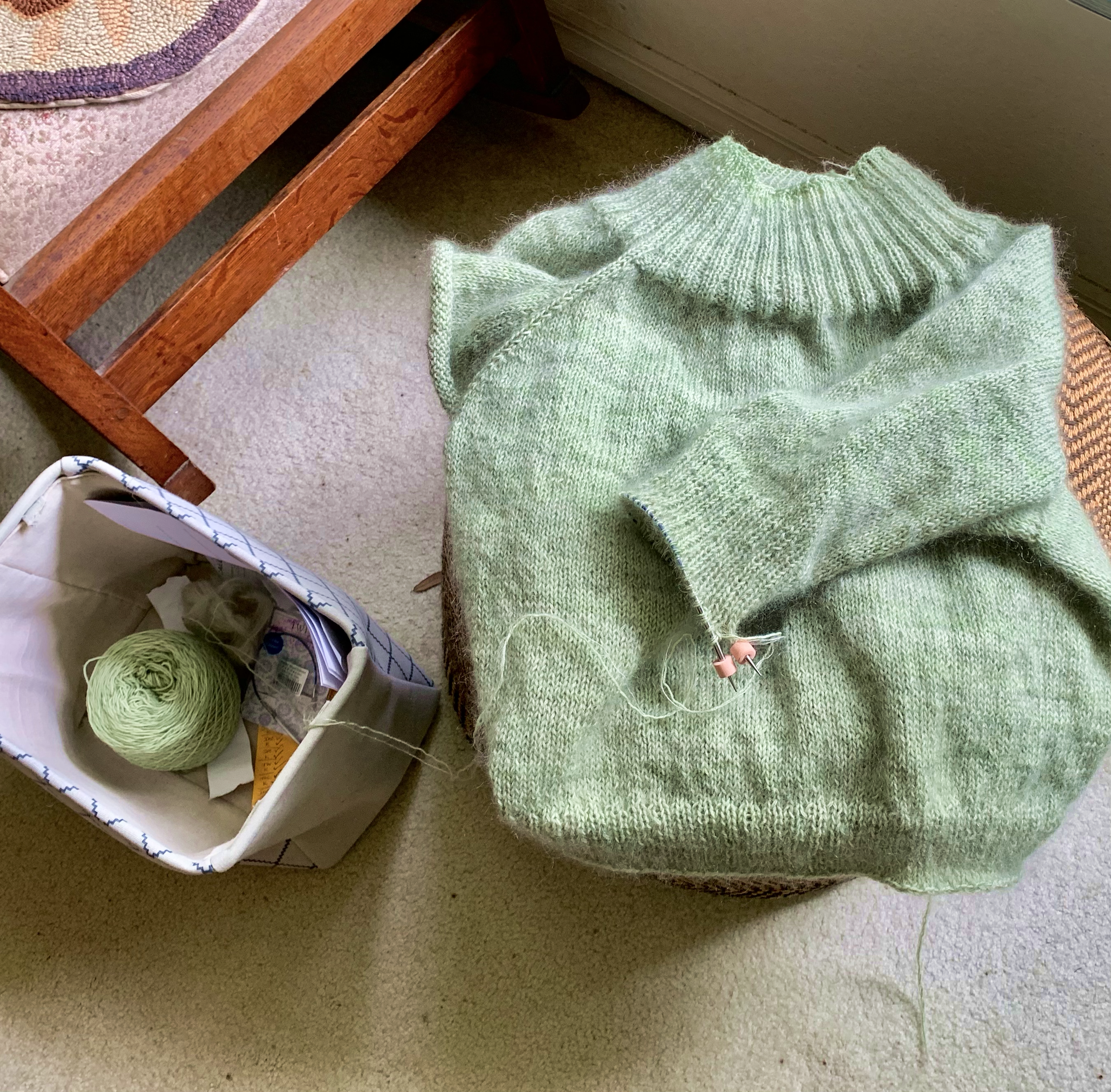
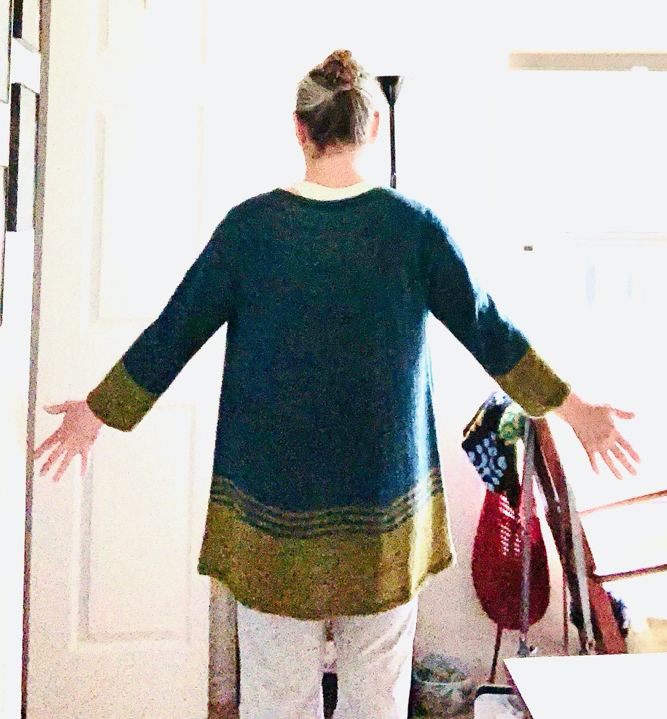
Now that I have finished the body on the Easy V sweater, I tried it on. Length is good, but other than that, I am not super happy with this knitting project. The pattern is fine, but I don’t like the style on me. I’m not happy with my yarn choices either.
See a link to the pattern buying page below in the pink block.
I had trouble getting the neck size cast on right. I’d begun with a green yarn and larger needle. Restarted the sweater using white Lettlopi yarn in a smaller size. This size seemed better.
When it came to using the hand-spun variegated yarn, the colors didn’t really mesh that well, but I was fairly happy with the color work yoke. But, the yarn is quite bulky and makes the fabric thick – even though I went up a needle size to knit that area.
Sometimes after washing and blocking a sweater can look immensely better. I’ve knit so much that I do plan to finish.
Maybe the neck will look better after washing and blocking. It is one of the elements of this top that is unique.
Pattern directions are very good, and it’s not that I don’t recommend this sweater pattern, but be sure you like the style before choosing it. The colorwork is very easy to do. It is supposed to be similar on the sleeves, but I changed the pattern for the sleeves to one of my own. The colors needed to be divided up a bit for my liking, and I was running low on the variegated yarn.
The Sleeves
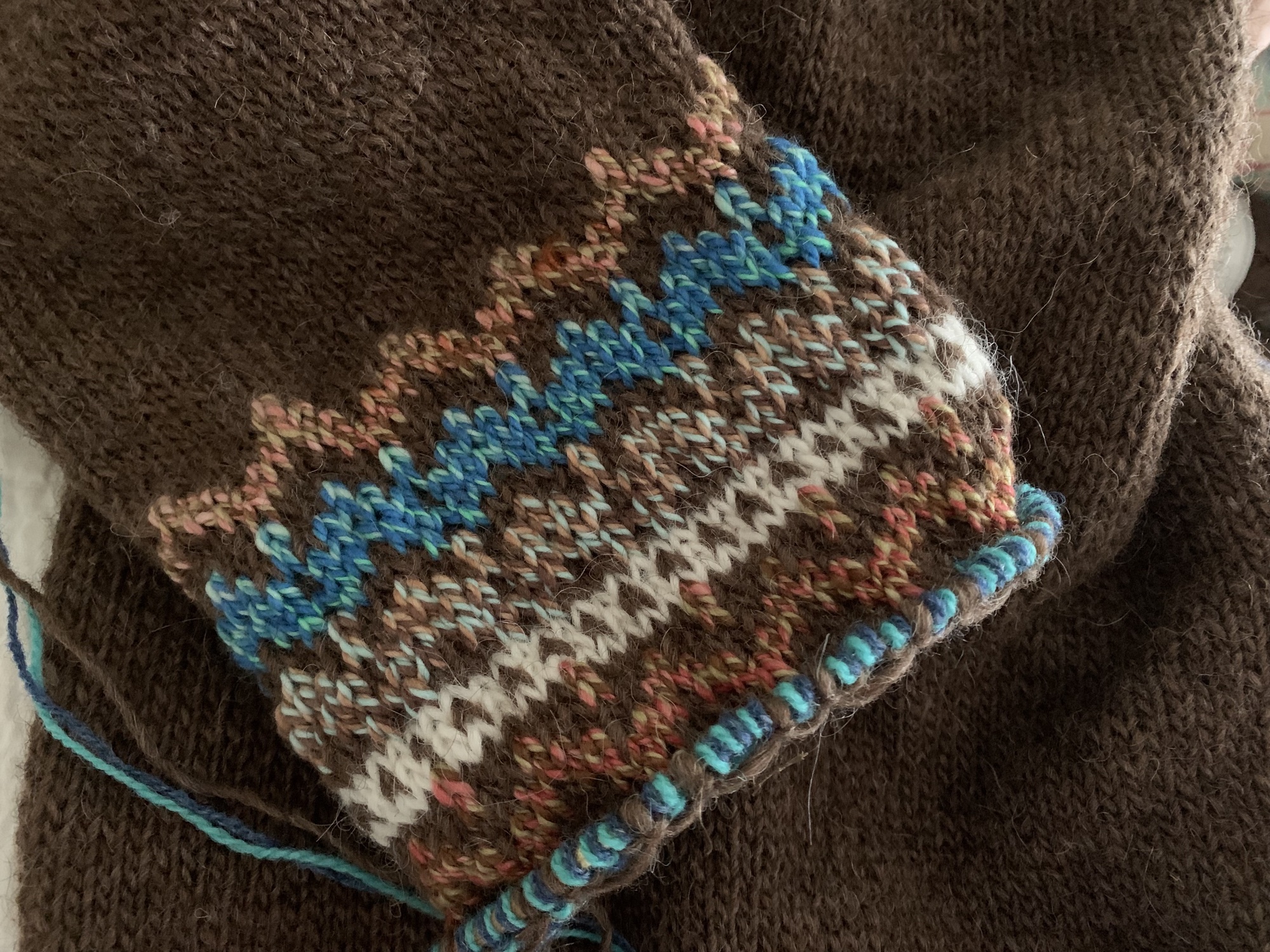
I substituted my own colorwork pattern on the sleeves. This is not part of the pattern. I debated omitting colorwork on the sleeves, but in the end I changed it up instead. It was an opportunity to use up the yarn and incorporate the white which is on the neck.
I ran out of the blue yarn and substituted two strands of Jamieson and Smith fingering held together.
The ribbing is twisted rib, like the body ribbing. This is also my own doing and not part of the pattern. I like the looks of a twisted rib. To do it, simply knit through the back loop, and purl – around.
Sleeve colorworkBlue at top is original worsted, blue at bottom near ribbing is tw strands of J&S held double.Sleeve and yoke comparison
At this point, finishing this sweater is a bit of a chore. I’m ready to move on. My yarn selections were bad (except for the brown Lettlopi), with that colored yarn being very bulky. I wish I had not followed the yoke colorwork and left some brown showing.
The more I knit, the more I realize which types of yarn to avoid, and which I like best. This sweater is really not my style, but I’m sure it will be cozy warm for when I need warmth — two days out of the year!
Check out the Easy V pattern page at Ravelry, and be sure to browse color combinations from other knitters.
Have you knit this sweater? What do you think? I’ll be trying mine on soon – in the air conditioned house.
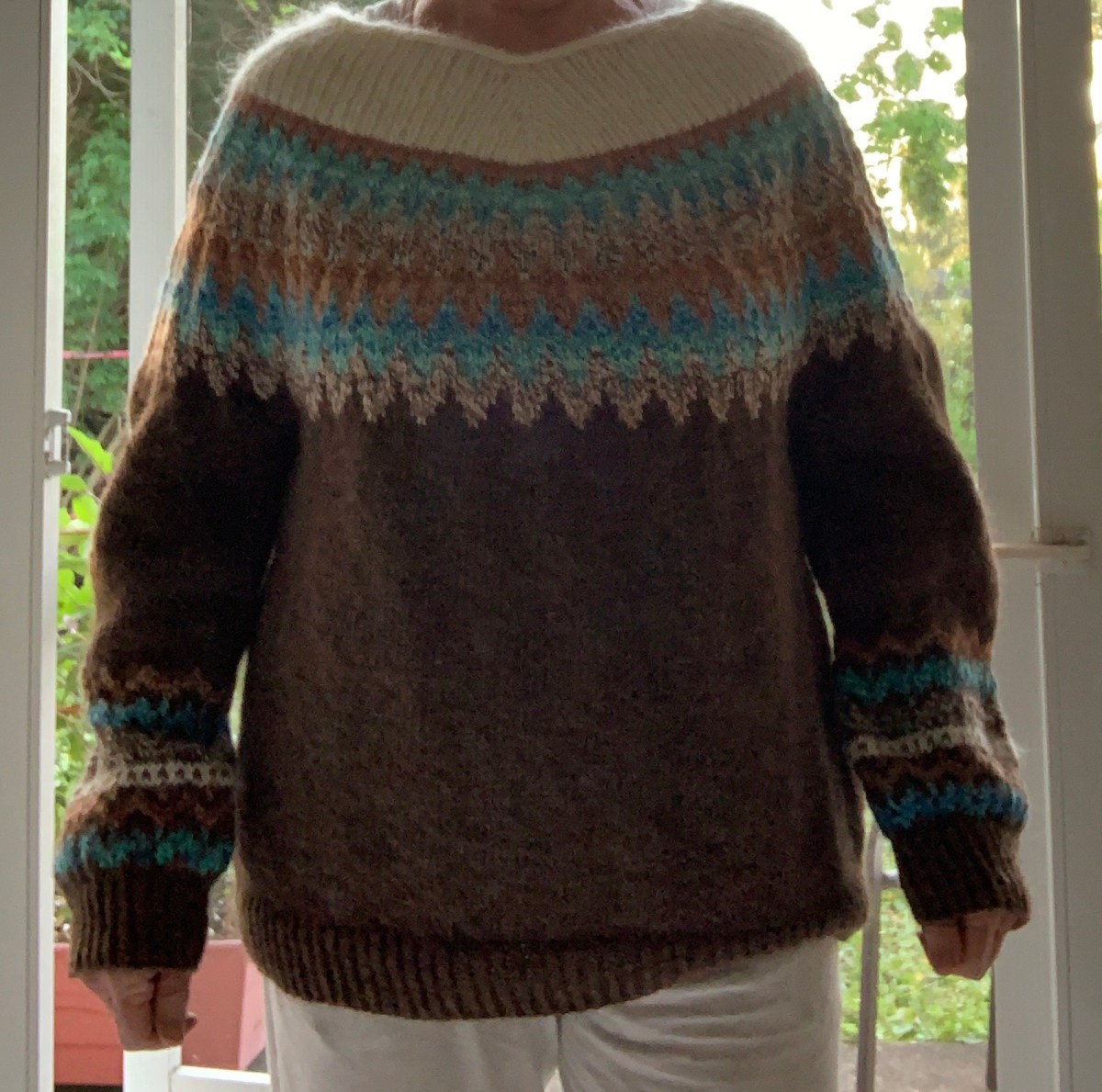
Sweater is dry and here are my photos after trying it on. I’m not too happy with the fit as the neckline is loose and makes the whole sweater sag. I used a size 3 needle to do the neckline, but it really should be tighter. I’m not happy with the outcome.
Writing a blog, sharing photos, and doing research and making links takes time. Lately I don’t think the time spent doing all that is worth enough to continue. I have stopped writing my gardening blog,…
The peaceful days of camping in the wilderness go perfectly with knitting. What could be better than having coffee outside, with knitting on my lap? We camped twice in the last month and here is…
Knitting the ribbing around the v-neck for the Arco Iris sweater pattern.
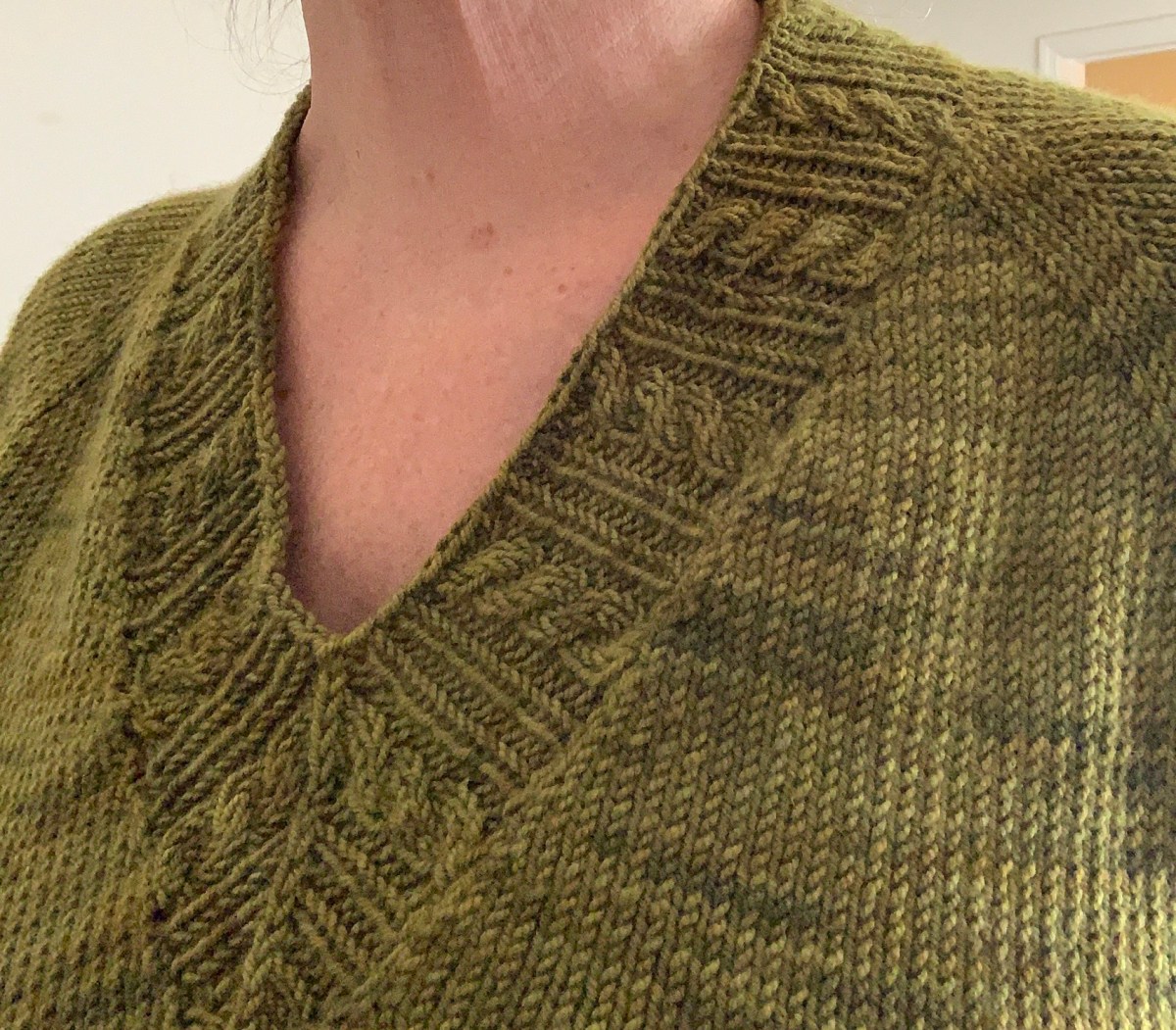
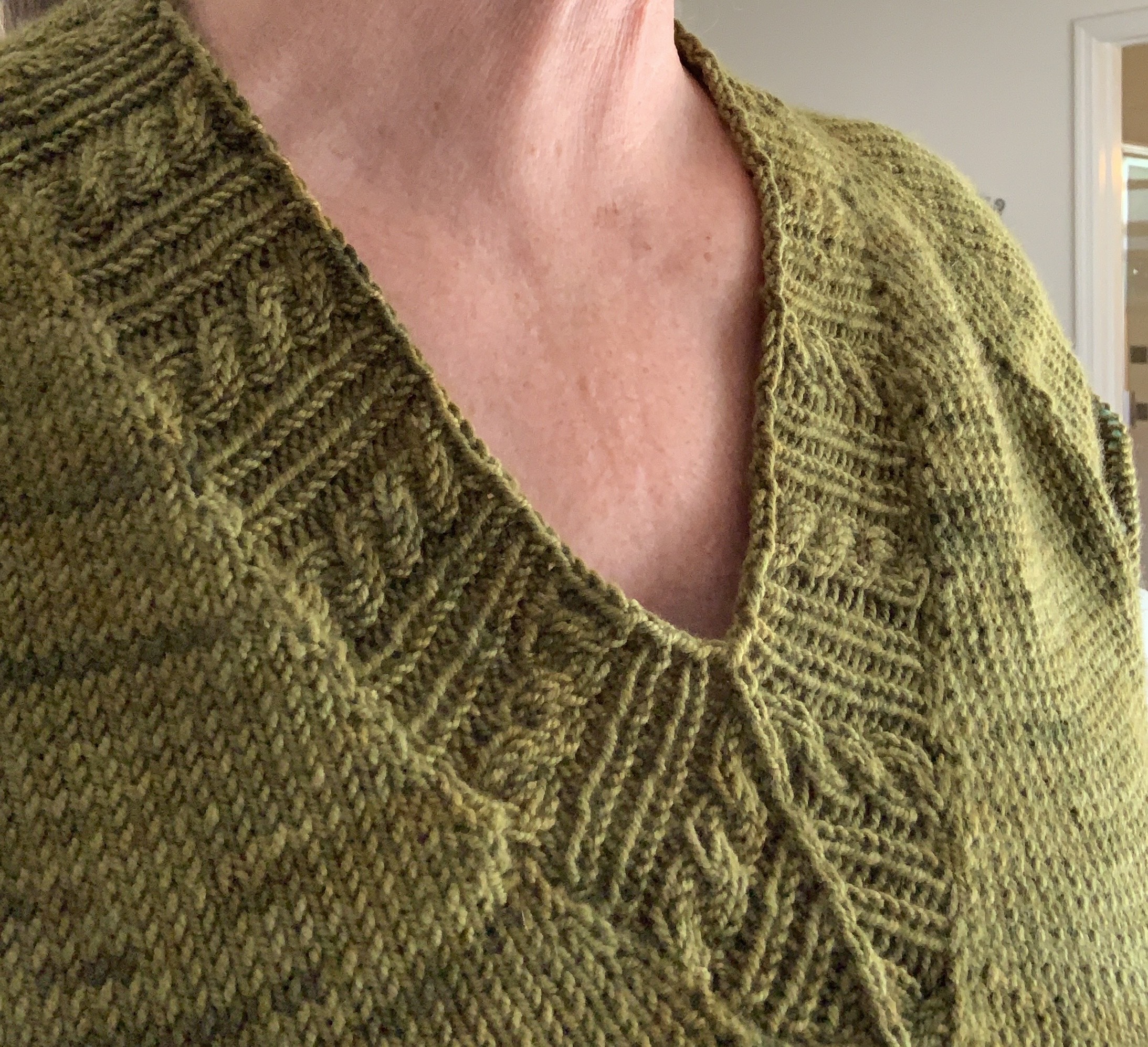
This v-neck sweater, the “Arco Iris”, has a pretty ribbed and cable border around the neck to match the sleeve cuffs and body ribbing.
Once I got the sleeves put on hold, and began knitting the body, I decided to take on that v-neck ribbing. I had a quiet day to myself, and decided not to knit round and round, but take on the challenge of the neckline.
Picking up Neckline Stitches
This pattern tells you exactly how many stitches to pick up for each section of the neckline. I had no trouble picking up stitches for the back of the neck. Each loop was easy to see. But going down, and then up, the V got tricky.
I have decided that I absolutely hate doing this. I came close to throwing the knitting across the room.
For this sweater the stitch count must be exact. The cables and ribbing are done in multiples of 9 / 18. I ripped out my pick ups more than I will admit, and finally gave up and did the best I could.
I ended up 5 stitches short and added those stitches back in (using backwards loop cast ons) when I did the first row around. So my advice to you is to maybe keep this in mind so you don’t go insane.
Skittle the Cat had to jump up into my lap at exactly the WRONG TIME. I had dropped a stitch and was trying to fix my problem while the cat insisted that I pet her. All I could do was laugh at the unlikelihood of that. Finally she settled in on my lap and was happy for me to continue knitting.
The first couple of rows of directions on the neck are the set up pattern for the cables and rib. Once that is done, the pattern gets very easy.
Once I finished the neckline, I put my body stitches onto waste yarn so I could try the sweater on and see how it looks. I actually like it a lot. My cables are off, but once I did one wrong, I had to continue to do it the same (left leaning / right leaning) way. Most people will never notice my mistake.
When you are told to do a “cable crossing every 4th round”, do the cable as you did in the beginning. The “lefts” will always be left. Each cable will be done the same way – with yarn held either to the back or front. If you are not familiar with cables, this could be confusing.
As I knit, the circle for the neck opening kept getting smaller, and I was getting worried, but it ended up perfect. That front part of the V is a decrease, so the circumference gets smaller on every round. I ended up using a 16” circular needle but began with a 24 inch.
Don’t make the bind-off too loose. You won’t want the neckline gaping open. Also, don’t make it too tight!
This pattern is not one of the easiest to follow. I’ve knit quite a few sweaters over the past couple of years. Some were lacking in directions, one in particular I simply hated, and many have been fun and easy to knit. Occasionally there will be a small mistake in a pattern, which is understandable. Common sense may be all that is needed to keep knitting.
I respect the time and effort that knitwear designers have put into creating their patterns. I suppose a designer may assume the knitter will figure it out. But I like to be told specifically what to do when knitting. Usually all it takes it one more sentence to explain.
What About the Test Knitters?
What is a test knitter? Someone who knits the project just as it is written. They look for problems and make sure the pattern is ready for everyone to knit. Usually designers will search for knitters who will make the pattern in a variety of sizes to be sure the pattern works for everyone. The testers are in touch with the designer and communicate any and all problems with the pattern to make it read to sell.
One test knitter included no notes at all. I guess they don’t have to. (I recently finished a Jenn Steingass sweater and she had a ton of test knitters, who did include helpful notes, and that pattern was very easy to follow.)
Test knitter Toriyu had helpful information which I am actually following, but she is the only one with useful notes.
The other test knitters had skimpy notes such as “made the sleeves longer”. Not a single one of them found problems with the purl increases… apparently. Or if they did, they may have told the designer, who knows? All I can say is that I found a few parts of the directions difficult to understand. And I probably would have gone ahead and done the purl increases incorrectly without realizing.
I’m going to leave notes on my Ravelry page incase anyone has my same problems.
There have been 76 projects knit (according to Ravelry numbers as of the date of this writing), or begun, by knitters such as myself, on this sweater. The pattern came out in December 2022, which means it is a new pattern (this is January) and lots of knitters plan to knit it. In the end this should be a beautiful new addition to the wardrobe.
Onward I knit. I’m thinking the most complicated part is behind me.
My son worked Thanksgiving Day and since it’s only me and him, I spent the day getting a new knitting project on the needles (I finished it on New Years Eve). The Carbeth Cardigan (Ravelry pattern page) is a design by KDD and Co., Kate Davies Designs. The pattern suggests holding two yarns together, but I chose woolly Alafosslopi yarn for this garment.
Lykke wood needlesKnitting the body
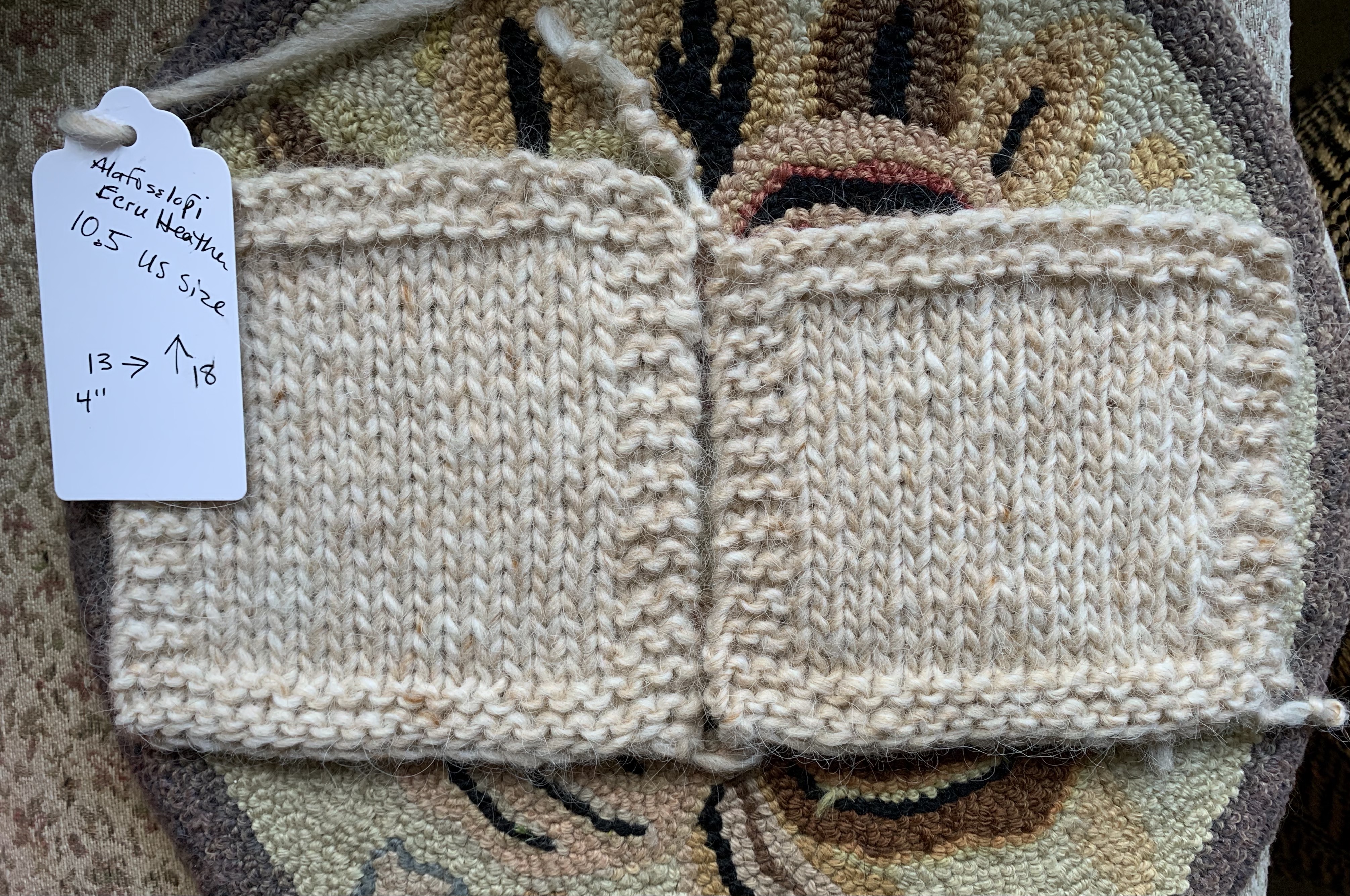
I did a swatch in size 10.5 with Alafosslopi yarn which was too large, so knit up another in size 10. That one turned out to match gauge exactly. I’m knitting this sweater in Icelandic wool which is bulky weight. Color is Ecru Heather. I will also need below gauge needles for the ribbing, neck and front bands.
Sweater Construction
I began with a sleeve and since I did not have a “below gauge needle” I knit the rib with size 10. The cuff is long. The body is knit, bottom up, and then everything is attached. This makes sleeve length a bit tough to figure. I knit 19.5 inches and the pattern called for 18. I’m glad I went longer. This pattern seems to have been written for a mini-sized person. I am 5’5” so pretty average.
Here (below) I have reached the point where my decreases are almost done. The back of the neck seems low, so I will try to figure out my own short rows to bring it up. Other knitters have done this and I can see why.
Adding Short Rows to the Back of the Sweater
I watched this video to figure out my short row placement, but added a life line (good video at Very Pink Knits about adding a life line) before I got to this point. I’ve never tried to figure out my own short row placement and wanted to be able to rip them out if need be.
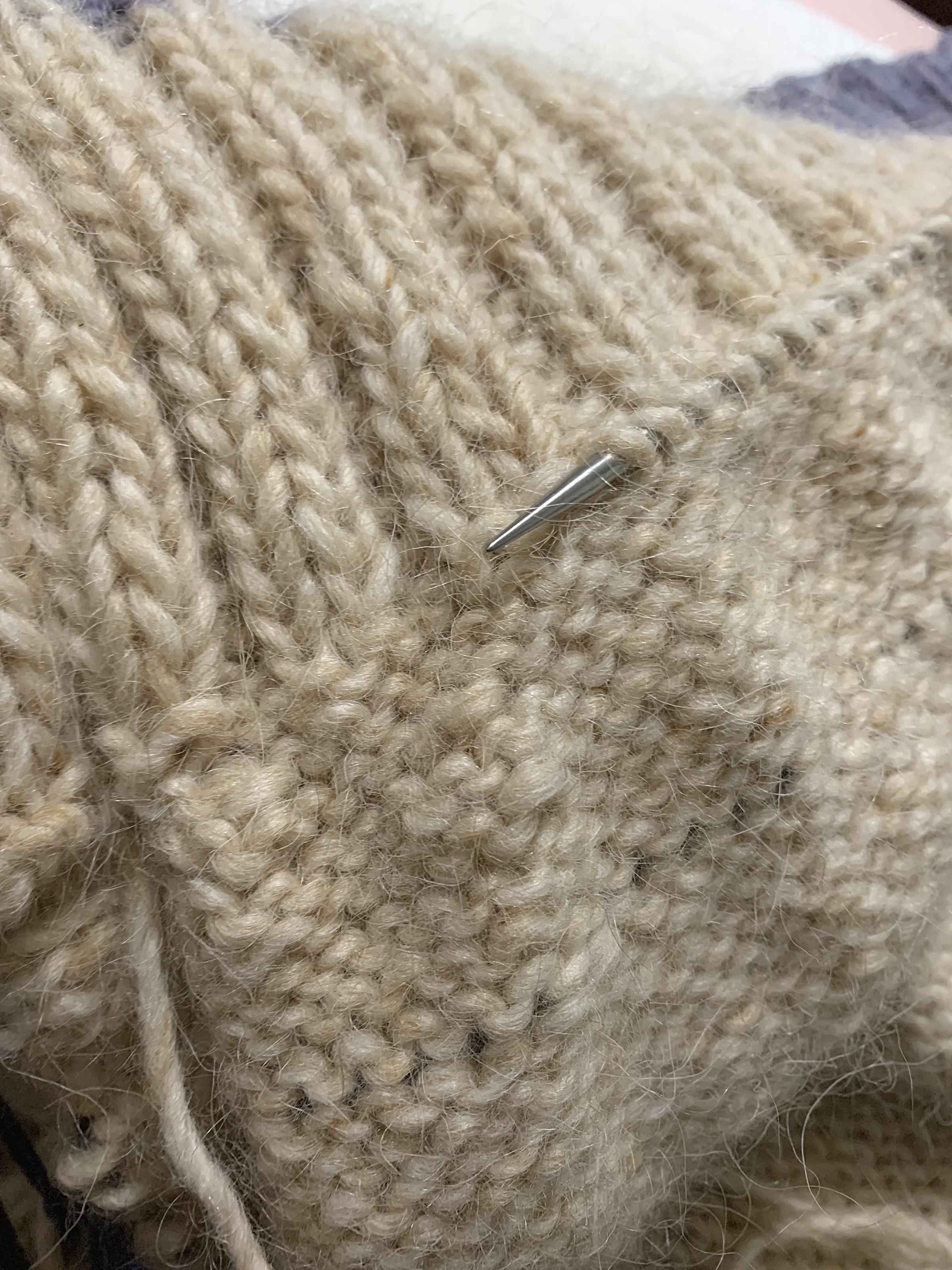
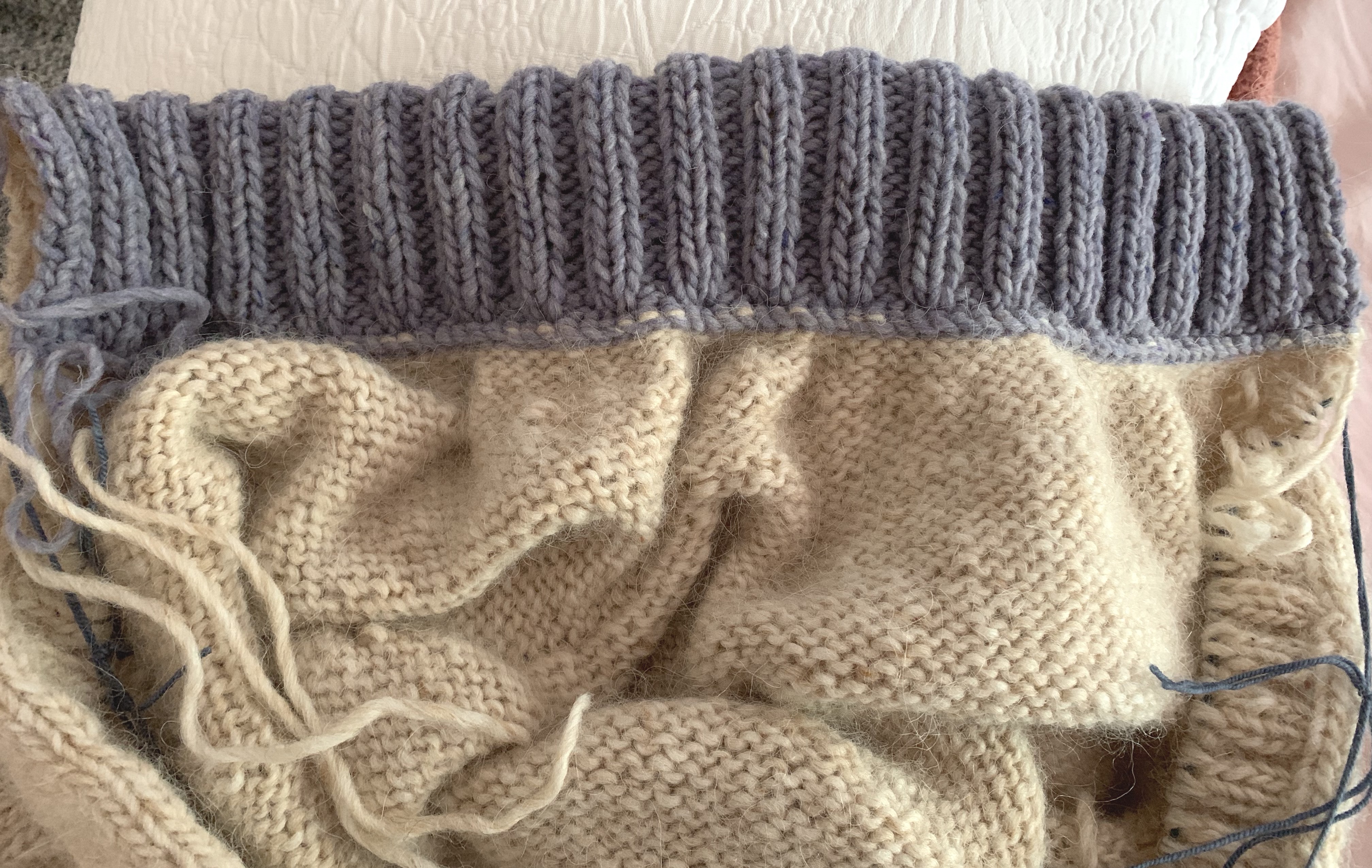
The blue yarn is my lifeline. Above that, in the center of the back, see the raised part which happened when I added short rows. I’m very glad I did this as the sweater seems to fit better.
Short Row Placement
I marked off the stitches for my short rows one row too early. Next time: Do short rows after the last row where the two center back stitches are purled together (or knit together for some sizes) and markers are removed. This is the row just before the neck decreases begin. **Another knitter made a note that she did the short rows after the decreases. This may work better as my short rows left a bit of a pucker in one spot. I didn’t notice this until AFTER the collar was worked, and I was not ripping that far back!
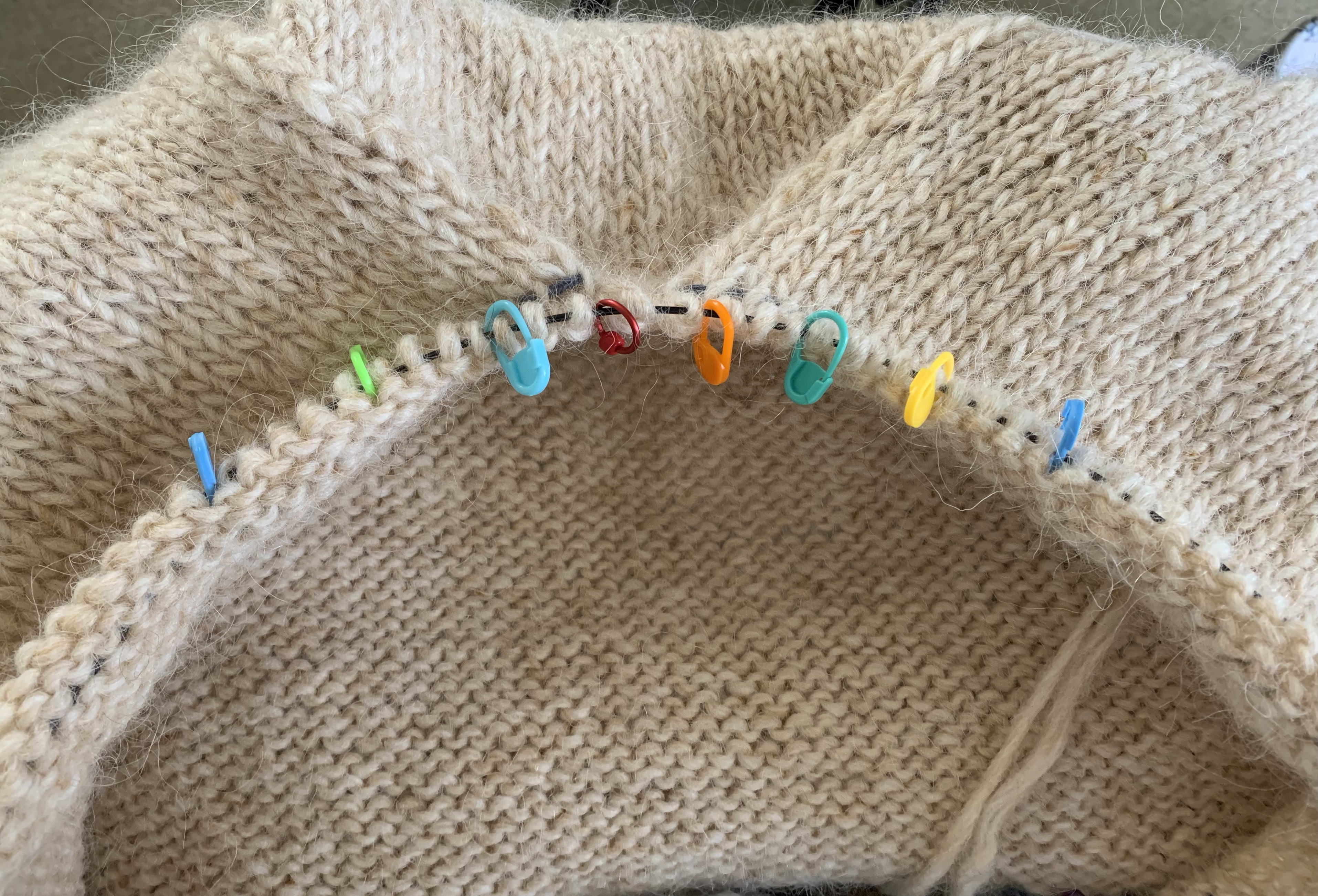
Adding a life linePlacement for short row turnsLife line and short rows visible with neck ribbing begunShort rows beneath neck in back
The Front Bands and Neck Ribbing
There is a lot of putting stitches on hold in this sweater. Once the joining of the sleeves and body and yoke knitting is done, stitches are held until time to knit the collar. The collar and front ribbing is knit on the smaller gauge needles. I have one size 9, 32-inch needle which I needed for all of this. The front ribbing has to be completed before the collar is knit.
The front bands were difficult for me as far as trying to pick up the right amount of stitches to make the top three work. Also, because I knit the body two inches longer, I needed to pick up extra stitches and not what the pattern said..! I ended up doing about 80 stitches on each band – which were way too many – but I won’t realize this until it’s way too late.
The button loops are added with an i-cord edging so no buttonholes were made.
Front ribbing on hold with neck ribbing begun
Neck Ribbing
The neck stitches are knit in ribbing and will be folded over to the inside and attached. I followed the advice of other knitters and put a softer yarn inside the collar. I used gray Quarry yarn because I had it, and it matches the thickness of the Alafosslopi.
Knitting the neck was easy but then it had to be folded and attached inside. I used a size 5, long circular needle with pointed tip to pick up those stitches. You really need much smaller needle to make this easier. This video helped me see what exactly I should be doing as far as picking up stitches. I picked up two stitches for each knit and each purl section and then two stitches on each end. This matches the number of rib stitches to do the bind off – that number has to match the number knit for the ribbing! Purl Soho has a good 3-needle bind-off video if needed.
I used a much smaller size needle – size 5 US when picking up those stitches. Then I used a size 9 US DPN to knit the bind-off. I began binding off with a 5 DPN but the stitches seemed very tight. (A helpful note from the designer about all this would have been very nice!)
pick up stitchesReady to bind off3-needle bind off doneCollar turned and attachedAttaching the Ribbed Collar
Explaining Pattern Section 8
I got to section 8 in the Carbeth pattern and was stumped. After some searching, I found a good explanation in the Ravelry forum, because it seems other knitters were also stumped.
The point in section 8 is to close up that hole in the collar, which was made by folding it over, by picking up stitches along the edge. Then, the collar and front band becomes one long set of stitches.
My band is being held by scrap yarn so I needed to pick up all those band stitches also. Now the needle is full, from top of collar to bottom of sweater. Go back to the top (on one side, the bottom on the other) and begin the i-cord bind off.
Although this video, by Andrea Mowry, is not exactly how the i-cord is done in the Carbeth pattern, it gave me an idea of what I needed to do, only with a different amount of stitches. Begin the Carbeth bind-off by adding two stitches to the LEFT HAND NEEDLE, and continue as the pattern says.
Firsts For Me While Knitting This Sweater
I did my very first spit splice using this yarn! It was pretty cool and I will definitely be using it more often when knitting with wool.
The lld decrease on the wrong side. Clear directions are given in the pattern abbreviations page.
Added my own short rows – successfully – for the most part. I’m very glad I did this because the sweater would not have been “high” enough around my shoulders and neck otherwise. I’m very surprised the pattern didn’t include short rows as many knitters added them in on their own.
It was not my first 3-needle bind-off, but the first time I’d done it to tack down a double collar.
I-cord rib and buttonholes. This was pretty easy to do, but the fact that I had picked up too many stitches (way back) for the bands, made the ribbing wavy. At this point I was frustrated.
I am trying to fix this with button placement and blocking. A simple note from the designer about how to pick up those front stitches – such as “pick up 2 stitches for every 3” – or something, would have helped. She does say how many to pick up – if you follow the pattern exactly and want a cropped sweater.
Final Review of Knitting the Carbeth Cardigan
Some previous knitters of this pattern mentioned that the sweater runs small. I would agree. I made my sleeves and body longer.
In my opinion, it is necessary to add those short rows at the back too. My gauge swatch was exact, so I chose the correct size to knit, it just would have been very small had I followed the pattern.
There is a lot of picking up of stitches and putting stitches back onto needles. Also, parts of the pattern directions were difficult to understand, and I needed to search the Ravelry forum and use YouTube videos (none were referenced in the pattern) to figure things out. I have notes written all over this pattern just in case I ever want to knit it again …. which I highly doubt.
I love that this pattern uses a bulky yarn because the project is completed quickly. Overall the construction is unique, but it’s not flattering to my shape and the button bands are wonky due to reasons mentioned above.
Because many parts of the pattern needed some figuring out, I certainly would not suggest it for a beginner sweater knitter.
Finished knitting the Typha cowl. I had trouble figuring the gauge for this because I was not very experienced, but I should have gone up at least one size in needles.
Finished Cowl
I am knitting a cowl in shades of pink – the finished photo above most closely matches the actual colors. This pattern comes from designer Kirsten Kapur and is named “Typha”. The link takes you to the Ravelry page where the pattern is sold as a download.
The cowl is a simple one to create, with the first part being a simple garter stitch. One row of knitting and the next of purling. After that, a simple repeating lace pattern is followed to finish off the cowl. The pictures below came out very “Pink”.
Done a few rows of the lace part of the cowl.
The second part of the cowl is a lace pattern. After knitting a shawl in the Through the Loops Knit Along, this pattern is very simple to follow. And I believe that most knitters with some experience can easily follow the pattern. It is fun to do.
Cowl knit in the round in lace and garter stitch
I will admit that getting started with this pattern was not easy. For some reason my cowl is coming out much smaller than the pattern implies (Go up 1 pr 2 needles size next time!). I did do a swatch to check gauge, but I am not familiar with figuring out gauge and finding it with a lace pattern threw me off. (Now I know to knit the pattern in a 4×4 square to measure for gauge.)
Consequently when I tried to cast on (for first the smaller cowl, and then the larger) the yarn did not reach, so I had to begin over.
My yarn is obviously thinner than what Kirsten used to create her cowl. The yarn she used is Fibre Company “Meadow”, which is listed as “heavier lace”, so I bought “heavy lace yarn” from Miss Babs, thinking it would be the same. I guess not. Live and learn… that is my motto, and once again, I have learned from making a mistake.
So my “long” version will actually be short, and probably not long enough to wrap twice. My plan was to make the shorter version of the cowl to give to my daughter, but now I will keep this one and try again to make a correct size for her.
I do plan to make this cowl again using a heavier yarn and trying to figure out my gauge. It’s a beautiful and unique cowl in the two colors, which gives us many color choices.





















 New England's Narrow Road