Tips For Beginning the Birthday61 Sweater Project

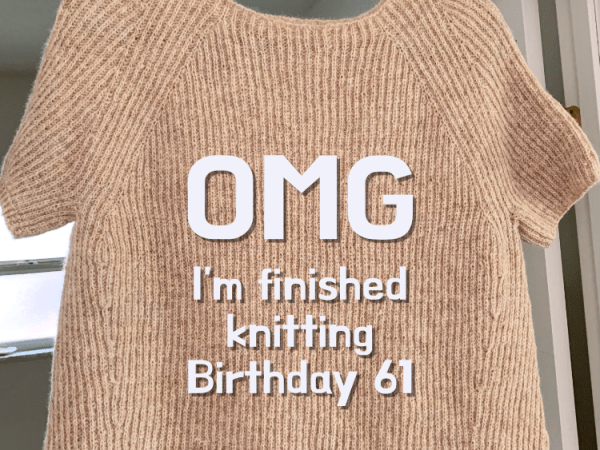
I’ve begun knitting the Birthday61 sweater pattern in half-fisherman’s rib. Here is my review with advice and tips for beginning this knitting project.

The Birthday61 sweater is a one-color pullover that is knit in half-fisherman’s rib. The yarn suggestion is fine fingering. My swatch is done and I have begun the project.

I sometimes get questions from readers related to a pattern. So I want to supply as much information now as possible NOW when the pattern is fresh in my mind. Five years from now (or even 5 months), I will have forgotten what I did.

Answering Your Questions About the Pattern

First I want to emphasize that Ankestrick has a forum at Ravelry that is especially for help knitting her patterns. That is where you should ask pattern questions! Begin on this page (sign into Ravelry to view) and search for your pattern alphabetically. Every pattern, by Ankestrick, is listed, so find the one you are working on, and ask the question there. I had a question about knitting the swatch, and I received a fast reply.

I am writing this blog post to help you knit this project. However, by the time you read this, I may have completed this sweater long ago. I will most likely not remember how to answer your question. Use the Ravelry forum for best results.

Also, Anke has a list of Special Techniques for her patterns. I watched her video for casting on and followed it without much of a problem. Although, the knits and purls tend to curl up and look bad, I managed to get through it.

Beginning the Pattern, the Cast On

I did Anke’s cast-on and row 1, which is the set up row, using a size 0 needle. (See her techniques link above.)

On Row 2, I switched to my main size 1 needle (16″ circular). I’m not sure this is necessary, and the designer does not suggest it. But the cast-on is like the Italian tubular where a smaller needle is used first. *Also, be sure that join looks good. It will be prominent in the middle front of the sweater neck.

Yoke markers and short rows could be confusing for some knitters. The directions are excellent. The designer provides a diagram for the placement of the stitch markers. This is very helpful for knitting the short rows.

To help keep things straight, I used various colored stitch markers. The colors designate a different section. The front (pink) and back (black) and sleeves (green-blue) – will get the increases. All of those sections are separated by a raglan section which will not be increased.

The color coding helped me a lot to visualize which part of the sweater I was knitting. Be sure the BOR marker is easy to see – make it different (I used a seahorse).
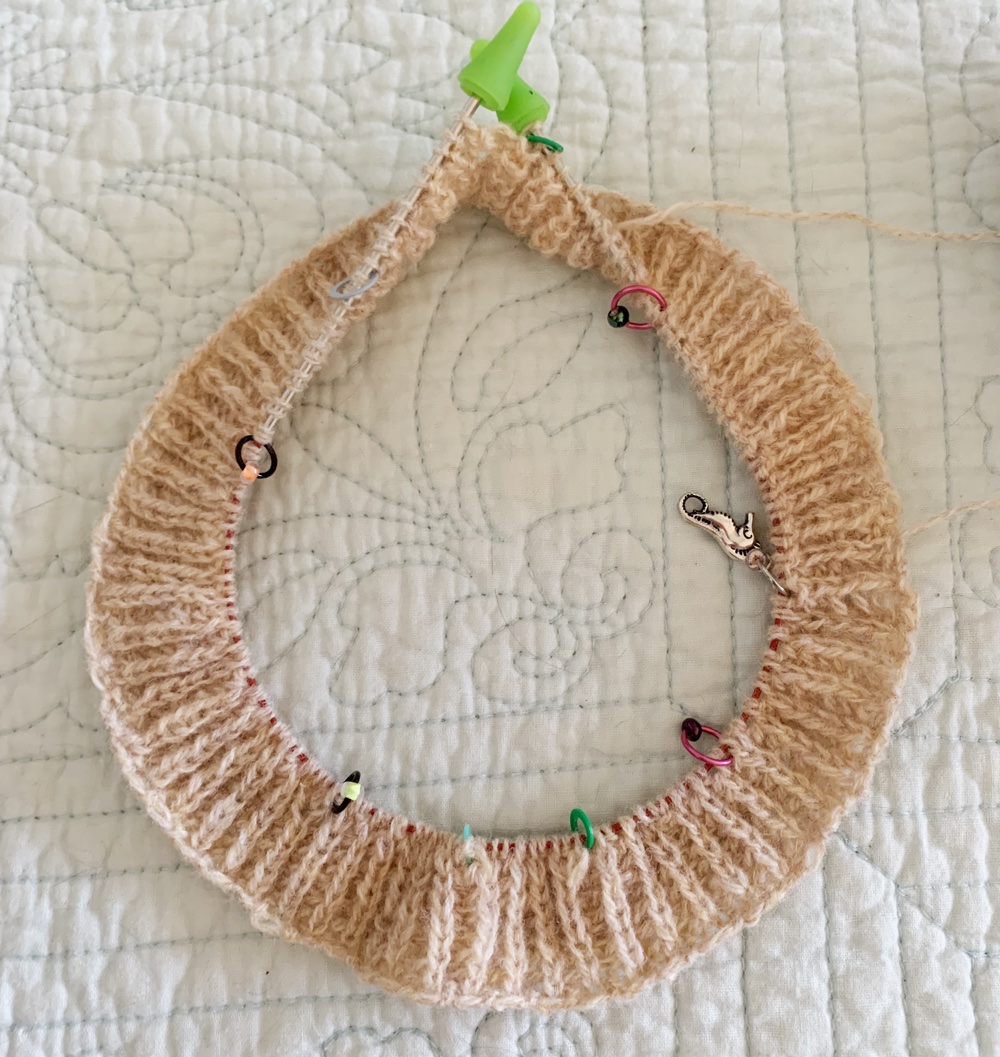
Birthday61 sweater cast on
Marker placement – BEFORE the yarn break for Birthday61

To begin with, the beginning of the round is in the front. Then, later we move it to the back.

Dealing With Knitting Mistakes

I picked up the project to get a new picture for this post and found a BIG FAT MISTAKE! It was staring me in the face, and is very obvious. It is a few rows back and I will not be trying to fix it. It is in a raglan section and I knit the whole section incorrectly. But I occasionally have small mistakes to fix.

I can’t believe I already have a mistake, but it won’t be the last. I only hope that my goofs won’t be too noticeable once the sweater is complete.

Missed the Increase? Here’s what to do.

This brings me to another issue I had. How do I fix, or rip back, a half-fisherman’s rib stitch? It’s tricky. It is helpful to use a tiny crochet hook. When you un-knit the stitch, it will leave 2 strands on your needle. One must be pulled through under the other and put back onto the left needle.

This happens to me when I am on an increase round and I forget to do the increase at the beginning, or end, of the section. I’ve already begun a new section when I remember I should have made the increase. I will only rip back a few stitches at most. If I am far ahead, I simply make up the increase later.

1. Ripping back Fisherman’s Rib – I’m not sure why she has 3 strands to deal with except that it’s not “half” fisherman’s rib. She is knitting the same rib on both sides of her work. We are knitting into the loop below on every other round for this sweater, which is called half fisherman’s rib. To fix a stitch we still have to pull a stitch under the other one.

2. Here is a video about fixing a mistake in half fisherman’s rib when the mistake is many rows back. It’s a little intimidating to me. Some of you may find it helpful.

*Be sure to count your stitches in each front, back and sleeve section and make sure they match up to the pattern. This helps point out missed increases.

Where I’m at on this Project Today

After many hours of knitting, I am still finishing the yoke. I have not separated for the sleeves yet. I’m measuring lengths to be sure the yoke does not get too long. For my size, the yoke length should be 9 inches and I’m nearly there.

knitting Birthday61 sweater
Progress on Birthday61

And then this…

It is mid January and I have separated the body and sleeves. I added waste yarn the same way I always do – with two strands. It went fine.

I’ll have to add a few increases as I begin the body because my counts were off. The yoke was getting long and I skipped a few rounds before the separation. I have 115 for back and front. It should be 123 for my size. I need to add 8 stitches to each – front and back. I’m not worried about the missing 2 stitches for each sleeve.
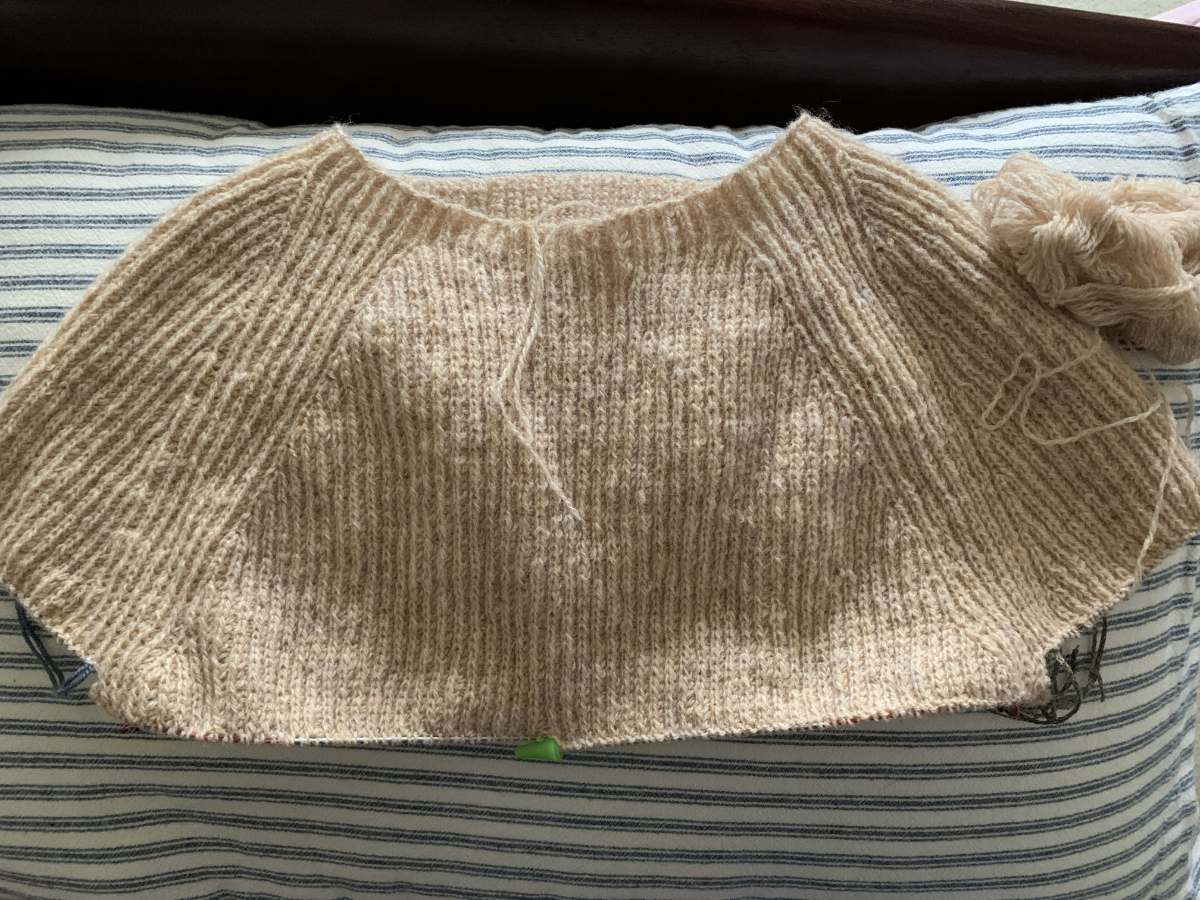
knitting sweater sleeve and body separation
Sleeves and body separated

I am loving the yarn. The light color makes knitting easy.

More sweater knitting posts

Cast On For the Rebel Cardigan

Some info here on beginning the Rebel cardigan. This is a top down sweater with a very unique construction at the beginning, which sets up the remainder of the knitting.

The Rebel Cardigan has been on my list of “to knit” items for a few weeks now. I had to finish knitting the Field Sweater, which I did, and immediately cast on this new pattern. (Pattern link at the bottom of this page.)

I’ve never begun a sweater like this. It’s begun in small sections, putting stitches on hold, and then knitting in another direction. It honestly looks a little weird.

This will be a long-sleeve sweater with an open front and no buttons or button-band to knit separately. This greatly appeals to me! I love the look of it.

Getting Started

The yarn I chose is by Knitting For Olive. I’m holding two strands, merino and mohair, together. The colors are Pea Shoots and Dusty Artichoke.

I’m knitting the Rebel sweater size 4, using needles size 6US.

Knitting for Olive yarn in green
Pea Shoots and Dusty Artichoke colors by Knitting for Olive.

The Rebel Cardigan pattern is written very well. Schematics are included so we are sure to know exactly where to begin knitting each of the sections. This is very helpful.

While knitting, we are putting stitches on hold (waste yarn), picking up stitches from edges and from waste yarn. All this is forming the collar, back, and right and left front. Soon it will all come together and make more sense, I’m sure.

Rebel cardigan knit in sections to form the collar, back and sides.

Below is my photo after all sections of the Rebel cardigan are attached. Now knitting is done back and forth – knitting on the right side and purling on the wrong side, while increases are made for the sleeves and the back / body.

knitting Rebel cardigan
All section attached

The sweater will end up with a wide 1×1 ribbing down both sides of the front. The sleeves and remainder of body are knit in smooth stockinette. It’s a pretty clever design. One reason for doing the knitting this way is to help keep the sweater sitting correctly on the shoulders, and not slipping off as some cardigans have a tendency to do.

If you are interested in knitting this unique sweater, I have provided a link to the pattern here, which goes to the designer’s Ravelry page.

Read the Blog

Learning the Tubular Cast on For Knitting Hats and More

Found some tutorials for knitting the tubular cast on. This one looks so nice when it is accomplished, but may take some practice.

For every pattern I have knit that suggests a tubular cast-on, I skip that part and do my usual German Twisted cast on. One time I did try to do the tubular and it was a disaster. Now, it’s time to try again.

The tubular cast on gives the edge of any 1×1 (or 2×2) ribbing a “rolled” appearance, without an obvious front and back. Often it is used for hat brims, sock tops, collars on top down sweaters, ribs on bottom up sweaters, mitten cuffs or flat knitting the edge of a ribbed project. I have found that it is not an easy thing to accomplish, but worth the trouble.

On this page I have linked a variety of tutorials for doing the tubular cast on in the round and doing it flat. 

Three Ways to Do the Tubular Cast On

I’m covering three general ways to begin and knit a tubular cast on. There could be more, but these are the ones I tried – to some extent. Some tutorials are done English style (yarn held in right hand) and some are Continental (yarn held in left hand). Some use waste yarn and some don’t. I had success using Tutorial #3 using a crocheted cast on.

Tutorial #1: Backwards Loop Cast On With Waste Yarn

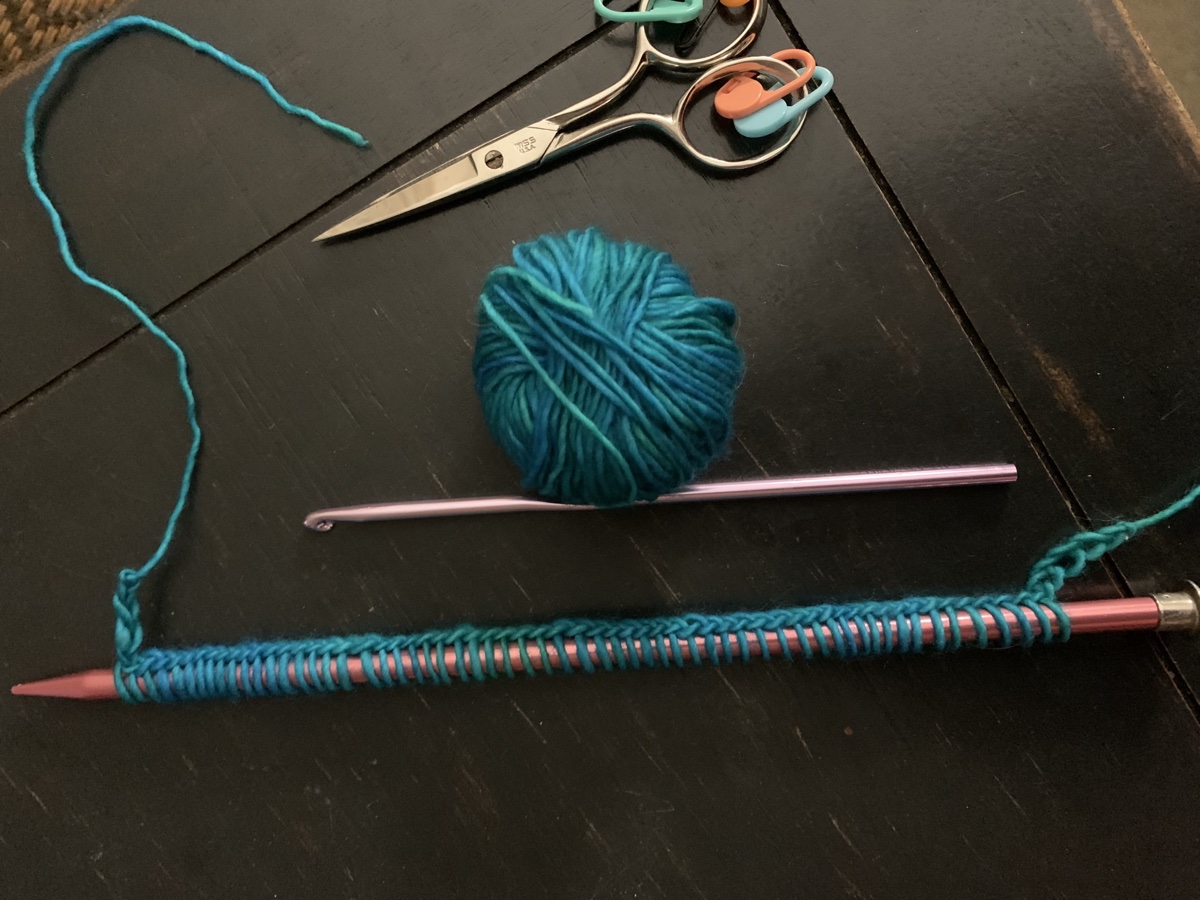
This tutorial shows flat knitting, or back and forth, not in the round. Half the number of total stitches needed – plus one – are added to a straight, or long, needle using the backward loop method and waste yarn. I used a size 3US straight metal needle for this. 

This is all I did. I did not continue with this cast on because I need to knit in the round for my hat. This beginning is similar to the crocheted cast on (see #3 tutorial).

tubular cast on examples
Backwards loop directly onto a straight needle

After a couple of set up rows are complete, the stitches would be connected to knit in the round (if that is needed for the project). She mentions having a video for that, which I can’t find!

Here is her flat knitting tubular cast on tutorial, done English style: Knitting Whimsy Tubular Cast on. 


Tutorial #2: Italian Tubular Cast on, or Alternating Knit and Purl Cast On

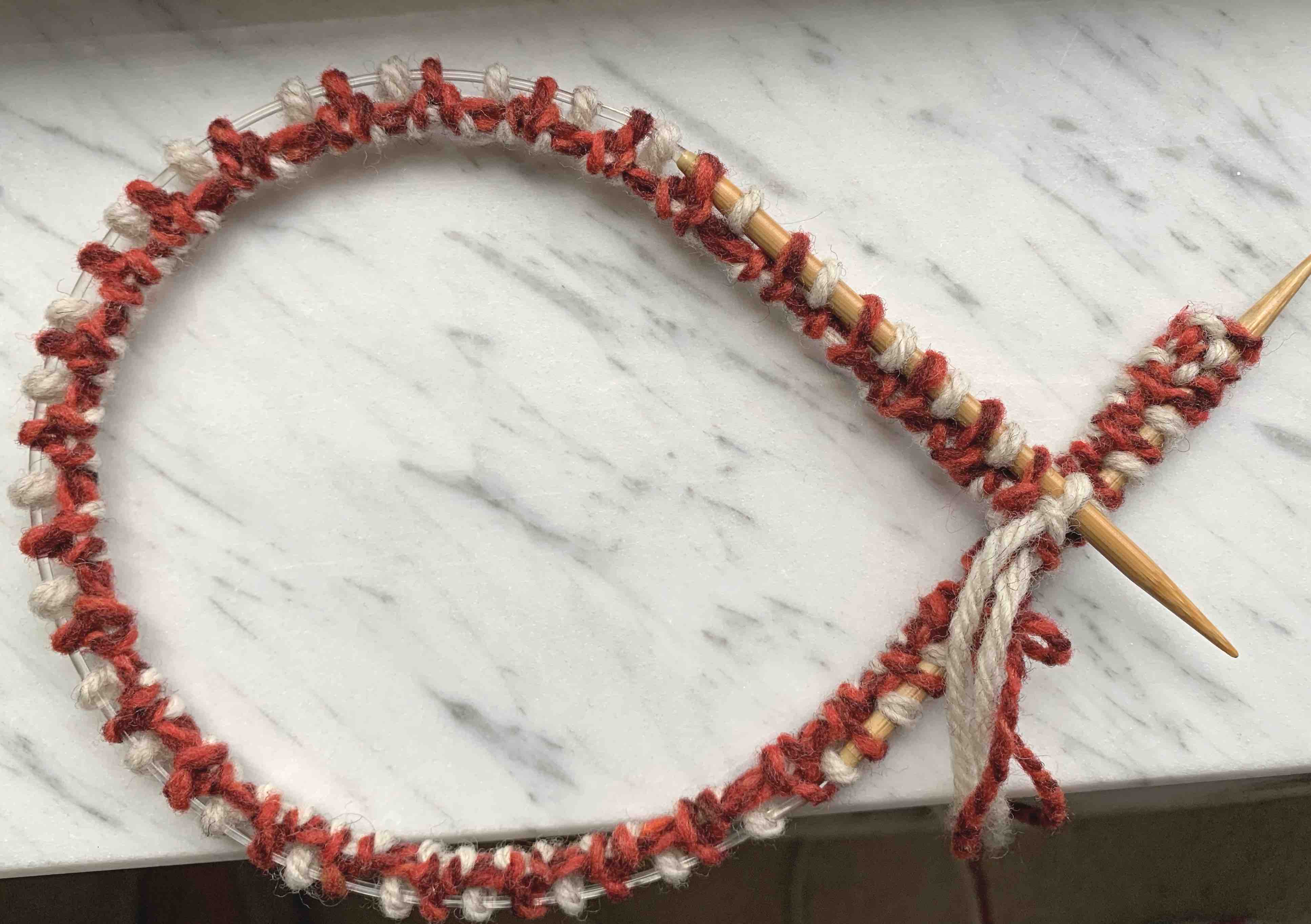
This cast on was tough for me. The Italian Tubular cast on does not use waste yarn. Stitches – all the stitches needed for the project – are added to the needle by doing alternating knits and purls. 

It takes practice if you have never done this type of cast on. Also, the stitches twist around the needle and the whole thing can look horrible and confusing (my experience). Getting them all straight for the first set up row might be challenging. 

Wool Bird has a very good video showing how to do this in the round. She knits Continental style. As an English style knitter, I found this an easy video to follow.

Jared Flood / Brooklyn Tweed has a video: How to Knit: Italian Tubular Cast On. He uses a thin yarn, which is more difficult to see, but it’s a good tutorial for flat knitting, English style. His pointers: Use a needle 2 sizes smaller than the pattern to begin this cast on, snug up the stitches so they don’t roll, and do a backward loop to hold the stitches in place when finished.

Ysolda has an excellent, and slow enough to follow, video here. She knits English style and does show how to join and knit in the round. She suggests doing two set up rows before joining. Near the end of the video she explains how to convert the tubular cast on to a knit 2, purl 2, or two by two ribbing, if that is what the project calls for.

Tutorial #3: The Crochet Cast On

My search for info first brought me to this video: Cushion of Joy. It is the one I was able to get through. She gets right to the point, after talking a bit about why we would want to do all that work for a cast on. Her approach is to use a large straight needle and crochet waste yarn onto it.This cast on needs only half the total number of stitches to begin with.

This video is good but, she knits Continental style and I don’t.  Her waste yarn is nearly the same color as her main yarn, which can be confusing. However, she does connect the stitches to do her knitting in the round.

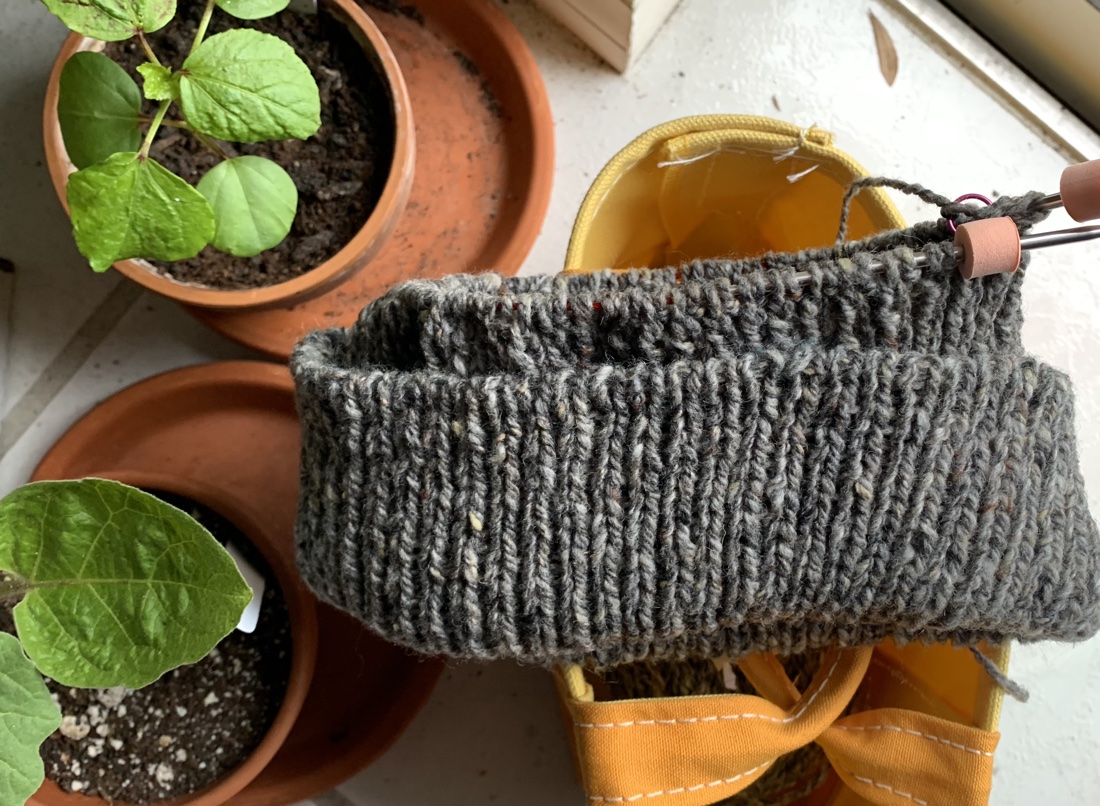
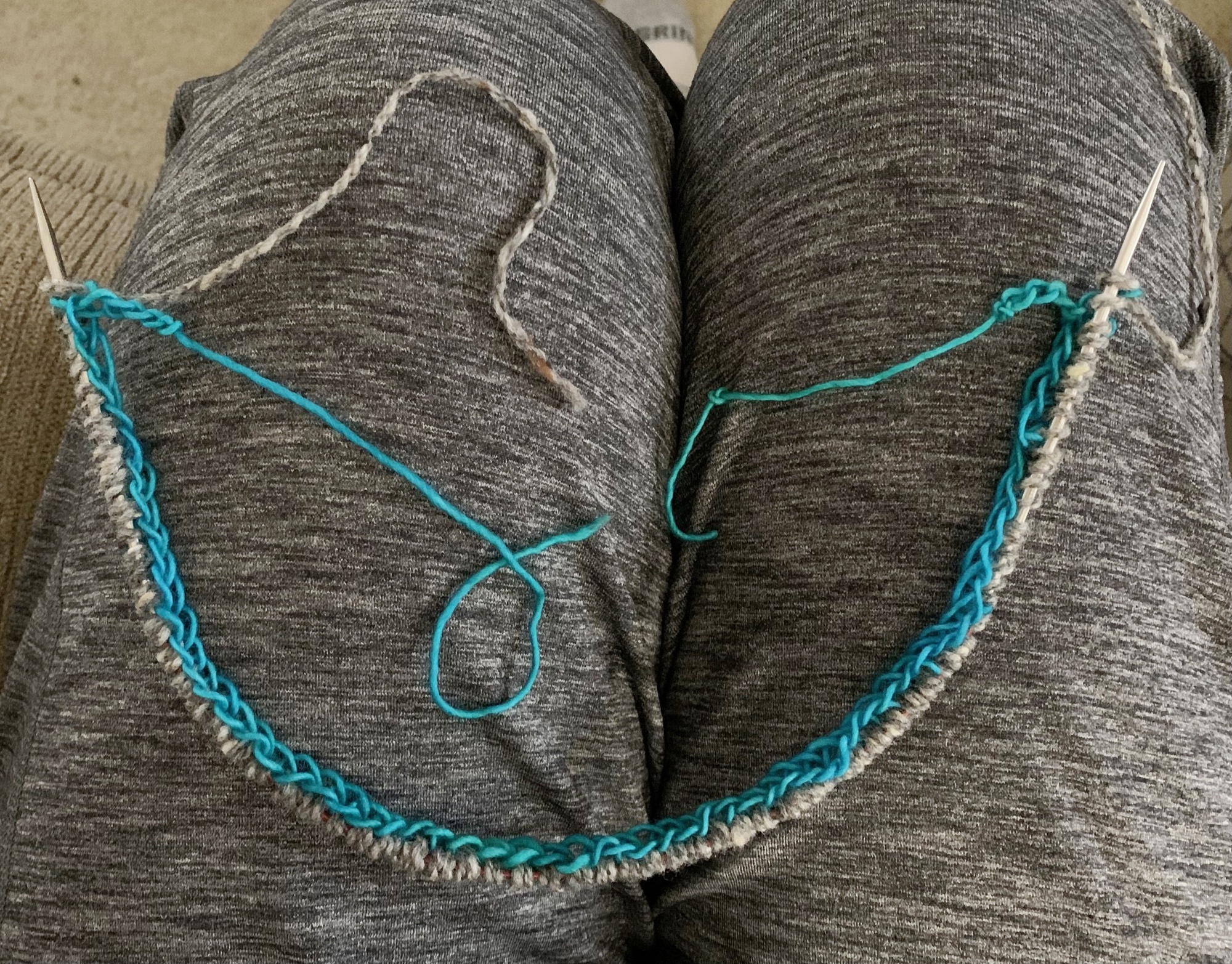
I did have some trouble. Before joining the ends to knit in the round, I made sure all my stitches were straight, as you do normally (middle photo). Once I did my first row, the stitches had become twisted! I fiddled around with it, and just kept going. I was sure the whole thing would be unusable anyway. So watch your stitches on that first row in the round.

This hat pattern (Classic Ribbed Hat – see pattern link below) had 120 stitches for the size I chose. It’s a lot of knitting on something that could end up a complete mess! 

As I knit each row, it was difficult to tell if my alternating stitches were in the right place. I really didn’t know what to look for and the tutorial could have been better in this area.

At the end, my crocheted blue waste yarn did not slip right out either. I had to cut it in various places and pick it out. 

Somehow, and much to my surprise, my first tubular cast on looked pretty nice! It was a miracle…!! I was short one stitch, which I added on my first k1,p1 round. Also, my nubby, tweed yarn is probably hiding some mistakes!

I was happy and amazed that my tubular cast on was usable. When I do it again it should be perfect, right? Now I am continuing to knit on this hat with finished pictures to come.

Be Positive About Learning Something New

If you have the time, always strive to learn a knitting technique you love. This type of cast on takes time and practice, and I know a lot of people don’t have much free time. I had to rip the whole thing out and start over more than once. Sometimes that is part of knitting and I’m here to say, “You are not alone!”

I recently learned how to do magic loop – finally. And wow, it is really pretty easy. This tubular cast on is not necessarily easy, but is worth learning how to do. 


Fiber crafters read on

My Collection of Good Cast-on Videos For Knitting

In knitting the cast-on is the first part of a project and it needs to be done well. Here I have gathered some useful videos that I have used, and still sometimes use, myself to get the cast on row right.

From simple to more difficult, this collection of good cast-on videos may help the newbie like myself. Never did I realize there were so many ways to get the yarn onto the needles to begin a project! I’ve been knitting for a few years now, and I am still finding new cast-on advice.

Doing a cast-on that stretches a little works for nearly every garment from socks to hats. There are specific types of cast-on stitches for ribbing and brioche to make the edge look rounded. It sets up the knitting of the garment, and seems like a small thing, but it can make a big difference in the end product.

I used to believe that a cast on was something to get out of the way so I could just knit. This is not true! The cast on is very important to get right. Don’t rush through, and practice at being as perfect as possible with those first stitches. They ARE important!

1. Basic Beginner Cable Cast-on

The cable cast-on is probably the most simple to do and is recommended for beginner knitters. It is the one I always used in the beginning of my knitting journey. For flat knitting (back and forth) a straight set of needles can be used. If the project is circular, then cast onto a circular needle.

For practice only, use whatever you happen to have on hand. Wooden needles and larger yarn is easiest.

Wooden straight knitting needles

2. The Long Tail Cast-on

The long-tail cast-on is the first different cast-on that I tried. For that reason it is second in my list of casting on options for knitting.

I do not use a slip knot when beginning the cast on process. I simply hold the yarn across my finger and thumb and put the needle down through and twist. It leaves a neater little first stitch. I tried to make a little video, but I am technology challenged.

Cast on and placing markers for the beginning of the Cobblestone Cardigan
Beginning the sweater

3. German Twisted / Old Norwegian Cast-on

This is my favorite cast-on and the one I use regularly. It works for hats, socks, sweaters and mittens, and really everything! This one makes the edging stretchy but not stretched out. Occasionally I do try a new suggested cast-on for a project, but the German twisted, also called Old Norwegian, is rhythmic and easy to do once it’s learned.

Space stitches casting on
Let stitches have some space

Neither of these videos mentions that when you cast on each stitch leave a bit of a space between the stitch as in my photo above. You don’t want the stitches close together. This is what helps to give the row some stretch.

One thing about this cast-on is that usually you will need to figure out the length of the tail before beginning. In general, make the tail at least 4 times the circumference of the end project. For instance, if your hat will be the size of your head (obviously), make that tail end 4 times that length. Some people say 3 times, but I cast on loosely and have found that I need four.

If you run out of yarn – and I have done that after casting on hundreds of stitches (sweaters) – you can turn the needle and do a few regular cable cast on stitches to finish up.

One more tip – Two different balls of yarn can be used where one replaces the need for a “tail”. This way you will have unlimited yarn and won’t run out during the casting on.

Here is an example, although the knitter is not doing the German Twisted, but is doing the long tail cast on. This method works whenever a long tail is needed. The beginning knot will not be counted, and will be dropped off when the cast-on is complete. This can be done using two different colors too!


4. The Garter Tab Cast-on For Knitting Shawls

Many crescent and triangular shawls begin with the garter tab cast-on. Shawls are usually knit with long, circular needles. This cast-on begins the knitting from the top center where new rows will increasingly grow out at the edges. It had me baffled until I saw a good video tutorial.

Here are some of my favorite YouTube videos showing this cast-on.


5. Provisional Cast-on

The provisional cast-on is made as a temporary edge holder for a project. Once the knitting is finished the last row worked will be attached to the provisional cast on row. Think about making an infinity scarf that is one complete circle. The two ends need to be grafted together.

I’ve done provisional cast-ons a few times, like when I knit the Keramos Cowl. This project was a colorwork cowl with a liner inside. Once everything was knit, the inside liner had to be attached to the bottom of the outer layer.

Keramos cowl Fair Isle pattern
The white yarn is the provisional cast on edge

Unique and Less Used Cast-ons

As a knitter you are likely to come across many other ways to begin a knitting project. If you knit brioche, there is a special way to cast on for that. If you knit hats, there are tubular cast ons that make the ribbing look nicer. For me, some of these cast-on ideas are quite involved and difficult.

6. Chinese Waitress Cast-on

I am not sure why we need to use this cast-on, but I’ve seen it mentioned so thought I’d include it here.


7. Two Color Tubular Cast-on

The tubular cast on is often used for hats to make the edge nice looking. If the hat will be knit in two colors, Andrea Mowry has a very good video about how to do the two-color tubular cast on. It is also called the Italian tubular cast-on.

I tried it when I made an attempt to knit a brioche hat in two colors. I did the pretty cast-on and then couldn’t figure out how to make the join in the round after the set up rows so I couldn’t continue. Brioche is still on my to-figure-out list! The cast on is pretty though so I took some photos.

Brooklyn Tweed also has a two color cast on for brioche (worked flat )which you’ll find here.


The Video Makers

I have curated the videos on this page because I’ve used them myself. Often I find that knitting videos are too wordy, too long, blurry, or just down right horrible. I’ve collected a little list of my favorite knitting video makers.

  • Very Pink Knits – also offers slow motion videos
  • Purl Soho – short and to the point, but they don’t cover everything
  • Designers – Jared Flood, Stephen West, Andrea Mowry and others have some good videos.

There are probably many more ways to cast on and begin knitting, but this is what I have for now. Search on YouTube and I’m sure you will find anything you need, but you may have to wade through the muck to find the good stuff.

More Knitting Stories

Something went wrong. Please refresh the page and/or try again.