Learning About Plies in Yarn

I’ve been relatively clueless about plies of yarn. Probably like most beginner knitters, you jump in and buy because of color!

And….Sale yarns… don’t you hate them? They call to me and say “What a deal! Too good to pass up!” And yes, I am a sucker. Without any idea what on earth I will do with the beautiful bargain yarn, I buy and stash and hope some wonderful pattern will spring to mind.

When I purchased my latest deal yarn, I was hoping to knit a baby blanket. I wanted “baby” colors and since there is no baby on the way in my family, a neutral color would work best. I also wanted to try my hand at a “center out” blanket, because they look so cool (not so easy to begin). Also I would be learning a new knitting skill.

Mrs. Crosby single-ply Satchel yarn in color way Dogwood
Ball of single-ply yarn by Mrs. Crosby

The super-sale yarn I bought the other day is a single-ply by Mrs. Crosby in an off-white mixed with other pastels colors. The type of yarn is Satchel, color name is Dogwood. I am not really thrilled with the color, but I am knitting up a swatch. I had recently made a little baby hat with animals using a similar sock yarn by Madeline Tosh and did not like the outcome. I think it’s safe to say I don’t like single-ply yarns. Or maybe I just don’t know how to use them.

Vogue Knitting book
My new Vogue Knitting book

I now own the new, hardcover, Vogue Knitting book and I love it! (I bought a used edition on sale and it’s like new!) Already it has helped answer some of my knitting questions, and it’s just fun to read. Unfortunately it really didn’t help much with how to choose a ply. It did describe plies, but there were no suggestions for choosing single, double, or more plies for knitting – not that I have found anyway.

Help With Choosing Plied Yarn

Plies are single strands which are twisted together to give strength to the yarn, so the more plies, the stronger. Am I correct? It seems to make sense. I understand what plies are, but not how to choose the number of plies for projects.

Since there is usually such good yarn places online to find information I went to Mason Dixon Knitting and found a wonderful explanation of ply! She even uses the Mrs. Crosby yarn as an example of single ply, and she knits up swatches to compare single, two and three ply yarns. It was a fabulous article.

After reading the explanation, it appears that 3-ply yarn is the best for stitch definition and performance. Sometimes yarn descriptions simply say “plied”, so what then? If yarn is made from three fibers, they would be 3-plied, I assume. I will keep learning.

Baby Hat Knitting With Color-work Trial and Error

I got the urge to try out a little baby hat with some color work animals around the brim. Also, I’ve been researching to find the best washable baby yarn for softness and ease of care.

First, About the Yarn

This was a quick little knit and I used a short, circular 9 inch needle length in size 6. I really needed to use smaller size needles, but I wanted to try the 9 inch length and size 6 was what I have. I cast on 64 and figured out the pattern stitches so they would fit evenly around. It was easy to knit the hat without using DPN’s until the top decreases. (Another way to avoid the DPN’s is to use Flexi Flips which I tried on the Flip Flop socks I knit for my daughter.)

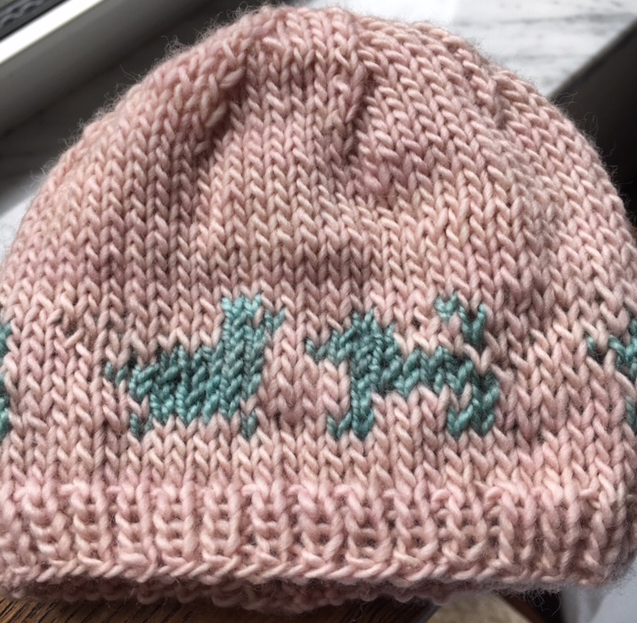
Finished little babyhat
Finished hat before washing

I choose some yarn that had been sitting around for a while, but it was sock yarn and labeled as “washable”. Generally, I hand wash anything I knit because I know the time and effort I put into creating the item. But if I knit baby items they will be to give away, and I need some type of yarn that will hold up. The photo above was taken BEFORE I washed the hat.

“Barbara Deserved Better” Yarn By Madeline Tosh

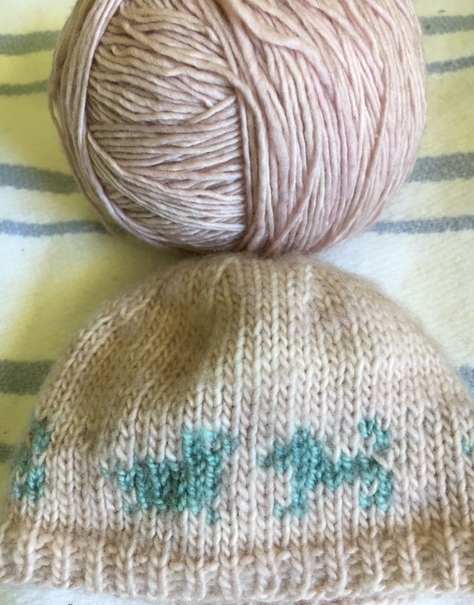
The name of the pink yarn I had in my stash was “Barbara Deserved Better” named for a character in a TV show, I believe. Anyway, when I search for yarn by this name it looks much better online! My ball of pink yarn has very little variation in color and is all dull pink without any splotches of bits of color throughout. See my ball of yarn in the photo below, and compare it to online pictures at Jimmy Beans Wool. I did not buy it at Jimmy Beans, and I can’t remember where it came from, but I certainly got a dull and colorless skein!

Faded yarn color
Faded hat after washing

Above is a photo of the hat AFTER washing and drying. When it came out of the washer it was very fuzzy, so I took a chance and put it in the dryer for 10 minutes. My little hat also seemed to have faded to a dull and lifeless pink! I haven’t been a big fan of Madeline Tosh yarns, and this makes me even less so.

Practicing Color-work

Another reason I wanted to knit a small project in-the-round was to try my hand at knitting some motifs in contrasting yarn. Inspired by the designs in a new book (150 Scandinavian Motifs) I chose a little puppy and chick for the brim design. Yup, that is supposed to be a chick! My color-work knitting needs help, but this was good beginner practice.

The green color yarn I used for the animals was leftover Yummy 2-Ply yarn from Miss Babs. It was one of the colors I used in my Bay’s Edge Shawl. It held up well.

Faded baby hat in Mad Tosh merino light, after washing
Machine washed and dried baby hat

In the end, the hat looks pretty bad. I will keep it as a practice piece because I wouldn’t give it to anyone to put on their poor baby! I love making hats, so I will make more (with better yarn), and I will improve my skills along the way. I’m still looking for the best washable baby yarn (that is not acrylic) too.

As far as yarn goes, I’ve been much happier overall with Malabrigo, Manos del Uruguay, and Miss Babs brands. I just need to look for “superwash” labels.

My Pinterest Knitting Board – please follow!

Free Knitting Patterns, Are They Worth It?

As a beginner knitter, I have searched for “free knitting patterns” to get a feel for stitches, directions and charts. Why would I want to spend money on a pattern that I can’t comprehend and knit once it is downloaded? For beginners, free is probably best to start with.

So is knitting something that is free worth it? Well, yes and no. Be careful where you find those free patterns.

A warning here is to try to find well known knitwear designers who sell patterns but also offer free ones. They care about their patterns because it’s a business for them. Offering free things could very well lead to purchases done the road.

Or, choose a free pattern that has already been knit a lot and has great reviews.

I do understand that starting out we beginner knitters have NO idea who the knitwear designers are. And where do we find reviews and comments on patterns?

This is where Ravelry – an online knitting (and crocheting site) can be a huge help. If you can ignore their politics, it’s an enjoyable place where I’ve learned so much.

My First Hand-knit Shawl Was a Free Pattern

My very first shawl was a free pattern from a designer who offered it with the stipulation that I sign up for her e-mails. The shawl was good practice for me, with wonderful directions, it and brought her a follower. Below is the Spindrift Shawl (a free pattern and my first shawl knit) by Helen Stewart. I still get her e-mails.

Spindrift shawl
My first shawl knitting project

That is not to say that many free patterns work out just fine. Usually they are fairly simple and closely match other free patterns of the same type. Sometimes knitters just like to share something helpful with other knitters.

The Scrappy Bias Shawl (below) is one that gets a lot of knitter’s attention. It is easy knitting and fun. The Honey Cowl is pictured at the beginning of this page, and it is a free, one or two wrap, cowl.

colorful scrappy bias shawl
Scrappy Bias shawl – completed!

For beginner knitters, using a free pattern can be very helpful. Usually they are simple patterns that give us good practice and cost nothing but the yarn. A great place to begin is with Tin Can Knits. I sure wish I had found them sooner in my knitting adventures. They have an excellent bunch of tutorials and a page full of free patterns such as hats, sweaters, mittens and more, for all ages and sizes. Below is my Playdate Cardigan.

Playdate cardigan in size 6-12 months
My experience knitting the Playdate cardigan

Purl Soho

One very good place to start, if you want clear knitting directions, often with video tutorials, is Purl Soho. They sell beautiful yarn, and offer many types of patterns for free! It is one of the first places I found for free things when I began searching. From simple hats and housewares, to sweaters and ponchos, this is an awesome site for free designs and helpful insights.

Beware that some of their pattern stitches are quite advanced, and those wraps and blankets can take a long time to knit.

One place to also find more advanced free patterns (as well as the more simple) is the Espace Tricot collection. They offer a slew of free patterns of all types. The sweater below is one I recently knit.

In closing, I suggest being careful where the free patterns come from. If you begin to knit something that looks good and get toward the end and hit trouble, you’ve wasted lots of time. But, many free patterns are definitely worth knitting.

Knitting Flip-Flop Socks

Until just the other day I hadn’t heard of flip-flop socks. I had begun to try my hand at knitting socks, and asked my daughter if she would like a pair. She said instead she would love a pair of flip-flop socks.

(When I first wrote this page, I followed a pattern that no longer exists. I have linked to other patterns for my readers, but I did not knit those. I hope you will still find my notes interesting and helpful.)

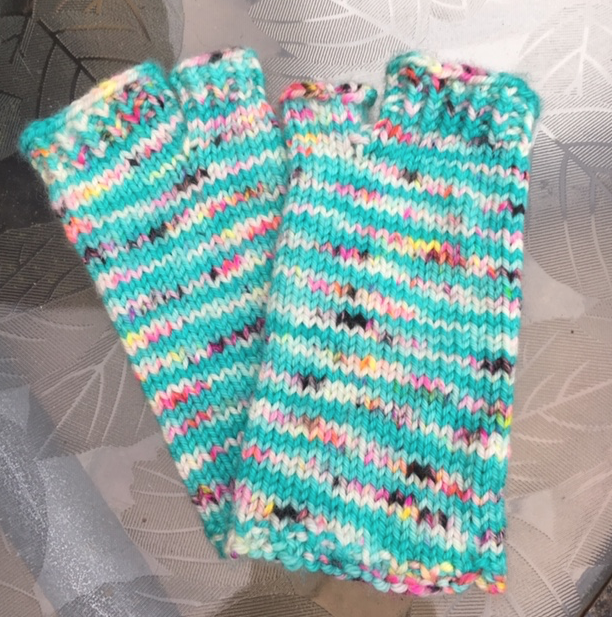
Flip flop socks in aqua blue variegated yarn with open toes and no heel.

My next question, which I thought was pretty logical, was “Why?”. Flip flops are to be worn in hot weather so why would you add socks? As someone who has outgrown flat, floppy shoes and now needs arch support in my sandals, I was obviously out of touch with the flip-flop wearers.

Who Wears Flip-flop Socks, and Why?

It appears that many people who love flip-flopping so much they will also wear their favorite comfy footwear in cooler weather. Because there must be compensation for the toe split, special socks are needed. People of all ages love these socks, and even men will wear them… who knew?

Choosing Yarn For Your Socks

It will not be difficult to find yarn to knit flip-flop socks. Any “sock yarn” will work fine as long as it is washable. I prefer natural, animal fiber, but cheaper acrylic yarn can be used. I knit my socks in DK weight, 100% merino wool. My yarn is Madeline Tosh DK, Hydroponic. I believe this colorway is discontinued, but you still may be able to find it.

knitting flip flop socks
Beginning to knit the second sock

This Pattern is Gone – So….

The FREE pattern I closely followed is called the Arizona Flip Flop Sock, but that pattern is no longer available for some reason. Maybe the sharer was not the original designer, or maybe they no longer have the website, or ??? For whatever reason I can’t give you the link.

SO…. here is a link to another Flip Flop sock pattern which is a free Ravelry download. It is not the one I knit, which changes things. I’ve also listed more socks like this at the bottom of the page. Some are free, and some are to purchase.

Joining in the Round – Switch Stitches

I used US size 2 addi Flexi Flip needles. I had never used this type of short needle before so I had to wing it. I prefer the 9 inch circular needles, but didn’t have any at the time.

Cast on however you like and join in the round as you prefer. Or you can do as I do.

Once all stitches are facing the right way – no twists, and working yarn is coming off the Right needle – drop the first stitch on the L needle and let it hang. Move the first stitch on the R needle over onto the L needle (use the spare needle to do this). Pick up the dropped stitch and put it onto the R needle. Place marker here to mark the beginning of the round (BOR). I used the cast-on tail as my marker.

How to do the flip flop sock pattern cast on with flexi-flips
flip flop sock pattern cast on

Once the stitches are joined, begin knitting the pattern using the free / empty needle. I’m using Flexi-Flips here, but DPN’s, 9inch, or Magic Loop would work.

Joining in the round using Flexi-flip needles

Making the Toe Opening

Most likely at some point, the big toe area will be separated from the other stitches. In the pattern I knit, I had to cast on 3 stitches. The video below helped me do that.

Flip flop socks with big toe separate from other toes

BE SURE TO BIND OFF LOOSELY !!! Or your toe openings will be too tight.

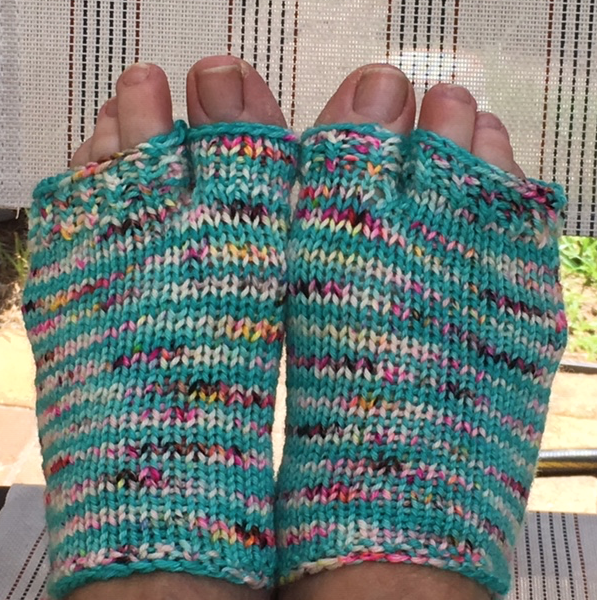
Wearing flip flop socks knit by me.

Here are my finished socks after being washed (below). Now I will pack them up and mail them to my daughter.

Flip flop socks after washing

The photo above was taken after the socks were washed in the washing machine. I let them air dry and they got a tiny bit fuzzy, but remain nice and soft and did not shrink. I had a few ends to re-tuck, but that was all.

I will admit that I dislike knitting socks. I’ve tried various patterns and have never fell in love with knitting them. Many, many people knit loads of socks, and sock patterns seem to be very popular. Knitting one sock can be sort of fun, but then you have to start again and knit the same thing all over again!

The nice thing about the flip-flop sock is that it is a much quicker knit because you are only knitting the sole and toe holders. There is no cuff or dreaded heel to deal with like regular socks. But you still must make two! By the time I finished the second sock, I was ready to celebrate.

I choose this free pattern because I have made socks and I thought I could figure this one out. You should be careful of knitting free patterns because they can end up being incorrect – (share them and then they disappear!). Read my next post about that.

More Flip Flop Sock Patterns

Not all patterns will be the same when you search for “flip flop socks”. Some designers will have you knit the whole sock and separate the big toe. Some have the heel included with the sole / instep area. Other socks are very short and cover only part of the foot.

Here are some patterns I have found and want to share. I have not knit any of these myself.