Yarn to Use for Warm Weather Knitting Projects

I want to knit a top I can wear in Florida’s jungle climate. It doesn’t have to be “summer” here where I live to need cool clothing. I wear capris and sleeveless tops nearly year round. I’m afraid that what normal summer people think is “cool” is not cool enough for me.

Please note that some links go to Ravelry, a popular knitting site, where non-members won’t see everything members will. If you knit, why not join, as it’s FREE!

Although most yarn I’ve used in the past is wool, or part wool, wool doesn’t work for a Florida lifestyle. I am branching out and looking into the plant-based yarns – haha….!

Because currently it is Spring, knitters are thinking about summer knitting, so this is the time of year for me to find the best summer knitting projects which I can wear year round. Designers are offering summer knits and shops are advertising summer yarns.

Popular Plant Fiber Yarns and Their Properties

After two years of continuous knitting, I have acquired a list of my favorite yarns. None of them are meant to use for summer tops because they consist mostly of wool! Warm weather tops need airy, light yarn such as linen, cotton, or other plant material.

Since I know next to nothing about knitting with summer type yarns, I searched for articles with good information. Those are hard to find too!

I was excited and thankful to find this Summer Yarns article at Interweave, which covers the Pros and Cons of knitting with cotton, linen and hemp.

Linen was my first choice, and when I found some (Berroco Indio / Stonewash Linen) on sale for $7.00 a skein at Wool and Company, I bought it. Reviews on Ravelry for this yarn were generally good.

I’m still researching, and planning to try, various plant-based yarns in hopes of coming up with some favorites to use for life in Florida and hot places.

A List of Yarns For Summer Knitting

  • Purl Soho‘s “Sweetgrass” is a mix of 65% cotton and 35% alpaca and comes in large, undyed, skeins (I love the gray) of 437 yards – fingering weight. Will the alpaca make this too warm? Also, I’m not crazy about knitting something to wear in cotton yarn.
  • Purl Soho‘s “Lantern” is a worsted / aran weight yarn of 61% cotton and 39% linen – 164 yards. Cotton and linen would be cool together, so might be worth a try. Comes in many pretty colors, **BUT some knitters mentioned it was rough – good for dishcloths but not clothing…FYI
  • Purl Soho also has “Linen Quill” yarn, but it is 50% wool, 35% alpaca, and 15% flax / linen.
  • *Quince & Co. offers us “Sparrow” – fingering, and “Kestrel” – worsted, which are both 100% organic Belgium linen. Both come in lots of nice colors, including a marl, and they get good reviews.
  • Shibui Twig is a combo of 46% linen, 42% silk, and 12% wool. Skeins are 190 yards, in Sport weight. I don’t like that there is wool in this one, but it is a small amount.
  • Hempathy is a cotton, hemp and rayon yarn. This one gets some good reviews at Ravelry.
  • Bamboo – Found the Dye Diana Dye (see page of bases) website which offers hand-dyed silk, linen, and bamboo yarns – very pretty and unqiue.
  • Burnish, by Purl Soho is Rayon from Bamboo.

A New Knitting Project / Pattern For Linen Knitting

After some searching, I decided on a pattern called “Over the Top Tee” designed by Heidi Kirrmaier. I had successfully knit her Fine Sand sweater last year using Miss Babs “Tarte” yarn (which I loved by the way).

I bought 8 skeins of the Berroco Linen for my “Over the Top Tee” project. Then, I went back and bought the remaining three skeins just in case I need to add length to my top. Because the yarn is discontinued, I was afraid I would need more and it would be gone!

Berroco linen yarn
This linen yarn is Discontinued

For this tee, the designer used silk yarn (Ito Kino) holding two strands together. I’ve always thought of silk as too hot to wear in hot weather, but many “summer” yarns include some silk, so I am still questioning that. The Ito Kino silk was a bit expensive too, so I found some cheaper linen yarn.

More Summer Top Patterns I Like

Florida does not have a normal summer. It is very hot with the heat index usually near or over 100 degrees because of the extreme humidity. When I went back to live in New Hampshire, people would complain about a humid day and I would laugh at them!

Here is a partial list of some favorite hand-knit top patterns by various designers. After I knit Heidi’s pattern I may try another, or knit hers again with different yarn. It is not as easy to find something to knit when it won’t cover my body as nicely as a big old sweater! Here are a few of my favorites.

  • Cullum, by Isabell Kraemer is a cap sleeve pullover with some lace at the top. The sample was knit with Sparrow, 100% linen – see link below.
  • Lakeland, by Heidi Kirrmaier is a short sleeve, two color blocks top, with opportunities to modify sleeve length and colors.
  • A Hint of Summer, by Isabell Kraemer offers lots of options. Make it with short or long sleeves, in stripes or solid. Looks very interesting.
  • View my ever-growing Collection of Summer Tops to knit on Pinterest.

I understand why knitters generally do not choose plant-based yarns for knitting. When we think “knitting” we picture hats, mittens and sweaters to keep warm. Where I live, no one wears scarves, shawls or any type of winter items – except very rarely. If I could knit some wearable clothing for myself, it would be wonderful.

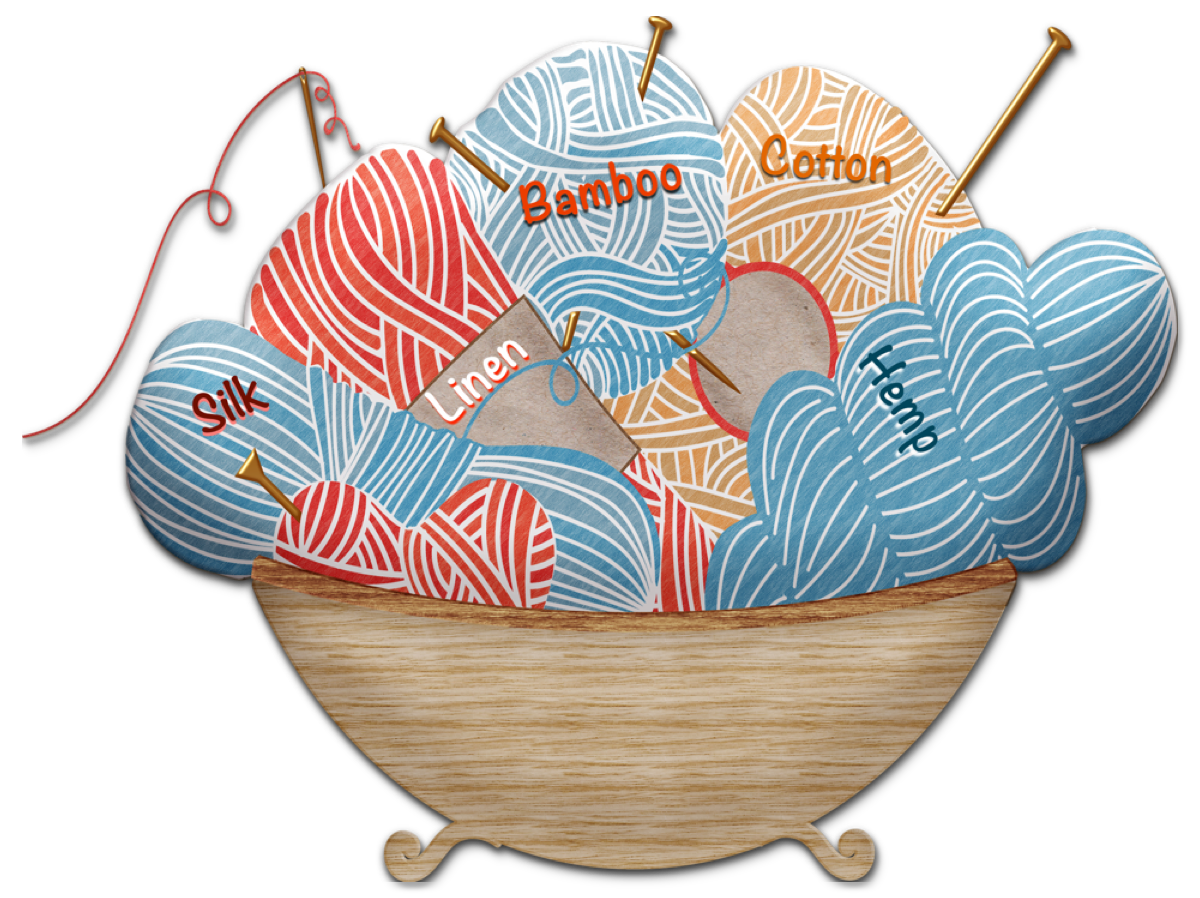
(Yarn bowl graphic credit to AnnaliseArt @ Pixabay.com)

Tettegouche is My Second Colorwork Hat

If you have the Milarrochy Heids hat-knitting pattern book, you have the pattern for the Tettegouche hat. ( It is also sold separately – see the link at the bottom of this post.)

It’s a beautiful book, with lots of pretty hat patterns and they all use Kate Davies Milarrochy Tweed yarn. I bought the yarn in a variety of colors and began this hat a while ago. I didn’t like the way it was coming out. I blamed myself for not being familiar with colorwork, good cast-on’s, or having the right hat gauge. Honestly I didn’t like the yarn. I put it aside.

Tettegouche hat pattern
Finished Tettegouche

When I joined The Woolly Thistle knit-along, I became familiar with Rauma wool and fell in love! Everyone was using it to knit colorwork projects. After knitting some mittens by this hat’s designer, Virginia Sattler-Reimer, I went back to try to knit the Tettegouche, only this time I used Rauma yarn. By the way, she has mittens to match the Tettegouche hat pattern!

Tettegouche hat pattern
Good size, with a bit of extra room at the top.

I made some changes to the pattern, and one was to do a 2×2 ribbing for the brim. The colors I used were what I had available and they are not the greatest. But I had fun with this. It has been a good practice hat after knitting Katie’s Kep. Because I had already knit that colorwork hat, I knew to try a smaller needle for Tettegouche.

Buy The Tettegouche Hat Pattern

The pattern is also sold separately and you can buy the Tettegouche hat pattern here. Please click the link to see it, because it is so much prettier than mine! You won’t believe it is the same hat…!

What Was My First Colorwork Hat?

My first all-colorwork, Fair Isle knitting project was Katie’s Kep, which is a fun hat pattern which is Free to download.

Katie's Kep hand knit hat
Nearly done, just working the crown

Simple Simon Met a Pie Man Lice Colorwork Vintage Sweater

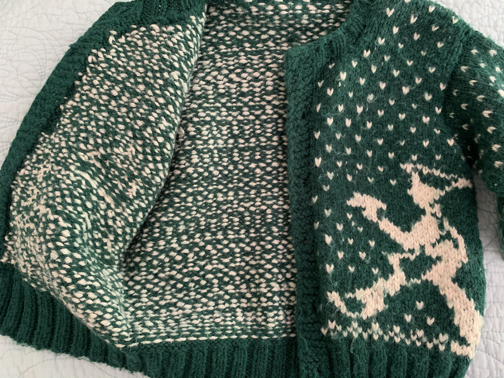
I am staying home, as we all should be, which gives me time to organize. As I was digging out things I hadn’t viewed since I moved, I came across the “Simple Simon” sweater. I’m not exactly sure of the image, but it looks like that nursery rhyme to me. It was knit long ago by my Nana who is not around to remind me.

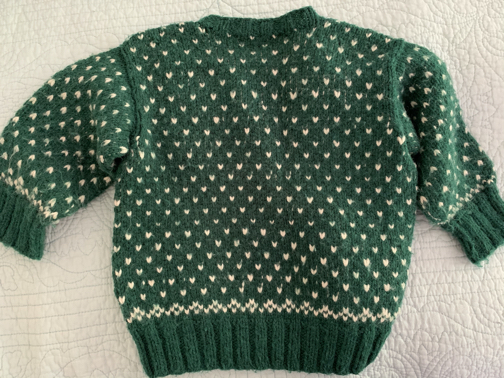
The pattern also includes white “dots” all over, which is called a Lice pattern and originated in Sedestal, Norway (as best I can tell). Because my Nana grew up in Denmark, it stands to reason she would knit this type of pattern. As for the images, she must have followed a pattern.

Old hand knit colorwork child's sweater with figures and house
My grandmother’s hand-knit sweater for a child with lice stitch and images of people and house.

The Simple Simon Verse

Just in case you are not familiar with this nursery rhyme, let me refresh your memory. The first part goes like this:

Simple Simon met a pie man, going to the fair. Said Simple Simon to the pie man, “Let me taste your ware”.

Truthfully that is all I know of the rhyme… but to read it in it’s entirety, view it here. The figure on the right, on the sweater front, looks like a man holding a pie. Because Simon, and the Pie Man are boys, I believe this sweater was made for my son. I only have one sister, so this boy-themed sweater was not made for us. It is “newer” and was knit in the late 70’s – is my best guess.

Digging Through Keepsakes

There is a container in my closet which holds some old baby clothes which were worn by my boys (who are now ages: 43, 37, and 21). When I moved, I left my daughter’s special baby clothes with her.

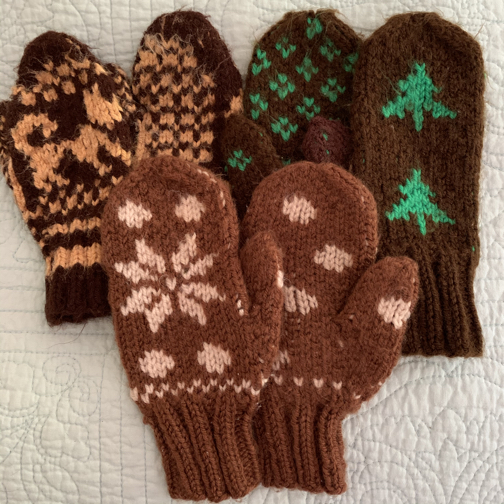
In that container, I came across two sweaters, this one and another that I wore as a kid – now that is old…..! Also, there were some mittens which were knit by my Nana, probably made for my oldest son as well (photo below). We moved to Florida where the rest of my kids grew up and there was not much need for sweaters and mittens. However I do have the coolest back-zipper sweater she made for my second son.

Vintage hand-knit kid's mittens
Nana’s mittens

My Nana had been knitting sweaters and mittens for kids, and adults, in the family since I was young. She may have begun knitting as a kid, for all I know. She came to New England from Denmark as a teenager. My father was her son.

Nana would knit mittens like mad for us kids, because we wore them out quickly. Back in the 1950’s and 60’s kids played outdoors all the time! We especially loved to play in the snow. I remember puppet type mittens – similar to the ones in this vintage pattern book sold on Etsy – which had buttons for eyes and long braids along the back of the hand. I loved those!

Of course I never appreciated all the work that went into those hand-knits.

lice pattern sweater knitting
Child’s cardigan with lice stitch on back and sleeves

In her nineties, Nana died of a heart attack, while knitting in her favorite chair. She had a little room off her kitchen which held a tiny Jotul woodstove and that is where she sat to knit. I remember visiting her and talking while she knit. I was never very interested in her hobby ….. not until now, when it’s too late to learn anything from her. Such is life. It’s pretty stupid.

I wonder today how many hand-knits are still around which were made by her. I also wonder what she was working on at the time of her death. Something wonderful, which was never finished? Or did one of her daughter’s finish the knitting?

Now that I do knit myself, I look at this handiwork with marvel. I love seeing all those carried stitches knowing that my Nana’s hands created them all! I wonder where her yarn came from and what her needles looked like. I always think of her when I knit and wonder what wise advice she would give me. She’d be able to teach me a lot.

I imagine us sitting together knitting away and comparing patterns and ideas. She would marvel at the internet and how easily patterns and yarn can be purchased these days.

Inside floats of stranded knitting on child's sweater
Inside floats of stranded knitting on child’s sweater

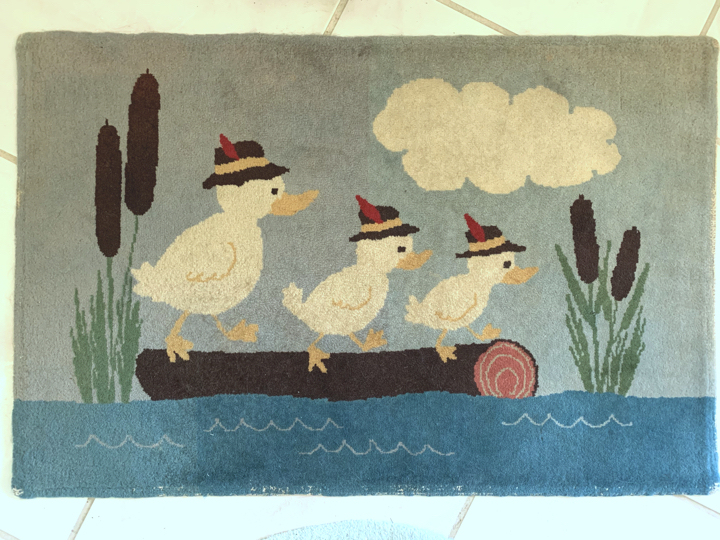
I don’t have anything else that belonged to my Nana, except a hooked rug she made for our family when I was young. She was a crafter, with busy hands, who also grew beautiful flowers, canned vegetables and fruit from their huge garden, baked “monkey faces”, and did weaving on a big loom.

She was only 4’10” tall and she was one of my favorite people.

Three ducks vintage, hand-made hooked rug
Vintage hooked rug (1950’s) with three ducks walking on a log in the water with cat o nine tails and one cloud.

Katie’s Kep, Knitting a Fair Isle Hat

After I finished knitting two different pair of color-work mittens, I wondered what to knit next. Suddenly, knitting with only one strand of yarn seemed boring! I may be on a Fair Isle, or stranded-knitting jag for a while.

I was browsing Ravelry and a very pretty colorwork hat caught my eye. I decided to save it in my favorites. When I went to the designer’s hat page, I found that “Katie’s Kep” was a free pattern – at the time – I wrote this and used the pattern. It is no longer free. 

The designer created it as a tribute to her mother. The pattern called for using wool fingering yarn – which I have in abundance – so I had to make it.

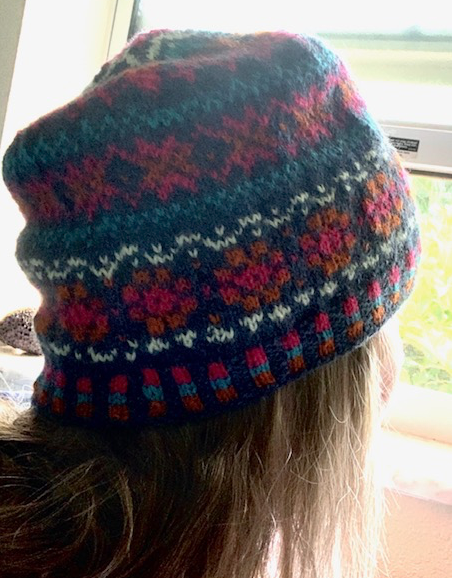
Katie's Kep in Rauma wool
Fair Isle hat

Choosing Colors

When I was planning my mittens, I bought a lot of Rauma wool yarn, in various colors. I ended up using Brooklyn Tweed Arbor for both pair of mittens, so I had lots of Rauma wool left. The “Katie’s Kep” pattern uses this type of wool, so all I had to do was choose the colors. Simple, right?

Honestly, it’s tough for me to envision a finished product by selecting colors. As I began the brim for the hat, I was wondering if I had made a mistake in my colors. If you begin this hat and think the same thing, it will probably look better as you knit more.

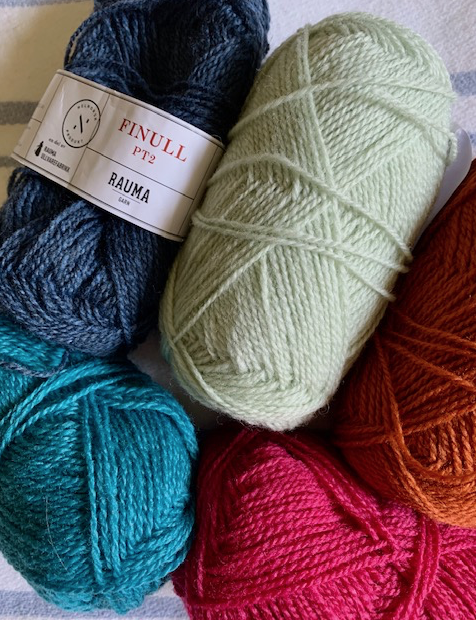
Rauma finull PT2 pure wool yarn from Norway
Wool yarn from Norway
Stranded Fair Isle colorwork hat knit with Rauma Finull wool yarn.

I wanted a dark background and I had a dark blue called Dark Petrol Heather, which I used. The rows that look whitish are actually a very light green, and I messed up on the first section! I’m not used to doing this type of knitting, and this was more good practice for me.

I think the only color mistakes you can make is to have colors that do not stand out enough to show the design. Wilma Malcolmson (links to her website), the Shetland designer, includes four various color way suggestions with her pattern download, so you can go buy the colors she suggests. It takes the guesswork out of the color selecting.

I also began knitting the colorwork on the brim incorrectly and had to begin over. After the purls the yarn must go to the back before the knits are done. Newbie mistake – lesson learned. BTW, that brim ribbing is called “corrugated ribbing”.

Katie's Kep hand knit hat
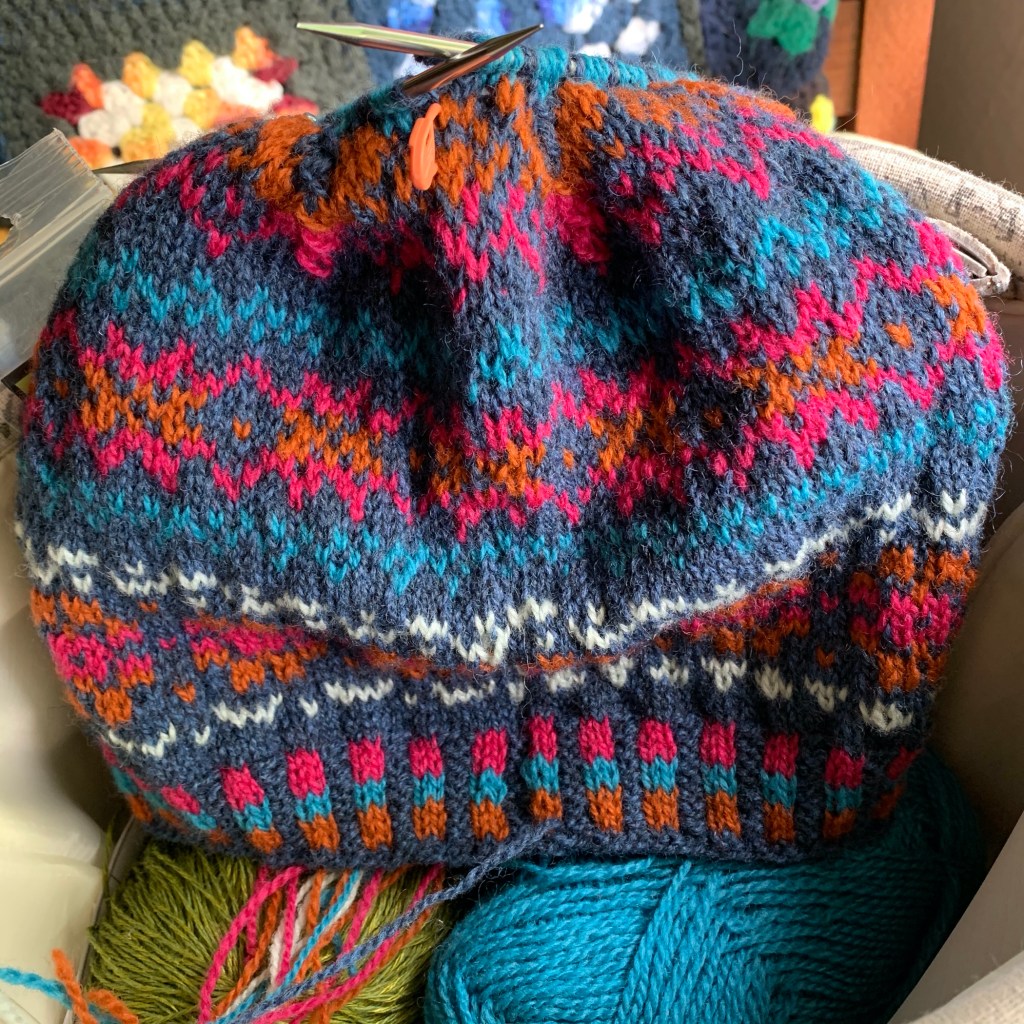
Nearly done, just working the crown
Working the crown using double-pointed needles
Switching to DPN’s at the top of hat

Needle Size

Another problem I had was which size knitting needles to use? Many of the knitters mentioned that the hat had come out huge. I know that I am a tight knitter. Usually I have to go up a needle size for all patterns. Because of this, I stuck with the size 3 suggested needle and the hat ended up being a bit large, but not crazy. If I knit it again I will try a size 2. If it’s too small I can give it to my daughter, who has a small head.

Knitting the Crown Pattern

Knitting the crown took me almost as long as it took to knit the rest of the hat. It came out looking fine, and I only made a couple of color mistakes. I’m becoming used to using DPN’s, and hats only have a few rounds where they are needed, but along with the colorwork, it made for a challenge. An experienced colorwork knitter would not have a problem.

Below is a photo before washing. I still had lots of ends to tuck in. I had read that some knitters were using the CDD (center double decrease) as opposed to the pattern’s Sk2p. And I think it may look neater. I’m not experienced enough to know and I didn’t do my Sk2p’s correctly because I slipped the first stitch purl wise and it should have been knit wise. Live and learn. I should have looked it up.

crown of Katie's Kep hat
Crown detail before washing
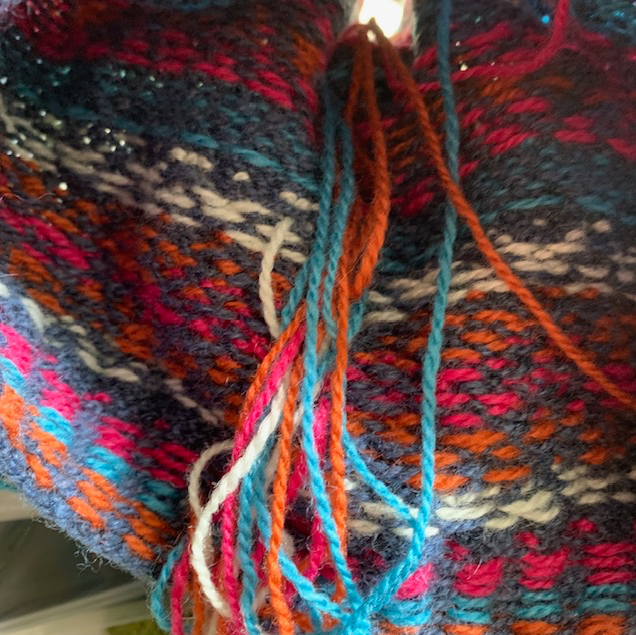
There will be lots of yarn bits to weave in.

The Sk2p is a left-leaning decrease and the CDD has no lean, it makes a ridge straight up. Once washed, this hat will look perfect – fingers crossed. I have notes written all over this pattern for my next project.

Scottish Fishermen Keps

So what is a Kep? I had to look around for some info, and it seems they were colorful, Fair Isle hats worn by Scottish fishermen while out to sea. The hats had a liner to keep the head warmer, and some were like stocking caps – longer with a tassel or something at the top. The Kate Davies Designs (KDD) site has a bit of info about Keps.

The yarn I used (Rauma) is from Norway, so to truly knit a Kep, I suppose I need to use Shetland yarn from Scotland. Maybe next time. I have none in my stash, but it’s on my list of yarns to try.

More Keps and Fair Isle Hats For Us to Knit

If you love to do colorwork and want to try more hats like this one, I’m making a list here. The Katie’s Kep pattern is free. The printout is in small print and I had to enlarge the charts – and yes, you must be able to read a chart.

Where to Buy Wool Yarn

The Woolly Thistle is based in New Hampshire and sells lots of wonderful wool sourced from the UK, Scandinavia, and Europe. This type of yarn must be hand-washed. It comes in many beautiful colors as well as natural animal colors. The prices can be high at TWT compared to other places that sell the same type of yarn. I’ve found Jamieson & Smith 2-ply, 125 yard skeins at Fairlight Fibers much cheaper!

At Wool and Company they also sell Rauma wool yarn, and other types of course. Remember that the purpose of a hat is to be warm, so real wool will do the trick. Even if the yarn is hand-wash only, how often do you wash a hat?