New England native, Florida resident. Blogging about boating, beach-combing, gardening, camping, and knitting. Work for Zazzle as a designer since 2008.
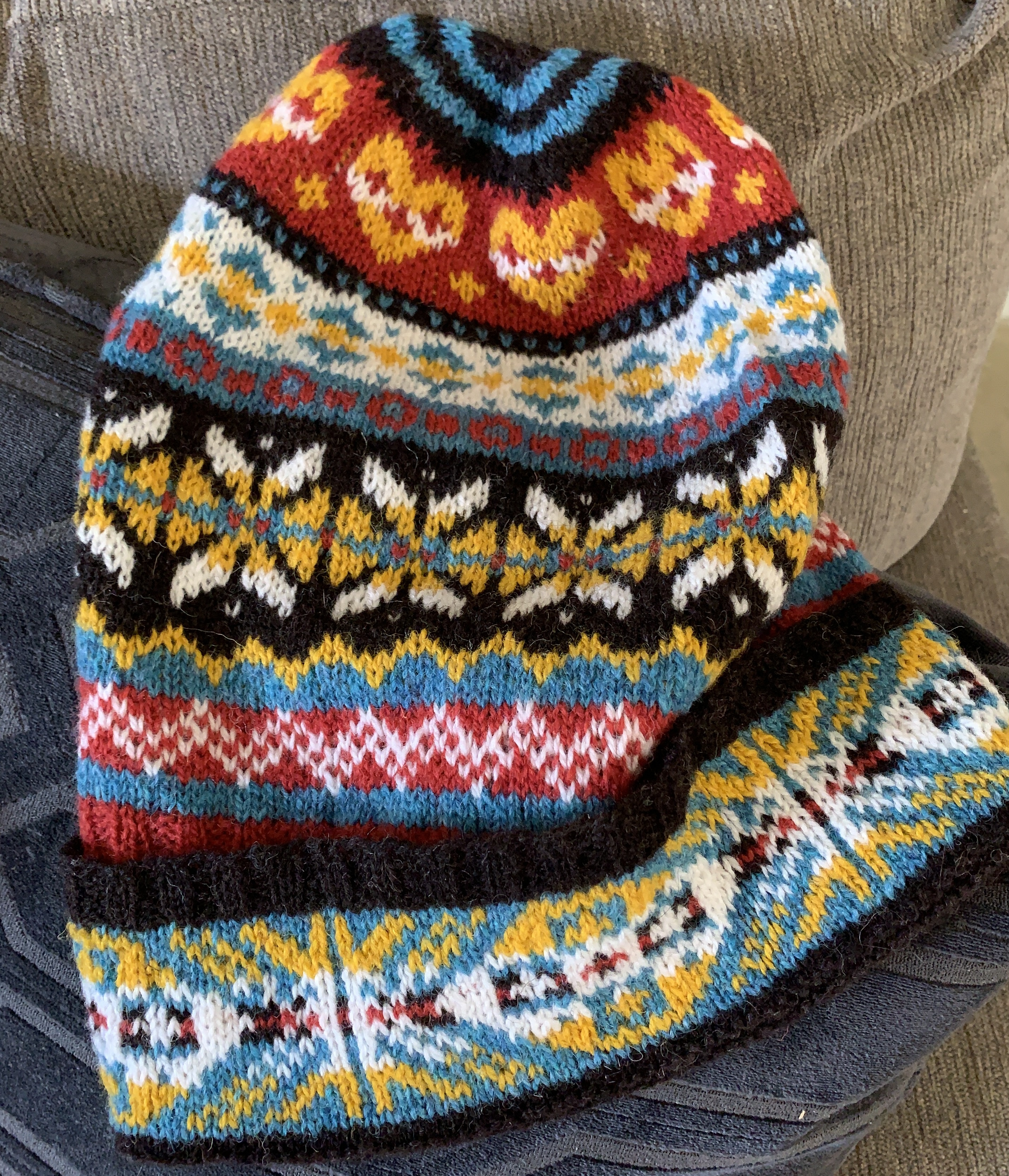
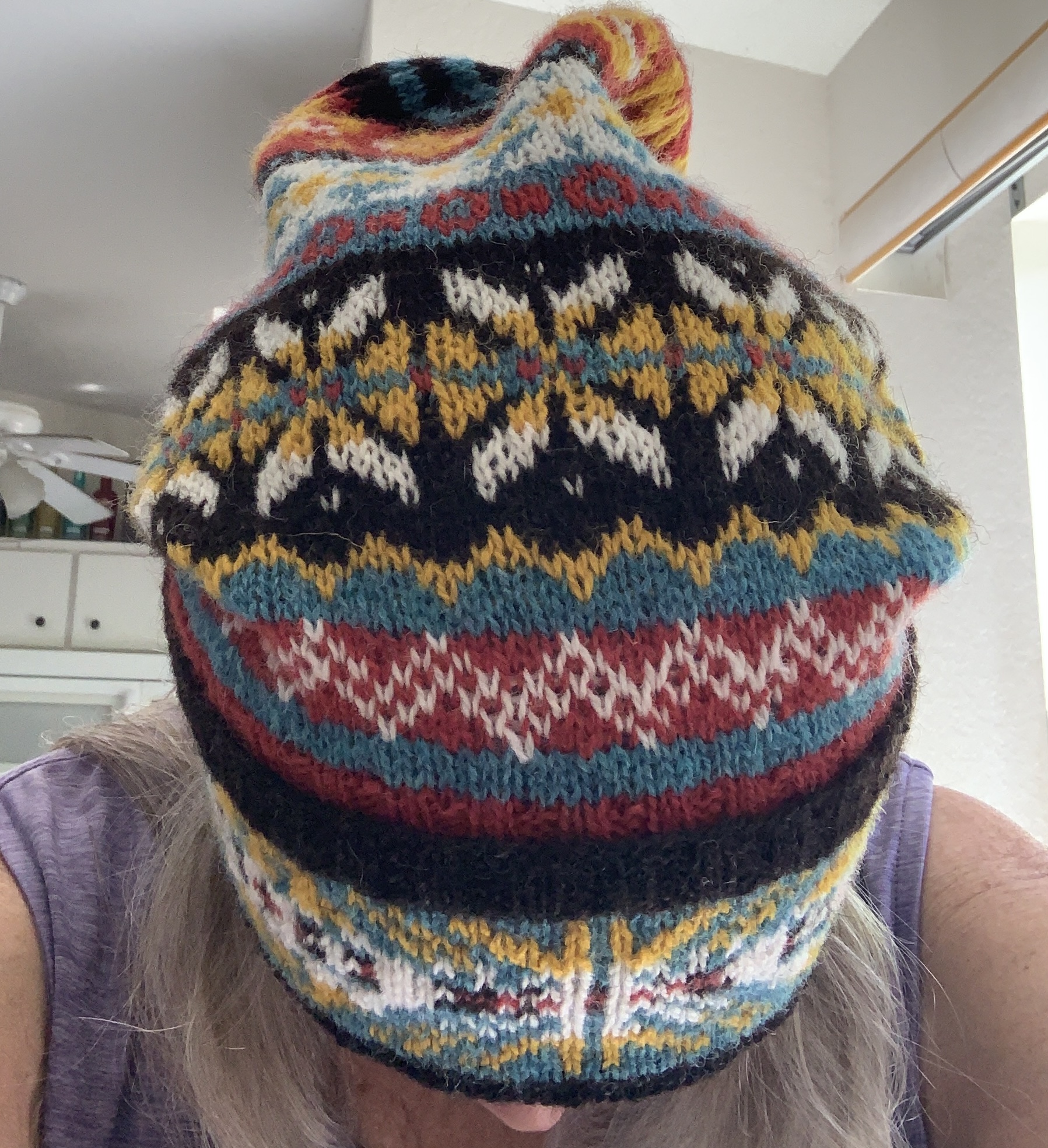
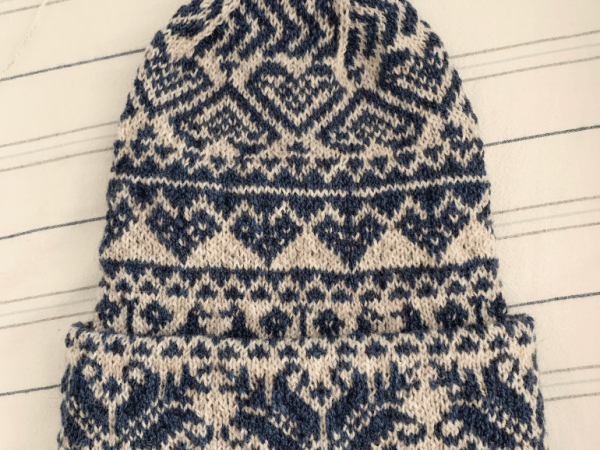
While cleaning out my yarn storage room, I came across the Fisherman’s Kep. I had finished knitting and had lots of ends left to weave in. I put it aside. It had been a while, so I decided to weave in the ends and give it a washing. I hadn’t been too happy with the fit but decided to I blocked it and see.
The hat construction begins with the brim, which will be folded up over a ribbed area. I think the ribbing was part of the pattern. After that, we begin rows of colorwork (fair isle) in our chosen colors.
Fisherman’s Kep blocked
This pattern was part of a fund-raising event. After taking some photos, I looked up my Ravelry page to add them.
I was thinking it had been maybe a year since I began this project. Lo and behold it had been THREE years!
I found my original post on this blog about the Kep and decided to give readers an update here. I also visited the Facebook page to see recently completed hats and noticed I had forgotten to add a tassel! Maybe I can dig out the pattern and see the suggestions. I’d love to add a fun little tassel to the top.
The hat is long and the knitter can create whatever patterns they like. Five colors total – of wool yarn – are used, which is traditional.
For more information please see my first blog post (link above).
One day, when I am in the mood, I will create and add a cute tassel.
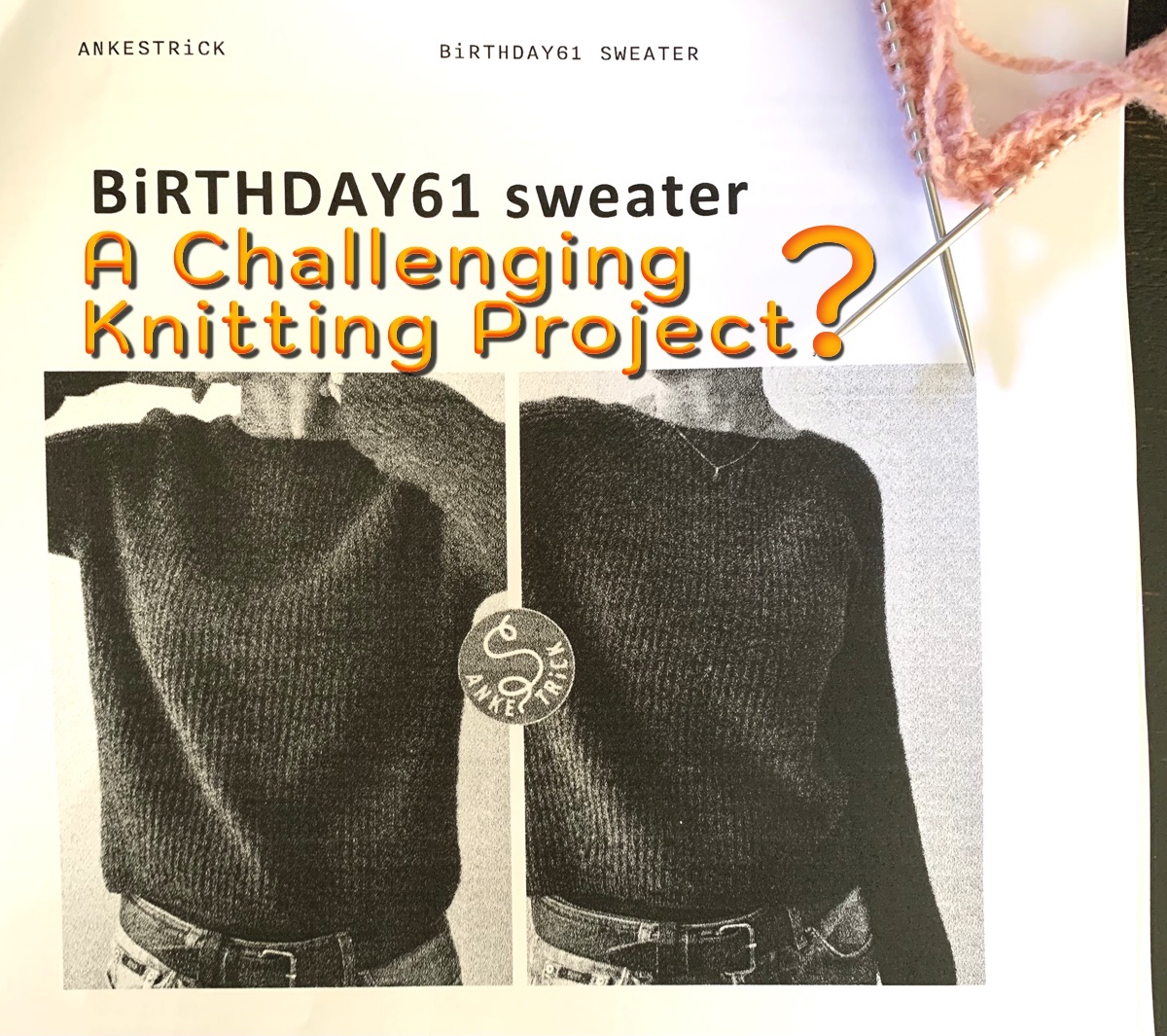
Looking further at the pattern, I realized that it may be too difficult for me to accomplish. I have my doubts, but will probably try it anyway. (See my trial below.)
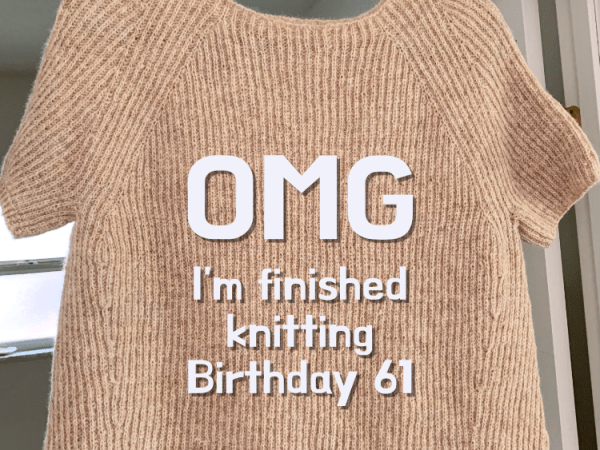
First of all, the whole sweater is knit in a small size needle. Suggested needle size 0 to 1.5US, depending on gauge. That is tiny! This means lots and lots of stitches, that could take me months to finish. On top of that, it is knit in a “half fisherman’s rib” . The tags for this sweater include “brioche tuck”. Scary. I’ve tried knitting brioche a number of times and failed miserably.
Pattern Help
Fortunately Ankestrick has a full page of links for help. Some links will apply to the Birthday 61 sweater pattern and go to YouTube. I love it when designers give me lots of help to achieve success. She also has a Ravelry forum page for help with this specific project.
She has her own suggested invisible cast on, seamless join, and decreases worked in the half fisherman’s rib stitch. The pattern explains how to incorporate the rib stitch while making German short rows. The pattern lists many special techniques I’m unfamiliar with. But, I should be able to find help to create them while knitting the project. Will I understand and accomplish them? Who knows. I have successfully knit her Rebel cardigan pattern, and am already a fan of this designer.
The Yarn
A sweater knitting project can be quite expensive. Lots of yarn is needed to knit a size 3 or 4 sweater (which is my usual pattern size). This pattern calls for 1800 yards. This is a lot of yarn, and must be because of the stitch used.
*Note to self: knit this using a light color to easily see the stitches!
The second issue for me is the needle size. After looking through my smallest needles, I have the required lengths in size 1US only. Otherwise, I would need to spend money on new needles.
The Swatch, Or Jump Right In?
This leads to the question of how to knit a swatch for the Birthday 61 sweater. I may jump in and try the pattern with some stash yarn just to see how far I get.
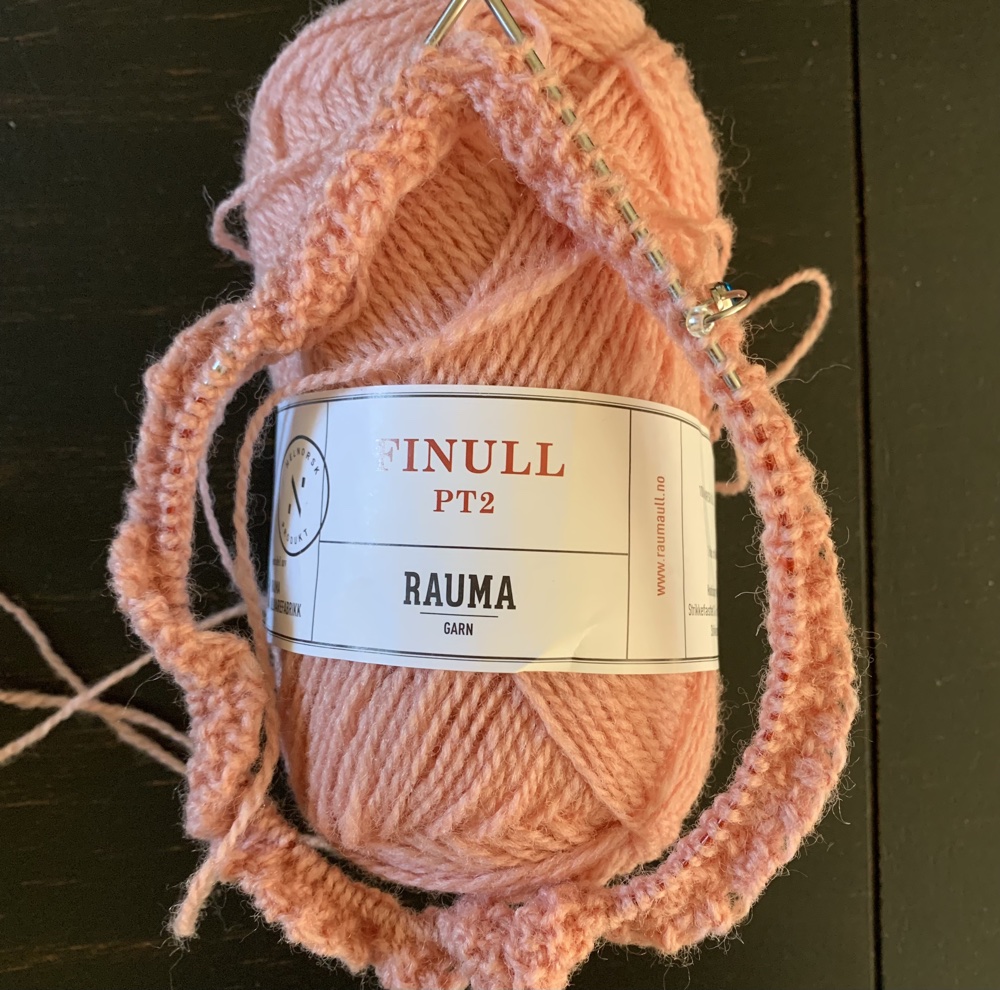
Okay, this is what I decided to do. I began the pattern using the smallest sweater size (my actual size will be 4). I dug out some Rauma yarn. I need to know if this pattern is something I can manage, so I’ll try out the special cast on and then down the yoke with increases and short rows.
A New Type of Cast On (for me)
Anke lists her cast-on as “Anke’s Invisible Cast On“. It seems very similar to the Italian Tubular cast on, except with better changes (IMO). She does her videos in Continental style, which can be confusing to those of us who knit English style. She also does not speak, but adds text to her vids.
For the cast-on, (use any length needle to begin, but switch to a 16″ for the join.) I watched the video, but then realized I could simply follow the directions in the pattern – this is easier!
This is not a super easy cast on for me, but with practice it will get better. I used my long 32″ size 1 needle. The first (set up) row is turned, and we work back across the stitches that were just cast on – without having to join in the round – yet. Get out the size 16″ for row 2 as that will be joined to knit in the round.
Cast on edgeRauma
Yoke Markers and Short Rows
I did not knit all the first rows after cast on because this is a trial knit and not something I will wear.
Upcoming are the yoke placement markers for raglan sections and sleeve / body increases. Those are combined with working short rows – and I was thinking that this could get sketchy. BUT… every short row is explicitly described – all 14 of them!
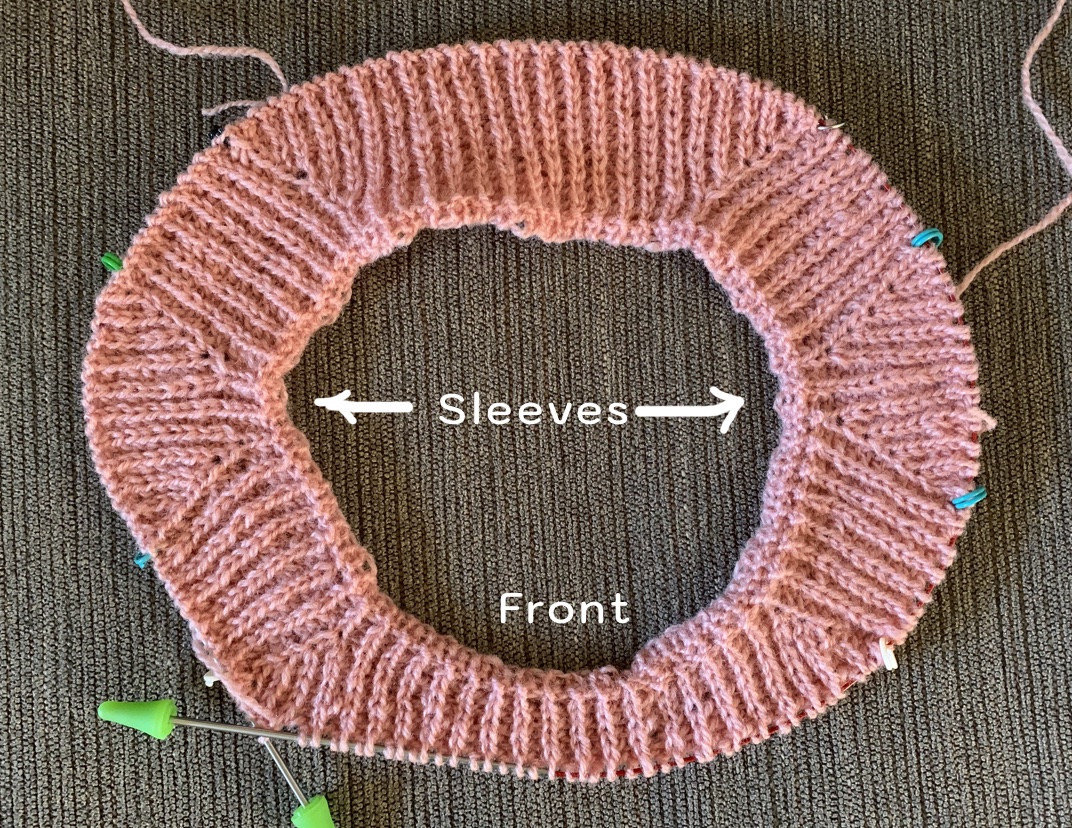
As a bonus, the designer has included a diagram of the neck opening with all the marker placements – 8 of them + BOR – for the four raglan sections, two sleeves, and body front and back. An image to reference is always helpful and this greatly helped me.
* When looking at the image showing marker placement, remember you are knitting counter clockwise from the BOR marker. Also, we are knitting down from the top of the sweater. Flip the page upside down if that helps to visualize.
Also, I suggest using various colored markers for the different sections. It helped me keep track of where I was (green means sleeves, white means front, etc.)
To get through the increases I need to know how to kbYOk. This is a knit below, yarn over, knit stitch. It is a two-stitch increase. See her video here. It is not difficult, but remember to do it because going back to fix a forgotten kbYOk is a bit tricky. And for some reason I kept forgetting to do them.
Below is my trial sample showing how the sweater top will look after all the short rows are complete. See how the very front is the shortest. Between each section of increases (sleeves and body) is a raglan section – four of them. Those do not change width.
Knitting short rows and increases
This sample is full of goofs (and the beginning neck rows have been omitted). I don’t like my cast on edge. I’ll have to practice that, or maybe not use it.
At this point I will be knitting increase rows alternating with purl rows. This continues to widen the sleeves and body. I probably won’t go much further as this is only practice. From this point on, I think I am able to continue and will plan to buy yarn and knit the Birthday 61 pattern.
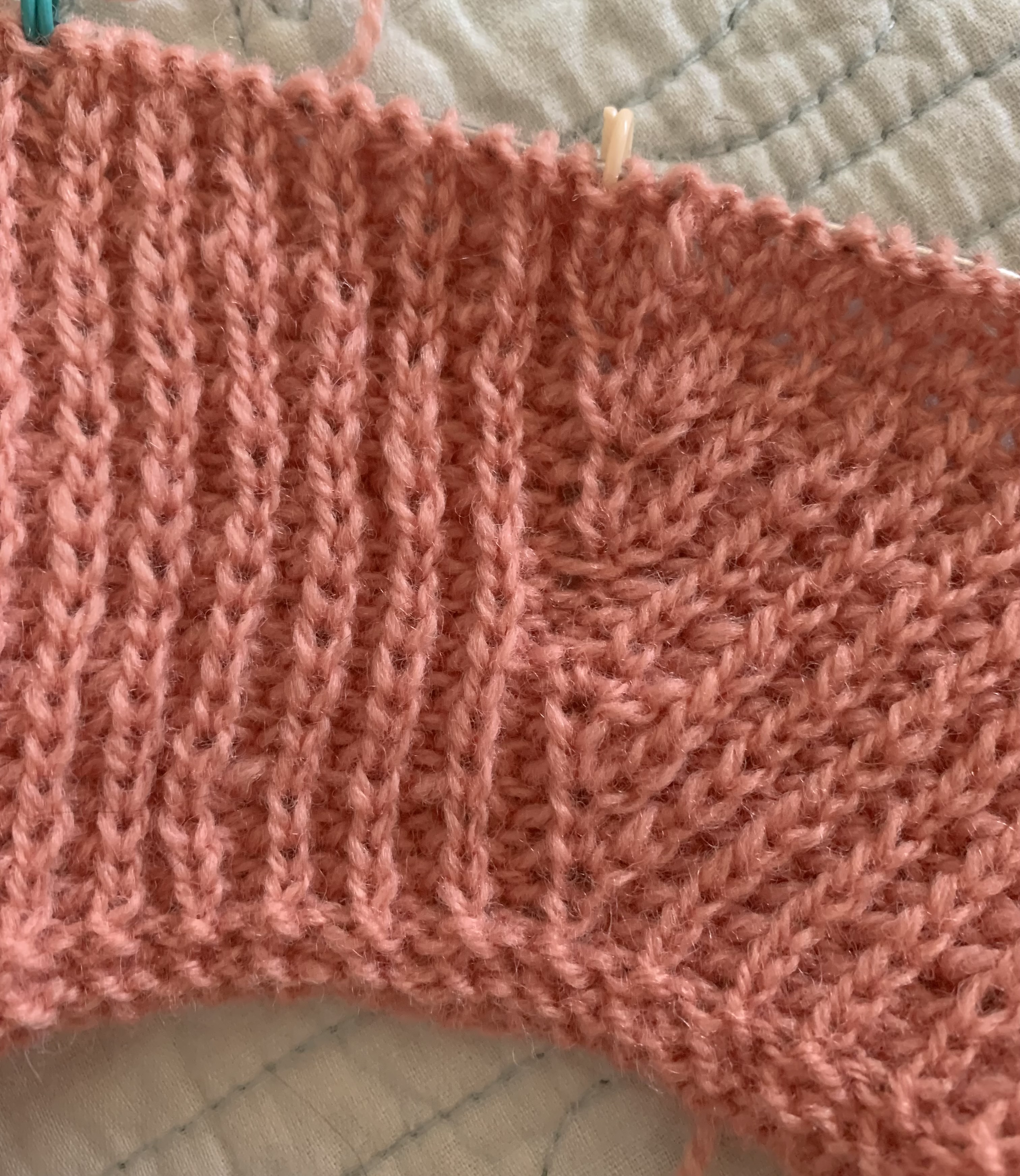
To keep track of knits and purls, here is what they look like. The purl stitch is “sunken” and the knits stand out.
Knits and purls.
So I have continued knitting on this trial piece and has you can see, I have made some obvious mistakes. I’m not happy with the cast on. I’ve messed up my knits and purls. Also, ripping back to fix something can be very tricky.
Birthday61 trial
A big goof!
More Advice From a Knitter’s Review
After viewing the test knits and other Ravelry knitters, it was brought to my attention that there is an alternate way of knitting the ribbing. On page three of the pattern, at the bottom, you’ll find the information. It replaces the purl row with a k1,p1 row. Apparently they look the same. I’m doing purls only for those rows.
Oh Gosh, More Yarn to Buy
I do not have enough of any fingering yarn to knit this project, so now I will be buying more yarn. The amount required is quite high – 1800 yards for my size 4. Once I begin this pattern for real, I’ll write another page all about it.
The first I’d ever heard of doing a corn maze in autumn was when I lived in New Hampshire. For a short time I lived near Concord, and often visited Beech Hill Farm. I think this was the first corn maze I ever did.
By googling the “history of corn mazes” I have discovered that it is a fairly new endeavor. In the early 1990’s the first maze appeared in Pennsylvania.
So what is the purpose of a corn maze? To aggravate the heck out of you! Haha.. really, they are fun, until you can’t find your way out. This has not happened to me, but I’ve heard stories of people actually calling for rescue from the maze!
Now, with nearly everyone having access to some sort of GPS on their smartphone, getting lost is unlikely. Traveling the maze means finding some unique and fun “gifts” along the way. Some mazes are like a scavenger hunt. Often maps will be provided so adults can help kids find the fun spots.
For more fun facts about corn mazes, read this insightful article at Cornbelly’s site.
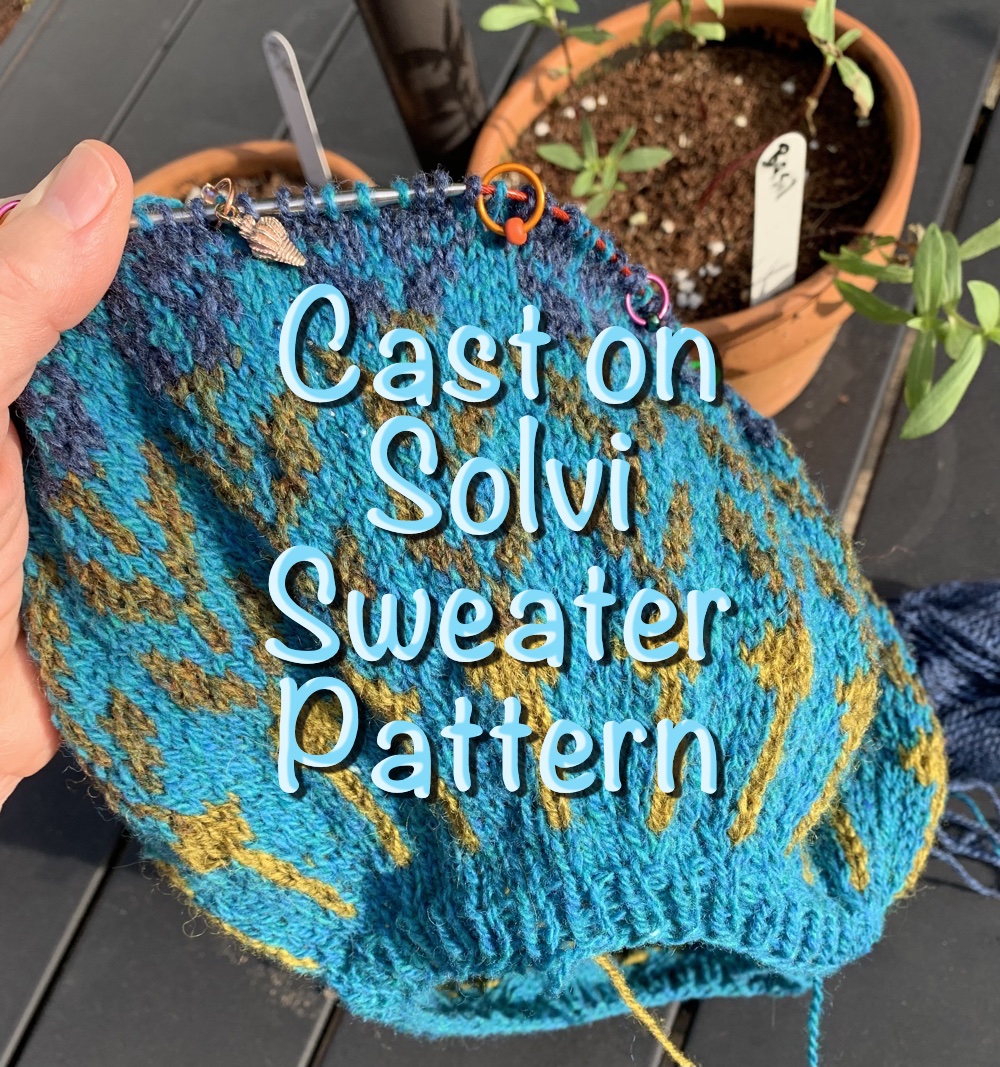
While I don’t really need another project on my knitting needles, I began a new sweater pattern anyway.
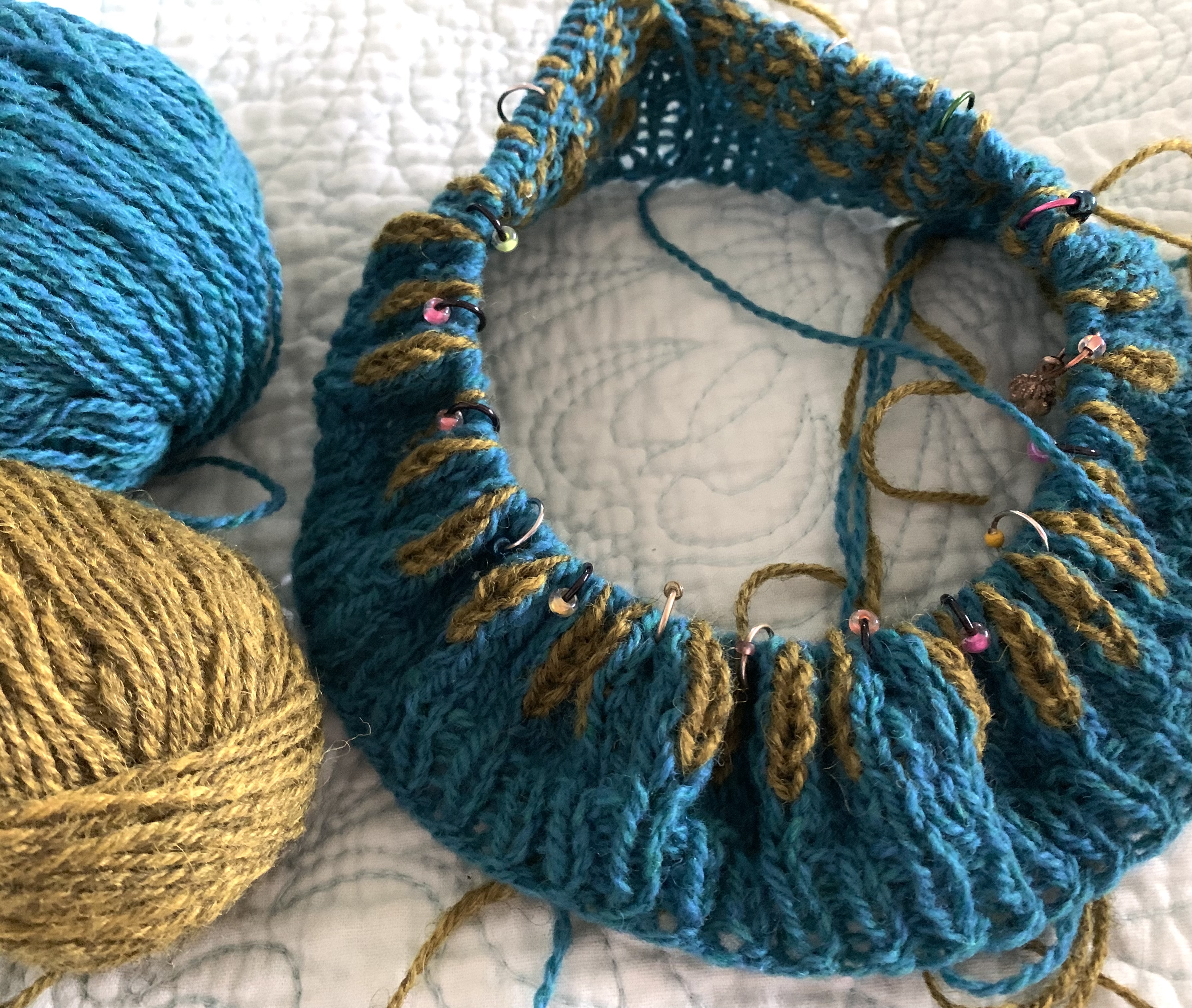
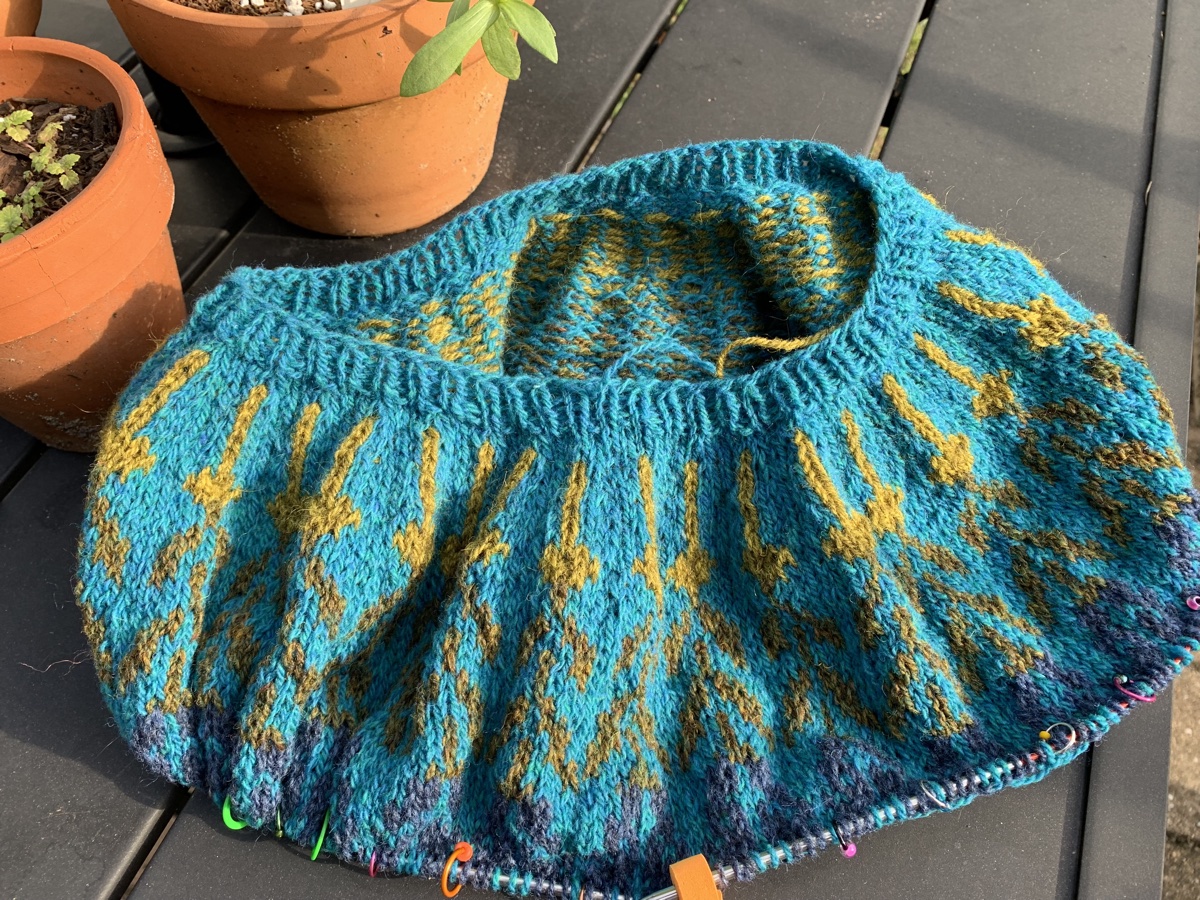
This pretty Shetland yarn, by Harrisville Designs, has been calling to me. The color is Peacock, and is so pretty. The contrast colorwork design will be done with a variety of wool colors I already have.
Here, I am using Tukuwool, J&S and Rauma. My plan is to have a low contrast between the main color and contrast color.
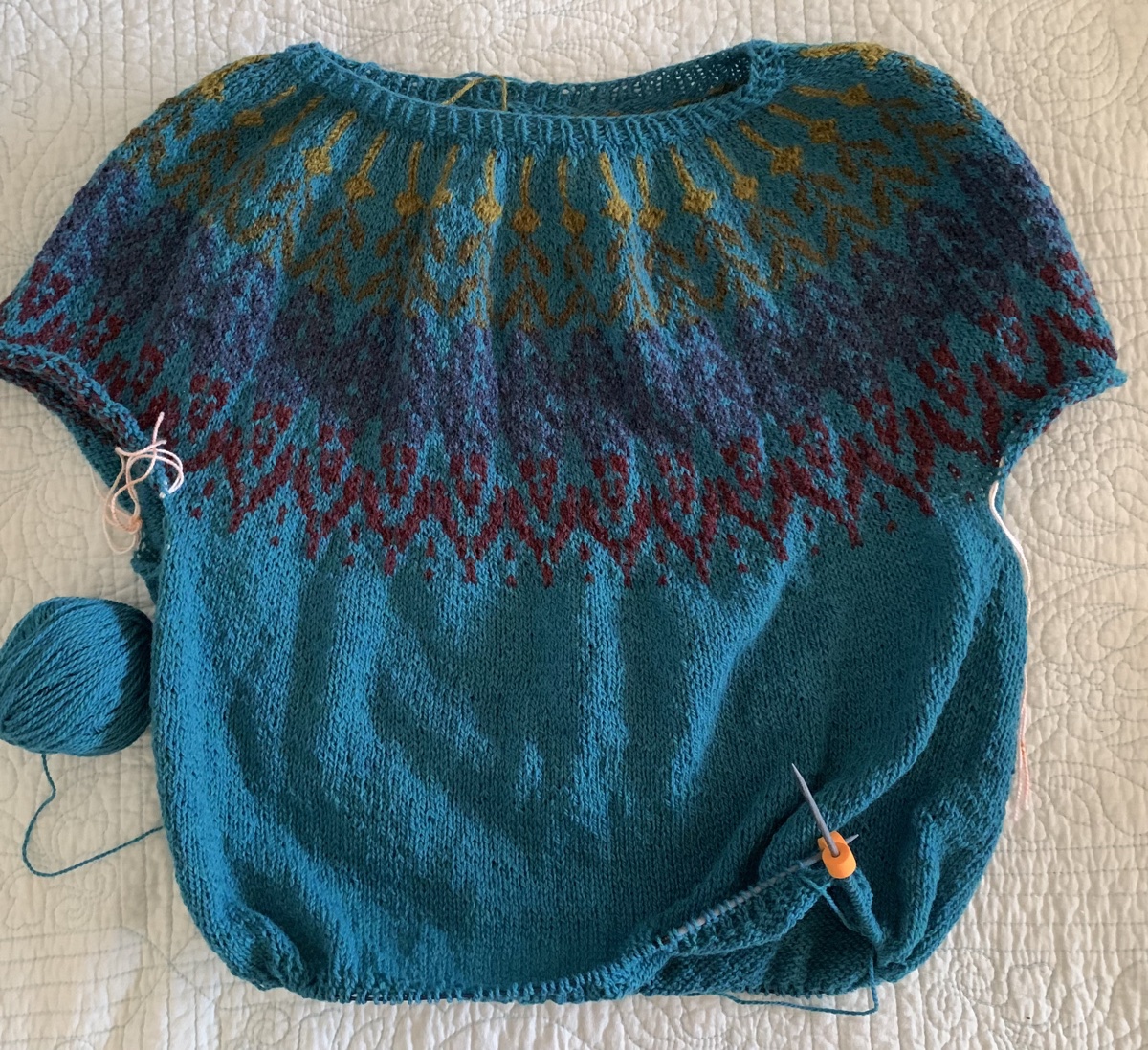
Solvi means “sun strength” in Norwegian (info from Jenn’s Ravelry page). The pullover has a colorwork yoke and long sleeves. After the cast-on, choose either a rolled neckline or 1×1 rib. The designer says it is a good pattern for beginners. I assume she means beginner colorwork knitters. If you can follow the chart, you can knit the yoke. Only two colors are used at any one time. One small section of the chart can be omitted to shorten the yoke.
As a beginner knitter, this pattern would have been tough for me. The reason being that I was not a good chart reader at the beginning of my knitting journey. I also had no idea what short rows did for a sweater.
Now, I would only knit sweaters that do include short rows. In the Solvi pattern, short rows are incorporated after the colorwork section. This happens way down by the armpit area, which is odd. Short rows are usually made near the upper back area to lift the back of the neck.
Why I Chose This Pattern
I was hoping to find a pattern that inspired me, and the Fallow sweater was at the top of my list … for a while. Then I discovered Solvi in my knitting folder (an actual folder, not online) which I had purchased a while ago.
The Peacock blue yarn amounts to a little less than 1300 yards, which is not enough for my size. But we’ll see. I’m now knitting the body ribbing and have two full skeins of yarn left. I’m thinking that one for each sleeve should be plenty.
Knitting body ribbing
Fall is a hard time of year for me. While everyone is winding down from summer, and viewing the foliage, and breathing fresh autumn air, I am still sweltering in the Florida heat. Sweater season has arrived, and new patterns are showing up all over the place. Everyone (it seems) is digging out their hand knits and wearing them.
For me, it’s the time of year to keep an eye on the tropical storms and hurricanes (Milton hit my area as a Category 1 in October).
I’ve lost interest in knitting over the past few months, and I’m not sure why. Even so, I have not stopped knitting. My projects are many, because when one begins to bore me, I take up another. You may say, “me too” or “that is normal, we all do that!” but the passion is not there. It is just a life slump. They come, and go, so I’ll wait and it will pass.
I am a bit excited to try some new yarn, which will arrive any day now. I may use it to knit Fallow. We’ll see.






















 New England's Narrow Road