Help With The Provisional Cast-on

The provisional cast-on is needed when you will have to go back at some point and use, or pick up, the stitches that were cast onto the needles to begin with.

Waste yarn – some yarn other than your main yarn – holds those stitches until they are used. This cast-on method combines both the working yarn and waste yarn to begin the project.

The gray yarn is my waste yarn, the pink is working yarn.

There are a couple of ways to get these two yarns onto the needles correctly. I use the crochet hook method because it is easiest for me.

#1. Cast-on Using a Crochet Hook

For the crochet provisional cast-on, I watch Purl Soho’s YouTube video. It is straight forward and easy to understand. However, it ends there, at the end of the cast on stitches. The first time I watched it, I was disappointed because I didn’t know what to do next!

HINT: After the crocheted cast on, you need to knit one row with the main / working yarn and then begin your pattern.

Provisional cast on with crochet hook

Below is a photo of the crocheted provisional cast-on I used for the Winter Morning headband. The gray yarn will later be removed as I pick up those pink stitches and graft them with the finished end of the headband to connect the loop.

first row of knitting on the provisional cast on
Knitting onto the provisional cast on

The Lion Brand page explains, and shows with photos, how to do this same cast-on. They also show how to pick up the live stitches / remove the waste yarn when the time comes to use those stitches.

#2. The Invisible Provisional Cast-on

As I was searching for help with the provisional cast-on, Lucy Hague’s blog tutorial popped up. I was specifically looking for advice on the type of yarn to use as waste yarn, and she mentions this in her article: Invisible Provisional Cast-on. Her information is all-inclusive, with photos to show what to do once all the stitches are cast on to the needle. In this case, you purl.

This type of provisional cast-on is made using two strands of yarn – waste and working – no crochet hook needed. Lucy shows us what to do; after the cast-on is made, how to begin the first couple of rows, what to do with the slip knot, and how to remove the waste yarn when the time comes. I have yet to find a video as comprehensive as her page.

But trying to knit while scrolling through photos is slow going. I did try to get the hang of this cast-on, but went back to the crochet hook! So I have not done this type of provisional cast-on. I mention it as an option.

What Type of Waste Yarn to Use?

Use a waste yarn with a color that contrasts with your working yarn. Lucy says to use a slightly thicker yarn. This makes it easier to remove the waste yarn when stitches are picked back up.

Do not use anything that is fuzzy. I learned that it’s more difficult to pick up those stitches when fuzz from the waste yarn gets in the way and is picked up into your project….! A smooth silky, or cotton, yarn may work best. If you have trouble gettin the gauge needle into the stitches, you can use a smaller needle to pick up the stitches. Then continue with the correct size.

Reasons to Do a Provisional Cast-on

Sometimes a scarf, cowl or shawl, will be knit from the center point to the end, like the little headband I mentioned above. If a pattern needs to look the same from both edges, or uses a cable that is knit one way, a Provisional cast-on might be used.

The headband / ear warmer I knit in bulky pink was knit from end to end and had to be grafted together to make the band. After I knit the length of the headband, I had to Kitchener stitch it together so it appeared to be one piece.

Kitchener stitch
In the middle of the kitchener stitch

Be Brave… Jump In… Try New Techniques

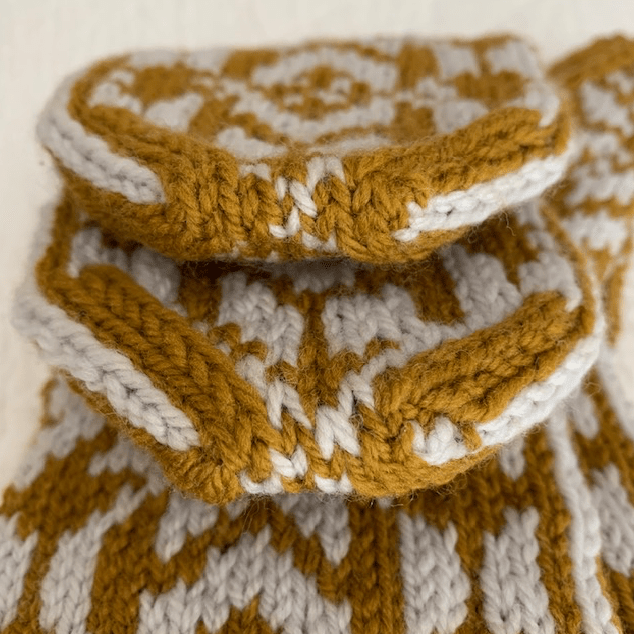
For a long time I avoided any knitting project that mentioned the provisional cast-on. Yikes… too scary..! My headband didn’t end up looking so great – because I needed practice on the Kitchener stitch. So I practiced. Then I knit some mittens that called for it at the top. I think they ended up looking pretty awesome!
Kitchener stitch
Kitchener stitch at top of mittens

I’ve used a lifeline before when knitting and had a heck of a time going back to pick up those stitches. So more frightening than casting on, was having to go back and picking up those stitches when the time came.

If you use a thick, smooth, yarn for the waste, and maybe use a smaller needle to pick up the stitches, you shouldn’t have a problem. Take your time, it’s not a race.

Every time we expand upon our knitting knowledge, a new world of projects opens up! Experience is key with all things, and that goes for the knitter’s world. You will never expand your knitting abilities unless you take a chance.

Try new things on a swatch before you mess up a project, if that makes you feel better.

Quick Headband / Ear Warmer Knit in Washable Yarn

I found this free pattern called Winter Morning (Link goes to Ravelry) to knit a chunky / bulky yarn headband with a cable. So here are the results and tips I want to share. First of all, my grown daughter has shown interest in this type of accessory in the past, so I believe she will wear it. I’ll make one for myself too because my ears may get cold on early morning winter walks here in Florida.

This is an easy pattern which I knit in 2 hours, and I do like the way it came out. BUT… the cast on, and kitchener stitch took time because I had to look them both up. (See more about the Provisional cast-on and Kitchener stitch down the page.)

Washing: The Madeline Tosh yarn is machine washable so I put it into a zippered mesh bag and washed with my clothes. I took it out to air dry – and the yarn smelled awful… which sometimes happens with treated yarn – but once it was dry there was no smell. It’s ready to give away.

Winter Morning Cable Headband
Finished!

Finding the Right Bulky Yarn

I needed to find some good, yet machine washable, yarn because it will be a gift for my daughter. She is a busy woman so I wanted an easy-to-care-for gift. The yarns below are not cheap and come from Peru, South Africa, and Italy. I should get 2 ear-warmers out of each skein of the Mad Tosh. You can find other super bulky yarns for a bargain, but I wanted nice yarn. After I bought my yarn, I found Mirasol Yaya for $5.54 on sale at Wool Warehouse. It ships from England. This yarn is only around 50 yards, and would make one headband, but it’s affordable.

Bulky Yarn That is Machine Washable

After doing much searching online I ordered the yarn shown below and chose the Mad Tosh ASAP in “Cosompolitan” (far right below) to knit the first headband. (I’ve begun a second using the Wool Addicts “Fire” super bulky yarn, in dark gray, and I love it and think it works better for this project.)

bulky washable yarn brands
Bulky yarn by Mad Tosh, Spud & Chloe, and Wool Addicts

Because I want an idea of which yarn is best for this easy project, I will try all four of the yarns above and do a comparison, which I will share at some point!

Manos del Uruguay Franca yarn
“Franca” super bulky, washable yarn
Wool Addicts Fire super bulky yarn
Wool Addicts “Fire” super bulky yarn is very soft

Provisional Cast On to Needle Using Crochet Hook

A provisional cast on means using yarn that will be removed from the project – in this case, at the end of knitting the band. The stitches will be picked up onto the needle and the gray yarn here will be removed. That way both the end and beginning stitches can be knit together to create a nice-looking seam (hopefully).

I’ve included a video by Very Pink Knits to show how to do this because the pattern calls for it.

Provisional cast on with crochet hook
Casting right onto the needle using a crochet hook.

Once the provisional yarn is on the needle, knit one row. Then, begin the pattern.

first row of knitting on the provisional cast on
Knitting onto the provisional cast on

Finish With the Kitchener Stitch

The worst part of knitting this headband / ear-warmer was putting the held stitches back onto the needle from the cast-on. It has to be done in order to finish with the Kitchener stitch. Once you figure that out, both needles should have the same number of stitches. They will be sewn together.

The Kitchener stitch is something I can only do when watching a video. I still don’t know if the working yarn has to come from the back needle or not. In Purl Soho’s video (below) they use an unattached piece of yarn, so I assume it doesn’t matter. Hold right sides facing out and have the same number of stitches on both needles. Once I get to the end with only one stitch on each needle I wing it because I have yet to see what to do!

For the kitchener stitch you will need a darning needle and long bit of yarn left from the end of knitting the headband. All I can say is watch the video and pause it as you go. I could not tighten up my stitches because I couldn’t tell where my stitches were! Purl Soho is using red on white, but I am not. Just a note: In case you are wondering, it’s helpful to know this stitch if you knit socks and mittens because sometimes you end the toe / fingers section doing this stitch.

Kitchener stitch
In the middle of the kitchener stitch
kitchener stitch on headband
My kitchener stitch

Changes to Make Next Time

Honestly, I wasn’t too impressed with my stitching (kitchener stitch) and I decided I would knit my next headband with a regular long-tail cast-on and regular bind-off and stitch the ends together. It will be much easier. We’ll see how it looks.

Also, if you know how to do other types of cables, it would be easy to change that part of the pattern. This cable is very simple and I knit with size 13 wooden needles and used a DPN as a cable needle.

pink headband on gray head
Just so you can see that it fits!

Once the band measured around 18.5-19 inches (my daughter has a small head and for myself I would go another inch). I stopped and finished it off. As you can see in my photo above it fits on my gray-haired head. It will look much prettier on my daughter’s head. As I mentioned above, this yarn is not really bulky enough even though it is called “super bulky”. The skein is 90 yards long, so one skein should make 2 headbands.

Types and Cost of Yarn

Here is a list of the yarn I bought and the approximate price per skein (at the time of this writing). Remember that some skeins have enough yardage to make two headbands from this pattern.

  • Madeline Tosh ASAP – $27 (two different colors)
  • Wool Addicts “Fire”– $25 (soft, thick and squishy, made in Italy)
  • Spud & Chloe Outer- $18 (wool and organic cotton – 60 yds, will make one headband)
  • Manos del Uruguay “Franca” – $36 (114 yards) is super bulky (reminds me of Mad Tosh “Rasta”, except it’s washable) I found some at Richland Street Yarns on Etsy for $26.75 per skein – in limited colors.