My first instinct is to rip the whole thing out. I’m talking knitting here, and looking at a big mistake, or a very tough and time-consuming mistake to fix. Are you calm, cool and collected and simply get on with the fix? Or, like me do you see lots of unraveling ahead – like the entire thing? How about tossing the project (and all at the yarn to go along with it) into a container, covering it up and hiding it so you can forget about the blunder.
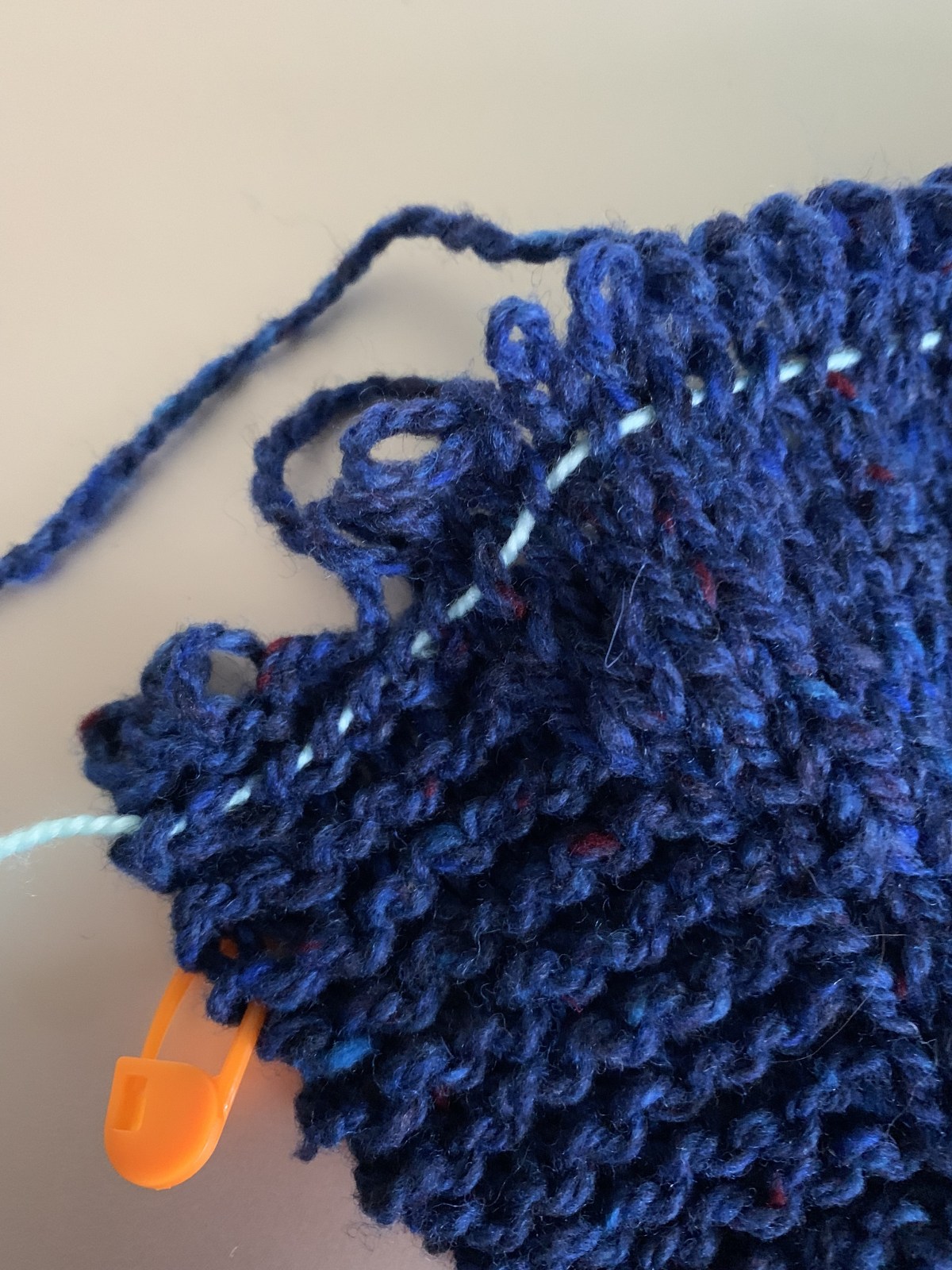
All these things crossed my mind as I looked at the mess that was supposed to be a buttonhole on the Cobblestone #2. Eventually, I did use an embroidery needle with light blue yarn and attempt a row pick up. I was not sure any of this would work, but I made the effort. It took a lot of time, which negated all the time it took me to knit about 4 rows that were then removed.
Big note here: The problem was all me, and not with the pattern. I’m doing a completely different type of buttonhole, rather than the super simple one in the pattern. I’ve knit this sweater before, and had no problems at all. It’s a great pattern.
Even the video for doing this buttonhole is excellent. (I decided to change the buttonhole from the one in the pattern to make it stronger.) The Horizontal Buttonhole video is by Suzanne Bryan, and can be found here. What I did was try to follow my notes instead of watching her video again. (I’d already successfully made one buttonhole by watching and knitting along). Live and learn. I can’t trust my notes.


What really upset me the most is that I’d already had trouble counting my stitches. YES… I have learned that I CAN’T COUNT.
Is this sweater cursed? I’m wondering that too. The increase rows call for a lot of increases at once. It is easy to lose count. Also, I have changed the pattern and am doing stockinette and not garter. For that reason, I am making my increases differently. I did it all correctly (I realize that the RRI includes a knit stitch), but when it came to counting the 200+ stitches, I simply screwed up. Then I thought I needed more stitches, added them on the next row, and counted again… wait, now I have too many stitches! So, backwards I go, unknitting my unneeded fix.
My exasperated conclusion: Quit counting stitches. Assume I am knitting it correctly and just keep going. This is not really a good idea, and I know it, but at this point I am quite mad at myself and have lost all confidence in my counting abilities. It was not a good day.
This sweater could take a year to finish because every time I knit, I end up “tinking” my work! Deep breath. Glass-es of wine, and try again tomorrow.
What Does it Take to Completely Frog a Project?
I’ve only once become so frustrated with a sweater project that I completely gave up. I don’t regret it to this day. When the knitting becomes a dreaded chore, it’s time to quit.
I was not at that point with Cobblestone. I know it’s a great pattern because I’ve already knit it once without a problem! Also, I did successfully rip back those three rows. Yay me!
I did give up when knitting the Oxbow Cardigan by Andrea Mowry. I’d gotten a long way with both sleeves finished, and much of the body – see my photo. I’d had trouble with the patterning on the sleeves, but managed to figure that out. It was the body that did me in. Whenever I thought about knitting Oxbow, I would begin to stress. Maybe the thing was too advanced for me, but I hated the pattern. To this day, I have not been inclined to attempt a textured pattern cardigan.

The following day I was back knitting my blue, Cobblestone #2. All went well and there was no “tinking”. I even managed to make my second buttonhole without a problem (knit along with Suzanne’s video). Lessons learned.
Here is a link to the Cobblestone Cardigan by Jarod Flood (link goes to Ravelry).

Keep Reading More Knitting Stories

Lots of Changes This Year
Writing a blog, sharing photos, and doing research and making links takes time. Lately I don’t think the time spent doing all that is…
Knitters and Our Many Projects
How many projects do you have on your needles? It is not uncommon to find that fellow knitters have many things going at once.
Happy New Year 2026 and Time to Cast On
A new year means a brand new knitting project to begin. What will you be making?

Christmas Day Project off the Needles
I finished knitting the Simple Stripes pullover on Christmas Day. Here is my review and photos.

Saying Good-bye to 2025 and Another Year of Knitting in the Books
A look back at all the knitting projects I’ve completed over the year. Also, what is already in the plans for 2026.

Year-Round Camping in Florida; Enjoying Nature While I Knit
The peaceful days of camping in the wilderness go perfectly with knitting. What could be better than having coffee outside, with knitting on my…





 New England's Narrow Road