Knitting the Playdate Cardigan For Kids

The little Playdate cardigan by Tin Can Knits is a wonderful pattern with excellent directions that will broaden a beginner knitter’s horizons!

The Playdate Cardigan pattern comes from Tin Can Knits. I bought and printed out the pattern a few days ago and have since been working my way through this cute sweater. The pattern has size adjustments from 0-3 months to 4XL…. so you can knit it for just about anyone.

I chose to knit the 6-12 months size. I’m using a 16-inch circular and 5 double-points in the same size. Another smaller needle (with same size dpn’s) is needed for the ribbing. My yarn is Emma’s Yarn, fingering weight, Super Silky in “Malibu”. I would not have chosen silky yarn if I was buying a skein to knit a sweater, but I wanted to use stash yarn for this first attempt. I would choose a favorite baby sweater yarn next time.

Creating Pockets

This is a bottom up pattern, but it begins with pocket sections. As I read through the pattern, the pockets were confusing to me. I’ve never done pockets. HINT: To knit a 2-color sweater begin the ribbing with the contrast color. But the pre-made pocket sections will be behind the work, so the main color can be used.

First thing to do was to knit two little rectangles which would become part of the pockets. I almost decided not to add pockets just in case I couldn’t figure it out, but I’m glad I used them. Because first, they are easy to add, and second, they make the sweater look cute!

Baby sweater
Getting started on “Playdate” baby sweater

Once the bottom of the sweater is begun, the little rectangles will be added to the long needles and create the backing. The top stitches will be knit into the regular line of knitting.
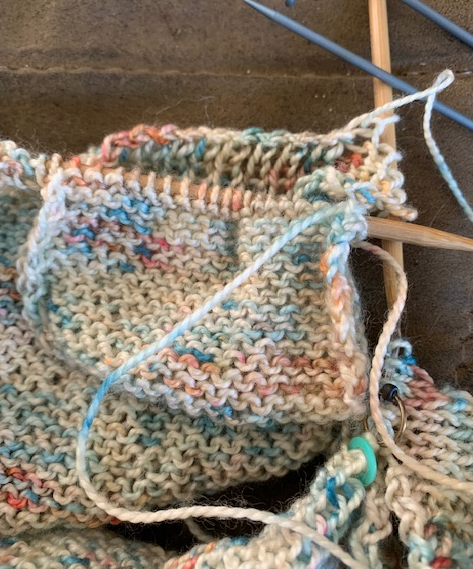
Adding the pocket to the Playdate cardigan
Placing stitches of pocket onto long needles

The K1P1 ribbing for the top front of the pockets is created first, then bound off. See the back of the pocket above and the front below. The little rectangular backs will later need to be sewn down to actually create the pocket.

Playdate sweater pocket knitting
Ribbed edge of pocket with backing added to needles

The Back and Shoulders

Once the front is knit to length, the back stitches and one shoulder will go on hold. I used some metal stitch-holders (they were my grandmothers) which work well for holding small amounts of stitches. I always have trouble picking up my stitches when I hold them using yarn. From here, each shoulder area will be knit, along with the back – separately.
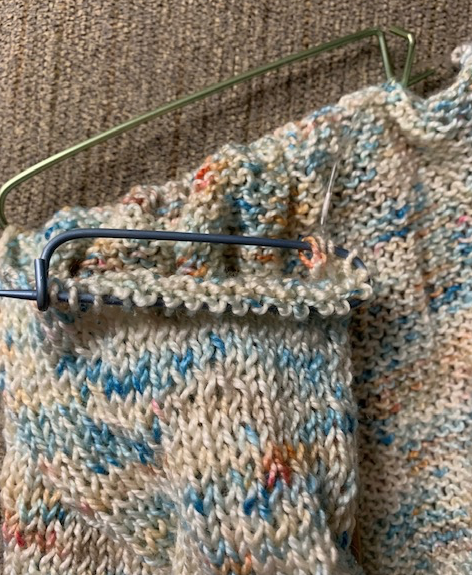
Knitting stitches on hold
Shoulder and back stitches on hold while knitting other shoulder stitches

I used DPNs to hold the shoulder stitches because my sweater is so small. The pattern directions say to work the stitches, ending with a RS row and then “break the yarn leaving a long tail”. I guess they figure you will know enough to keep those stitches on hold, but you need an extra needle for that (or yarn). So it helps to have double-points handy with good stitch stoppers (Mine are by Cocoknits and they work great). The same thing happens for the neck and I left my stitches on the main circular needle for that longer section of knitting. I used 2 double-points for straight knitting the first shoulder section.

Top edges of sweater on hold
Shoulder parts of Playdate on hold using three needles

Once the back and shoulders are the correct length, they will be stitched together. I tried 2 different methods here, and decided I liked the Kitchener stitch – as shown in slow motion by Very Pink Knits – which came out pretty smooth. I sat in front of the computer while I did it so I could watch her video.
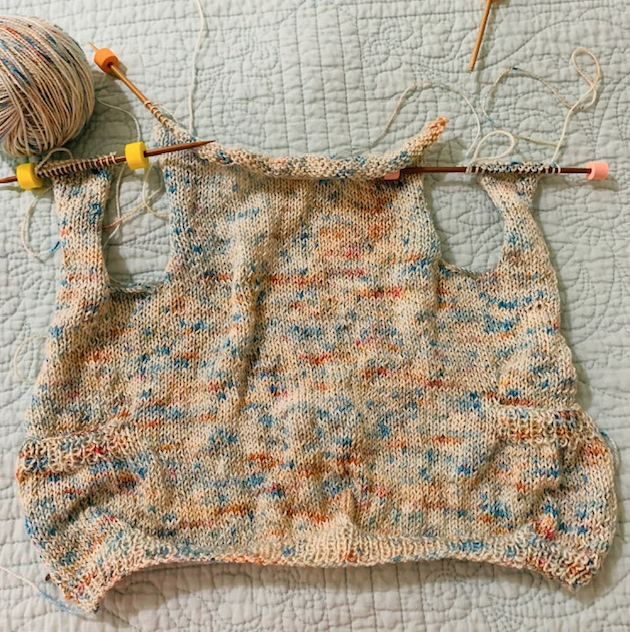
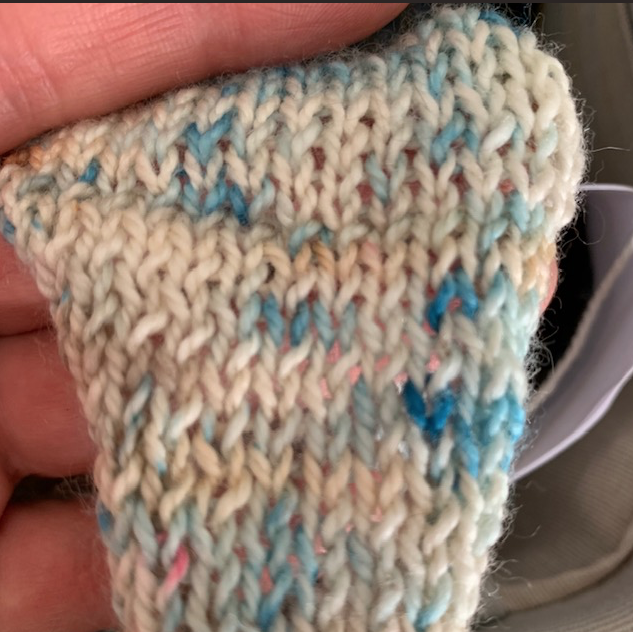
Playdate sweater knitting in progress
Ready to connect at shoulder seams
Shoulder seam in kitchener stitch
Kitchener stitch joining back and front at shoulder
Ridge on wrong side of kitchener stitch
Shoulder seem, wrong side of kitchener

All the edges are curling up badly, which is par for the course when knitting stockinette. I had the same problem on the Fine Sand sweater, but after washing and blocking it looked great.

Baby sweater with pockets
My front and back knitted sections are now attached at the shoulders

On To The Sleeves

As I went around the armholes picking up stitches, I picked up a few more than was suggested just so there would be no holes. On the next couple of rows I decreased back to the correct number. I was able to knit one sleeve within a few hours time. I think I like making this little sweater. It’s finishing up fast and looking pretty cute!

Playdate with button band started
Getting there!

A long, circular #3 needle was used to pick up the required stitches around the sweater front opening. A #3 was suggested for the bottom ribbing and sleeve cuffs, but I used a #4. The rest was knit on a #5. I didn’t check gauge because the end size did not matter to me.

Knitting a Button Band and Doing Buttons

This is my first attempt at doing a button band around a cardigan. It means placing the buttonholes evenly and making each hole the correct size for a button. Thanks so much to Tin Can Knits and their excellent page all about knitting a button band. I will definitely be referencing it during this phase of knitting. My buttons are on order from an Etsy shop (Ginger Mint Collection) because I have no place local (that I know of) to buy buttons.

In the meantime, I decided to knit a little swatch and try out a couple of buttonhole sizes. Once my buttons come from Australia I can see which of the sizes to knit on this cardigan. I’m not sure which set of buttons I will use, but hopefully one of the button designs will match well.

I’ll keep this swatch for reference and have added a tag with info as a reminder. I did the 2-stitch buttonholes because a good size button will fit through.

Buttonhole knitting practice
Measuring buttons

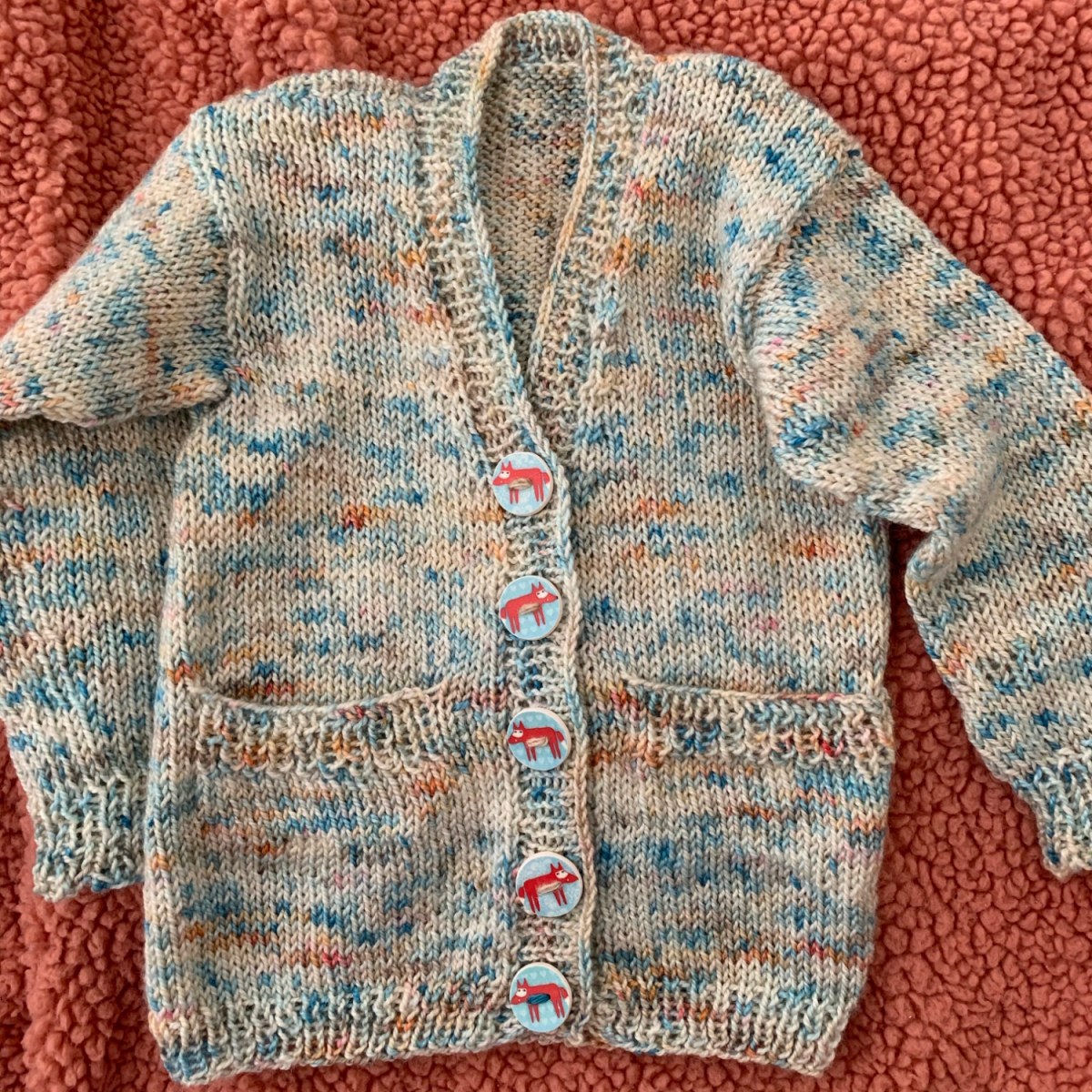
Until my buttons come, and I’m sure they will fit the size holes I make, this sweater will be on hold…. changed my mind. I decided to add 5 buttonholes and continue to finish the band. Today I washed the sweater and when the buttons arrive I will pick the ones I like and add them. *Update: chose the fox buttons!

Finished! My Thoughts on Knitting the Playdate

This was a fun sweater to knit and I got it done quickly. Here is a link to the pattern once again: Playdate by Tin Can Knits. I learned to make buttonholes and pockets, so that was nice. It’s good to learn new things. I would love to knit this one again – and in October / November 2022 I am, using blue yarn this time.

Tin Can Knits has a book out called Strange Brew with loads of options for knitting pullovers and maybe other things. I just found it for sale at Jimmy Beans Wool and ordered a copy.

knitting divider

Knitting Stories From the Blog

Washable Yarn For Knitting Baby Garments

Although I have four grown children, I have no grandchildren! In fact, at the moment, none of my grown kids are married. Now that I have begun knitting again, I love some of the baby and young child knitted projects I am seeing. (I will write a post listing some favorite designs soon.)

Moms have very little time to themselves and I don’t think they would like the idea of hand-washing garments for their kids. Lots of yarn requires hand-washing only, or machine washing on gentle and drying flat. I’m looking for yarn that can handle washing and even machine drying.

How to Find Natural Fiber Yarns That Go in the Washer

After knitting up a couple of pink baby hats as starter projects, I gave them as a gift to a friend. Unfortunately they were knit with merino yarn that had to be hand-washed. Now that I know better, gifting hats to new parents means knitting in yarns that wash well in the machine, and if possible, can go into the dryer.

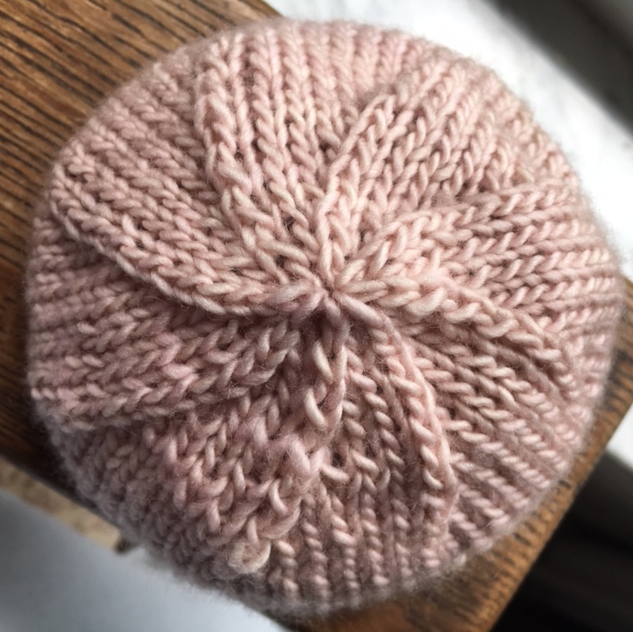
Top of baby hat spiral with decreases

Lots of cheaper yarns (usually made of acrylic) are easy to care for – I will list some acrylic yarns at the end of this post. But these yarns are not as soft and unique as natural fibers. Most really nice yarns must be hand washed, so I’m looking for the in-between choices.

Without buying every kind of yarn out there, how do I really know what yarns to choose? There is no easy answer except to search online (unless you have a local store). A good place to start is Ravelry, where knitters leave comments about specific types of yarn. Search for the type of yarn, then view the comments about it. Sometimes there are a lot of opinions, and sometimes not. I’ve spent a lot of time reading reviews to create this list!

All prices are estimates of what I saw at the time of writing this post.

Rowan Baby Cashsoft Merino

This is a yarn I have been considering for a while now. I wanted to knit a small baby blanket and began searching for yarn. Rowan’s Baby Cashsoft Merino can be machine washed, but lay flat to dry. It is made up of wool, acrylic, and cashmere. The nicest thing about this yarn is that it comes in lots of good baby colors. ($9.95 / $10.00 for 142 yards – that is not a lot of yardage)

Sublime Baby Cashmere Merino

You don’t have to knit for baby with yarn that has “baby” in the title, but it’s worth a look if the maker has tried to create a truly soft, wearable yarn. Sublime Baby Cashmere Merino Silk DK doesn’t get the greatest reviews on Ravelry, but it comes in lots of pretty baby colors.

What reviewers at Ravelry say: Doesn’t wash well – shrinks and felts. Also knitters mentioned pilling. However, reviews at Jimmy Bean’s were all good!

Cost: $9.95 for 127 yards

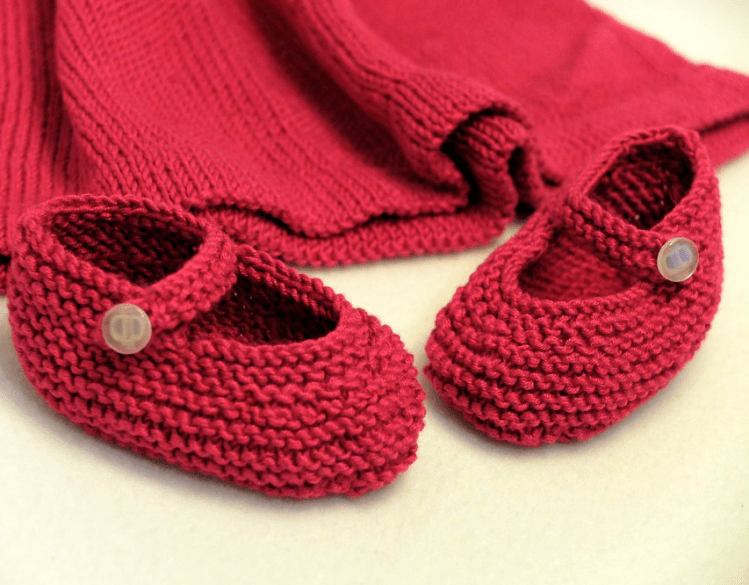
Red baby booties hand knit

HiKoo CoBaSi – No Wool!

Some people don’t want to take the chance that baby may be allergic to wool. Alternatives are usually cotton or bamboo which can be a bit stiff and unforgiving.

HiKoo CoBaSi yarn is something different and it gets great reviews from knitters! It is available at Jimmy Beans and is made of cotton, bamboo and silk. (Also see more colors at Dizzy Sheep – which offers free US shipping!) It is “soft and machine washable” and “perfect for baby garments”. Probably drying flat is best, but it can go in the dryer. Use to knit summer, or warm weather clothing. ($8.00 for 220 yards, so it’s cheap!)

Ravelry reviewers generally say good things about this yarn. It is long lasting for socks, good for people allergic to wool, great for warm weather wear. It stretches nicely and gives good stitch definition. Goes in washer and dryer! Really… I would like to try this yarn.

Babies born in summer can benefit from newborn items knit in this type of yarn. I am thinking it may be a good choice for those of us who live in warm climates year round.

As I searched for baby patterns made with CoBaSi, I found that many knitters used the yarn to make toys / stuffed animals. If you are into that, this yarn seems like the perfect choice.

Malabrigo

Malabrigo yarn is well known and loved by knitters. I’ve used their bulky Rasta yarn to knit a few hats, and Rios to knit a sweater. Malabrigo sock is 100% merino wool, and is machine washable, but needs to lay flat to dry. Skeins are 440 yards and cost a bit less than $20.

In fact most “sock” yarn will be washable. After all, who wants to hand-wash socks! But it may not be as soft as you’d like for a baby item. Sock yarn is usually fingering weight, so hold two strands together to make a thicker item.

I think I would prefer a blend, like the yarn listed below. Any superwash merino tends to stretch with washing – and I can attest to that when I knit the Polliwog Popover baby sweater in Lorna’s Laces yarn. I loved the yarn, but it did stretch like mad.

Cascade Cotton Yarn

I usually use all cotton yarn for dishcloths and dish towels, but lots of knitters use if for baby things.

Cascade Ultra Pima is a washable yarn which is all cotton. Directions say to wash in cool water and tumble dry on low setting. Cotton doesn’t have a lot of give, so this may be best for a baby blanket, bib, or something that doesn’t need to stretch. ($10.00 for 220 yards)

Mrs. Crosby’s “Hat Box”

I have a few skeins of Mrs. Crosby’s yarn and it is lovely. The “Hat Box” is made of wool, silk and cashmere and comes in a wide variety of colors including variegated colors and some pretty colors which would work for a baby. It is Sport weight, and costs around $29.00 for 317 yards.

Purl Soho’s “Posy”

Purl Soho has a washable merino, cashmere and nylon yarn called Posy. It a more expensive choice at $29.00 for 318 yards. They also sell smaller skeins of the same yarn called Pocket Posy – which could be purchased for colorwork projects. Posy has a pretty pale pink color and a few others that may be suitable for baby items.

Ravelry comments on Posy say it tends to pill, so not good for socks, or clothing maybe. Also that it seems thicker than a regular fingering weight yarn.

Just remember that it’s always a good idea to include directions for the person who will be responsible for washing the item. Most hand-knits do better if they lay flat to dry. If you are a grandma or grandpa who lives close by, maybe offer to hand wash items for the new mom and dad.

Acrylic Yarn For Baby

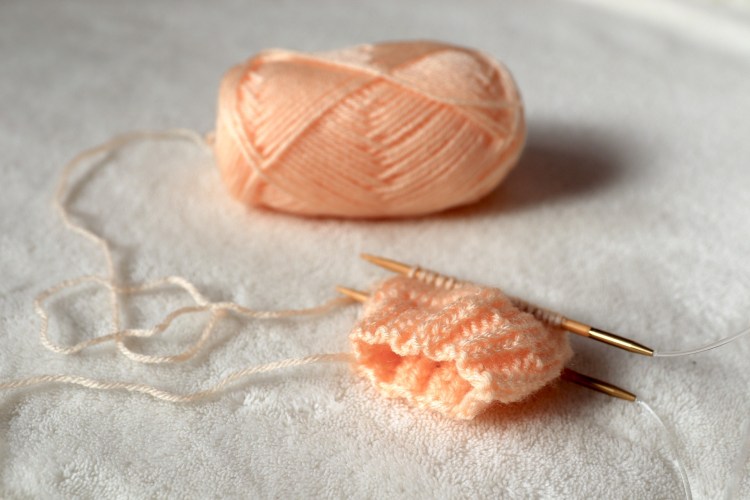
peach color acrylic yarn for knitting

Although I do not knit with acrylic yarn, I understand the appeal of cheap and easy care knitwear. If you know the gift-ee will simply throw the item into the wash – hot water or cold – and let it got through the dryer for sure, then a pretty man made fiber may be the best choice. Here are a few that are meant for babies, and come in nice colors.

I hope this gets you started in your search for a favorite baby yarn. I plan to try some of these myself. If you are already an experienced baby garment knitter, please share your expertise, experience and advice in the comment section.

Thanks to Pixabay for the images I used in this post.