The Doublemassa massive hat knitting project is done. I have to model it for the full effect, so here goes.
Don’t get excited, no gorgeous models here. But the Doublemassa deserves to be photographed while worn. I’m the only one around to do it, so here goes.
I’m a little late posting this because life got busy! But I do need to share the final photos of this knitting project.
Tips For Finishing the Hat
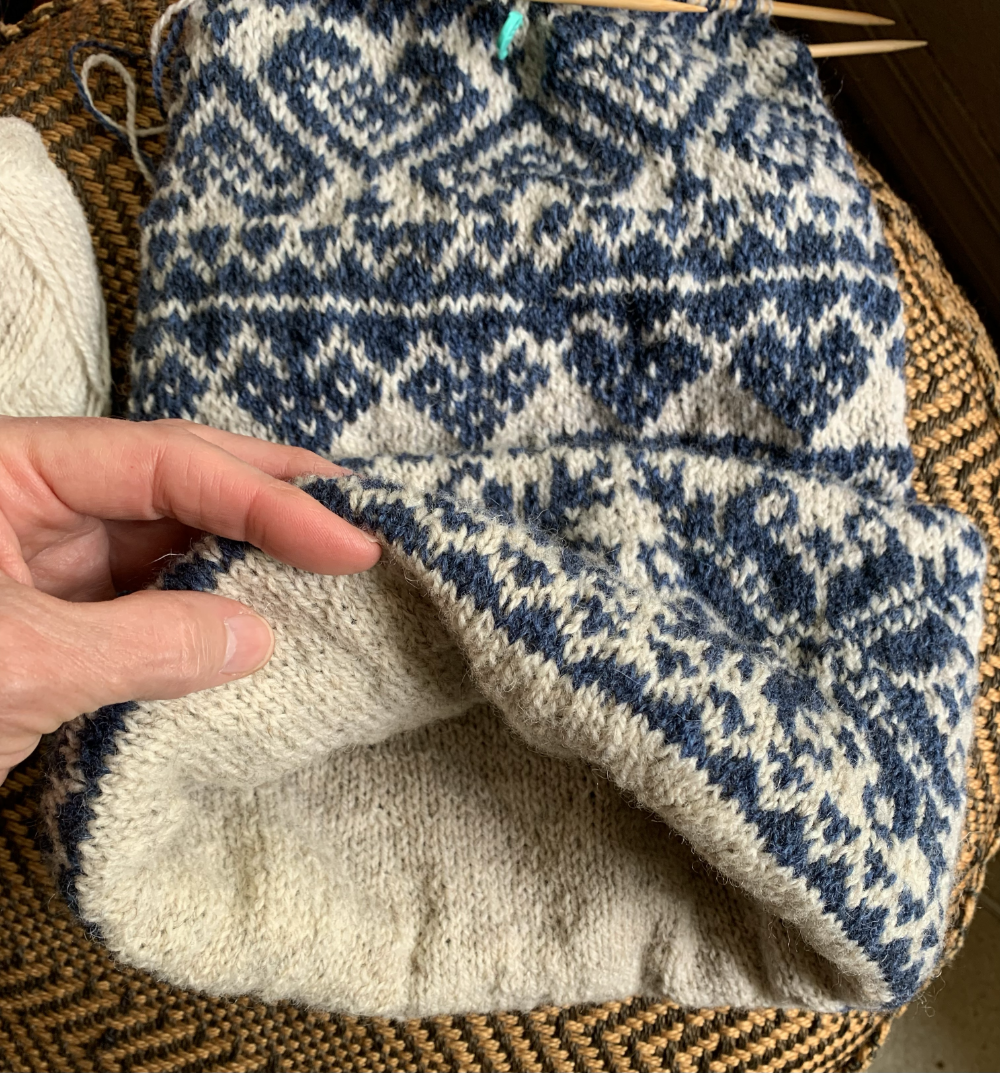
First a note on finishing up this knitting project. One key thing I want to mention is to be sure and weave in your ends BEFORE you make decreases at the crown. I spit spliced my wool, and only had two ends to weave, but I had to pull that section up through the crown opening.
I ended up pulling the whole hat out just to check for ends. Maybe next time weave as I go, or at least keep track of how many ends there are. Wool makes yarn splicing easy, and this means fewer ends hanging.
Only 2 ends to weaveInside out
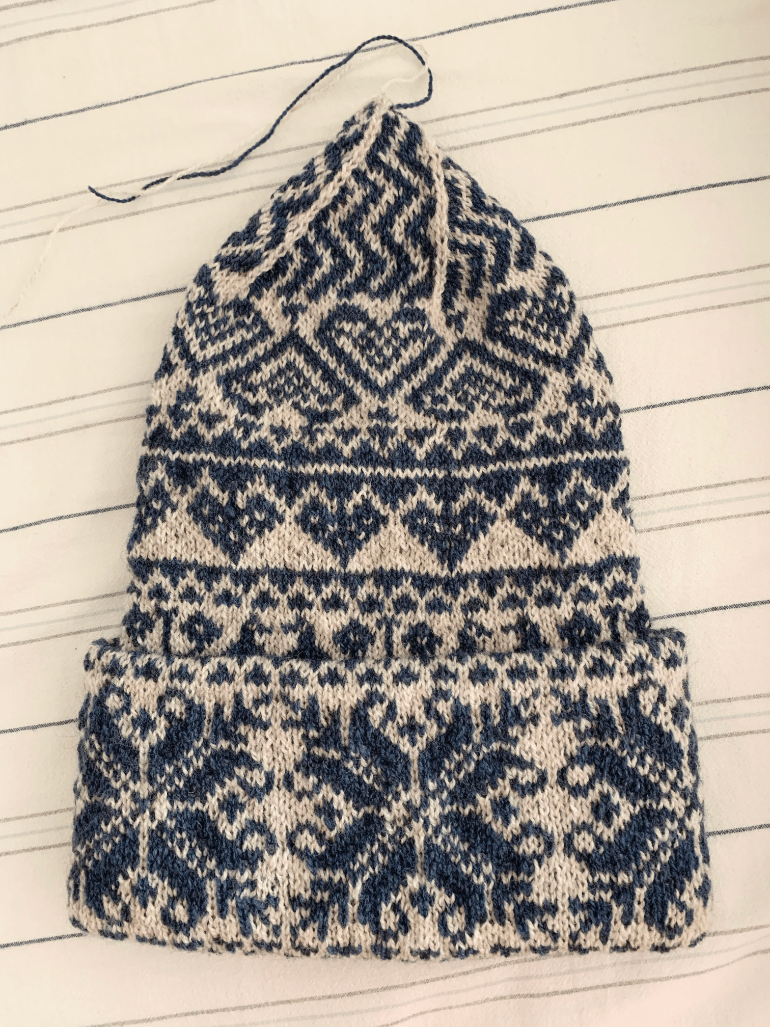
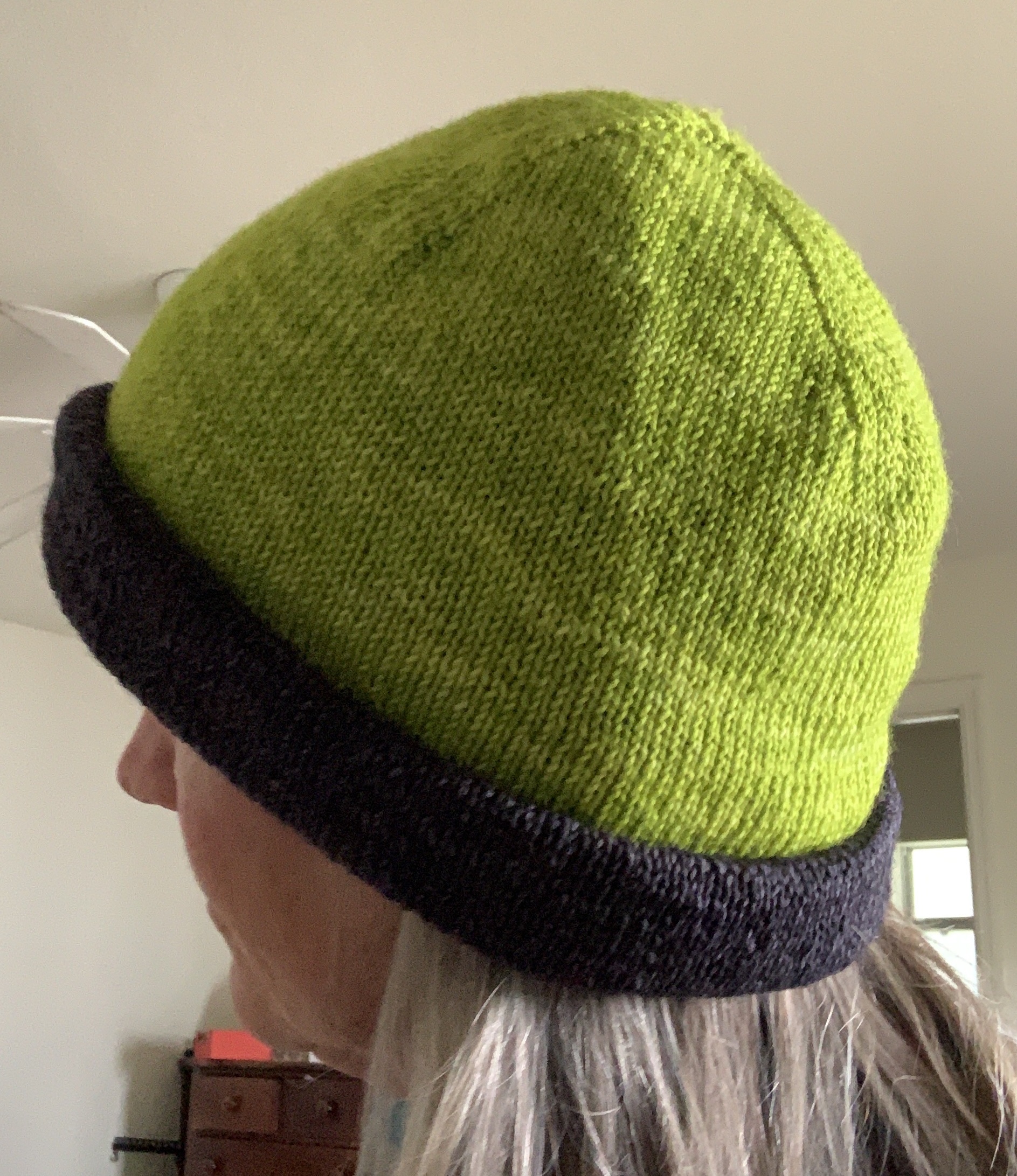
As I began the crown decreases, the hat was finally long enough to fold the brim and try on. This hat is seriously cool! It fits like a charm too. I’m knitting it for my daughter and she has a small head. I hope she likes the fit. The Rauma wool is quite soft, so no itchy problem there. I highly recommend Rauma.
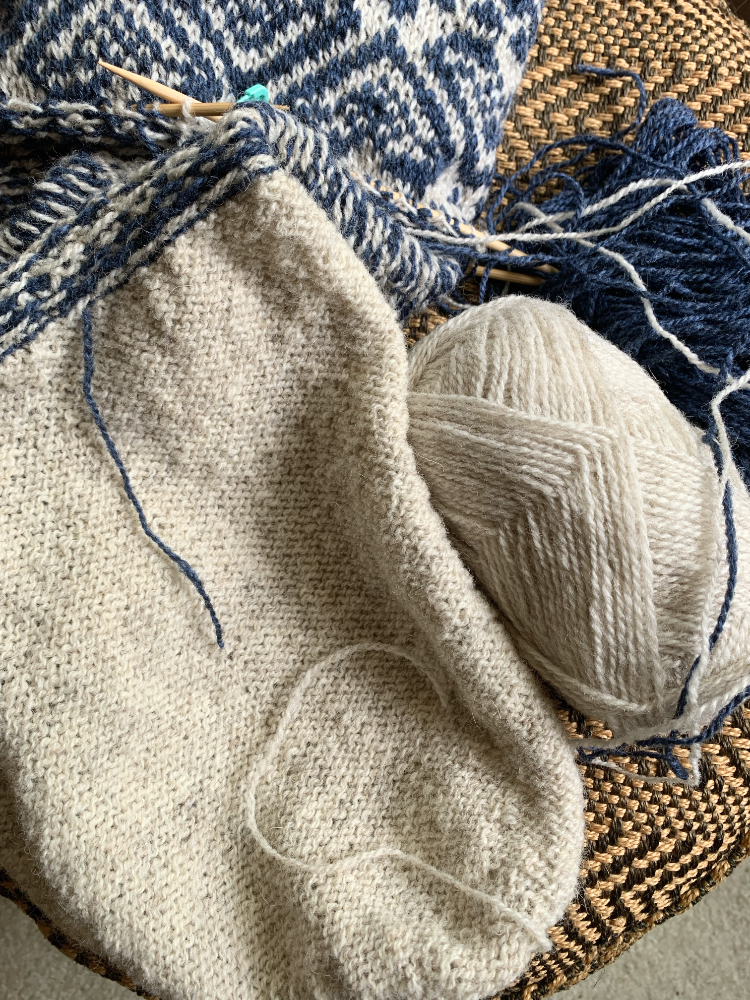
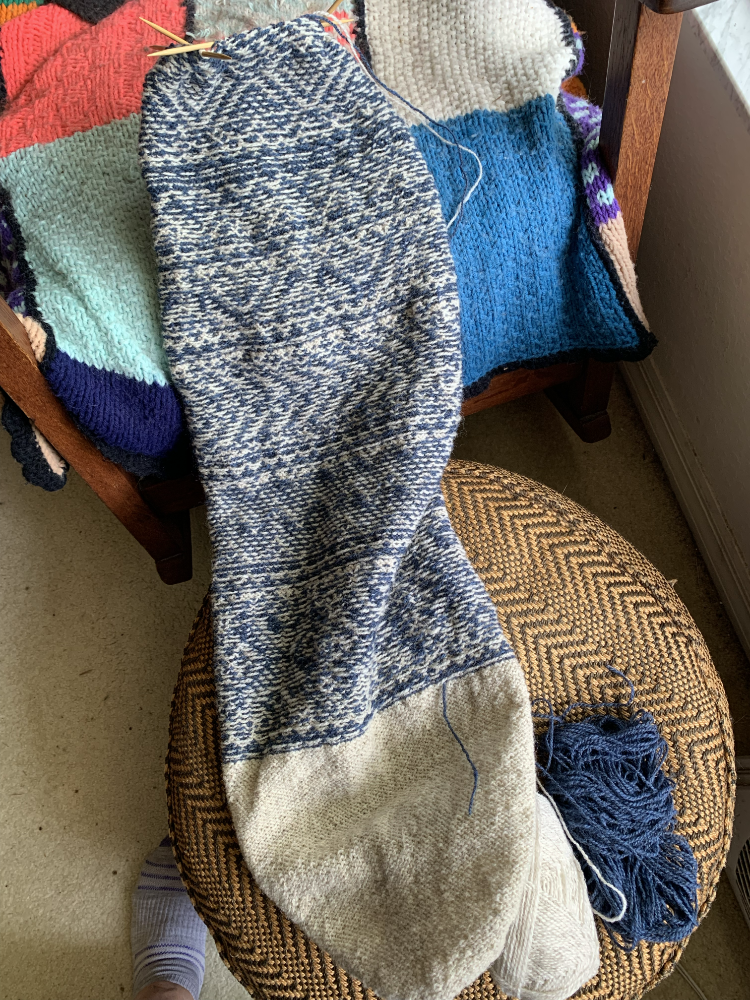
Photo below: At this point all I have left to knit is the crown decreases. I’ve swapped out the 16″ circular for DPNs. Once that is finished I need to make a fun tassel for the top.
Making the Tassel
Tassel directions are included in the Hat’s On book. However, the directions are not great. I found a good video to follow, but the tassel must be attached to a hat without an inside access. I wrote a blog post about making and attaching the tassel.
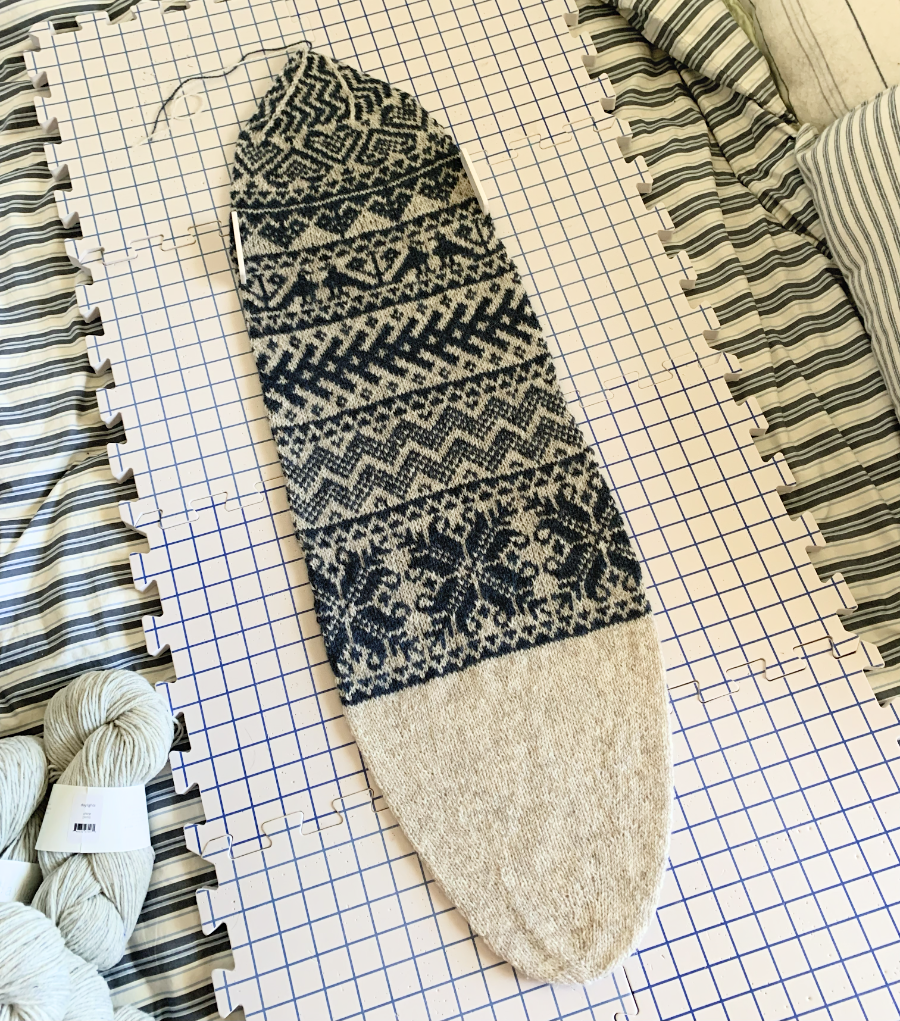
Washed and Blocked
Fontana immediately claimed the hat as her newest cat bed!
Unwashedquick try onBlocked and dryingPerfect cat bed size
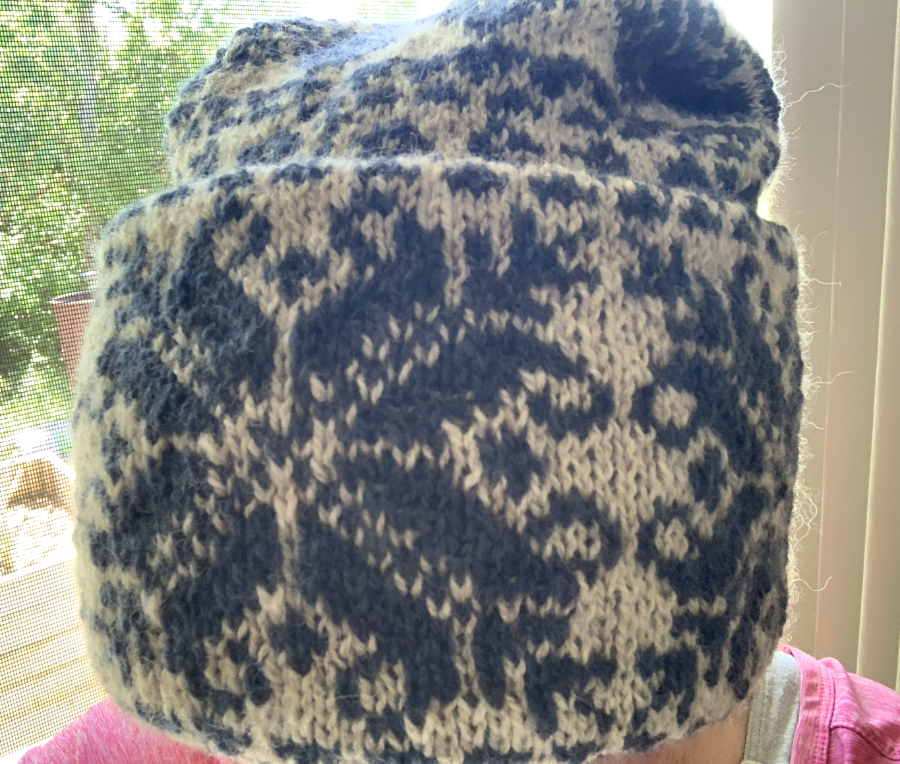
Modeling the Hat
I hate to show too much of myself, but in this case the Doublemassa deserves to be shown on a head. My head was it, so here goes.
All my knitting photos are selfies. I prop the camera somewhere and use the 3, or 10 second delay. Usually I go outside, unless it’s too hot. Then I do a lot of cropping and fixing, … oh and deleting too!
These photos would look a lot better with a snowy background and me wearing a puffy winter coat. Instead it was a hot, cloudy morning.
The Doublemassa really is an impressive pattern. I used colors I already had, but this would be pretty in many combinations. The pattern is available in the Hat’s On book (paid link) by Charlene Schurch.
If, as a knitter, you get a request for a hat that is warm over the ears – this is it! I don’t know how you get much warmer than a 4-layer fold.
Beginning the lined, Doublemassa hat pattern. It is a stocking cap done using two different yarn colors.
The hat pattern book “Hats On!” has provided loads of fun hats to knit. I have already knit quite a few, and a few more than once. My favorite of all the hats has always been the pink one featured on the front of this book. It is named the Doublemassa.
Way back when I purchased Hats On! I was a beginner knitter. Many of the patterns in the book seemed too difficult and involved reading a chart. I hadn’t mastered that yet, so I stuck to knitting the simpler beanies. It has taken many years to work my way up to attempting the Doublemassa.
Doublemassa Difficulty Rating
There is a lot to this hat pattern. I don’t recommend it for beginners.
This colorwork hat is knit using a chart. A long chart. The anatomy of the Doublemassa is this. It is a short-ish stocking cap. It has a fold up wide brim that is 4 layers thick. Two yarn colors are used for the colorwork and there is a lining. The pattern begins with the lining being knit from the top-down. Once the lining is complete, the colorwork begins. A tassel is added at the end.
This hat book is full of various types of hats, but honestly, the directions are not in depth. For example, in the case of the Doublemassa pattern, we begin by knitting the lining as a top-down hat. We cast on only 12 stitches and knit in the round while expanding (4 each round) with yarn-overs.
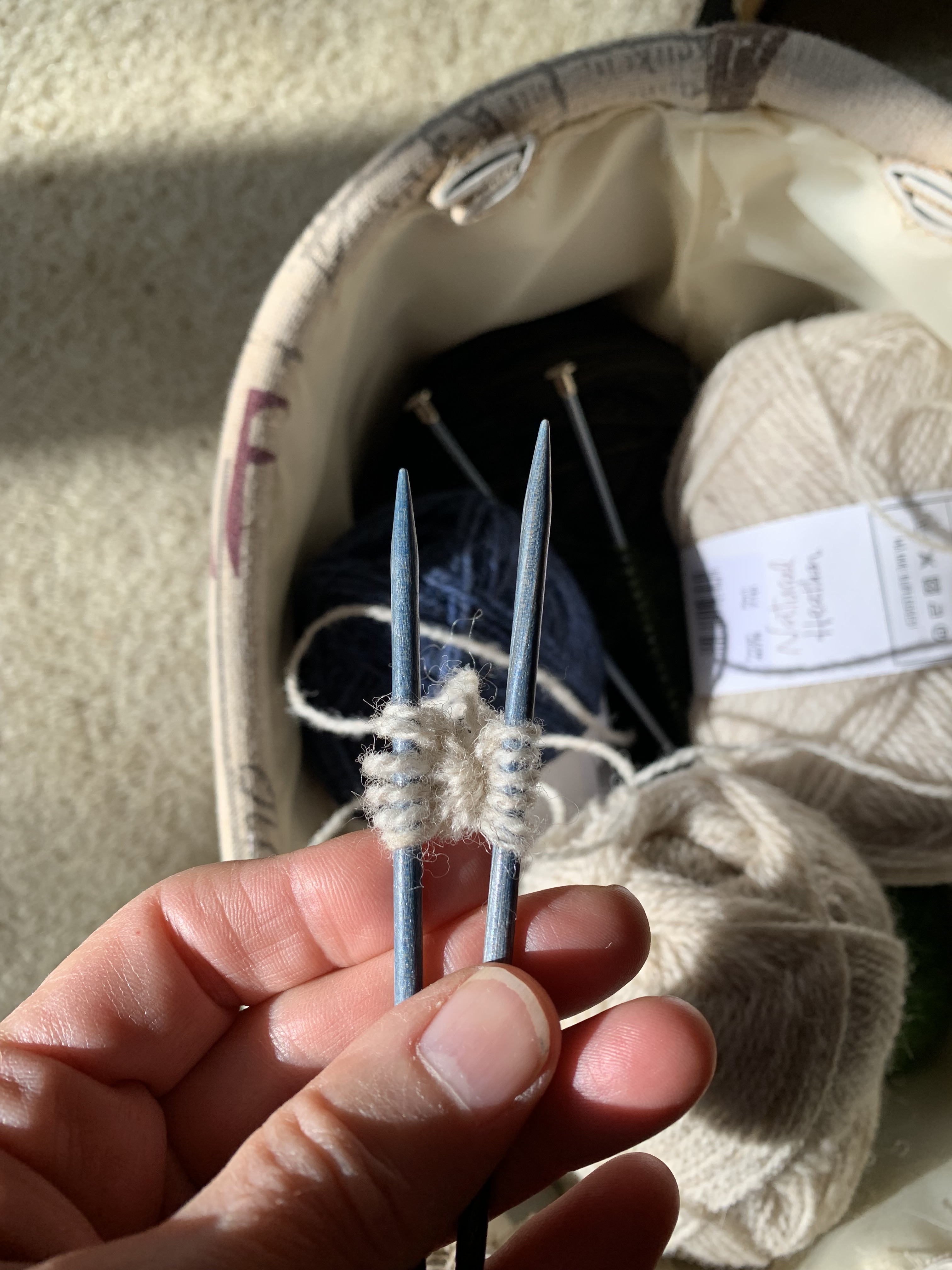
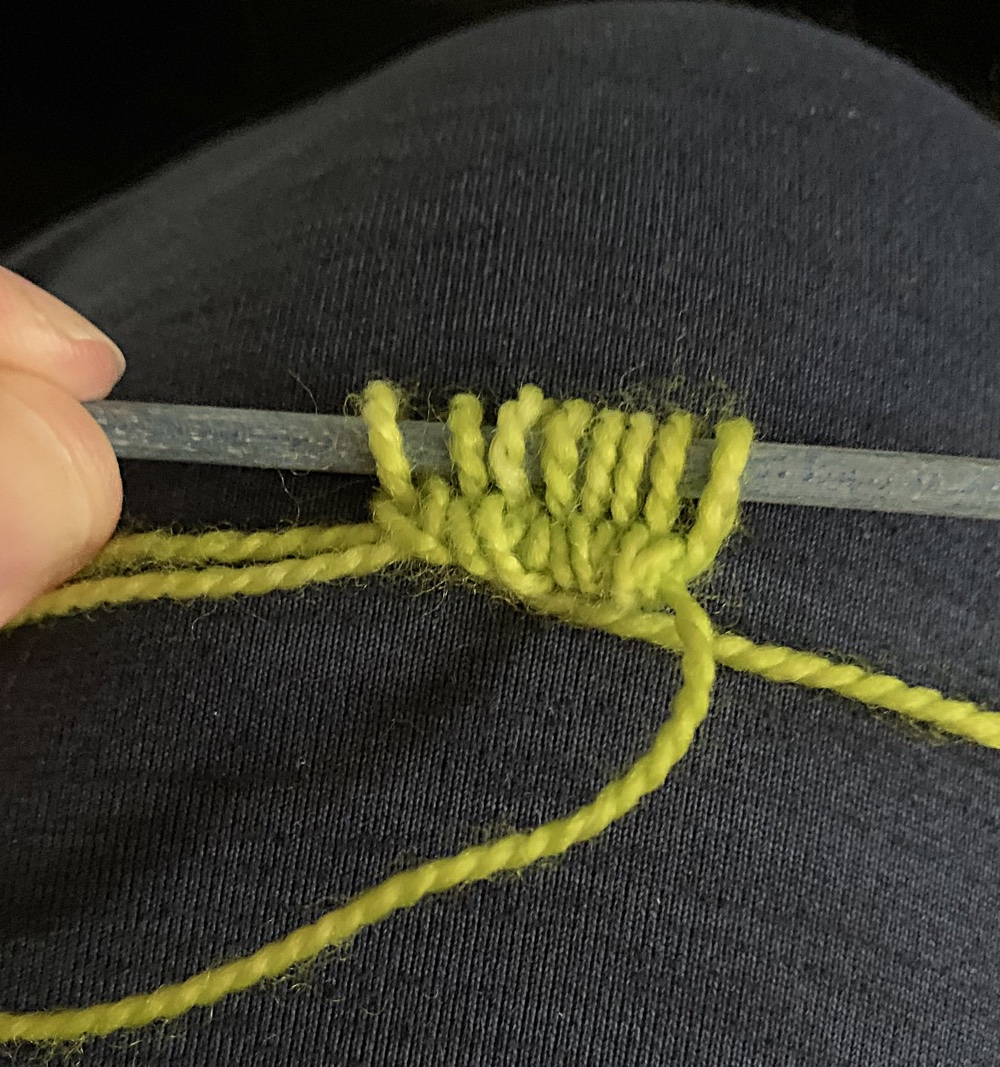
I used the Disappearing Loop cast on, by rewatching this video by Always Knitting. This is the same cast on I used for the Musselburgh Hat. It allows for knitting in the round from a very small circumference outward. It also involves Magic Loop. This type of cast on is fiddly no matter how you do it! I used a tiny crochet hook to help.
Disappearing LoopMagic Loop16″ circular
The pattern simply says to expand by 4 stitches using yarn overs. Since it’s a lining, and won’t be seen, I was not very careful about spacing my beginning increases evenly. Those yarn-overs need to be knit through the back loop, or else a hole is created. This is something the writer assumes we know.
As I read on, the colorwork part has various rows where decreases are made. All the row says is “decrease – with the number”. So let’s say there are 130 stitches and I need to evenly decrease by 6 stitches. I’m going to use the Knitulator to space my decreases. (Or, divide by 6 to estimate.) Most decreases are 2 or 4 which are easy to figure.
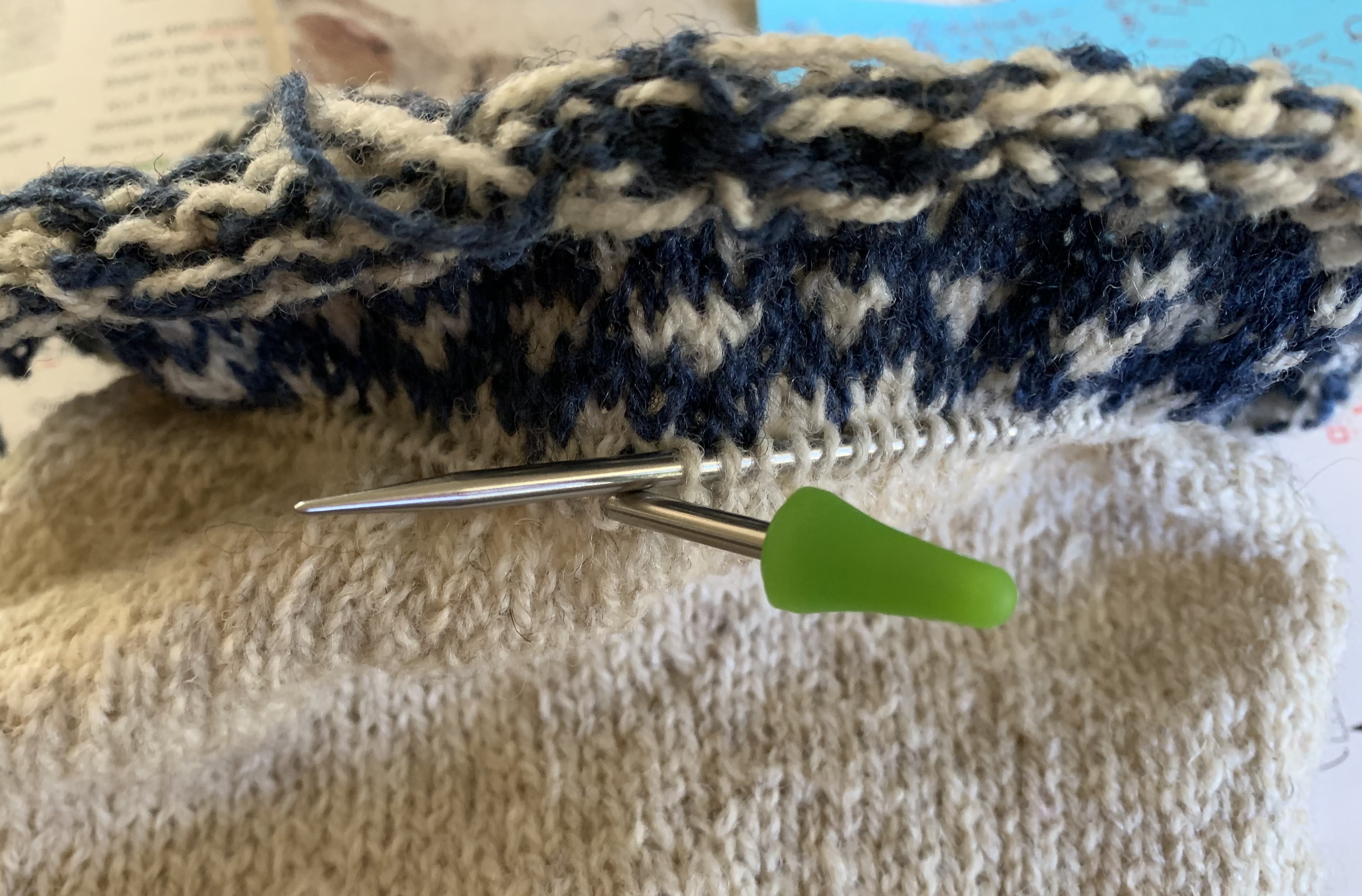
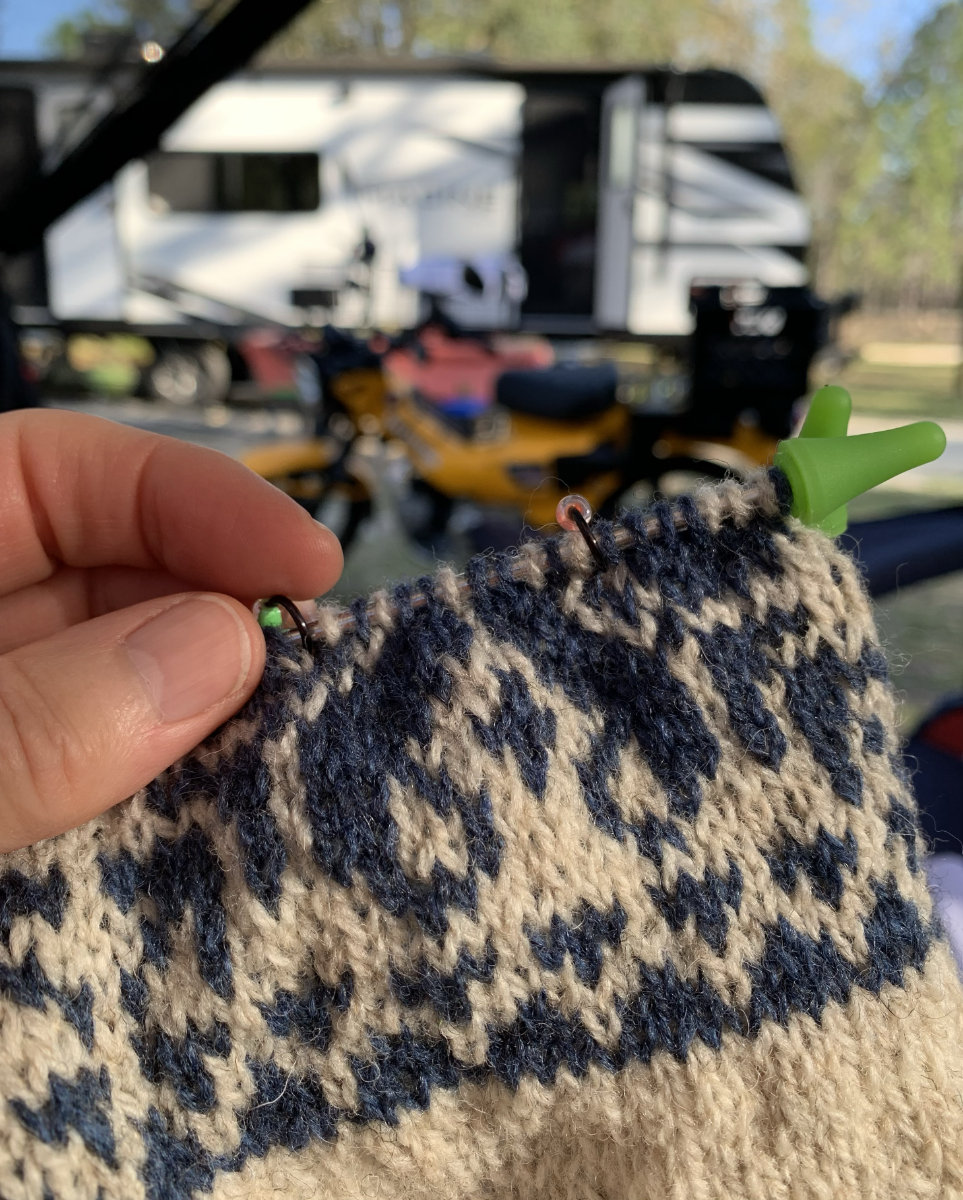
Did colorwork wrongNeedle with picked up stitches to rip backBegan colorwork againKnitting on the Doublemassa while camping
Yarn
I’m using three skeins of Rauma Finull, which is a fingering weight, rustic wool. I dug into my stash and had enough of the natural beige heather to be the main color and lining. I’m using a dark blue as the contrast color.
Needle size is 4, but I’m not sure if I will go up a size when it comes to the colorwork. (I did not change the needle size.) My daughter’s head is small, so I may stick with the size 4. She has been asking for another hat with a brim for ear warmth. Doublemassa should work nicely.
The folding of the hat is hard to figure out, by looking at the photos. I guess it will be obvious when it’s done. I have quite a few patterns in the works now, so it may be a while before this one is finished.
The Musselburgh Hat pattern is super popular and I’ve seen the finished hat photos everywhere online. Knitters are raving about this simple, unique, double layered hat that is really two hats in one. It is knit from one crown to a second crown, creating a long section of stockinette in-between.
The Musselburgh pattern is by Ysolda Teague and can be found to purchase at her Ravelry page, or on her website. At the time of this writing, over 17,000 projects have been knit…!!! Wow. Knitters LOVE this hat.
The big draw, I imagine, is not only the simple circular stockinette, but the fact that it’s a perfect hat for using up stash yarn. Suggested weights are heavy lace to DK, and nothing bigger because this hat will be worn doubled. Also, if you knit it long enough for a brim, the brim will contain four layers when folded up.
If you don’t understand this pattern, I have drawn a picture. The hat is knit, in the round, from one end to the other. You make a long, enclosed tube. One end is tucked into the other when worn, to make a double layer. The long style creates a folded brim using the center colors, or make it shorter for a doubled hat with no brim.
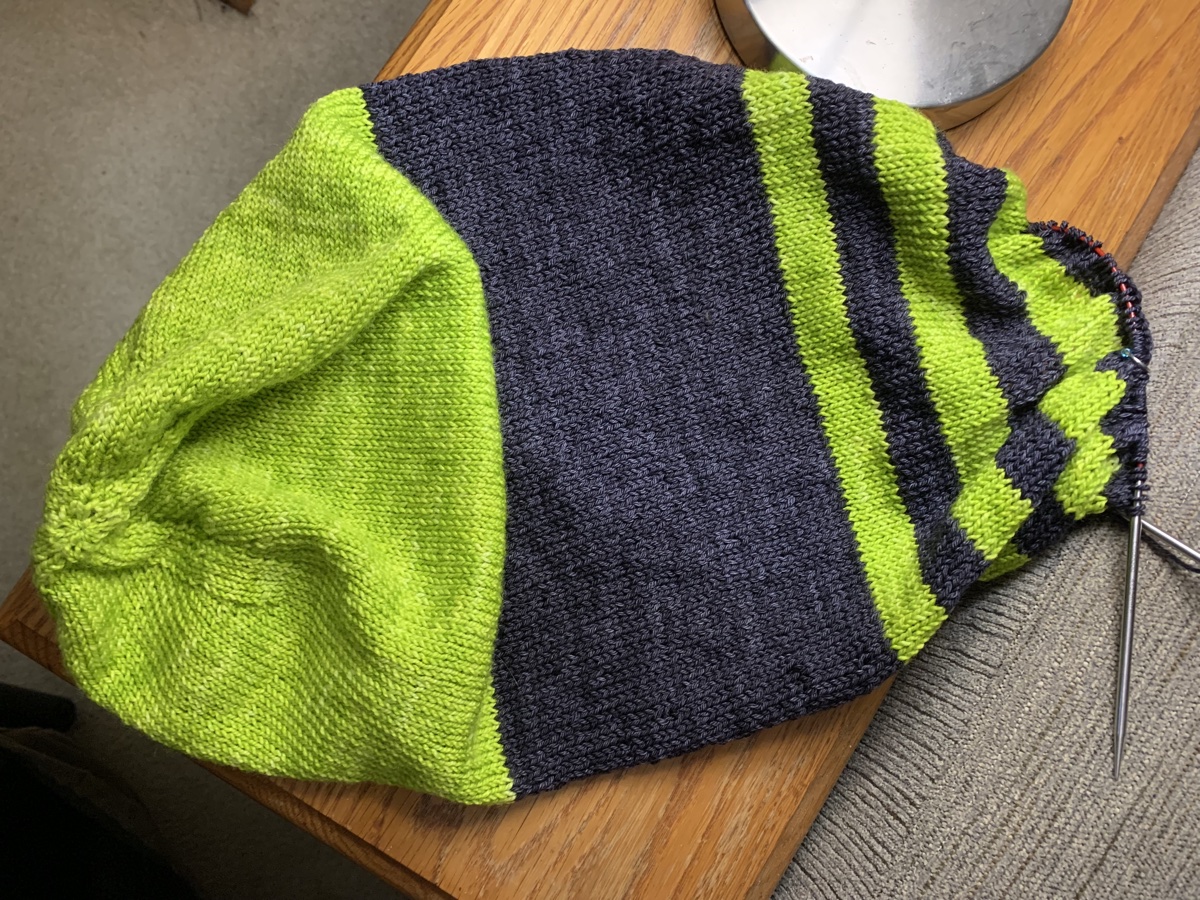
My finished hat will be bright green with a folded black brim, OR a striped (black and green) hat with a folded black brim. Two hats in one. Each hat will be two layers of fabric with four layers at the folded brim.
Musselburgh tube
Musselburgh Finished
I decided to knit a total of 25 inches with 9 inches at each end and 6 inches in the center for the brim (folded measurement 3 inches). That was the plan, but my hat ended up measuring less at 21.5 inches. Too short for my liking. See this video from a knitter who has made 12 of these hats!
How Do I Begin Knitting This Hat?
Although I’ve been knitting quite a lot of items during the past few years, I was stumped when it came to beginning this hat!
To begin the project, the cast-on begins at the crown with a small number of cast-on stitches, which will expand outward with increases made. (You must be able to knit “make ones”.) Directions say to cast on the stitches using your “preferred center-out cast on.” The designer goes on to list a few, but it’s up to the knitter to figure out which one to use and how to knit it.
Pinhole, or Disappearing Loop Cast On
When I searched for “Musselburg cast on” the pinhole, or disappearing loop, cast-0n came up. This video, by Mostly Knitting, is a good tutorial – not for the hat, but for the cast-on. She gets straight to the point and the tutorial is easy to follow. However, be prepared for this fiddly cast on. She makes it look easy – and for me, it was not! I won’t go into detail, but let’s say it took me a few tries to get my stitches made. Hint: It does help to keep the loops of each cast-on stitch loose.
FYI: I am using a size 4, 32″ circular needle, wood Lykke brand, to do the pinhole cast on. My yarn is from stash, and I am guessing it is a fingering weight sock yarn.
Below left: My stitches have been cast on and there is a loop still open. Below Right: I have pulled the strand to close up the loop. Hence the “disappearing loop” cast-on name.
Pinhole, or Disappearing Loop cast on. I’m not sure it should look this messy, but oh well!
Loop closed
Now I have my cast on accomplished, but I need to knit in the round with only a few stitches. Apparently most people use the magic loop knitting method to continue knitting from here. Maybe it is time for me to learn Magic Loop.
Magic Loop Knitting Tutorial
The video above gets the cast-on made and ends with four stitches on each end of a long circular needle. Then, the rounds begin and must be knit using the magic loop method. Or, the stitches can be transferred to DPNs, which can’t be easy to manage with so few stitches. I dislike DPNs. So, I figured I would try to do the Magic Loop.
In this video by Myra Wood, the details of the magic loop are covered. She is not casting on the the Musselburgh Hat, but it doesn’t matter. She is showing us how the needles are positioned to knit in the round starting with very few stitches. So, first do the pinhole / disappearing loop cast-on, and then begin knitting in the round using the magic loop method. Simple. It’s always good to learn something new – or in this case, two somethings!
For magic loop knitting remember this:
Use good needles, with soft, pliable cable. This is important. The needle I used was wood (Lykke brand) with a rather thick cable for my liking. I should have used my Chiaogoo needles (Amazon paid link). Try a metal needle with a bendable cord. Make sure the join between the needle and cable is smooth because the stitches have to slide easily from the cord to the needle.
Whichever needle has the working yarn, pull that needle out of the stitches and use it to knit.
Place a marker as a reminder of the beginning of the round..!
Stitches divided evenly on needles
Markers in center of each needle
Transfer of stitches to DPNs
For the Musselburgh Hat pattern, I didn’t worry about the markers until I knit the first round using Magic Loop, and added them on that first round. From there, I followed the hat pattern while doing Magic Loop. The orange marker in my photo is for the beginning of the round – BOR. You need to mark that somehow.
Transfer Stitches, or Continue in Magic Loop
The knitting could continue using magic loop, but I transferred my stitches – on a plain knit round – to four DPNs making each corner (end of needle) a marker. Because I had the needles, I began on shorter DPNs and then transferred to longer DPNs. Once I had my total number of stitches to begin the length of the hat, I used a 16″ circular needle.
Find Your Gauge to Complete the Crown
The pattern has charts for size and gauge. This was confusing at first, but as is usually true, reading the directions carefully is everything!
The designer has created these charts to help us get the right size hat for our knitting tension. Once we begin the crown knitting and take the measurement, we will then know our personal gauge number. This is the opposite of what is generally done to knit a pattern. Usually we (the knitters) have to match the designer’s gauge.
Because each knitter will be using various types of yarn and various needle sizes, the gauge will vary for each individual. The designer has calculated the gauge variations and given us a number to go by for the crown and hat size.
Once the crown size was big enough, I measured for my gauge. I counted six stitches in one inch across, so my gauge is 6. From there, I used the charts to find out how much more knitting I would have to do to complete the crown section. BUT, I decided to add more stitches for a total of 136 around, and this ended up being too large. I think the original count would have been too small, so somewhere in-between.
Don’t forget to weave in the ends at the right time!
Before finishing up by decreasing for the second crown, don’t forget to weave in the ends! Pull the hat inside out and do your weaving before the entire thing gets closed up. Glad I remembered this step.
Reducing for second crown at the opposite end. First – weave in the ends!
Final Thoughts
This pattern is versatile and looks to be quite easy, until you try to get started with the crown. It’s probably going to be a learning curve for many. Once the second crown is knit, the final yarn must be woven so it can’t be seen with the tail tucked inside.
I used sock type yarn, which is not my favorite to work with. I was hoping this hat pattern would help me use up some stash. But, in the end, I am not very impressed with the outcome. Mainly it is my own fault for bad measuring and using too many stitches.
More than that, I simply have knit hats that are much more fun and end up looking and fitting a lot nicer. A ribbed hat for instance hugs the head better.
I’m not sure I will knit another Musselburgh, but if I do, I think I will try using colorwork patterns for each end section, and a ribbed center for a snug, turned up brim.
The Triple-patterned Watchcap pattern comes from the “Hat’s On” book. I love the look of this little colorwork hat, but “little” is the key word here.
I should have known better. I knit tightly and this is colorwork – which tends to be tighter and smaller in the end than regular knitting. I decided to knit the size “small”. It ended up being about 15 inches around, which is a child’s size.
Unfolded, finished hat
Originally I had wanted to make this for my grown daughter, who does have a smallish head, but not that small. I realized, not too far into the knit, that this hat would be too small for an adult head. I kept knitting anyway to see if I liked the pattern after all. And I did.
Reminder: Stranded knitting does not stretch much!
This small size ended up measuring 16 inches around, just as the pattern noted for the Small size. If I use the same type of yarn, same needle size (I used size 6 as the pattern suggested) then each of the other sizes should give me the correct measurements. This is good to know because I do plan to knit this one again.
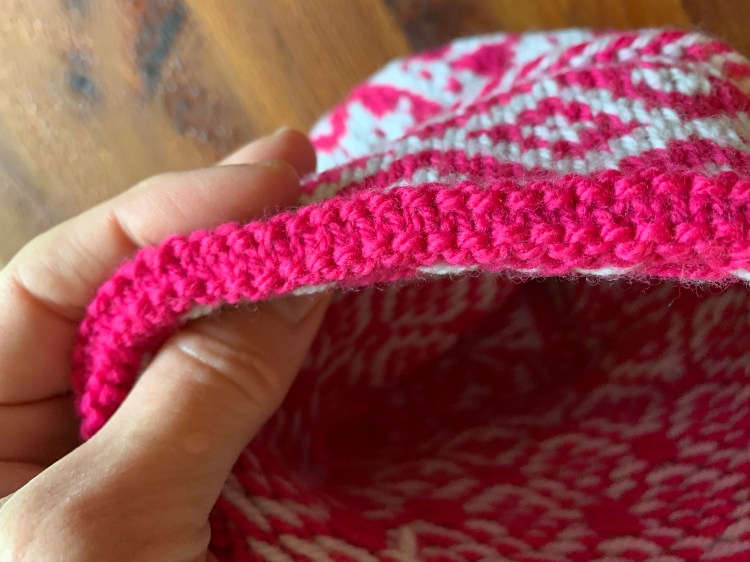
The edging at the fold
Some previous knitters of this pattern had swapped out the turn edging for a braid. I almost did that too, but I’m glad I didn’t. The turn rows for the edge, which end up at the bottom of the brim, work very nicely.
The brim of the hat is very pretty with the braid which ended up at the top and row of turning stitches along the bottom. The pattern is begun with the braid, worked to the end of the brim, then the work is turned (see notes below for turning) to begin the rest of the hat. This way the brim is made to fold up.
Crown
I made the second pattern section a little taller than called for and I honestly don’t know why. I was thinking the hat would be too short since it was turning out small. A short hat is not good, but I overcompensated.
I think another row of smaller snowflakes before the top section would be nice.
Finished!
The yarn I used is Arbor, by Brooklyn Tweed, and it’s become a favorite type of yarn for me (The link goes to Wool & Company). It is very soft, and creates a beautiful, squishy end product. The colors here are Azalea and Thaw.
Doing the “Turn”
The pattern says to work the cuff pattern for so many rounds, then “turn”. There is nothing else about doing the turn, but I have notes from doing a pair of mittens which are made in this manner where the cuff turns to begin knitting the rest of the mitten.
Simply turning the project and knitting in the opposite direction is what’s called for, but if it seems daunting, here are my notes:
Turn work inside out, with needles at top.
Slip the last worked stitch from the Left needle to the Right. This stitch will be the last stitch of the round.
Cut the unused color.
Begin knitting with the main color as pattern calls for.
Three Hats in Three Different Sizes
I’ve now knit three of these hats, and the green one is a Large – which will be gifted to my daughter. The XL size fits me perfectly, and was knit in another type of wool.
























 New England's Narrow Road