Knitting The Polliwog Popover Baby Sweater

I have fallen in love with the washable Lorna’s Laces Sportmate yarn. I decided to knit the Polliwog Popover with the gray (Dobson) and blue (Cermak) colors I recently bought on sale. It’s a little sweater with a unique neckline for babies or young children. It is a great pattern for a little boy. The pattern is by Mary Lou Egan and I found it in my copy of “Drop Dead Easy Knits” (link to the book below).

The title mentions easy, so none of the patterns should be difficult – you would think. However, as I have been knitting this baby top, I’ve run into some difficulty.

Polliwog Troubles, Mistakes and My Personal Fixes

First of all let me suggest that whenever you choose to knit a pattern search for possible errata – or changes to a pattern due to direction corrections. A mistake here and there is understandable. No one is perfect. I’ve noticed that patterns often have an errata listed.

Most knitwear designers have test knitters, who will all knit up a pattern and give feedback, including catching pattern mistakes. So the fact that the Polliwog was included in a book, but contains numerous mistakes, is disappointing … and annoying.

IMPORTANT: If you plan to knit this PATTERN, go to the Ravelry Polliwog Popover pattern page where the designer lists the mistakes on the page. Take note of them and make fixes on the pages in the book before you begin knitting. The first mistake was the number of stripes to knit for the body.

But I had more troubles than just the ones listed, so I wanted to share my woes here. In the end, I really like the top. It is soft and cute and works well for a boy or girl. It would be a breeze to knit again now that I have made my changes to the pattern and provided notes to myself.

I may actually sew down those flaps on the front, but I’ll see how it looks after washing.

Completed knitting the Polliwog Popover baby sweater
Polliwog Popover – done!

Check Your Gauge!

First, I strongly suggest you knit a swatch to find your gauge. Usually I have to go up a needle size to make my gauge correct. This time I did not knit a swatch and used the suggested size 4US needle, but I should have used a 3 or maybe even a 2.

The sweater is WAY bigger than even the measurements for the largest size (12-24 months), and now I fear I may run out of blue yarn (I didn’t – see my yarn photo below). I’m following the smallest size (6-9 months) directions. So my gauge is way off. I’m thinking it would fit a one-year old. This is my own fault, and not a fault with the pattern. I should have found the correct gauge before I began.

Knitting Stripes That Align

I was no expert at knitting stripes, but after making all the stripes on the body and sleeves of this sweater, I consider myself an accomplished stripe-knitter. And for the most part, my stripes align pretty well. This is how I did it.

Row 1 (of 3 knit in same color) – when adding / changing colors, bring the new color up behind the old to tug the little area closed.

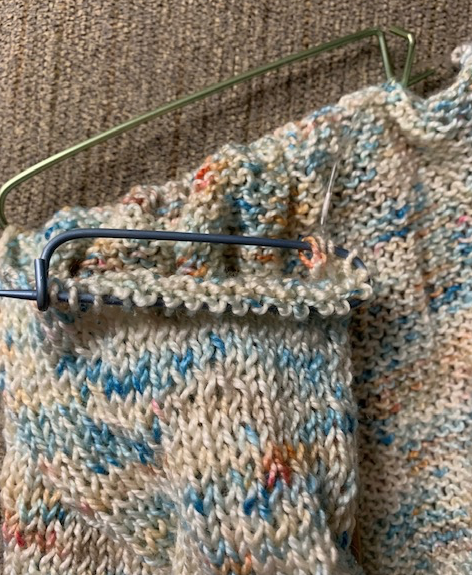
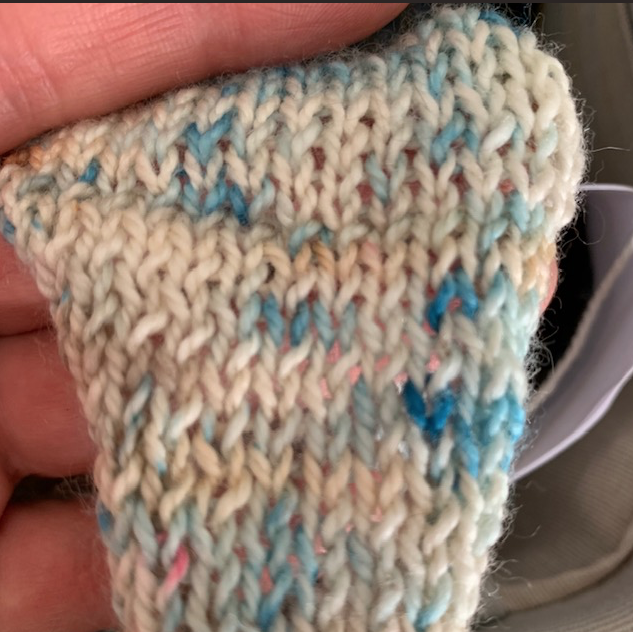
Row 2 – when you reach the BOR (beginning of round) marker, and are ready to begin knitting row 2, lift the right side of the knit stitch below the row onto the LEFT needle and knit through both strands. This will make the first worked stitch of the row look like only 2 stitches when the rest of the row will have 3. This makes the rows of color line up nicely. You can see this in my photo below on the BOR seam of a sleeve.

Row 3 – knit around… begin again at row 1 when you change to the new color.

How to knit stripes on a sweater
Aligning the rows of stripes

The Shaping

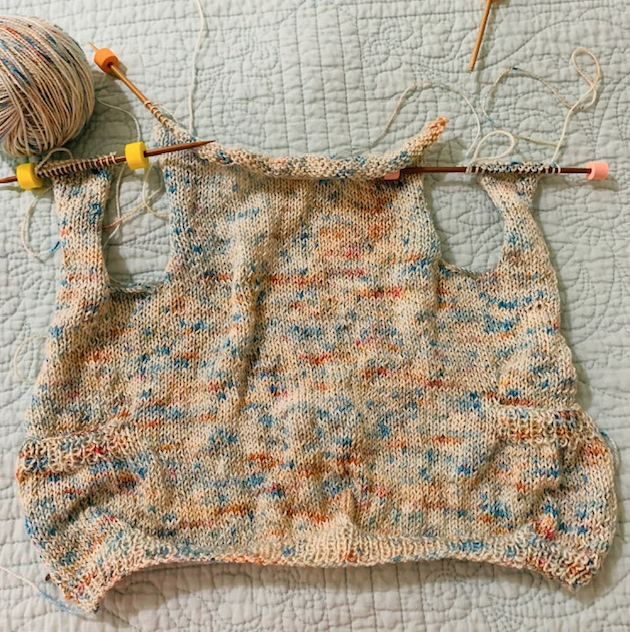
Once I had the front section shaping on the left shoulder completed, I felt pretty good. I had managed to do the short rows and then knit them up fine.

Polliwog popover shaping
Shaping the front

My troubles began when I had to do a similar thing on the Right Shoulder. The stitches are opposite and the directions to “slip the stitch and pull the yarn over the needle to create a double stitch” did not work because you end with a purl stitch. Or maybe you just pull the lumpy thing over and call it two stitches ???, but it looked bad. I tried searching YouTube for help and found nothing that made sense.

After wasting lots of time trying to figure out what to do – after all this was going to be the neckline of the sweater – I used my notes from a little scarf I began a while ago. On the Ruffle scarf you create a number of short rows, or wrap and turns. I could do that simple thing when knitting the scarf, so I simply did the same thing for the Popover. I did the same when working the back sections as well.

Short Rows on Right Side Shoulder

Here is how I did my turns on that right side – front and back sections of the sweater.

When I got to the end of the row the yarn was forward because I ended with a purl stitch. I kept the yarn forward, in front, and slipped a stitch from the Left needle to the Right needle. Then I turned the work and brought the yarn forward again. Slipped a stitch once more from left to right and began knitting in pattern back to the end of the row.

Super easy, looked fine, and easy to pick up each knit and purl on the finishing row. No stitches needed to be knit together.

The Neckline Bind-Off

Here is where my blood pressure rose once again. First of all the patterns says, “work a sewn bind-off … as described in the Techniques section”. So I flipped to the back and found the page for Techniques. None of the technique titles were for a “sewn bind-off”. I finally decided it must be the “K1, P1 Bind Off” because it called for using a tapestry needle. I didn’t like the sounds of that.

Reading through the long directions for this type of bind-off I began to have serious doubts about my ability to not mess it up! So I knit up a little swatch in the knit 1, purl 1 ribbing to try it out. I couldn’t figure it out. It was a disaster. So I looked on YouTube. Even watching videos describing this sewn bind-off, and following along on my swatch, I gave up after making a complete mess of it. This was not easy, even after watching a video.

Jeny’s Surprisingly Stretchy Bind-off

I really didn’t want to have to use a tapestry needle, but I knew I would need a stretchy bind off for the neckline. I’d heard of Jeny’s Surprisingly Stretchy bind off, but never bothered to look into what it entailed. Now I decided to see if I could handle it. I’m so glad I did. And yes, it is VERY stretchy, and EASY!

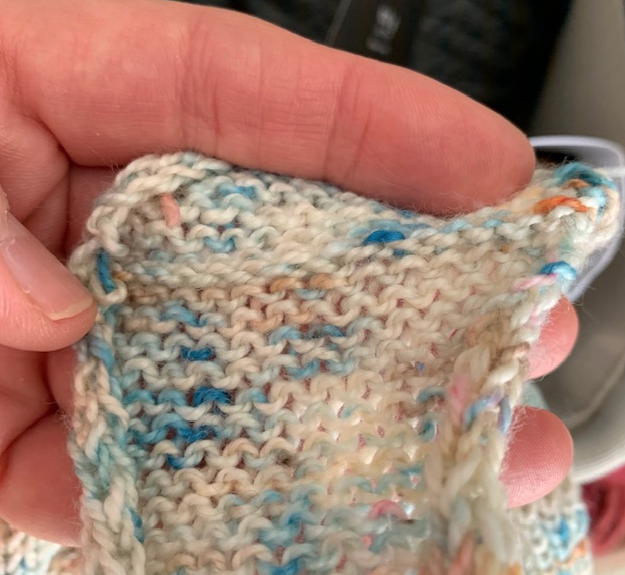
This is a very easy bind-off to use for anyone. Once it was done, I believe it looks just fine. See my photo below.

As is usually the case, I had to watch a couple of videos to find one I liked. Here is a link to the YouTube video for Jeny’s bind off that helped me – she goes super slow considering it’s super simple to knit.

As I’ve read some notes by knitters of this garment, a few have said that the neckline is too loose and flaps open. Now I am wondering if a normal bind-off would work because of the way the neckline overlaps to make an extra large opening anyway. I don’t have a baby to try it out on.
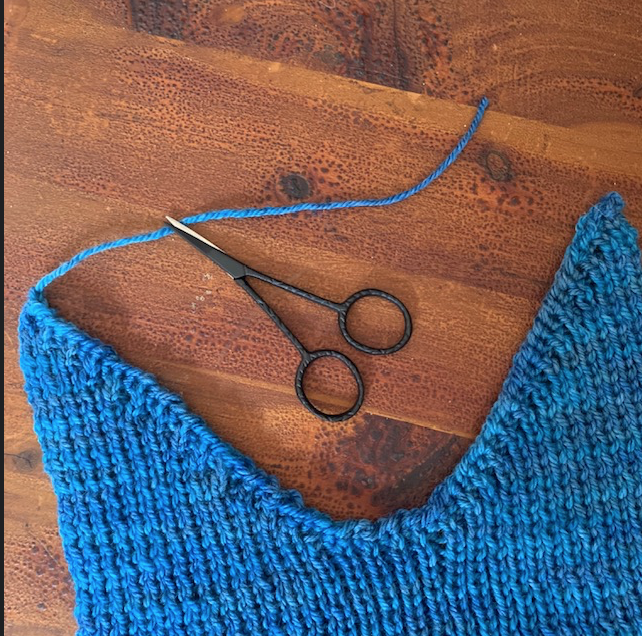
Jeny's surprisingly stretchy bind off
Finished look of Jeny’s bind off

Jeny’s Bind-Off Written Directions

You don’t need to watch the video because it is easy to explain how to do Jeny’s bind-off. And at least now I know how to do it.

Do This: You are ready to bind off – on the right side – and are holding an empty RH needle. Begin by first wrapping the yarn around the RH needle clockwise. This is opposite of how you would make a Yarn Over. Then, knit the first stitch and pass that wrapped stitch over the knit – like a regular bind-off.

Now, wrap yarn clockwise again, which will give you 2 stitches on the RH needle. Knit the next stitch – giving you 3 stitches (my image below). Bind off by passing the first two stitches over the one recently knit. (I did not deal with alternating knits and purls. Honestly I don’t know if I should have. I was so fed up at this point I just wanted to be done!)

Doing Jeny's surprisingly stretchy bind-off
With three stiches on the RH needle, slip the first 2 over the last – as in a regular bind-off

Continue to wrap clockwise before knitting, passing two stitches over one, and so forth. Super EASY! And yes, it is also super stretchy. I guess lots of people use this bind off for toe-up socks so the cuff is not tight. Believe me, it works. I think I could get my big head through this neckline!

The Polliwog Sleeves

To begin the sleeve, first the two sections of the shoulder have to be overlapped. Then stitches have to be picked up, sometimes going through two layers of knitting. I used a crochet hook to pick up stitches through two layers.

Also, pick up through nearly every stitch, or the count will be short. I had to re-do my pick ups for this reason. I used DPN’s but quickly became fed up with them and ordered a 9-inch circular needle to finish the sleeve.

Knitting the sleeve of the Polliwog Popover
First sleeve transferred to new 9 inch circular needle.

I have a few small circular needles for knitting small round things like mittens, so this new size five, nine-inch circular has been added to my collection. They are totally worth it if you hate using DPNs. I was able to knit all the way to the sleeve cuff and bind-off using the small circular needle. (I did a regular bind-off here, not the “sewn bind off”.)
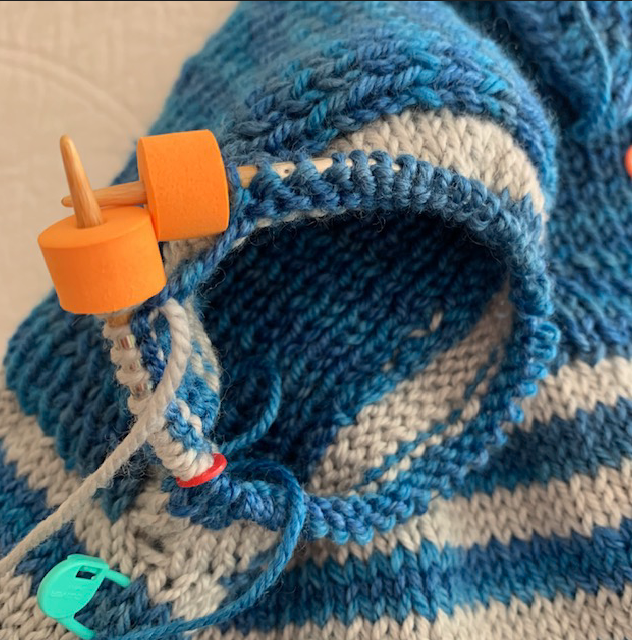
9 inch circular needles
Knitting the sleeve

I will say that I love Lorna’s Laces yarn. The blue color is slightly variegated and looks really nice. I will be washing it in my machine and throwing it into the dryer for a little bit to see how it ends up. (Directions for washing this yarn are: Machine wash cold with like colors. Machine dry until just damp. Lay flat to finish.)

I did not have a lot of blue yarn left, but as I said, the garment turned out large. After washing (and drying) it seems that either the sleeves should be longer or the body should be shorter. It’s hard to tell.

How Much Yarn is Needed?

Once I finished knitting, below you can see how much yarn was left of the 2 skeins I used. Each skein has 270 yards and I had leftover yarn. The pattern sample uses Swan’s Island washable wool which contains even more yarn per skein (360 yards) and the pattern calls for 2 skeins of the Main Color – which in my case was the blue. So I used less than 270 yards altogether (blue) – less than one skein. And remember that my sweater came out extra large.
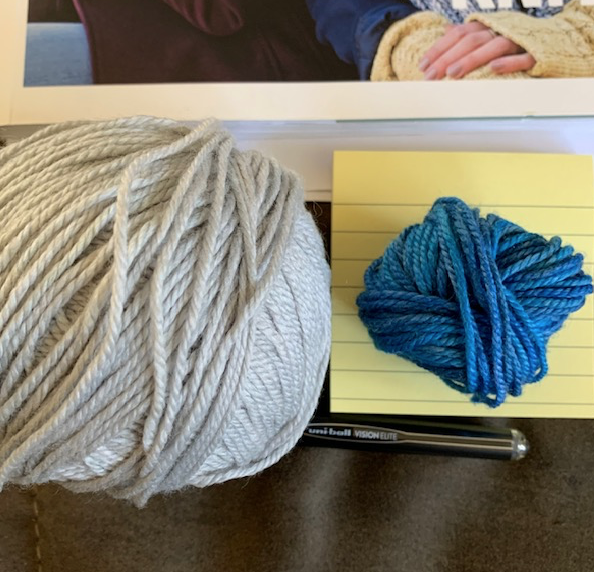
yarn left over from knitting the Polliwog Popover
Used up nearly all my blue yarn.

Drop Dead Easy? Not This One

The Drop Dead Easy Knits book contains a wide variety of projects. As others have also noted, in comments on Amazon, they are not all that easy! “Easy” is relative. To a fairly experienced knitter, yes, they would probably be easy. To a beginner, not so much. And maybe the writers meant this when putting the book together.

I don’t consider myself a beginner, as I have knit lots of various items in the last couple of years including two sweaters for myself, but the problems I had knitting this one made it unenjoyable. This Polliwog Popover should be simple, but with the mistakes and issues I’ve had with it, I would not label it as so. It was a headache. However, if decided to knit it again, it will be easier, thanks to all my notes!

More From the Drop Dead Easy Book

If you don’t expect all patterns to be easy, the book is still a good one. When I first searched through I was disappointed to find sweater and sock patterns. I don’t consider sweaters to be easy, and I dislike knitting socks. But then again some knitters may consider these items to be “easy”. And lots of people knit socks. The book offers a very wide variety of items to try, from blankets and shawls, to mitts, hats, bags, and even a dog jacket!

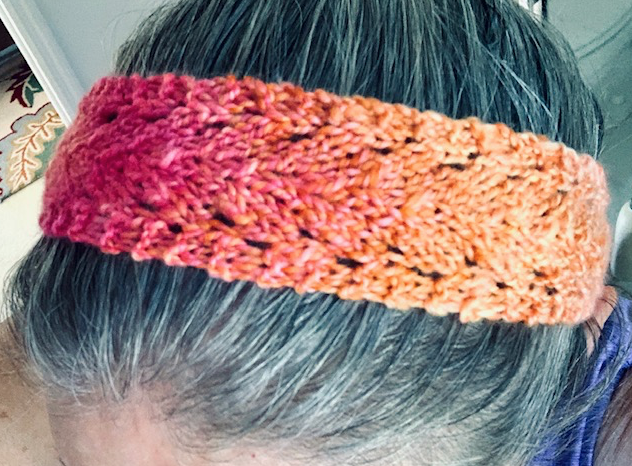
I’ve already knit the very easy Shandy Headband (my photo below). Along with the baby sweater I just wrote all about, these two items are my only experience with the patterns in the book. I will be trying more. It’s a very nice book.
Buying Buttons For Hand Knits

Anyone who crafts may eventually need to buy buttons. I’ve been knitting for a couple of years now and recently knit a little baby cardigan that needed buttons.

I don’t know of any local craft stores or specialty shops that sell buttons near where I live, so I began searching online. Etsy is the first place I looked. I searched for wooden buttons and kids buttons.

Wooden Button Sellers

These pretty wooden buttons came from Richland Street Yarns, and I have since found other places at Etsy that sell pretty wooden buttons. You can go to Etsy and search, of follow my links below. These are large, smooth and beautiful.

wooden buttons
Wooden buttons by Richland Street Yarns @ Etsy

Etsy Shops That Sell Buttons

Buttons From Australia

Whenever I purchase something that comes to me from the other side of the world, it makes me feel good. I love to see foreign postage and open a package that was filled with goodies from far away. This button collection came from an Etsy shop located in Australia (see link above). I had to wait a while for them to arrive – which is understandable… from Australia to Florida is quite a trip. The creator contacted me when they were mailed to let me know they were on their way, but it would take a while. I appreciated that.

I’ve never had a bad experience buying from an Etsy shop owner.

Collection of buttons for kids with images of farm animals, Australian animals, wild animals, tractors and nautical designs.
Button collection with animals, tractors, and nautical designs

Online images are often different from actual products, and it’s funny but the buttons I thought I would like least are one of my favorites. I almost did not order the nautical set, but I am very glad I did.

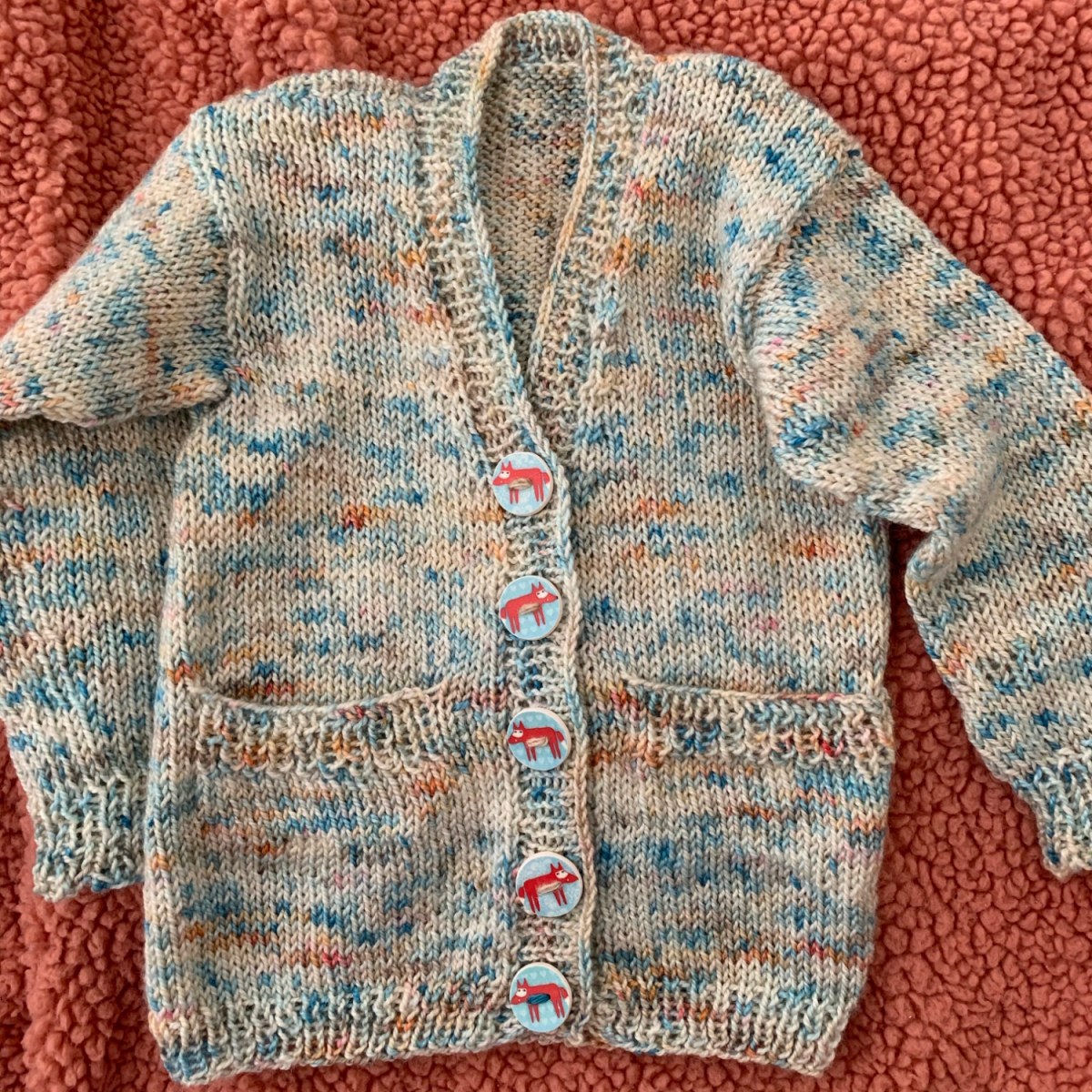
I’ve already used the set of red fox buttons… see image below. The set of wild animal buttons, with a fox, hedgehog, rabbit, raccoon, owl and bird, are probably my favorite. They will look cute on some child’s sweater – which I will make one day.

animal buttons
Set of fun animal buttons from Ginger Mint Collection

Things to Consider When Buying Buttons

I’m new to creating buttonholes while knitting, and then having to sew buttons on through a knitted garment. It’s very different from working with fabric. I left a long tail when I began sewing the button using yarn, and then tied the end tail to that to make a knot when finished.

Come to find out, I was partially correct in tying the knot. The Tricksy Knitter has a post: “Sewing Buttons on to your Knitting” which has good advice.

This blog writer uses back-to-back buttons to give support to her buttons so they are less wobbly. This would work best on a heavier type of knitting I think.

Button size is the first consideration once the right type of button is located. To get a reference for the sizes I ordered, I pushed coins through the holes and measured them.

With all the button choices out there, shop around for savings and look for good quality buttons. Fancy buttons can add interest to a more simple knitted pattern. Rustic wooden buttons, or antler buttons can dress up a casual sweater. Fun and colorful buttons can make children happy.

Throwing away a shirt or sweater? Cut off the buttons first to save for future use! I could kick myself for all the times I have forgotten to do this.

I will admit it was not fun sewing on these buttons. A small eyed needle is needed but getting the yarn through the eye… grrrrrr. I think it turned out looking fine.

Notice the button-seller gave me opposite facing foxes… which was nice of her!

Fox buttons on baby sweater
Fox buttons on the Playdate cardigan

The Playdate sweater, with fox buttons, could be worn by a boy or girl although it looks more girlish to me. I am making another sweater, the Polliwog Popover, which is for a little boy – and there are no buttons to deal with.

For more on buttons, see what Tin Can Knits has to say about shopping for the perfect buttons. The writer takes her finished knitwear to a local button shop… lucky! … and then picks out her buttons.

How do you shop for buttons? Any tips to share?

Just Bought New Hand-spun Yarn

As I was browsing Instagram the other day I saw some beautiful handspun yarn photos. Taking a chance, I clicked the website link and there before my eyes were beautiful, colorful skeins to purchase! It wasn’t cheap, at $38 a skein – see the store link below this photo – as would be expected for good quality yarn of this type – but finding handspun yarn in such lovely colors is nearly impossible, so I jumped in and ordered two skeins.

Pink and tan handspun yarn
New handspun! Beautiful..!

Wound Up Fiber Arts

Wound Up Fiber Arts is the name of the shop where I purchased the bright pink “Fire Starter” and lovely “Toasted Coconut”, and I’m so glad I did. Today – the day I am typing this – they are offering only roving or top (not sure that is the correct term), fiber, to be spinned into yarn. There is not one skein of yarn left for sale. Of course that will change, I’m sure, but it’s hit or miss unless you keep up with the postings of such a site. On Instagram they admit to being “sporadic”. And that seems to be the way. This beautiful type of yarn doesn’t come off a machine. It is painstakingly crafted.

I believe that a lot of people who spin their own yarn use it themselves! It’s hard to get buyers to understand the higher price, so I understand.

Sample Swatches of the Handspun

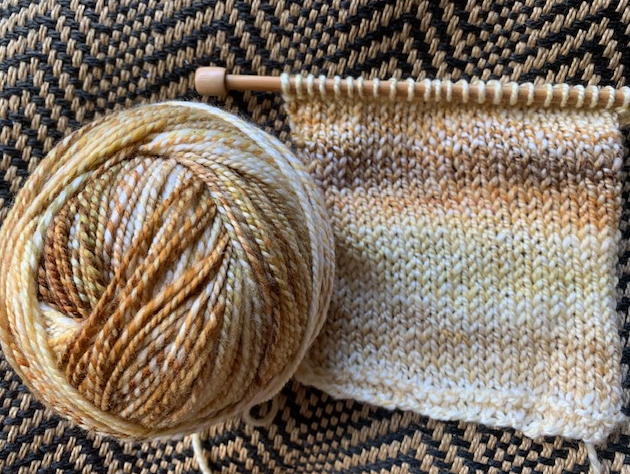
For my swatches here I used a size 7 needle for the pink, and a size 10 for the tan. Each swatch is only around 25 stitches across, but I wanted to see how the colors looked knit up.

When I look at a skein or ball of this yarn I can’t imagine how it will look in a project. When knitting a hat or sweater using this yarn for colorwork, each shade will carry a longer way so the colors will slowly work their way up the garment.

Bright pink handspun yarn
“Fire Starter” handspun

I always wind my hanks of yarn into a ball because I don’t have a winder. This yarn was easy to wind and I found no knots. I just love the colors of this pink. It’s so soft and quite a big skein too. Both are over 300 yards.

Sample swatch handspun pink
Fire Starter yarn color way knit up
Tan "Toasted Coconut" handspun yarn
“Toasted Coconut”
Handspun swatch in tan variegated
“Toasted Coconut” sample swatch knit on size 10 needles.

I think I’ve found a hat I’d like to make where this yarn could be used. Hats are one of my favorite items to knit. The swatch will be ripped back now that I’ve seen the colors.

I ended up using a little of this yarn to create a little baby hat and it came out so cute!

Three little hand-knit baby hats
Baby size hats

Finding More Handspun Yarn to Purchase

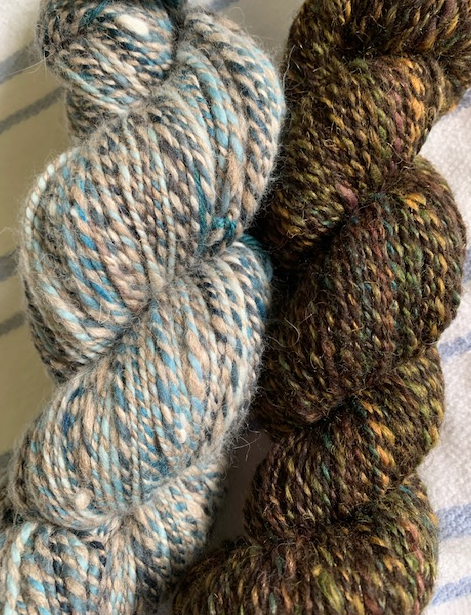
Many types of yarn are hand-dyed, but not all that many are also hand-spun. With any luck you may find a yarn maker who is happy to share how they came by their wool / fiber and explain the process of hand-spinning it into lovely knitting yarn. I purchased a large skein of blue variegated handspun yarn from Clarion Call Fiber Arts on Etsy, where she explained that some of the fiber used in the yarn came from her sister’s bunny! The brown skein below is from her as well, but it is very scratchy.

I’ll admit that after buying Wound Up’s yarn and Spincycle’s yarn, I prefer those over Clarion Call’s, for color and softness. But, Clarion’s yarn is rustic and I decided to knit a hat.

two skeins of hand-spun yarn
Hand spun yarn by Clarion Call shop at Etsy

I ended up knitting this ribbed hat with the blue hand-spun. I love the rustic look with the fuzzy rabbit fur. It will keep my ears warm on these cold Florida winter mornings… LOL.

Bunny fur hat
Beanie made from hand spun yarn

Handspun yarn is time-consuming to create, and that is probably the number one reason it is in short supply. I’ve read articles about how spinners create these lovely collections of color and it’s interesting. It can be done using a drop spindle or a spinning wheel. But there is a lot involved, and I am no expert. YouTube has numerous videos on the subject of hand-spinning.

What to Knit With Handspun Yarn

I now own five skeins of variegated handspun yarn. I need to find a way to show them off in projects!

On Ravelry and Instagram the main knitting project using Wound Up Fiber Arts yarn is socks. Yuck, I dislike making socks. This yarn is too pretty to go on my feet, so I will save it for something like stranded colorwork on a sweater or hat. Although I see why people use this yarn for small, circular knitting. Each section of color will make pretty stripes.

Mill-spun with similar appearance of hand-spun

Andrea Mowry of Drea Renee Knits has a shawl pattern called “Nightshift” that I’ll bet you are familiar with if you knit anything at all. This shawl is all over the internet and has been knit by thousands of people! And she often calls for handspun yarn in her patterns. This is how I came across Spincycle yarn. The problem is that many of Spincycle’s yarns are not in stock, and especially those lovely colors needed for Andrea’s patterns.

Spincycle’s yarn is really lovely, but these skeins contain 200 yards only as compare to the yarn above, and each skein is around $32.

Spincycle yarns
My two skeins from Spincycle Yarns

Here is a pullover sweater named “Shifty” which calls for 4 different colors of Spincycle handspun yarn. If I wanted to knit this sweater I could only buy 1 of the 4 colors named in the sample pattern (at the present time) because the other three are sold out.

Handspun yarn is especially pretty when combined with other colors and used as colorwork. As you knit the contrasting color pattern the variegation of the handspun adds even more uniqueness to the design.

Knitting the Playdate Cardigan For Kids

The little Playdate cardigan by Tin Can Knits is a wonderful pattern with excellent directions that will broaden a beginner knitter’s horizons!

The Playdate Cardigan pattern comes from Tin Can Knits. I bought and printed out the pattern a few days ago and have since been working my way through this cute sweater. The pattern has size adjustments from 0-3 months to 4XL…. so you can knit it for just about anyone.

I chose to knit the 6-12 months size. I’m using a 16-inch circular and 5 double-points in the same size. Another smaller needle (with same size dpn’s) is needed for the ribbing. My yarn is Emma’s Yarn, fingering weight, Super Silky in “Malibu”. I would not have chosen silky yarn if I was buying a skein to knit a sweater, but I wanted to use stash yarn for this first attempt. I would choose a favorite baby sweater yarn next time.

Creating Pockets

This is a bottom up pattern, but it begins with pocket sections. As I read through the pattern, the pockets were confusing to me. I’ve never done pockets. HINT: To knit a 2-color sweater begin the ribbing with the contrast color. But the pre-made pocket sections will be behind the work, so the main color can be used.

First thing to do was to knit two little rectangles which would become part of the pockets. I almost decided not to add pockets just in case I couldn’t figure it out, but I’m glad I used them. Because first, they are easy to add, and second, they make the sweater look cute!

Baby sweater
Getting started on “Playdate” baby sweater

Once the bottom of the sweater is begun, the little rectangles will be added to the long needles and create the backing. The top stitches will be knit into the regular line of knitting.

Adding the pocket to the Playdate cardigan
Placing stitches of pocket onto long needles

The K1P1 ribbing for the top front of the pockets is created first, then bound off. See the back of the pocket above and the front below. The little rectangular backs will later need to be sewn down to actually create the pocket.

Playdate sweater pocket knitting
Ribbed edge of pocket with backing added to needles

The Back and Shoulders

Once the front is knit to length, the back stitches and one shoulder will go on hold. I used some metal stitch-holders (they were my grandmothers) which work well for holding small amounts of stitches. I always have trouble picking up my stitches when I hold them using yarn. From here, each shoulder area will be knit, along with the back – separately.

Knitting stitches on hold
Shoulder and back stitches on hold while knitting other shoulder stitches

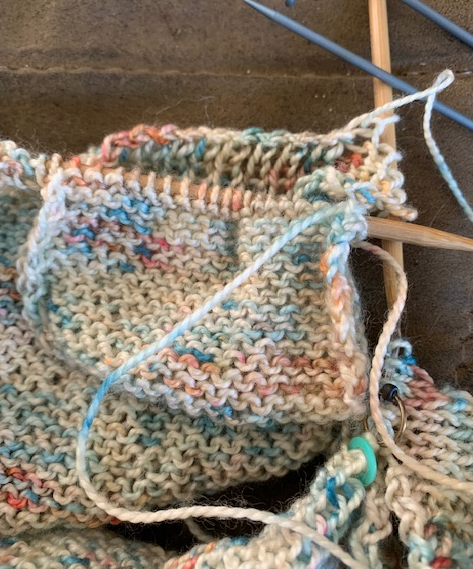
I used DPNs to hold the shoulder stitches because my sweater is so small. The pattern directions say to work the stitches, ending with a RS row and then “break the yarn leaving a long tail”. I guess they figure you will know enough to keep those stitches on hold, but you need an extra needle for that (or yarn). So it helps to have double-points handy with good stitch stoppers (Mine are by Cocoknits and they work great). The same thing happens for the neck and I left my stitches on the main circular needle for that longer section of knitting. I used 2 double-points for straight knitting the first shoulder section.

Top edges of sweater on hold
Shoulder parts of Playdate on hold using three needles

Once the back and shoulders are the correct length, they will be stitched together. I tried 2 different methods here, and decided I liked the Kitchener stitch – as shown in slow motion by Very Pink Knits – which came out pretty smooth. I sat in front of the computer while I did it so I could watch her video.

Playdate sweater knitting in progress
Ready to connect at shoulder seams
Shoulder seam in kitchener stitch
Kitchener stitch joining back and front at shoulder
Ridge on wrong side of kitchener stitch
Shoulder seem, wrong side of kitchener

All the edges are curling up badly, which is par for the course when knitting stockinette. I had the same problem on the Fine Sand sweater, but after washing and blocking it looked great.

Baby sweater with pockets
My front and back knitted sections are now attached at the shoulders

On To The Sleeves

As I went around the armholes picking up stitches, I picked up a few more than was suggested just so there would be no holes. On the next couple of rows I decreased back to the correct number. I was able to knit one sleeve within a few hours time. I think I like making this little sweater. It’s finishing up fast and looking pretty cute!

Playdate with button band started
Getting there!

A long, circular #3 needle was used to pick up the required stitches around the sweater front opening. A #3 was suggested for the bottom ribbing and sleeve cuffs, but I used a #4. The rest was knit on a #5. I didn’t check gauge because the end size did not matter to me.

Knitting a Button Band and Doing Buttons

This is my first attempt at doing a button band around a cardigan. It means placing the buttonholes evenly and making each hole the correct size for a button. Thanks so much to Tin Can Knits and their excellent page all about knitting a button band. I will definitely be referencing it during this phase of knitting. My buttons are on order from an Etsy shop (Ginger Mint Collection) because I have no place local (that I know of) to buy buttons.

In the meantime, I decided to knit a little swatch and try out a couple of buttonhole sizes. Once my buttons come from Australia I can see which of the sizes to knit on this cardigan. I’m not sure which set of buttons I will use, but hopefully one of the button designs will match well.

I’ll keep this swatch for reference and have added a tag with info as a reminder. I did the 2-stitch buttonholes because a good size button will fit through.

Buttonhole knitting practice
Measuring buttons

Until my buttons come, and I’m sure they will fit the size holes I make, this sweater will be on hold…. changed my mind. I decided to add 5 buttonholes and continue to finish the band. Today I washed the sweater and when the buttons arrive I will pick the ones I like and add them. *Update: chose the fox buttons!

Finished! My Thoughts on Knitting the Playdate

This was a fun sweater to knit and I got it done quickly. Here is a link to the pattern once again: Playdate by Tin Can Knits. I learned to make buttonholes and pockets, so that was nice. It’s good to learn new things. I would love to knit this one again – and in October / November 2022 I am, using blue yarn this time.

Tin Can Knits has a book out called Strange Brew with loads of options for knitting pullovers and maybe other things. I just found it for sale at Jimmy Beans Wool and ordered a copy.

knitting divider

Knitting Stories From the Blog