Knitting Brioche, Cast-on Ideas

At first, I was not interested in learning the brioche stitch. Most patterns I saw kind of turned me off. In fact, I considered brioche to be a bit ugly sometimes. Then again, some brioche patterns are stunning! This type of knitting can create hats that are reversible, with a different look on each side.

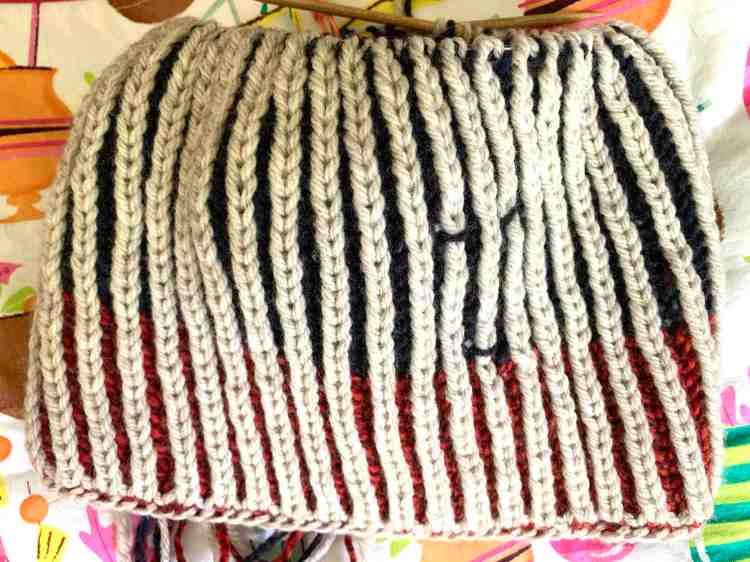
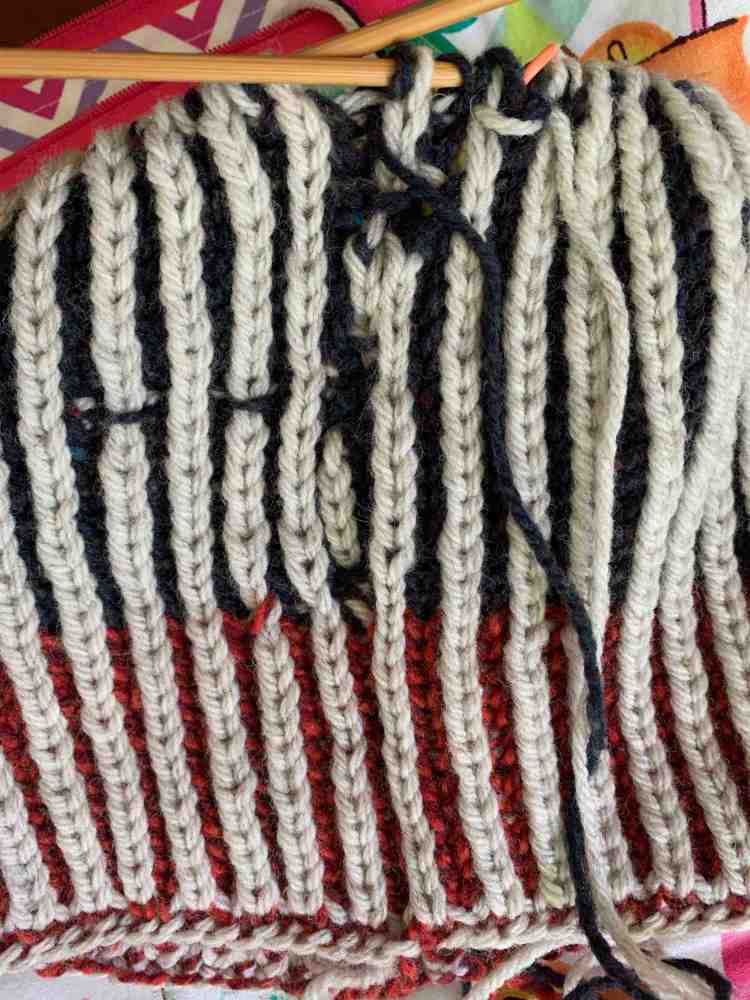
Here is the beginning of a hat with brioche in three colors. First I used red and white, then added some blue. If I had been able to knit this correctly, the hat could be worn with the white (gray) mostly showing, or the color side. It could have ended up being a nice hat – if I hadn’t failed so miserably at knitting it!

Brioche Hat – “Skipp” by Brooklyn Tweed

I love to knit hats and I’ve knit a few BT patterns. Hats are my favorite knitting projects because they are quick and use DPNs for only a short time. After I knit the Habitat hat in bright orange cables for my daughter, I wanted to knit more hats. Why not learn some new things while doing so? And let’s try some brioche.

My son had given me a Brooklyn Tweed gift certificate for Mother’s Day and I needed to use it. I decided to buy some patterns because my yarn stash is already large. One of the hat patterns I purchased is called “Skipp” and it’s done in brioche stitch.

The idea of creating a reversible hat appealed to me, and brioche creates a reversible fabric. Yippee… onward. But first I would have to learn a new kind of cast-on to create a nice hat edging.

Hat’s can’t be knit until a good cast-on is completed. These special cast-on directions will create a tidy edge for a brioche knit hat. As I note on this page, I did a few different cast-ons but then had lots of trouble jumping in and beginning the pattern.

#1. Rib Cabled Cast-on

The cast on for the Skipp beanie is called a Rib Cabled Cast On. It’s not that difficult to accomplish, but I needed to use two yarns held together (notes for this pattern). I can’t go into the list of all the mistakes I made because there were too many, but in general the stitches in my rounds didn’t line up at the join. There are no directions for joining in the round – and this is the problem.

brioche knitting and finding a good cast on
First of many fails….this shows that rib cable cast-on with double yarn

Hint: To learn brioche use two contrasting colors of yarn. Don’t use variegated. Make the stitches easy to tell apart by color. Also, try a pattern that calls for a heavy weight yarn. This will make that difficult cast-on progress faster!

Grrrrrrr…..

So I decided to try again with a single yarn color and I began that looooong cast-on again. I needed two yarns, so I had to cut a length from my skein hoping it would be enough – it wasn’t – only made it to 60 stitches and needed 96.

Hint: This type of cast-on uses lots of yarn. More than a normal cast on.

Ripped out again and cut a longer length – I needed about double (if you try this, double what you’d use for a normal long-tail cast on). Got finished with that cast on, joined and began the purl using both yarns – but I was only supposed to use one… when I went to un-purl that stitch the join fell apart… I don’t even know what happened, but at that point I gave up for the day and ripped it out.

Knitting Skipp Video Reference

I found THIS VIDEO of a woman who is actually knitting the Skipp hat… at about 5:47 minutes she shows how to join the cast-on, which is to simply purl into the first stitch for the set up round. What? Could it really be this easy??

The video is not great, but at least it tells how to join after the cast on. So, I tried it – just began with a purl like she did. And my join was not really a join… I discovered this after a couple more rounds. It looked like crap. This was another waste of time. (However, if I ever get past the cast-on, this video shows the crown shaping for Skipp, which I might need.)

#2. The Italian Tubular Cast-on

In Jared Flood’s tutorial for the Italian Cast On, he says it’s perfect for brioche. He knits a small, flat brioche sample. This is a good video but there are no directions for joining in the round because it’s back and forth knitting...! So, no help there.

#3. Italian Tubular Cast-on in Two Colors

In Jared Flood’s tutorial for the Italian Tubular Cast On in Two Colors, he does a little flat swatch. This is not helpful for hat knitting.

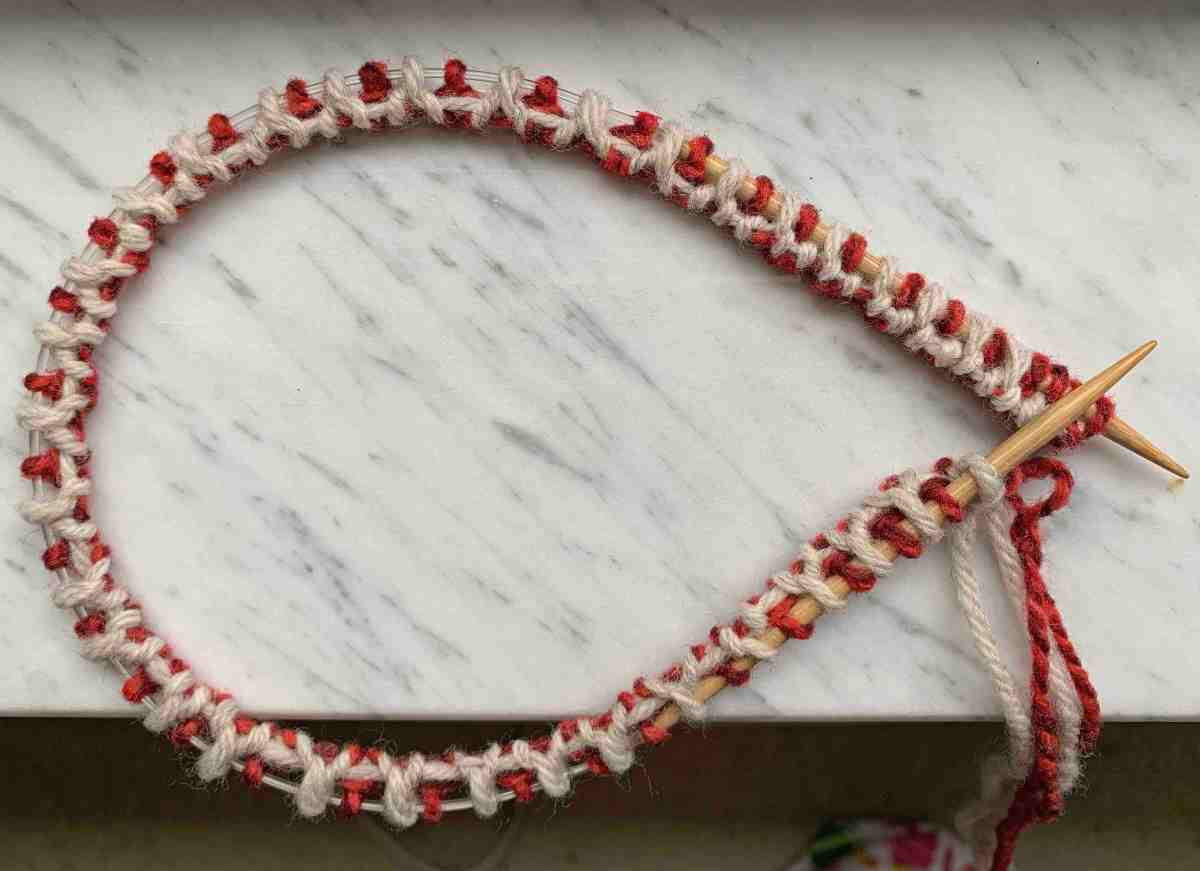
Andrea Mowry has a tutorial for Two Color Tubular cast-on which is pretty good. She slowly (thank-you) shows and explains the cast-on and set up rows. See my examples below from following her video. Notice my circle is not joined because there were no directions for that – OF COURSE…!!! But this video is a good one.

Her video is for her “Harlow” brioche hat pattern. The cast-on and two set up rows are knit before joining in the round. If I could get to this point, join in the round, and begin brioche knitting, I think I would be okay.
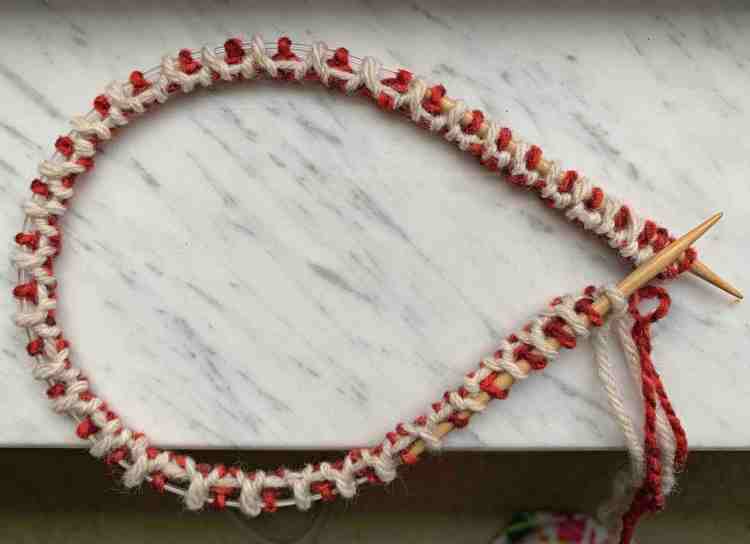
The Italian tubular cast-on is not easy, in my opinion. As the stitches are put onto the needle, they are loose and if you stop or take your hand away, the stitches fall off the needle! I suggest using two colors because it’s easier to see where you are in the cast on, and in the video.

I never figured out how to do any new “brioche” cast-ons, but began the Skipp hat using a normal cast-on. Then, I kept messing up my knitting and ripped the whole thing out. I hate brioche.

So What is My Problem?

I’ll tell you where I keep getting stuck – it’s at the BOR (beginning of round). Once the cast-on is finished I can’t join correctly because the knitting of brioche requires different BOR stitches. I guess maybe adding one extra stitch to combine with a regular stitch might work. Usually I transfer the two end stitches on my needles to join in the round, but that won’t work for brioche. Am I just making this more difficult than it needs to be?

#4. Long-tail Cast-on Over Two Needles

Maybe another designer can explain all this better. So I went looking for a new pattern to try.

The free hat pattern called BriocheStarter Hat (link below) is listed as using worsted yarn. But, the cast on number is the same as Skipp’s (fingering weight) at 96 stitches. This is confusing, and must be wrong. I noticed that many knitters using worsted cast-on fewer stitches (80).

And what type of cast on does this free pattern call for? A long-tail cast on over two needles. The tutorial does not show how this cast-on looks once it’s finished. One needle gets pulled out, and I’m not sure I would like the looks of this cast on. It sounds a little odd but what do I know. My Vogue Knitting book also says to do the brioche cast-on in this manner. (Truthfully this is one I did not try myself.)

For a free pattern, this one is very well written with charted and written directions for knitting brioche. The designer does mention knitting the first couple rows flat and then to join… AGAIN…no directions for how to make that join and then begin the pattern.

Please, someone help me get my cast-on joined!

Brioche Knitting Patterns

I have not knit any of these projects, but if I ever decide to try brioche again – and get it right – I will probably try one of these.

  • Brioche Knotsbeautiful hat by Katrin Shubert, done in DK yarn in two colors.
  • Magic Brioche – also by Katrin Shubert.
  • Brioche Loop – FREE cowl pattern
  • BriocheStarter Hat – This is a FREE brioche hat pattern.
  • Gina’s Brioche Hat and Cowl – FREE pattern by Purl Soho – This pattern uses a rolled brim cast on which means after a normal cast on, simple rows of knitting are done to create the roll. The second color is added after that.

Failing at Brioche in Photos

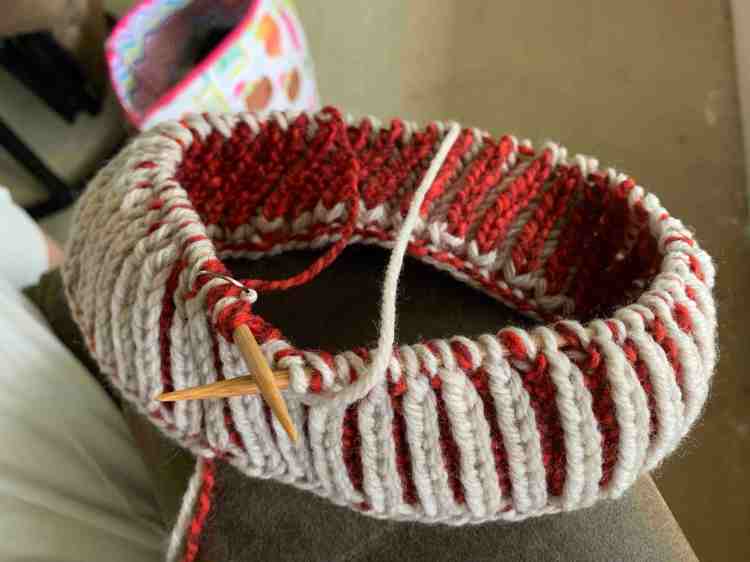
Once I began to knit brioche, I loved it – when things were going well – but most of my knitting was a BIG FAT FAIL.

For the “hat” below I did a normal long-tail cast-on, because I gave up on the special brioche cast-ons. Although I had many mistakes – which mainly began at the beginning of each round – I kept knitting for the practice. Finally, I took photos and ripped out the project.

I will NOT be attempting to knit brioche again anytime soon, but will post this page for future reference. If you have any tips for brioche knitting, or have a favorite cast-on, I’d love to hear from you in the comments.

Keep Reading More Knitting Pages

Washable Watch Cap Knit Inside-out

A watch cap is pretty simple to make, and can be quite boring once the casing on is done. Any knit one, purl one, pattern can take ages to finish. But it is good and easy enough for evening knitting, when no pattern has to be followed … and I could be drinking wine.

Sometimes I begin a hat with one pattern in mind and switch to another once I get going. I must have some type of ADD or something, but I am doing that a lot recently. (See the Curly Snowflake Hat)

I’m getting a start on some hand-knit Christmas presents for my kids and have wanted to knit a hat for my youngest son. I have some washable Lorna’s Laces yarn so I got started.

Beginning the ribbed watchcap
Cast on 144 stitches and knit one, purl one… on and on

I have tried to do a Tubular Cast-on, but I failed to pull it off. So, now I stick to the Old Norwegian / German Twisted cast-on, which is stretchy and nice for a hat.

I cast on 144 stitches to a size 4 needle. I’m not sure where I got that number or which hat specifically I planned to knit. I have Churchmouse Classics, Ribbed Watch Cap and Beanie pattern, which I have wanted to try, and also a Stockinette Wachcap in my Hat’s On book. Both are similar but the Churchmouse hat has a different decrease at the top, and it’s knit inside out. Neither pattern suggests that number for a cast-on, but I ended up doing the Churchmouse crown decreases. Since my stitch numbers were different I had to do some figuring.

This is “sock” yarn, and the Churchmouse cap calls for fingering yarn also, but in smaller needle sizes, with a larger number cast on. So my hat is looser. But I didn’t begin with this pattern in mind!

Crown, wrong side
Crown, wrong side, which is how it’s knit

The Decreases at the Crown

I was curious as to how this type of inside-out knitting and decreasing would look. Well, if you were curious too, there you have it. In my photo above, which is the wrong side – but knit as the right side until the end – you can see the four decrease sections.

Ribbed watchcap
Ladders! Ugh

The photo above is how the hat looks when it’s turned rightside out. As I was knitting on my DPN’s I had such trouble trying to keep the yarn tight to prevent “ladders”. You can see my difficulty in the finished product. Between each decrease section there is a weird row that doesn’t look right. That is the change between DPN’s where the yarn was looser. I pulled the yarn tight to try to prevent this, but it didn’t work.

I have never had ladder problems before, and I blame the stretchiness of this yarn. I bought my Lorna’s Laces Grand Street Ink color a while ago on sale somewhere, and it’s not cheap. This yarn is nice for making washable items which can also go in the dryer. This hat is for my son who will not be washing anything by hand!

Notes and Observations

I was glad to be done knitting this hat! Haha… But, I would like to try the actual Churchmouse pattern – correct cast-on with the correct yarn – maybe in the “beanie” without the long, rolled brim. It would mean less knitting before the decreases.

Next time I would use something like Rauma Finull wool, which I use for colorwork hats. I think that would turn out very nice, but then it would need hand-washing, so couldn’t give it to my son!

There is the dilemma. Knitting for boys is tough.

finished watchcap hand knit
Finished watchcap – washed and drying

Three Little Baby Hats and Basics of Creating

My best friend has recently become a Grandma for the first time. Now I am the only one of “us” who does not have that title. I have the most children, but may never have grand babies. Who knows? I can’t blame people for not wanting to raise kids in this world. Lots of young people are sticking to raising furbabies instead.

So, I am knitting for her grand baby, and of course I am making little baby hats.

knitting baby hats
On my fourth hat

Needle size 4US, cast-on 72. I use the German Twisted CO. Go from there and create your own little hat. I guessed at height as I don’t have a baby’s head handy for trying on!

Make Them Washable!

First off, any baby items need to be easy to care for. Although hats will probably not get all that dirty, when the time comes for cleaning, they must be machine washable. We can’t expect any new parents to take the time to hand-wash anything!

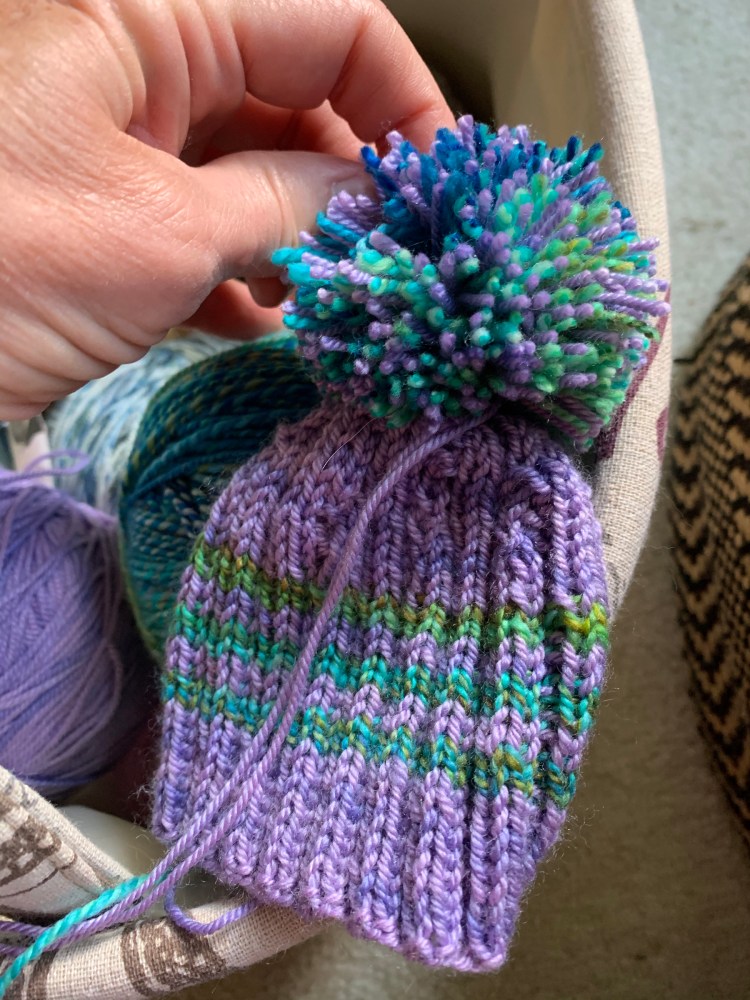
All the yarn I used is sock yarn, which is washable. But then I wanted to add a pompom to the green and purple hat.

Making My Pom Pom

Is pompom two words or one? I’m trying it both ways, so I will be right at least part of the time.

Pompoms can be made without a little pompom maker gadget, but the gadget is fun and there are lots of videos to show you how to use it.

However, do you make the pompom and add it before washing, or after? If the hat is ever to be washed again… which hopefully it will be at some point …. don’t you want to know that the pompom will hold up? Yarn is dirty, so it must be washed, and the pompoms should be added once the hat is knit, before washing – unless it’s a fur pompom. That is another blog post – some you can wash, I think.

If you don’t have a pompom maker like the one in my photo below, you can make a pompom using cardboard. This blog post shows one way to do that. Some people use forks. There is lots of info out there.

If you have any hat knitting books, chances are they may include a “how to” for pompoms and tassels. My pompom maker was really too large, so I had to cut the finished pompom down quite a bit.

pompom maker wrapping yarn
Making a pompom – that would later fall apart while washing!
baby hat with pompom
Pompom which needs trimming

How to Add a PomPom to a Hat

I knew from experience that pompoms can be floppy if they are not attached correctly. And I always thought I needed to use the ends from the pompom to secure it. The secret is to use the hat yarn to go up through the pompom and back down again. To see how, check out this wonderful tutorial about “how to add a pompom to a hat”. the video is excellent.

Then I Lost My Pompom

When I began hand-washing, which is soaking really, the last hat I made, which is the green and purple one, suddenly there were bits of yarn all over the sink! The whole pompom came apart, so now the hat has nothing on top. And, I’ve wasted a bunch of yarn. And I am wondering how to finish this hat. Maybe a tassel would work.

I’m also wondering why this happened. Possibly the yarn was too silky, so the strands slipped right out.

Three little hand-knit baby hats
Baby size hats stretched over apples!

The orange and pink striped had was knit using hand-spun yarn from two different skeins. I really like the look of that one.

Two hand knit hats with pompoms
Pompom hats

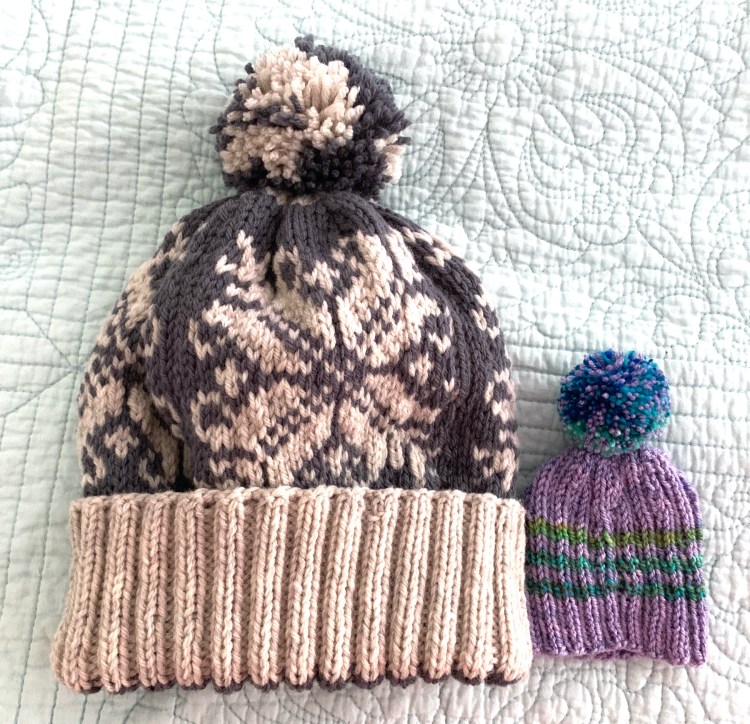
I had knit the Curly Snowflake Hat and purple baby hat at about the same time, so after the pompoms were attached, I washed them together in the sink. The difference is the yarn: the big hat is wool, and the baby hat is sock. The gray pompom held up to the soak, but not the little one.

Curly Norwegian Snowflake Hat In Worsted Wool

After knitting the Skiff beanie pattern, I decided to knit the same pattern in the Watchcap style. I asked my daughter if she liked the style, since it would be for her, I wanted color input. She then was happy to give me some color ideas which ranged from “speckled white” to “gray blue”. She wouldn’t mind hand washing the hat, so I could go with beautiful and soft wool of some kind.

If you are a knitter, you may well know that many places are simply out of yarn. As we “shelter in place” due to Covid, lots of yarn suppliers are not supplying yarn. Colors can be hard to come by within our favorite brands.

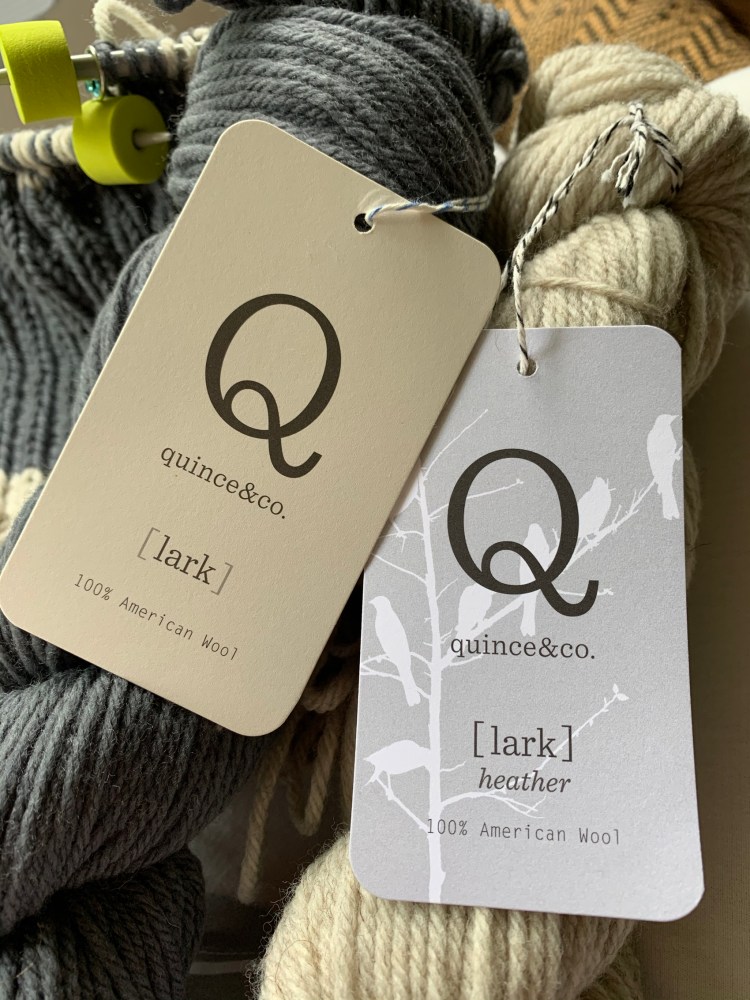
In this case, I was searching for yarn by color, but also by good reviews. I have rarely knit with worsted weight yarn in the past. Quince & Co. had good reviews, and the colors I needed. This is my first experience using this yarn.

Each skein is 134 yards and I used all of the gray and most of the natural to make this hat. I had to finish the very top in the light color (see my last photo). There is not enough yarn leftover to make a nice, two-color pompom, which I think is needed. Also, I am a fairly tight knitter, so you may run out of yarn sooner.

Quince & Co. American wool yarn in "Lark" colors Storm and Audouin
Quince & Co. yarn in gray (Storm) and heather natural (Audouin)
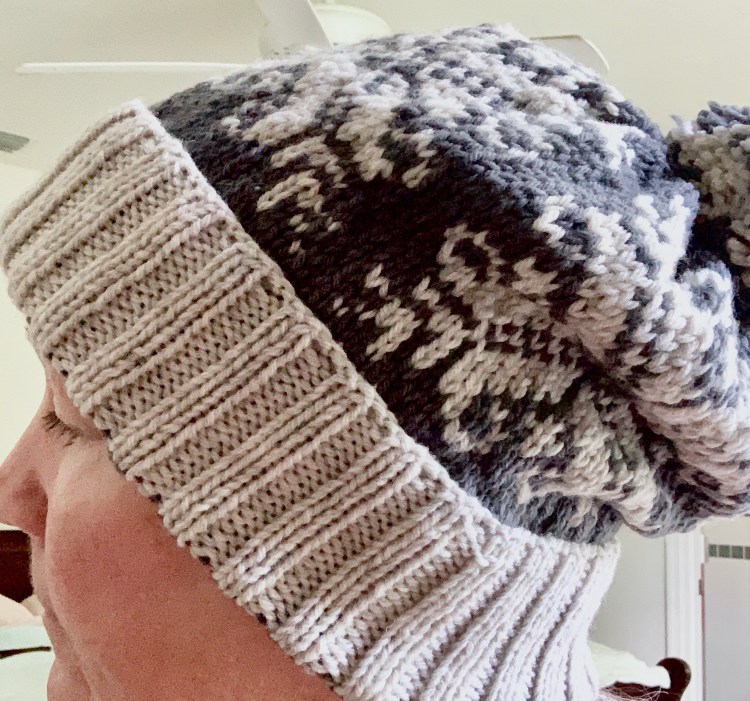
Gray and natural double brim snowflake hat
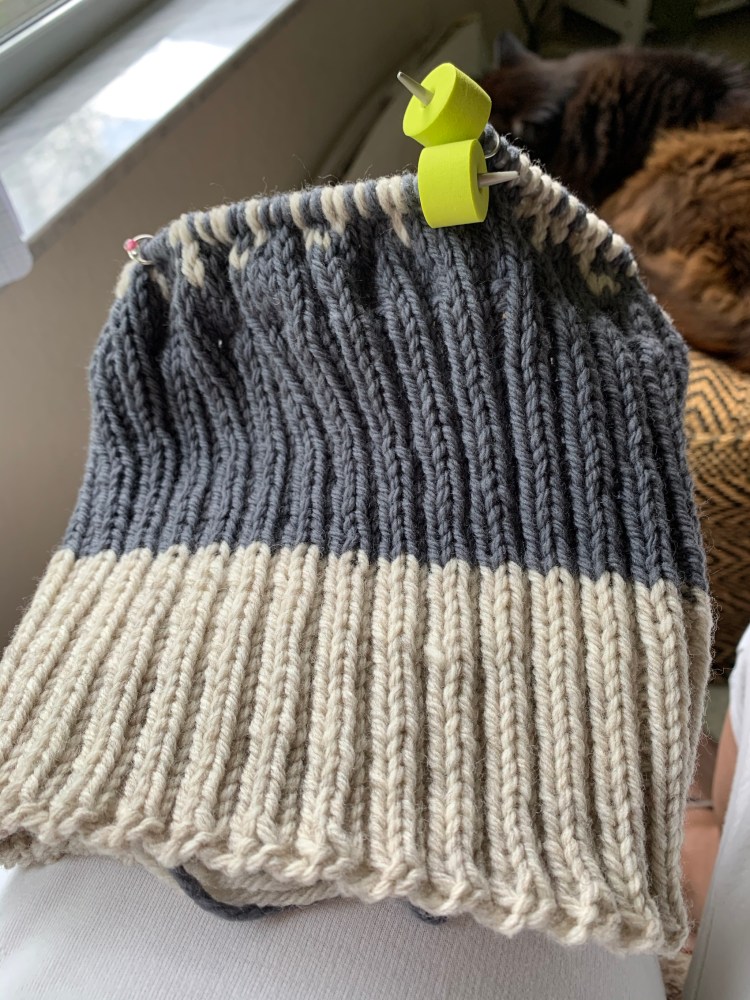
Ribbing to make the roll brim

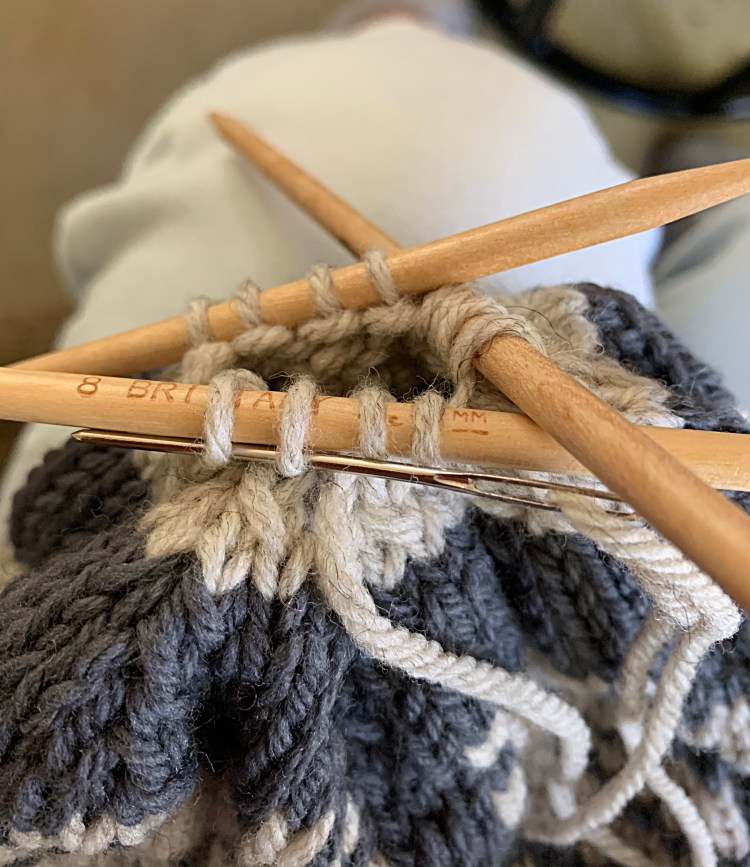
When I began the Skiff Watch Cap pattern, I used a needle that was too small, with the solid gray yarn. That Skiff cable pattern gives you a nice hat, but the pattern directions are difficult to follow. The long brim is the toughest part to figure out because so many size needles are mentioned. I had to tear out the first brim I knit, which was turning out to be too small, and I admit that I wasn’t really crazy about the yarn. In fact, I was thinking of returning the unused skeins. I have never returned yarn before. Neither color is really what I am looking for to knit the cable Skiff hat.

As I began the hat a second time, I used the natural color instead of the gray, which is listed as “heather”. I like the color better than the gray, but I thought it was too “dirty” looking for an entire hat.

These yarn colors just didn’t suit me for a solid color hat. This is when I decided to use up the two skeins – one gray and one natural – to make a different hat altogether. I needed a colorwork pattern that would work for 2 colors for the hat top section.

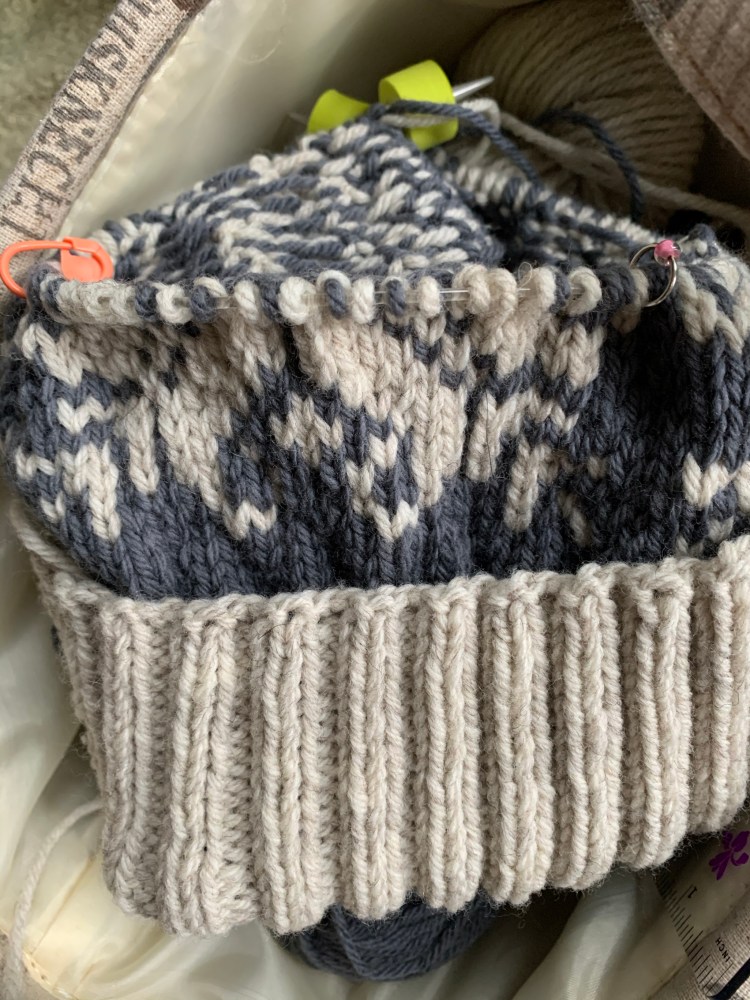
My snowflake chart
Following the chart

I’ve had this curly snowflake on my mind for some time and have planned to make a hat using it. Well, now is as good a time as any! I found the star in a section of a hat pattern in my “Hat’s On” book which is part of the Doublemassa Cap. (I am working my way up to knitting that big project.) Anyway, it’s exactly the type of Norwegian “star” I wanted for my hat.

So I copied the star part only into my knitting notebook (by hand, and made a couple mistakes) so it would be easier to read. Also, I could save it for other projects.

Rolled brim hat stitch stoppers
Beginning the snowflake pattern

To use up the yarn evenly, I made the second part of the brim gray. For the top, the gray would be the background color with the natural color used for the snowflake.

Norwegian snowflake hat in gray and heather off-white
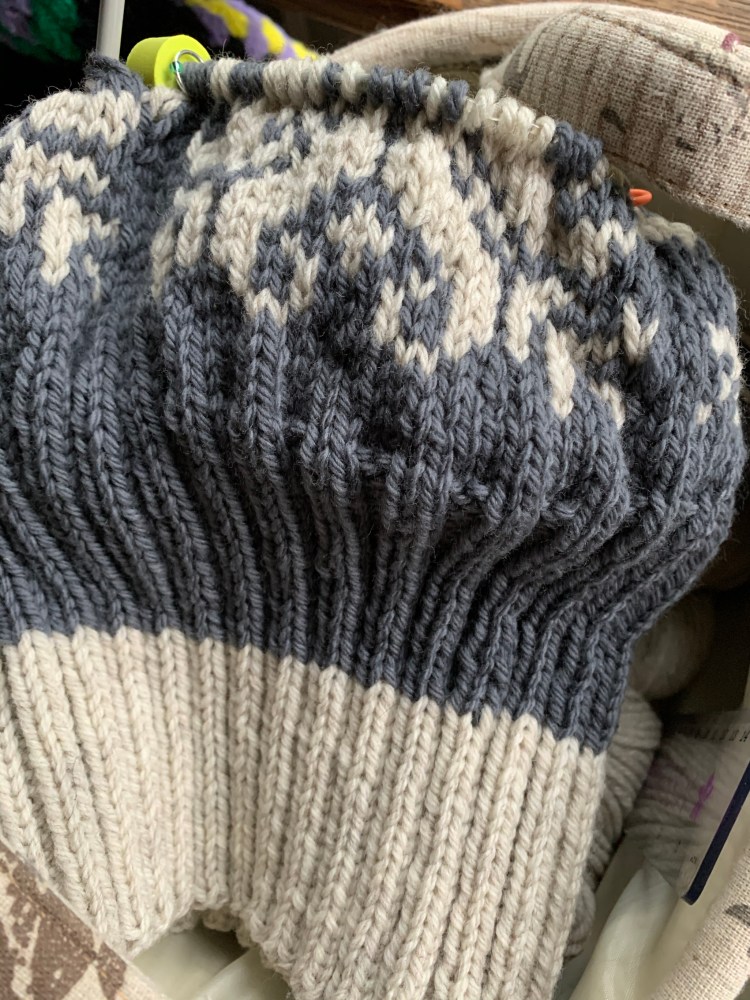
Working my way to the crown

I like the Lark yarn much better when mixed. It seems to be excellent for colorwork knitting. And I do like the two colors together.

beginning the snowflake pattern
The snowflake pattern

How I Made This Hat

  • Size 6, 16 inch needle, Cast On 120 stitches (Old Norwegian / German Twisted) and join.
  • Knit 2, purl 2 around, in off-white for 2 3/4 inches, then gray for same length. Do more rows of white than gray, and there might be enough gray left to finish the top.
  • Change to size 8 needles and knit 3-4 rows around in gray.
  • Begin snowflake chart. Many books have snowflake charts of all kinds that are very pretty. Your pattern must fit the number of stitches. I had to add 3 rows of solid color between my snowflakes to make the stitches come out even.
  • Knit in gray for 2 rounds and place markers as below
  • Decreasing the crown: Divide into 20 sections of 10 stitches – PM at count of 10
  • Decrease round 1: K2tog, k6, SSK, SM, around (This is how I did the top, with knit rows between the decrease rows. The last row was a k2tog around leaving 4 stitches on each of 3 DPNs to tie off. Next time I would do the decreases differently for a smoother crown.)
  • The “star” is a bit big for this type of cap. In the Doublemassa, the star is used in the brim, and the hat is knit in fingering yarn.
Crown finishing with darning needle picking up stitches

Finishing off the Top

The way I did the decreases left the top of the hat puffy and lumpy looking. This hat needs a big shaggy pompom, but I have used up all the gray yarn, unless I dig into a new skein. There is not much of the natural color left either.

I have to decide if I will keep the rest of this yarn or return it.

Snowflake hat finished
Used all yarn except for small ball of natural color
Top finished image of snowflake hat with bumps and white yarn used
Very top of snowflake hat is white because I ran out of gray yarn.

This hat really needed a big pompom, so I wound a new skein of gray yarn and created a gray and white pompom. Guess I will keep this yarn. I would like to use it to make another colorwork hat. This type of hat works well in winter winds, with double brim over ears and good thickness on top.

Snowflake hat slouch pompom
With extra on top, the hat can be pulled down to look slouchy