All notes on knitting the Arco Iris sweater have been completed. The sweater is very nice, love the yarn, and end product, but had a few struggles along the way with this pattern.
Over the past couple of days I’ve been knitting like mad to finish up the body of the Arco Iris sweater pattern by Joji Locatelli.
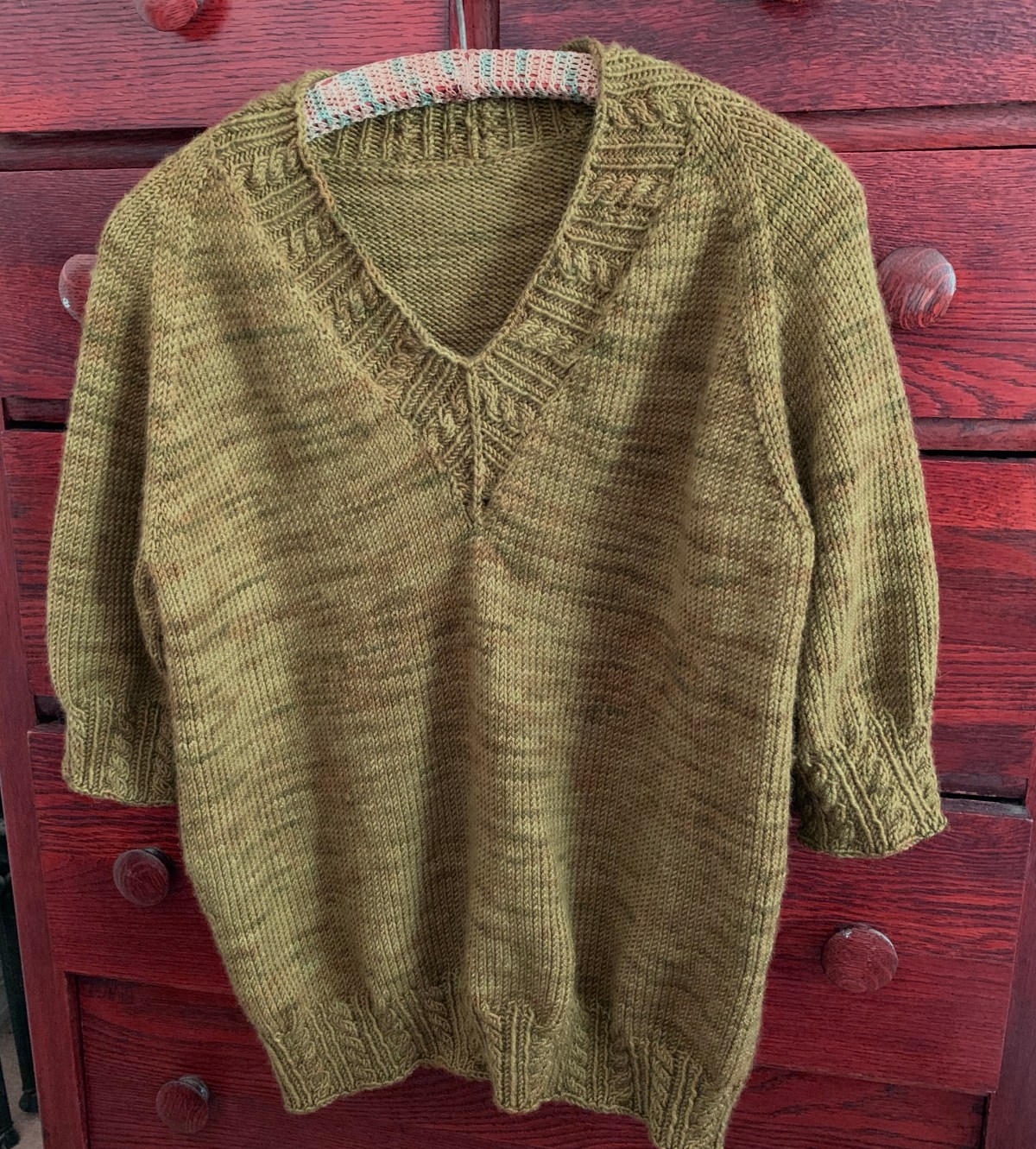
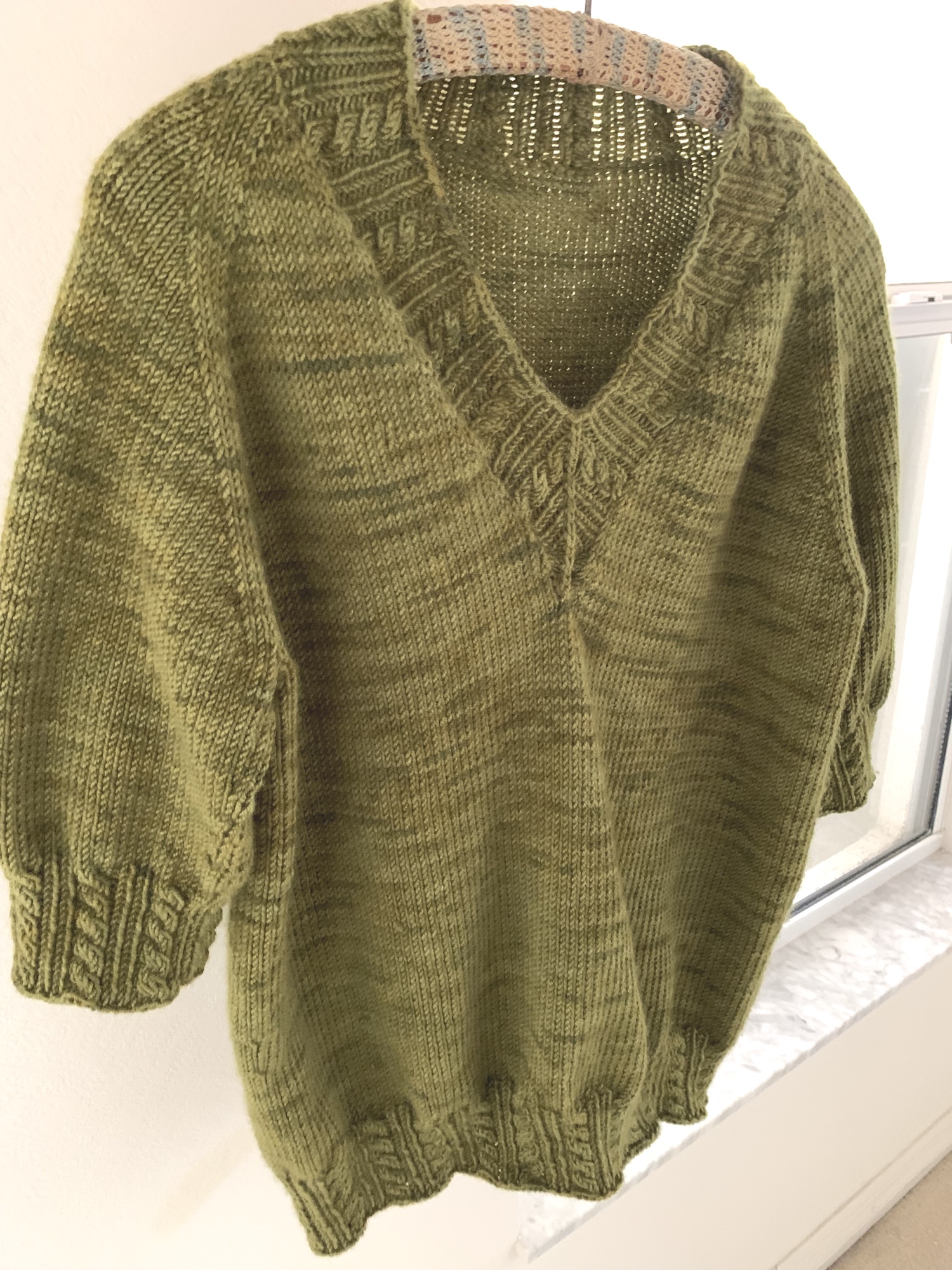
Instead of dreading that k1, p1round and round hem, this hem has an interesting cable and rib alternating pattern. It’s a nice way to finish up after long rows of plain old knitting. And it looks pretty cute too!
I was already familiar with this ribbing because I jumped ahead and knit the v-neck before finishing the body.
I knit sweater size 4 (with mods), using main needle size 6, hem needle size 4.
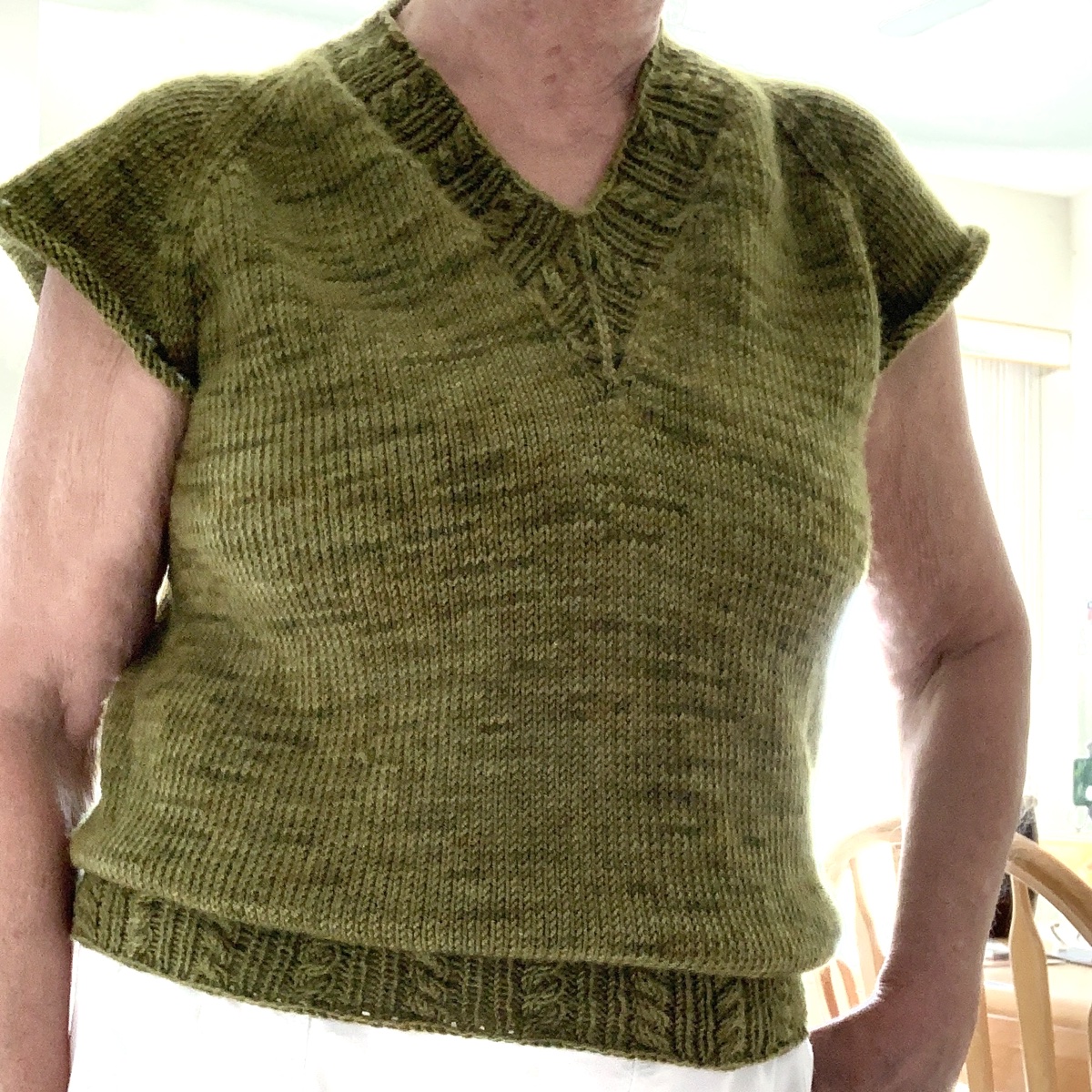
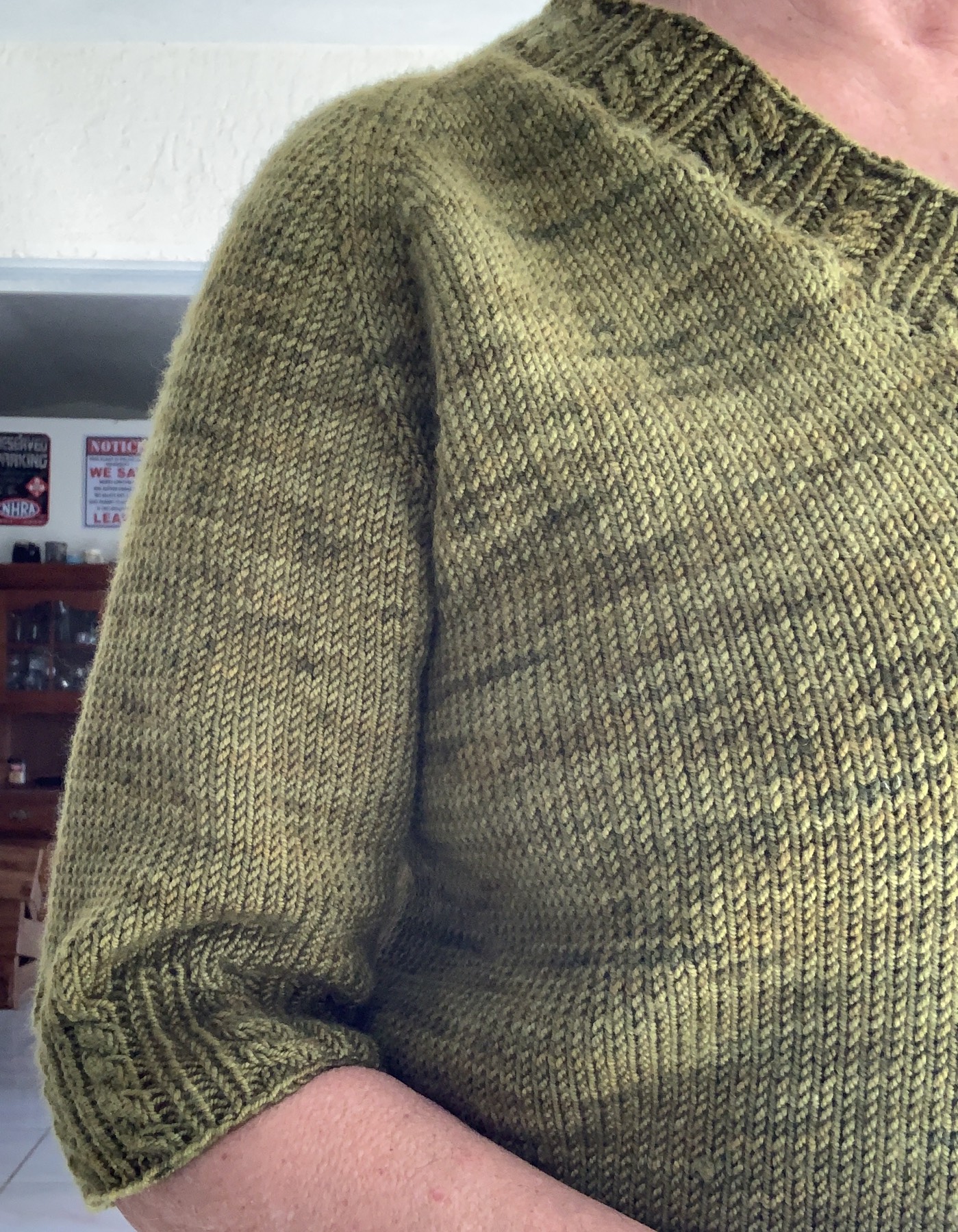
My selfies are not great, but I’d say that photo #3 is the way to wear this top. It’s sort of a blouson effect.
Notes about the body and ribbing
I followed the advice of one test knitter who added 12 extra stitches under the arms. This widened the bust and body area (I did not reduce those stitches until near the bottom) which seemed to be a good idea once I tried it on.
I would not have reduced at all except that I needed an exact number of stitches (a 18 stitch repeat) for that hem. *Hint: Place markers between the 18 stitch repeat just in case you lose your place.
Knitting The Sleeves
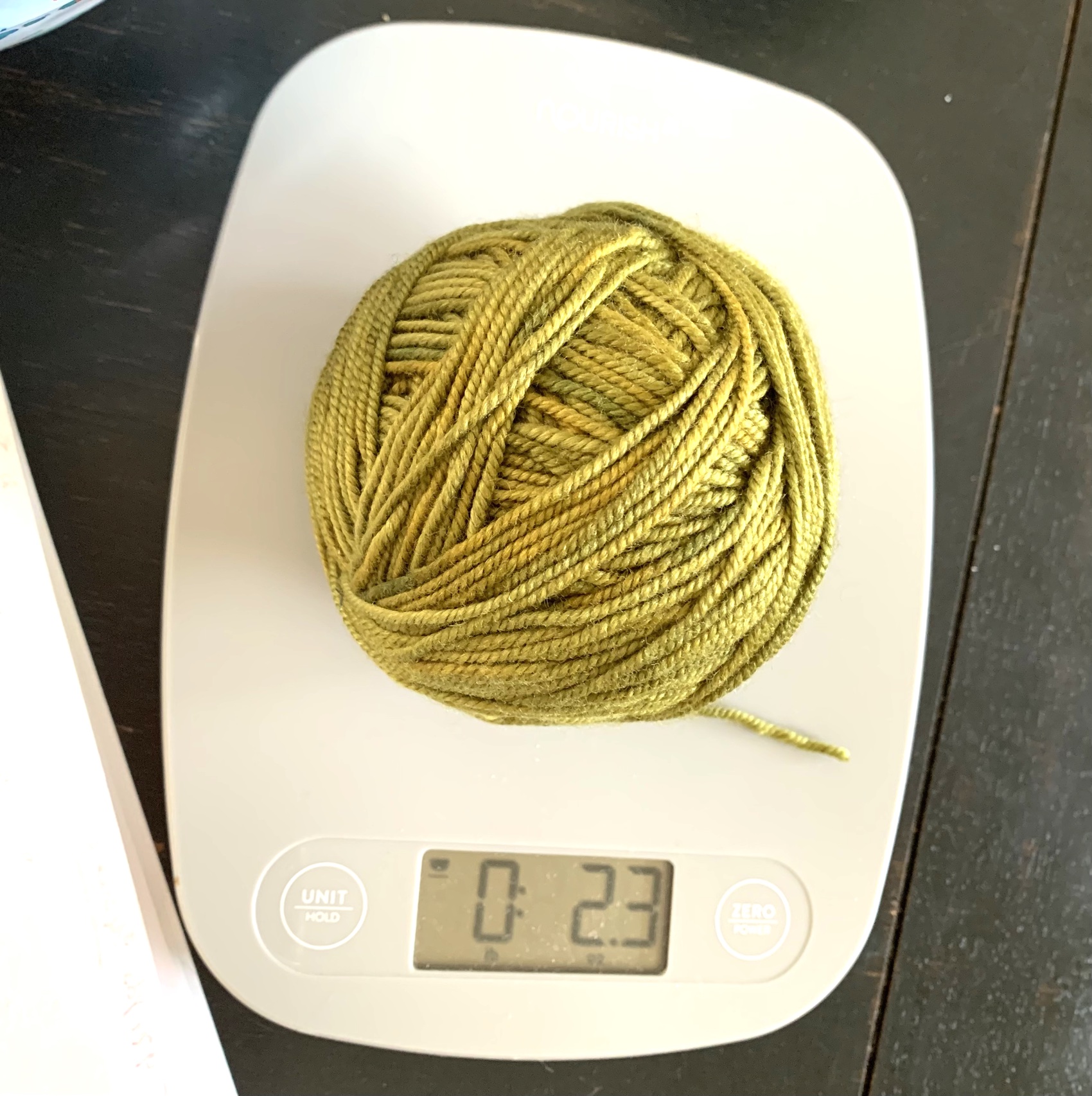
I have two balls of yarn left to knit the 3/4 sleeves of this sweater. This is when a scale can come in handy. I don’t know yet if I will alternate skeins, but knowing the amount of yarn (by weighing) will be helpful if it seems I might run short.
Notes on Knitting the Sleeves
While knitting the first sleeve of the Arco Iris sweater, I made some mods and will share them here.
I felt that I had to be mindful of yarn use so I only knit to six inches before beginning the ribbing. I would have liked to go about another inch and have the cuff fall just below my elbow, but didn’t dare. It turns out I probably could have done that and had enough yarn.
I also began with more stitches at the arm pick up. I picked up 8 extra stitches and that gave me 74 total stitches when I began knitting down the sleeve (as opposed to 66 per directions). I reduced stitches on every 5th row, until I got to 63 total. I did alternate balls of yarn.
Also, I did not reduce as many stitches as called for while knitting down the sleeve. AND the decrease directions seemed wrong to me. The pattern says to do the SSK first and the K2TOG at the end of the round.
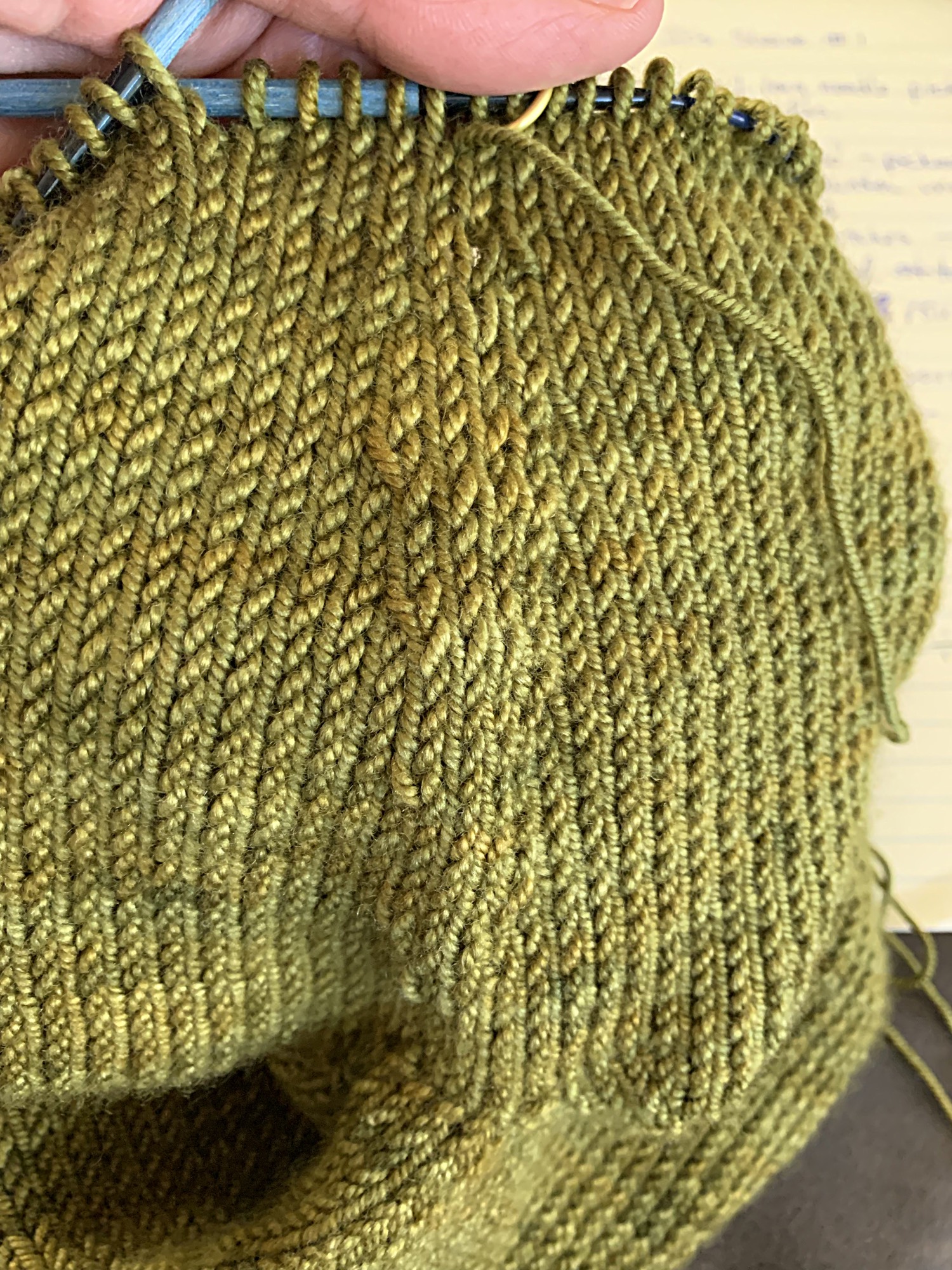
If you follow the designer’s suggestion, this is what it will look like (photo below). I think every sweater I’ve knit has the decreases listed the opposite way. By following the directions, my knitting left a weird bump because on each side the decreases faced outward. On the last decrease I did it the right way with the k2tog first, and the SSK last – and it looks much better!
*Note: Check those decrease directions, you may want to change them.
Decreases are wrong, I believe.Comparing both underarm decreases- Left, my way, Right, pattern directions
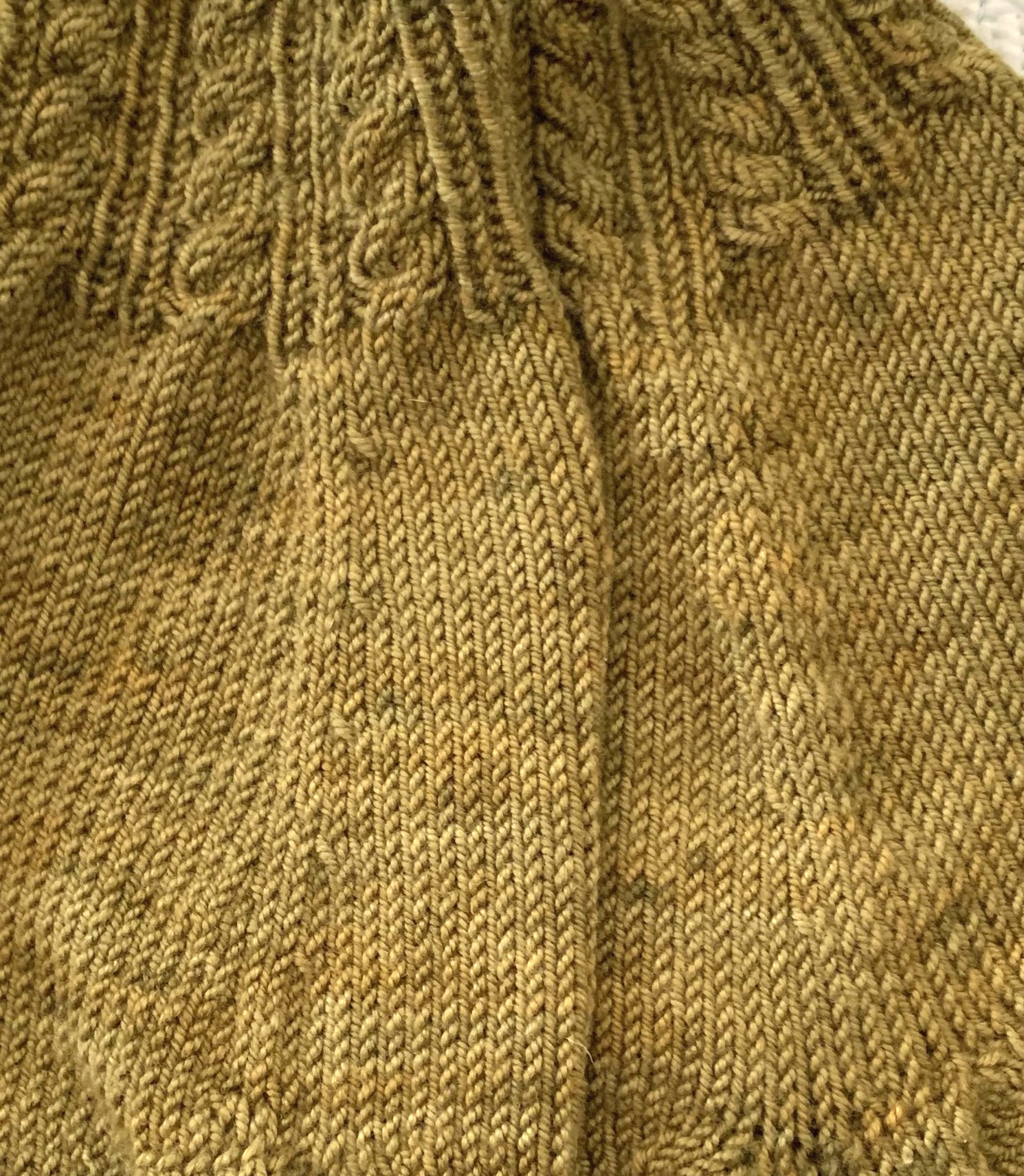
The ribbing is done much like the body hem and neck, except the repeat is only 9 stitches and not 18. The reason is that the cables will all face the same way on each sleeve cuff. So you must begin the cuff with a stitch count that is a multiple of nine. For the sweater size 4, which I was knitting, the cuff should have 54 stitches. I had 63. I’m glad I did not reduce to 54 because my cuff is perfect.
*FYI: My actual elbow measurement- where the cuff ended up – measures 10 inches around. This cuff feels perfect at 63 stitches, and I’m glad it is not any tighter.
Pictures of the top once I finished knitting. Washing and blocking to come. The style is not really made for my body type, but I do like the finished sweater. The fabric is quite heavy, so it won’t get worn at all until maybe next December.
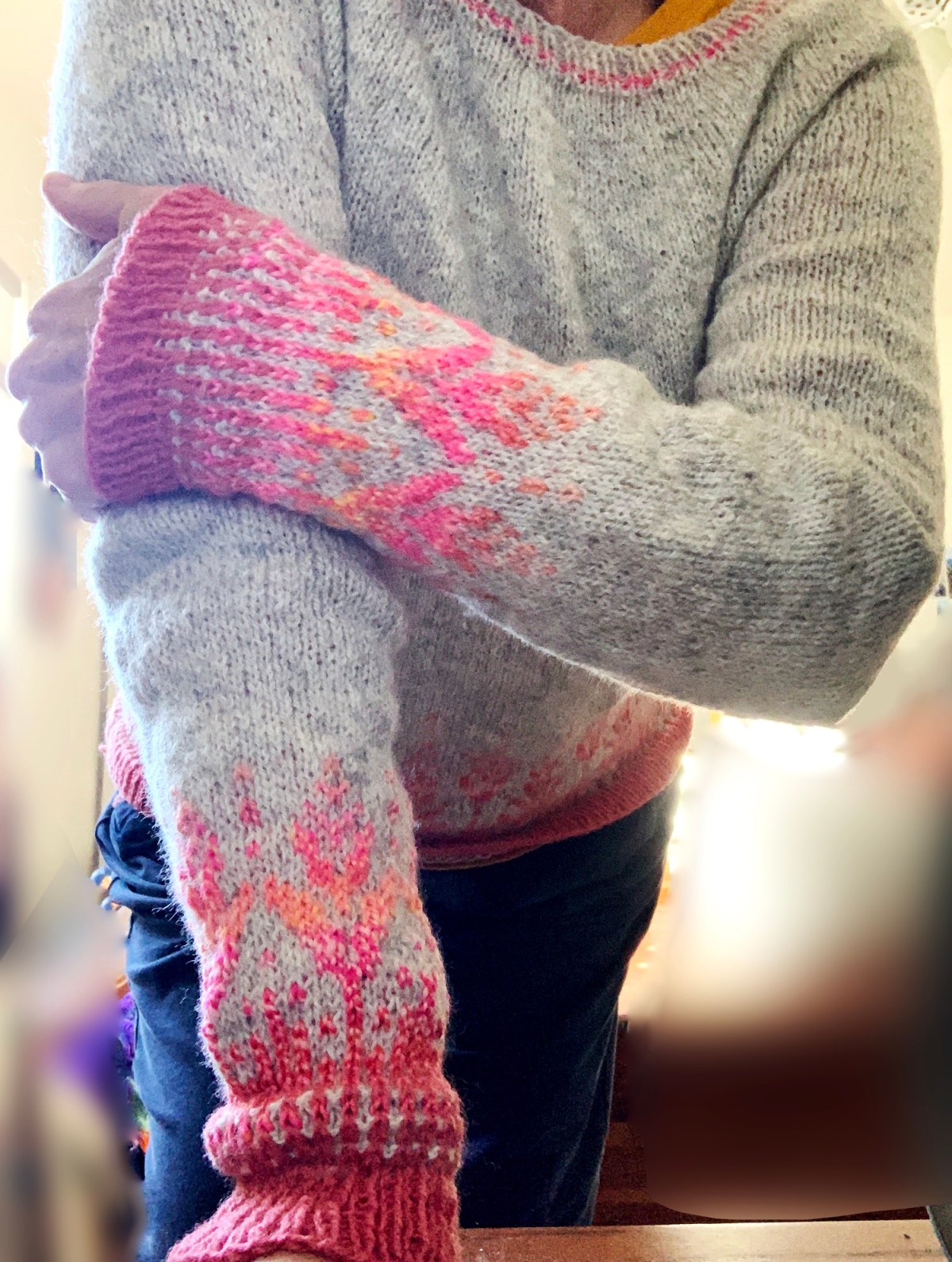
Knitting the Goldenfern pullover, a Jenn Steingass pattern, in Rauma yarn with pink yarn colorwork at the bottom and on sleeves.
The Goldenfern pullover is a Jenn Steingass knitting pattern design. It is knit using fingering weight yarn and has colorwork at the bottom of the body and end of sleeves.
The yarns I chose were Rauma Garn, in light gray, combined with a gradient pink handspun. The darker, coral pink color is Jamieson & Smith, which I used for the very bottom of sleeves and all bottom ribbing. I chose to add one row of pink at the neck.
Casting On and Needle Sizes
My gauge was off, but in the end the sweater turned out fine. For me: The cast-on at the neck (this is a top-down sweater) was done on a size 3, 16 inch circular. The main body and sleeve knitting was done on a size 4 needle. All colorwork was done using a size 5, although a size 6 is recommended for the body colorwork, and I’m thinking maybe I should have done that. Size 3 needles were used again for the ribbing at the bottom of the body and sleeves.
Knitting The Sleeves
I picked up the stitches to begin knitting sleeves downward, using a 16 inch circular needle. As the circumference became smaller with decreases, I switched to a 9-inch size needle.
Then I used a size 5 circular and did the pink colorwork down to Row 37. Using the J&S coral pink when the chart said to use a new CC color.
This is when I changed to size 3 DPN needles and did a plain color 1×1 rib for about 7 rows. The bind-off is a normal bind off and not the i-cord suggested in the pattern.
Total sleeve length is 18.5 inches. Pattern suggestion is 18, so I’m close.
Pretty colorwork on the sleeveUsing a 9-inch circular for the cuff
The Fall of 2022 was not a good one, with two disastrous hurricanes hitting the area. The knitting on the Goldenfern pullover began in September, and alternated with some other knitting I wanted to do. It has been a relaxing escape for me with other stresses, like the hurricane mess, that piled up. The pattern is easy to follow with lots of helpful notes by the designer.
The link above goes to Ravelry, where you will find so many beautiful finished knits that use some truly gorgeous yarn color combinations. Go there to get inspired and knit your own Goldenfern. The designer has an offer to buy 2, get one free. Her patterns are so well written, and she has many beautiful patterns.
February photo
Finished Knitting
January 7th and the sweater is finished! I took some photos before all ends were woven in. Now, for the wash and blocking. But before all that I would say the pullover is a great success.
I’m very bad at keeping track of the amount of yarn I used, so I can’t list it here. I had one ball of the hand-spun and it was plenty for all the colorwork with some left over. I have a small bit of the Rauma left as well, so my calculations worked. I probably used around 1,100 yards of Rauma.
This pattern shows the sweater as being more cropped, which does not work for me. I added a few more inches. Thevlength is perfect at 14 inches from underarm to bottom.
This sweater knitting project was a fun one. Although there were a few things to figure out, I recommend the pattern to any fairly experienced knitters out there.
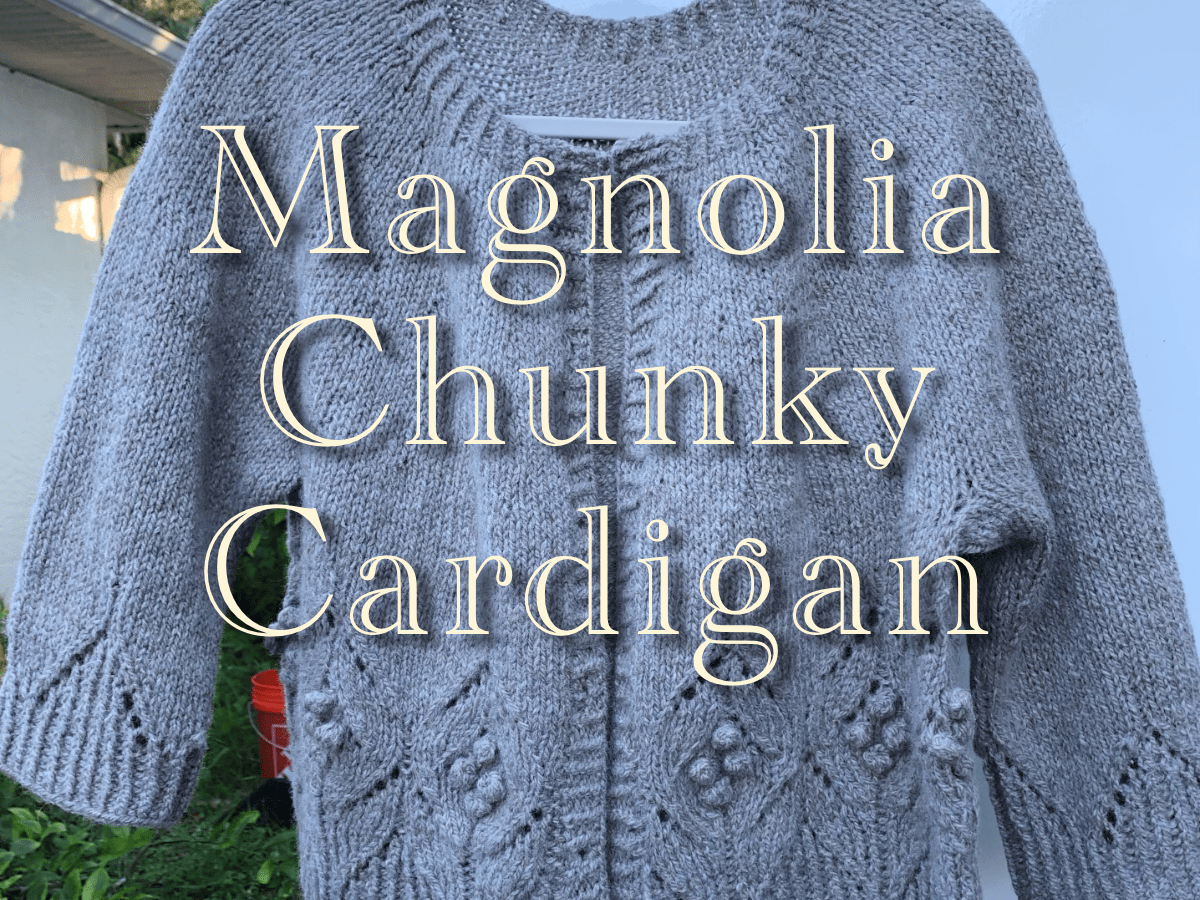
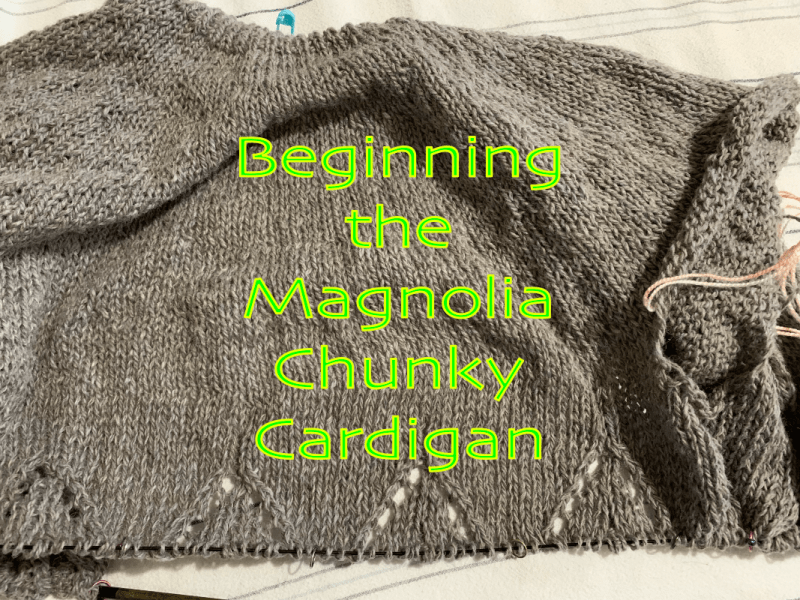
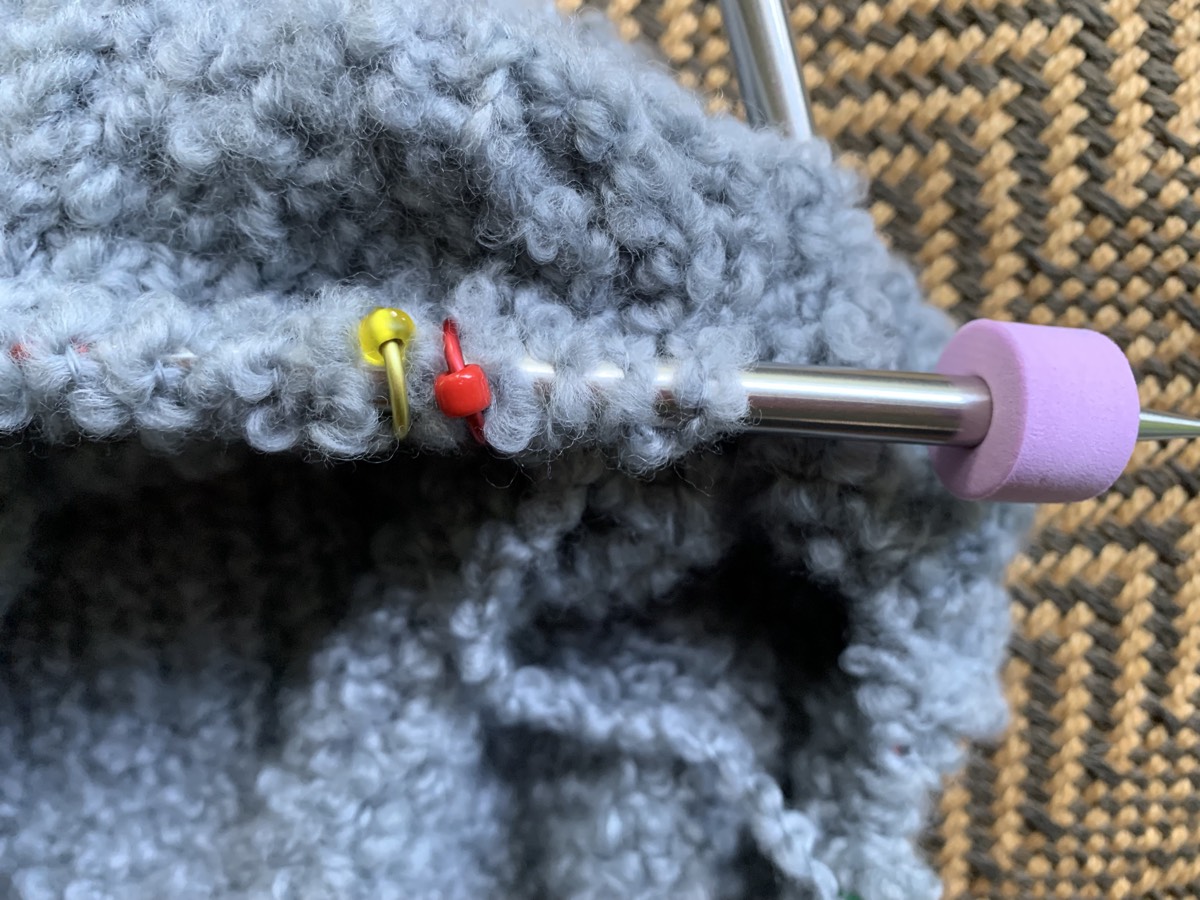
I’m knitting a beautiful cardigan pattern by Camilla Vad. The Magnolia Chunky Cardigan is knit top-down with lace and bobbles on the body and sleeves. On this page I cover some issues I had in the beginning.
Get an early start on hat knitting for Christmas. This page lists a few hat patterns, for free and to purchase, that work well for guys. Also, I’ve listed some machine washable yarn to get you started.
A knitting pattern review of the Venlig sweater using Woolfolk’s Flette bulky yarn.
I chose to knit the VENLIG sweater pattern mainly so I could use Woolfolk’s Flette bulky yarn. This yarn looked (and is) so soft that I jumped in and bought the pricy pattern. Ten dollars for a sweater pattern is a lot. This page contains my review of an unnecessarily confusing pattern for a simple raglan pullover.
I have a link to the pattern buying page at the end of this post.
Making This Pattern Easier to Follow
Problems with the pattern.
First, pattern printouts should have readable type. My eyes are not good, but this pattern has the tiniest print possible! The teeny tiny print was very difficult to read. Come on designers – make your patterns readable on paper! It may seem old school to print out a pattern, but that is what I do. (Without internet and power, a paper pattern is necessary. I just came through a hurricane (Ian) and had no electricity for four days. Knitting was my sanity.)
I should have added it to Knit Companion on my iPad so I could read it without using a magnifying glass. But a bigger problem was the difficult to follow pattern. The way the designer separated the raglan sections and added increases, along with short rows – done as “wrap and turns” – was confusing.
Tip: Use a place marker on either side of the “knit one”. That is where the increases are made – before the first marker and after the next. It’s quite simple, but the instructions are hard to follow as you knit along and try to read the tiny print at the same time. Use the markers to guide you. Anyone who has knit raglan style sweaters will get this.
More Mods
I chose not to do the “wrap and turn” and did German Short row shaping instead. I couldn’t’ even understand her wrap and turn directions.
I also made all my increases on the Right Side row and did away with the “make one purl increase”. I used the Backward Loop as my increase and not the M1L and M1R. This was my personal preference. This yarn does not show stitches well, so I figured I’d make the increases as simple as possible.
Reviews of this pattern on Ravelry were unhelpful. Surely I am not the only knitter who had issues?
The Yarn
Once I had the VENLIG pattern, I waited and hoped for a Flette sale. (Be aware there is also a lighter weight Flette yarn, but you need the “bulky yarn” for this pattern.)
One day, there in my inbox, was a notice of a sale from Eat.Sleep.Knit with some yarn listed that included Flette Bulky! Woohoo… I immediately grabbed up my four skeins with a savings of $4.80 per skein. That was huge! And I got free shipping… double win! Eat.Sleep.Knit is one of my favorite places for buying yarn online.
Flette Bulky by Woolfolk – ordered from Eat.Sleep.Knit
So how well does this yarn wind, and what about knitting?
Winding
I had to wind my skeins, which I do by hand, over my knees. And I was a bit worried because of the nubby texture. It wound very easily, but there was a tag attached and I mistakenly cut the yarn at the tag- I should have cut the tag – not the yarn! So I ended up with one small ball and used it to knit my swatch.
Don’t cut the yarn at the tag! And when making the swatch, know your stitch and row numbers because you will not be able to count them.
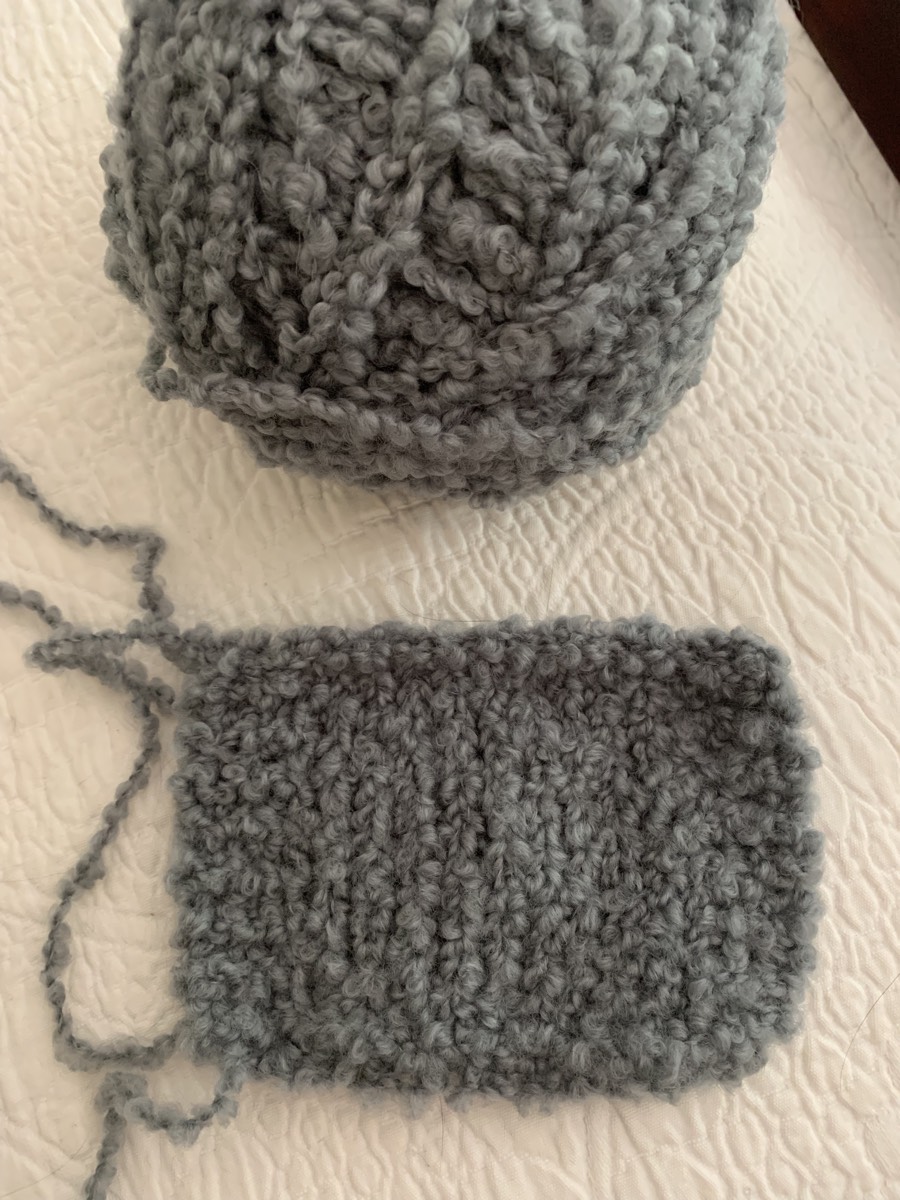
BoucleFlette swatch
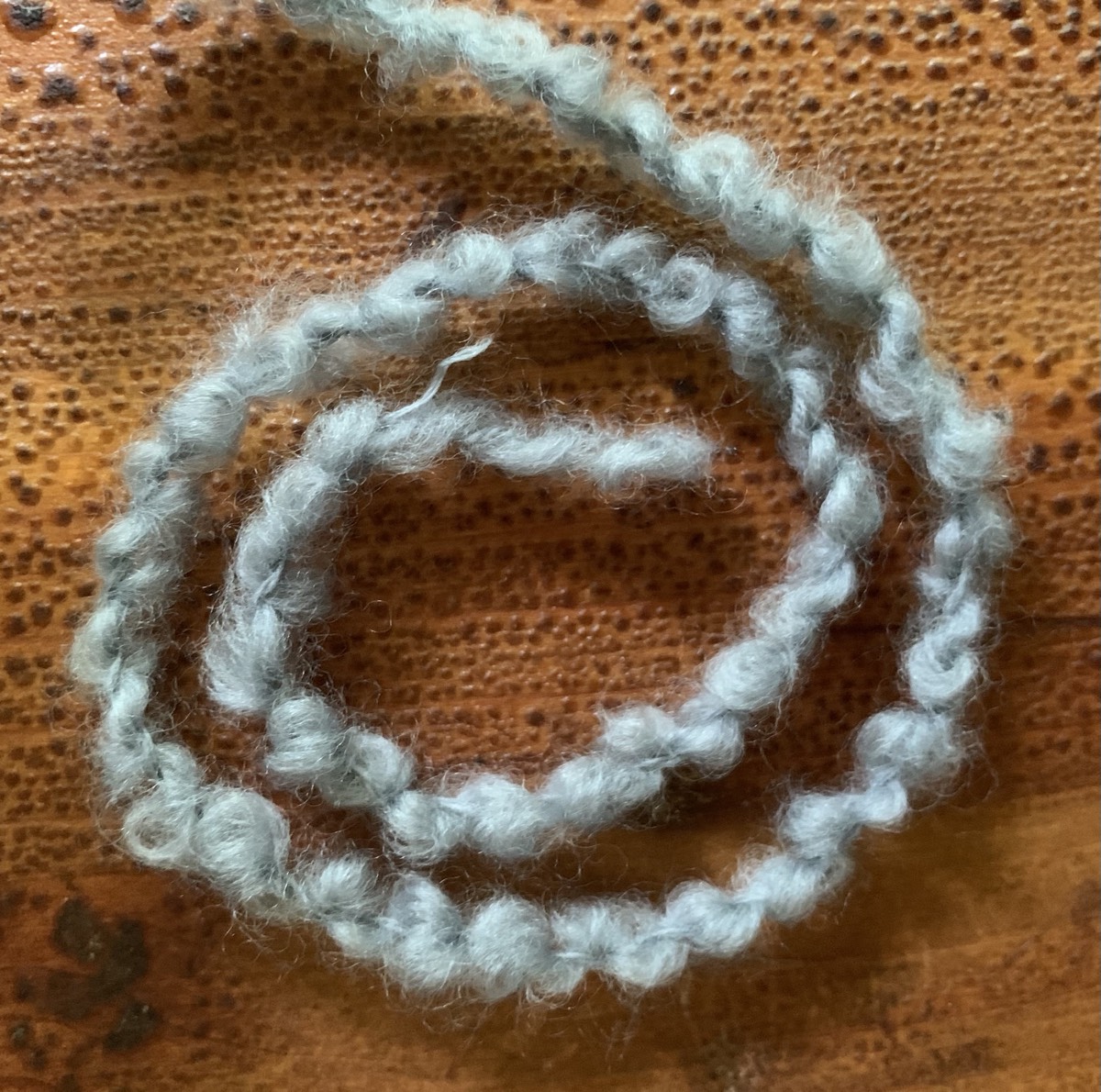
This Flette yarn itself is pretty awesome. It is a boucle (pronounced “boo – clay”) which is a “yarn with a looped, or curled, ply”. It is quite different from anything I have knit with, and super soft. The skeins did have little knots occasionally. I cut out the first one, but decided to knit the others in.
Knitting
As far as knitting with this yarn, it was okay. Unknitting can be tricky and if you have a mistake many rows back there is no way to pick up stitches to unravel – you must tink, or unknit, your stitches. I noticed a dropped stitch and had to bring it up over 5 rows and that was not easy either!
Doing the 1×1 ribbing was tricky too. See my swatch above which has stockinette in the center with garter at the edges – it’s hard to tell what is what!
Below is a photo of my body ribbing. I’m doing knit one, purl one. Can you even tell the difference?
These are knits and purls – can you tell?
Suggestion For the Ribbing
Simply knitting around and around isn’t bad. When it came to the 1×1 ribbing, forget it. I had no idea which was a knit and which was a purl if I lost my place. I ended up placing markers every 10 stitches or so (an even number) knowing that I would begin after each marker with a knit stitch. It was the only way to keep track of my knits and purls.
Knit a 4 inch tall neck
The Sleeves
Because I was worried about yarn amount, I put body stitches on hold at 8 inches to knit the sleeves. I knit the first sleeve on a 16” circular to begin, then changed to DPNs. It was difficult. The yarn is slippery and keeping the stitches on the needles was a pain. On the second sleeve, I used a 16” circular for the entire sleeve after dropping stitches when one of the DPNs slipped right out of the stitches! I was not having fun. (I knit with Lykke wood DPNs, but switched to the same brand 16”.)
I don’t know how to do Magic Loop, but it is probably the best way to knit the sleeves. *Changes made on sleeves: Pick up extra stitches when taking stitches off the waste yarn to close up the gaps under the arms. Usually patterns will say to do this, but this one did not.
Venlig sweater try-on with one sleeve complete
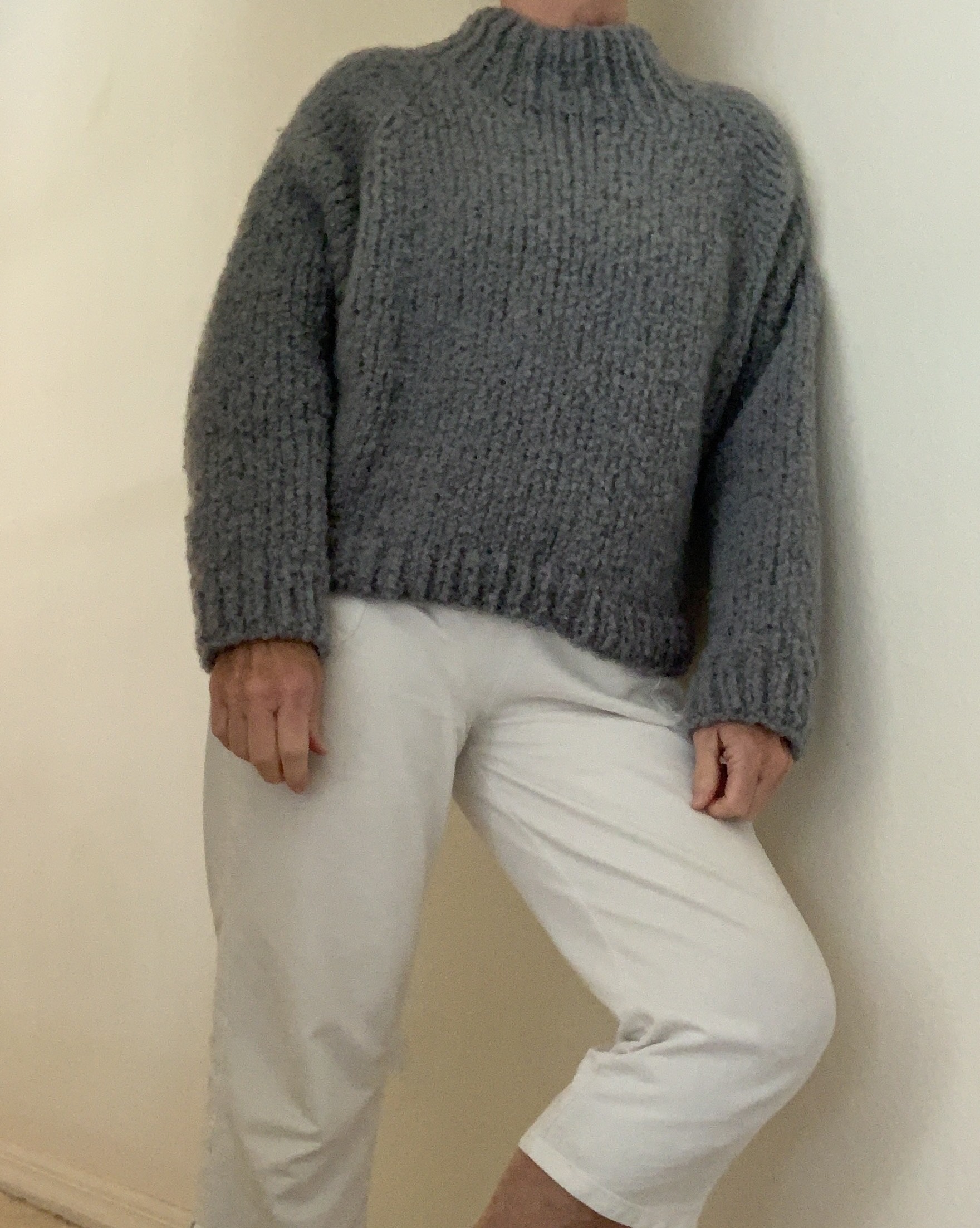
After finishing the sleeves I picked up the body stitches with the smaller size 10 needle and did the ribbing until the yarn was gone – with enough to bind off. I would have liked a little more length, but the yarn was gone.
Flette Colors
On a positive note, Flette yarn has great color selections. Choosing my yarn color was difficult because I had many favorites! I’d have chosen the dark navy blue, but dark colors can be a challenge for my eyesight. I love the dark green and purple-brown colors as well. I’m not ruling out using this yarn for another project. In fact, I wish I had chosen one of the unique colors instead of gray.
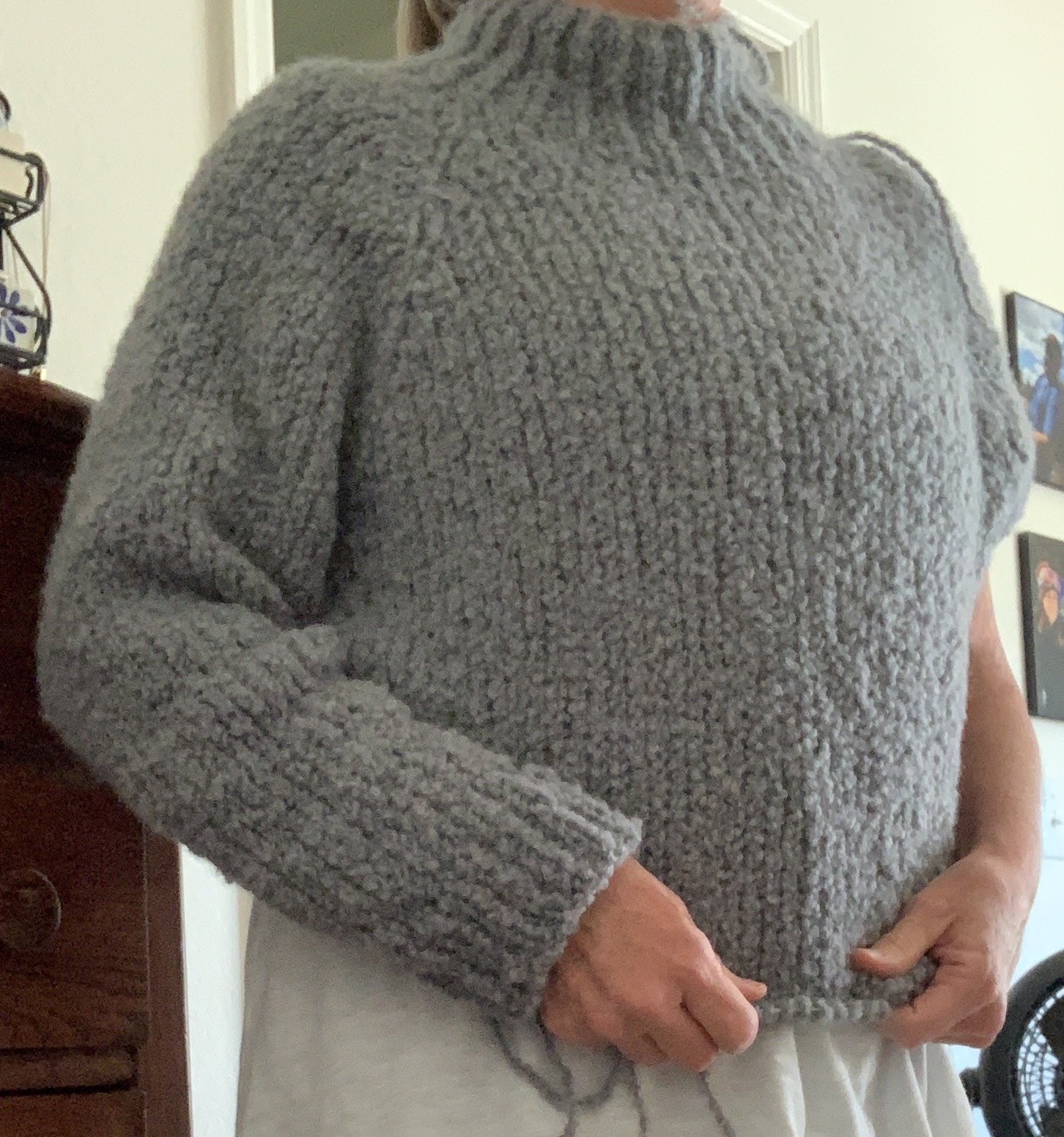
Before washing
This sweater is probably my most favorite of everything I have knit. The Flette yarn creates a beautiful, soft fabric. The minimal yarn difficulties are completely worth the trouble.
My final opinion of this sweater pattern is to follow my own changes if I ever make it again. The pattern is basically a normal raglan with short rows. Directions were made difficult for no reason.
This pattern (and yarn) is NOT for beginners. Having sweater knitting experience will be helpful.
How Much Do Sweater Patterns Cost?
Here are some sweaters I have knit recently with the price I paid for the patternat the time. Sweater patterns can be found for FREE and up, but the general price seems to be around $7-$8.
The unisex Cobblestone cardigan, by Jared Flood, was also $10.00 but the directions were excellent. (I loved that the buttonholes were made while the sweater was being knit.) I would certainly knit this one again.
Meadow Moon, by Jennifer Steingass, was $7.00 and has colorwork and great instructions. This designer goes to great lengths to explain her patterns and provides helpful links.
The Carbeth cardigan, by Kate Davies, was around $8.00 and certainly gave me lots to learn. The construction was unique and the folded collar was something new for me. It was missing short row instructions, which I had to figure on my own (yikes), but the intricate pattern was worth the money.
The Calliope and Warm-up were both free patterns, with excellent directions. The Turtle Dove (free) sweater pattern from Espace Tricot uses Woolfolk Luft yarn, which is cheaper than Flette, but also bulky. The pattern is also raglan, and the sleeves could be modified to create a sweater very similar to Venlig, but for free!
Tin Can Knits also offers many free patterns including sweaters.
So paying $10 for this needlessly difficult, yet simple raglan, was too much in my opinion. I only chose it because no reviews of the pattern warned me away… and I wanted to try out the Flette yarn. I did search for other sweater patterns that used the Flette bulky, but did not like them as much.























 New England's Narrow Road